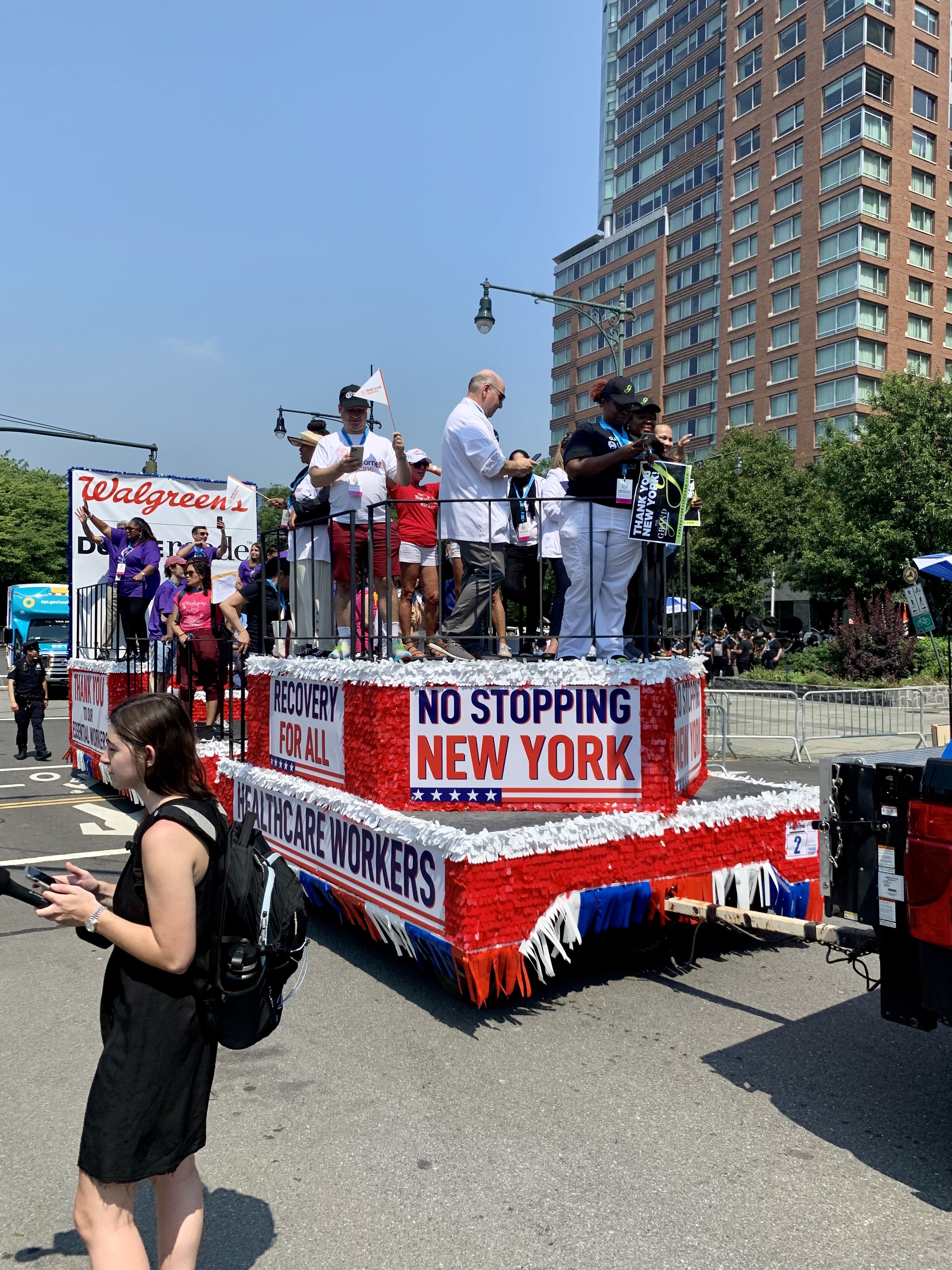
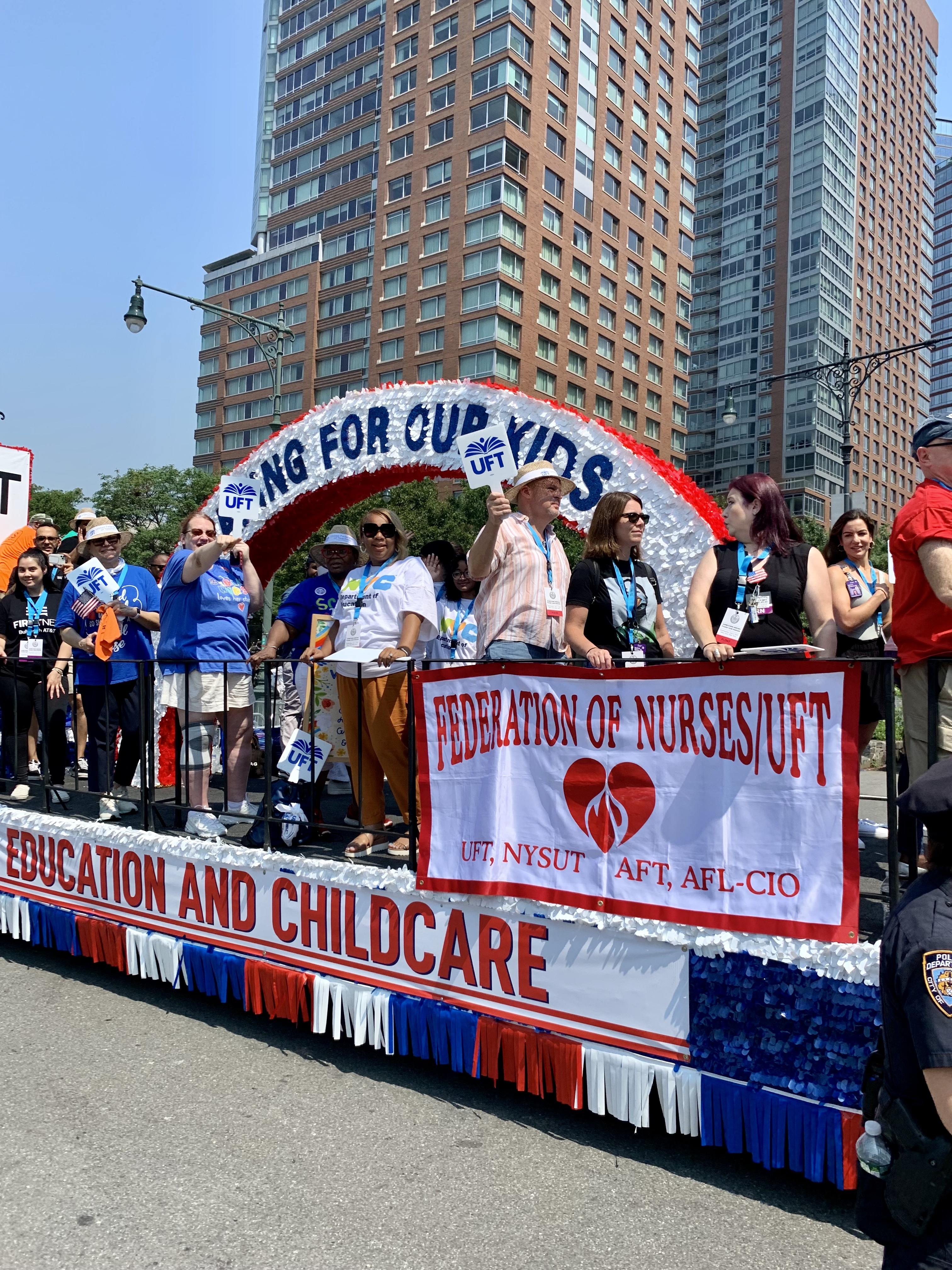
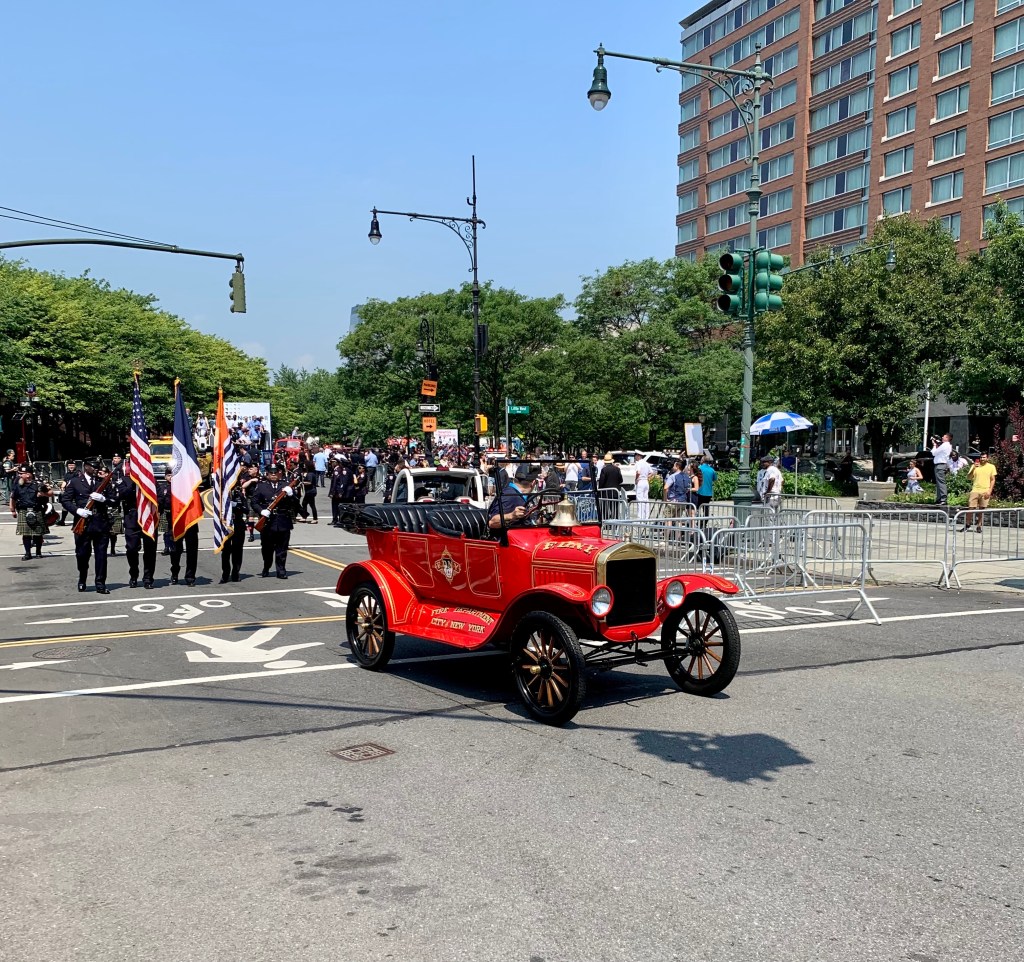
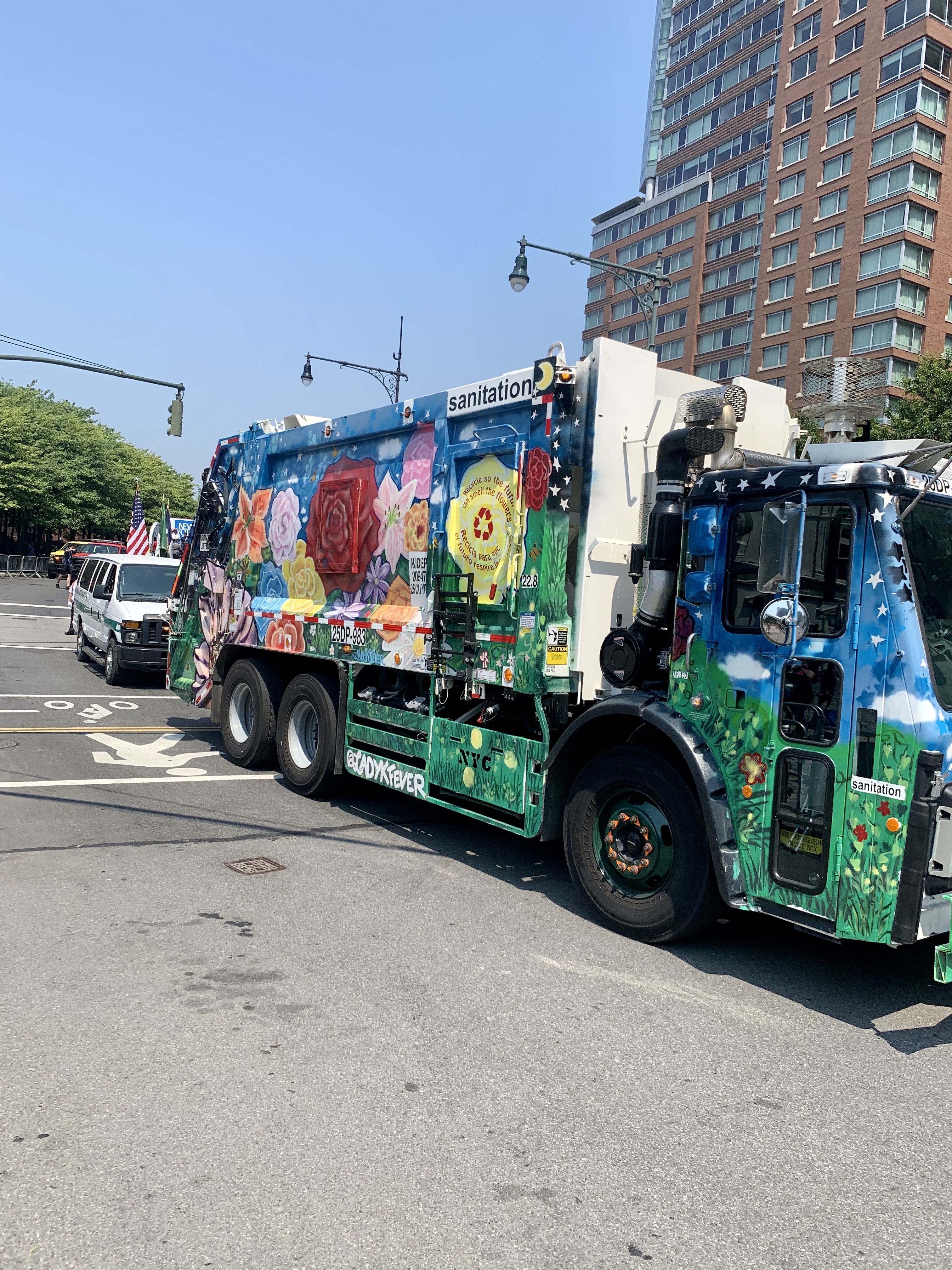
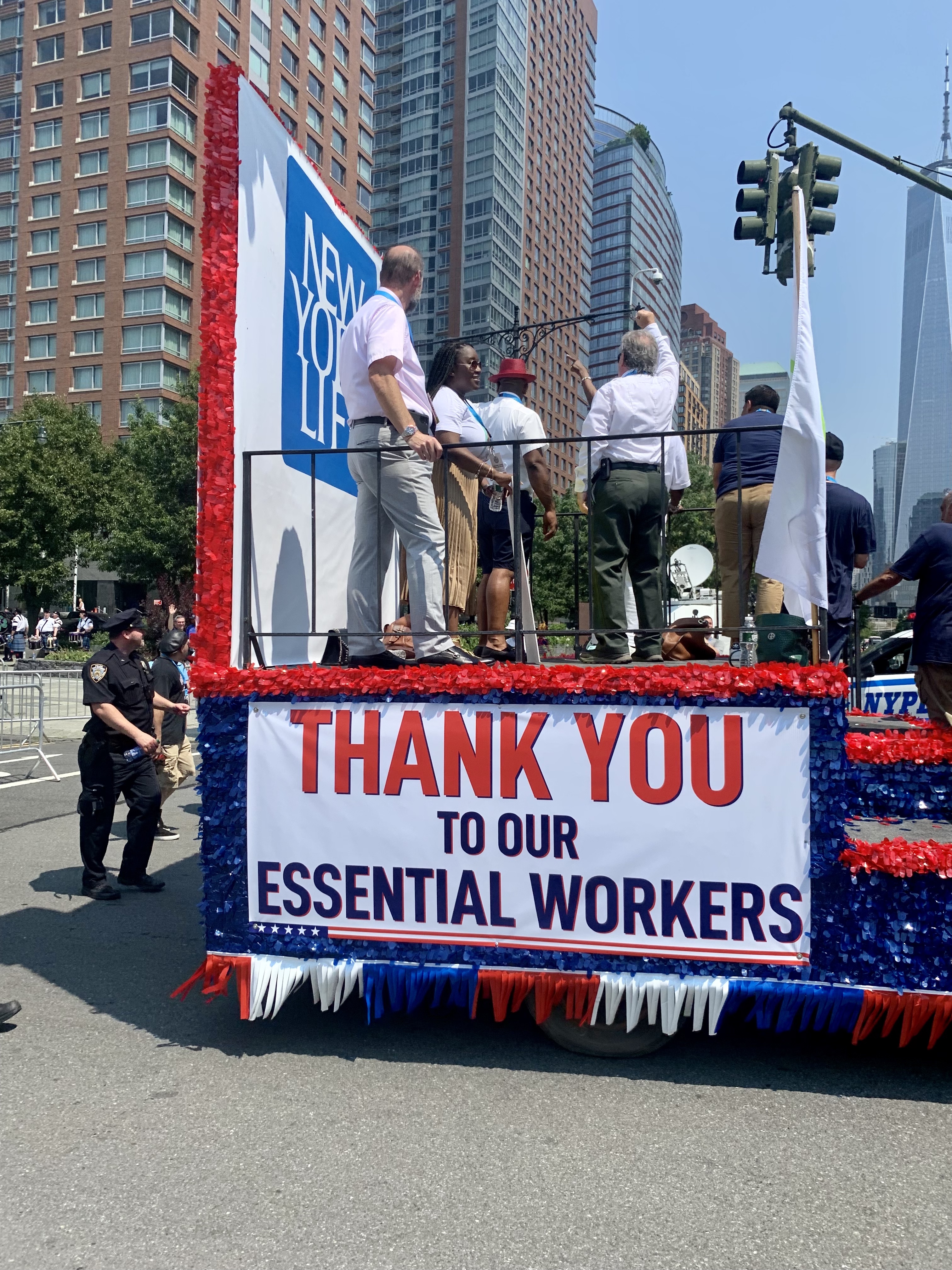
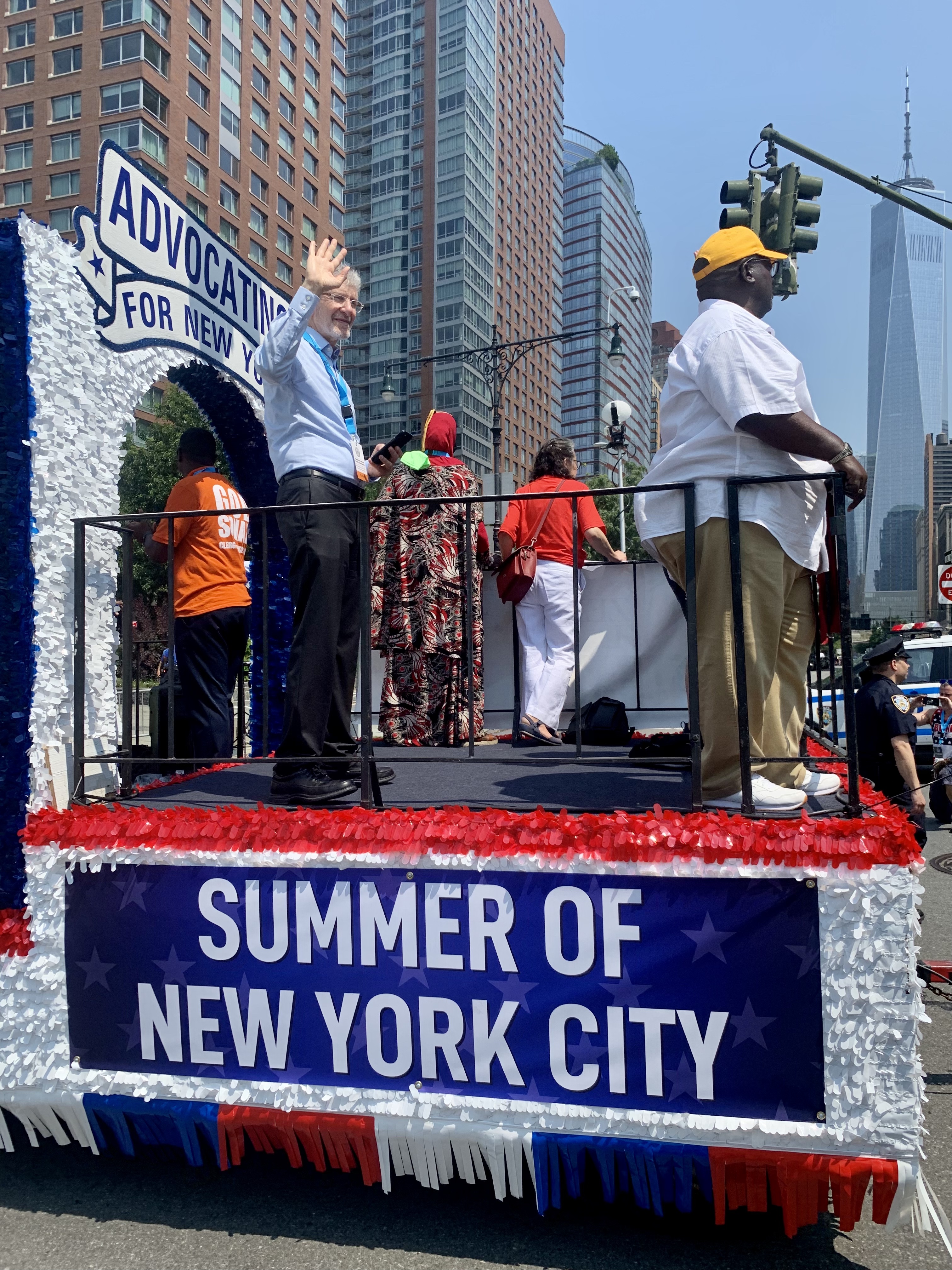
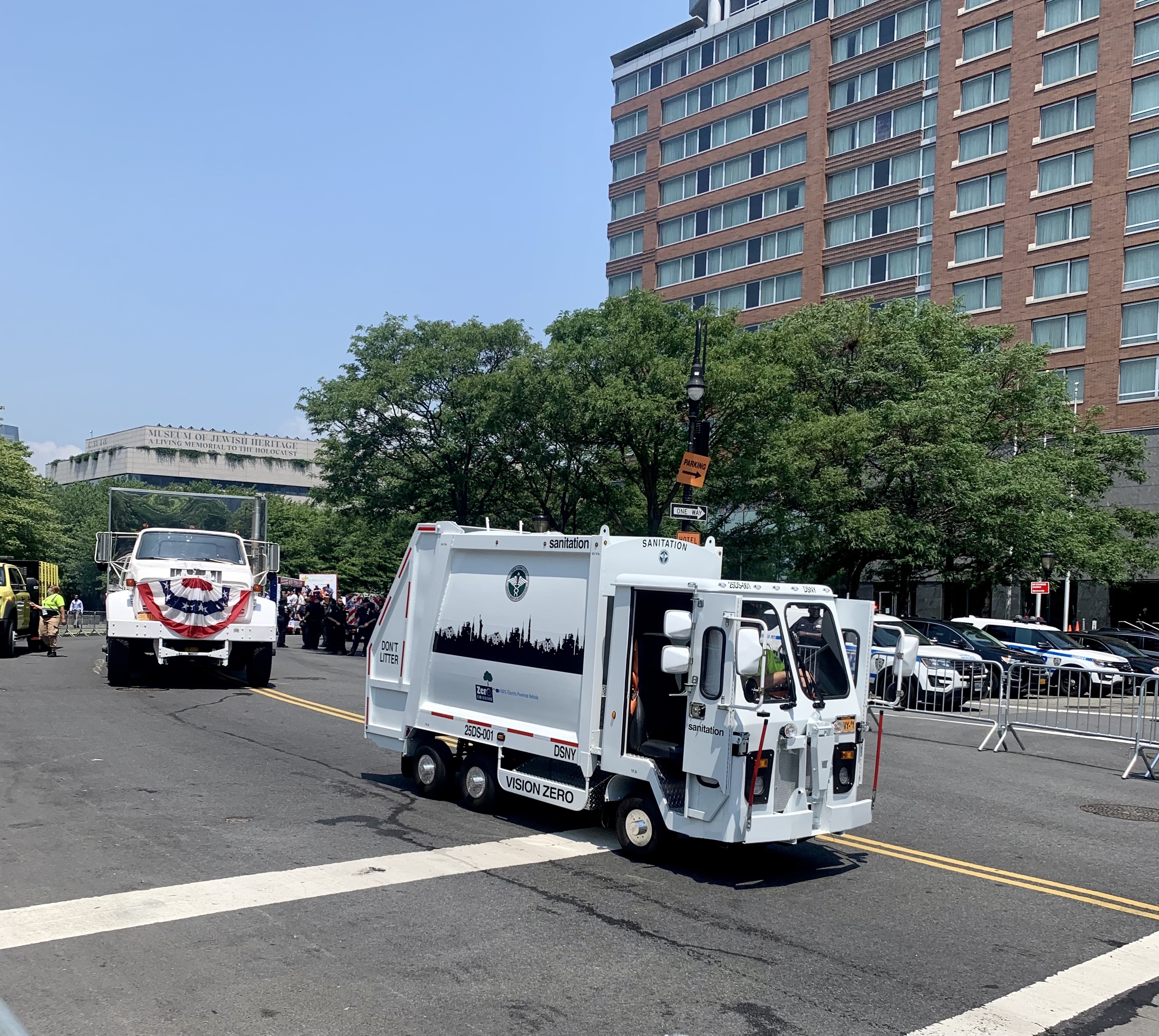
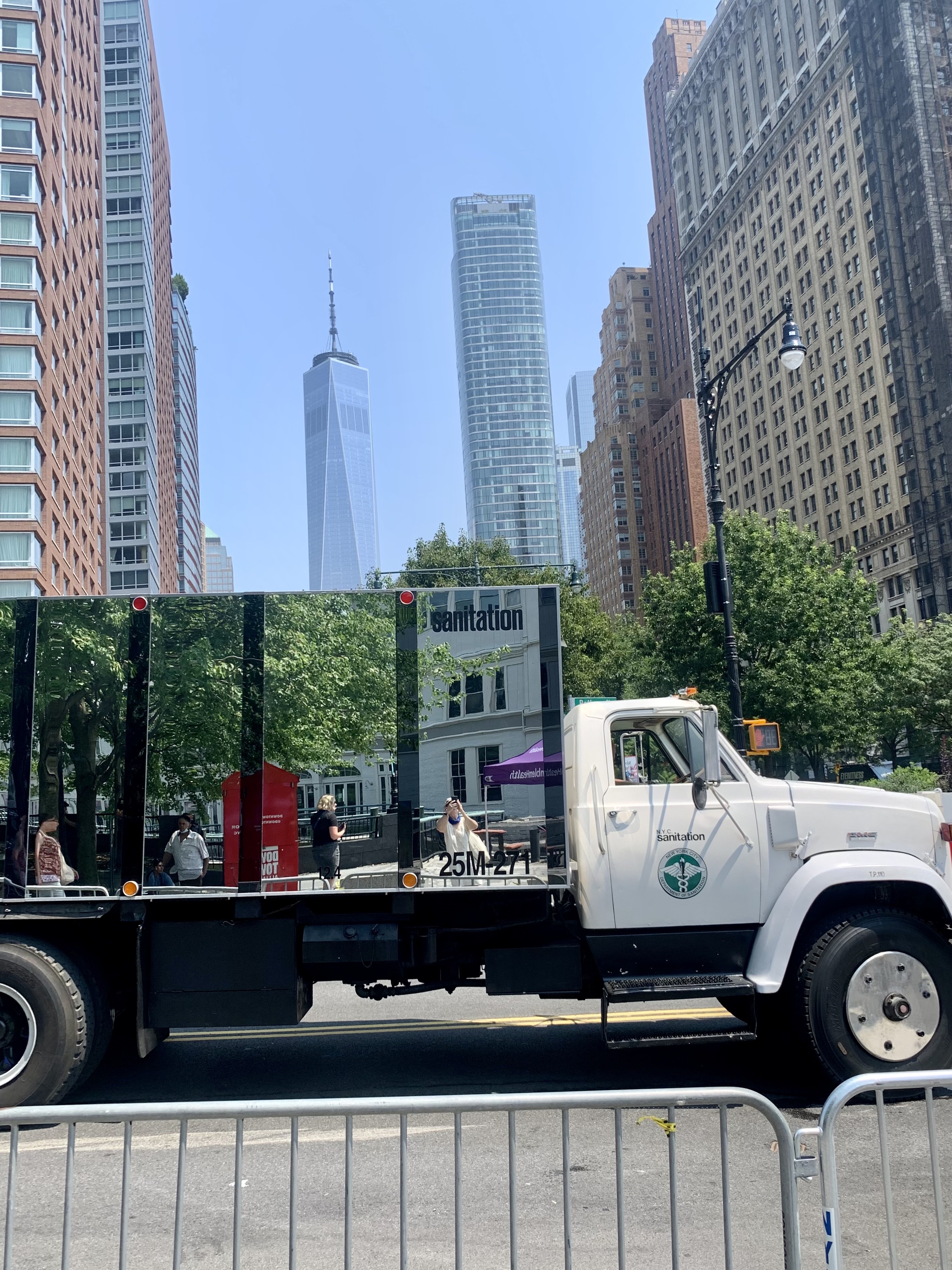
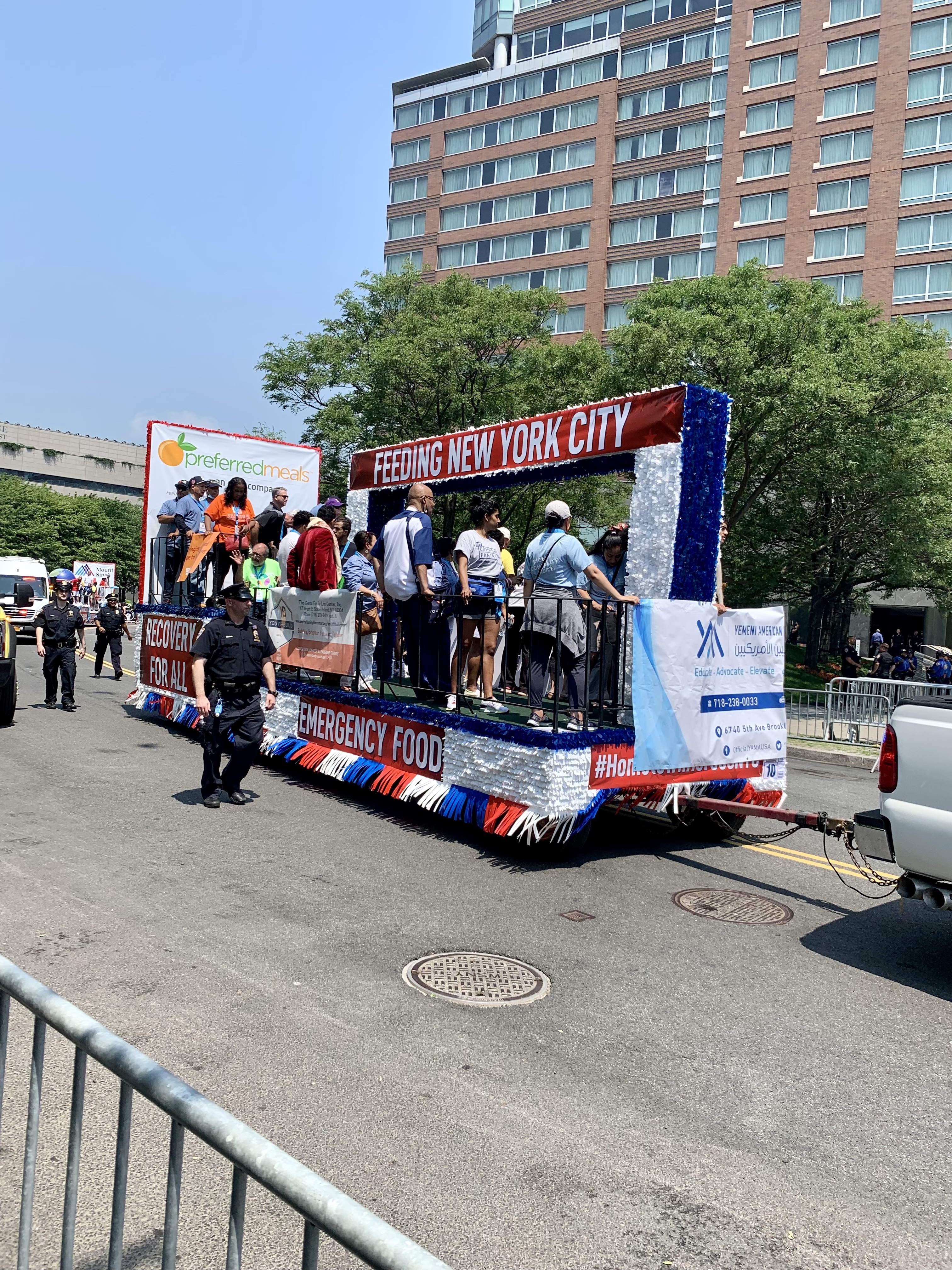
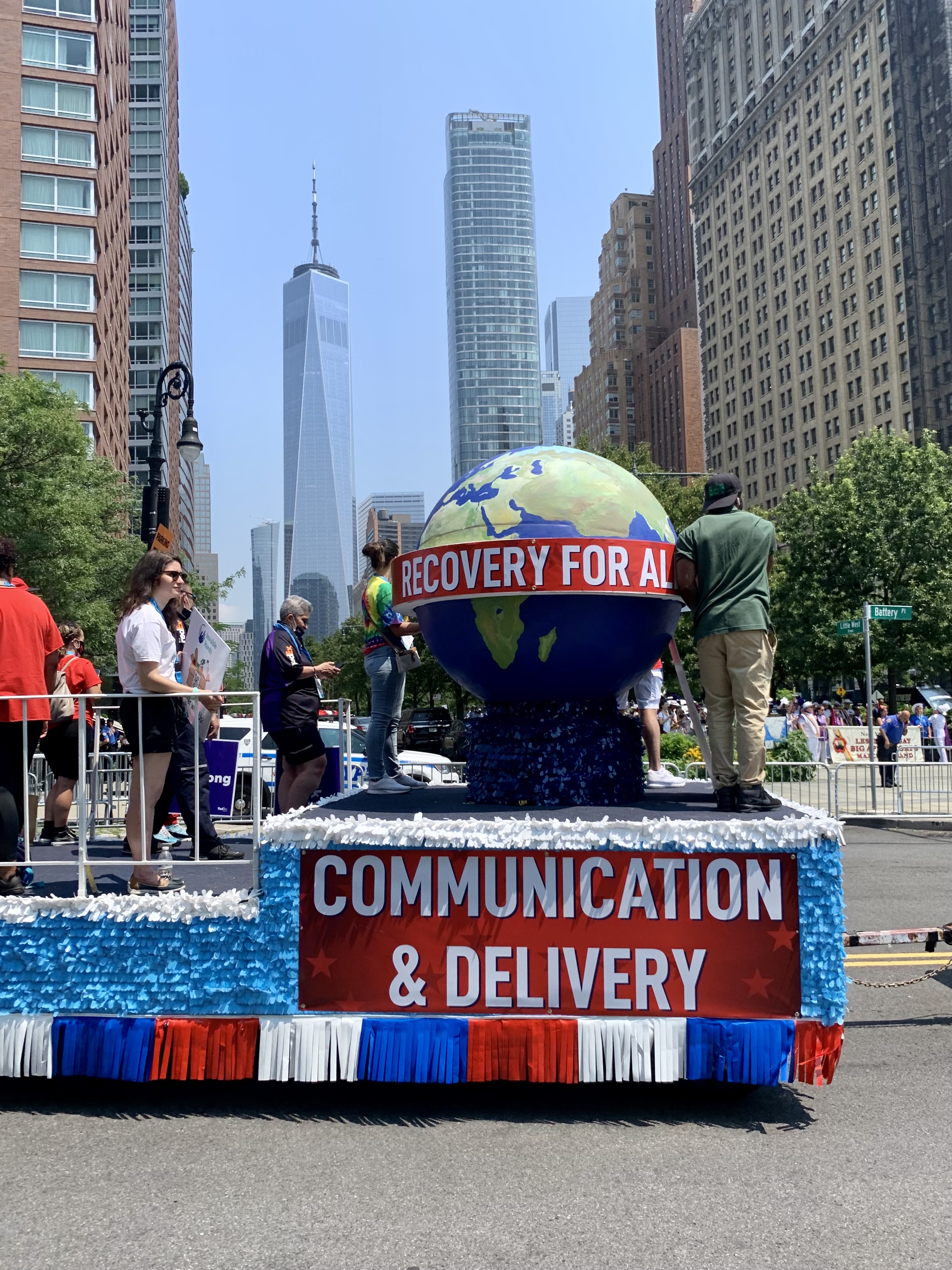
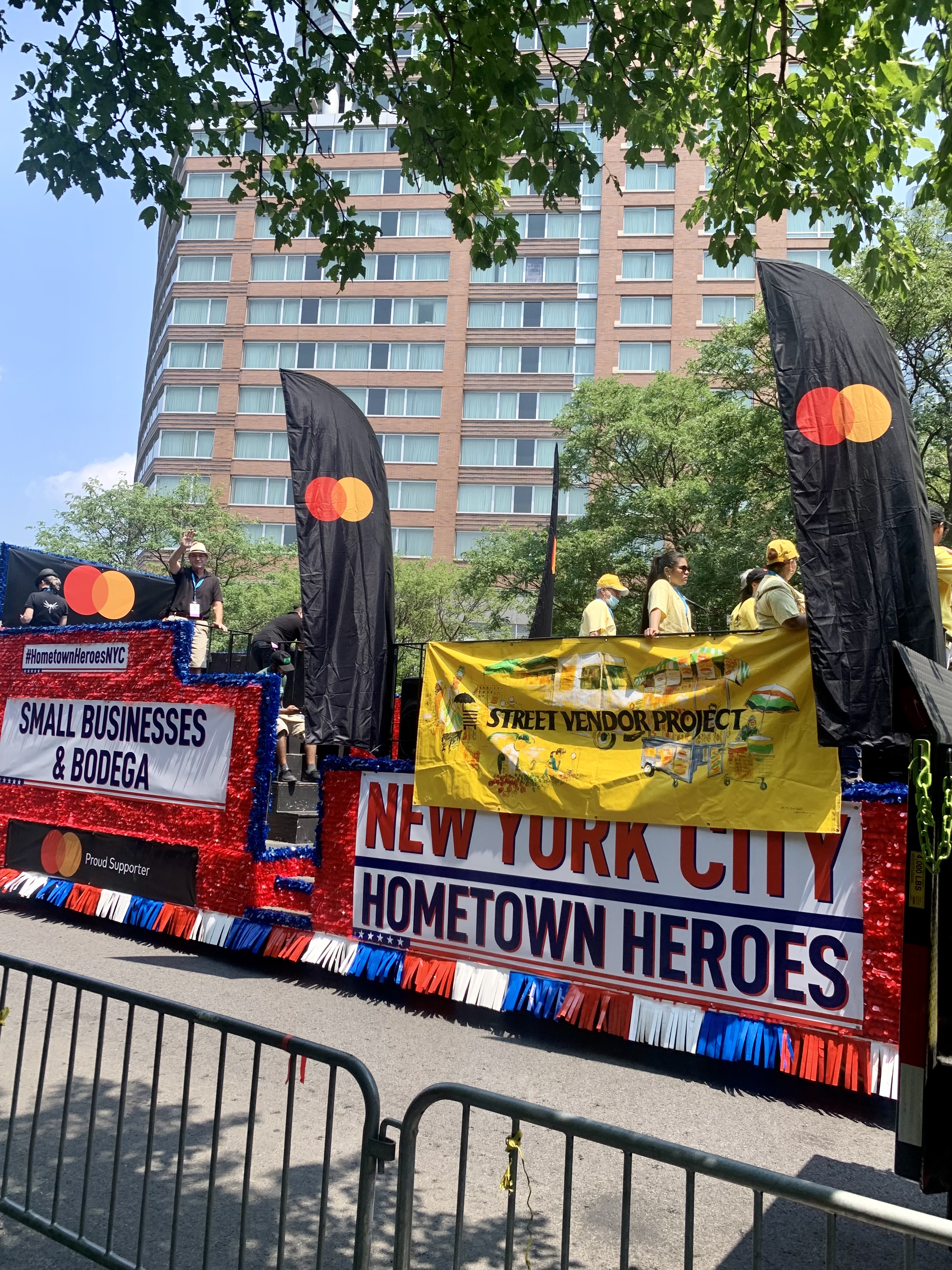
As I have posted before, I was in NYC during the entire Covid-19 pandemic lockdown, and have blogged about what that was like (“Missing my city while still in it,” here) as well as about how things slowly came back to life after being shut down (like NYC museums). Although it is impossible to pinpoint the exact moment that NYC is back – and in some ways, it still isn’t – the Hometown Heroes parade a few days ago was a celebration of those essential workers who kept the city going while most of us were sheltering in place. Having a parade like that (my favorite sign said simply “We Did It”) was certainly the most joyous indication that NYC is feeling more like itself again, thanks to high vaccination rates and very effective vaccines.
The first person to receive a Covid-19 vaccine in the United States, Sandra Lindsay, was the parade grand marshal.
One of the things that kept bringing up emotion to me during the parade was in part due to seeing it from its starting point in Battery Park. During the most extreme lockdown, when New Yorkers were asked to stay at home except for exercise, I began biking along the Hudson River bike path from Hell’s Kitchen to Battery Park, walking around, and biking back. It was so rare to see anyone else that if I did pass another biker we would generally wave and acknowledge each other. More often than not, I was completely alone walking in Battery Park, gazing out to the Statue of Liberty and seeing signs that once would have been baffling about wearing a mask and keeping six feet apart. To be back in Battery Park in a crowd of vaccinated and unmasked fellow New Yorkers, celebrating those who kept the city going, was especially meaningful to me.
NYC’s reawakening has been gradual, and many new parks (like the Pier 26 ecopark and Little Island Park) have opened during the pandemic while familiar places like Lincoln Center have found new ways to reimagine old spaces. For me, NYC will truly be back once I am in a Broadway theatre (I have so many tickets already!), and that day is coming soon. But on July 7, I remembered all the times we clapped for our essential workers in isolation, hearing our fellow New Yorkers do the same from their own isolation – but as we clapped and cheered as the parade passed by, we were finally able to do it together again.
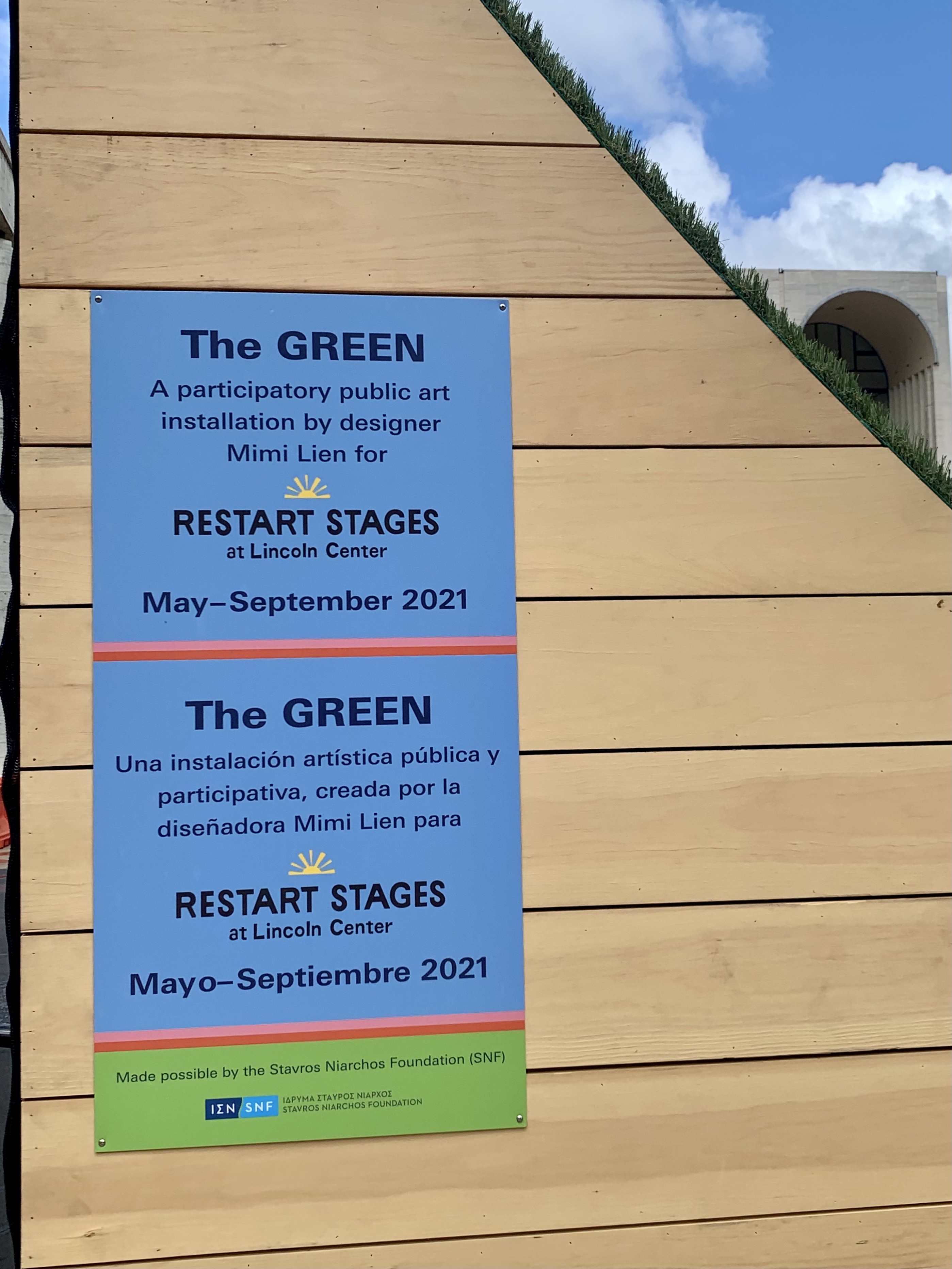
As of mid-May in New York City, we feel on the very brink of real reopening as our vaccination rate increases and our covid positivity level decreases. Many limitations will be lifted May 19th, and Broadway tickets are on sale now for performances beginning this September. Lincoln Center launches its “Restart Stages” performance schedule tonight (May 10) and will be offering multiple opportunities to enjoy the arts through September (check out the calendar here). In addition, they have transformed the iconic plaza into a lush green space with real grass, courtesy of MacArthur “Genius grant” recipient Mimi Lien. Here’s what it was like to be there on the first day it was open.
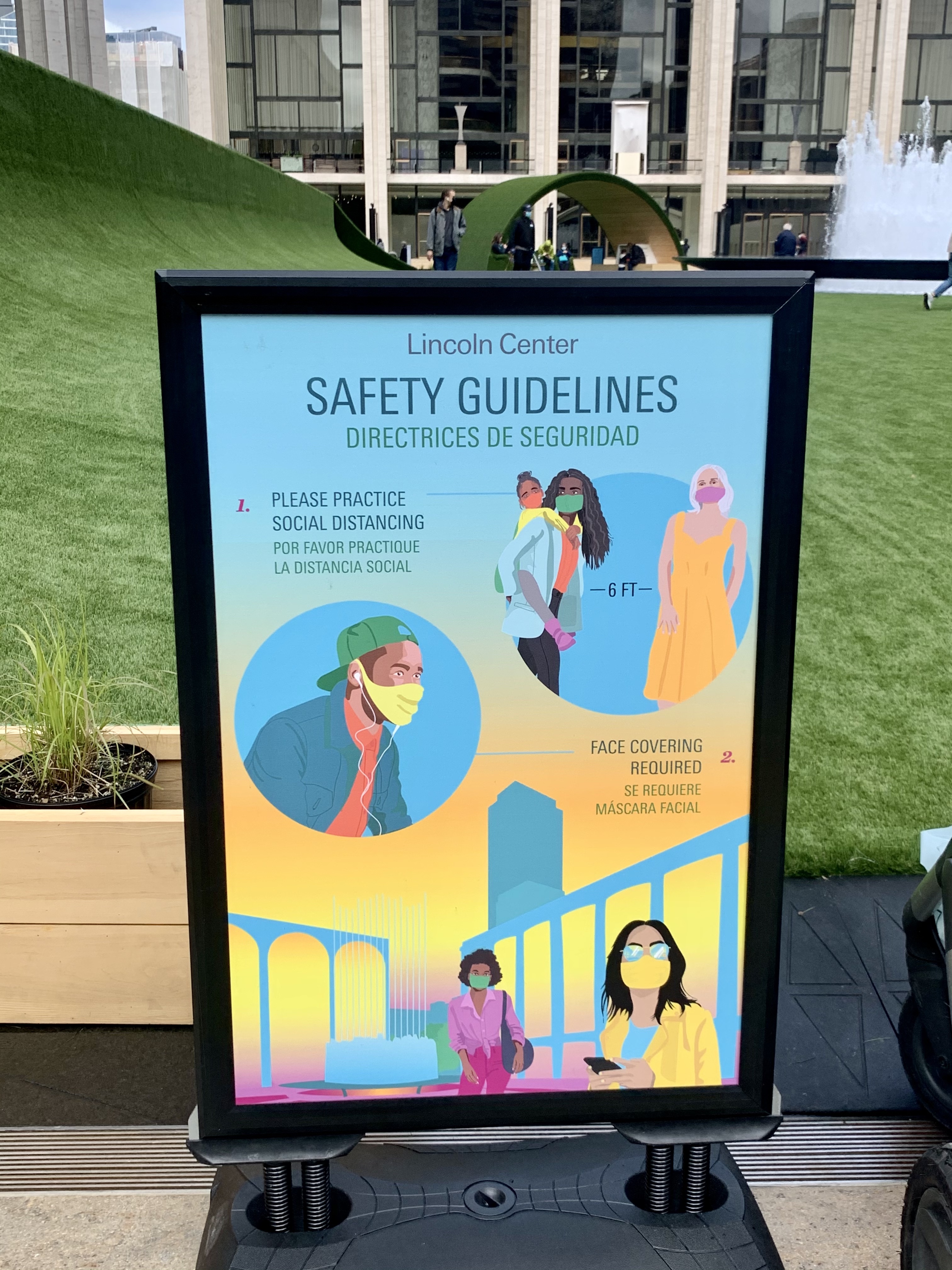
If you want to visit, you need your mask, and to keep distance from others.
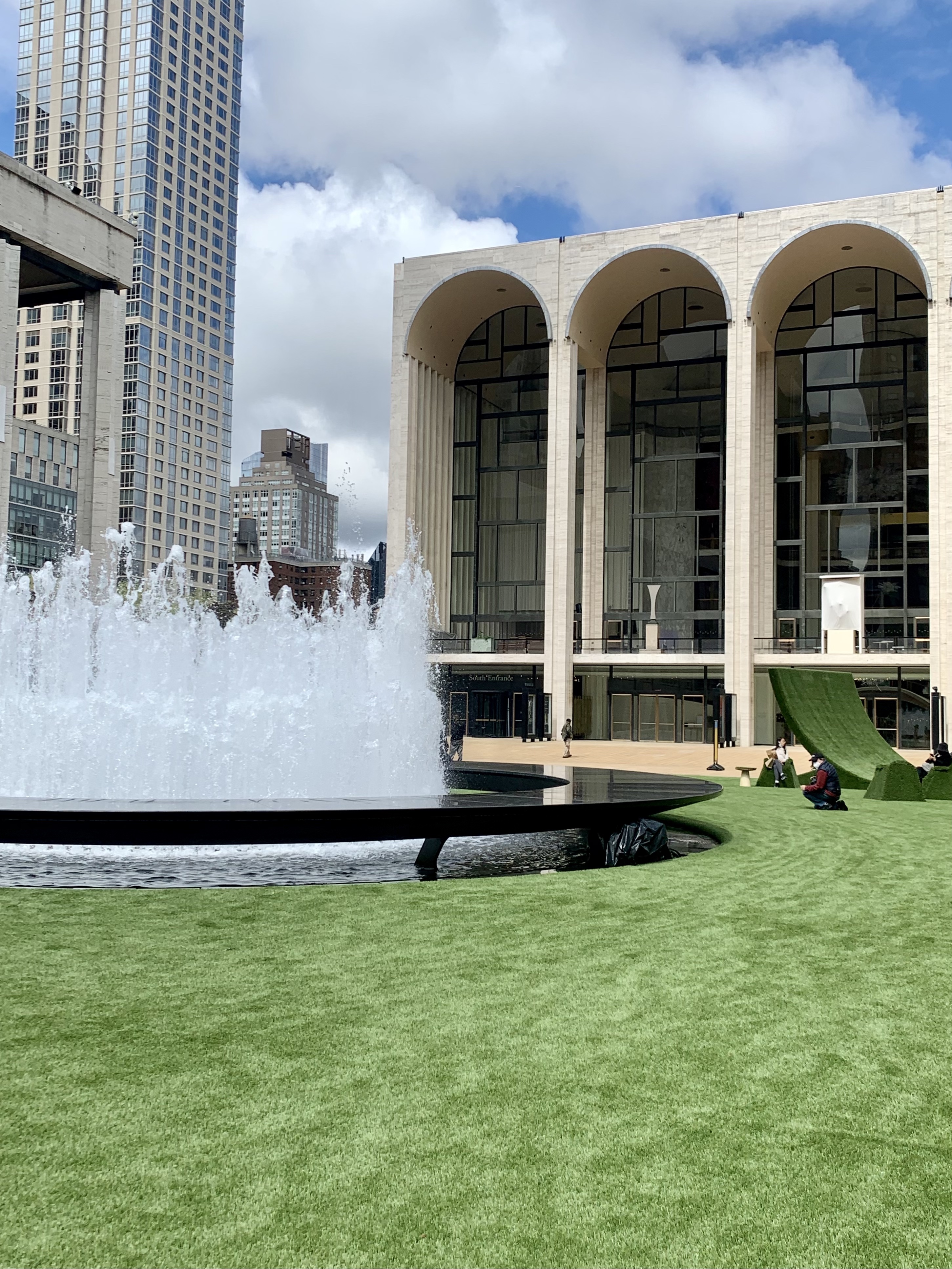
The entire plaza is covered in lush green grass, and it swoops sinuously up on the north and south sides.
There are occasional swoops of green added for extra places to sit or relax.
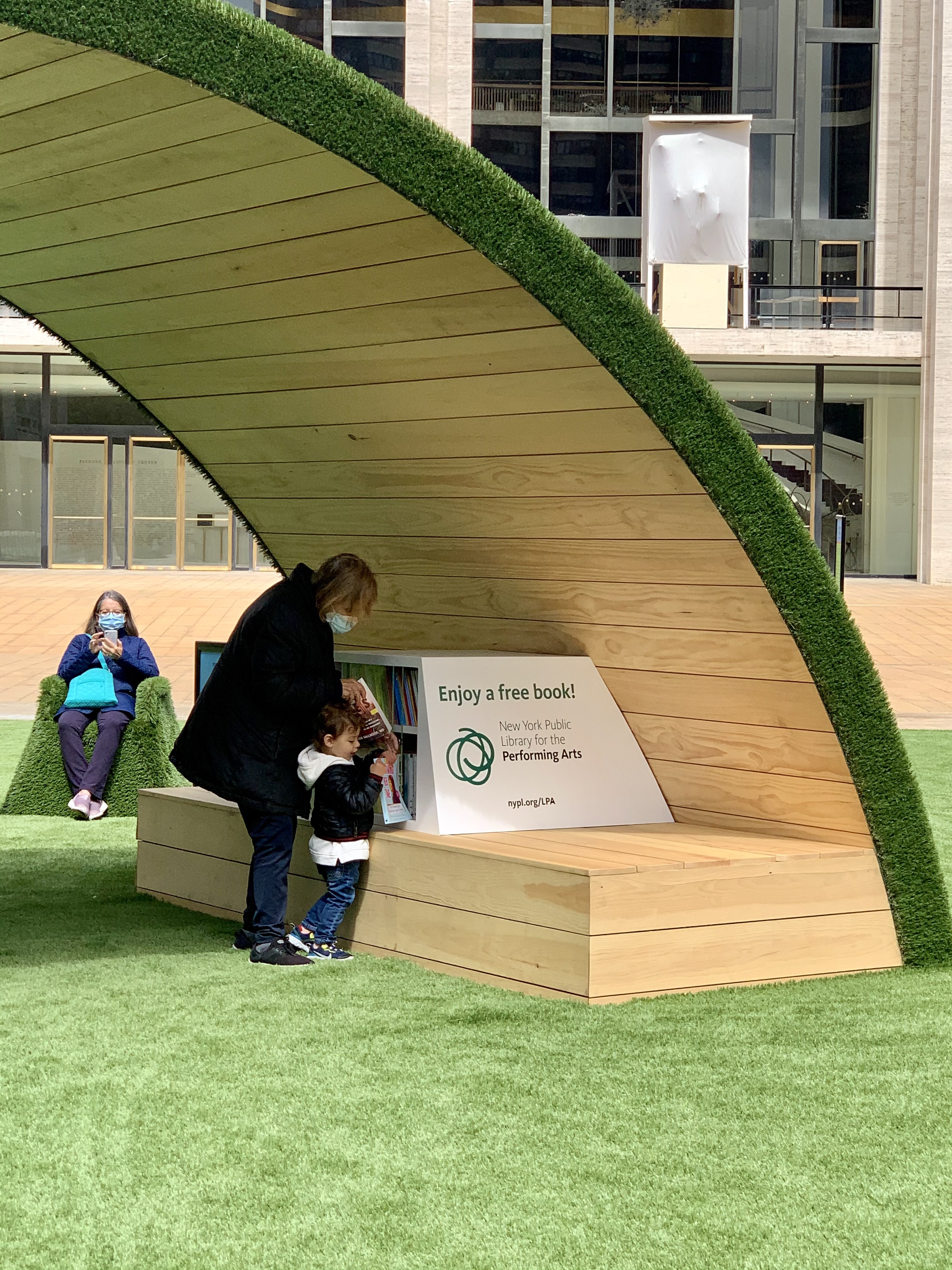
There’s even an upside-down swoop with free books and a shady reading space! There’s a pop-up sandwich shop for snacking as well.
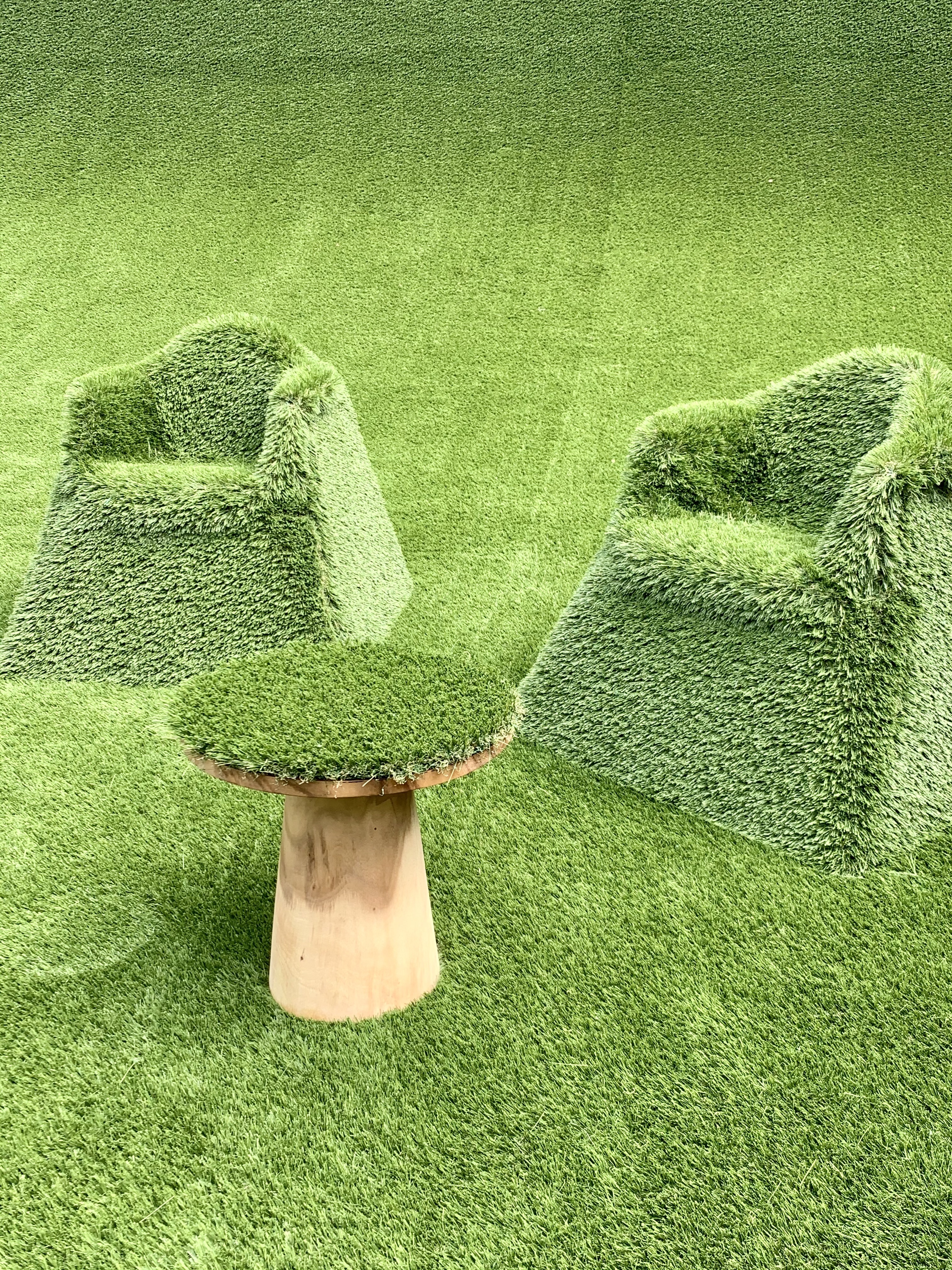
My favorites were the grass-covered chairs and tables, though!
Elsewhere around the Lincoln Center campus, there are multiple outdoor performance spaces, some smaller and more intimate but others quite large like this one. Tickets are generally free, and can be won through an online lottery through the Today Tix app. Winners get a “pod” of two tickets – good luck and I hope to see you at Lincoln Center!
I was fortunate enough in February to work with videographer Mikey Pozarik and with Compass to create two videos that express my ethos as a real estate agent. The first one (see it here) features a quote by E.B. White, and reflects my love for New York City as someone who was born elsewhere but has chosen to live and work in the city. I hope every day that I am able to bring my passion to this city I love. The second one (see it here) is more of a manifesto. The quote is attributed to Steve Jobs, and I am drawn to the work ethic it expresses. I truly enjoyed making these videos – the locations were all areas of the city I have a particular relationship with, and selecting and recording the quotes was also a process I found artistically and creatively challenging in a very positive way. Even the process of deciding how to go about making these videos helped me think about and crystallize who I am in my role as a real estate agent. My thanks to Mikey and to Compass for helping these projects come to life.
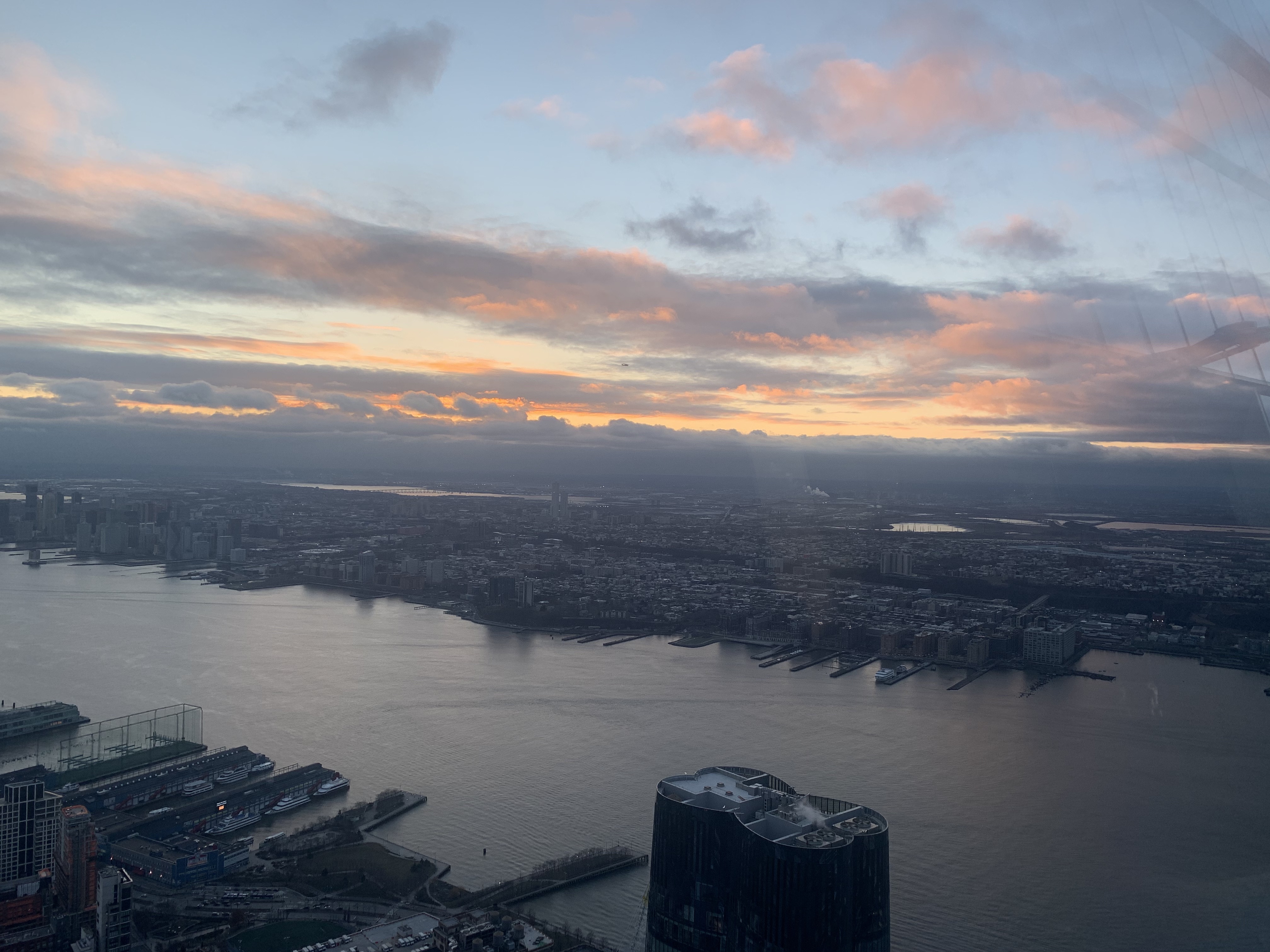
Always looking for another way to look at the New York City that I love so dearly, I was eagerly anticipating the opening of The Edge observatory in Hudson Yards last year. It opened on March 12, 2020 – and was shut down almost immediately by the pandemic. The Edge reopened in the fall with capacity restrictions, a mask requirement, and physical distancing, and I was able to experience it early in 2021. I had decided that it would be optimal to go for sunset, and those tickets sell out quickest (and have a surcharge). Given that going in inclement weather would reduce the view, I was looking for a time to buy tickets a day or so in advance when the weather was more predictable, and was able to once the holiday season increase in interest had passed.
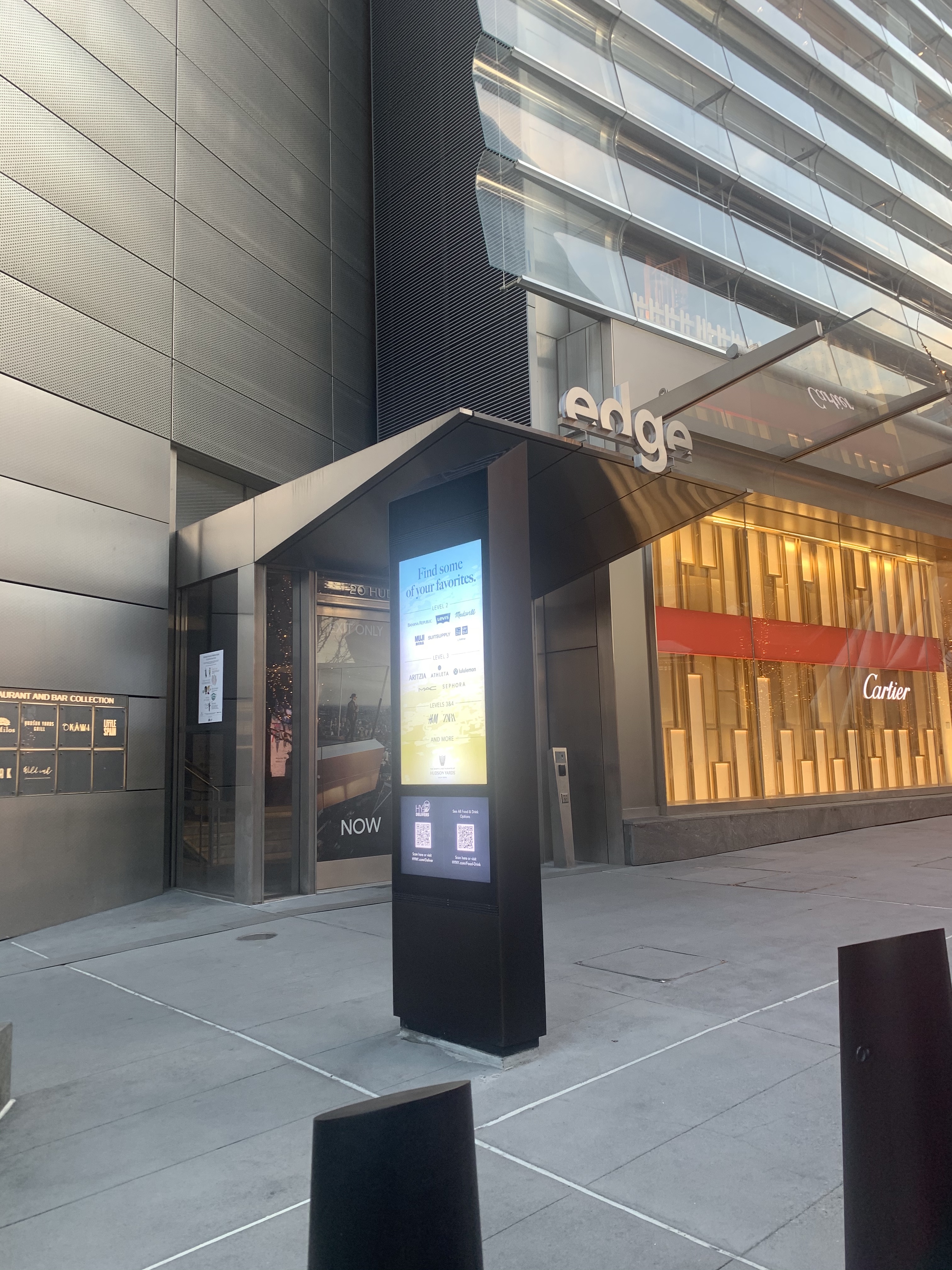
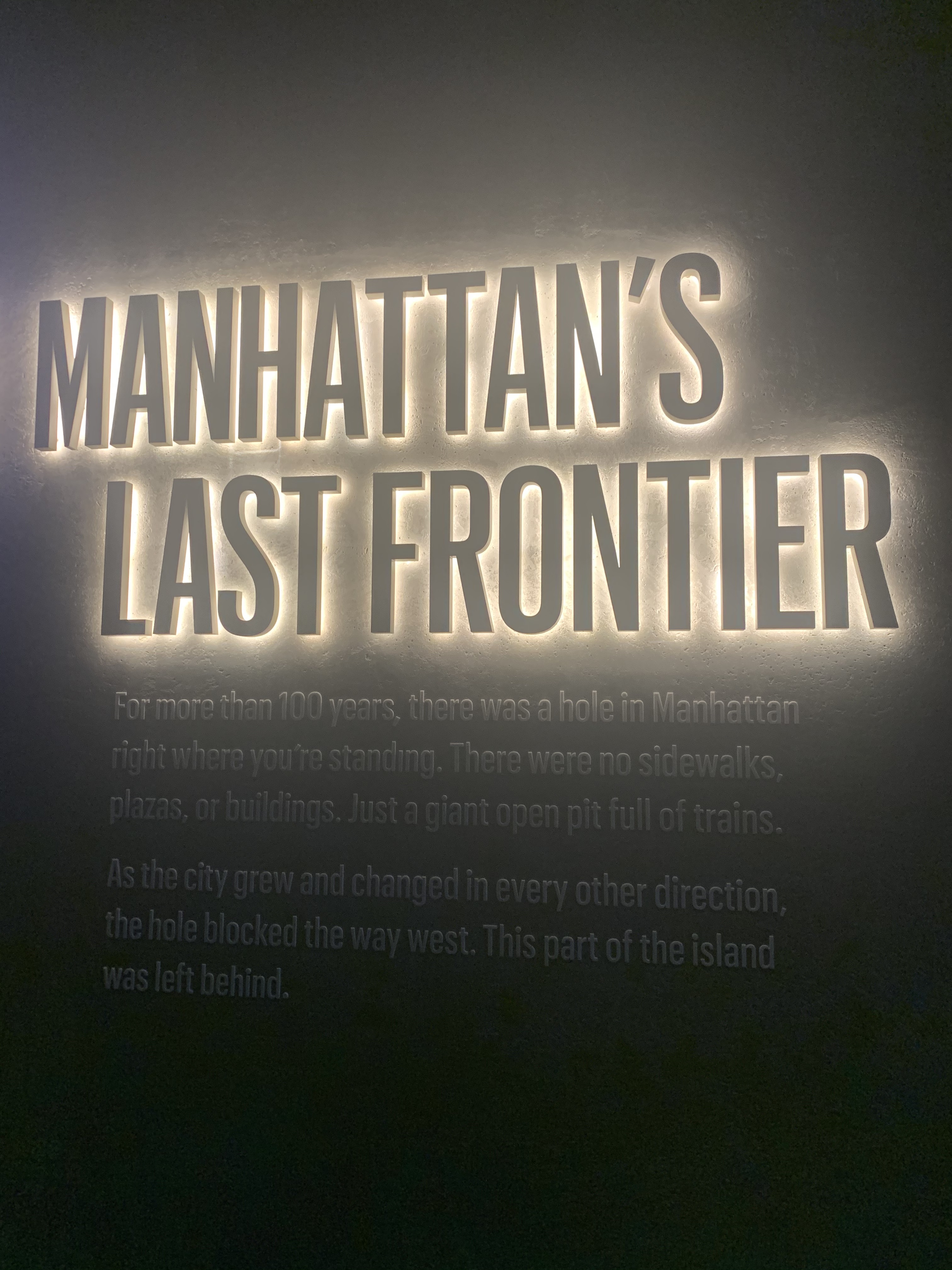
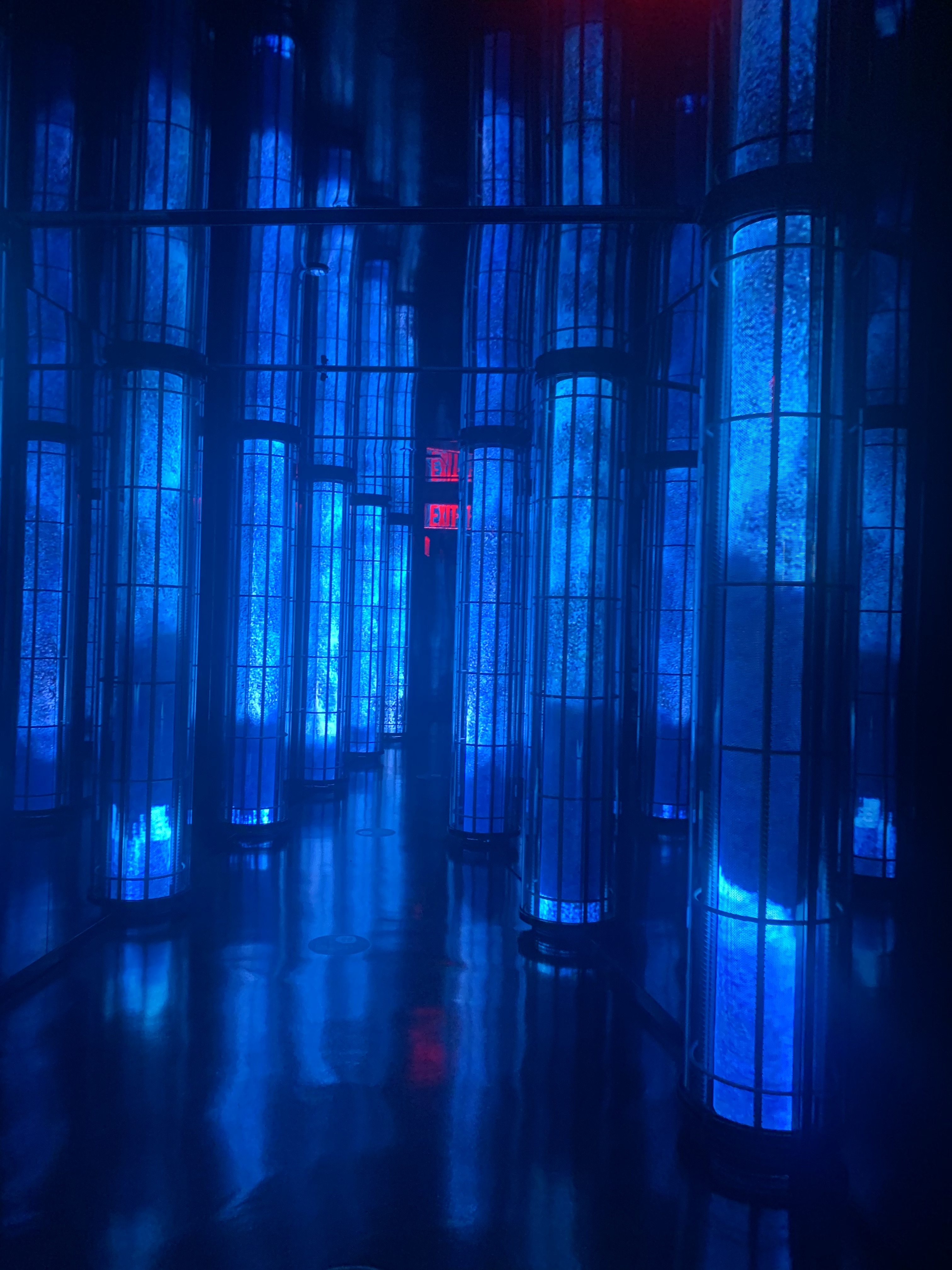
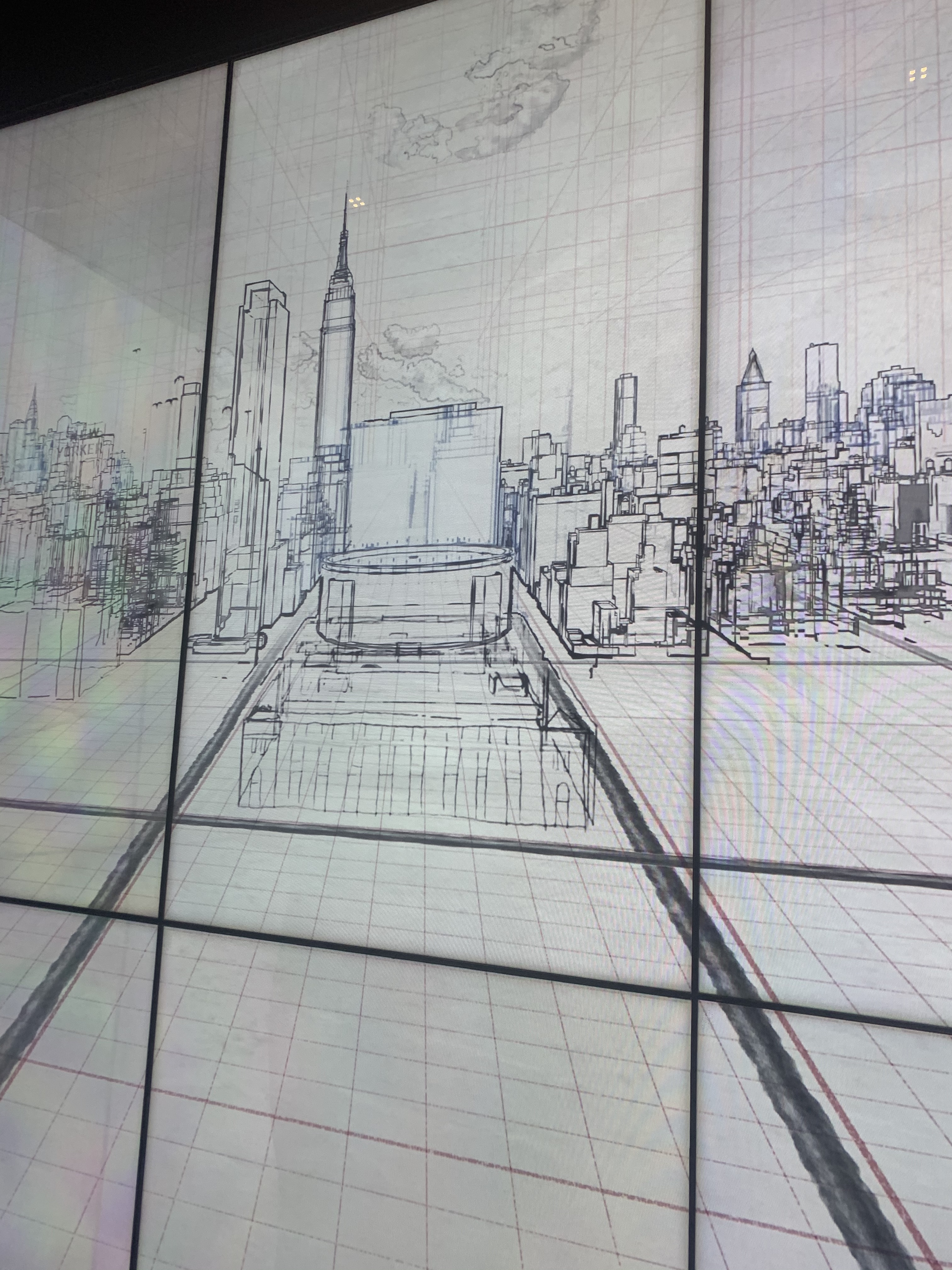
The entrance is just to the left of the shops at Hudson Yards, if you are standing with the Vessel behind you. Everything is clearly marked, and you will be unable to enter and have your ticket scanned until about ten minutes before the entry time listed on your ticket. After being scanned in, you walk through a high-tech display about the development of Hudson Yards (which is still only partially complete at this point), before entering an elevator to go up. A virtual display of the history of the area and the views plays as you ascend.
The time I had been able to get was 4:10, on a day when sunset would be just after 4:41. With the various procedures required to get up there, it was getting pretty close to sunset. We discovered that you needed to wait on line up in the inside area to get to the outside observatory, due to covid capacity limitations. Would we get out there in time?
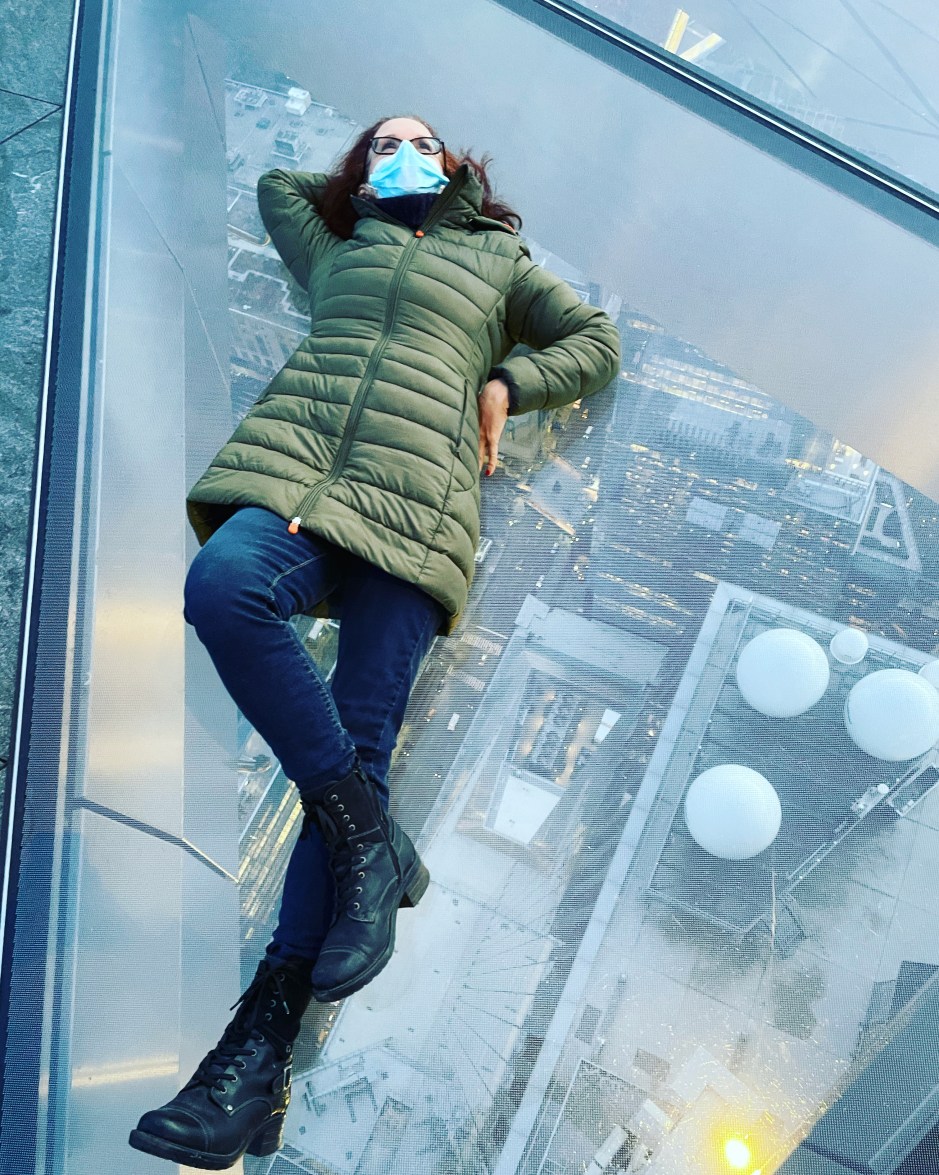
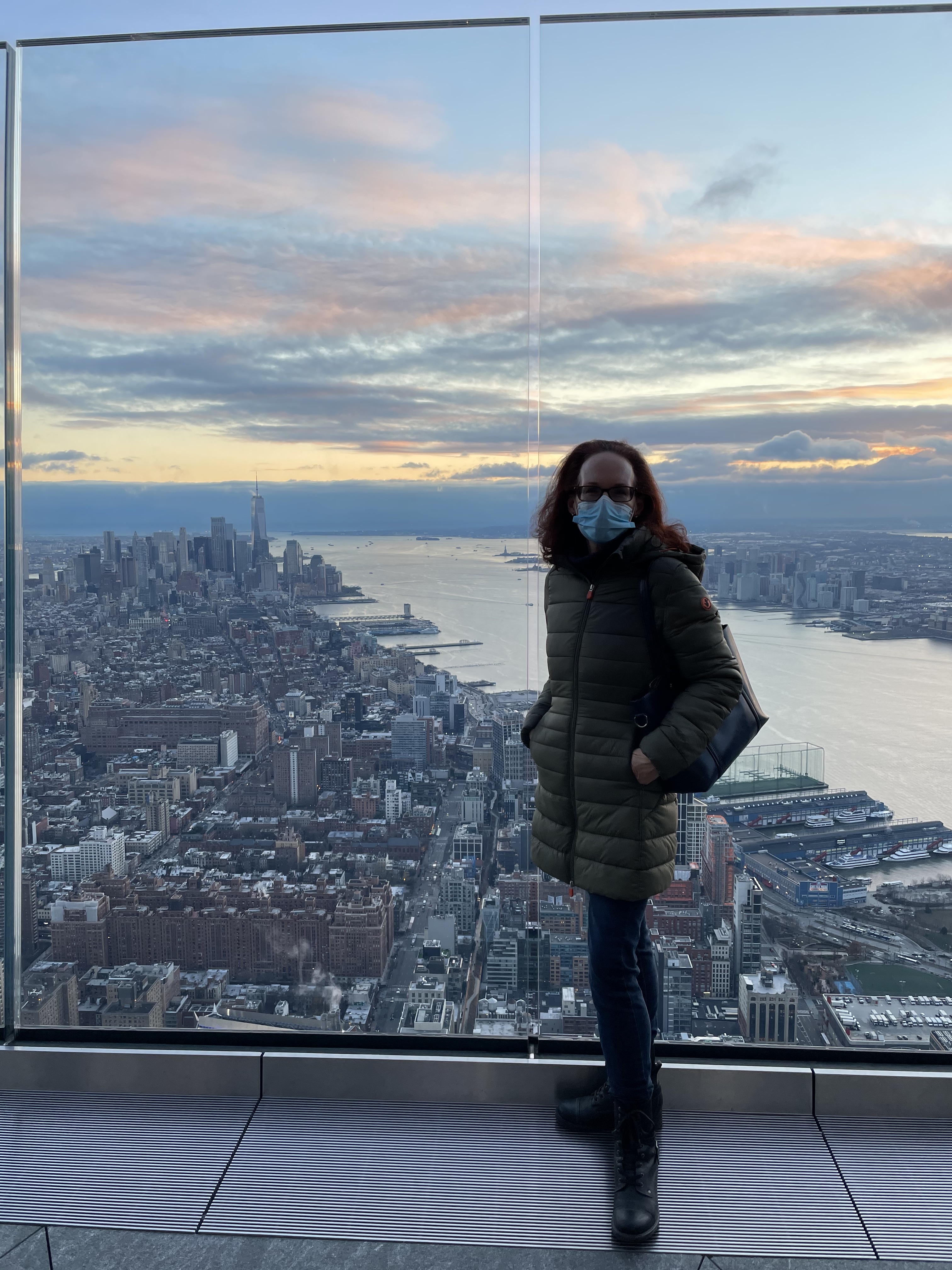
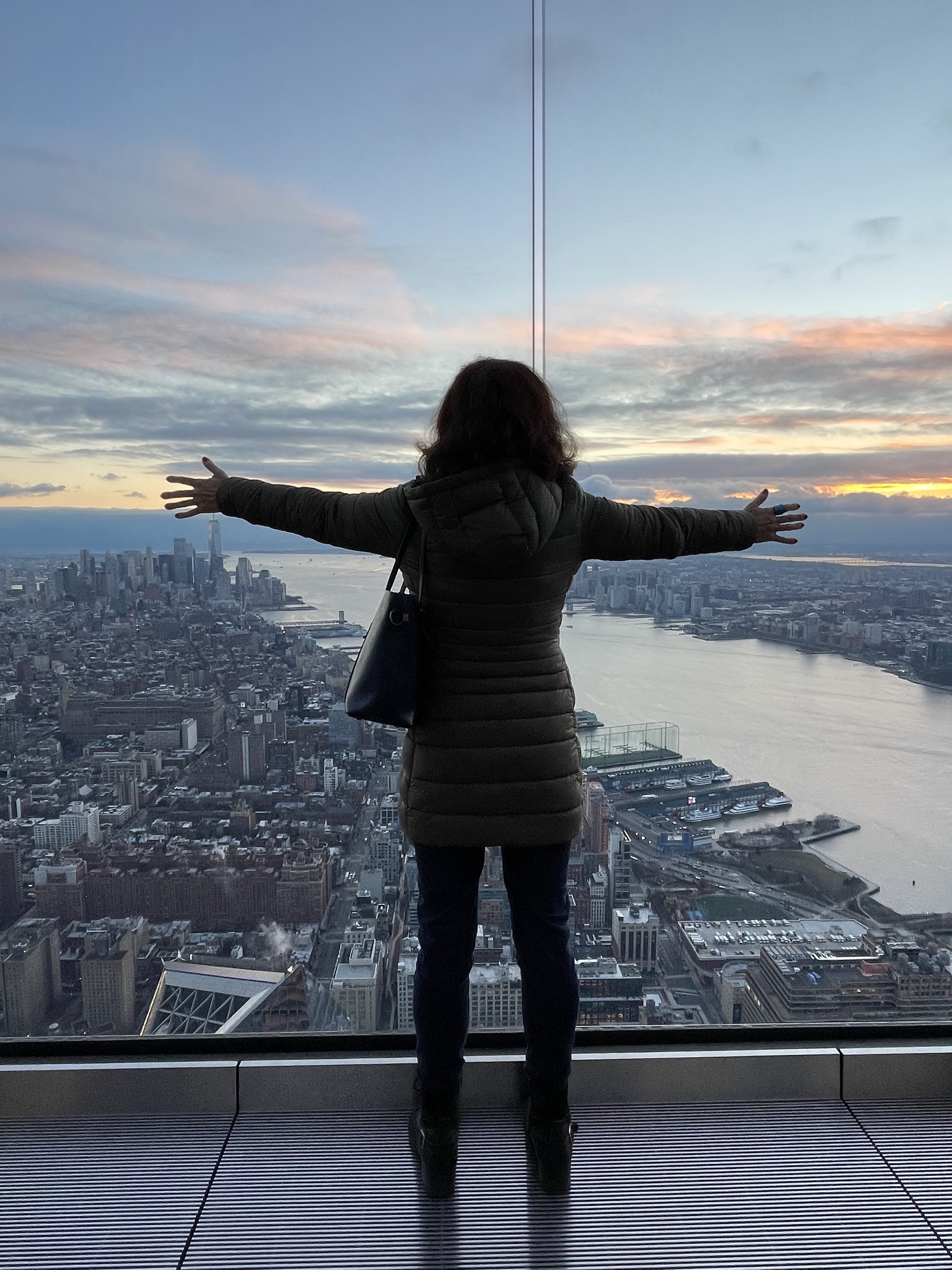
Luckily, things were run very smoothly, including limitations on time people could spend in the various corners outside, so we were able to get out before the sun had fully set. The Edge is the highest outdoor observatory in the Western Hemisphere, and with its unique design, you feel it. You are on a huge triangle protruding 80 feet out from the side of 20 Hudson Yards, 100 floors (or 1,131 feet) up. There are only glass walls surrounding you, and open air above.
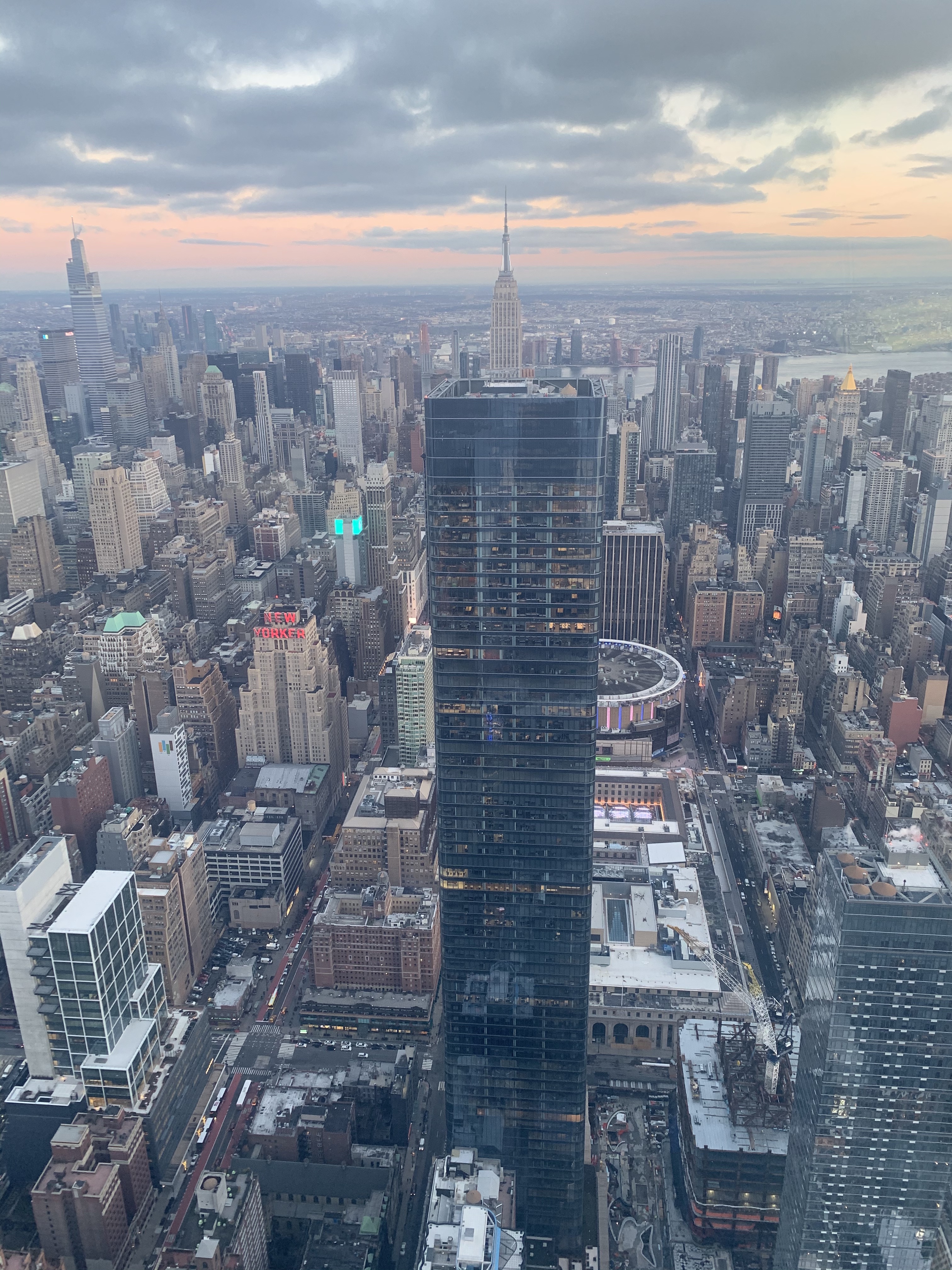
And the views! Just lovely, and a different perspective from midtown observatories like Top of the Rock or the Empire State building, or One World Trade downtown.
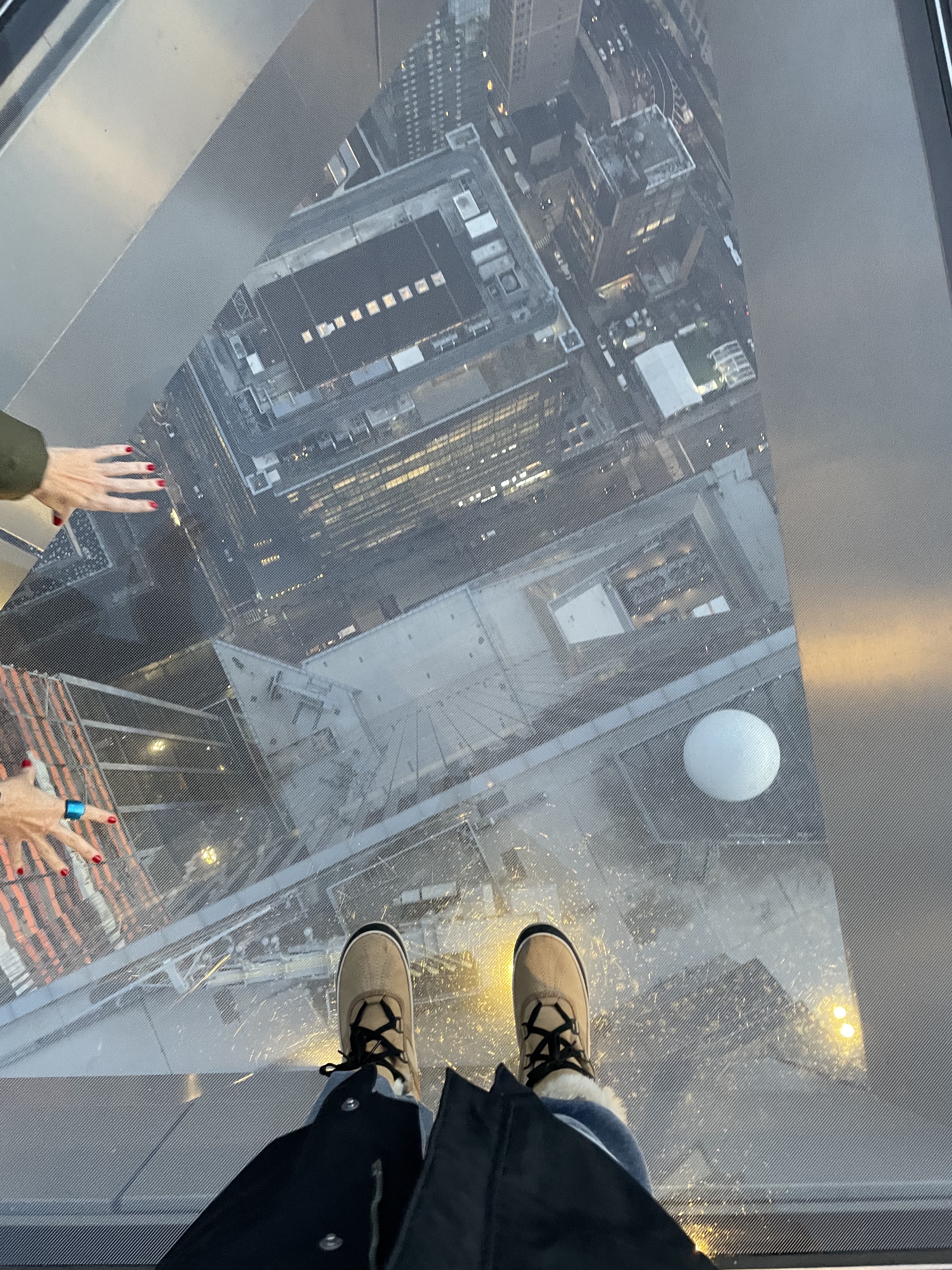
One of the most exciting things to do – if you can take it – is to go on top of the clear glass floor area that they have near the point of the triangle jutting off into space. It’s a long way down, and that distance is quite tangible! This is one of the places where they have staff monitoring your time, and you have one minute alone on the glass floor before you need to give someone else a turn. I found that the staff at The Edge were great at maintaining physical distance between visitors and monitoring time limits.
There are stairs with seating that are reserved for those who have ordered champagne or snacks from the bar. As sunset passed and the lights of the city began to sparkle, the experience transformed again from end of day to NYC night magic. Having been to several observatories in the city, I find this newcomer to the scene to be the “cool kid” of the bunch, and well worth your time. It’s not cheap, but there is a (small) discount if you are a NYC resident. If doing the sunset experience, try to get the earliest time you can within the sunset window, as it turns out they don’t limit your time while up there (just at a few of the photo opportunities) and I felt a little rushed getting out there for sunset with the timed ticket I had. While outside, we heard a cheer and caught the end of a successful marriage proposal . . . New York City, a little thrill, and romance – what more can you ask of an adventure these days?
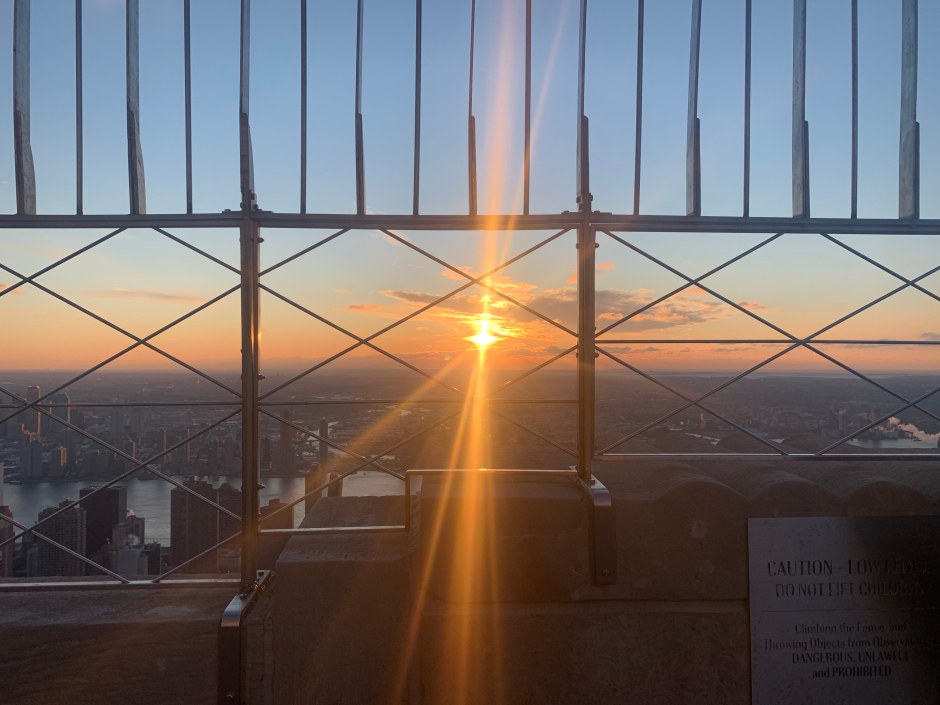
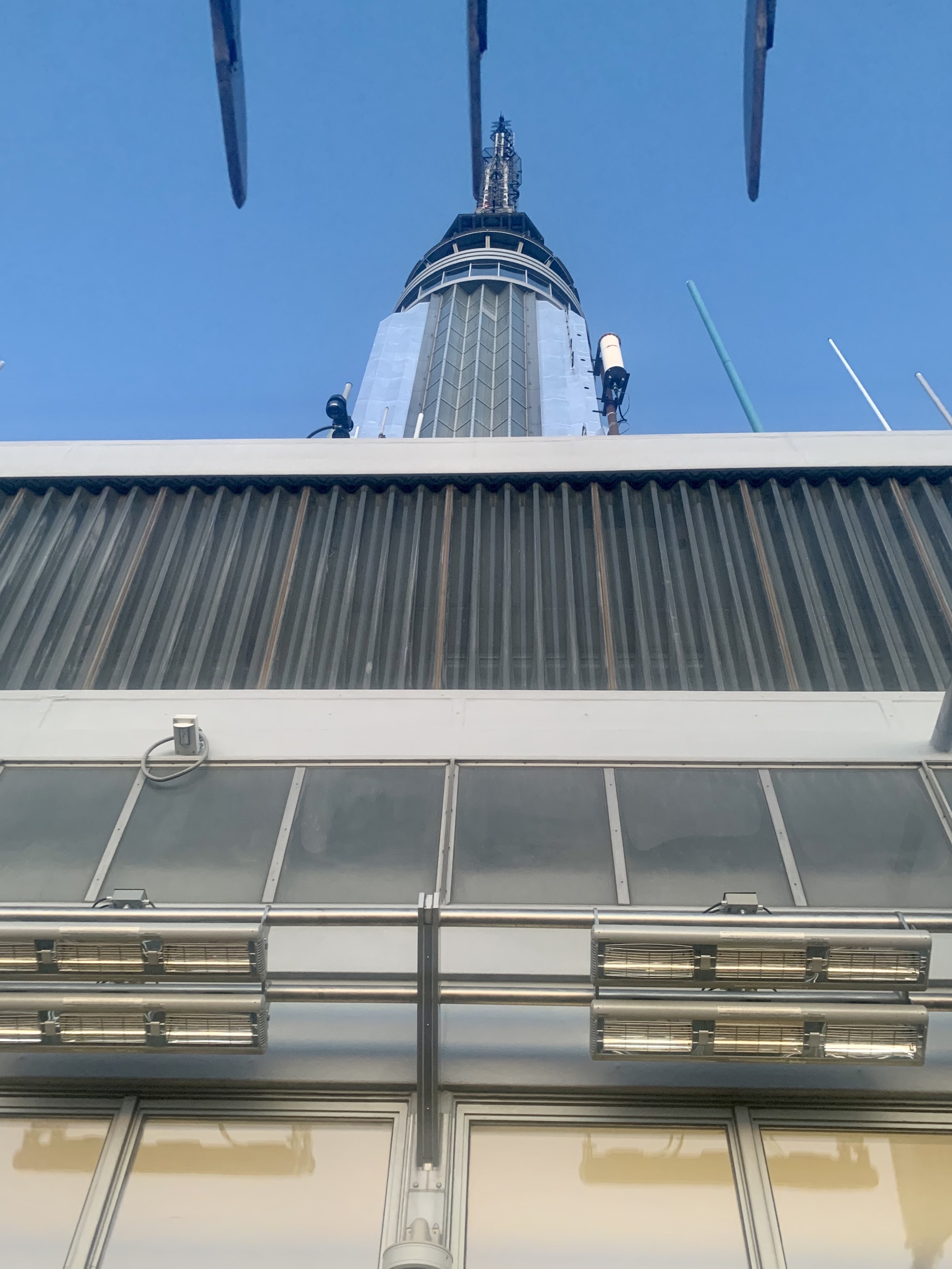
One of the things about living in a place like New York City is that often you don’t end up exploring many of the things that visitors consider a “must do” (unless, of course, you have visitors and accompany them!). But one of the silver linings of this pandemic time, when so many things are not available, is that you can find yourself drawn to figuring out what it is that you can do. One of my daughters discovered that the Empire State Building has an experience, limited to a very small group, where you watch the sun rise from the 86th floor observation deck. So, the day after Christmas in 2020, we found ourselves walking through the quiet city streets before dawn on a very cold and windy morning on our way to enjoy this experience.
Tickets are extremely limited – only 30 people – and on the morning we did it, there were only 18 (including ourselves). Our temperatures were taken, masks were required, and we filled out a health questionnaire upon checking in. Sunrise on Dec 26 was at 7:19, so we checked in at 6:30 and were allowed up (4 to an elevator) at 6:45.
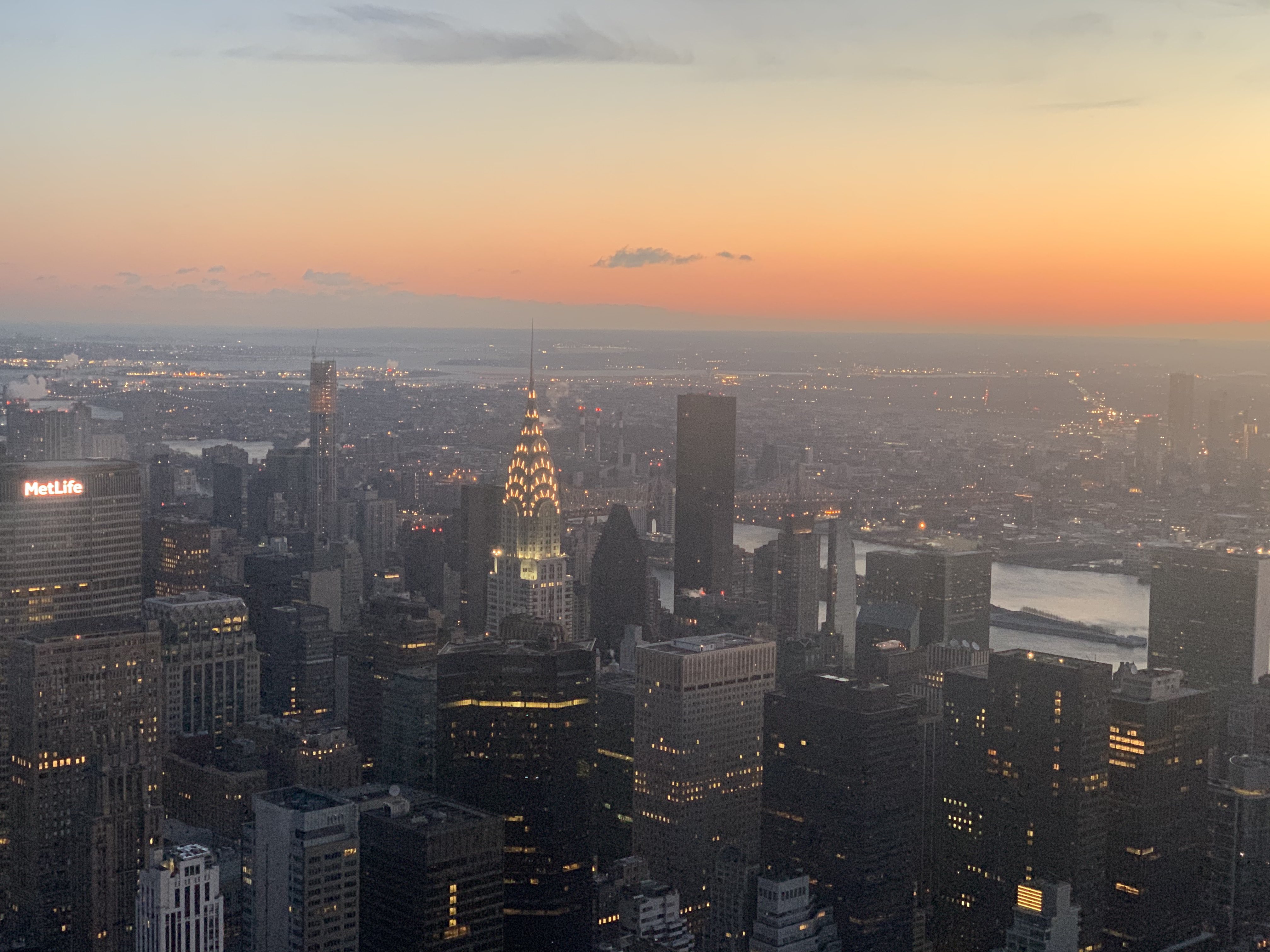
We had noticed even while walking there that the sky was brightening toward the east, and when we walked out to the observation deck, there was a definite sense of dawn even though the Chrysler Building was still illuminated.
Being up there with so few people meant that often you had the feeling of having the deck – and the views – and the city! – to yourself.
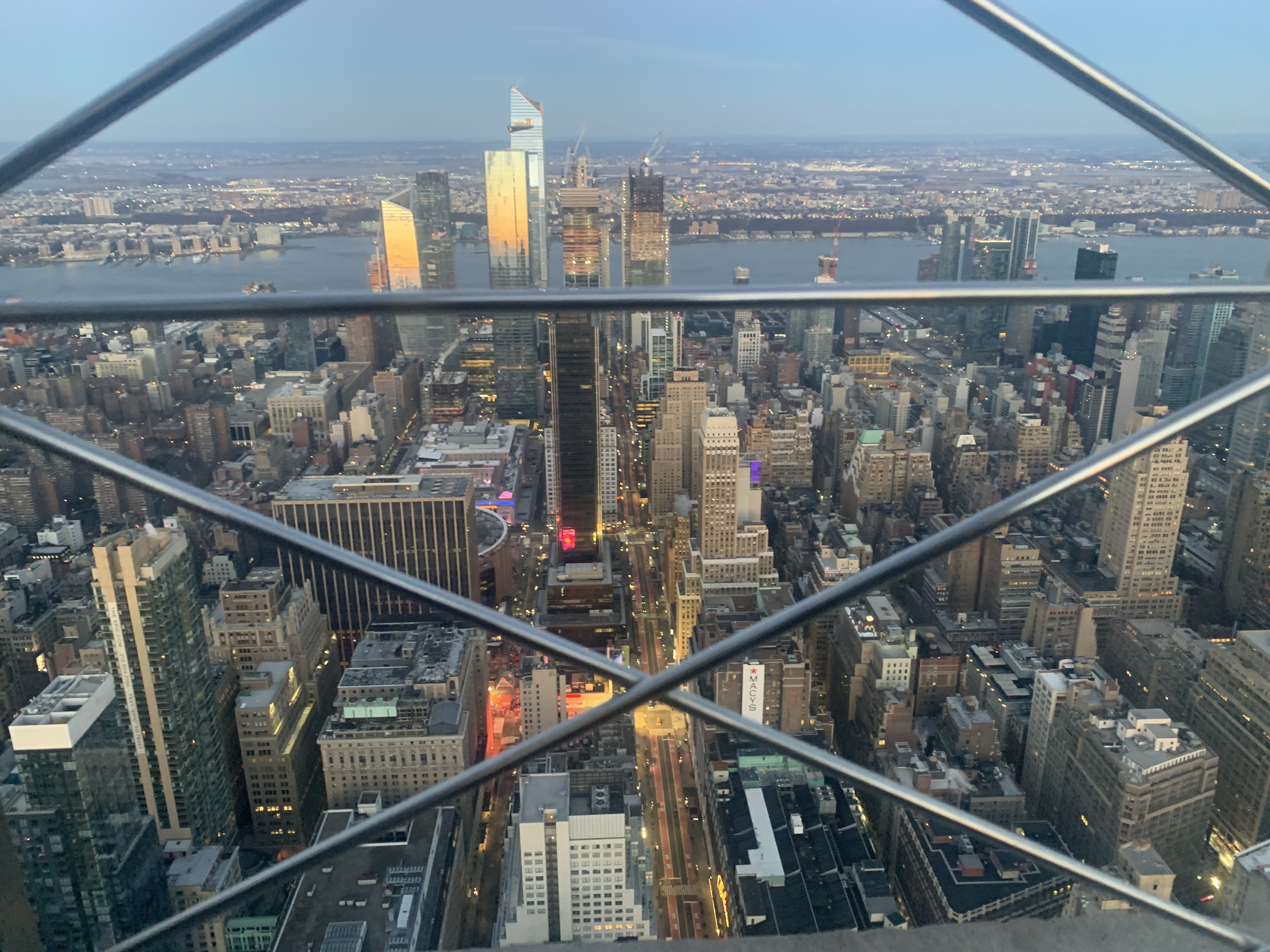
From the deck, you could see not only the dawn, but the way the morning light hit buildings in every direction, giving them a pink glow.
I see many, many more sunsets than sunrises, so it was lovely to see the light slowly increase.
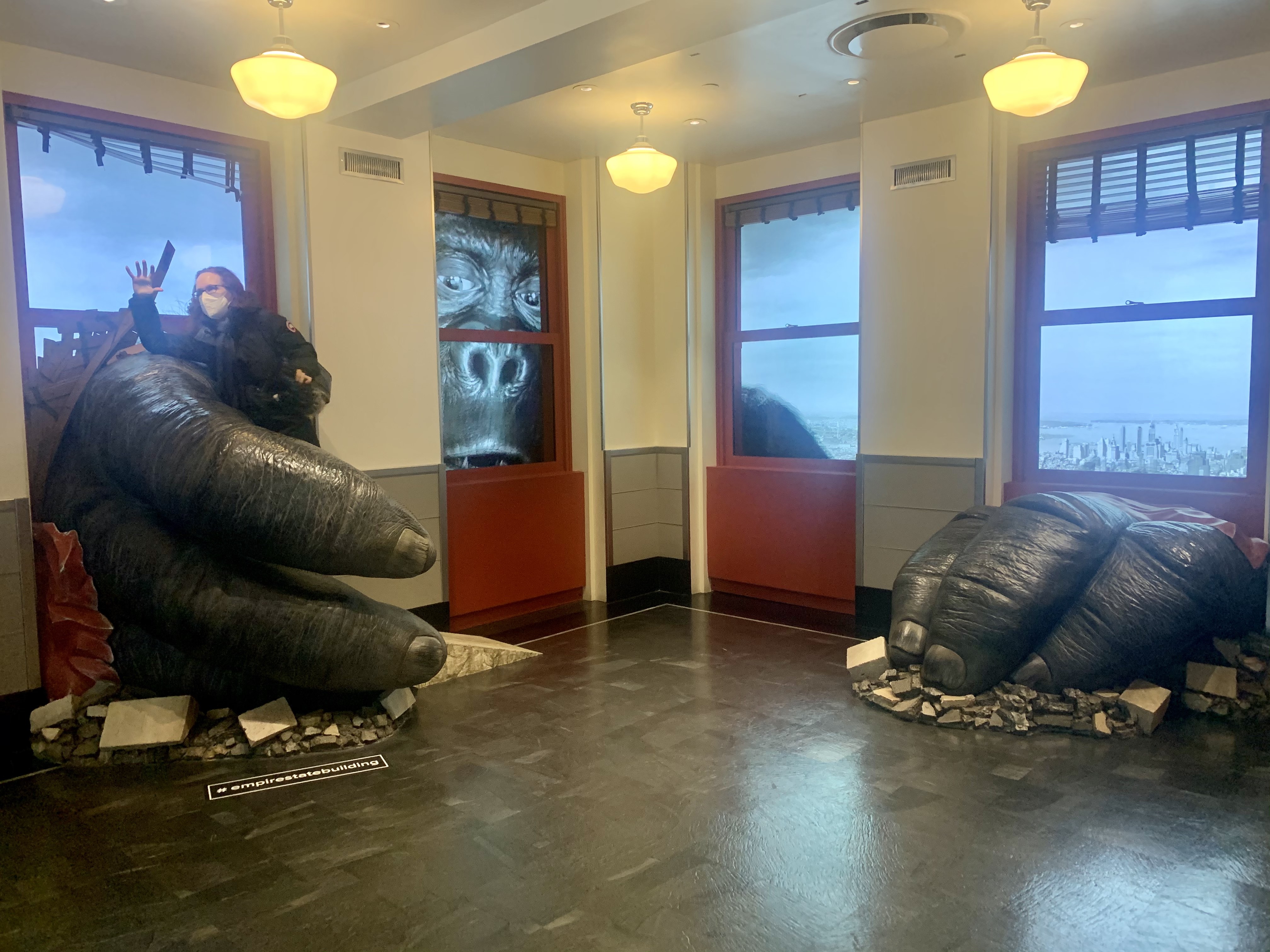
Finally, the sun appeared above a low bank of clouds on the eastern horizon! Over the next half hour, the morning sun rose and no longer gave a rosy glow, but simply illuminated the city – from One World Trade south to the entirety of Central Park looking north to Harlem. At 8AM, they were going to let regular ticket holders come up, so just before that, we left and were offered a private ride to the lower floor that held a display on the history of the building as well as a few fun photo ops. There were no other people there, and I can only imagine how crowded it must be usually (or how hard it is to get that perfect King Kong shot!).
Walking back home to make coffee at what would normally be very close to the start of my day, I reflected on the experience. It was expensive, but the privacy of being up there with virtually no one else there made it worth the cost to me. Would I have preferred it be sunset rather than sunrise? Well, yes – but I can see that there is no way for them to clear the observation deck for a private sunset experience like they can at sunrise by simply opening earlier to a small group. Would I have preferred for it to be less cold? Definitely, although in the warmer months the sunrise is earlier so you have to be there earlier as well (as early as 4:30 near the summer solstice). The ESB sunrise experience runs most days in the peak tourist season (and yes, that will come again!) and only a few days per month the rest of the year. For the price, you want to be sure the weather is good because the tickets aren’t refundable if it is rainy or snowy and you can’t see much. For this reason, I waited until two days before to book – and in more popular times, it is possible that all the slots are gone by then. So all in all, I was very glad I went and very happy with the experience of seeing my city welcome the sun from King Kong’s personal favorite perch.
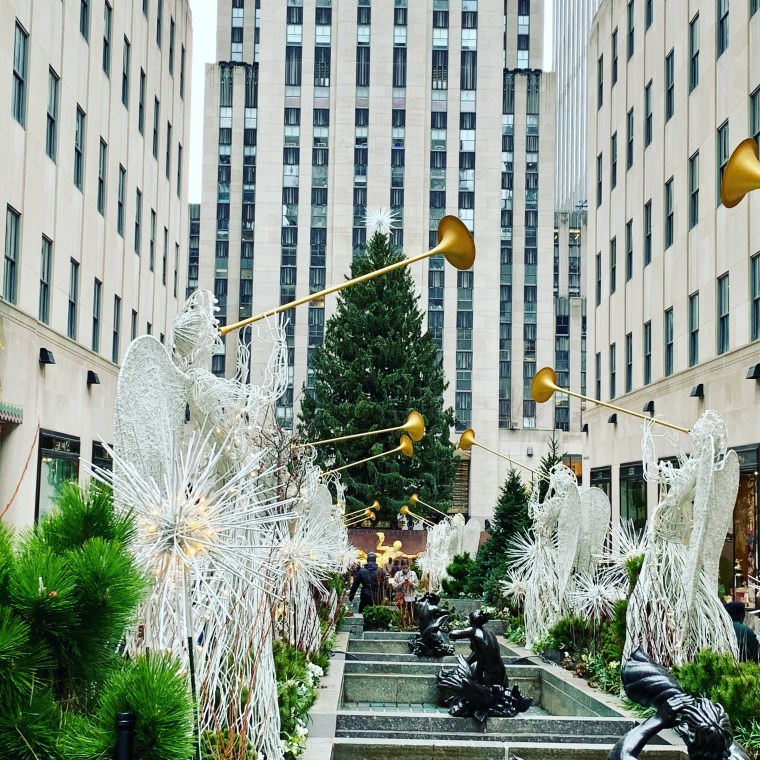
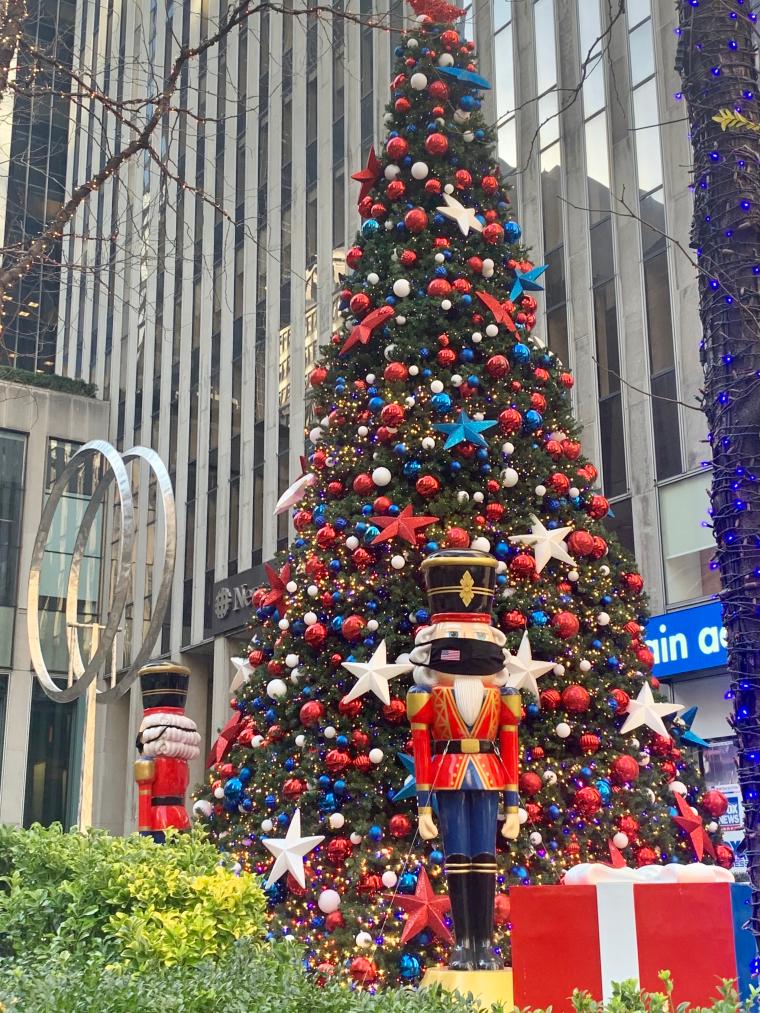
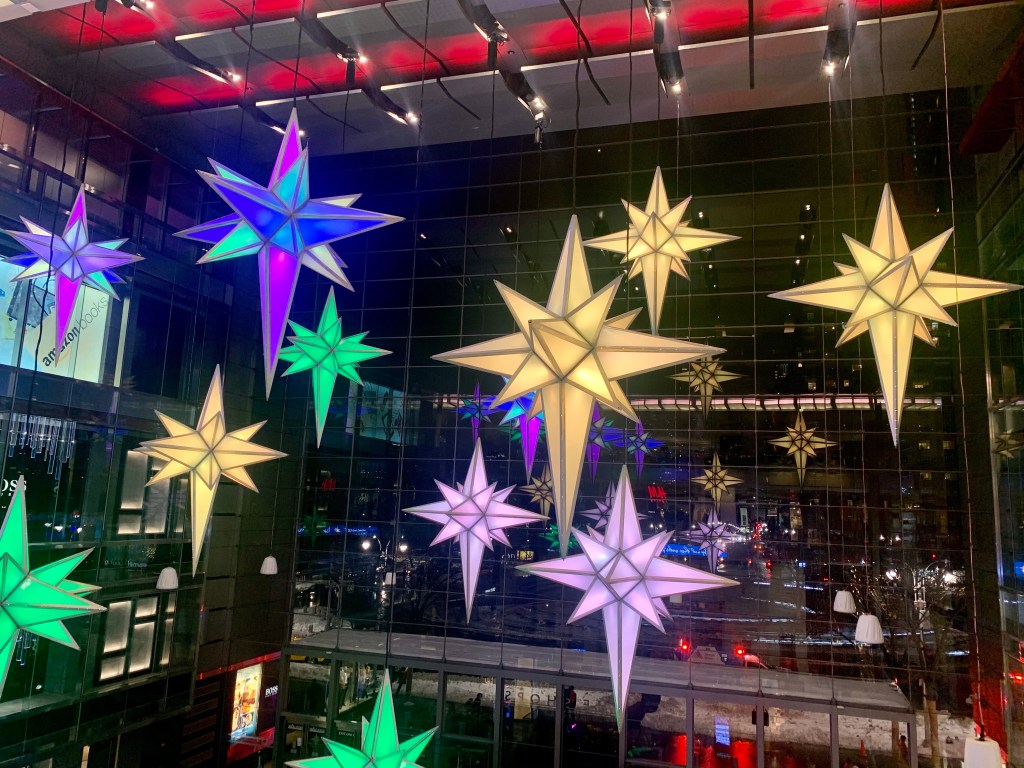
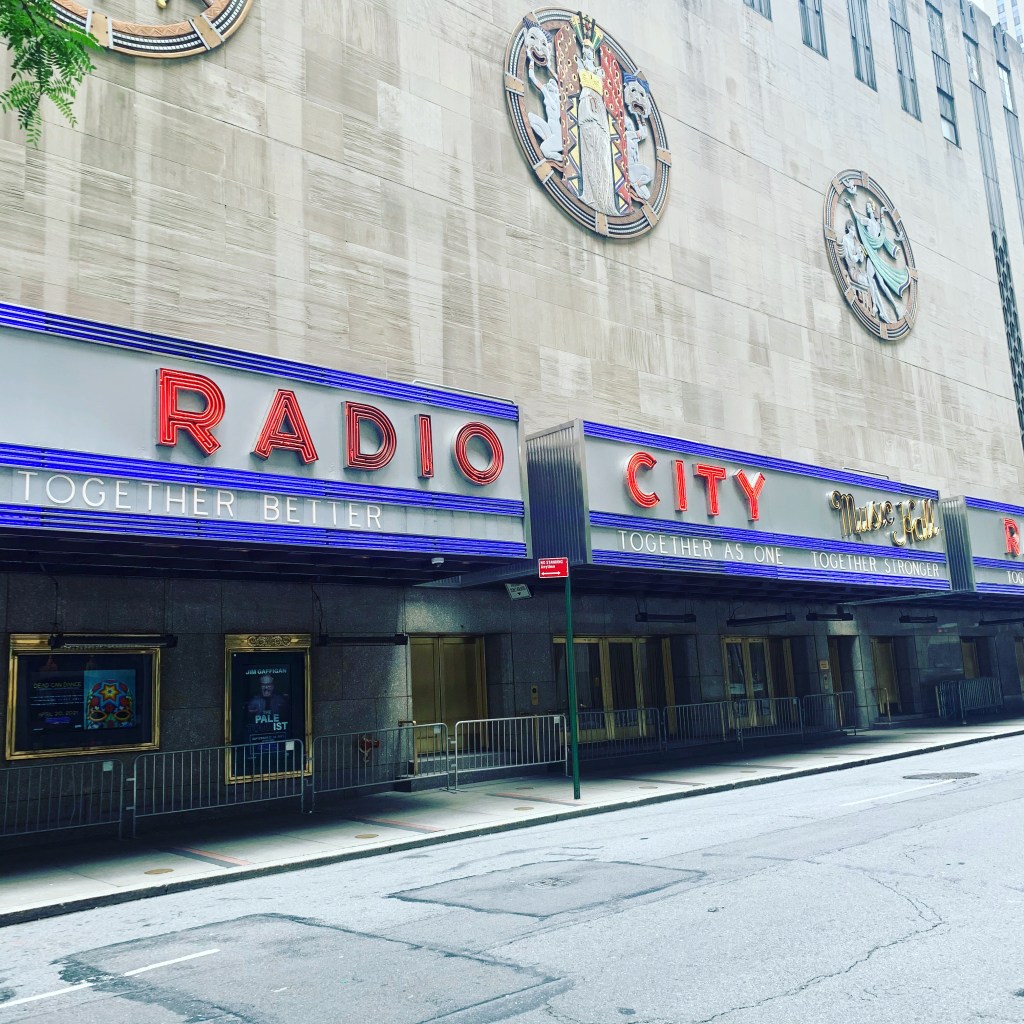
The year 2020 in New York City has certainly not turned out as we all would have hoped when they were clearing confetti from Times Square on January 1. This holiday season is unlike any other one – no Radio City Christmas Spectacular, or NYCB Nutcracker at Lincoln Center, or Santaland at Macy’s, just to name a few- but despite the pandemic, the city came through again with plenty of gorgeous lights and decorations.
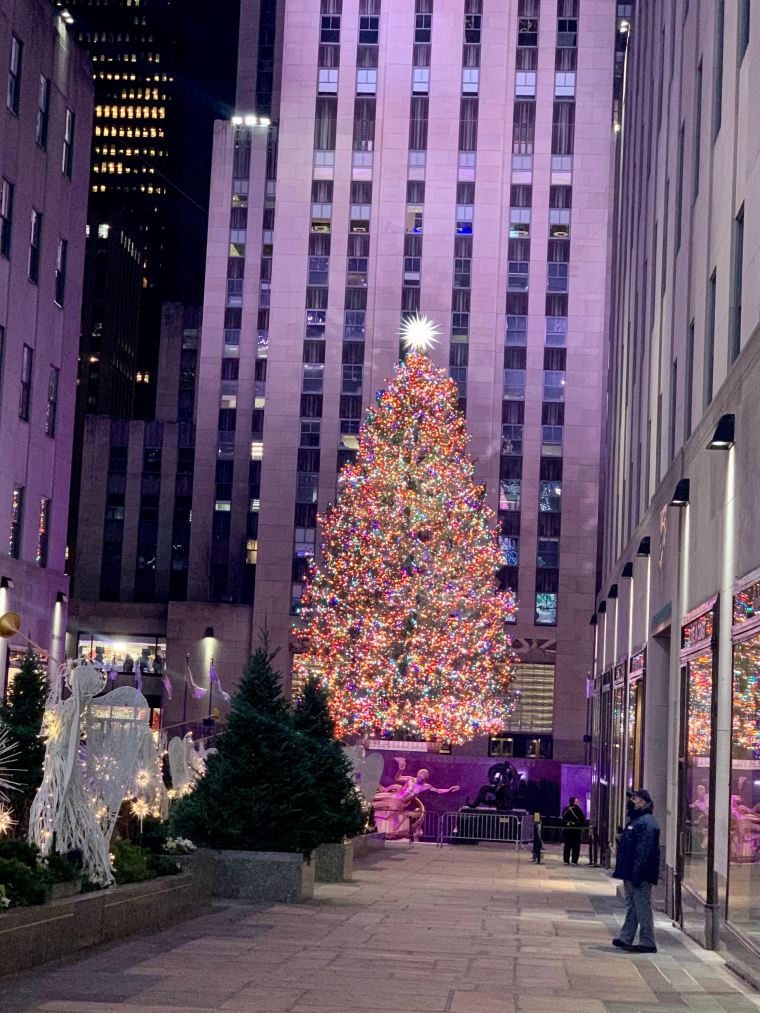
I was so relieved when I heard Rockefeller Center would have a tree again this year. They limited access so that crowds didn’t gather unsafely taking photos under the tree, but it was easy to see it from Fifth Avenue (actually easier than usual, with so few tourists here).
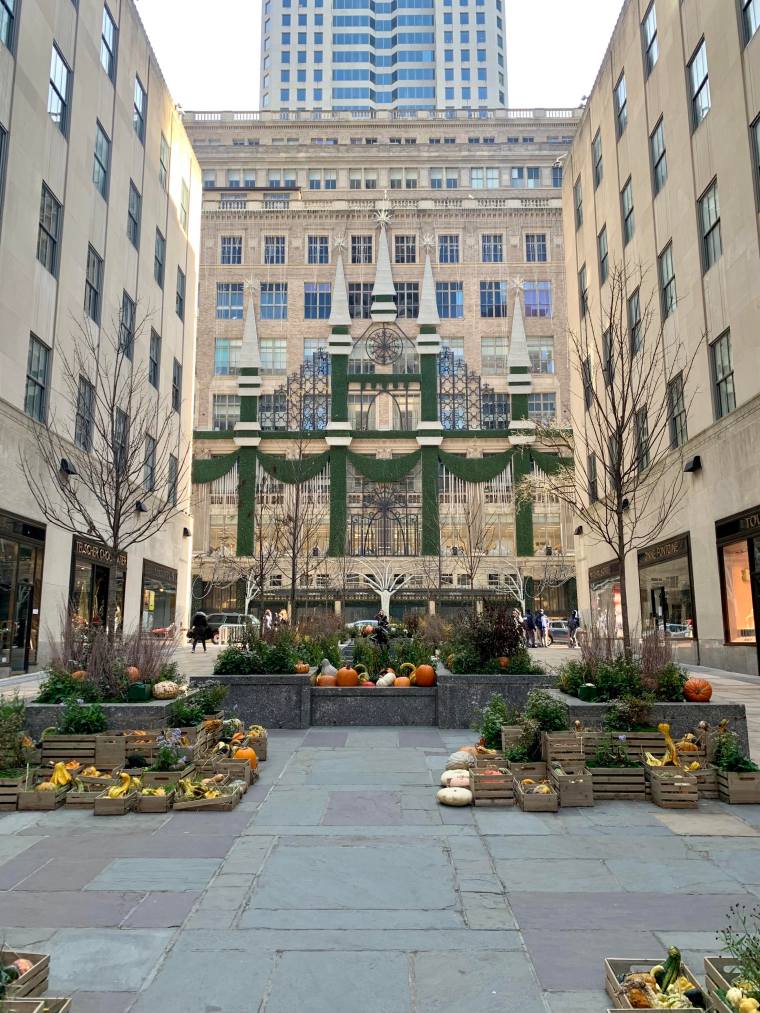
Similarly, it was great to see Saks continuing their tradition of decorating the facade of their building on Fifth Avenue (just across from the Rock Center tree) with a light/sound show every 15 minutes after dark. To see a video sample, check out my Instagram post here.
This display on Sixth Avenue is a favorite of mine. Again, if anything it is easier to appreciate this year with the crowds so light.
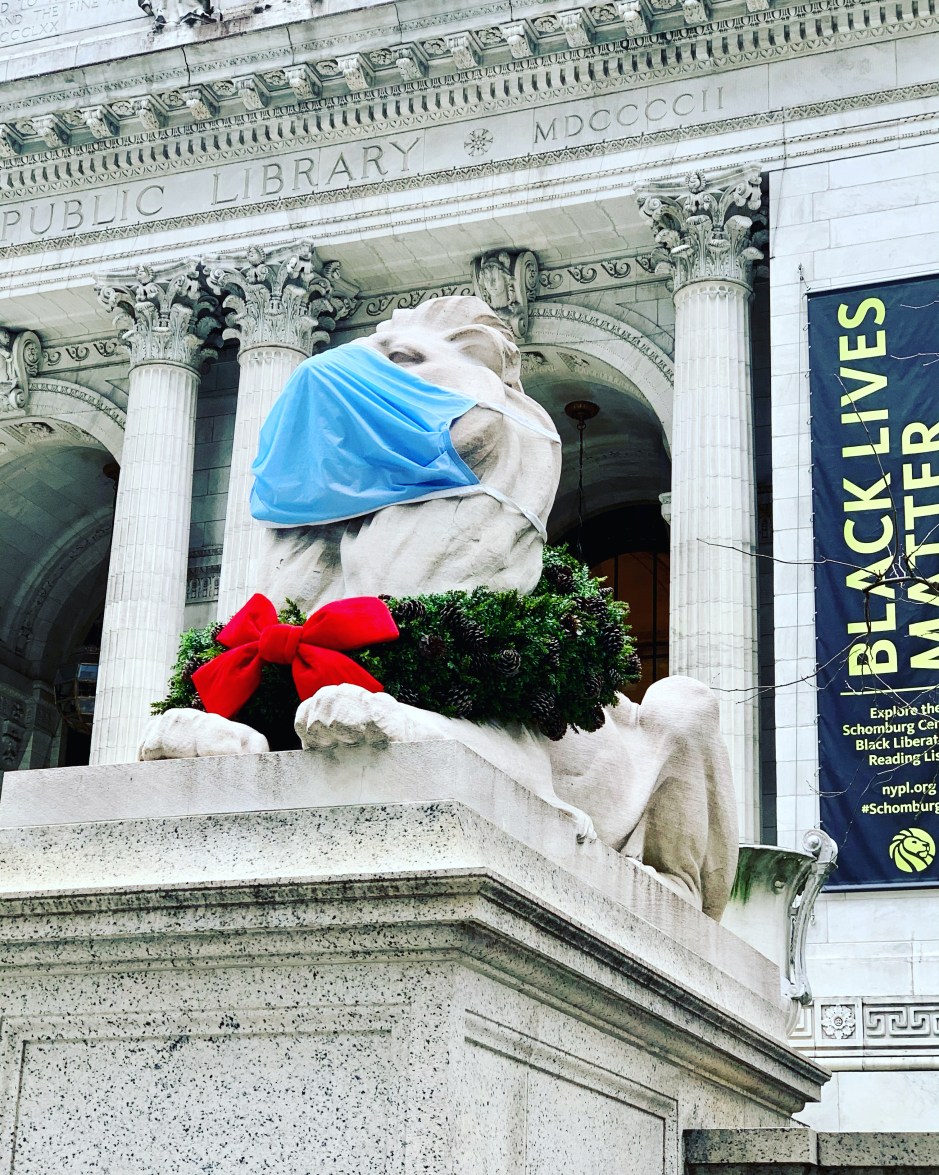
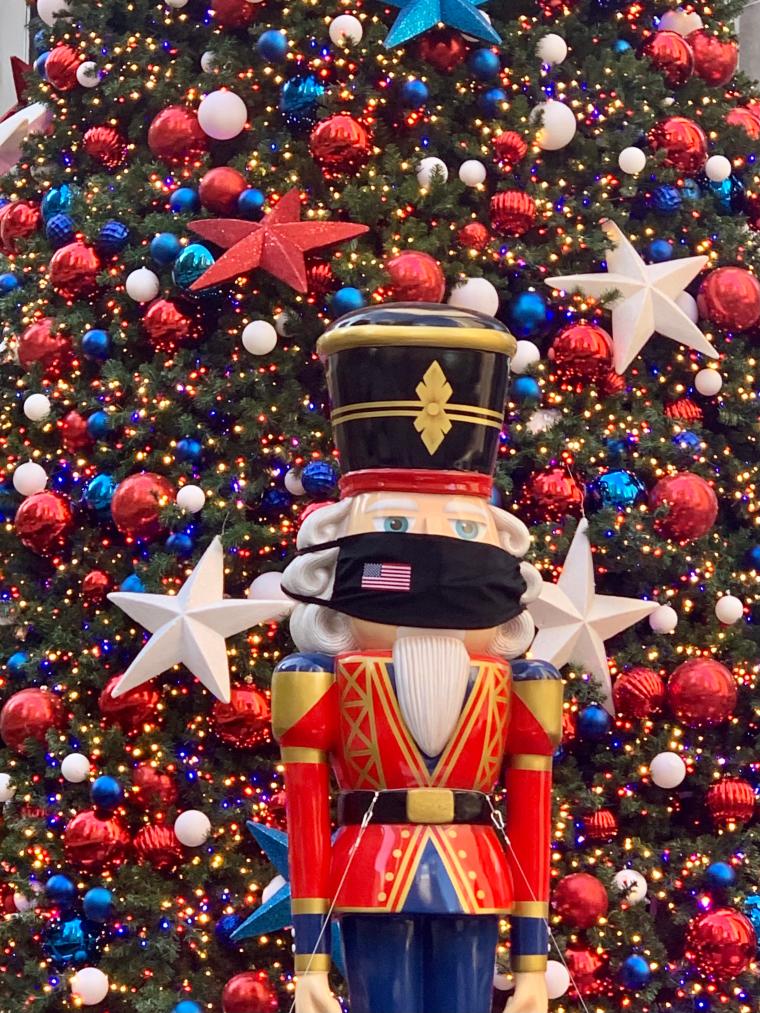
Many holiday displays this year managed to work proper modeling of mask wearing into their offerings, including the New York Public Library lions and this nutcracker on Sixth Avenue.
Walking along Fifth, you could mail a letter to Santa, or listen to holiday music played from the Cartier display.
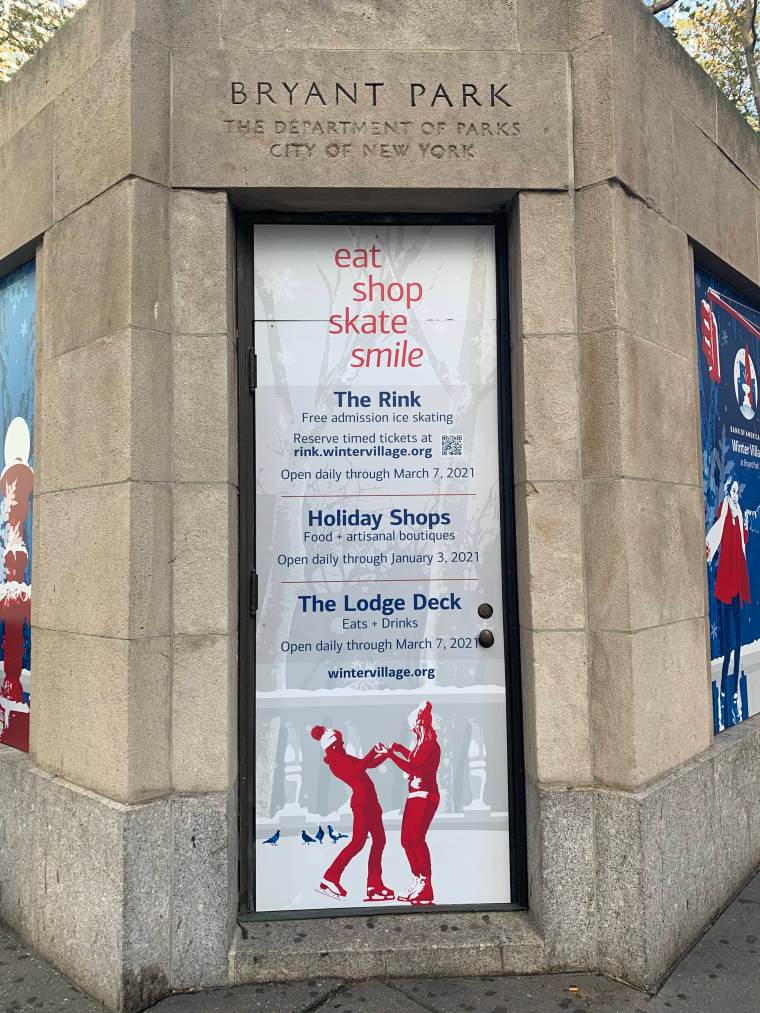
The Winter Village at Bryant Park and holiday market was back this year, just with more space between vendors and lighter crowds. Skating is going on as well, you can see a video of that here. To see this and many other holiday markets a few years ago, click here.
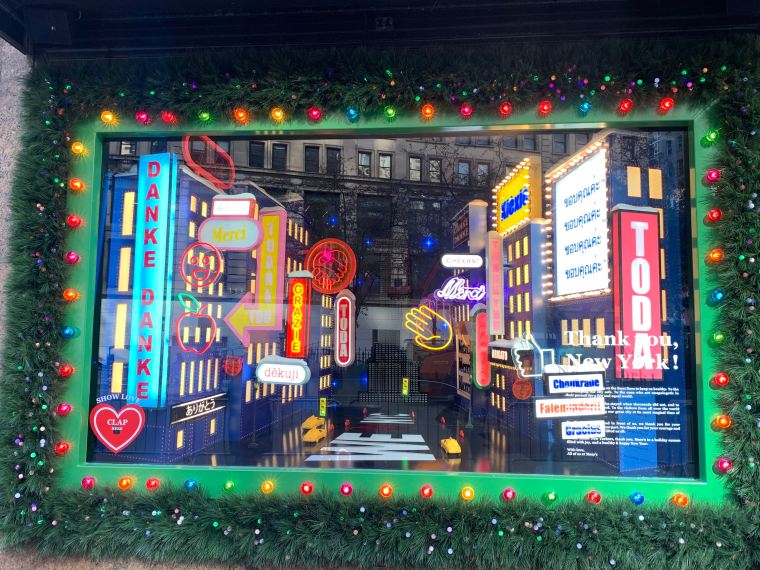
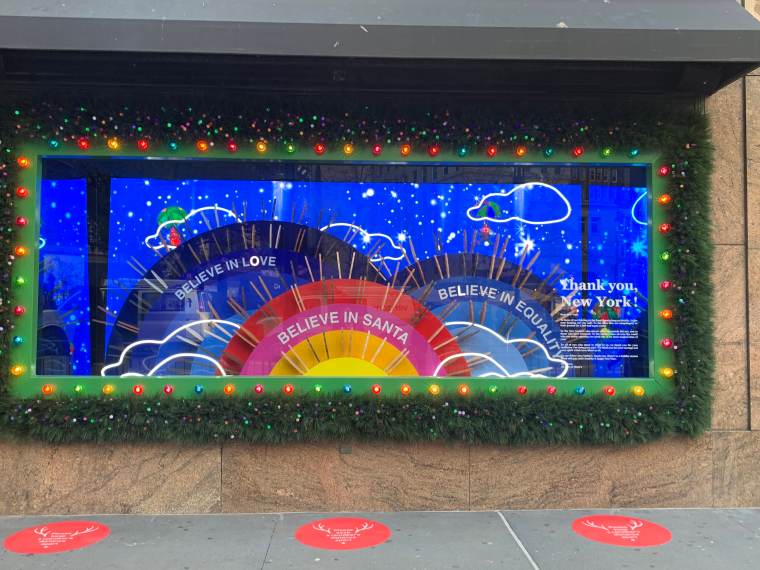
There was no Macy’s Thanksgiving Day parade winding through the streets of Manhattan this year, but the Macy’s windows remind us of the importance of gratitude this year – for our health care and essential workers (and for our health if we have been lucky enough to maintain it).
There’s nothing quite as magical as New York City at Christmas, and we needed that delight and joy more than ever this year.
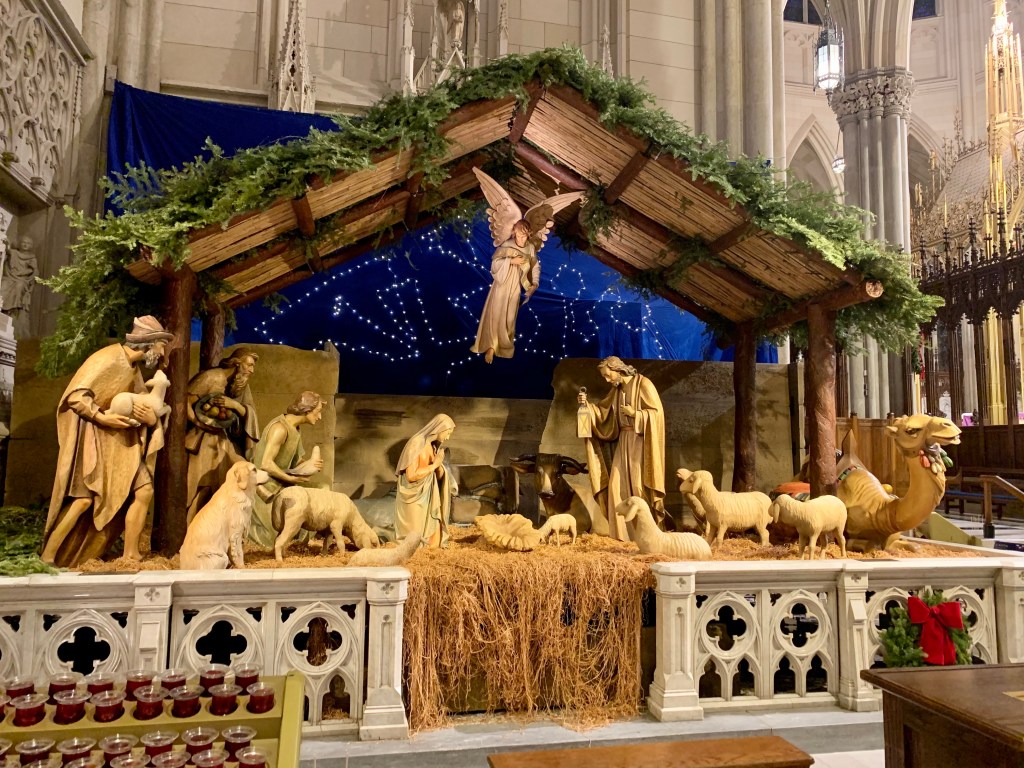
St. Patrick’s Cathedral was as majestic as ever this Christmas season.
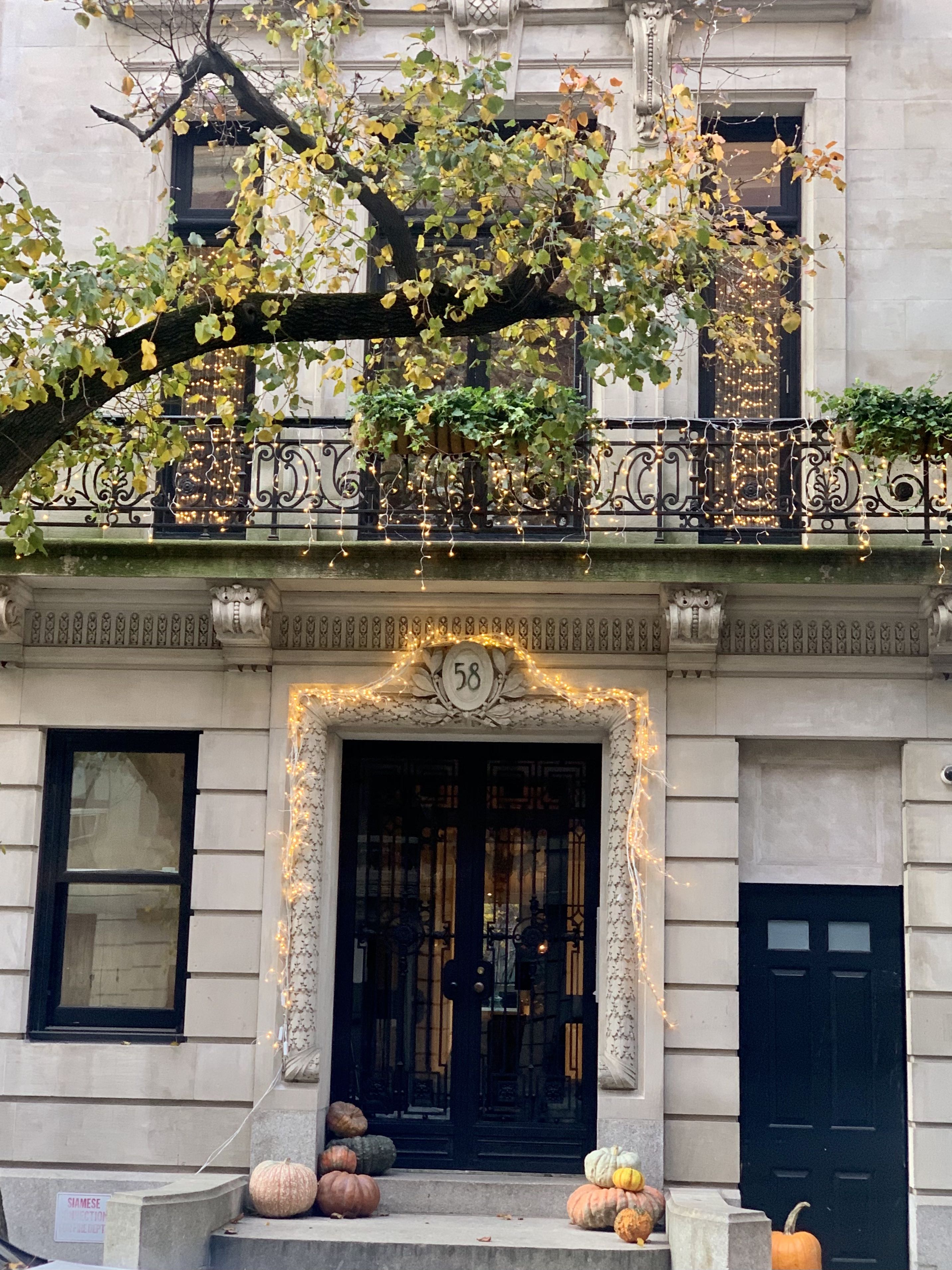
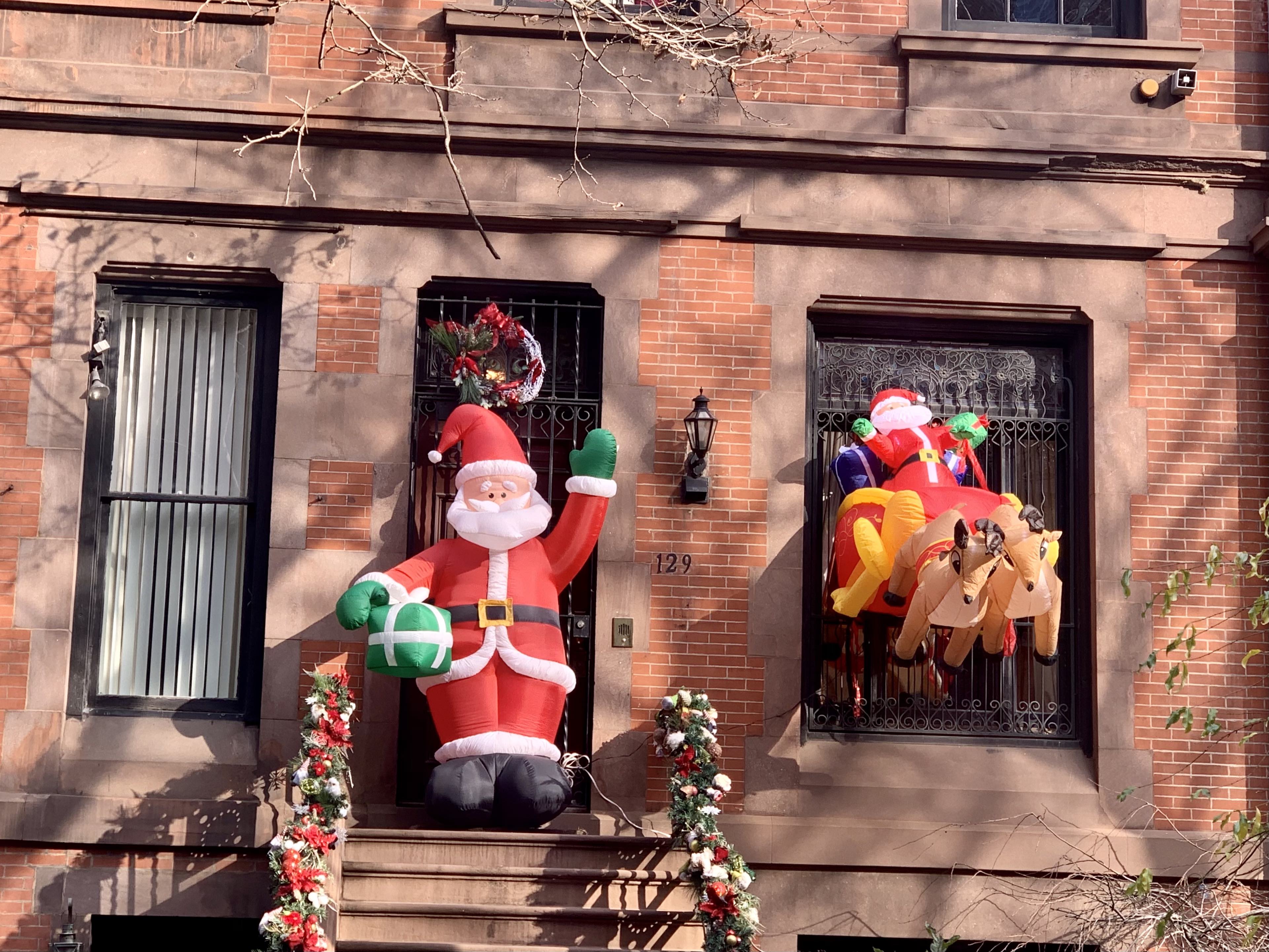
Once again, New Yorkers decorated their homes to celebrate this dark time of year – in a very dark year – with light, humor, and bright color. To see a previous blog post about residential holiday decorations, click here.
So the dropping of the Times Square ball will be televised this December 31, but will occur in an empty area gated to prevent people from gathering. Regardless, the rejoicing that will ensue as we welcome in 2021 will not be lessened in any way by celebrating at home. As I wrote on the piece of confetti that will fall as 2021 arrives in NYC, I have tremendous hope for health, love and prosperity in this new year ahead.
One of the things I have done during this strange year of pandemic and lockdown has been to really get to know Hudson River Park (and I do plan a blog post on it soon). Although I have always explored Central Park – and it’s magnificent, no one can deny – during lockdown I began riding a bike (yet another planned post) and soon discovered my favorite thing was to use the dedicated bike lanes along the Hudson River, then explore the park on foot. On September 30, 2020, a new section of the park at Pier 26 opened, dedicated to the exploration of our waterfront’s ecology. Having visited it, I can say that it is a unique and very worthwhile addition to New York City’s incomparable parks.
Pier 26 juts out from West Street on the far side of Tribeca, roughly between Hubert and N. Moore Streets. It is just north of Pier 25 and behind City Vineyard restaurant and wine bar (more about that later!). Also in the old section of Pier 26 is the location for free kayaking (temporarily halted during pandemic, but keep it in mind for the future) and two dog runs.
The park is organized so that you experience different native ecological environments – woodland forests, coastal grasslands, maritime scrub, rocky tidal zone and the Hudson River itself. However, you could not even know that this was the purpose of the park and just enjoy the multiple places to relax, and the spectacular views.
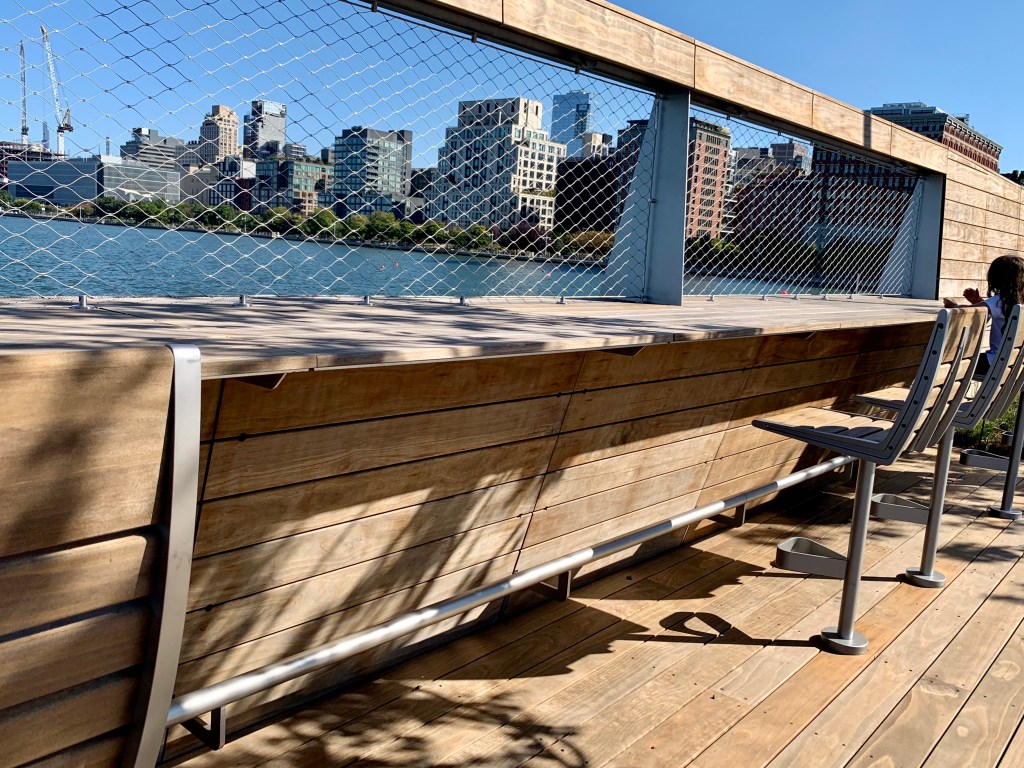
This part has a really unique variety of places to sit and relax – loungers, workspaces with a bar to place your laptop or food on while sitting at barstools, and even BENCH SWINGS.
As the pier reaches out to its westernmost point, you can see the lower section leading to the tide deck and the Hudson River. This section isn’t open at all times, but in the future there will be periodic tours for the public. This tidal marsh was created with native grasses and shrubs, and is submerged at high tide and visible at low tide. The hope is that over time the pier will become home to native species. The rocky tidal marsh is visible at all times from the elevated platform above.
In addition to places to relax, and places to learn, there is a sports play area, a sunning lawn, and my favorite – lovely walking paths. At. the end of the pier, you have the choice of looking south to the Statue of Liberty, or east toward the NYC skyline. You might see boats pass by, or jet skis.
With City Vineyard at the entry to the pier available for food and drink in the open air, it would be easy to spend a day at Pier 26. The wine garden and rooftop deck are both outside, and the deck has incredible views of New York Harbor. City Vineyard’s menu is locally sourced and inspired, and its wines are actually made in the city with grapes from some of the finest vineyards in the world.
While 2020 has been a very difficult year to be sure, one silver lining has been that we have learned to explore and appreciate what we can do outdoors. When walking the Hudson River Park, I have seen toddler movement and music classes, yoga classes, and personal training in progress outside. The bike paths are crowded with scooters, skateboards, and skaters as well as bicyclists. Parks host joggers, walkers, and babies being pushed in strollers. This turns out to be the perfect time for this new park to be unveiled, its importance now – not only as a refuge for New Yorkers escaping a pandemic but also for a reminder of what we need to do to heal our broken planet – unimaginable when planned in the early 2000s.
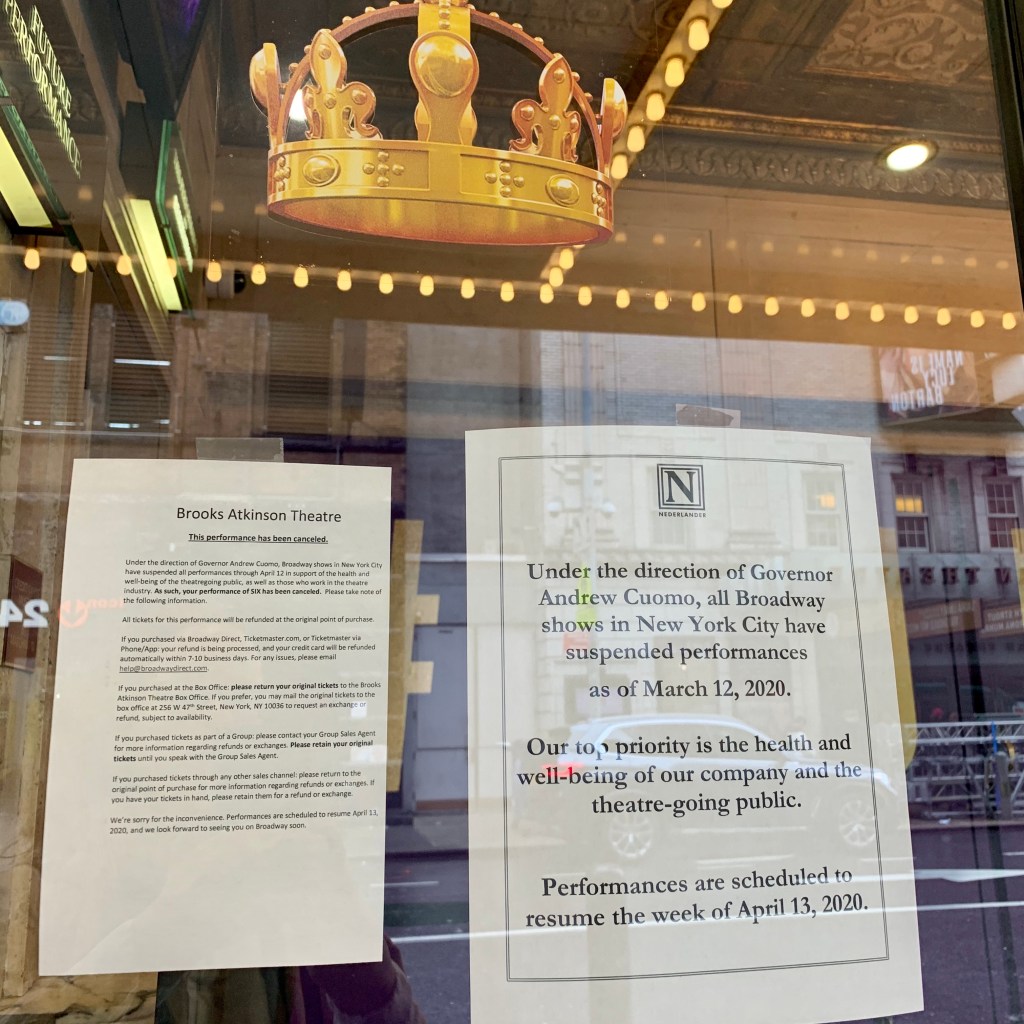
January and February of 2020 were just another winter in NYC: cold, punctuated with occasional extreme cold, but not that much snow this year. I showed apartments, went to sales meetings and my office, and enjoyed the city as I always did: experiencing the performing arts multiple times per week, trying out bumper cars on ice at Bryant Park, and a public art installation just south of Times Square that involved giant seesaws in the middle of Broadway. There were reports on the news of a new virus in Wuhan, China. By the first week of March the alarms were beginning to sound louder. On March 6 (two days after I enjoyed a preview performance of Company with Patti Lupone), Compass, where I am an Associate Broker, suggested that agents work from home when possible. On March 7 I attended an all-day board retreat at the Larchmont Yacht Club, where one topic of conversation was contingency plans around the virus. Just a few days later, Thursday, March 12, Broadway and all performing arts in NYC were shut down for a month “resuming the week of April 13.”
March 13, 2020 – a day after all Broadway performances were shut down immediately
By March 16, NY Governor Andrew Cuomo had placed our state on “pause.” Real estate showings were not allowed, and everything was shut down except for grocery stores, pharmacies, and other essential businesses (which included bike and liquor stores). People were encouraged to stay home at all times except for getting essential items like food, or for exercise outdoors.
The city quickly became a ghost of itself. Many who had another place to go left the city, and the rest of us spent most of our time inside our apartments. We all began to hear of friends who were sick, or even very sick.
As March crept into April, it became clear that we were far from the peak of infection, despite weeks of lockdown. As we headed toward the second week of April, when we did hit our peak, most of us learned that someone we knew had died, or was close to it.
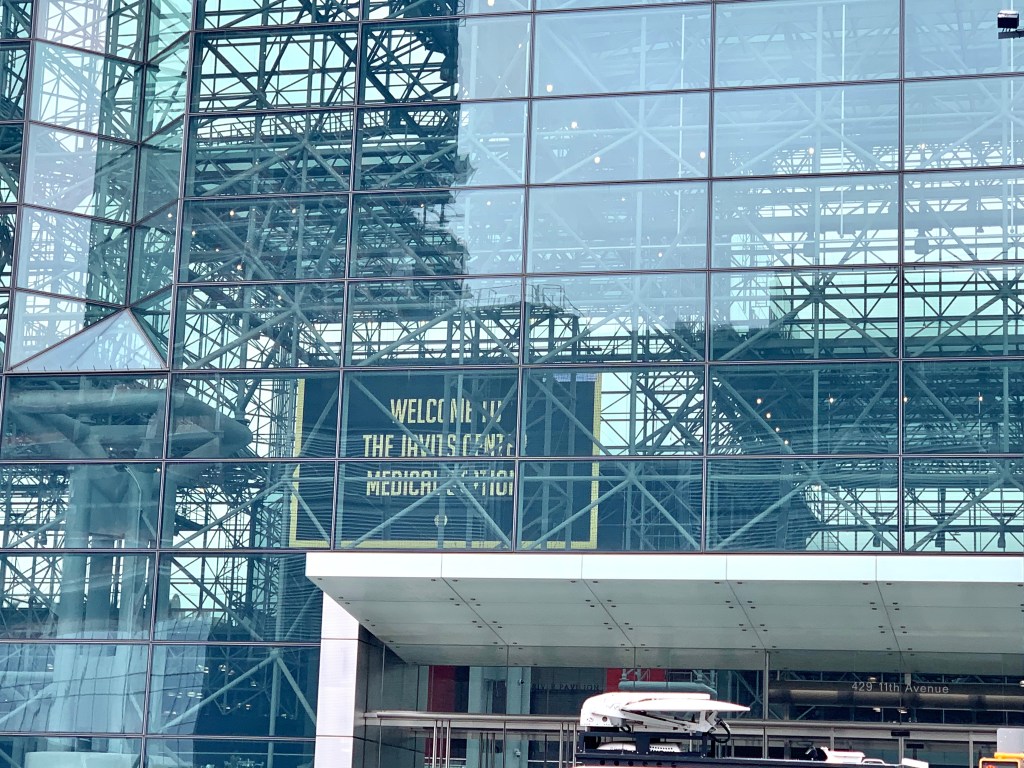
In April, we began to see refrigerated trucks outside hospitals. The US Comfort docked a few blocks from my apartment, and the Javits Convention Center was set up for hospital overflow (although neither of these turned out to be heavily used). There were hospital tents in Central Park across from Mount Sinai Medical Center.
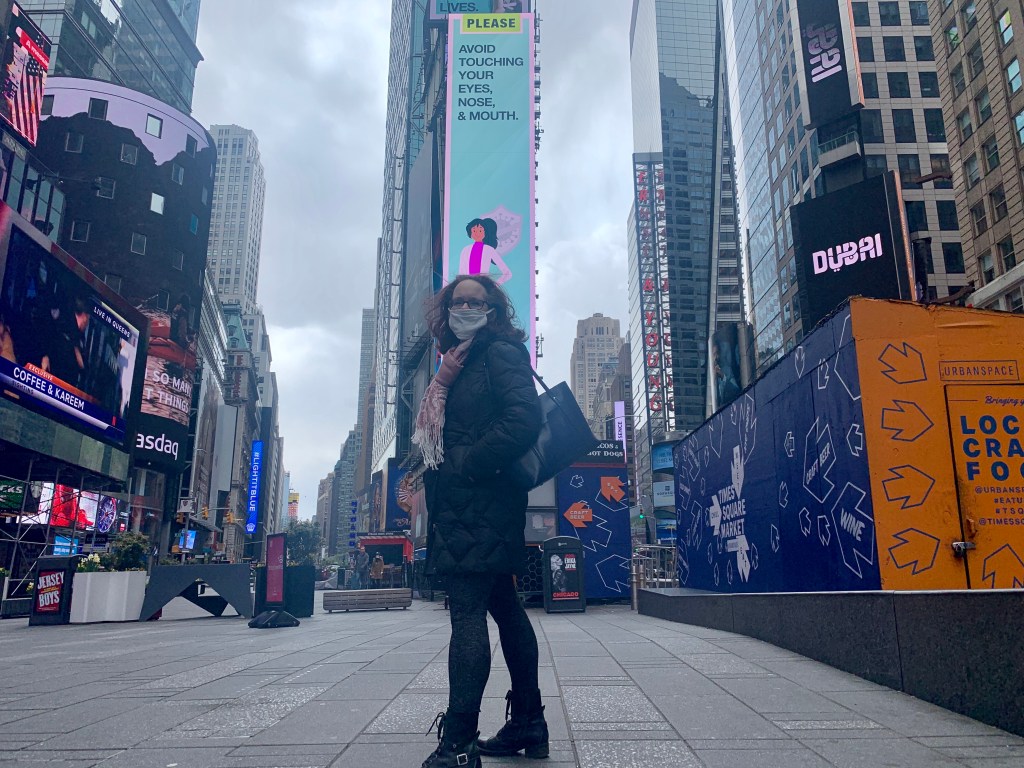
At first we were advised not to wear masks; but then we were. This is the way science works with a new phenomenon: educated guesses are made until more data come in that suggest alternate approaches. Going out for a walk every day for exercise and fresh air was eerie at times. Where were all the people? To stand in Times Square in the middle of the day and have no one else in your photos was previously not something I could have even imagined.
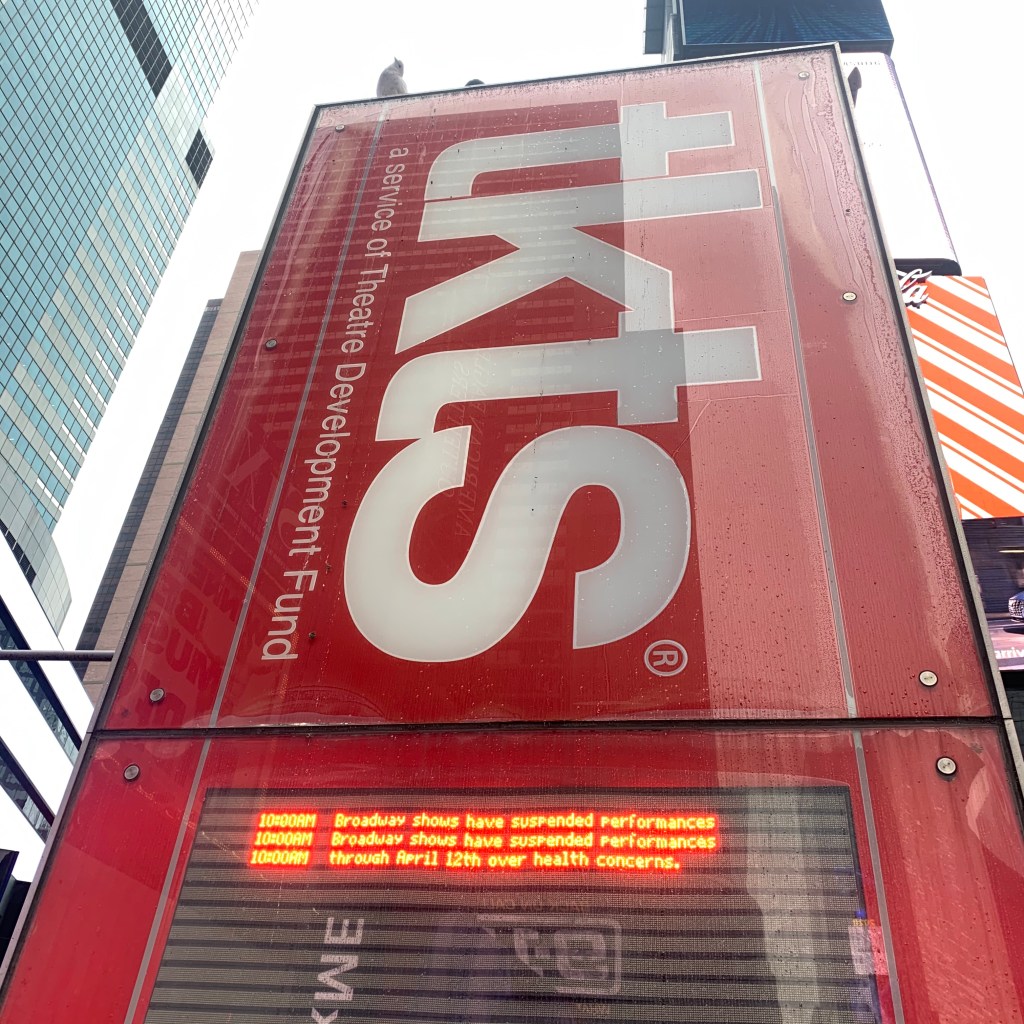
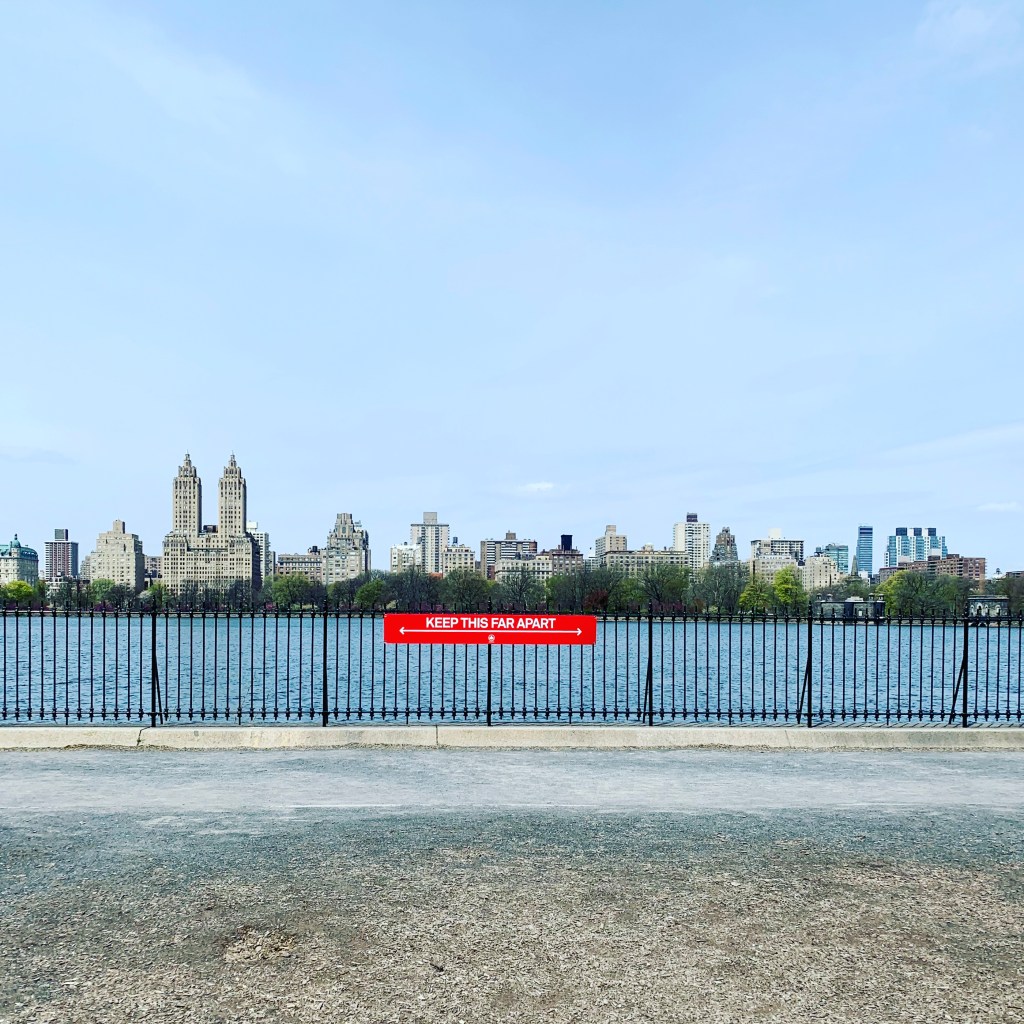
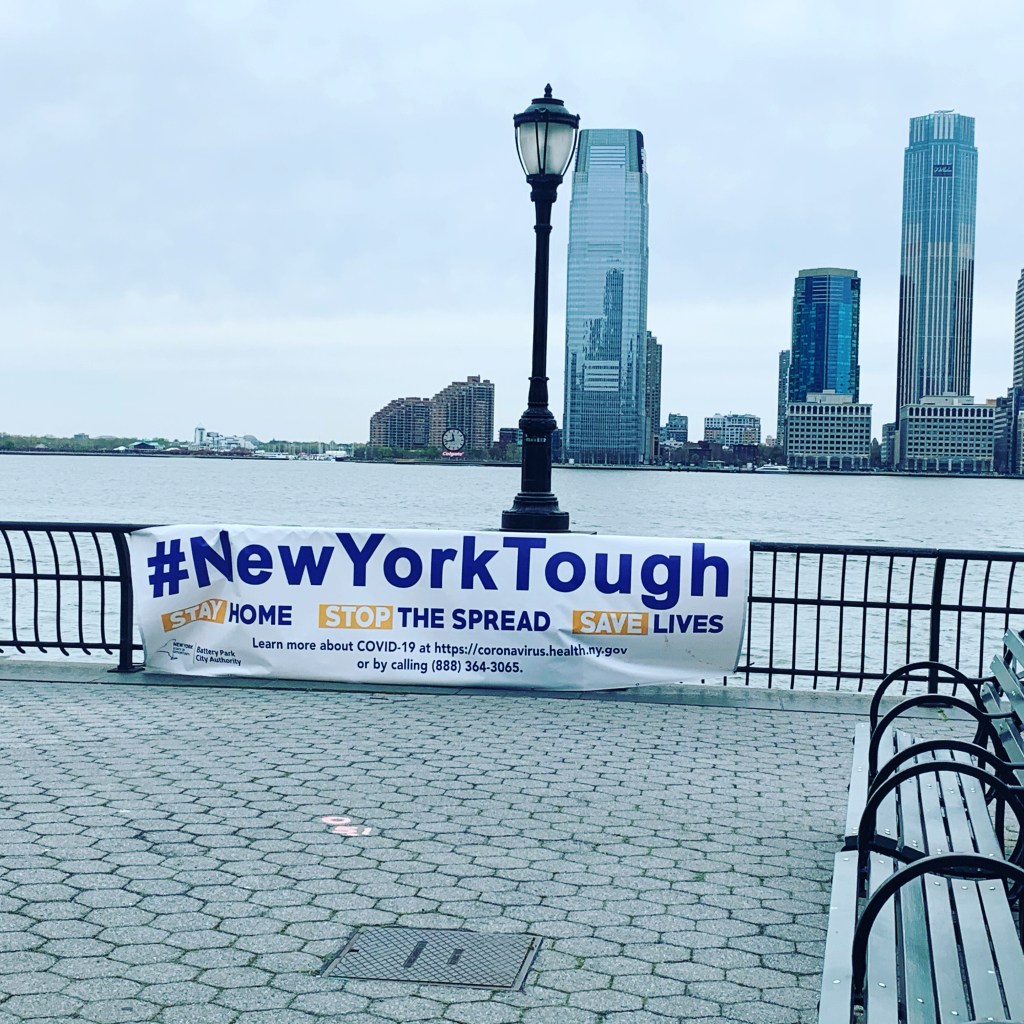
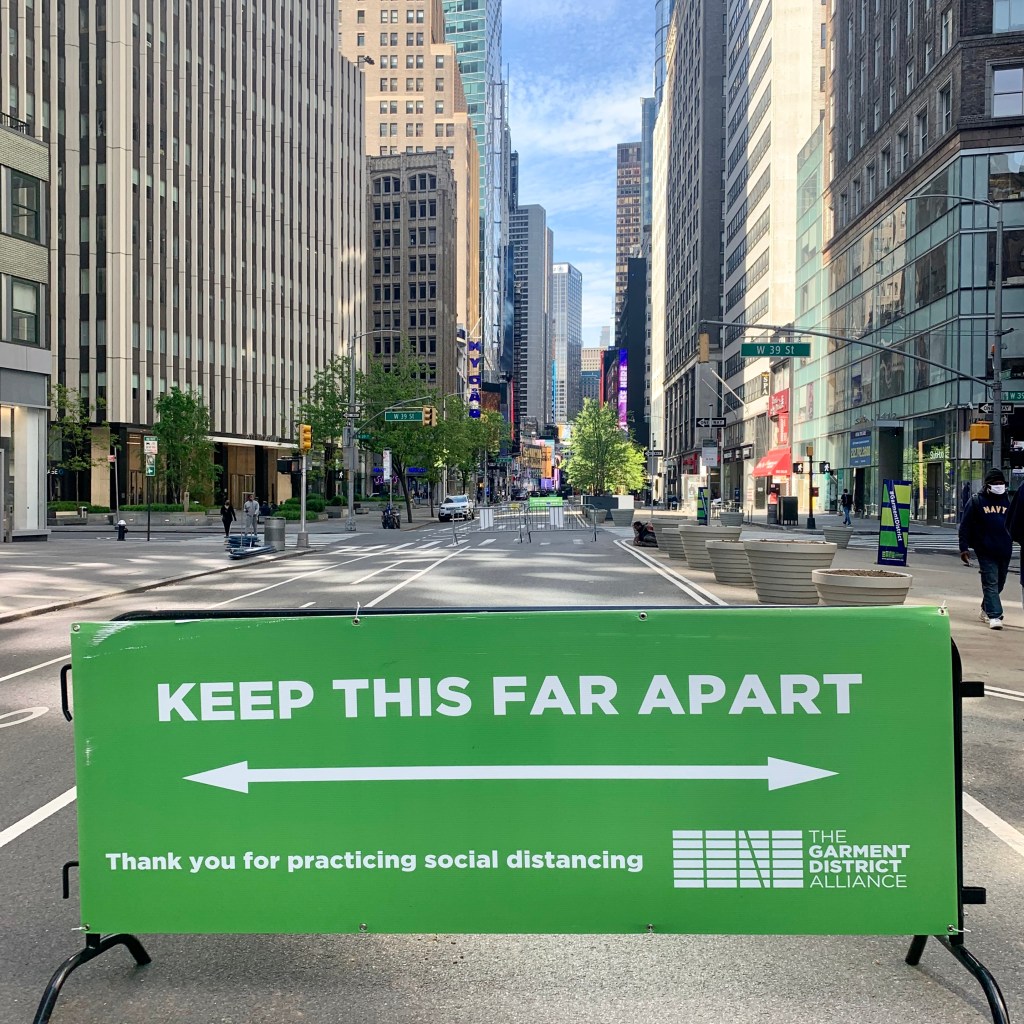
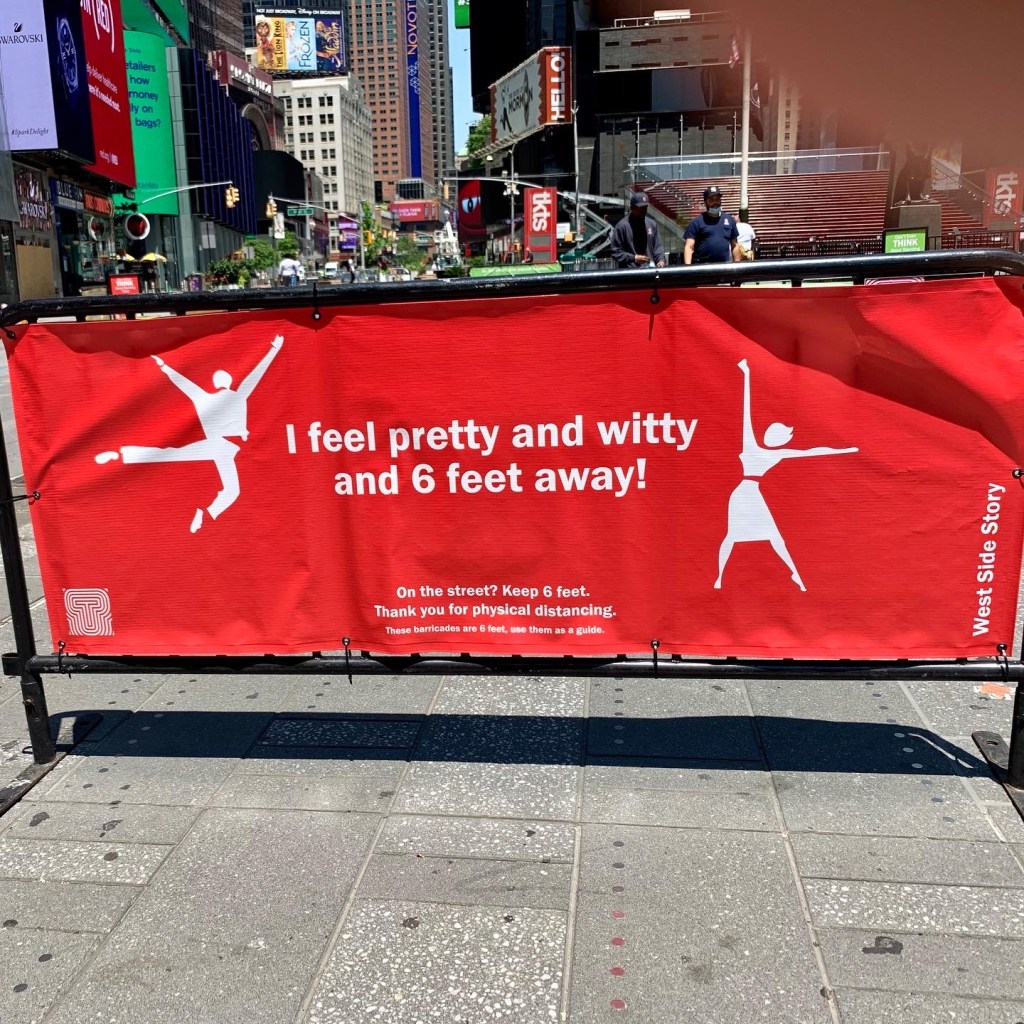
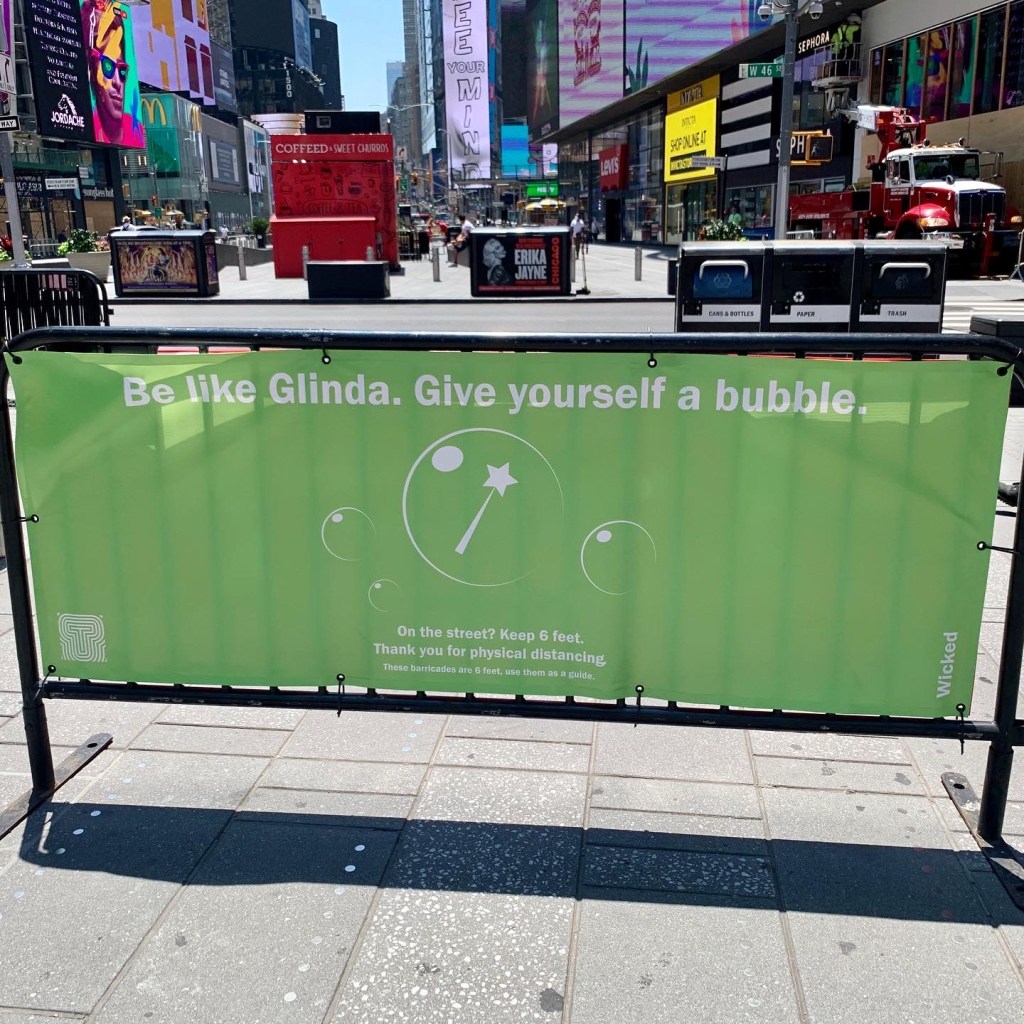
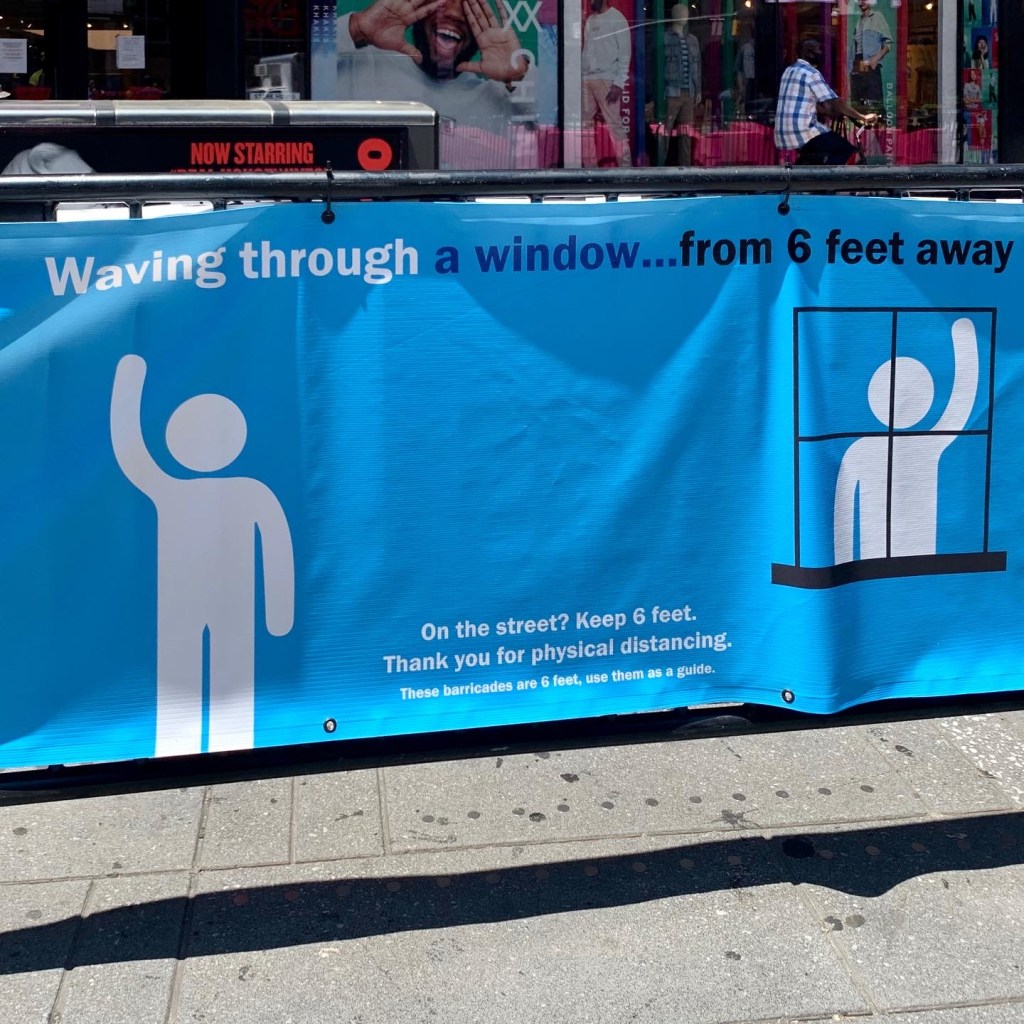
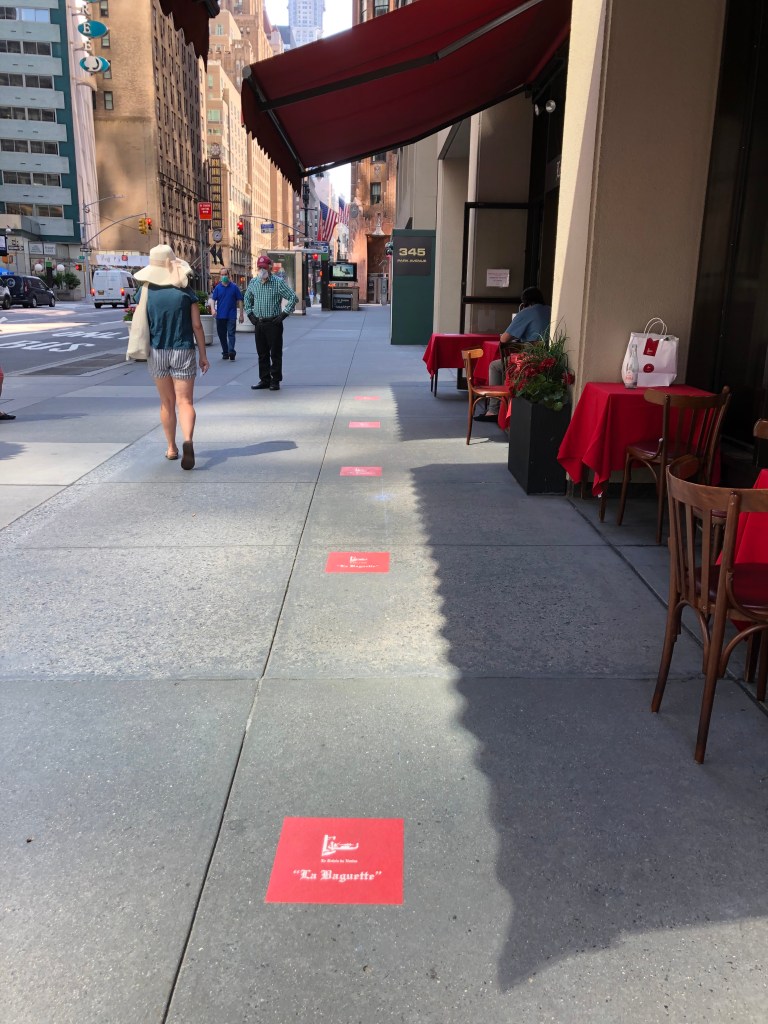
As April came to a close, it became clear that what we were doing – isolating, distancing, wearing masks – was working and our numbers began to improve. Signs began to appear everywhere showing what 6 feet of distance looked like, and reminding us that we are “New York Tough.”
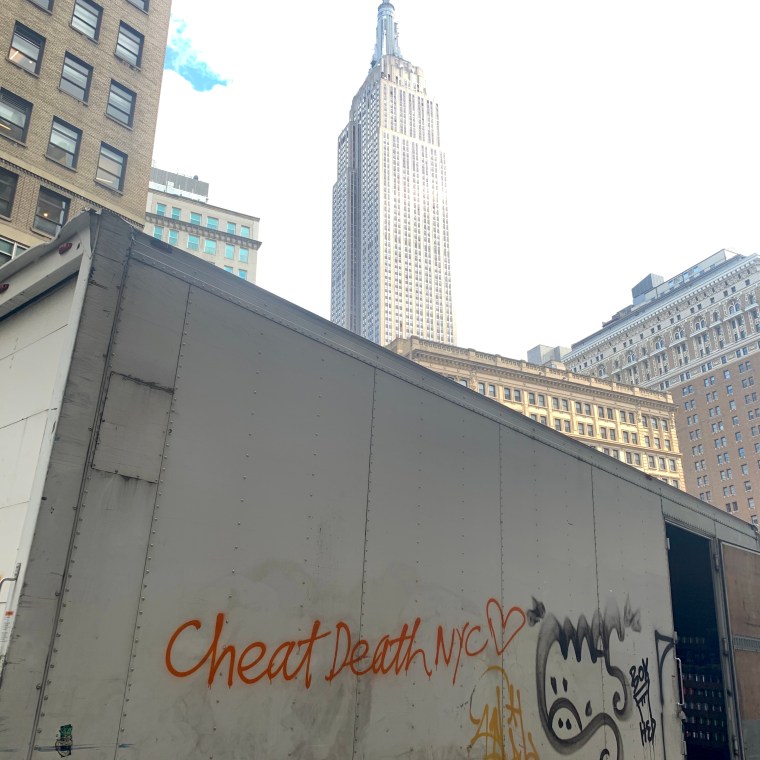
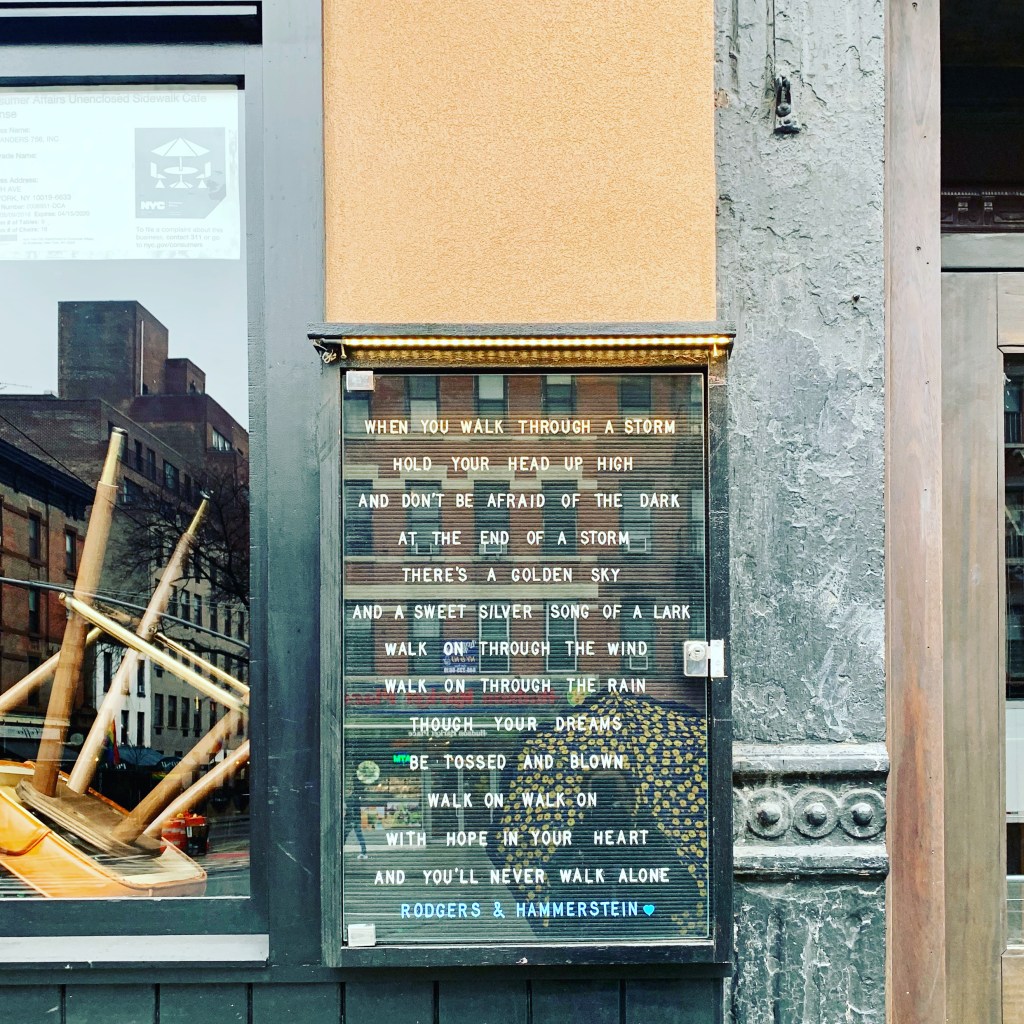
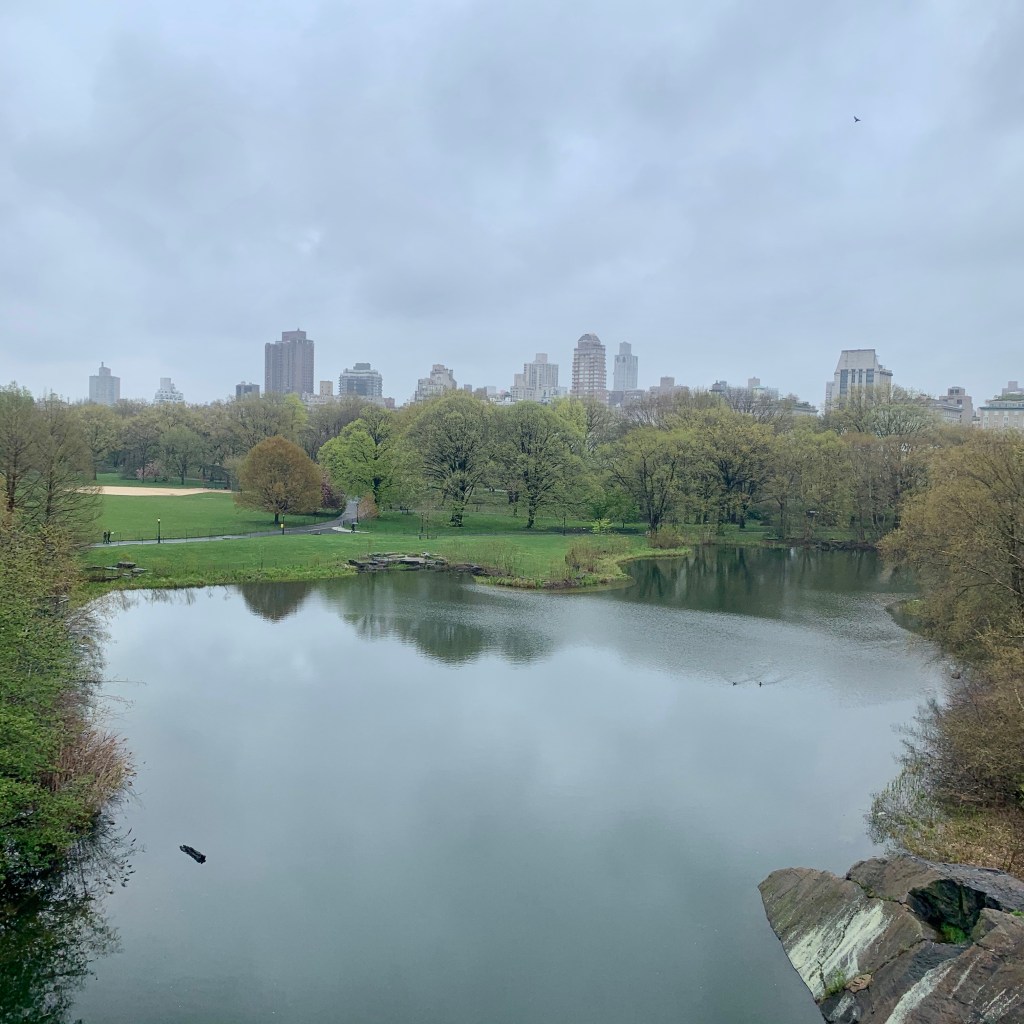
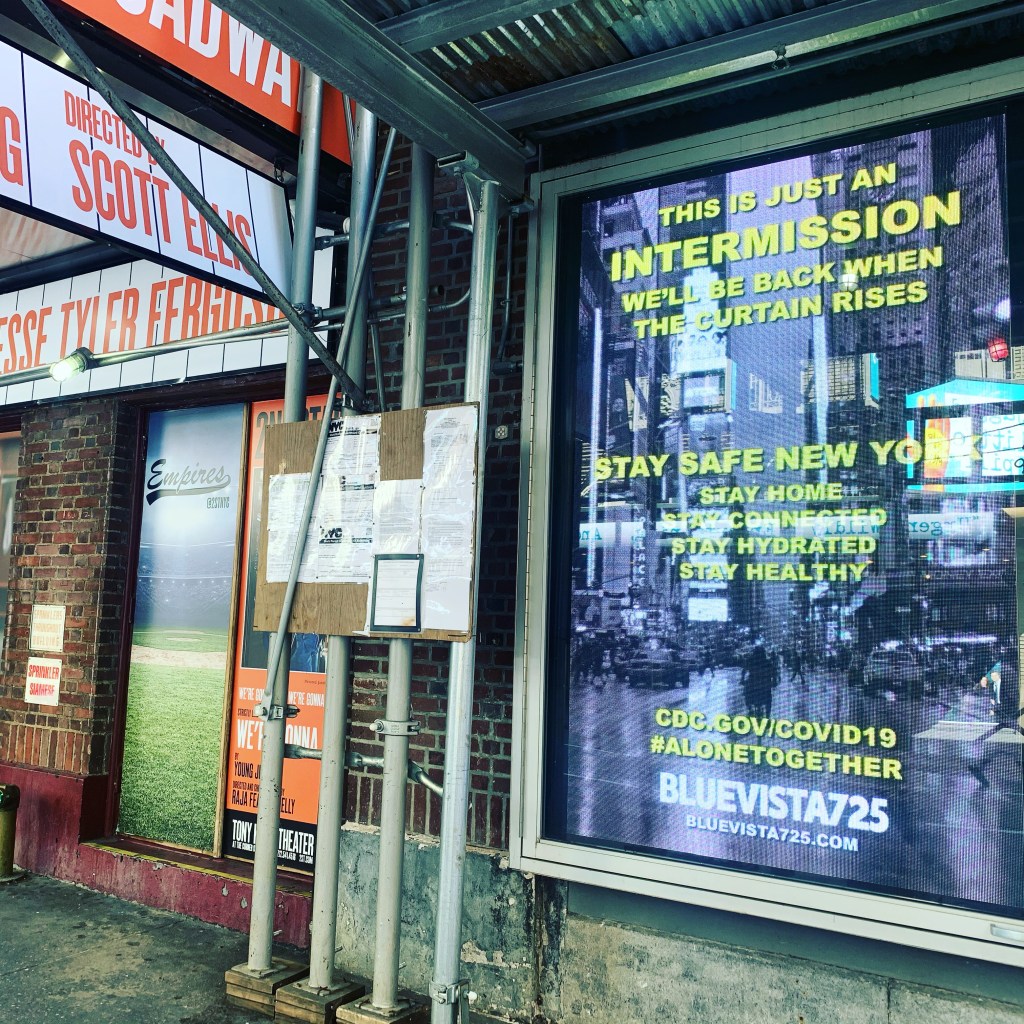
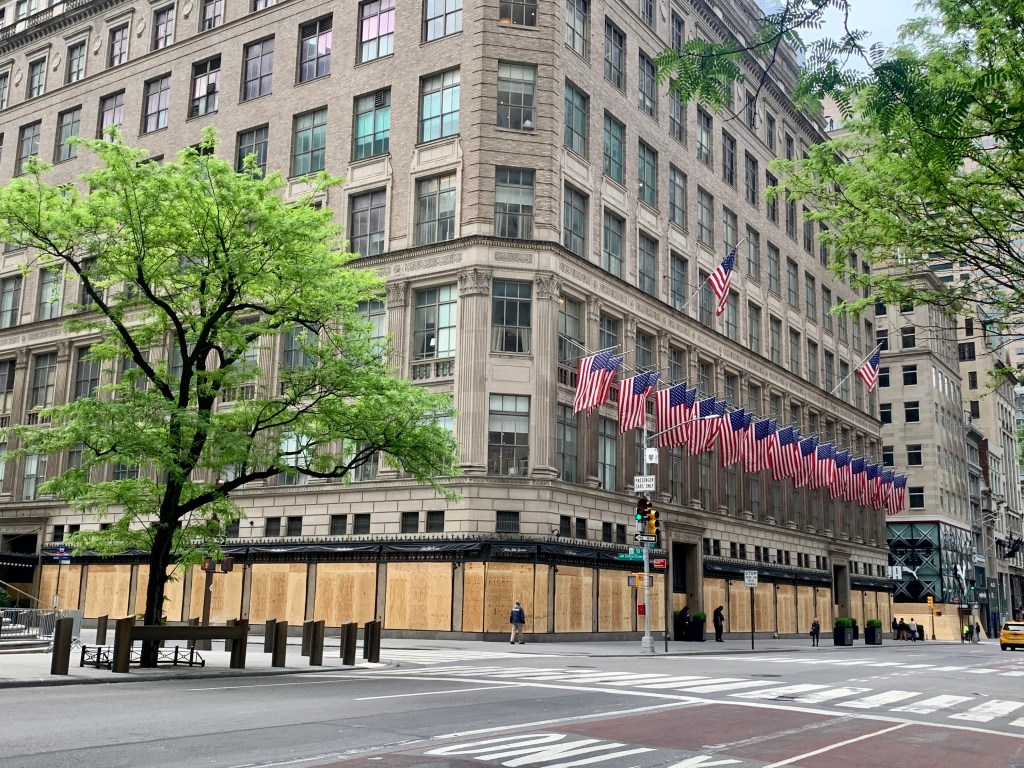
An empty Central Park, sign in the Theatre District, Broadway blocked off for pedestrians, mask reminder
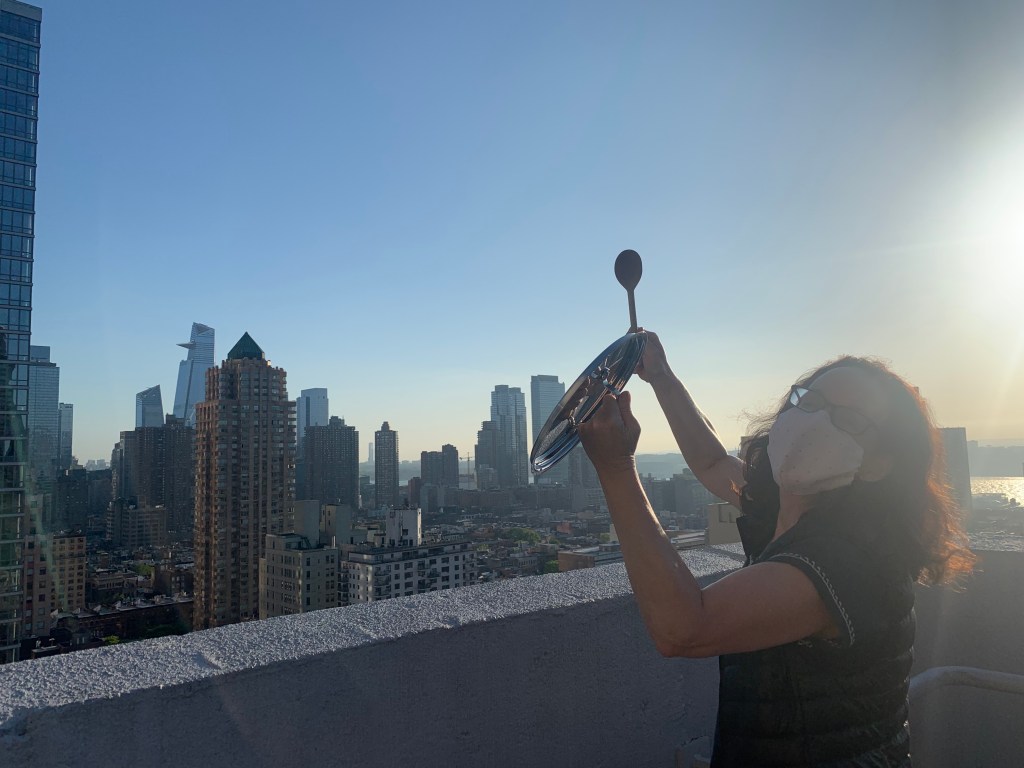
Meanwhile, the entire city seemed to lean out of their windows, go up to their roofs, or out to their balconies or terraces, to applaud and make noise to thank the essential workers every evening at 7PM. It was incredibly touching that so many people did this, night after night, and it also served as a way to feel less isolated. As we applauded with others, we also signaled to each other “I’m still here, and I’m glad you’re still here, too.”
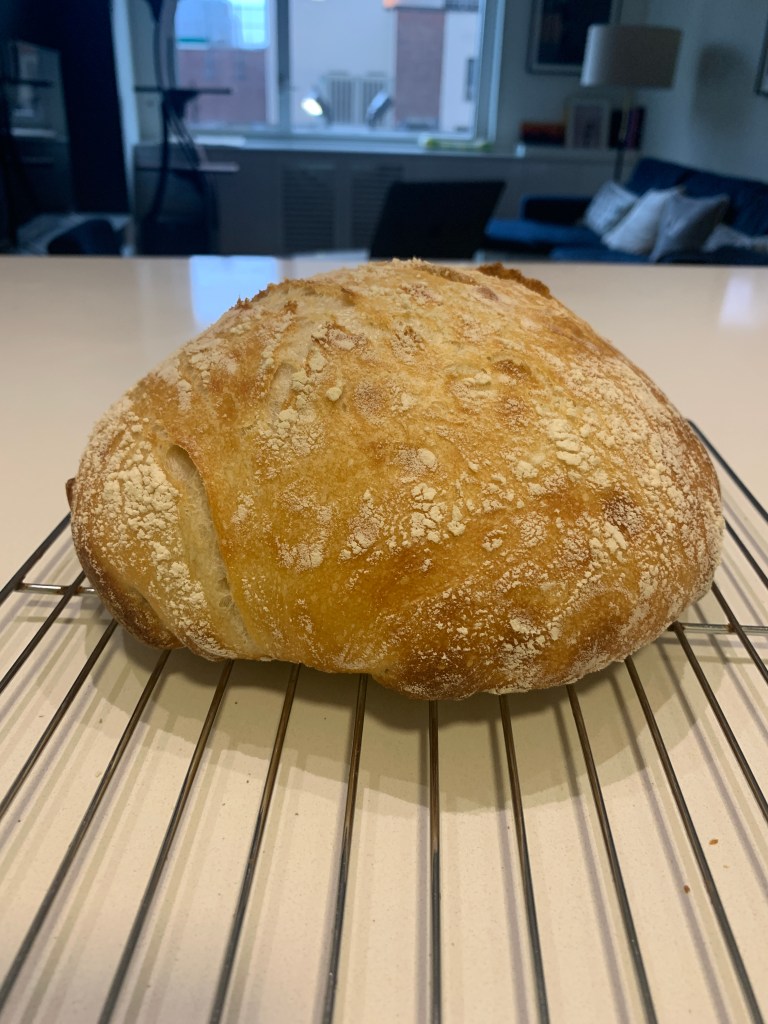
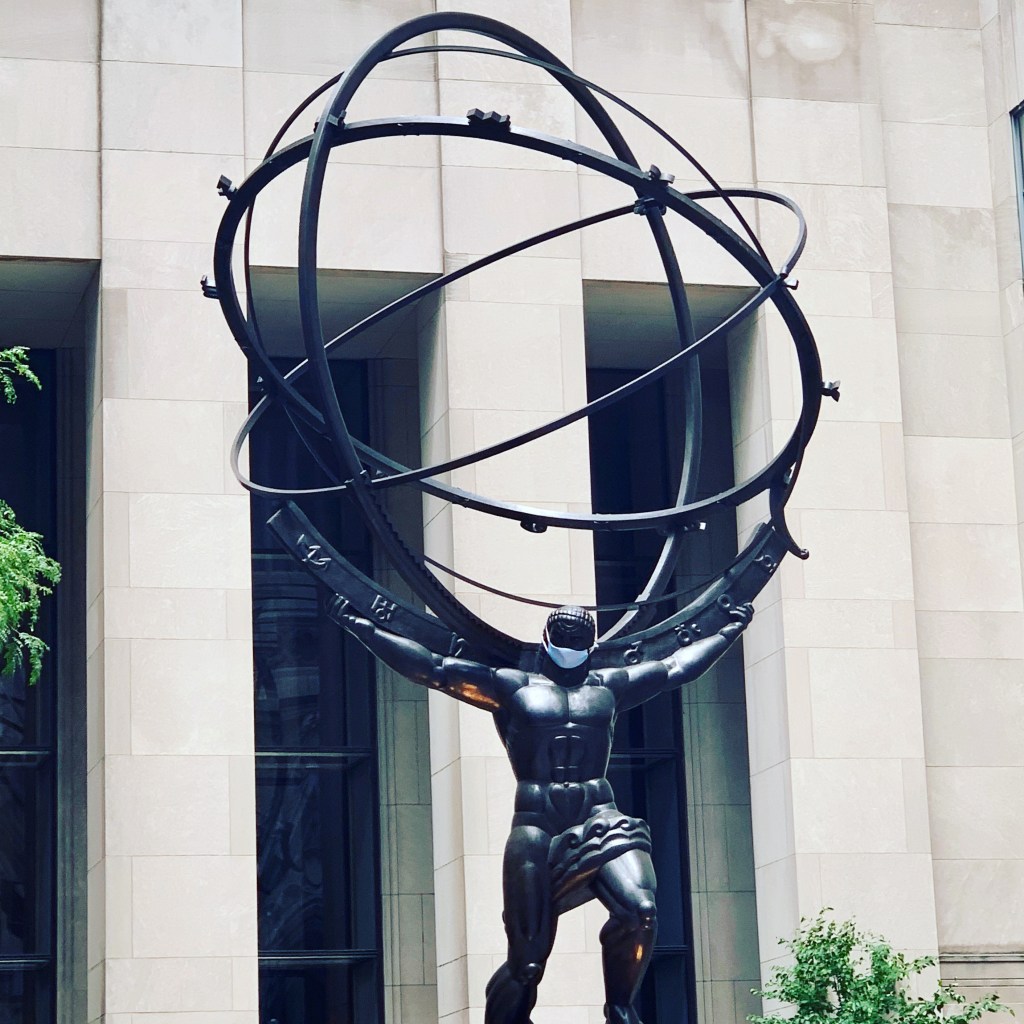
Homemade bread, a sign in a grocery window, a thank you display outside Mount SinaiAs time went on, masks appeared on statues around the city
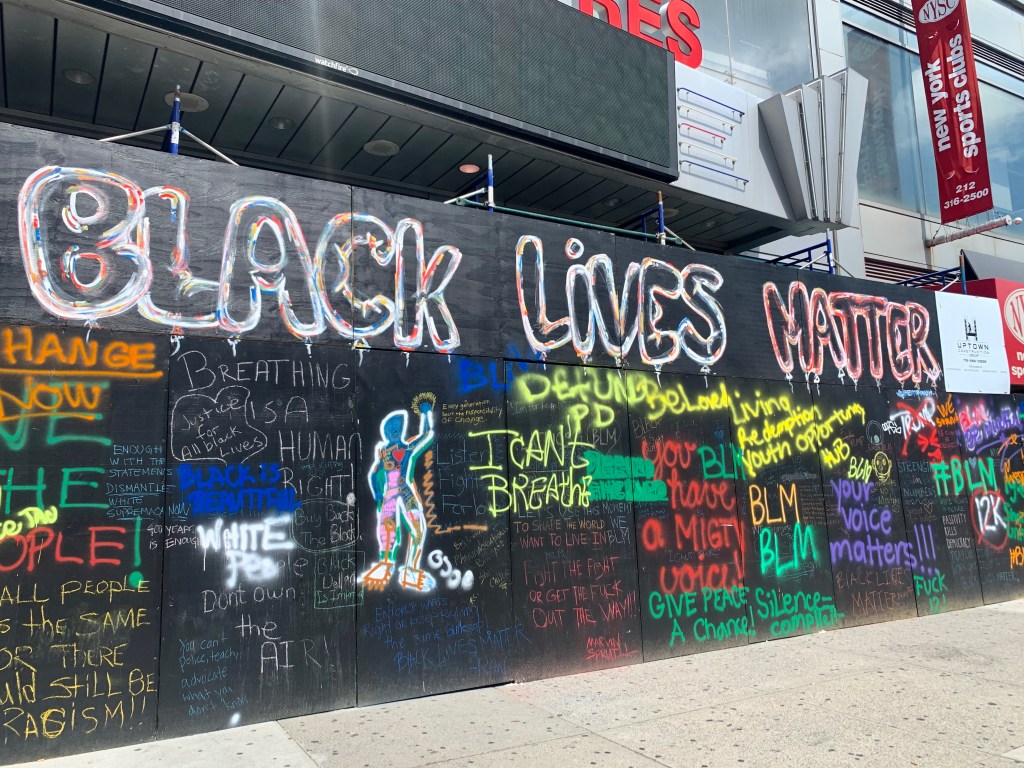
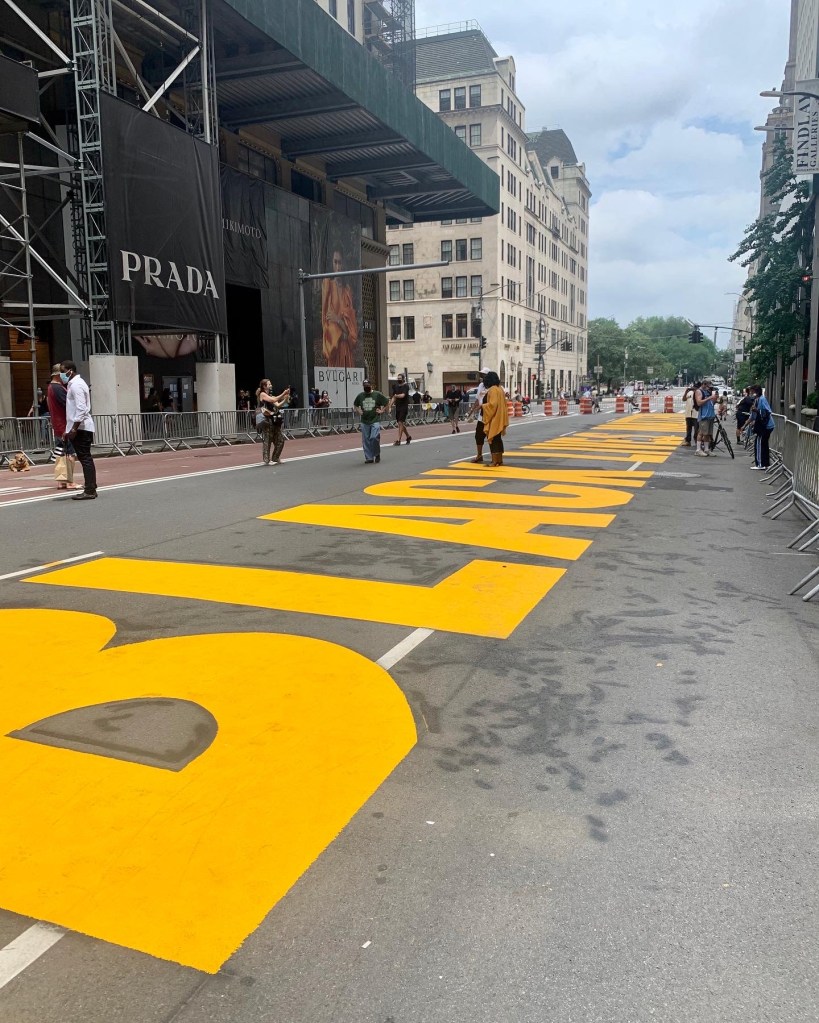
As May turned toward June, our numbers were under control enough that we began hearing about the future of phased reopening. Simultaneously, protests over the death of George Floyd swept the city. Although the vast majority of these were peaceful, some of the unrest led to the city having a curfew for several nights.
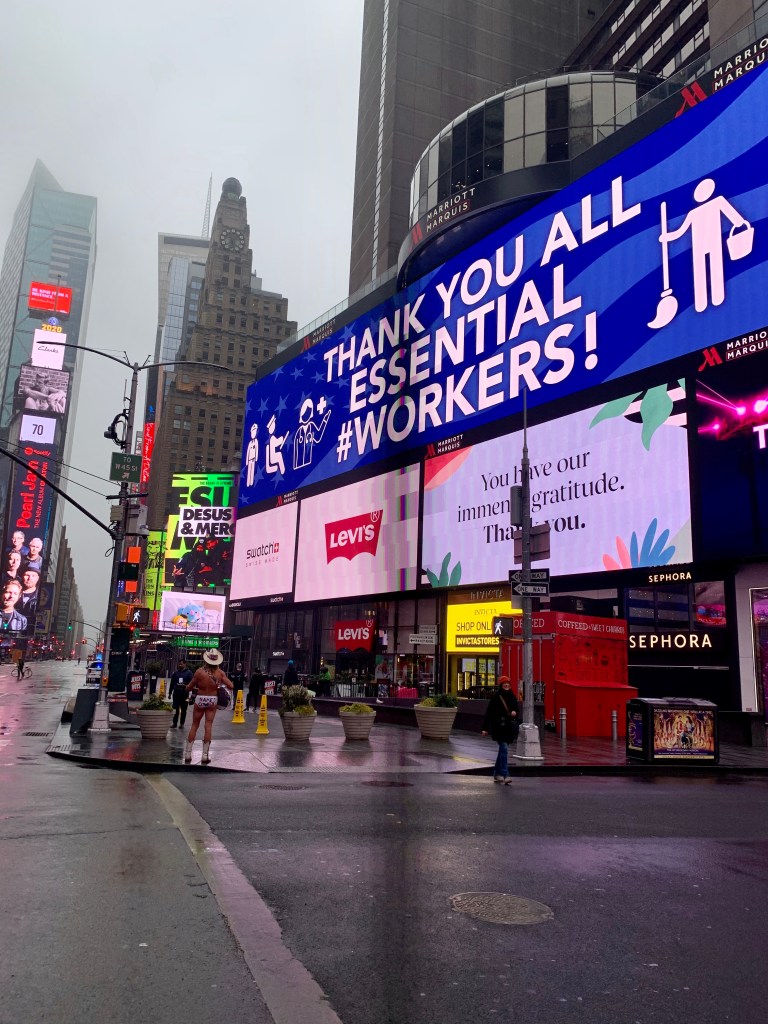
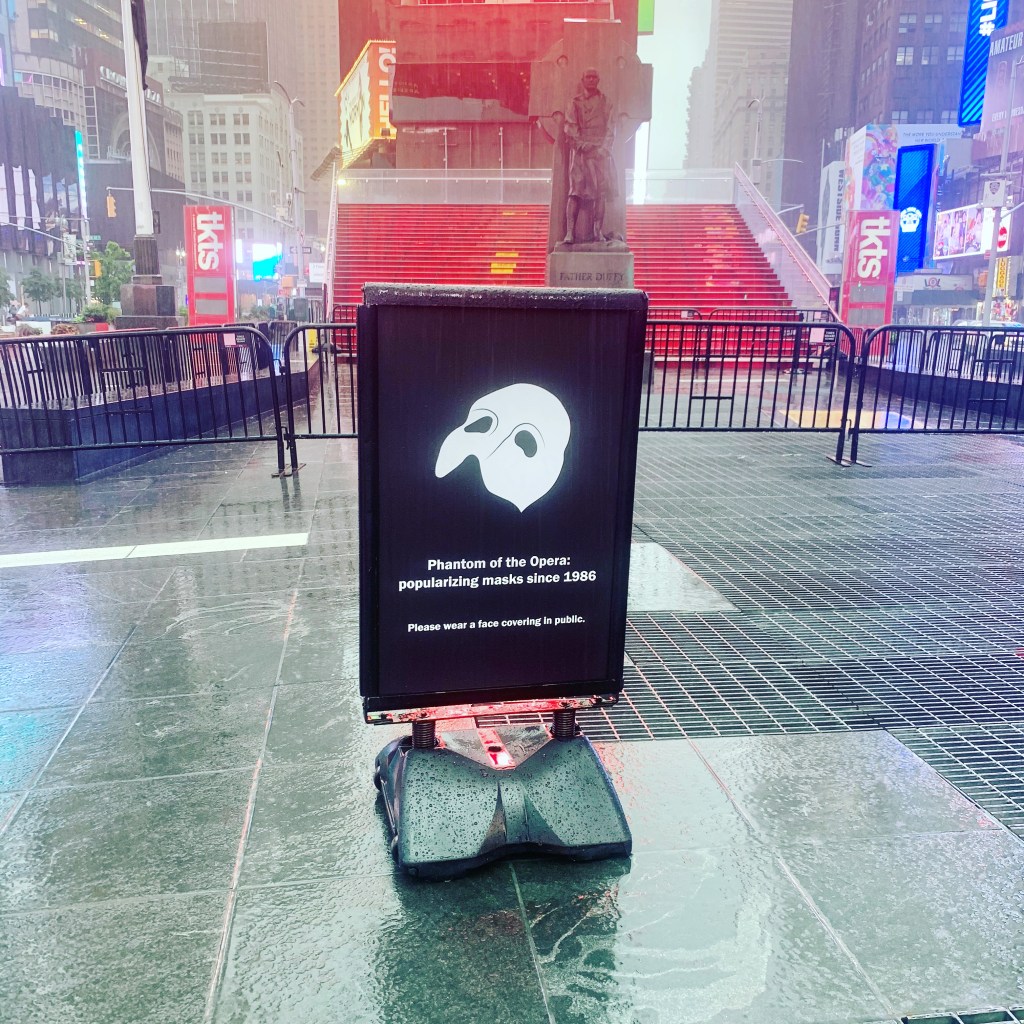
In June, the city began to slowly reawaken. Times Square was still quite empty, but clever signs were put up to remind people of safe distance and mask wearing, with hat tips to beloved Broadway shows.
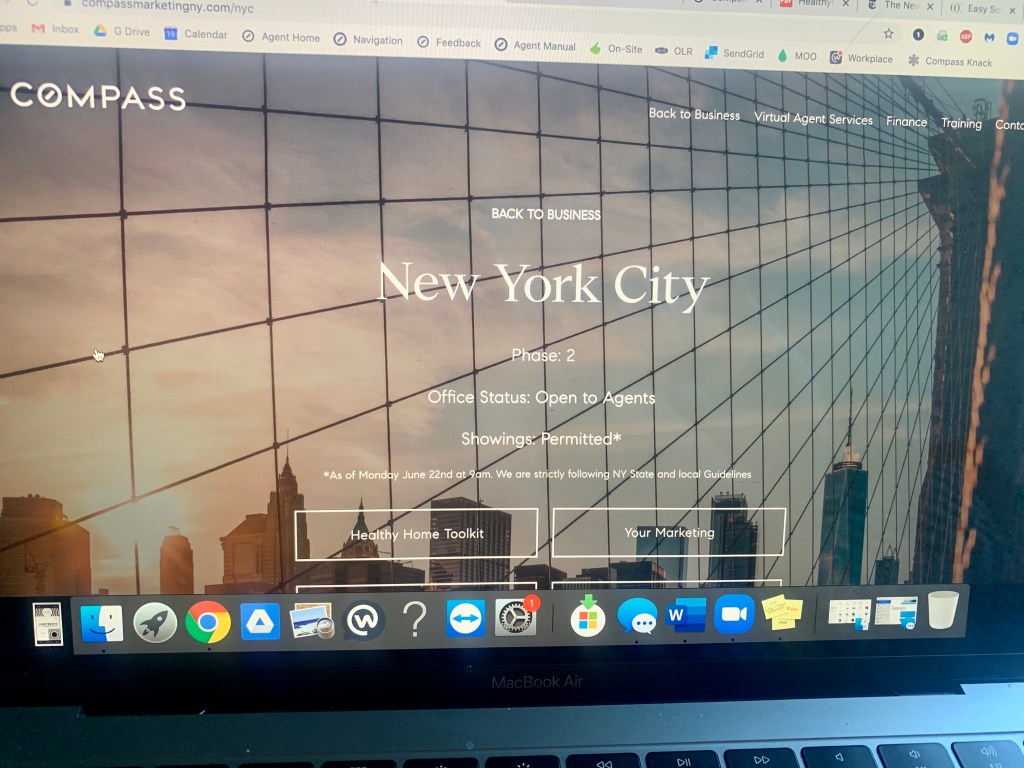
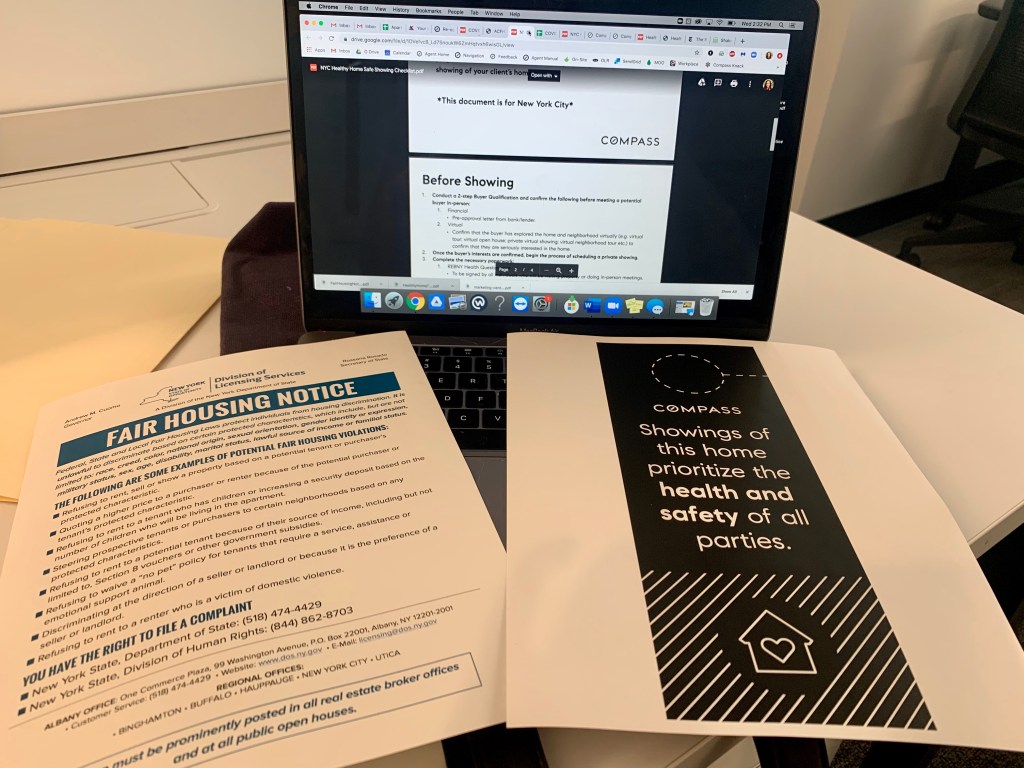
On June 22, Phase 2 reopening meant the return of real estate showings – with extensive safety measures in place. Appropriately, new Fair Housing disclosures and notices also became a part of our new normal, along with the Covid-19 health questionnaires and liability forms.
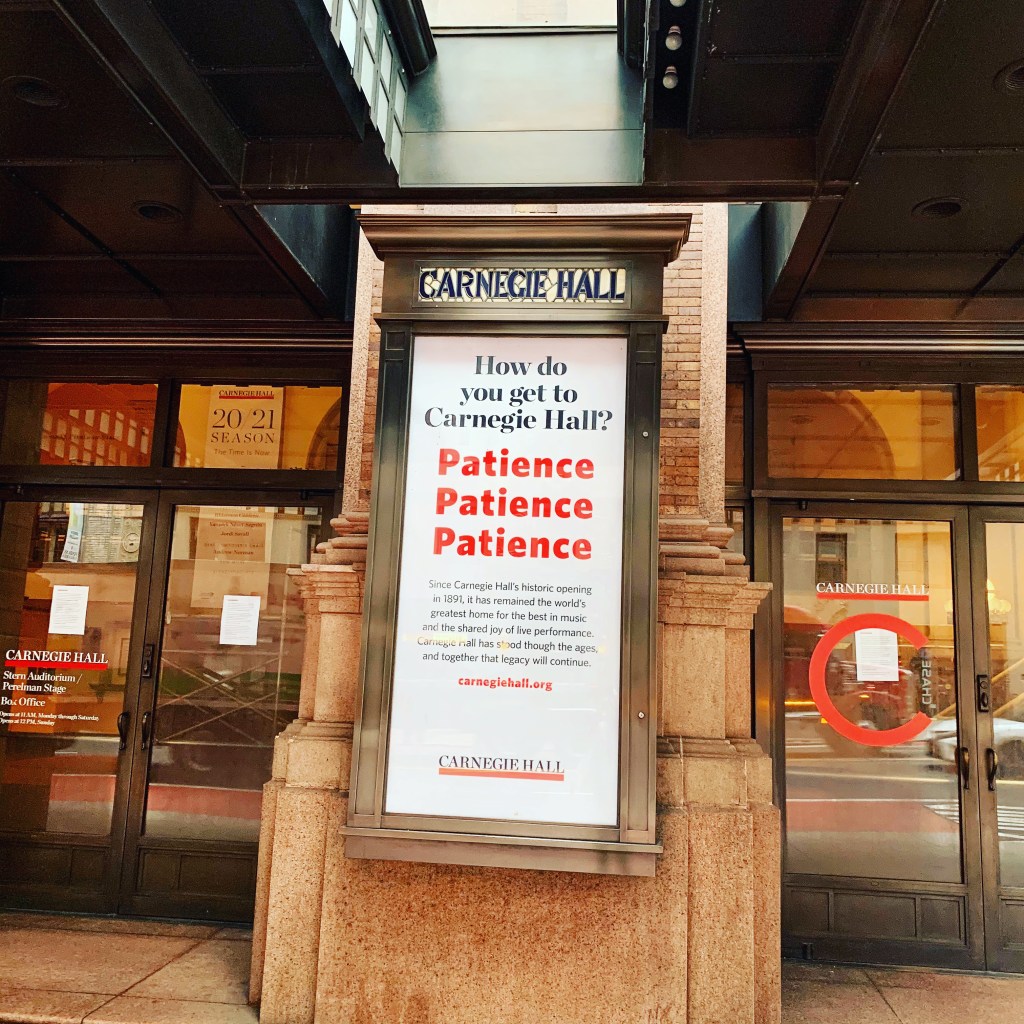
Now in August, it is clear that it will be a long time before New York City can reopen performing arts, indoor dining, and so many aspects of life that make living here such a rich and enjoyable experience. This pandemic has taken NYC’s super powers – so many people from so many places, all crowded together and often experiencing things together in crowds indoors – and turned them against us. But there is more to New York City than these experiences, although of course I can’t wait to be able to have our city back to normal again. We have shown that we could do the difficult things and make the difficult choices to save as many lives as possible, led by data and science, and beat back a virus that had taken hold before we realized it. If we can continue to do so, we can stave off this enemy until we can declare it vanquished and return safely to the activities we love. To meet a group of friends and hug them, to sit in a darkened Broadway theatre and be transported, to eat and drink and laugh and sing together – I believe we will do these things again. Many times before people have counted NYC out, and yet we always rise again like a phoenix. Being patient is hard, but we will rise again.
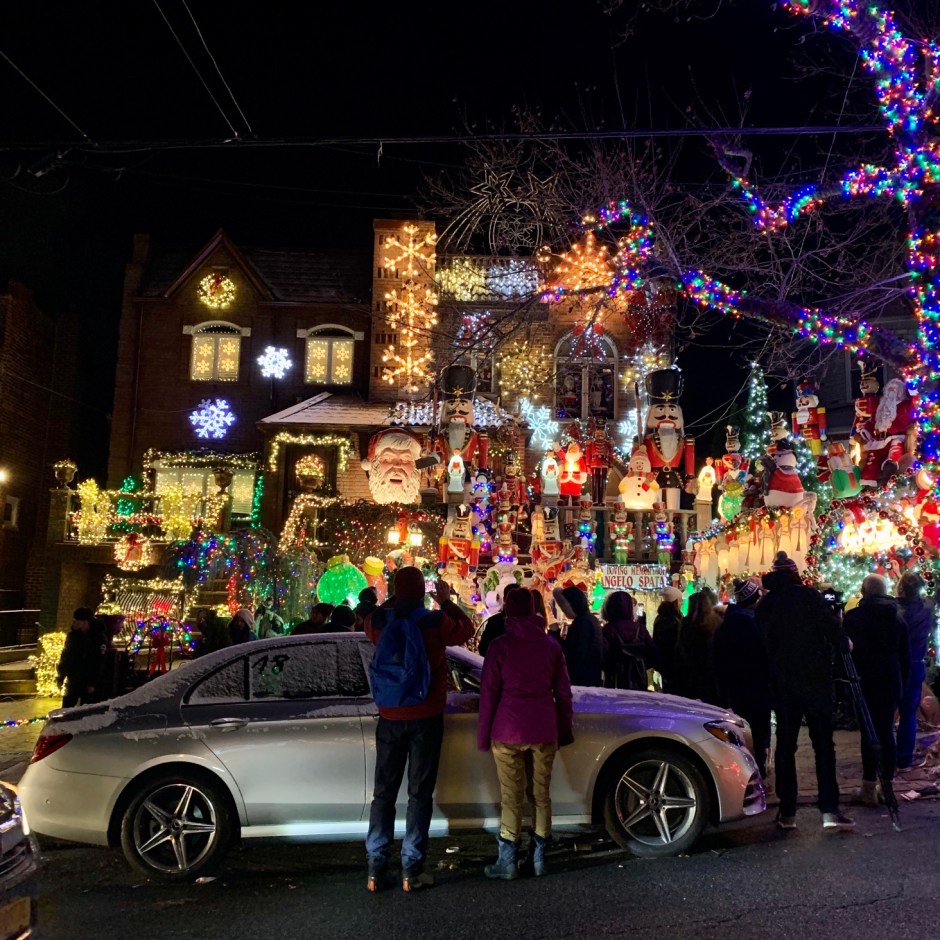
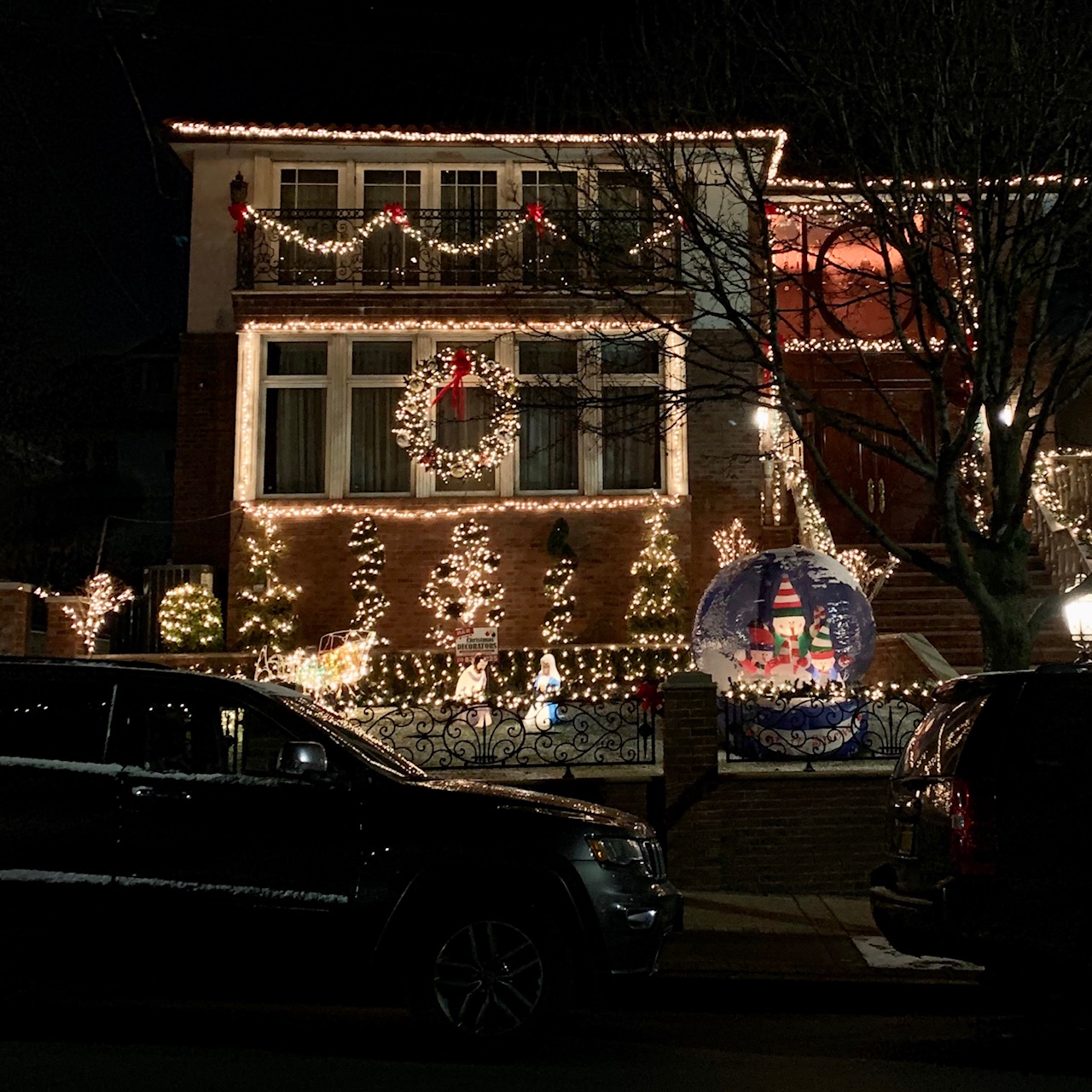
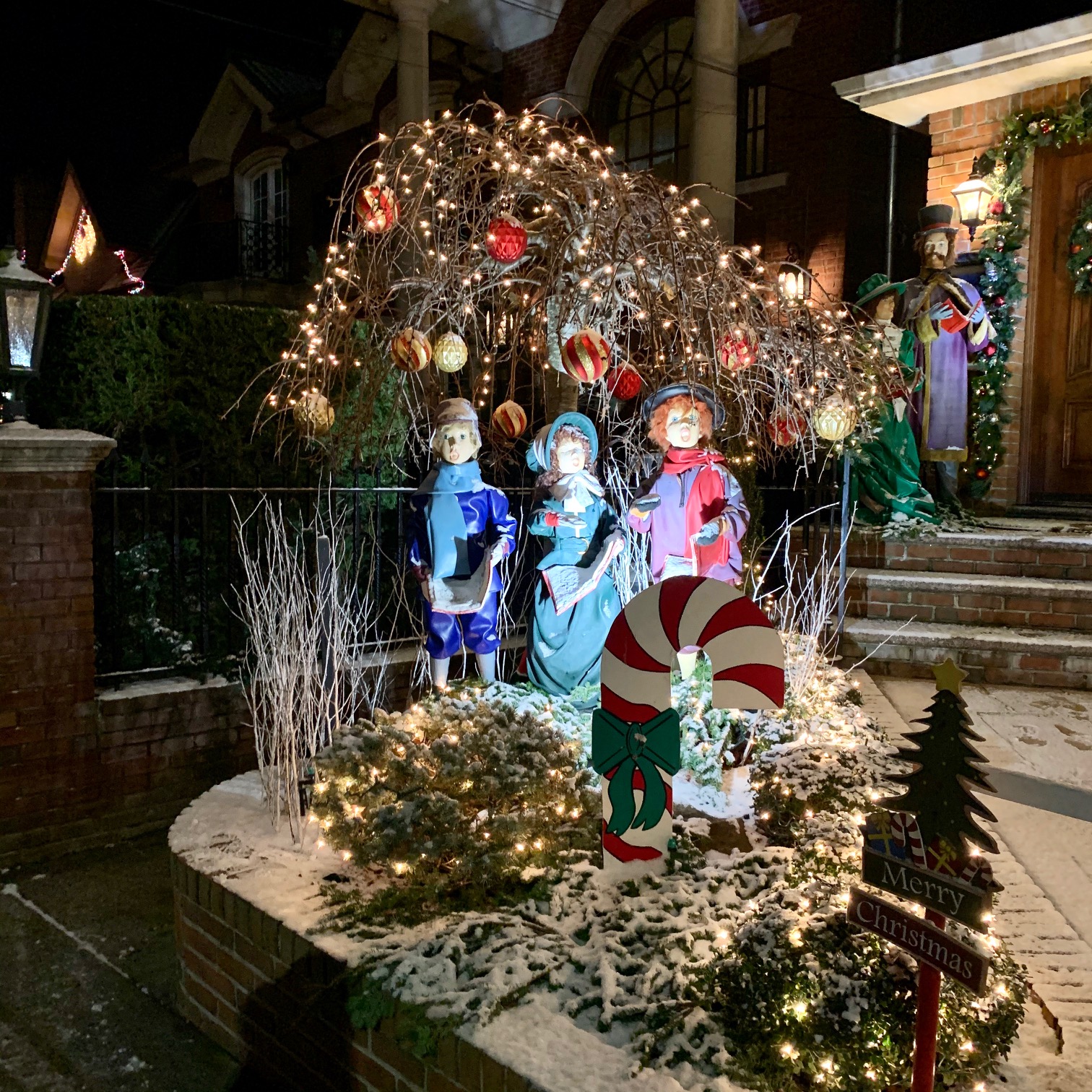
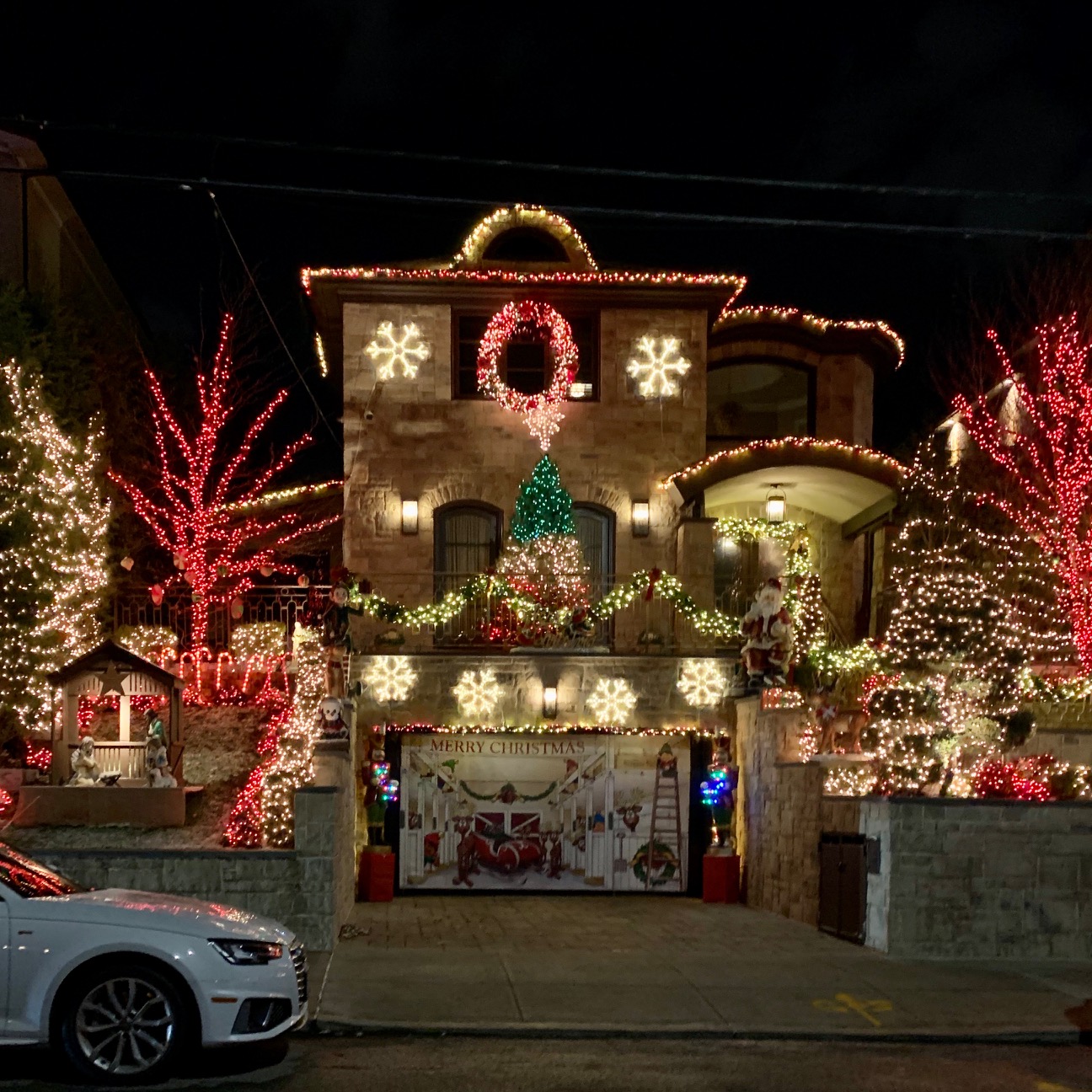
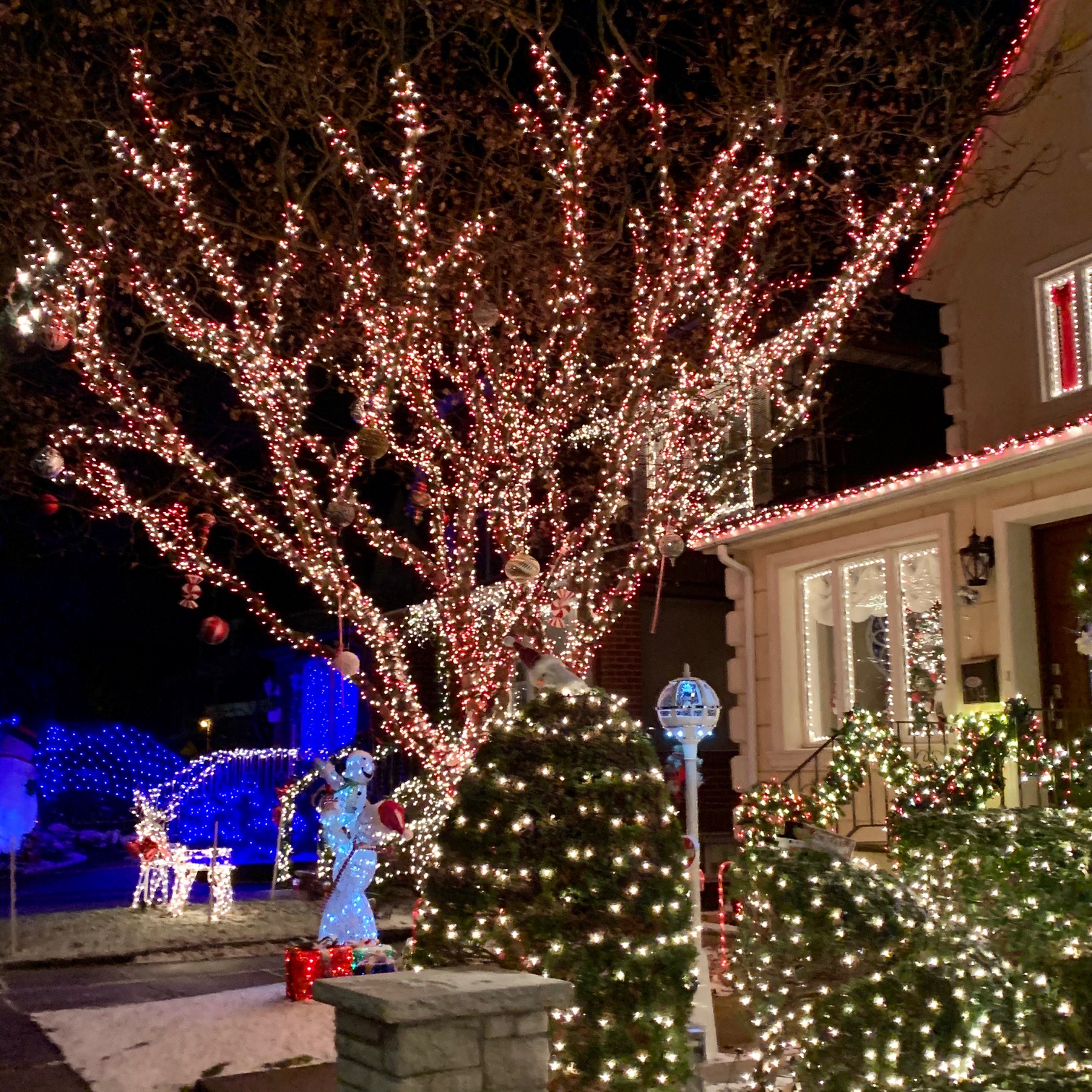
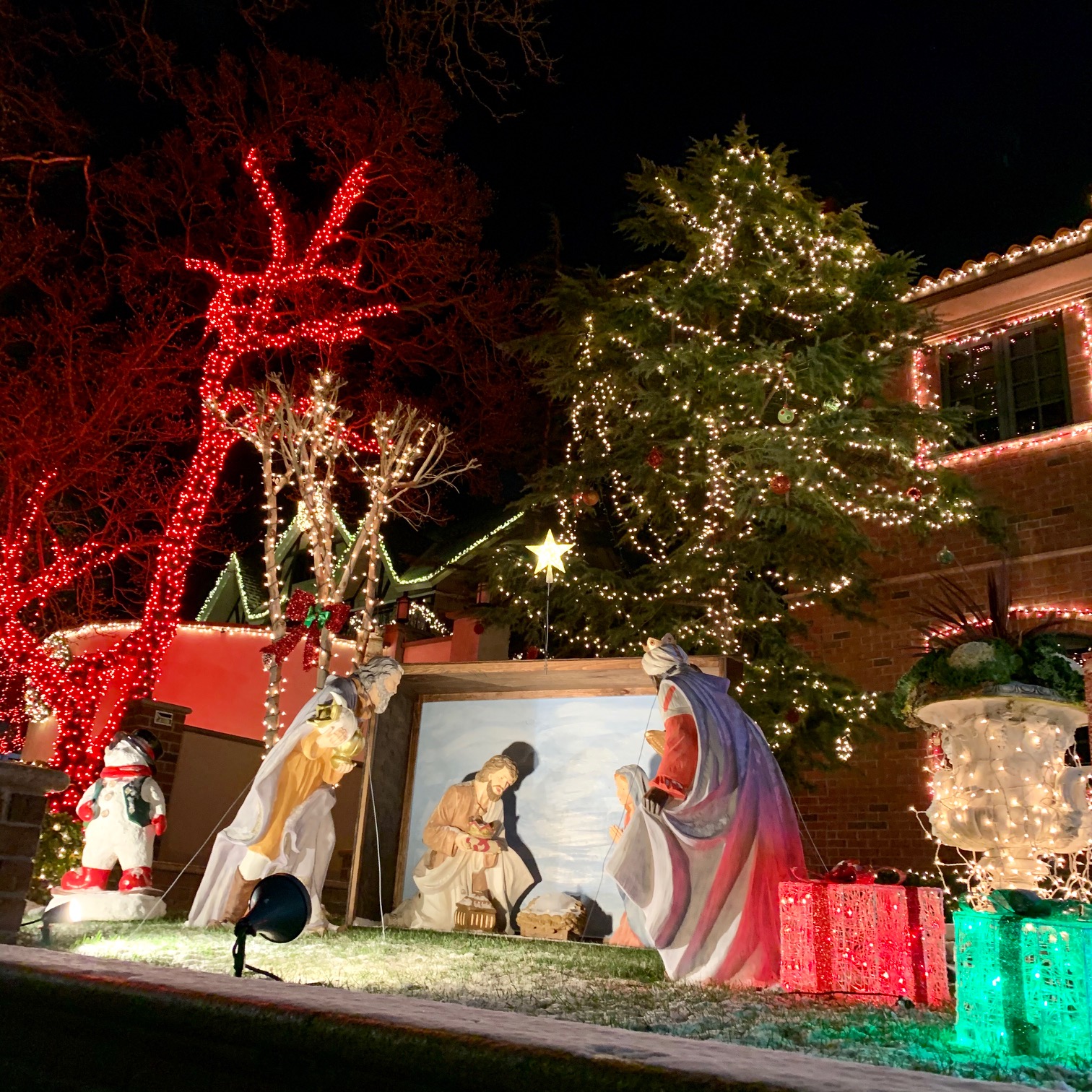
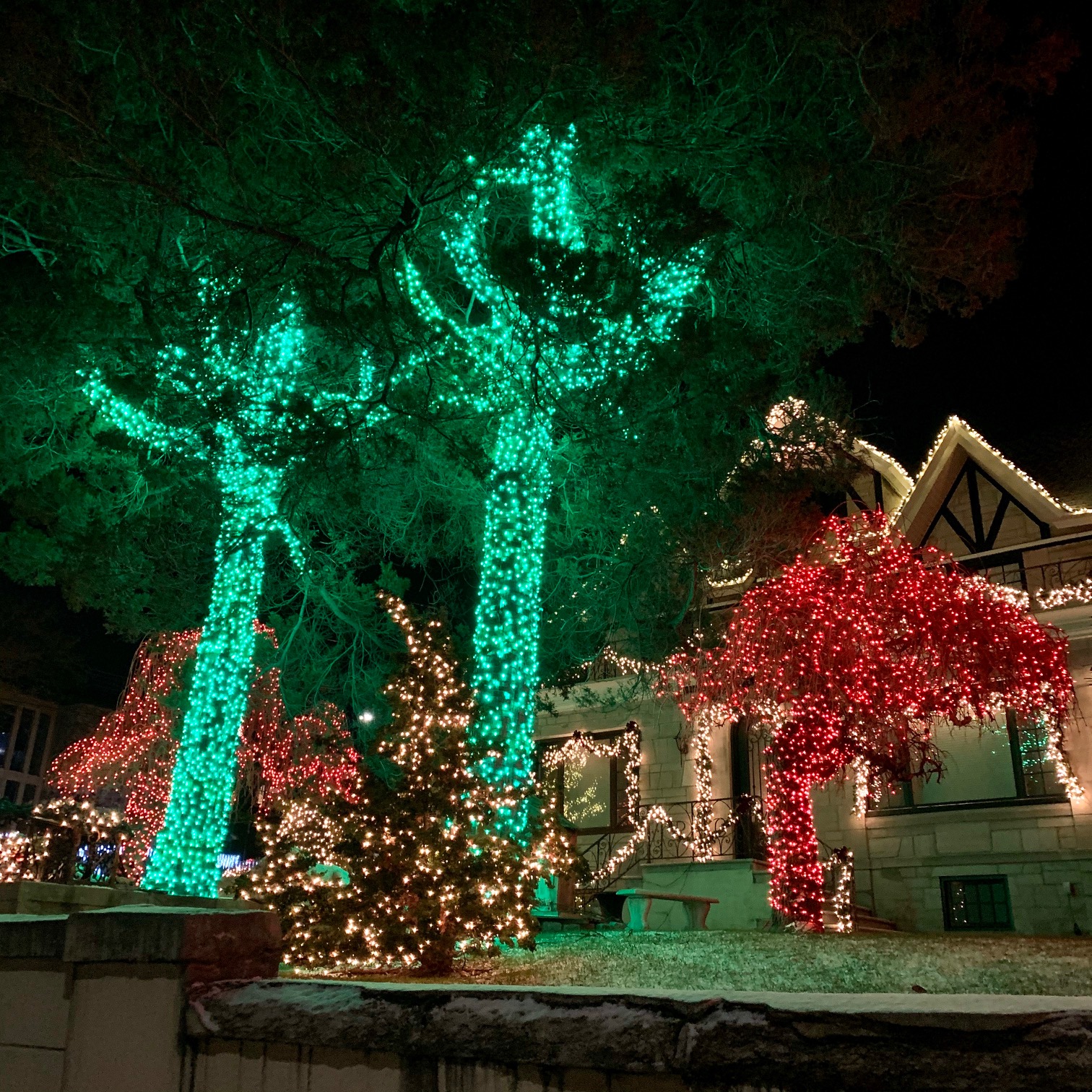
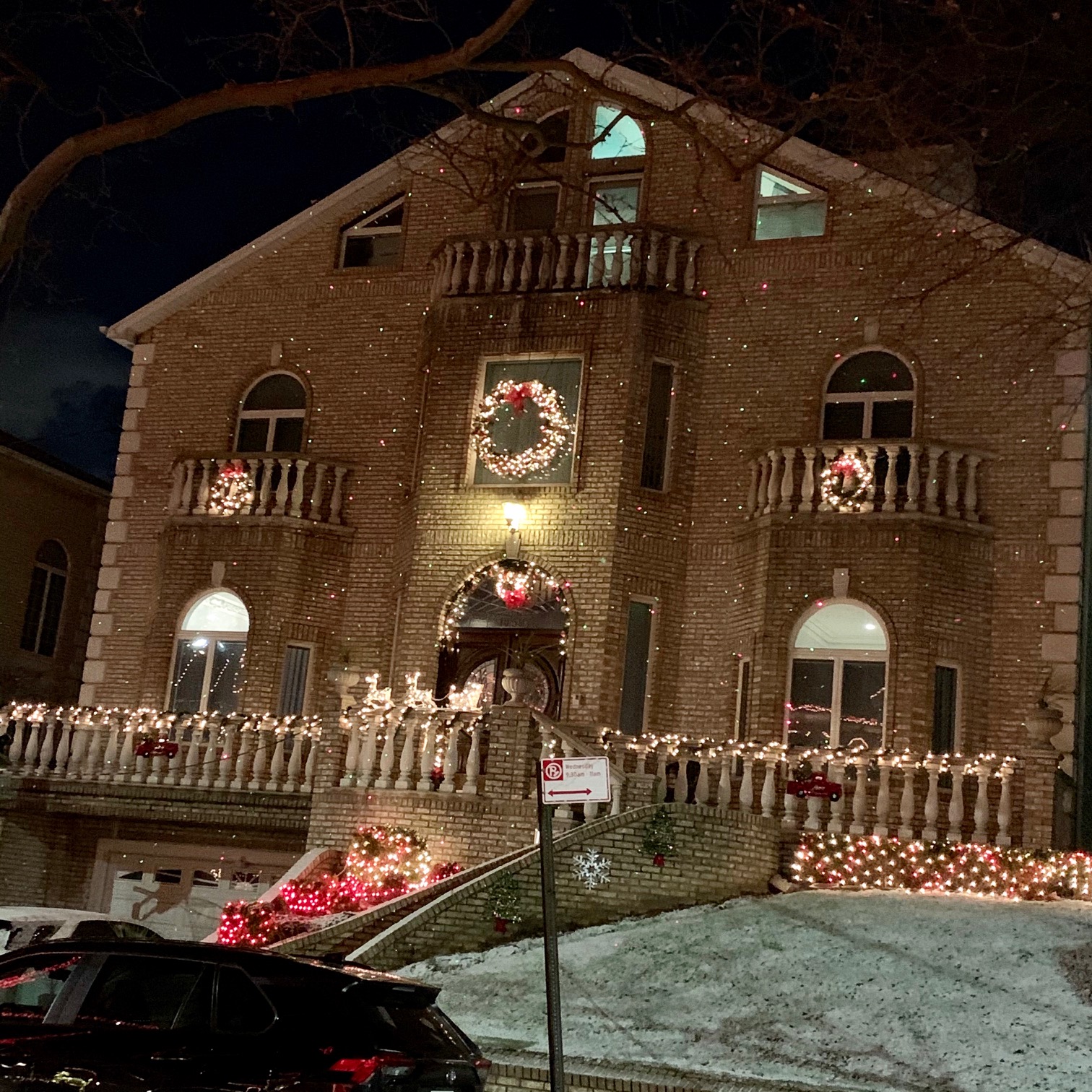
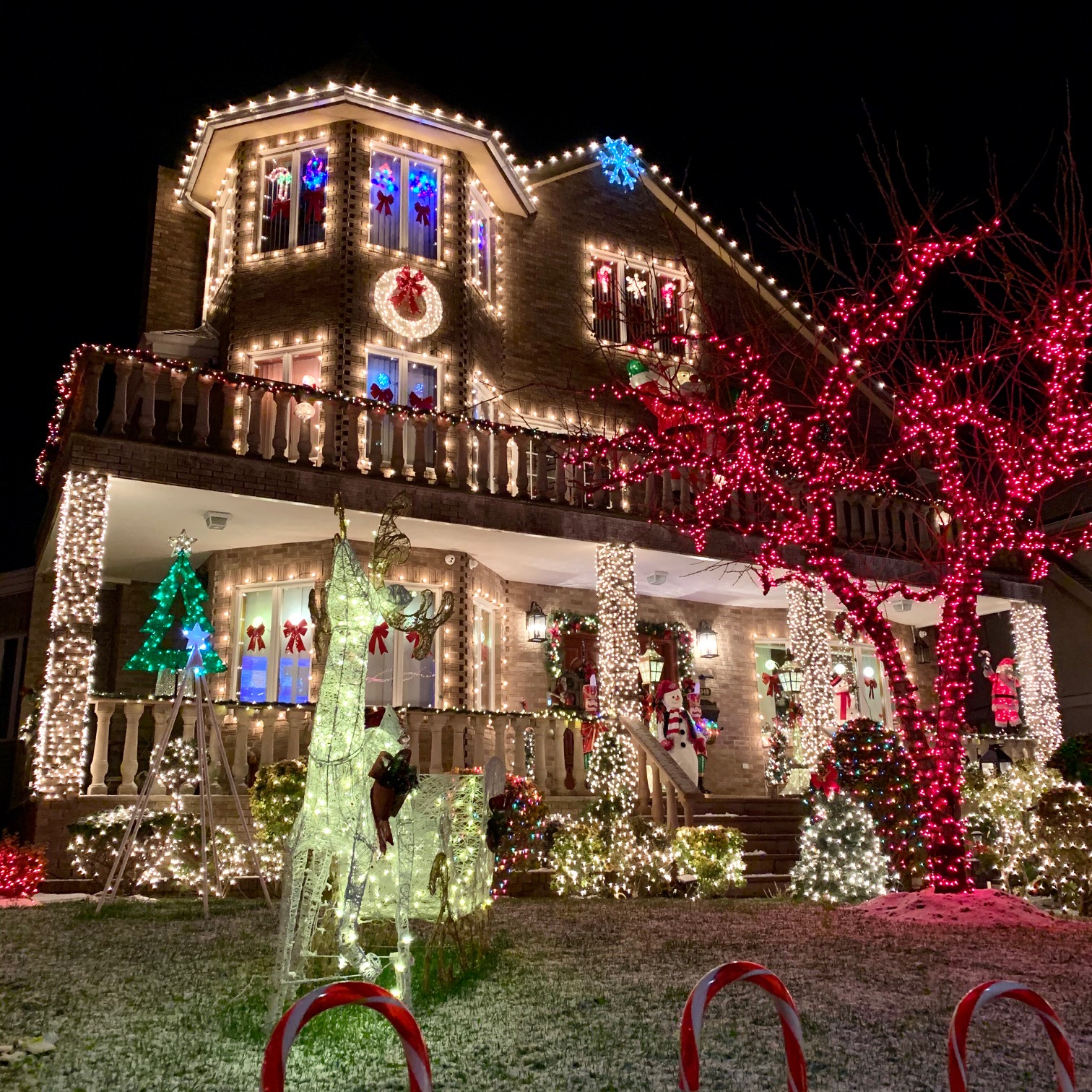
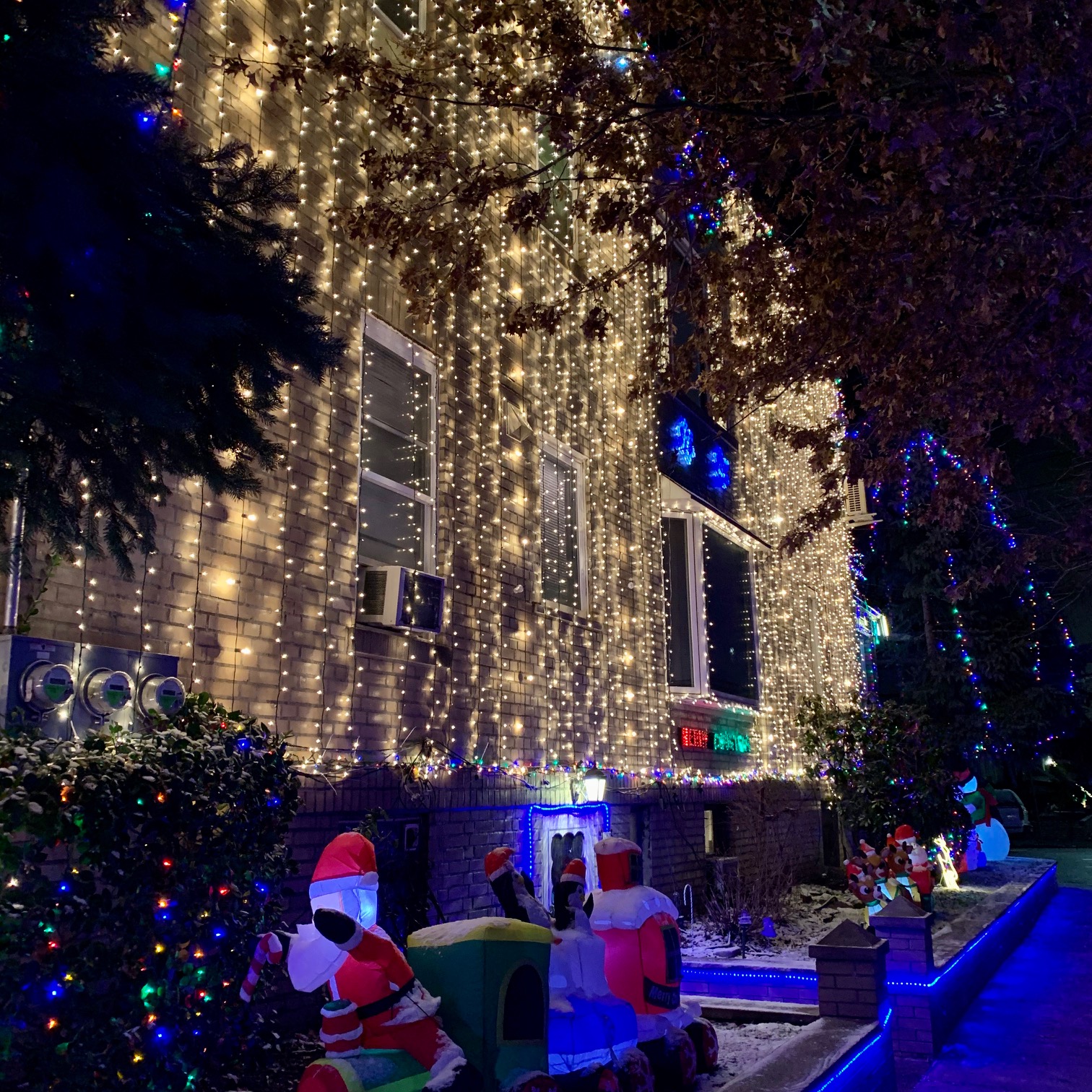
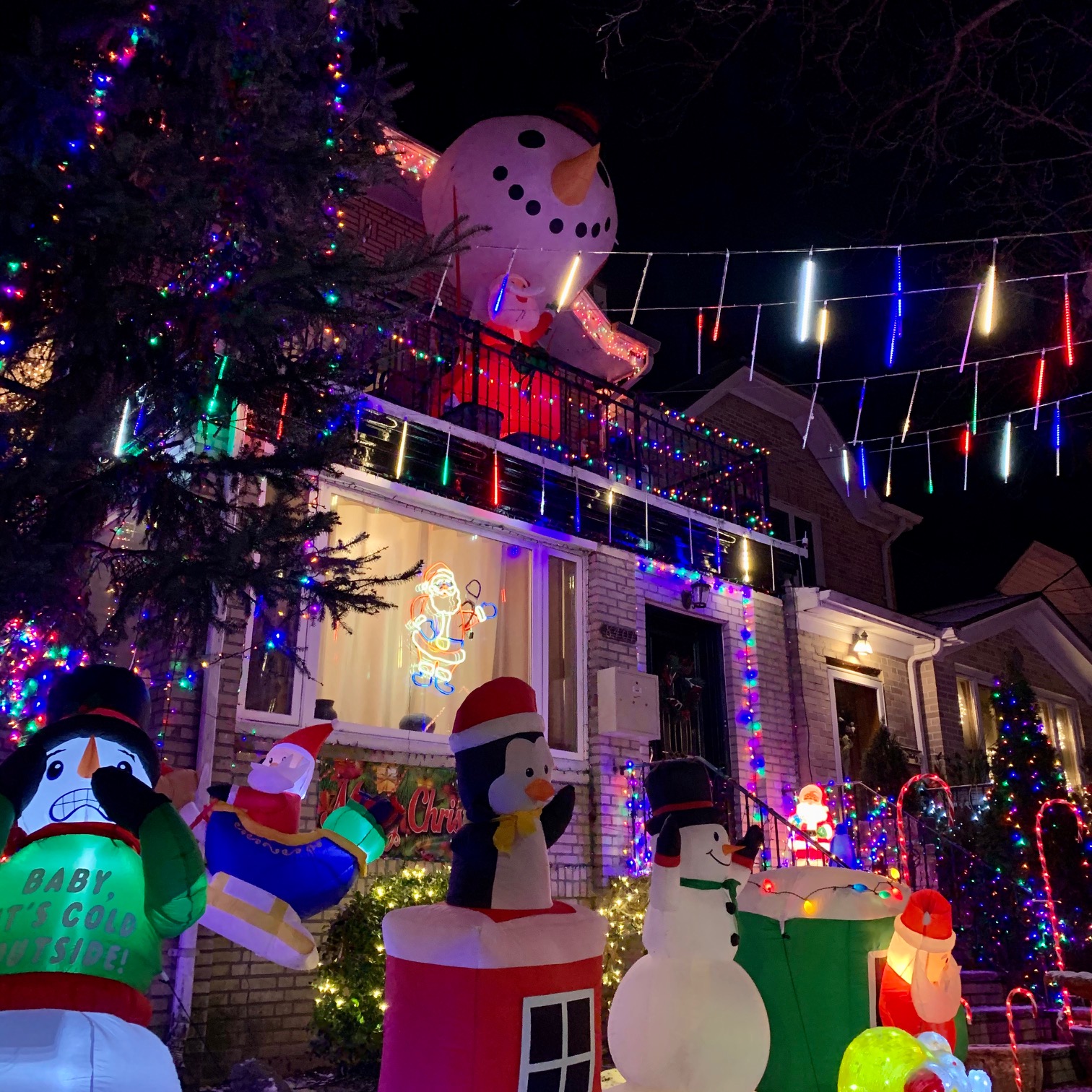
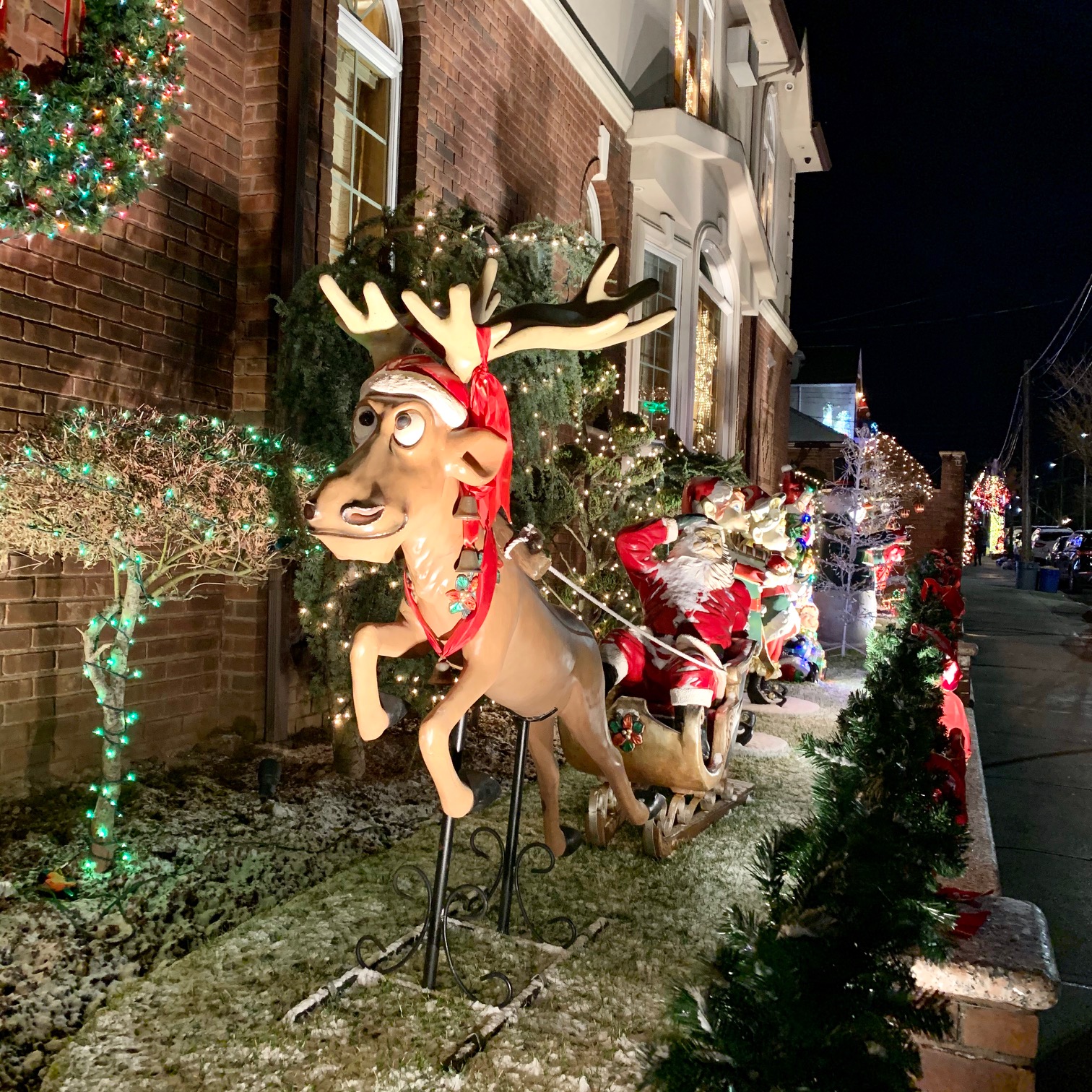
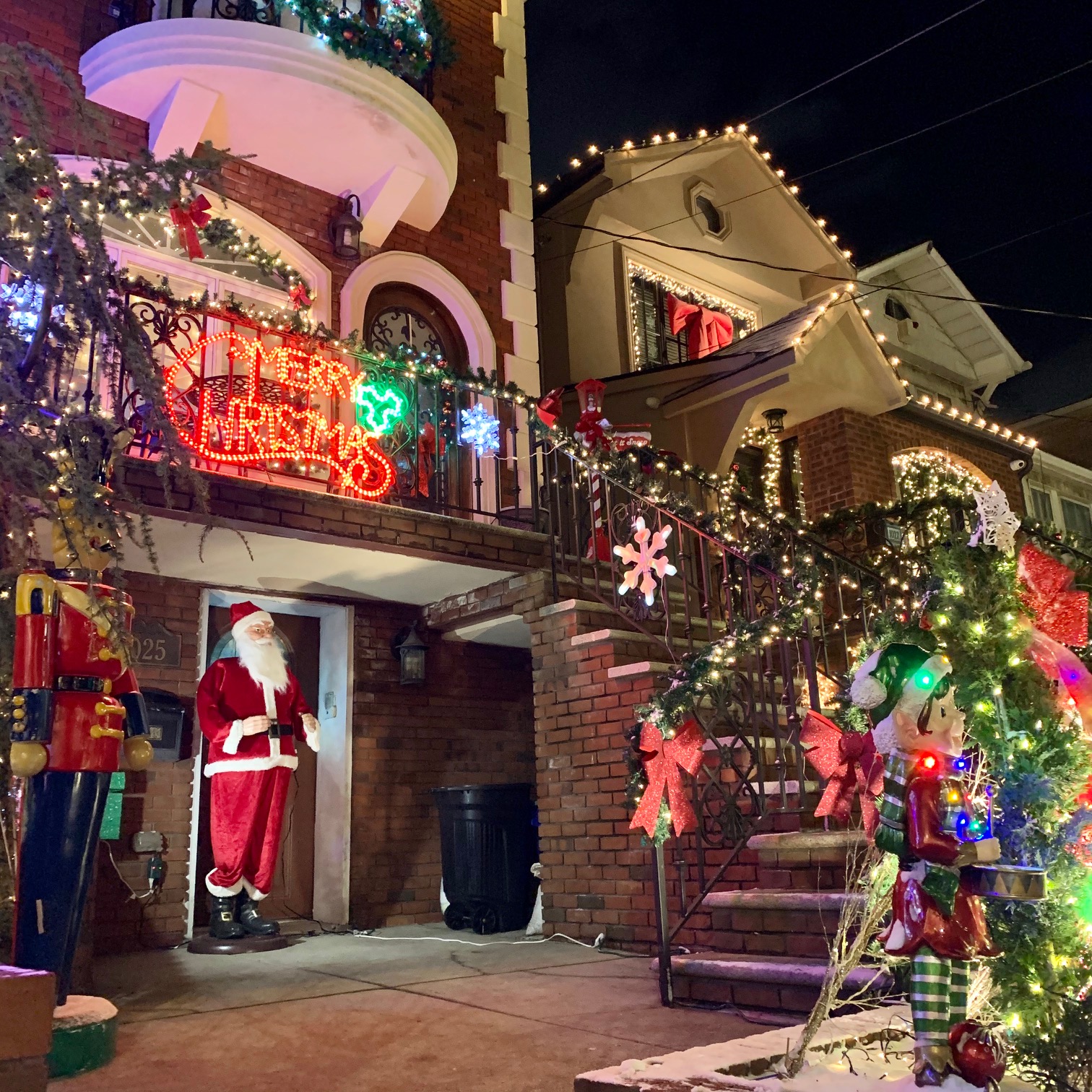
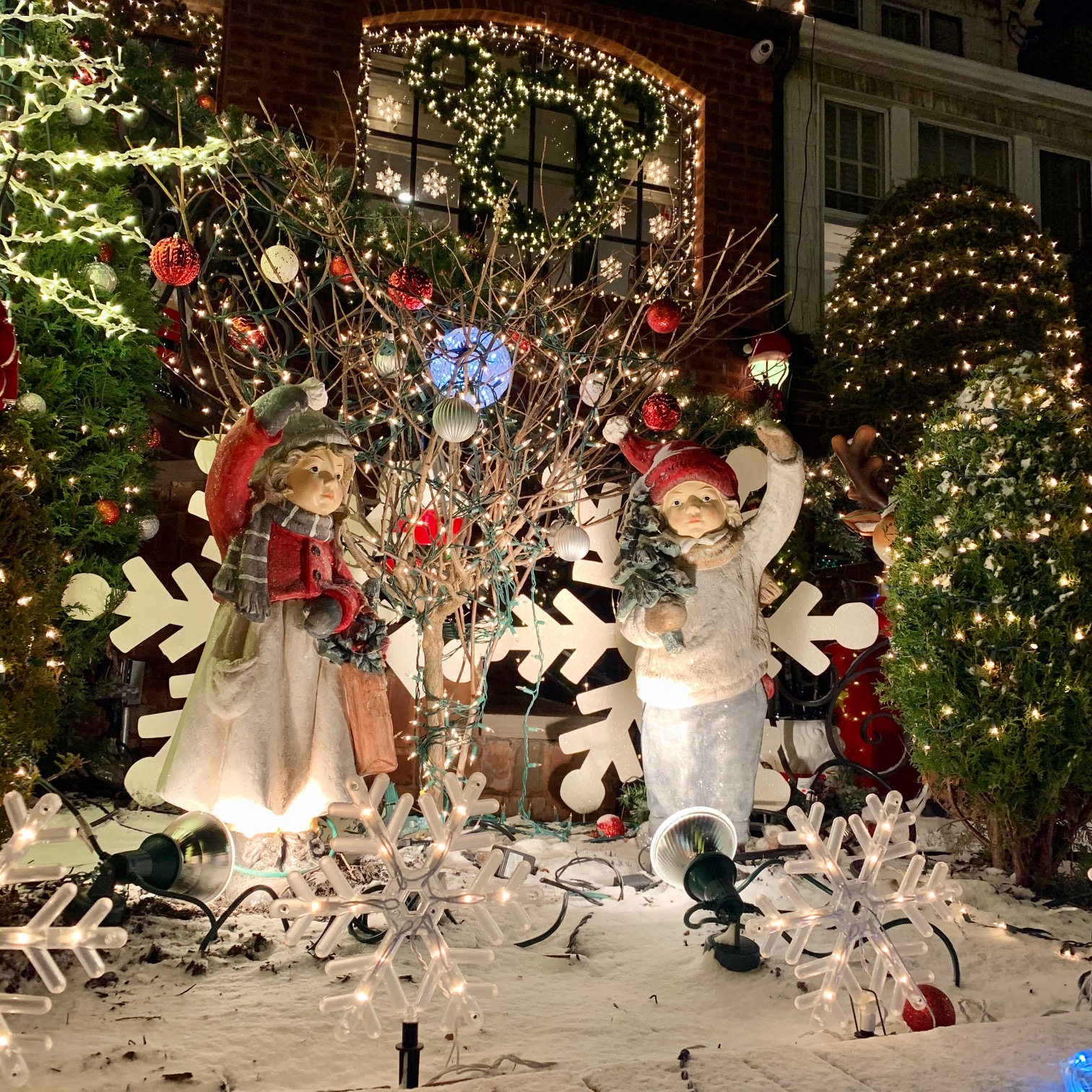
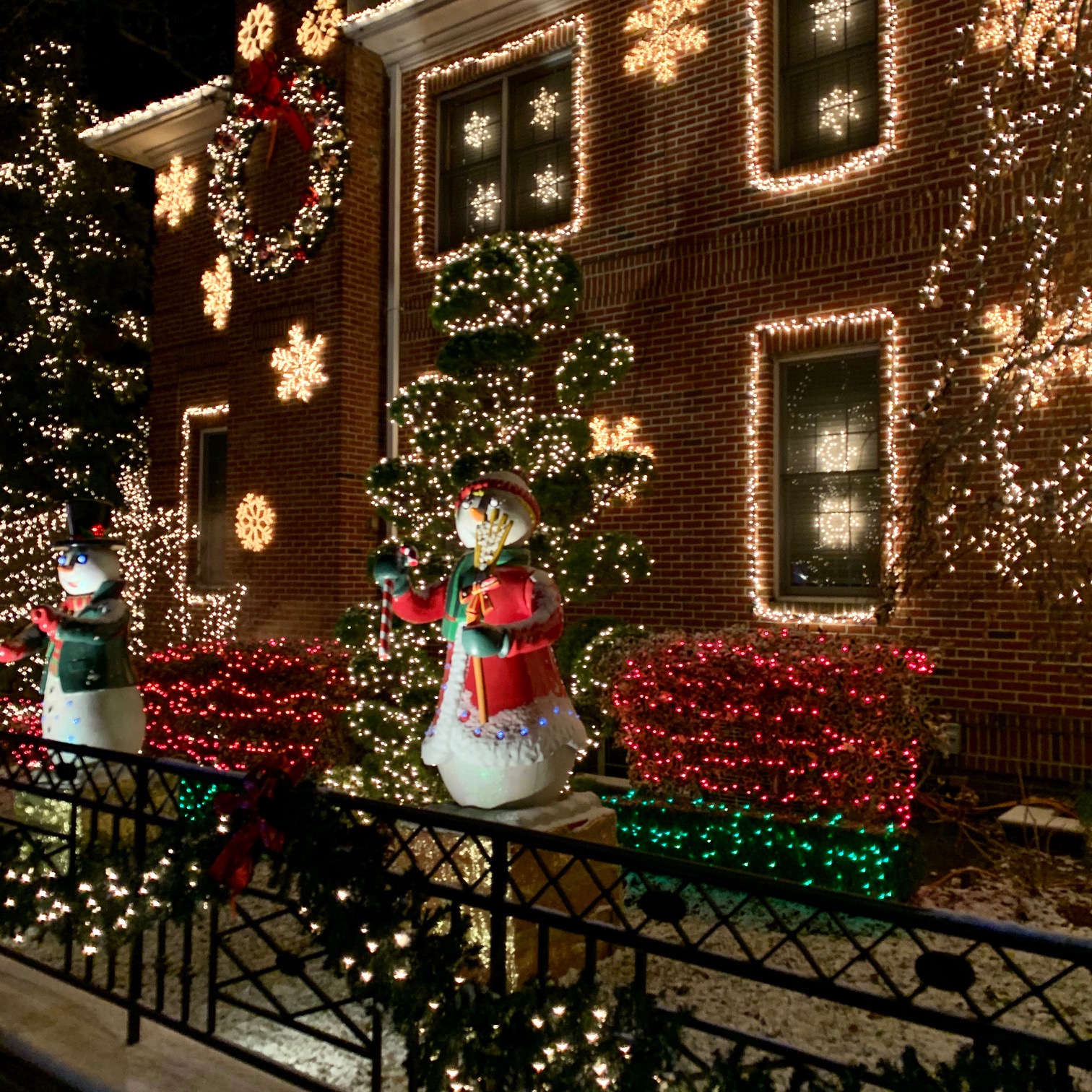
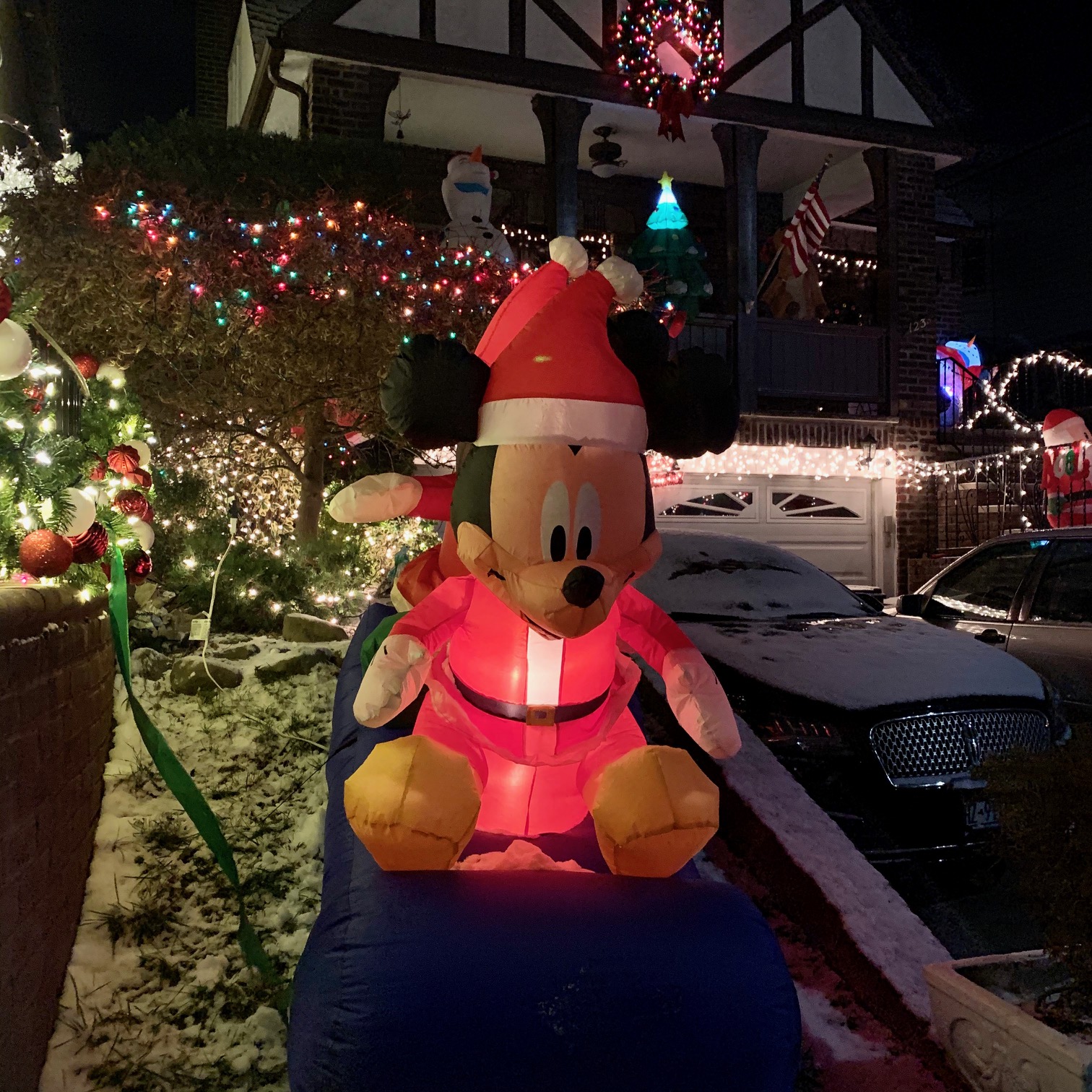
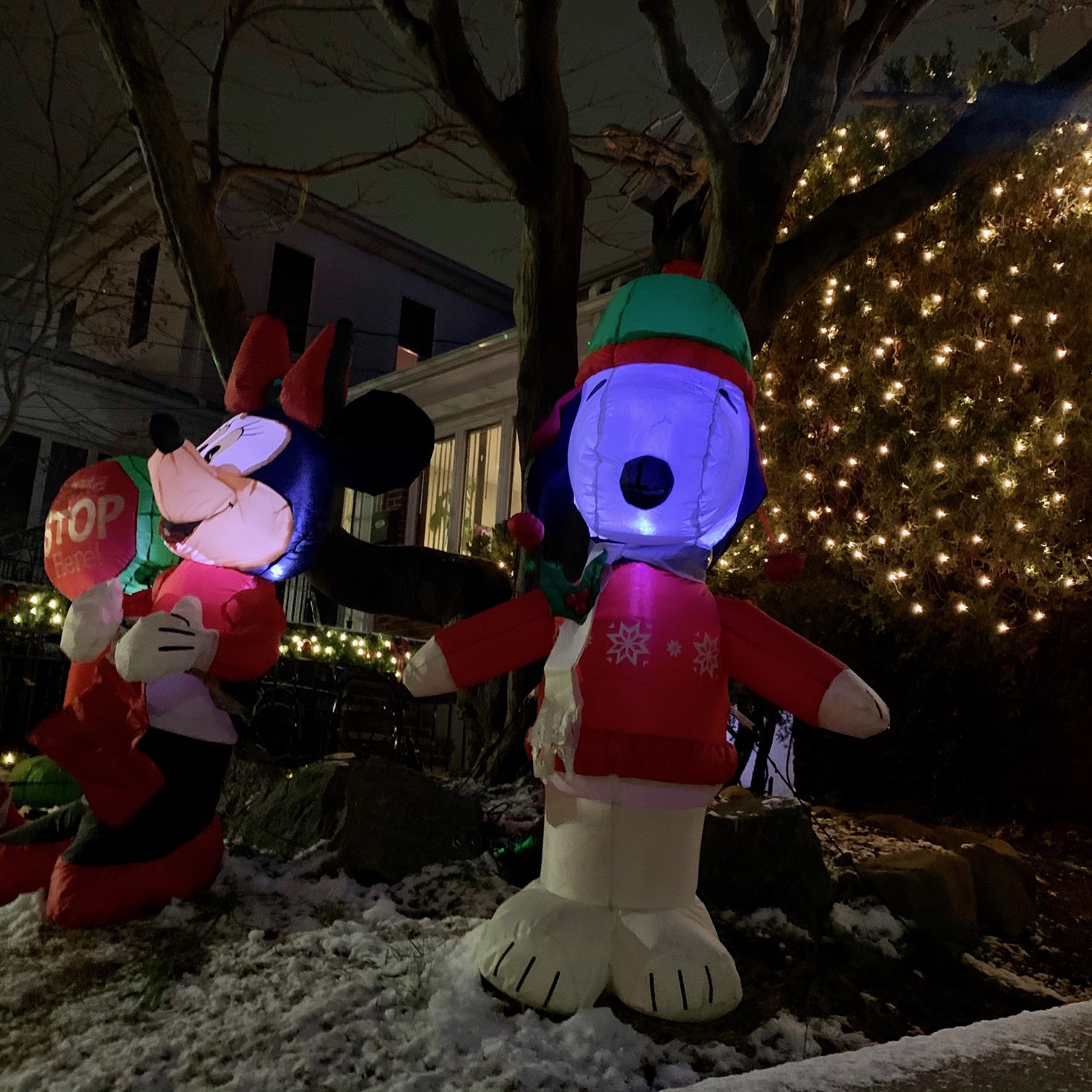
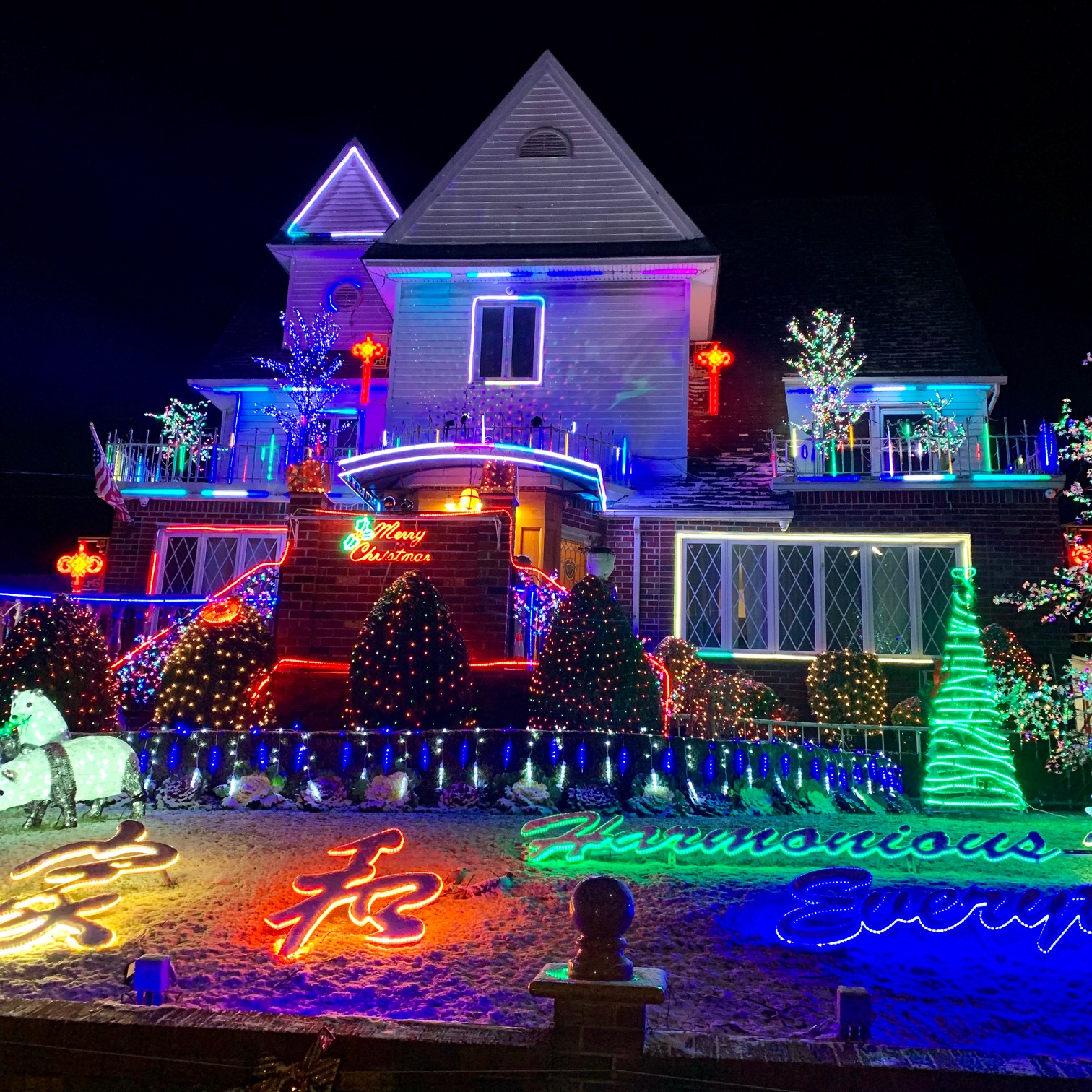
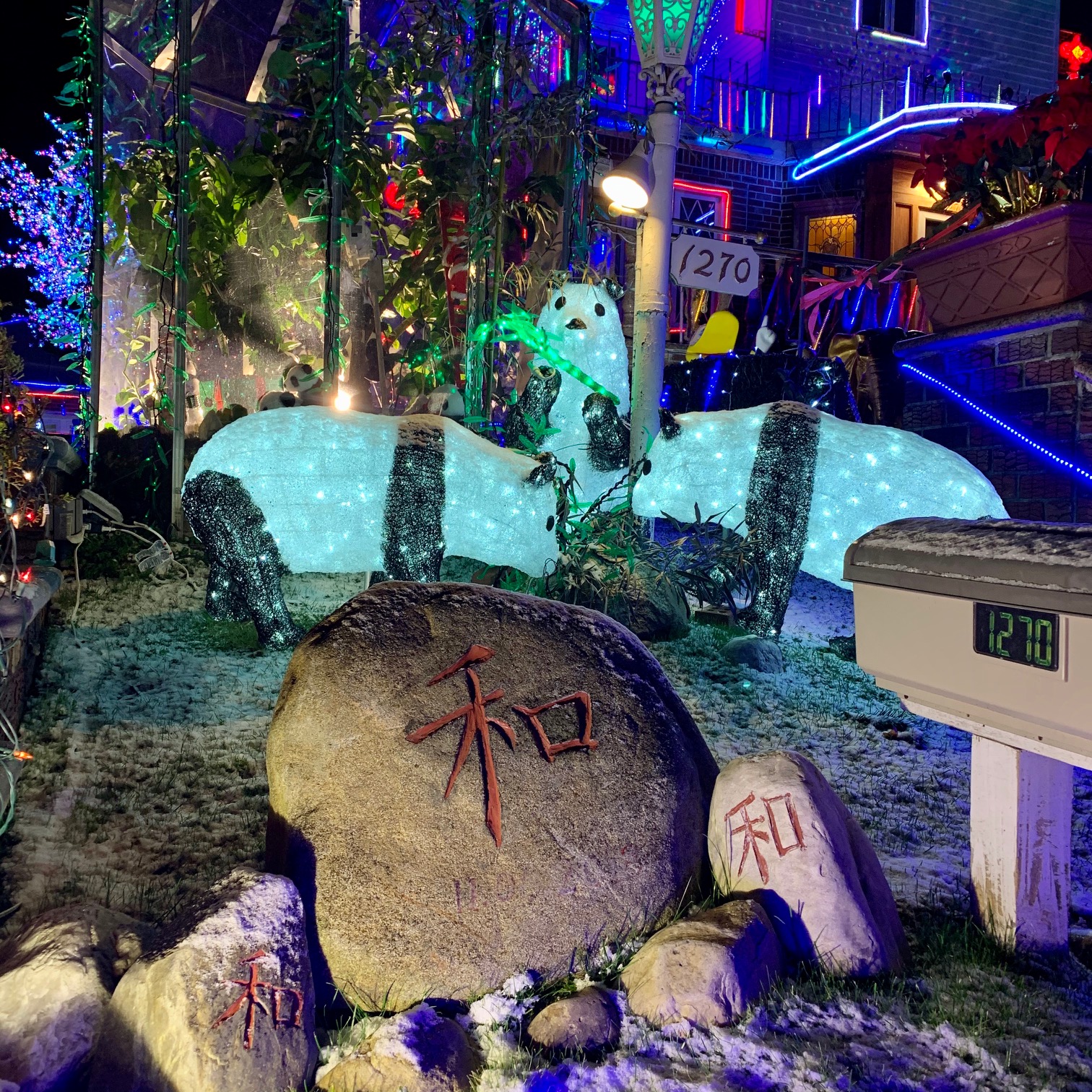
As we head into the shortest days of the year, we fight off the dark with celebrations of light. In previous years, I have written about how New York City celebrates publicly (see here for 2015 and here for 2016 posts, and here for last year’s post on holiday markets). Several years ago, I had access to a car regularly, and drove to Dyker Heights with my family to see the famed holiday lights (see that post here). This year, one of my daughters and I decided to take the subway (D train from midtown) and walk (about 20 minutes from the 18th Avenue stop in Brooklyn), and on a cold evening with some snow flurries, the lights once again did not disappoint – and I believe they have become more elaborate since the last time I was here in 2014. This tradition in Dyker Heights began in the 1980’s and since has increased every year, with many residents paying professionals $20K or more to deck out their homes. On weekends, traffic is bumper-to-bumper, and the sidewalks can be packed – so go on a weeknight if you can. The best viewing is roughly 11th Avenue to 13th Avenue, 83rd to 86th Streets. Here are some photos of what I saw this year:
As we head into our own Roaring Twenties, I wish light and joy in the hearts of all!
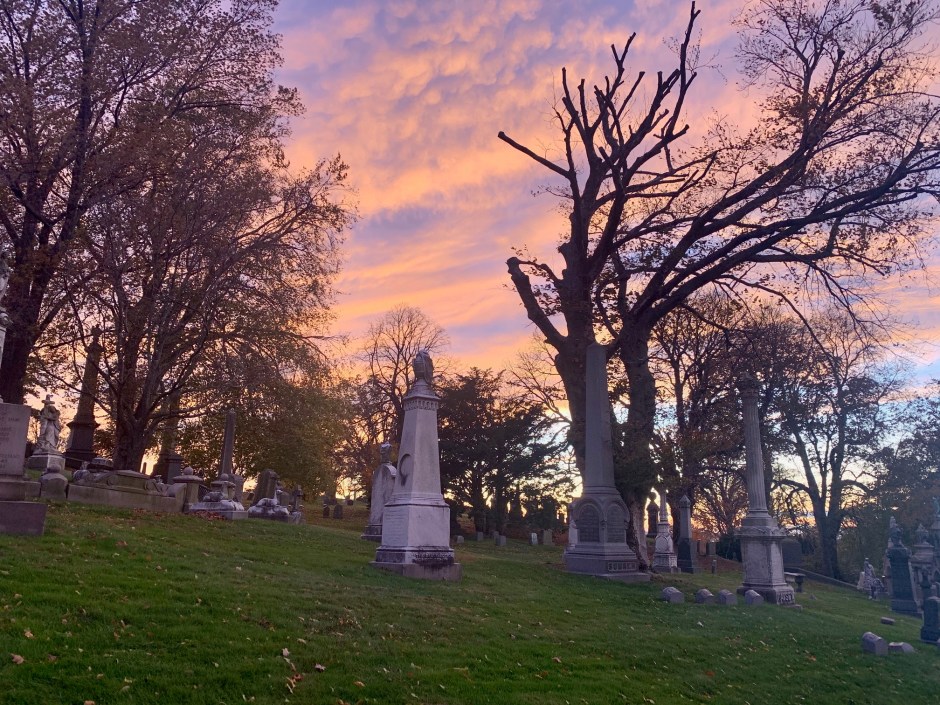
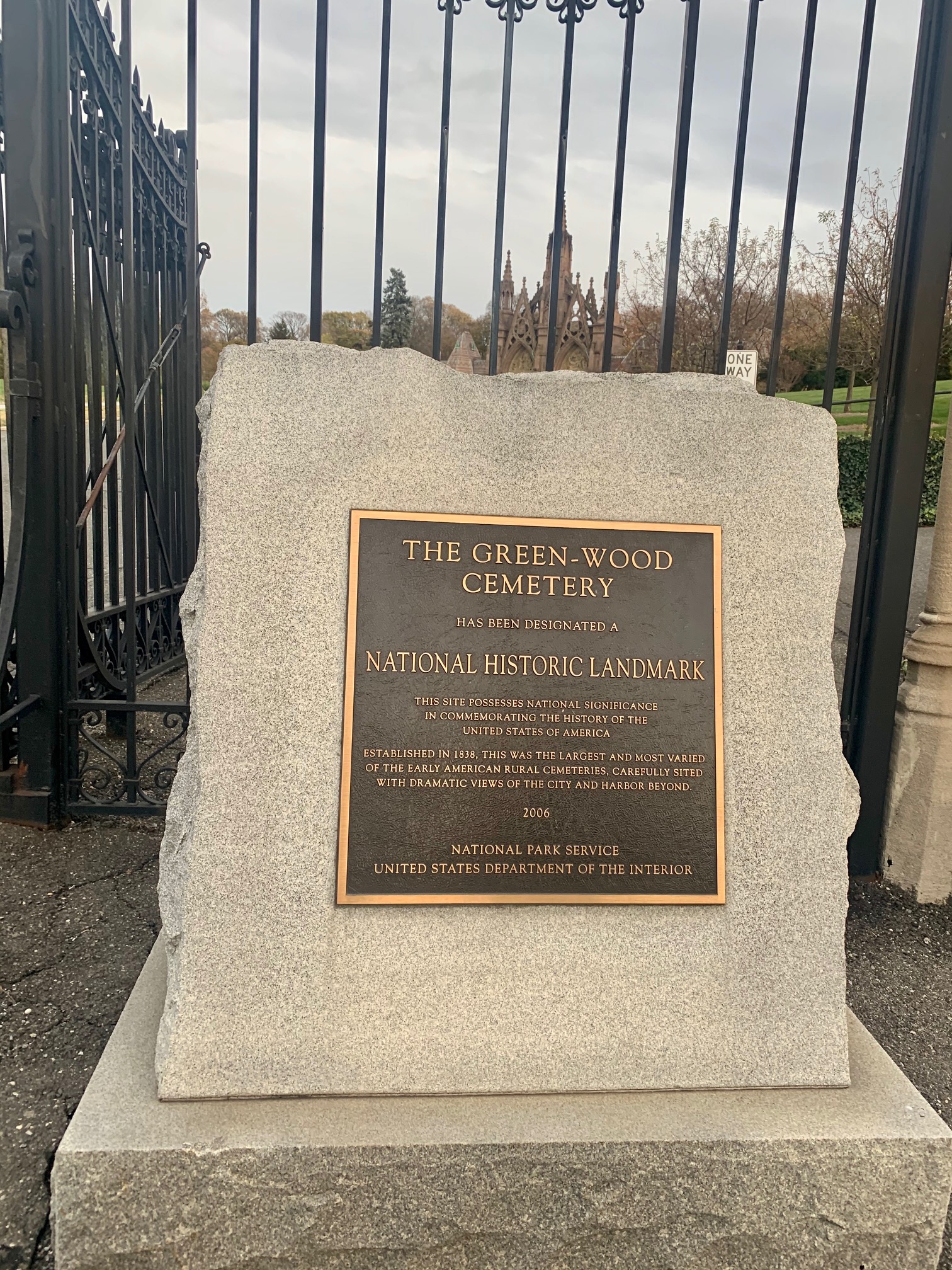
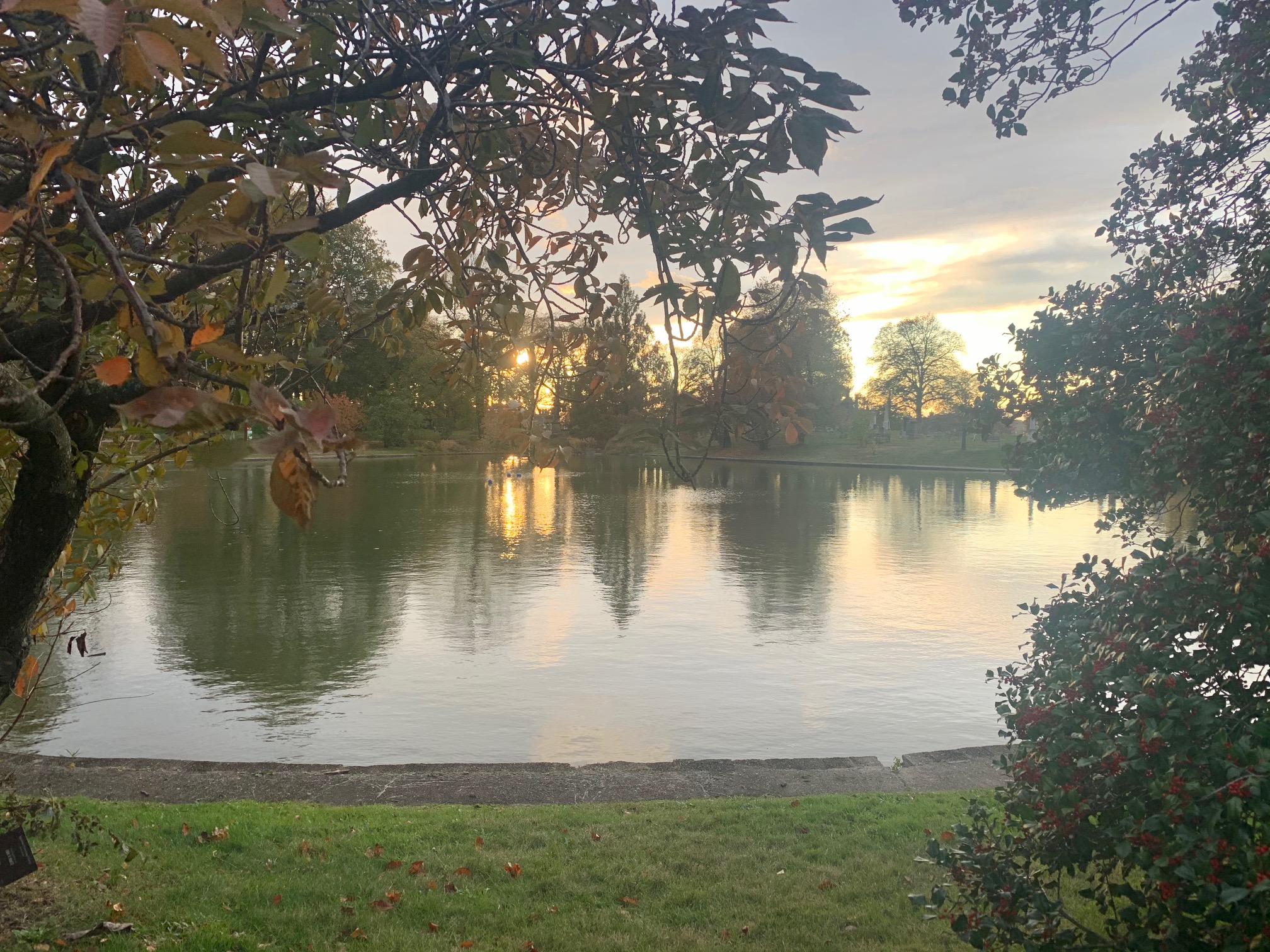
Green-Wood Cemetery in Brooklyn was founded in 1838, and by 1860 was the second most popular tourist attraction in New York State, with over half a million visitors per year (Niagara Falls was #1). Its popularity as a public park spurred on the creation of Prospect Park in Brooklyn as well as Manhattan’s Central Park. It was designated as a New York Landmark in 1966 and became a National Historic Landmark in 2006. Now with over 600,000 “permanent residents,” Green-Wood is still a wonderful place to visit, as I did recently near sunset.
It is easy to get to Green-Wood via subway (get off the R at 25th Street in Brooklyn, or get off the N at 36th Street and walk for about 15 minutes). Entering the main gate on 25th Street, it is impossible not to be impressed by the enormous brownstone gates. An escaped colony of monk parrots has lived in and around the gates since the 1970’s, but unfortunately I was not able to spot (or hear) any.
The cemetery is huge, at 478 acres. It is also really gorgeous and peaceful. Like Prospect Park and Central Park, which it influenced, it is a beautiful place to explore on foot and experience nature while being surrounded by the city.
The monuments reflect a variety of styles. Many are very grand, suggesting that even if you can’t “take it with you,” you can still show “it” off after you are gone.
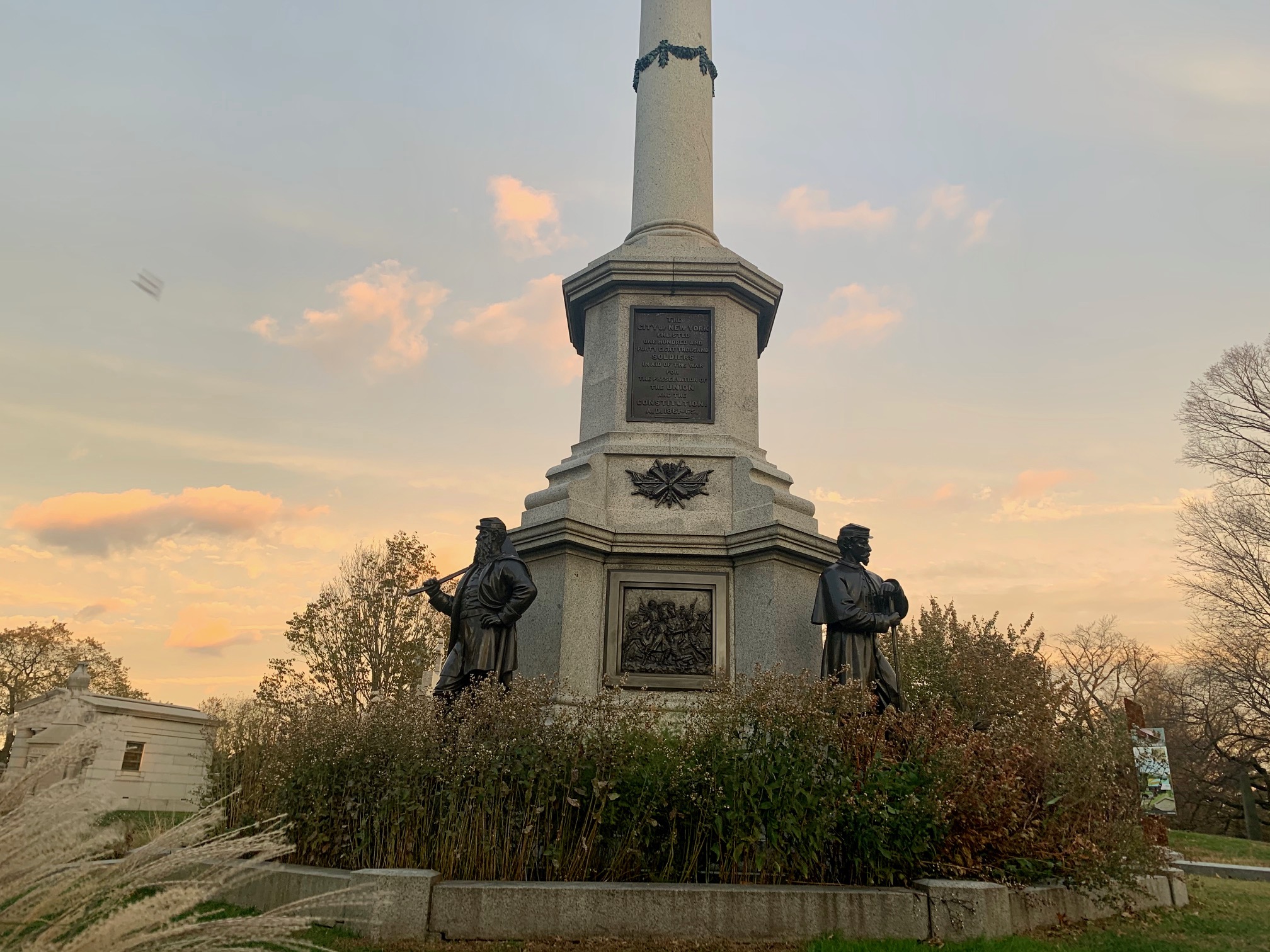
On the site of the Battle of Brooklyn, from the Revolutionary War, there is a memorial to the soldiers of the Civil War.
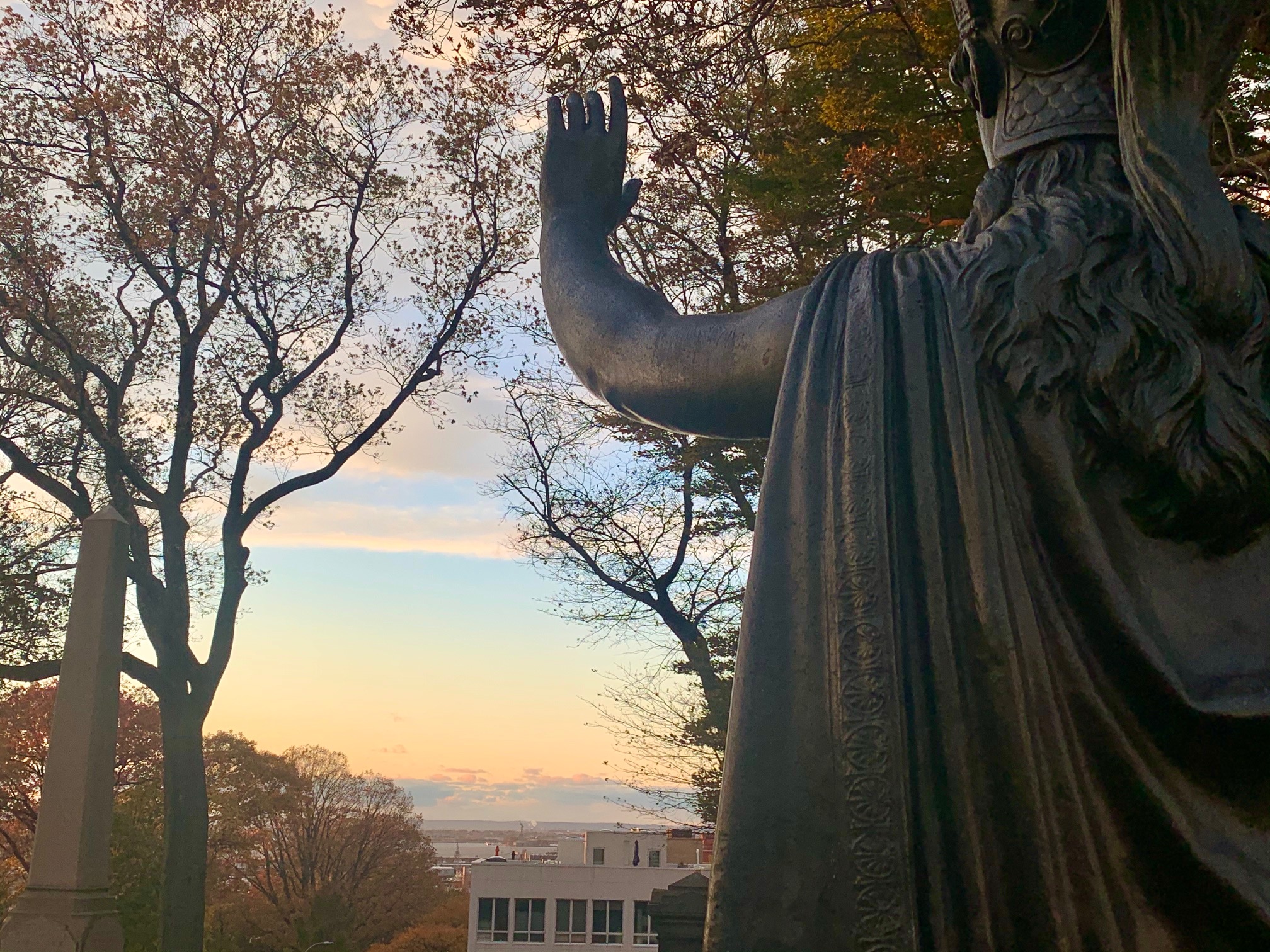
Near the Civil War memorial is a statue of Minerva, dedicated to the soldiers of the American Revolution. She waves out to the Statue of Liberty, which can be glimpsed off in the distance when you look from underneath her arm.
There are many famous residents of Green-Wood, including the artist Jean-Michel Basquiat; Samuel Morse, creator of the Morse Code; and Leonard Bernstein.
There is a public artwork by Sophie Calle in Green-Wood. Visitors to the cemetery are invited to write one of their secrets on a slip of paper and insert into a monument that is inscribed “Here lie the secrets of Green-Wood Cemetery.” As the grave becomes filled with the secrets, the artist returns to cremate them in a ceremonial bonfire. Yes, I put a secret in – and it is a surprisingly satisfying thing to do.
The sunset the evening I was there happened to be spectacular. And from higher vantage points, the skyscrapers of lower Manhattan shimmered in the last rays of the sun off in the distance.
The New York Times in 1866 remarked that “It is the ambition of the New Yorker to live on Fifth Avenue, to take his airings in [Central] Park, and to sleep with his fathers in Green-Wood.” This is certainly a statement of its time (even ignoring the gender specificity), in that many a New Yorker today would rather live in TriBeCa, take airings on the High Line, and be cremated and have their ashes scattered just off Montauk. That being said, Green-Wood still does have plots available if you are interested in becoming a “permanent resident” one day. And for now, it provides a beautiful place to appreciate the life we are currently fortunate enough to be enjoying in this splendid city.























































































 Julie Brannan, NYC residential real estate