A walk in the East Village

The fabulous Public Theater on Lafayette Street

I have written before about the pleasure of taking a dérive, an unplanned walk in an urban environment with the intention of encountering something new. New York City is the perfect place for such an experience, since its multitude of neighborhoods results in endless possibilities. For today’s derive, I took the 6 subway to Astor Place and began to walk.

The Astor Place subway station is one of the original 28 subway stations, and has been open since 1904. The mosaics on the wall of the subway platform feature beavers, a tribute to the beaver pelt business that built the Astor fortune (John Jacob Astor, who died in 1848, was once the wealthiest person in the United States). Emerging from the subway station, you are in Astor Place, only about two blocks long, and the site of the Astor Opera House in the 19th century. The Astor Place Riot in 1849 was theoretically a fight over the relative skill of two rival actors who were playing Macbeth in nearby theaters (!), but the underlying tension had to do with anti-British sentiment among Irish-Americans at the time of the potato famine.

Turning onto Lafayette Street and heading south, on the left is the magnificent Public Theater, housed in what once was the Astor Library (they have a wonderful place for drinks and nibbles within the Public, called The Library as an homage to the building’s history). Home to five different theaters as well as the singular Joe’s Pub, this is where “Hair” was born, and continues to surprise theatergoers today with “Here Lies Love,” a musical based on the Imelda Marcos story with music by David Byrne. The Public is truly a New York institution, presenting Shakespeare in the Park performances every summer – for free! – in the Delacorte Theater within Central Park.

Walking down Lafayette, I was struck by the different feeling you get in this part of town, where most buildings are shorter and you can see more sky as you walk down a wide street like Lafayette. The Manhattan Schist (the bedrock that allows skyscrapers to be built in midtown with a strong foundation) dips several hundred feet lower in the Greenwich Village/East Village region, so fewer tall buildings were built in this area. (As a comparison, the schist is only 12 feet below Times Square.) The shorter buildings do give the area a more open, less imposing, air. Turning east on 4th Street, you soon see the Cooper Union – a school for art, architecture, and engineering founded by Peter Cooper in 1859. Abraham Lincoln gave his famous Cooper Union Address in the Great Hall while running for President in 1860, the address that turned the tide positively for his winning his party’s nomination.

Crossing Bowery (which immediately north of 4th Street is briefly Cooper Square before becoming Third Avenue), you find yourself on a block known for the support and incubation of new work. On the south side of the block is LaMaMa, founded by Ellen Stewart in 1961 to give free space and support for artists. On the north side is New York Theatre Workshop, founded Stephen Graham in 1979 to encourage innovative new works for the theater. “Rent” was born here in 1996 before moving to Broadway, and more recently “Peter and the Starcatcher” did the same.

Crossing Second Avenue and continuing east, is a building (85 E 4th) that I particularly love. It’s home to the New York Neo-Futurists “Too Much Light Makes The Baby Go Blind” every Friday and Saturday night at 10:30. The show is never the same, and involves trying to complete 30 two-minute plays (written by the performers) before the hour-long timer goes off. I’ve seen this feat many times and never fail to laugh, be inspired, and given something to contemplate within the array of short plays performed. Most nights of the week there are literary readings above the Kraine Theater at KGB Bar, and even if there is not, it is a fun place to relax and enjoy the authentic Soviet-era décor.

Hitting First Avenue and turning north, within a few blocks you will find St. Mark’s Place, a few blocks of 8th Street with a distinct character. There are certainly other places within the city to get a tattoo or elaborate piercings, but you could do considerable comparison shopping here within a few blocks. I chose to get a quick bite to eat at Mark on St. Mark’s between Second and Third for some great sliders and a shake. Continuing along St. Mark’s Place gets you back to Astor Place and its distinctive sculpture that I always thought was called (descriptively) “The Cube” but I found out is named “Alamo.” This cube turned on a point is balanced so that one person can, with effort, spin it around, while two can do it easily. This interaction of art and playfulness, to me, sums up the appeal of this creative, stimulating neighborhood.

Central Park West from 72nd to 59th Street

Image

For this dérive (an unplanned walk within an urban landscape), a portion of the Upper West Side beckons. Emerging from Central Park, passing the guy who will tell a joke for $1 (money returned if you don’t laugh, according to the sign, but I’ve never personally tested it), and with the sounds of the ever-present guitarist singing Beatles songs to the throngs of tourists in Strawberry Fields fading away, Central Park West welcomes you at 72nd Street with a visual treat: the facades of two iconic buildings, the Dakota and the Majestic. Central Park West, like Fifth Avenue, features an unbroken line of residential apartment buildings from 59th Street to 110th Street. While the buildings on CPW and Fifth gaze (or perhaps glare?) across Central Park at each other, they do differ quite a bit from each other in style. The buildings on Central Park West are more elaborate and ornate, while those on Fifth tend to appear more stately and reserved. The west side buildings are often named, while those on the east side are called by their street address.

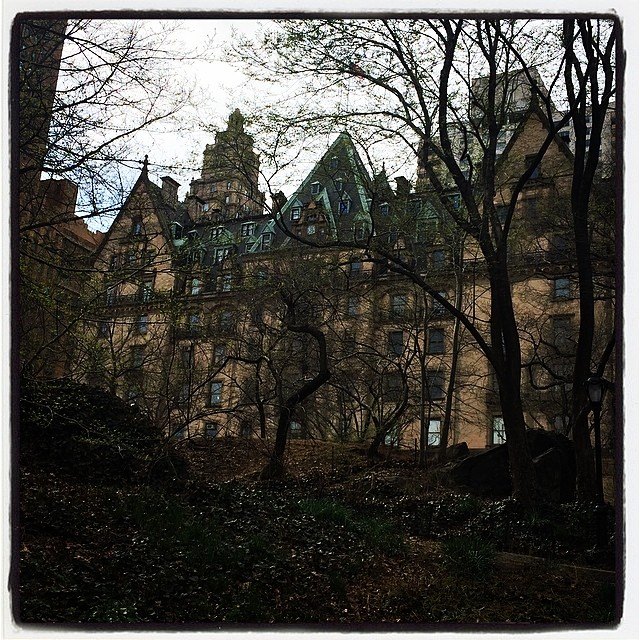
The Dakota, on the northwest corner of Central Park West and 72nd Street, was built between 1880 and 1884, and seemed as distant from the city and alone as the Dakota Territories (whether that was in fact the origin of the name, which is unclear, it was certainly true – it is bizarre to see photographs of the building in 1890 with just a scattering of short rowhouses in the far background, with nothing on either side or behind). The Dakota was the beginning of a building boom on the Upper West Side from 1885 to 1910, in part because of the creation of the city’s first subway line, the Broadway/Seventh Avenue line, making the area less remote from downtown. Being featured in the opening credits of “Rosemary’s Baby” certainly has not adversely impacted the value of the apartments in the Dakota, demonstrating that it takes a lot more than the prospect of living next to a group of Satanists to keep people away from a fabulous apartment in New York City.

The Majestic, built long after the Dakota in 1930-31, is a splendid example of minimalist Art Deco design, inside and out. The spare and square two towers were a result of the Multiple Dwelling Act of 1929, which restricted how tall a building could be immediately above street level, but allowed towers if the building would house a large number of people. The west side of the building has curved ornamentation that looks like the side of a jukebox. Take a peek in the lobby to enjoy the elaborate geometric designs that decorate the entrance.

Although I was walking along Central Park West, I was unable to resist turning into the park at W. 67th Street to look at the exterior of the newly renovated Tavern on the Green. Originally the location of a building to house the sheep that grazed (and kept the grass mowed to a civilized length) on Sheep’s Meadow in Central Park, it was converted to a restaurant as part of Robert Moses’ 1934 renovation of the park. Closed since December 31, 2009, it has just reopened. I will be interested to see how it has transformed; the Tavern I knew was certainly unique! The photographs I have seen from inside the renovated space look more understated and the menu seems promising. As I snapped a photo of the exterior of the building, I couldn’t help but notice One 57 looming in the background. The transformation of West 57th Street into “Billionaire’s Row” was certainly in some developer’s minds when Tavern shuttered in 2009, but was not yet cocktail party conversation, which it is now.

Walking along CPW, just a block or so west you can catch glimpses of Lincoln Center, a triumph of urban development that meant that the tenements shown in some of the beginning scenes of West Side story on the current site of Lincoln Center would be torn down immediately after filming. The people who lived in this area at that point would scarcely be able to believe the creation of a super-luxury building like 15 CPW (at 62nd Street), “the world’s most powerful address,” as a recent book declares.

Central Park West dead ends at Columbus Circle and the Time Warner Center. A mix between residential homes, office space, CNN studios, performance spaces (Jazz at Lincoln Center is there) and shopping areas, it signifies the transition from Upper West Side to Midtown. The statue of Columbus seems to turn his back with distain on Central Park West, instead looking south toward midtown. I can never see this statue without remembering the Public Art Works Project from 2012, where Tatzu Nishi created a living room in the air surrounding Columbus. Despite Columbus’ arrogant upthrust chin, hand on his hip, once you have climbed several flights of stairs to see him within a completely furnished living room with pink wallpaper and a large television, he never quite commands the same level of intimidation. Such is the power of art, and the joy of living in a city that values art enough to support innovative projects at no cost to the public.

Sutton Place

Image

A few weeks ago I took a dérive (an unplanned walk in an urban environment) in the Hell’s Kitchen area. If you were at the north edge of Hell’s Kitchen and walked all the way east until you reached the East River, you would realize how quickly Manhattan neighborhoods can change; from gritty Hell’s Kitchen, you would walk through rapidly evolving “Billionaire’s Row” along 57th Street in Midtown, and then eventually into quiet, laid-back Sutton Place. Because of the geography of Manhattan, it is often confusing to some to find that there are often areas east of “First” Avenue, despite its name. In lower Manhattan, you find Alphabet City – Avenue A, B, etc. Avenue A eventually becomes Sutton Place briefly in midtown, before changing its name to York Avenue on the Upper East Side and disappearing at 96th Street.

So how did Avenue A come to be called Sutton Place between 53rd and 59th Streets? In 1987, the delightfully named Effingham B. Sutton constructed a group of brownstones between 58th and 59th Streets, lending the area his last name, if unfortunately not the first. Even tiny Sutton Place is subdivided again into Sutton Place South (from 53rd to 57th) and Sutton Place North (from 57th to 59th). The area, quiet and seemingly removed from busy midtown just a few blocks away, has been home to residents as diverse as Marilyn Monroe and Arthur Miller, Aristotle Onassis, I.M. Pei, and Freddie Mercury (lead singer of Queen).

This dérive will begin at First Avenue and 59th Street, at the Bridgemarket development tucked under the Ed Koch (AKA the Queensboro, or 59th Street) bridge, home to a T.J. Maxx and a Food Emporium, as well as a Starbucks. Despite the pedestrian nature of those businesses, the Bridgemarket building is gorgeous inside, designed by Rafael Guastavino, who also did work on Grand Central Terminal and Grant’s Tomb (an interesting article on Guastavino and his son was recently on Curbed). Walking east, the bridge looms to your left; on the sunny early spring day when I did this walk, I found myself being unable to resist thinking of Simon and Garfunkel’s “59th Street Bridge Song.” This neighborhood does tend to make you agree with the sentiment, ”Slow down, you move too fast/Got to make the morning last” (even if no one has thought that they were “feeling groovy” for several decades now!).

Turning south to Sutton Place North, the buildings are post-war, except for a block of townhouses on the east side of the street. Crossing 59th Street, two imposing grand dames of Sutton Place South face each other, One and Two Sutton Place South. I tend to think that when Holden Caulfield refers to a “swanky party” on Sutton Place in Salinger’s The Catcher in the Rye, it must have taken place at one of these two buildings. Before you know it, Sutton Place South has ended in a turn west on 53rd Street.

I recently attended a broker’s open house for several large apartments on Sutton Place, and was struck at the value of some apartments in this area compared to similar ones on Park Avenue. Of course, you are farther east, but in addition to the Second Avenue subway being completed in the next several years, there is also the M31 bus that travels the length of 57th Street before turning north and going all the way up York Avenue to 91st Street. There are some apartments with wonderful views, too; the East River across to Queens and the iconic Pepsi sign, and even the bridge looming to the north. Manhattan is truly a series of neighborhoods as diverse as cities, and that is one major reason that I never tire of walking around this city

The High Line

Image

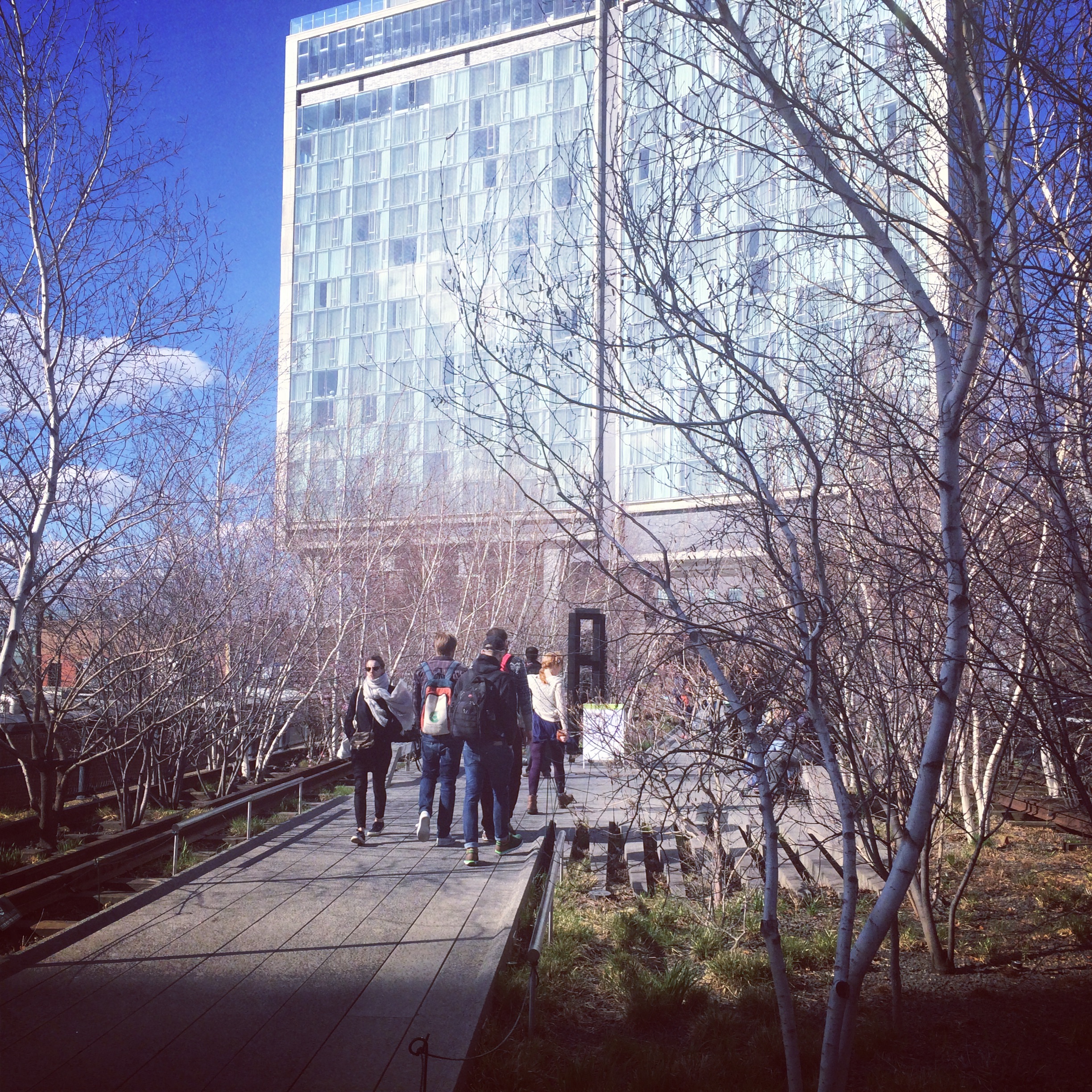
In previous blog posts I have discussed the concept of a dérive, an unplanned walk through an urban environment, and also mused on why city dwellers might be willing to pay a premium for a view of nature. This week’s derive is a little less unplanned, but might be one of the best examples of the value of being able to experience a taste of the countryside within the heart of Manhattan. The High Line is a one mile long park built along a previously abandoned railway line on the West Side of lower Manhattan. Beginning in the Meatpacking District on Gansevoort Street three blocks south of 14th Street, and continuing through Chelsea to 10th Avenue and 30th Street, this unique city park opened in 2009, with a northern expansion opening in 2011. It has spurred real estate development in this area, and many of the newer buildings specifically incorporated the High Line into their building plans.

In the mid-19th century, there was a non-elevated railroad along 10th Avenue, leading to so many accidents the area was called “Death Avenue.” The creation of an elevated railroad along 10th Avenue eliminated many of these dangerous crossings, and the trains could stop and deliver goods inside of the buildings without disrupting traffic. However, by the 1960’s the railway was no longer used and much of the elevated area fell into disrepair.  Scheduled for demolishment in the Giuliani years, it was saved by the creation of a non-profit organization, Friends of the High Line, in 1999. By 2004 NYC had earmarked $50 million to create a public park along sections of the remaining elevated track, and the first section opened in 2009. A huge success, the High Line has been virtually crime-free, in part because of the high visibility the park has from the surrounding buildings.

Starting at the southernmost end of the High Line, you can see the site of the new Whitney Museum of American Art, scheduled to move from its Lenox Hill location next year. Walking up to begin a tour of the High Line, you are struck by the wild beauty of the flowers and plants surrounding you, and the contrast of that with the gritty urban buildings rising on either side. The High Line seems an organic part of the neighborhood, with buildings seeming to grow around it. Walking along the High Line, it is interesting to see the railroad tracks appearing on occasion, sometimes recessed within the pathway and other times raised above it. The texture of the path itself changes over the course of the walk, echoing the changes in plants and flowers along different sections of the High Line.

As you pass 15th Street, look east and imagine the first Oreo cookie being made, in the same year that the Titanic sank. In New York, the layers of history are interesting to learn, this trendy neighborhood having seen many different incarnations over the years. When you get to 16th Street, consider popping downstairs to visit Chelsea market, in the former factory of the National Biscuit Company. Fruit, bread, wine, cheese, desserts, or prepared meals – there are a multitude of interesting shops to provide you with something to eat. At 18th Street, your eyes are drawn west to the fabulous Frank Gehry IAC building. Completed in 2007, it looks a bit like a huge glass bee hive. At 27th Street, look west to the south side of the street, and try and spot the McKittrick Hotel, not a hotel at all, but rather the home of the immersive theater piece, Sleep No More, created by British Punchdrunk Productions. I recently wrote a blog post  about immersive theater in general, so for now, just note that it is an enormous theater/art installation/dance piece in which you choose which parts of the story to follow. Consider stopping by the Heath, a restaurant on the top floor of the “hotel,” or having drinks at Gallows Green on the roof during warmer months.

I recently went to a presentation of a new residential building being built a block from the High Line; although it is about 18 months away from being completed, it launched sales a month ago and is already a third sold. The High Line can’t take credit for the radical changes in Chelsea, but it is certainly a unique injection of nature into this quintessential downtown neighborhood.

Times Square into Hell’s Kitchen

Image

My previous blog posts about taking unplanned walks in an urban environment (a dérive) have all centered around the Upper East Side of Manhattan. As Monty Python would say, “And now, for something completely different!”  This dérive will begin in what is perhaps the area of Manhattan that residents love to hate, Times Square, and will end in colorfully named Hell’s Kitchen.

I understand a resident’s tendency to avoid Times Square at all costs. Several times I have had a Broadway show to go to and fought through throngs of tourists looking up as I tried to move with a purpose toward a theatre. All too often, however, I think we overlook some aspects of NYC because they are familiar, and occasionally it’s good to step back and take a fresh look at some old clichéd parts of the city. I remember a time years ago when I was waiting for a light to change in midtown along with a crowd of other jaded preoccupied New Yorkers, and a car drove by with people literally hanging out the windows and exclaiming “WOW!” while snapping pictures. We all looked up to see what they were looking at and realized we were right under the Empire State Building, but oblivious to its grandeur.

For a dérive beginning in Times Square, pick a less crowded time (not thirty minutes before curtain, and definitely not on dreaded New Year’s Eve), emerge from the subway (you have a multitude to choose from) and for a moment really look at it – despite what you think, you are not too cool to realize the power and excitement of Times Square. Named because the New York Times once occupied the building that now hosts the infamous New Year’s Eve ball drop and formed by the intersection of Broadway, Seventh Avenue, 42nd Street, and 47th Street, this loud, blinding jumble of neon and giant screens is the world’s most visited tourist attraction, and gateway to the fabulous Broadway theatre district. Call it “Crossroads of the World,” “The Center of the Universe,” or “The Great White Way,” it is undeniably impressive. While there, if you spot someone taking someone’s picture (and you will), offer to take a photo of them together. I often do this and end up feeling better about myself as an ambassador for the city, fighting the unfair stereotype of rude New Yorkers.

Heading west on 44th Street, you pass Sardi’s, home of the famed theatre caricatures, on the south side of the street between Broadway and Eighth Avenues. The Tony Award was born at Sardi’s – after Antoinette Perry’s death, her partner thought up an award in her honor while having lunch here, and the restaurant itself was given a special award in 1947, the first year of the Tonys. Walking along 44th Street, you appreciate the compactness of the Broadway theatre district; unlike London’s West End, where shows are scattered over a large area, most Broadway shows are within  a relatively small area at most a few blocks from Times Square.

Crossing Eighth Avenue heading west, you have entered Hell’s Kitchen (roughly 34th Street to 59th Street, and Eighth Avenue to the Hudson River). Although there has been some interest in renaming it Clinton or even the generic Midtown West, I personally think that telling people you live in Hell’s Kitchen would be impressive! Although the area was once a bit gritty, it has been gentrifying and after rezoning in the past decade removed the restriction on buildings higher than six stories, several gleaming new condo towers now dot the neighborhood. Consider some of these “Chelsea North” – the style and views of the new Chelsea buildings at a slightly lower price. Walking north on Eighth Avenue, the advantages to this neighborhood are clear: Broadway theatres conveniently scattered to the east (imagine how easy it would be to pop over to the Eugene O’Neill to try the Book of Mormon lottery; with enough chances, you might eventually win front row seats for $32!), restaurants to the west (of particular note is Restaurant Row on 46th Street between Eighth and Ninth Avenues with about 40 places to eat on this block alone), and an undeniable sense of place.

 The amazing thing about New York City is that each neighborhood has its own personality and character. Hell’s Kitchen is certainly for those who like to be near the action, but also many of the side streets west of Ninth Avenue are surprisingly quiet and tree lined.  On some of these blocks you would feel far removed from the bright lights and clogged intersections of Times Square, and yet it is there for you to curse, or embrace while taking photos for grateful tourists, whenever you want.

Immersive theatre

Image

The abundance of the arts is one of my favorite things about living in New York City, and attending theater performances is certainly near if not at the top of my list. I enjoy all kinds of theater – Broadway (of course), off-Broadway, off-off Broadway – and each type has its own unique charm. However, there is a more recent form of theater that is not for everyone, but which can provide a thrilling experience for those open to a less predictable encounter – immersive theatre.

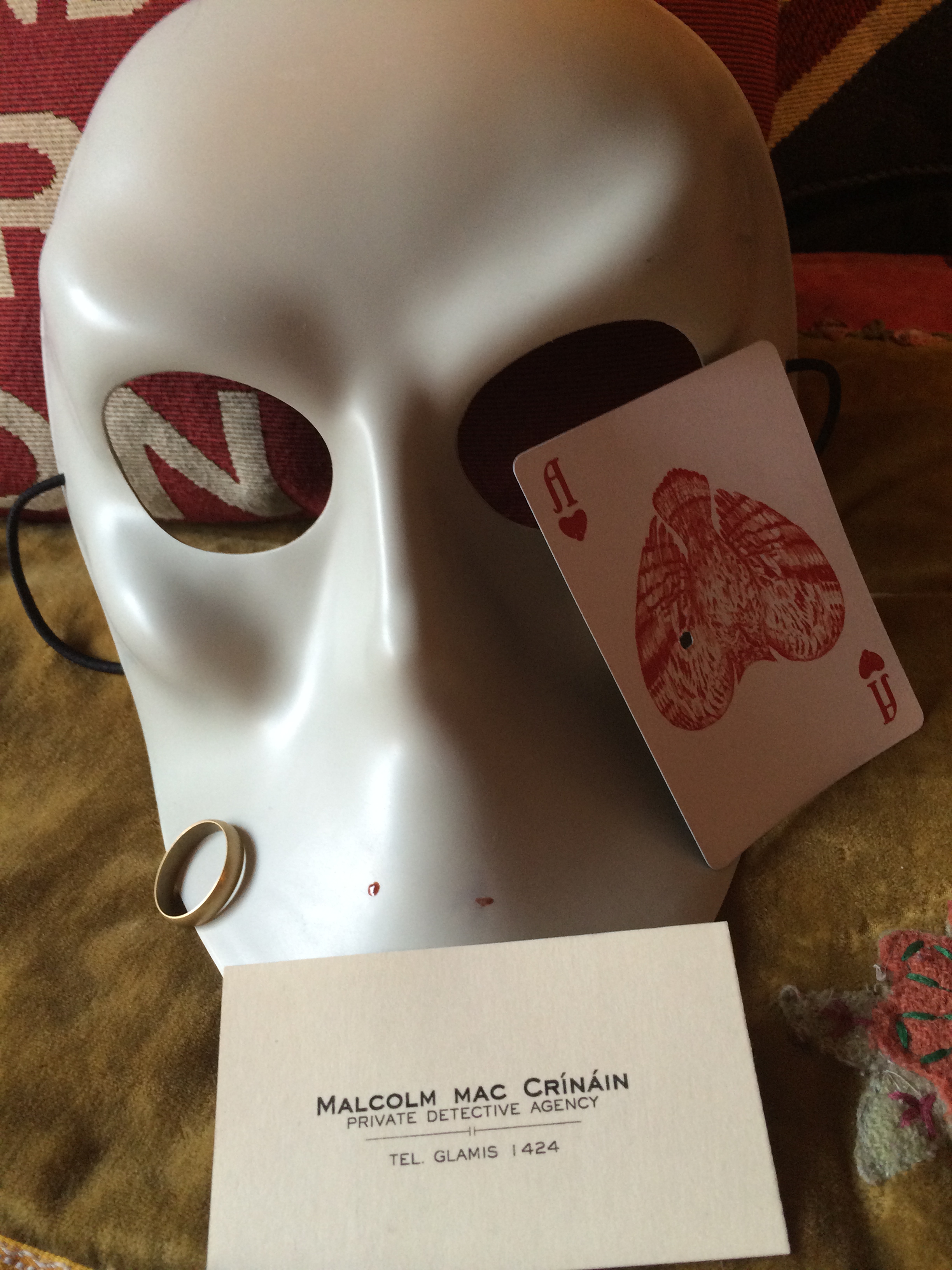
The grand dame of the genre here in New York City has been intriguing theater goers in NYC since 2011 – Sleep No More, at the McKittrick Hotel, 530 W. 27th Street, in Chelsea. A free-form mash-up between Macbeth and Hitchcock movies (especially “Rebecca”), previous incarnations of this theatrical event were presented in London in 2003 and in Boston in 2009. Created by Punchdrunk, a British theatre company founded in 2000 by Felix Barrett, Sleep No More follows this company’s innovative structure (or lack thereof). In a Punchdrunk production, as an audience member you are free to wander around a large performance space, which is decorated elaborately with an astonishing level of detail (in fact, it could be considered an art installation in its own right) and can be explored at will.  The costumes, set design, and music reflect the 1920-30’s, except for when Bernard Herrmann’s themes from “Vertigo” or “The Man Who Knew Too Much” interject a sense of danger, or when the witches’ prophecy to Macbeth turns into an electronic dance rave. Those attending the performance are welcome to sit at a desk and read psychiatric notes at length from Lady’s Macbeth’s doctor, nibble on candies from a shop, get lost in a cemetery, or wander a maze near a nurse’s hut. What you are not allowed to do is to talk or show your face (the audience is distinguished from the actors by wearing white masks). However, there are also actors/dancers (it’s as much a modern dance performance as a theatrical one) roaming the five floors and you can choose to follow one throughout an entire loop (a performance is comprised of three repeating hours with a finale), or change your mind and decide to follow another character they interact with. This freedom of choice sums up the thrill of immersive theatre, but also why it is overwhelming for some: the three hours you spend within the McKittrick will be yours to control. As opposed to traditional theatre where a director has decided how to present the theatrical experience to you, in Punchdrunk’s version of immersive theatre, you largely direct the experience yourself. If you go many times (and I have!), you have the capacity to create a unique experience for each of those times. As you are admonished when you enter, “fortune favors the bold,” and the greater your willingness to open unlocked doors or be led into a private area for a one-on-one experience with one of the actors, the deeper your enjoyment of the experience will be.

Punchdrunk currently has a different production running in London, near Paddington Station, called The Drowned Man. Based loosely on elements of Georg Büchner’s unfinished play, “Woyzeck,” as well as Nathanael West’s “Day of the Locust,” this production exists on a more epic scale from Sleep No More, within several floors of a very large building (previously a mail sorting facility). The theme of duality pervades the experience, which takes place at the wrap party of a film shoot at the fictional Temple Studios in Los Angeles in the early 1960s.  Two largely separate but similar storylines take place, one within the gates of the studio, and another outside the gates within the town. As in Sleep No More, the performance space is elaborately decorated, and the set, music and costumes reflect the time and place (ironically, set in America despite being in London – while Sleep No More is set in Scotland but is in New York). What I found, experiencing The Drowned Man after many experiences with Sleep No More, is that although the basic structure remains similar, the shows themselves are strikingly different in tone but equally thrilling. The actors speak more in The Drowned Man, and the storyline is more explicit. This production will be closing this summer, unfortunately, but if you have the chance to be in London before it does, I highly recommend checking it out.

My advice for anyone attending a Punchdrunk performance for the first time is to wander until you find a character, and then begin following him or her. The first time I attended Sleep No More I ended up on the fifth floor, and explored the rooms for almost an hour before even finding an actor. I left the evening with an appetite to experience more, but if there is even the chance that you may only experience a Punchdrunk performance only once, the experience will be greatly enhanced by trying to follow a thread of the storyline through a few actors’ performances. Wear comfortable footwear – if you have a busy evening you will likely be doing a lot of walking (perhaps even running) and multiple flights of stairs. My final piece of advice is not to try to stay with the person or people you arrived with – you aren’t allowed to talk and holding hands blocks up passageways for others (it’s very annoying to try to follow a character, but then lose them because you can’t get around a couple of confused people blocking the stairwell). You will likely have a much more satisfying experience exploring on your own, and then discussing your separate experiences over drinks after the performance.

At the McKittrick Hotel, site of Sleep No More in Chelsea, you can even enjoy delicious drinks and dinner while experiencing a taste of immersive theater. The Heath, a restaurant on the sixth floor of the building, is set as if you were enjoying a railway restaurant in a village in Scotland. As you enter the elevator, a sign warns, “This is no ordinary station and things are not always as they appear. If you are lucky enough for one of our residents to invite you into their space, you might experience an intense psychological situation. Please note that you may decline, however, fortune does favor the bold . . .” Live music and hosts in character, who may or may not whisk you away for a mysterious phone call or to open a back room with a key delivered on a silver platter, complete the unique atmosphere. And, yes, the food and drinks are excellent as well!

Punchdrunk may have originated immersive theatre, but they no longer have the monopoly on it. In Williamsburg, Brooklyn, Third Rail Projects has created Then She Fell, an immersive theatrical/dance experience on a much smaller scale than Sleep No More. Limited to only 15 audience members per show, it is based on the fictional characters in “Alice in Wonderland” but also explores the complex relationship between the real author of the work, Oxford mathematics Professor Charles Dodgson (pen name: Lewis Carroll), and the young daughter of the Dean of Christ Church College, Alice Liddell. In this immersive experience, you are not the director of your own experience: you are led by performers into a series of one-on-one (or in some cases, like the tea party run by the Hatter, small group) experiences. Occasionally you find yourself in a carefully curated room for a period of time, and are welcome to explore before a performer comes in to interact. Alcoholic drinks and food may be a part of the evening, depending on your particular experience. In this performance, you guaranteed not to see everything in one round, and in fact may not see the person you came with for the entire evening; they may have had some of the same experiences, but in a different order.

Queen of the Night, a recent foray into Manhattan immersive theatre, is at the Diamond Horseshoe Revue at the Paramount Hotel in midtown. Loosely based on Mozart’s character in “The Magic Flute,” it is far less interactive, and includes an element of dinner theatre (albeit a risqué version!). Alcoholic drinks and food are included, and there is a Cirque-type show to be watched while eating. While entering the venue and selecting a pre-show cocktail, there is a strong likelihood that you will be taken off for an interactive experience with one of the performers. Once seated at the tables (and unless you have a large group, you will likely share a table with people you didn’t know before you arrived) food arrives – but not necessarily the same food that tables nearby have. If you are up to the experience, you can barter some of your food with other tables. When I went, our table had lobster, so it was fairly easy to barter some of that for prime rib with our neighbors. While it is interactive in the sense that you may have an experience or two with performers, you do not direct your own experience. The drinks and wine are plentiful, so if you go into this ready to have a good time, and open to interacting with other members of the audience, you are likely to have a fun evening.

Immersive theatre seems to have influenced many productions, which break or eliminate the fourth wall despite being more traditional theatrical experiences. Here Lies Love at the Public Theater on Lafayette Street, certainly does not qualify as true immersive theater, but it is certainly more free-form than traditional theater. David Byrne wrote this musical version of a surprising (Imelda Marcos) story, and it was first presented last year at the Public but is back again this year due to popular demand. You don’t direct the experience yourself, but on the main floor you are not seated in static traditional style, but rather stand and move around to see different parts of the story. You may have a character interact with you or ask to dance with you, but that is the limit to the immersion.

My personal bias is that I think that the freedom Punchdrunk productions allows a participant is exhilarating, and that is what makes their shows so addictive – you can keep returning and experiencing something different. There is an exciting change that occurs from watching television or a film to experiencing live theater – the knowledge that events are happening in real time with people performing in your space with you. Immersive theatre takes that up one more level. Not only are things happening at the moment that you see them, but you can become a part of them, and possibly even take control of directing the theatrical experience you have. If you are willing to embrace the unknown and take risks, the satisfying result will prove that fortune truly does favor the bold.

The value of a city view

Recently I gave my personal perspective on the value of an apartment with a view of nature after touring a series of Upper East Side penthouses with terraces. A few days after writing that post,  I was able to view a spectacular apartment on the Upper West Side with tremendous south facing city views; even the master bathroom had a window with a perfectly framed view of the Empire State Building! Now that it has programmable LED lights and even twinkles on occasion (thank you, Tour Eiffel, for the idea – imitation is indeed the sincerest form of flattery), I was captivated by the idea of taking a bath while looking at an ESB light show. The other day I also saw another apartment uptown which has the misfortune of being in a building with an entrance blocked by the Second Avenue subway construction, but also with great south facing views. It made me wonder, what is the value of an iconic city view?

The most obvious answer, of course, is that its value reflects market demands; the price a qualified buyer is willing to pay more for that apartment compared to an identical apartment in the same building without the view is the value. But why do we value an iconic view above one without one but with as much open space and light?

Perhaps for some it is conveys status; an apartment with an iconic city view clearly cost the buyer more. However, I believe that for many it is more than that. The feeling I get when I am in a wonderful apartment with a view of New York City’s stunning skyscrapers is a cinematic one. So many filmmakers have set the scene with a sweeping view of our skyline that to have such a view from the windows of our own homes roots us firmly in the city. The idea of mise-en-scène, the generating of a sense of time and place in a film, and setting a mood, can generalize to an individual’s creation of the kind of feeling they want in their home. For me, a city view embraces New York and all that it represents, grounding a person in this place and time.

So which is worth more, the view of nature that answers our animal beginnings, or the view of the city that sets us clearly within our current human-made environment? It’s an individual choice, and the one that speaks to you when you see an apartment will reveal which provides value to you.

Lenox Hill

Image

Although there are many wonderful parts of New York City, and I plan to be walking through many in upcoming posts, after describing parts of Yorkville, Carnegie Hill, and Upper Carnegie Hill into El Barrio (see previous blog entries), it made sense to complete my tour of the Upper East Side with a dérive in Lenox Hill. As a reminder, Wikipedia defines a dérive as “an unplanned journey through a landscape, usually urban, on which the subtle aesthetic contours of the surrounding architecture and geography subconsciously direct the travellers, with the ultimate goal of encountering an entirely new and authentic experience.” As mentioned in earlier posts, I find that walking through a neighborhood gives me the best instinct for what it would be like as a place to live .In addition, it allows me to connect with the city in a more tangible way, as a part of it rather than as an observer of it.

Lenox Hill is an area of the Upper East Side of Manhattan between 77th Street and 60th Street, and between Lexington and Fifth Avenues. Lenox Hill itself was at what is now Park Avenue and 70th Street, and named for Robert Lenox, who owned much of the land in this area in the early 19th century (interesting fact: he was the executor of Archibald Gracie’s will, the same Gracie who built the mansion now used as the New York City mayor’s residence in Carl Schurz Park).

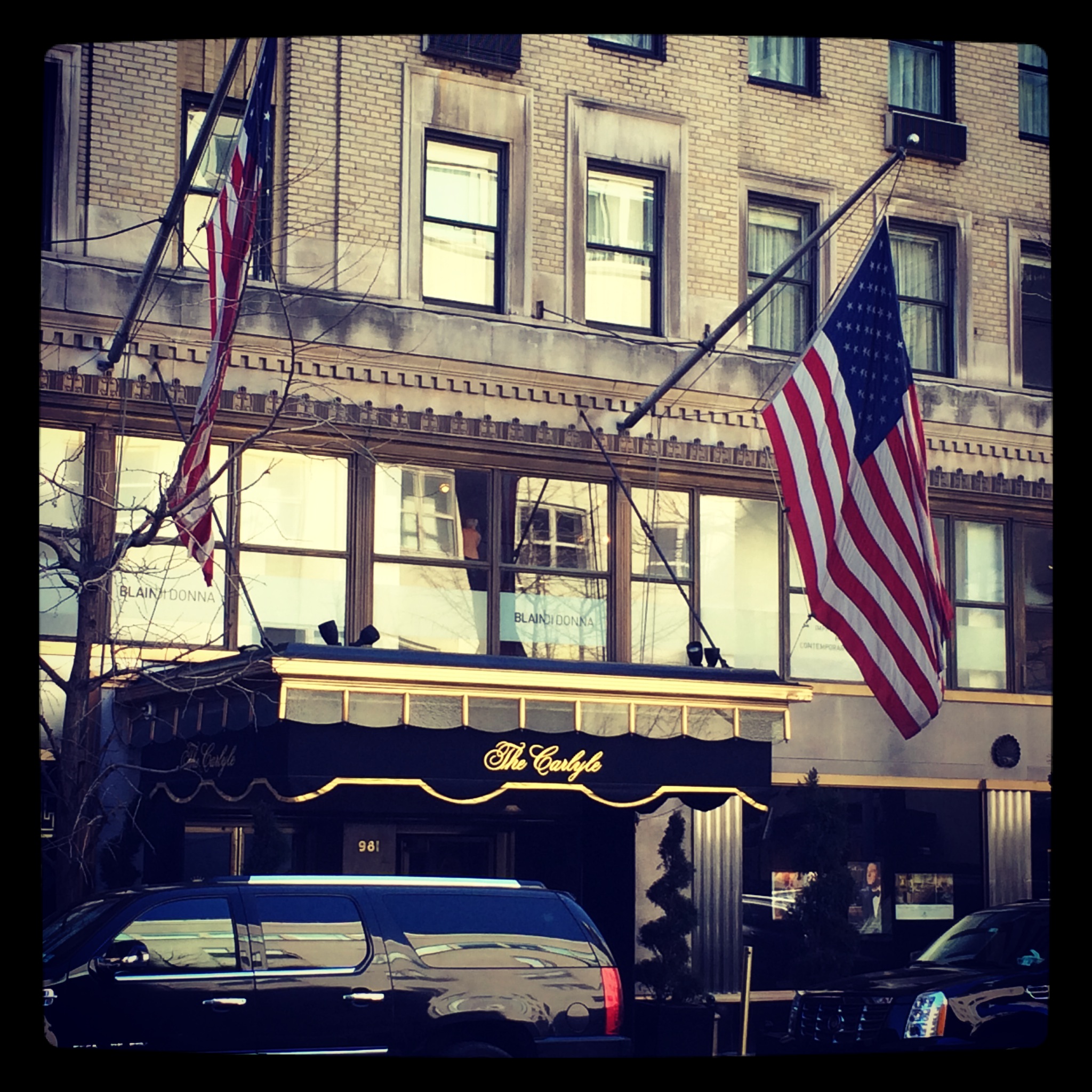
Starting on Madison and 77th, you can see two classic Upper East Side hotels – the Mark on 77th between Fifth and Madison, and the Carlyle (known as “The New York White House” during President Kennedy’s term) on Madison between 77th and 76th Streets. Both have a few residences as well as hotel rooms, if a home with maid and room service is what you have always wanted!  The Carlyle is also the home of Café Carlyle, the famous supper club where you can have dinner while hearing live cabaret or jazz performances. Walking south on Madison, you also run across two unique pharmacies: Zitomer’s, on Madison between 76th and 65th, and Clyde’s on Madison and 74th. Both are a far cry from the chain pharmacies that proliferate every few blocks –  if you are looking for an obscure European skin care product or a scented candle from Santa Maria Novella in Italy, try one of these distinctive shops.

At Madison and 75th Street is the new home of the modern art collection of the Metropolitan Museum, in the brutalist building once occupied by the Whitney Museum before its move to the Meatpacking District at the southern end of the High Line Park.

Continuing south on Madison is an enjoyable stroll, with the window displays of the designer shops themselves providing an artistic experience. Looking right while heading south on Madison, you can see beautiful rows of townhouses lining the blocks, and Central Park beckoning just on the other side of Fifth Avenue. Looking left, you see quiet residential blocks and, just one block over, the majestic expanse of Park Avenue. Fairly unique to this neighborhood is the contrast between the densely packed shops and restaurants all along Madison and Lexington Avenues, and the primarily residential expanses on the cross streets and along Fifth and Park Avenues.


The value of a view

Recently I had the opportunity to attend a broker’s open house tour, featuring Upper East Side penthouses with terraces. All the apartments included gorgeous interiors, large functional kitchens, and comfortable bedrooms – and yet I found myself constantly drawn to the windows with a view of Central Park. Even walking into another room adjacent to one I had just walked through enjoying the view, I would be unable to resist walking over to the windows to gaze once again at the spectacular scenery. For me, the highlight of each apartment tour was a trip outside to walk along a spacious terrace – even though on that particular day, the temperature was unseasonably cold. Many people think of a park view or terrace as a status symbol, and yet I was drawn to each simply as an observer, with no one there to be impressed (or not). As I finished up a few enjoyable hours at several wonderful buildings, I found myself wondering: what is the value of a view?

Since the apartments I was touring all had Central Park views, with trees, rolling hills, and a large body of water (the reservoir), my mind turned to the work of Diane Ackerman (author of The Natural History of the Senses, among many other works).  I heard her speak many years ago, and was struck by her observation that, as the human animal moves into increasingly artificial environments, we crave adding nature back into our habitats. This could be through cultivating plants in our tiny apartments, keeping companion animals, or spending a premium to see nature unfurl through our windows (or on our terrace). Human-made objects tend to be linear and three dimensional; natural objects tend to be more serpentine and of fractional (fractal) dimensions. The world we have created is fairly static and unchanging, while nature is constantly chaotic and fluctuating. Ackerman proposes that people need nature; we evolved as a part of the natural world and our industrial, mechanical world is too recent a development to completely remove this primal need.

So, is paying a higher price for an apartment with a view worth it? Of course, this is a personal decision for everyone looking to buy a home. For me, I can say that it does have value, and the only way you can be sure if it is worth it to you is to include a few options with views and see how you respond.

While these concepts apply to view of nature (whether Central Park, some other park, or a river), in another post I will discuss the different value of a city view. In my next blog post I will be back with another dérive (an unplanned walk around Manhattan).

Image

Central park : from the boat pond to Strawberry Fields

I had another blog post written for this week, complete with photos. Then, New York City decided to break into spring – finally, after a persistent and painful winter, it was suddenly warm, sunny, and bursting with new blooms. I was compelled to take a dérive in Central Park, as it beckoned a block from my office. A dérive, as described in more length in previous posts, is an unplanned walk within an urban landscape. While Central Park is undeniably beautiful and delivers a much-needed injection of nature into our lives in the concrete jungle, it is still supremely urban. One of the best aspects of Central Park is the way that massive buildings line the edges of the park, like an irregular geometric frame around a lush Impressionistic painting.

Entering the park at Fifth Avenue and 79th Street, the first thing that struck me was the fields of daffodils in bloom. Something I love about NYC is the way Christmas trees are recycled each year. As depressing as it can be to see dried trees lining the streets waiting to be picked up in January, they are turned into mulch that is used in city parks to protect and fertilize the bulbs that create these oceans of yellow in April! Walking roughly south, eventually you run into the sailboat pond, full of remote-controlled small boats on clear spring and summer days. Gazing at the pond, unless completely covered in climbing children, is the famous Alice in Wonderland statue. Commissioned in 1959 by George Delacorte, whose philanthropy has enriched many areas of the park, it was designed to be interacted with by children. The statue of Alice was based on the sculptor José de Creeft’s daughter, and the face of the Mad Hatter is a sly tribute to Delacorte himself. Also looking at the pond with his back to the west side, is a statue of Hans Christian Andersen absent-mindedly feeding a duck while staring at the apartment buildings on Fifth Avenue (perhaps looking for a hawk’s nest).

Heading west, you soon come across the Loeb Boathouse, an elegant restaurant (and, with Tavern on the Green gone, the only place within the park that deserves getting dressed up for). They even have a shuttle along upper Fifth Avenue for those who are too dressed up to walk to the restaurant through the park. The Boathouse sits on the location of an old functional structure that was used to store the rowboats that have launched from this location since the late 1800’s (and you can still rent them next to the restaurant). There is even a gondola for hire!

Walking past the Boathouse, roughly west, you come across the majestic clearing surrounding the Bethesda Fountain. Unveiled in 1873, Bethesda Fountain was created to commemorate the Civil War dead, based on a passage in the New Testament about a pool that healed anyone who stepped into it. However, to me it is always the symbol of healing from Tony Kushner’s brilliant Angels in America, when Prior says about it, “This angel. She’s my favorite angel. I like them best when they’re statuary. They commemorate death but suggest a world without dying. They are made of the heaviest things on earth, stone and iron, they weigh tons but they’re winged, they are engines and instruments of flight.” (Epilogue.17)

Continuing to head west, you enter Strawberry Fields. Dedicated to the memory of John Lennon and recognized by 121 countries as a Garden of Peace, it is officially a “quiet zone,” but you are likely to come across a performer playing Beatles tunes near the famous Imagine mosaic. The mosaic was given to the city of New York as a gift by the city of Naples, and was dedicated on October 9, 1985, on what would have been John Lennon’s 45th birthday.

So much to see on even such a relatively short walk in Central Park! The Park belongs to all New Yorkers, not just those fortunate enough to look out the windows of their homes and watch the seasons play out throughout the year. If you’re not a New Yorker, you are as always welcome to explore it as our guest; perhaps someone will even offer to take your picture at the Bethesda Foundation.Image