Times Square into Hell’s Kitchen

Image

My previous blog posts about taking unplanned walks in an urban environment (a dérive) have all centered around the Upper East Side of Manhattan. As Monty Python would say, “And now, for something completely different!”  This dérive will begin in what is perhaps the area of Manhattan that residents love to hate, Times Square, and will end in colorfully named Hell’s Kitchen.

I understand a resident’s tendency to avoid Times Square at all costs. Several times I have had a Broadway show to go to and fought through throngs of tourists looking up as I tried to move with a purpose toward a theatre. All too often, however, I think we overlook some aspects of NYC because they are familiar, and occasionally it’s good to step back and take a fresh look at some old clichéd parts of the city. I remember a time years ago when I was waiting for a light to change in midtown along with a crowd of other jaded preoccupied New Yorkers, and a car drove by with people literally hanging out the windows and exclaiming “WOW!” while snapping pictures. We all looked up to see what they were looking at and realized we were right under the Empire State Building, but oblivious to its grandeur.

For a dérive beginning in Times Square, pick a less crowded time (not thirty minutes before curtain, and definitely not on dreaded New Year’s Eve), emerge from the subway (you have a multitude to choose from) and for a moment really look at it – despite what you think, you are not too cool to realize the power and excitement of Times Square. Named because the New York Times once occupied the building that now hosts the infamous New Year’s Eve ball drop and formed by the intersection of Broadway, Seventh Avenue, 42nd Street, and 47th Street, this loud, blinding jumble of neon and giant screens is the world’s most visited tourist attraction, and gateway to the fabulous Broadway theatre district. Call it “Crossroads of the World,” “The Center of the Universe,” or “The Great White Way,” it is undeniably impressive. While there, if you spot someone taking someone’s picture (and you will), offer to take a photo of them together. I often do this and end up feeling better about myself as an ambassador for the city, fighting the unfair stereotype of rude New Yorkers.

Heading west on 44th Street, you pass Sardi’s, home of the famed theatre caricatures, on the south side of the street between Broadway and Eighth Avenues. The Tony Award was born at Sardi’s – after Antoinette Perry’s death, her partner thought up an award in her honor while having lunch here, and the restaurant itself was given a special award in 1947, the first year of the Tonys. Walking along 44th Street, you appreciate the compactness of the Broadway theatre district; unlike London’s West End, where shows are scattered over a large area, most Broadway shows are within  a relatively small area at most a few blocks from Times Square.

Crossing Eighth Avenue heading west, you have entered Hell’s Kitchen (roughly 34th Street to 59th Street, and Eighth Avenue to the Hudson River). Although there has been some interest in renaming it Clinton or even the generic Midtown West, I personally think that telling people you live in Hell’s Kitchen would be impressive! Although the area was once a bit gritty, it has been gentrifying and after rezoning in the past decade removed the restriction on buildings higher than six stories, several gleaming new condo towers now dot the neighborhood. Consider some of these “Chelsea North” – the style and views of the new Chelsea buildings at a slightly lower price. Walking north on Eighth Avenue, the advantages to this neighborhood are clear: Broadway theatres conveniently scattered to the east (imagine how easy it would be to pop over to the Eugene O’Neill to try the Book of Mormon lottery; with enough chances, you might eventually win front row seats for $32!), restaurants to the west (of particular note is Restaurant Row on 46th Street between Eighth and Ninth Avenues with about 40 places to eat on this block alone), and an undeniable sense of place.

 The amazing thing about New York City is that each neighborhood has its own personality and character. Hell’s Kitchen is certainly for those who like to be near the action, but also many of the side streets west of Ninth Avenue are surprisingly quiet and tree lined.  On some of these blocks you would feel far removed from the bright lights and clogged intersections of Times Square, and yet it is there for you to curse, or embrace while taking photos for grateful tourists, whenever you want.

A walk around Carnegie Hill

For today’s dérive (an unplanned journey through an urban environment; see my previous posts), you are in another sub-neighborhood of the Upper East Side in Manhattan – Carnegie Hill. Yes, this area is named after Andrew Carnegie of Carnegie Hall fame, whose former mansion now houses the Cooper-Hewitt National Design Museum (part of the Smithsonian). The rough outlines of this neighborhood are E. 86th Street to the south, Third Avenue to the east, Fifth Avenue to the west, and E. 96th to the north (although with recent gentrification of the area near the park north of E. 96th, some call that area Upper Carnegie Hill rather than East Harlem).

Standing on the south side of 86th and Fifth, the imposing bulk of the Metropolitan Museum is still visible a few blocks behind, but the smaller, elegant, Neue Galerie (dedicated to early 20th Century German and Austrian art) sits on the corner, signaling a change from grand to more intimate. Walking north on Fifth, Central Park is an overwhelming presence to your left, but I will leave a dérive in Central Park for later in the spring, when it is a riot of color with seas of sunny daffodils and explosions of pink and white blossoms from the flowering fruit trees (although the Park has its own special beauty covered in snow, this particular winter has left me longing for spring).

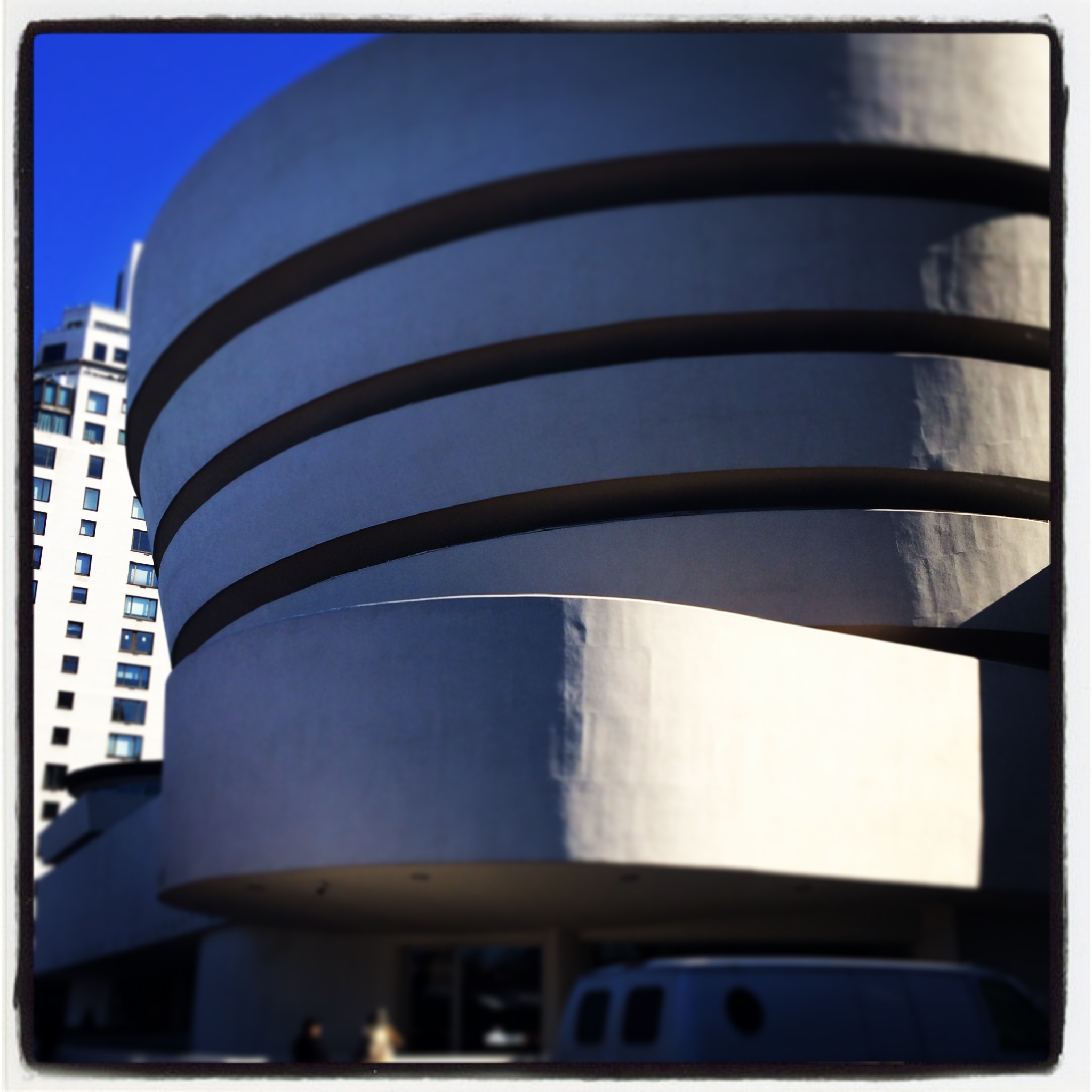
At Fifth and 88th, it is impossible to miss the Guggenheim Museum, whose most impressive work is the iconic Frank Lloyd Wright building itself. Built in 1959, it was intended to be a “temple of the spirit,” and the museum is known for using its innovative space creatively to showcase exhibitions. The Maurizio Cattalan exhibition in 2011, “All,” hung over 100 of the artist’s works from the ceiling, and the observer experienced the pieces from different perspectives while moving around in the museum’s circular ramps. The museum also hosts special events during the year, including an excellent “Works & Progress” series that shows the creative process behind developing works in dance, music, or drama.

Once you have passed the Guggenheim, the quiet nature of this neighborhood truly reveals itself; other than the museums, it is primarily a residential neighborhood. In fact, until the Church of the Heavenly Rest opened its “Heavenly Rest Stop” on Fifth between 89th and 90th Streets, there were few places to get a quick bite to eat or a cup of coffee unless venturing to the east to Madison. On Fifth between 90th and 91st, there is the namesake of the neighborhood, Andrew Carnegie’s mansion, now the Cooper-Hewitt National Design Museum (currently closed for renovations but due to reopen later in 2014).  It’s hard to imagine, but this 64-room mansion was once the home of Carnegie, his wife, and their daughter! It was the first home in the United States to have a structural steel frame, the first in New York City to have an Otis elevator, had heat and central air conditioning (certainly unusual for the turn of the 20th century) and the conservatory was made entirely of Tiffany glass.

Continuing north on Fifth, on the corner of 92nd is the Jewish Museum, which recently held a wonderful retrospective of Art Spiegelman’s work (most notably, Maus). Like the Cooper-Hewitt, the Jewish Museum also occupies a former family mansion, that of the Warburgs.

Turning east on 92nd, one is struck by the quiet elegance of these off-avenue blocks, dotted with townhouses. When I first visited the Pimlico neighborhood in London, it reminded me of Carnegie Hill, edged by the Thames rather than Central Park, but with the same peaceful quiet on side streets. The northwest corner of 92nd and Madison houses Ciao Bella, a New York City local gelateria with intense flavors as varied as blood orange and malted milk ball.

On Madison Avenue in Carnegie Hill, there is an abundance of shops, many one of a kind, and casually refined restaurants where it is unlikely to be too noisy to hear your companion’s conversation.  Sarabeth’s, on Madison between 92nd and 93rd on the east side of the street, is a neighborhood staple, and getting a table for brunch can involve a bit of patience if you didn’t have the foresight to make a reservation (they are on OpenTable).

Continuing east on 92nd, you cross Park Avenue – be sure to look south and appreciate the expansive view all the way to the MetLife building above Grand Central. The buildings along Park Avenue provide financial support to maintain the malls in the middle of the divided street. In the spring, there are carpets of tulips, and the holiday season brings a forest of evergreen trees lit with tiny white lights (started in 1945 to honor those who died fighting in World War II).

At Lexington and 92nd Street, this dérive will end at the 92nd Street Y, a cultural and community center serving the neighborhood since 1874. In addition to the classes and sports club offered on the site, it regularly hosts concerts, lectures by notables, dance performances, and film screenings.

The Carnegie Hill Historic District was created in 1974 to preserve the unique environment of much of this neighborhood, ensuring that Carnegie Hill retains the quiet understated elegance that makes this an inviting place to walk through or live in.Image

Yorkville: From Lexington and 86th Street to the East River Promenade

Although the Upper East Side is roughly a large rectangle of space bounded by 59th and 96th Streets to the south and north, and from Fifth Avenue across to the East River, within this large area are several distinct neighborhoods. Today I will be taking a dérive through Yorkville. In my first blog post, I explained the concept of a dérive – an unplanned journey through an urban environment.

Getting off the 4, 5, or 6 at the E. 86 subway stop puts you on busy, commercial 86th Street. Heading east, make sure to enjoy the fantastic burger smells emanating from Shake Shack on the south side of the block between Lexington and Third (following in my footsteps, if you have the time and the line is not snaking out the door, go in and treat yourself to Danny Meyer’s brisket-infused delicacy). When you cross Third Avenue, you have entered Yorkville. The highlight of this block to me, a resident, is the excellent Fairway Market. From experience, I can recommend that you try to avoid shopping after 6 PM on weeknights or virtually any time on Saturday, when the lines to check out can become tangled with the mass of people trying to get on the elevator for the lower level, making for a stressful experience. Crossing Second Avenue, one gets the less-than-scenic view of a large construction site for the long awaited Second Avenue Subway line. Estimated completion date for the line is December, 2016, and I hope they are not too far off! In the early 20th century, Yorkville was a German immigrant enclave, and crossing Second and looking south, you can see evidence of that – a German biergarten, Heidelberg Restaurant.
Getting to First Avenue, the Duane Reade on First and 86th is much like every other Duane Reade in New York, but was recently renovated. As an aside, I once had an interesting conversation with Dan Ackroyd while waiting to pick up a prescription here (Pope Benedict was visiting the area at the time, leading to an amusing chat with him about the pontiff). Turning north on First on the east side of the street will take you by Glaser’s (http://www.glasersbakeshop.com/) between 87 and 88th. This bakery, started in 1902 by German immigrants, is a neighborhood staple, and on weekends and holidays the lines can be formidable. In my household, my girls have always just called this “the bakery” (as in, “Could you get me some bakery brownies?”) and may not in fact know the actual name. I suspect it is just “the bakery” for many loyal neighborhood residents.

Arriving on E. 88th, turn right and head east. How many of you read to your children (or were read to as a child) The House on East 88th Street by Bernard Weber? The sequel was called Lyle, Lyle Crocodile, after the star of both books. On the south side of the street on this block is The Shaggy Dog, a pet grooming business. When Bernard Weber came to my daughters’ school once, he showed a photo of The Shaggy Dog when describing his choice of E. 88th for the location of his book, making me believe that the fictional Lyle might in fact have lived on this block.

Crossing York, ahead you can see the first glimpses of Carl Schurz Park. Once again, the old German roots of this neighborhood emerge, as the park was named after German-born Secretary of the Interior Carl Schurz in the early 20th Century. As you cross East End, eyes are drawn to something very unusual in Manhattan – a two story wooden mansion. Built in 1799 and the official home to mayors of New York City since LaGuardia (except for Michael Bloomberg, who had an even better home on E. 79th Street near Fifth that he couldn’t bear to leave). A tip for those living the area with children: it’s a great spot for trick or treating. Giuliani handed out candy personally during his time at Gracie Mansion, and during the Bloomberg years, the mayor would leave candy with the security detail to hand out. (Perhaps in another blog post later in the year I will give some more detailed personal tips about trick or treating in the neighborhood.)

Carl Schurz Park is just lovely; it is of course much smaller than Central park but also more cohesive, with a uniform look. Like Central Park, it has a Conservancy group for its maintenance (http://www.carlschurzparknyc.org/). Although there are not off-leash hours for your dogs like there are in Central Park, there are two dog runs where you can take your dog to play with others off-leash within a gated area. The small dog run is for dogs up to 25 pounds, and the large dog run is for dogs larger than that (or for smaller dogs with big attitudes; my beagle fits this category). Because Carl Schurz Park is relatively narrow; even a short wander will take you to the East River Promenade, with a fantastic view of the East River’s “Hell Gate” and its ferociously swirling currents.

My dérive is over, and there are so many other aspects of this neighborhood that I regret not being able to mention, but you will have to check out this area for yourself and see what you discover. From experience, I can tell you that Yorkville is a convenient (even more so once the Second Avenue Subway is finished, but for now there are Select Bus Service routes on First and Second) and comfortable neighborhood to visit or live in. As a real estate professional, I will also note that this neighborhood offers great value for someone looking to purchase a home.
Yorkville