Central park : from the boat pond to Strawberry Fields

I had another blog post written for this week, complete with photos. Then, New York City decided to break into spring – finally, after a persistent and painful winter, it was suddenly warm, sunny, and bursting with new blooms. I was compelled to take a dérive in Central Park, as it beckoned a block from my office. A dérive, as described in more length in previous posts, is an unplanned walk within an urban landscape. While Central Park is undeniably beautiful and delivers a much-needed injection of nature into our lives in the concrete jungle, it is still supremely urban. One of the best aspects of Central Park is the way that massive buildings line the edges of the park, like an irregular geometric frame around a lush Impressionistic painting.

Entering the park at Fifth Avenue and 79th Street, the first thing that struck me was the fields of daffodils in bloom. Something I love about NYC is the way Christmas trees are recycled each year. As depressing as it can be to see dried trees lining the streets waiting to be picked up in January, they are turned into mulch that is used in city parks to protect and fertilize the bulbs that create these oceans of yellow in April! Walking roughly south, eventually you run into the sailboat pond, full of remote-controlled small boats on clear spring and summer days. Gazing at the pond, unless completely covered in climbing children, is the famous Alice in Wonderland statue. Commissioned in 1959 by George Delacorte, whose philanthropy has enriched many areas of the park, it was designed to be interacted with by children. The statue of Alice was based on the sculptor José de Creeft’s daughter, and the face of the Mad Hatter is a sly tribute to Delacorte himself. Also looking at the pond with his back to the west side, is a statue of Hans Christian Andersen absent-mindedly feeding a duck while staring at the apartment buildings on Fifth Avenue (perhaps looking for a hawk’s nest).

Heading west, you soon come across the Loeb Boathouse, an elegant restaurant (and, with Tavern on the Green gone, the only place within the park that deserves getting dressed up for). They even have a shuttle along upper Fifth Avenue for those who are too dressed up to walk to the restaurant through the park. The Boathouse sits on the location of an old functional structure that was used to store the rowboats that have launched from this location since the late 1800’s (and you can still rent them next to the restaurant). There is even a gondola for hire!

Walking past the Boathouse, roughly west, you come across the majestic clearing surrounding the Bethesda Fountain. Unveiled in 1873, Bethesda Fountain was created to commemorate the Civil War dead, based on a passage in the New Testament about a pool that healed anyone who stepped into it. However, to me it is always the symbol of healing from Tony Kushner’s brilliant Angels in America, when Prior says about it, “This angel. She’s my favorite angel. I like them best when they’re statuary. They commemorate death but suggest a world without dying. They are made of the heaviest things on earth, stone and iron, they weigh tons but they’re winged, they are engines and instruments of flight.” (Epilogue.17)

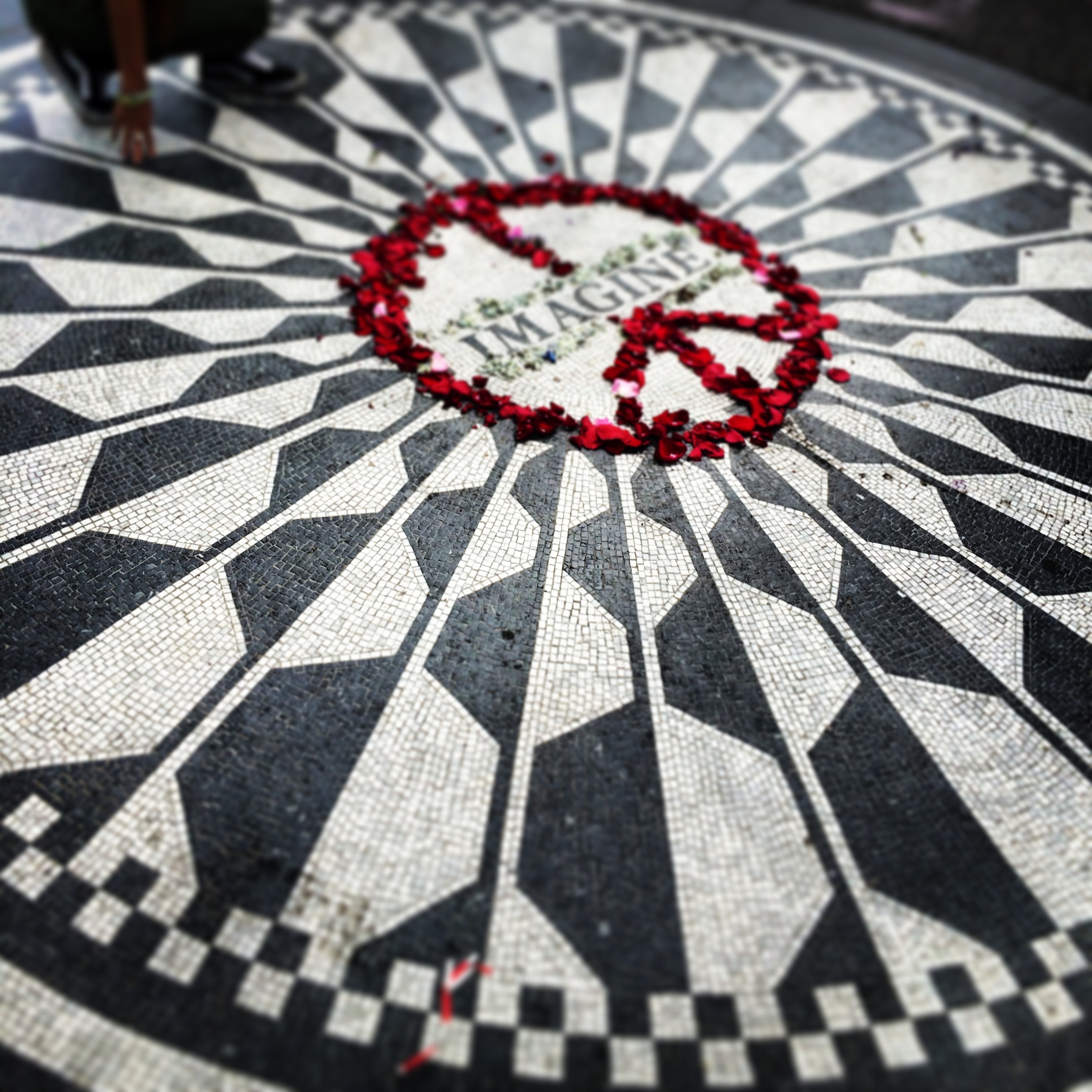
Continuing to head west, you enter Strawberry Fields. Dedicated to the memory of John Lennon and recognized by 121 countries as a Garden of Peace, it is officially a “quiet zone,” but you are likely to come across a performer playing Beatles tunes near the famous Imagine mosaic. The mosaic was given to the city of New York as a gift by the city of Naples, and was dedicated on October 9, 1985, on what would have been John Lennon’s 45th birthday.

So much to see on even such a relatively short walk in Central Park! The Park belongs to all New Yorkers, not just those fortunate enough to look out the windows of their homes and watch the seasons play out throughout the year. If you’re not a New Yorker, you are as always welcome to explore it as our guest; perhaps someone will even offer to take your picture at the Bethesda Foundation.Image
Upper Carnegie Hill into El Barrio

The line between Carnegie Hill on the Upper East Side and Spanish Harlem, or El Barrio, once seemed carved in stone. Generally speaking, El Barrio stretches north of 96th Street, from Central Park to the East River. East Harlem was New York City’s first “Little Italy,” hence the famous Italian restaurants still in the area, like the original location of Patsy’s Pizzeria and Rao’s. After World War I, a large influx of Puerto Rican immigrants began the transition of this neighborhood to Spanish Harlem.  Regardless of the name, the area along Fifth Avenue north of 96th Street (now sometimes called “Upper Carnegie Hill”), has certainly undergone a transformation over the past decade.

For this dérive (an unplanned journey through an urban environment; see my previous blog posts), we start at Fifth and 96th, walking north. For several blocks, Fifth Avenue is dominated by Mount Sinai Medical Center, a dominant presence in this neighborhood. Just north of Mount Sinai, beautiful apartment buildings, pre- and post-war, emerge. Some of the apartments in these buildings with views of Central Park are being sold for prices that would have been unimaginable ten years ago!

Looking at the Central Park Conservatory Gardens (Fifth Avenue between 104th and 106th Streets), one can easily see the value of such a view. The entrance to the Gardens is a massive iron gate, built in Paris in 1894 and once the entrance to the Vanderbilt mansion at Fifth and 58th Street. The Gardens is divided into three spaces with different styles: Italian, French, and English. During the spring and summer, all sections of the Conservatory Gardens are lush and colorful, and of course in the autumn the entire park is overtaken by red, orange, and yellow foliage.

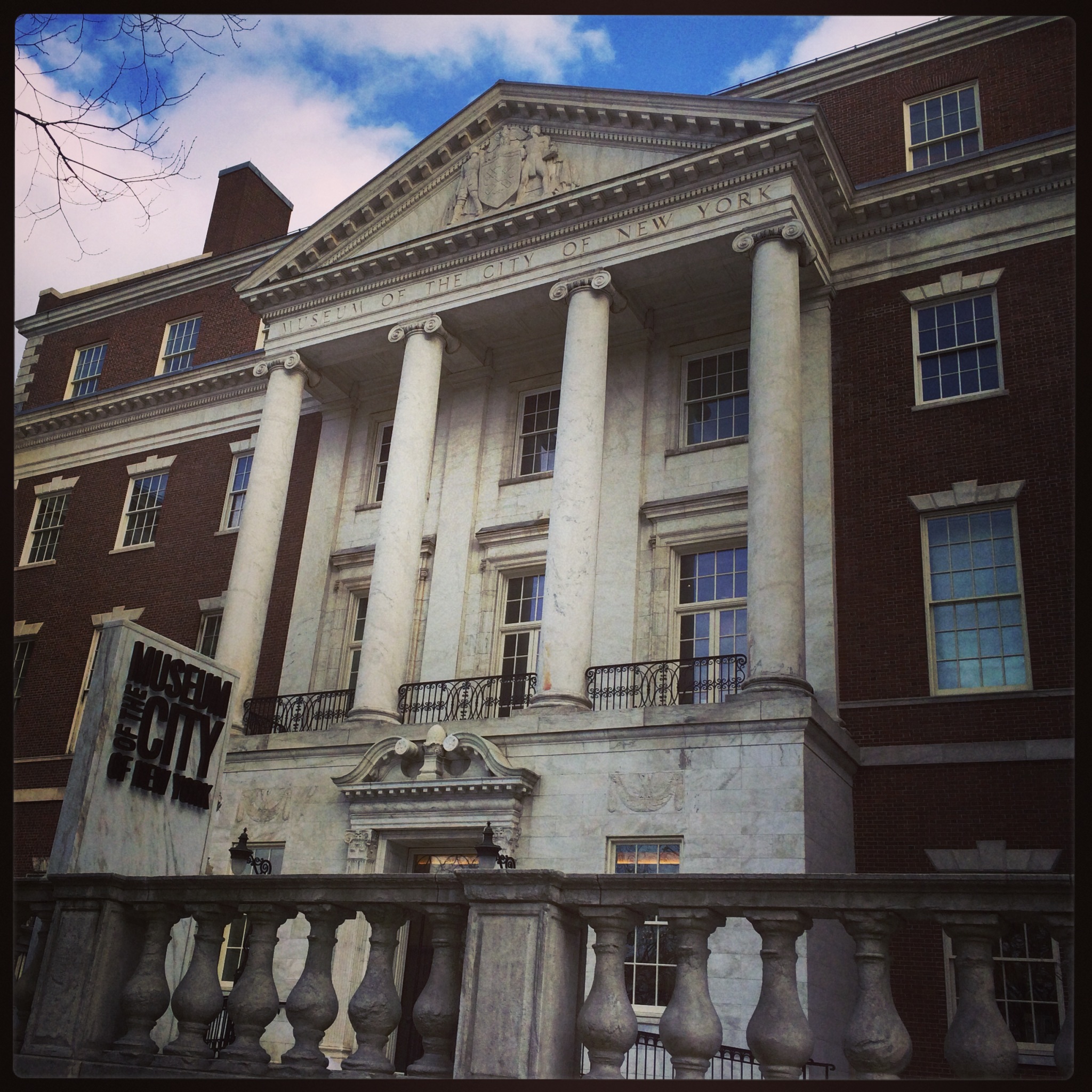
This area along Fifth Avenue also houses a few museums here at the top of “Museum Mile.” On either side of 103th Street on Fifth sit the Museum of the City of New York  and El Museo del Barrio. The Museum of the City of New York was founded in 1923 to educate the populace about the past, present and future of the city. It was originally housed in Gracie Mansion (see my blog post on Yorkville) but a dedicated building was constructed on land donated by the city, completed in 1932. Interesting artifacts housed in the museum are as diverse as original manuscripts by Eugene O’Neill, a man’s suit worn to George Washington’s Inaugural ball (which took place in NYC, the nation’s capital at that time), and a dollhouse containing an original miniature work by Marcel Duchamp. Founded 40 years ago, El Museo del Barrio celebrates the art and culture of all Latin Americans in the United States, and hosts concerts, educational events, and exhibitions.

Strolling east on Fifth, there is a quiet nature to the neighborhood that does perhaps justify the term “Upper Carnegie Hill.” Turning east on 106th Street, however, things become more vibrant, with abundant dining opportunities once you reach Lexington Avenue. Heading south on Lex, you can’t miss Duffy’s Hill at 103rd, one of the steepest grades in New York. Whoever Duffy was, he was certainly out of breath! There is a 6 subway stop right at 103rd before the hill begins, if it looks too daunting. However, a little cardio and some stretched calf muscles will reward the walker with several blocks of interesting places to eat and a few new condo residential buildings. Lexington between 104th and 99th Streets has been called a new “restaurant row.” On Lexington between 99th and 100th Street, check out Lloyd’s Carrot Cake (http://www.lloydscarrotcake.com/). The first time I had a Lloyd’s carrot cake, I was at a friend’s party and the cake had been bought from the original location in Riverdale. If this location is more convenient than Riverdale (as it is for me), you can try a slice before purchasing an entire cake. On the corner of Lexington and 97th is ABV (http://www.abvny.com/), a casually sophisticated place to eat and drink, with great tapas, interesting cocktails, and live music on Monday nights.

Ending up at Lexington and 96th Street, the 6 subway or a crosstown bus can take you quickly where you need to go elsewhere in the city. Whether or not East Harlem is the “next Williamsburg,” as has been touted, it’s a neighborhood with good value and plenty to offer as a place to visit or to live.Image

A walk around Carnegie Hill

For today’s dérive (an unplanned journey through an urban environment; see my previous posts), you are in another sub-neighborhood of the Upper East Side in Manhattan – Carnegie Hill. Yes, this area is named after Andrew Carnegie of Carnegie Hall fame, whose former mansion now houses the Cooper-Hewitt National Design Museum (part of the Smithsonian). The rough outlines of this neighborhood are E. 86th Street to the south, Third Avenue to the east, Fifth Avenue to the west, and E. 96th to the north (although with recent gentrification of the area near the park north of E. 96th, some call that area Upper Carnegie Hill rather than East Harlem).

Standing on the south side of 86th and Fifth, the imposing bulk of the Metropolitan Museum is still visible a few blocks behind, but the smaller, elegant, Neue Galerie (dedicated to early 20th Century German and Austrian art) sits on the corner, signaling a change from grand to more intimate. Walking north on Fifth, Central Park is an overwhelming presence to your left, but I will leave a dérive in Central Park for later in the spring, when it is a riot of color with seas of sunny daffodils and explosions of pink and white blossoms from the flowering fruit trees (although the Park has its own special beauty covered in snow, this particular winter has left me longing for spring).

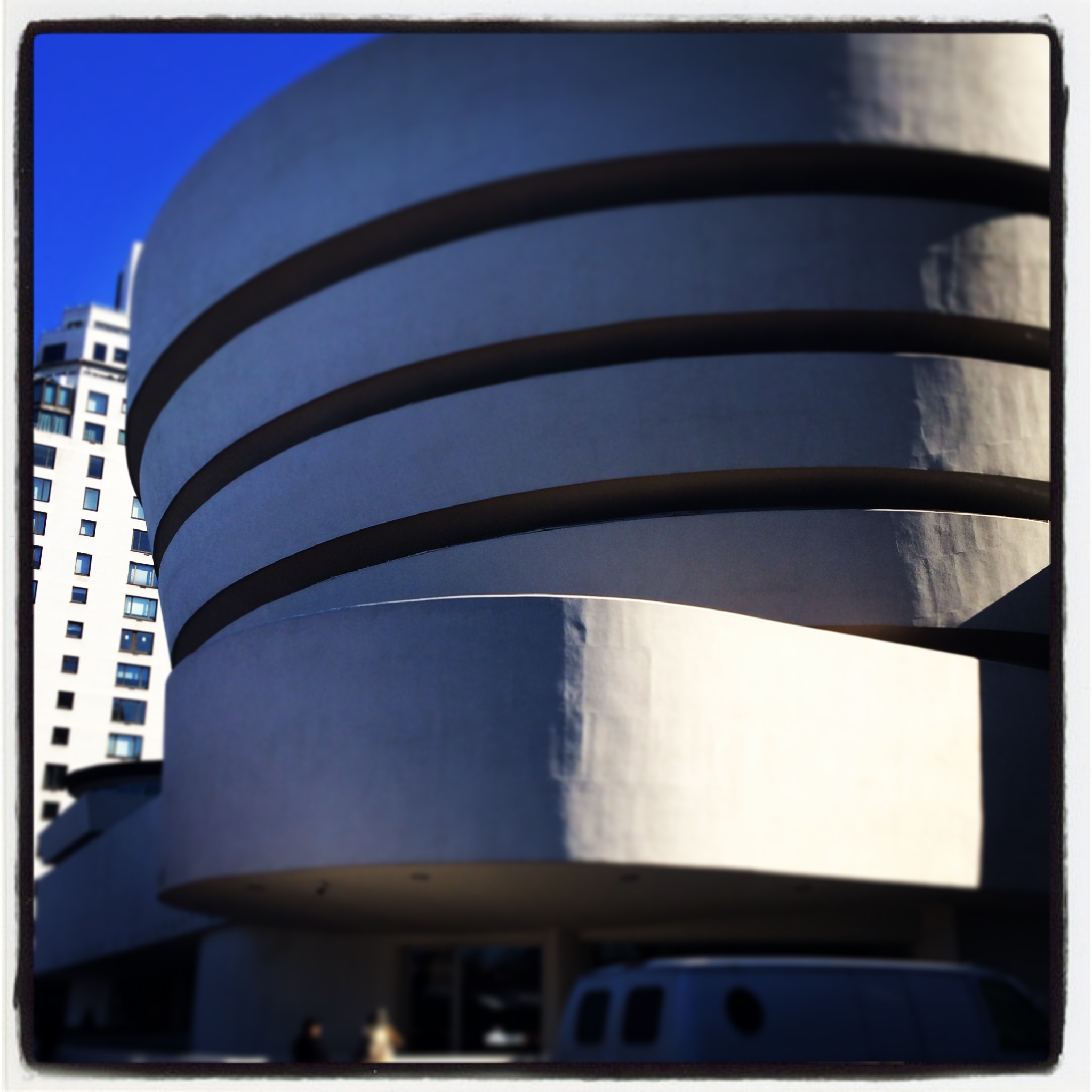
At Fifth and 88th, it is impossible to miss the Guggenheim Museum, whose most impressive work is the iconic Frank Lloyd Wright building itself. Built in 1959, it was intended to be a “temple of the spirit,” and the museum is known for using its innovative space creatively to showcase exhibitions. The Maurizio Cattalan exhibition in 2011, “All,” hung over 100 of the artist’s works from the ceiling, and the observer experienced the pieces from different perspectives while moving around in the museum’s circular ramps. The museum also hosts special events during the year, including an excellent “Works & Progress” series that shows the creative process behind developing works in dance, music, or drama.

Once you have passed the Guggenheim, the quiet nature of this neighborhood truly reveals itself; other than the museums, it is primarily a residential neighborhood. In fact, until the Church of the Heavenly Rest opened its “Heavenly Rest Stop” on Fifth between 89th and 90th Streets, there were few places to get a quick bite to eat or a cup of coffee unless venturing to the east to Madison. On Fifth between 90th and 91st, there is the namesake of the neighborhood, Andrew Carnegie’s mansion, now the Cooper-Hewitt National Design Museum (currently closed for renovations but due to reopen later in 2014).  It’s hard to imagine, but this 64-room mansion was once the home of Carnegie, his wife, and their daughter! It was the first home in the United States to have a structural steel frame, the first in New York City to have an Otis elevator, had heat and central air conditioning (certainly unusual for the turn of the 20th century) and the conservatory was made entirely of Tiffany glass.

Continuing north on Fifth, on the corner of 92nd is the Jewish Museum, which recently held a wonderful retrospective of Art Spiegelman’s work (most notably, Maus). Like the Cooper-Hewitt, the Jewish Museum also occupies a former family mansion, that of the Warburgs.

Turning east on 92nd, one is struck by the quiet elegance of these off-avenue blocks, dotted with townhouses. When I first visited the Pimlico neighborhood in London, it reminded me of Carnegie Hill, edged by the Thames rather than Central Park, but with the same peaceful quiet on side streets. The northwest corner of 92nd and Madison houses Ciao Bella, a New York City local gelateria with intense flavors as varied as blood orange and malted milk ball.

On Madison Avenue in Carnegie Hill, there is an abundance of shops, many one of a kind, and casually refined restaurants where it is unlikely to be too noisy to hear your companion’s conversation.  Sarabeth’s, on Madison between 92nd and 93rd on the east side of the street, is a neighborhood staple, and getting a table for brunch can involve a bit of patience if you didn’t have the foresight to make a reservation (they are on OpenTable).

Continuing east on 92nd, you cross Park Avenue – be sure to look south and appreciate the expansive view all the way to the MetLife building above Grand Central. The buildings along Park Avenue provide financial support to maintain the malls in the middle of the divided street. In the spring, there are carpets of tulips, and the holiday season brings a forest of evergreen trees lit with tiny white lights (started in 1945 to honor those who died fighting in World War II).

At Lexington and 92nd Street, this dérive will end at the 92nd Street Y, a cultural and community center serving the neighborhood since 1874. In addition to the classes and sports club offered on the site, it regularly hosts concerts, lectures by notables, dance performances, and film screenings.

The Carnegie Hill Historic District was created in 1974 to preserve the unique environment of much of this neighborhood, ensuring that Carnegie Hill retains the quiet understated elegance that makes this an inviting place to walk through or live in.Image