With the ongoing smash success of the Broadway musical “Hamilton,” there has certainly been an increased interest in learning about Alexander Hamilton (see my past blog post about this here) and the areas in NYC associated with him. What many may not realize is that the home that Hamilton built in what is now known as Hamilton Heights is now a National Park Service site. On a recent day, I decided to head up to Hamilton Heights and tour Hamilton’s home, The Grange.
Before heading to the Grange, my companion and I had lunch at a cool spot nearby called The Grange (just to set the mood!). The food and atmosphere were both really enjoyable.
Walking from The Grange to the actual Grange, we passed plenty of reminders that this is Alexander’s part of town.
Hamilton Heights is gorgeous, and these townhouses are still relative bargains compared to a similar home on the Upper West Side, for instance. Right now (end of March, 2018) there is a 4 bedroom/3.5 bath townhouse in Hamilton Heights for sale asking $2,700,000. Larger and more recently renovated townhouses in the area generally sell for between $3-4M.
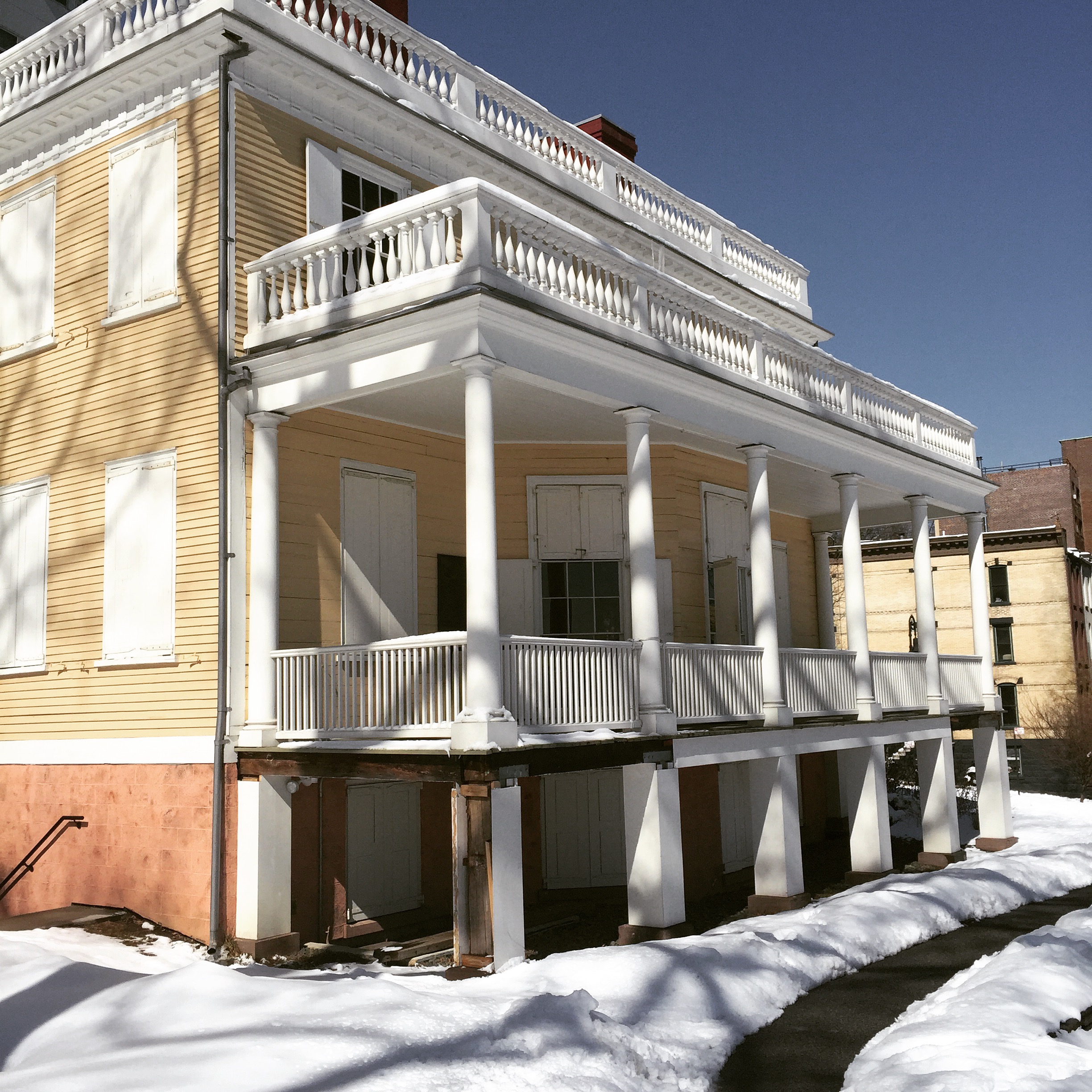
The Grange is currently at 414 West 141st Street, within St. Nicholas Park. It has been moved twice before but still lies within the property that Hamilton owned. The home was built in an early Federalist style (very appropriate!) in 1802 (just two years before Hamilton’s unfortunate duel with Aaron Burr). Entrance to the Grange is free. There is a section of the Grange that functions as a museum, and you can also sign up for ranger-led tours of the upstairs rooms. Check out their website for details of hours, as they vary throughout the year. In less busy times of the year and during the week, the ranger-led tours can likely be joined close to time, but in busier seasons and weekend days, it is best to be there at least 30 minutes before the tour you wish to join to get added to the list.
In the museum section, there is a short film about Hamilton’s life.
Of course there is also a gift shop with plenty of Hamilton swag for purchase.
My favorite item in the gift shop was a small book of George Washington’s “Rules of Civility and Decent Behavior.” Some of these seemed self-evident to me (“In visiting the sick, do not presently play the physician if you do not know therein.”) and others amusing (“Show nothing to your friend that may affright him.”). If you want to have a little fun, you can read them all here.
Heading out for the ranger-led tour, it was wonderful to see this exquisite home beautifully renovated.
By “ranger,” I mean a real National Park ranger, complete with uniform, which seems a little incongruous in NYC.
This room was Hamilton’s study. The traveling desk he used was the portable laptop of the time, allowing him to write important messages on the go.
The living room featured a portrait of George Washington, and tables for card games.
The formal dining room was splendid. Because there was no electric light in that time, windows were as large as possible to capture daylight, and mirrors on the walls and on the table were used to reflect candlelight at night.
Toward the end of the ranger-led tour, there was a very entertaining film about moving the Grange. It was moved the first time because city streets were being built in the area, but the second place it sat was overdeveloped and it became hard to see the house properly. It was moved to St. Nicholas Park by literally being rolled down the street in the summer of 2008.
The Grange never directly references the popularity of Hamilton due to the Broadway musical. It cannot be escaped, however. While on the ranger-led tour, a young boy (perhaps 6 or 7) raised his hand and exclaimed, “I can name four of Hamilton’s friends – Aaron Burr, John Laurens, Lafayette, and Hercules Mulligan!” The ranger never cracked a smile, and continued his description of the room we were in. I could not stop smiling however, so delighted that a work of art that is so pleasurable can also inspire an interest in history.
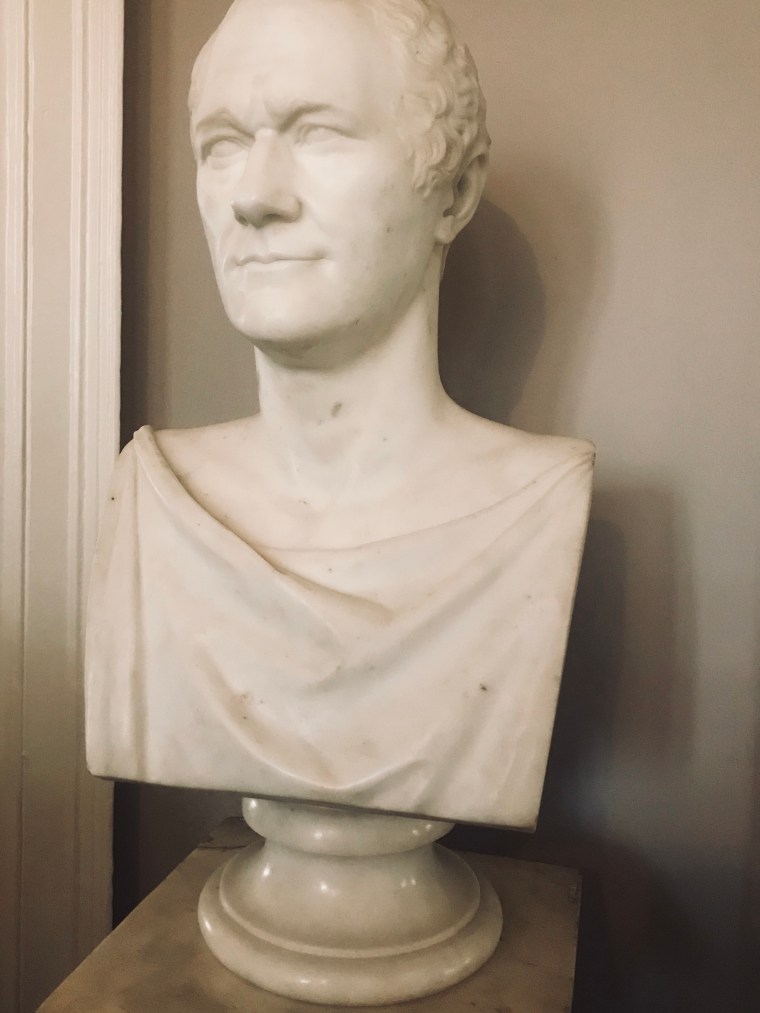
Bust of Alexander Hamilton, flanked by portraits of Aaron and Theodosia Burr, in the New York Historical Society
In the incomparable new American musical, Hamilton, currently the hottest ticket on Broadway in New York City at the Richard Rodgers theatre, the Schuyler sisters are introduced to the audience as they sing joyfully about living in the “greatest city in the world.” This is my own bias as well, and I do consider myself to be “so lucky to be alive right now” and living in NYC. However, as a real estate agent, I know that being able to live in the city is often a struggle – quite often financially in terms of being able to afford living here, and even for those with the means, difficult in terms of limited inventory. Because of my love for the city, and my day-to-day immersion in the city’s residential real estate market, I have found myself thinking about the different neighborhoods mentioned in Hamilton in terms of real estate availability and value. I have already blogged about many of these areas in terms of taking a dérive, or an unplanned walk in an urban environment (see my initial explanation about this idea here), and I will link to those posts when possible.
Before getting into the fun stuff, a few technical notes about price per square foot measures mentioned below: All stats on sales price per square foot are from the Real Estate Board of New York’s third quarter 2015 report here. Condos and coops are listed separately, as the comparative ease of buying a condo versus a coop is reflected in generally higher prices for condos (20-25% more per square foot). Also, higher prices for condos often reflect differences in types of housing – newer developments tend to be condos. For reference, I will also mention current average listing prices found on streeteasy.com for the different neighborhoods, but keep in mind that listing price averages are always higher than closed sales averages, since half or more of all listings end up selling for less than asking price. Also, I am focusing on sales, although I may mention rentals in each neighborhood as well.
Financial District
When the Schuyler sisters sing about living in “Manhattan,” the area we now know as the Financial District (see my previous blog post here) was almost entirely the area considered to be the city at that time. This is quite fitting, since the Financial District as a business center and home to Wall Street owes a great deal to Alexander Hamilton, who as first Secretary of the Treasury provided much of the foundation for NYC as the financial powerhouse it is today. However, over time, the fashionable residential areas spread north, and this area as a residential neighborhood has only returned in force over the past 10-12 years. Walking these streets is an exciting mix between reminders of our colonial and revolutionary past, and the very new and modern development that is occurring now and transforming the neighborhood.
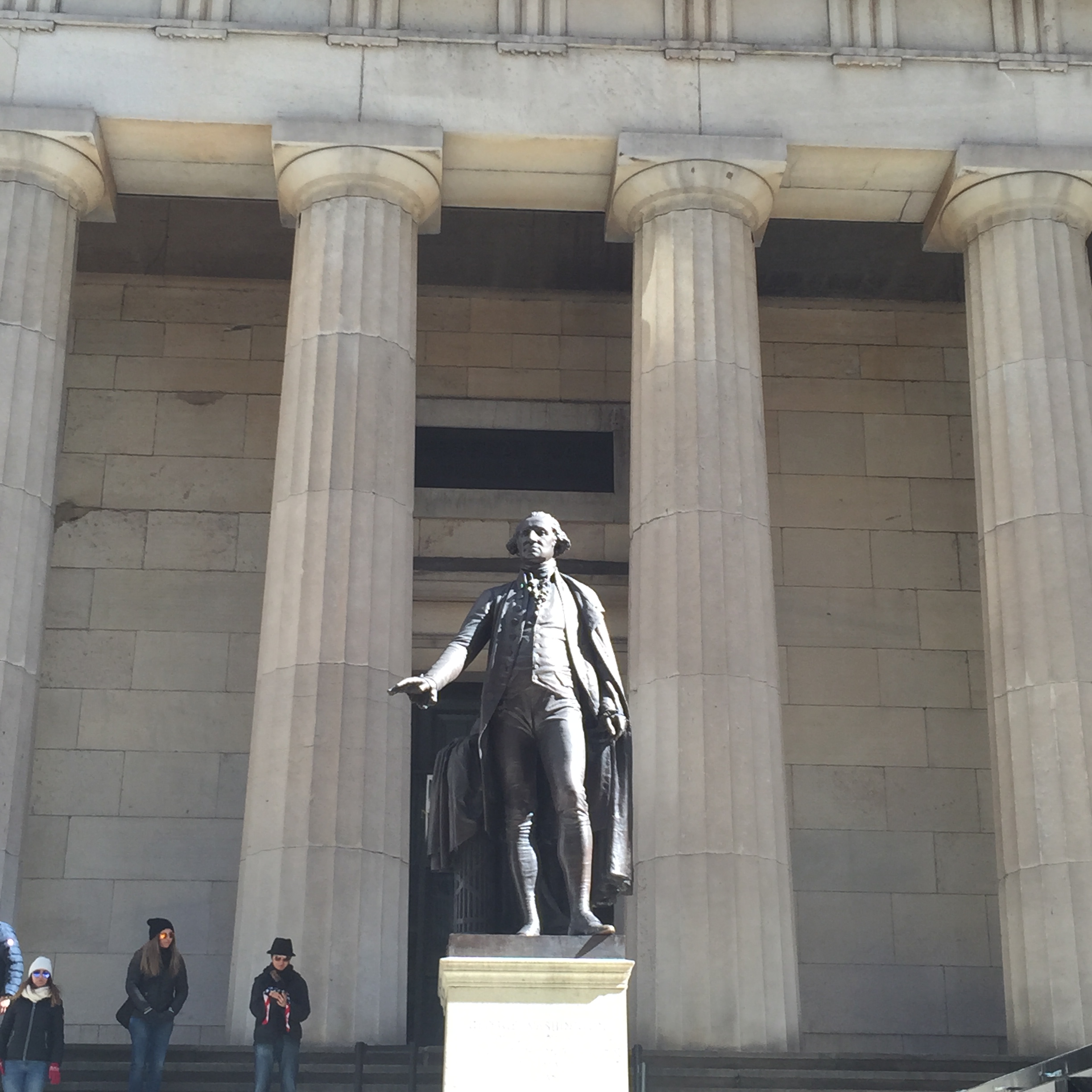
When Hamilton, Laurens, Lafayette, and Mulligan sing “The Story of Tonight” while drinking in a pub, it might well have been the Fraunces Tavern, since the Sons of Liberty (of which Hercules Mulligan was a member) met there and it was a popular pub at the time. George Washington gave his farewell address to his officers at Fraunces Tavern in 1783. From there, you are a short walk to New York Harbor where Hamilton stole the British cannons at the Battery (as described in “Right Hand Man”), or Trinity Church, where Alexander and Eliza Hamilton are buried near Eliza’s sister Angelica.
How affordable is the Financial District (F.D.)? All city prices would seem unbelievable to those living here at the time of the American Revolution, but for downtown Manhattan, it is relatively affordable. The most recent REBNY numbers showed condos in the F.D. averaging $1207 per square foot (compared to $1593 overall for all of Manhattan, and nearby areas Soho at $2021 and the West Village at $2323 much higher per square foot). Coops average $906 per square foot in the F.D. (compared to $1218 for all of Manhattan, $1509 for Soho, and $1629 for the West Village). I recently did a rental search for a friend wanting to move from Tribeca, and showed her that she could either save about a third in rent if she kept the same size and quality of apartment, or get another bedroom for about the same price or even a little less.
Hell’s Kitchen
Yes, you can call it Clinton if you like, but I think the name “Hell’s Kitchen” is one of the coolest in all of New York City and when I move there I will state the name proudly. No, this area is not mentioned in the musical Hamilton and in fact would not have been populated much at all at the time, but it is very near the Richard Rodgers theatre, currently the home to the musical. The proximity to the theatre district keeps prices down a bit, but would be a plus to me (see my previous blog post about Times Square and Hell’s Kitchen here). There are blocks in Hell’s Kitchen that look just like quiet leafy Chelsea blocks – but at a fraction of the cost – as well as new condo high rises with every amenity and the prices to match.
The REBNY report is for Midtown West, which encompasses a bit more than just Hell’s Kitchen, but lists the average price per square foot at $1734 for condos and $1230 for coops.
Stage door at the Richard Rodgers
The Upper East Side
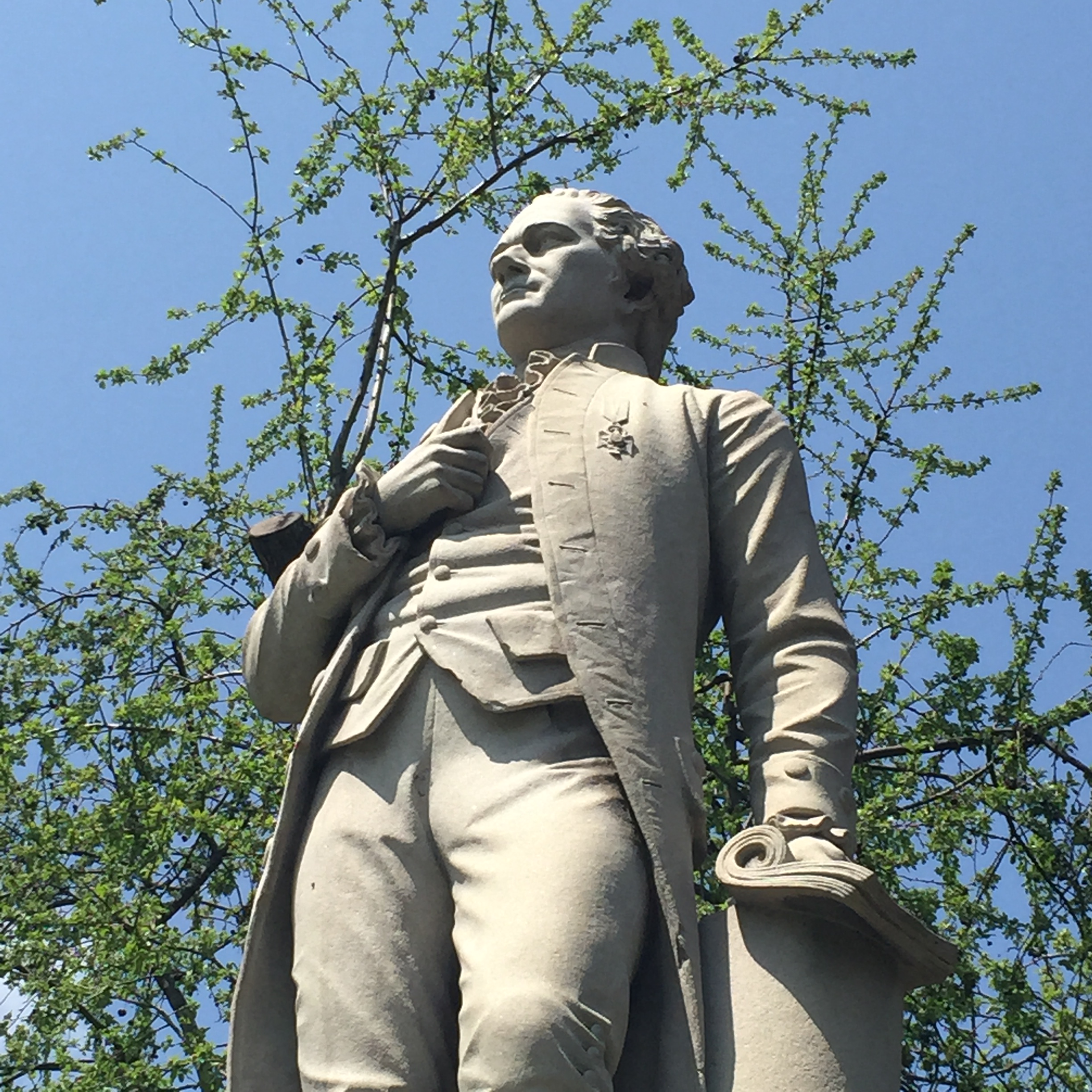
Statue of Alexander Hamilton in Central Park
Again, not mentioned in Hamilton (although a family with the wealth and connections of the Schuylers would have certainly moved to Fifth Avenue along with the robber barons in the early 20th century), but mentioned because of the statue of Alexander Hamilton standing proudly among the trees behind the Metropolitan Museum of Art, in our beloved Central Park (not created until long after Revolutionary times).
The Upper East Side has long been a bastion of wealth, and areas to the west of Lexington Avenue still command a premium due to proximity to Central Park (see one of my many blog posts about the park here, and another about the value of a park view here). However, the far east side (east of Second Avenue, particularly the area called Yorkville, see my post here) still has value, in part because of its perceived remoteness and the construction mess due to the building of the Second Avenue Subway. While overall the Upper East Side averages $1764 per square foot for condos and $1234 for coops, Streeteasy listings show the difference in listing prices for Yorkville ($1693 per square foot, all types) versus Lenox Hill near the park ($2667 per square foot, all types). Rentals in Yorkville are particularly well priced compared to other areas of Manhattan, except for areas of upper Manhattan that will be discussed next.
Harlem and Upper Manhattan
There are plenty of references to Harlem in Hamilton, from Washington’s “run to Harlem quick” in “Right Hand Man, ” Hamilton’s wooing of Eliza with a plan to “get a little place in Harlem and we’ll figure it out” in “Helpless,” and “the Hamiltons move uptown” in “It’s Quiet Uptown.” Moving to Harlem in those days before motorized vehicles and the subway was the equivalent to moving to the remote countryside, and even King’s College (later renamed Columbia, sorry again, King George) was at that time in lower Manhattan, not in its current spot in Morningside Heights (see a previous blog post here). Hamilton Heights, an area of Harlem I wrote about in this blog post, is named for the location of Hamilton Grange, and the Hamilton home can still be seen there (although not in the exact location, still within the farmland owned by the Hamiltons). Even farther north than Harlem is Washington Heights (see previous blog post here), home of the Morris-Jumel mansion – once Washington’s headquarters (and then the British government’s), later the home of Aaron Burr, and most recently the site used by Lin-Manuel Miranda to work on composing Hamilton. This historic home hosted many other notable figures who also live on in the musical by reference or as characters – John Adams, Thomas Jefferson, and yes, Alexander Hamilton.
Harlem and much of upper Manhattan is rapidly appreciating in value, but still represents a relative bargain in Manhattan. The REBNY numbers separate Harlem only by East ($748 per square foot for condos, no figures for coops) and West ($713 for condos, $996 for coops), not a very practical demarcation. Streeteasy listings show average prices as $829 per square foot for trendy Central Harlem (all types), $667 for East Harlem, $661 for Hamilton Heights, $721 for Morningside Heights (the Columbia effect), and $638 for Washington Heights.
There are other areas in NYC mentioned in Hamilton, some vague (“British take Brooklyn” in “Right Hand Man” – likely Brooklyn Heights) and others specific (“abandoning Kips’ Bay,” also in “Right Hand Man”) and those will be future places for my dérives and the subsequent blog posts.
At a recent social event, a friend and I were talking about getting together more often, and I said, “Well, you know how to find me.” Her husband responded, “Yes, at the Hamilton lottery!” (clearly he is following my Facebook posts) and my friend asked what the show was about. After explaining that it is a hip-hop musical based on the life of Alexander Hamilton, and she replied, “You know, that sounds like the craziest thing I have ever heard!” Well, crazy good . . . Yes, finding a place to live in New York City is frustrating, you will always end up spending more than you hoped (even those with more financial resources but especially those with fewer), and it will likely take longer than you want and you will end up compromising, but how lucky we are to be alive right now, in a city filled with creativity and the arts – truly, the greatest city in the world.






 Julie Brannan, NYC residential real estate