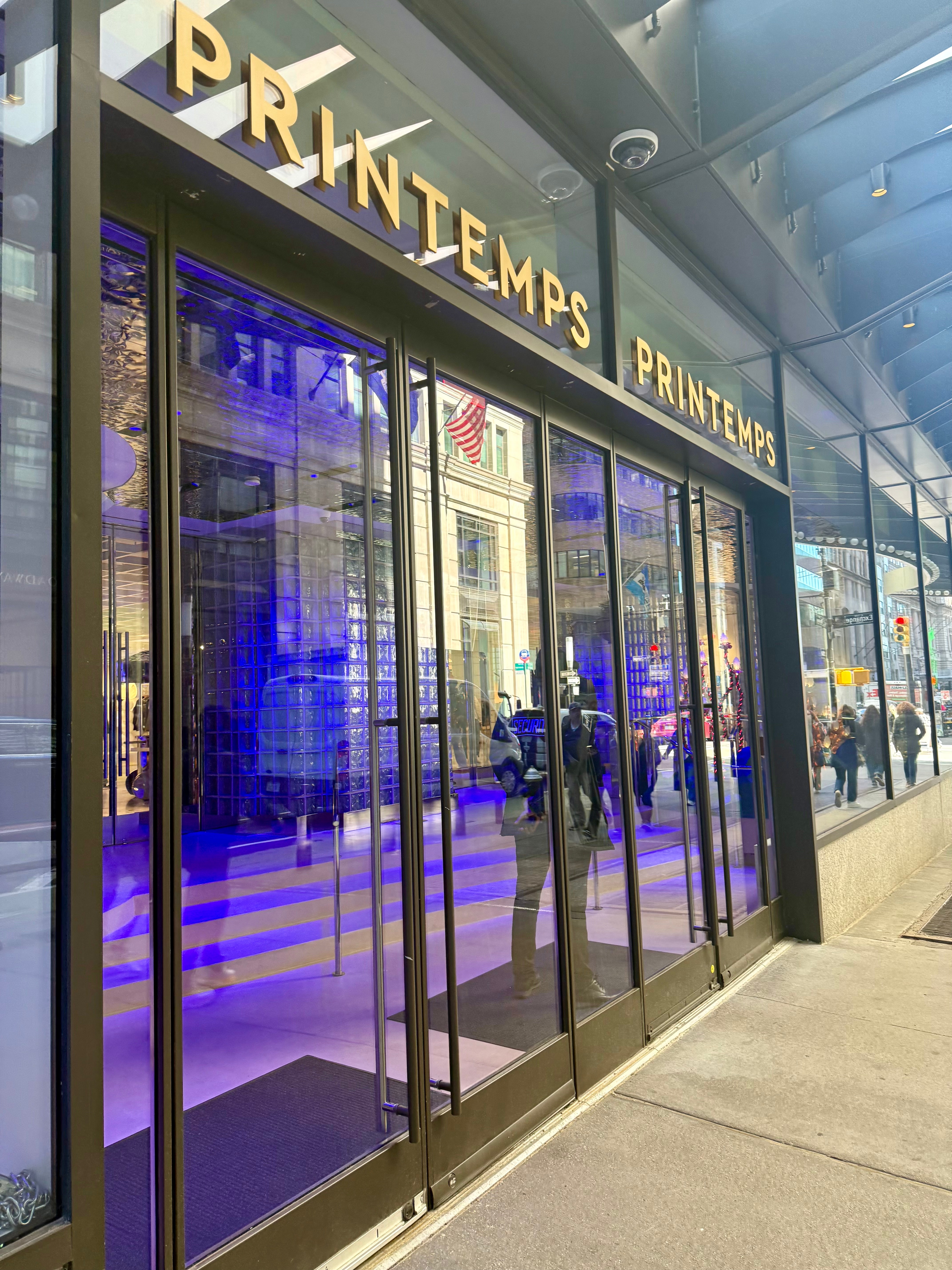
The Art Deco masterpiece One Wall Street, at Wall Street and Broadway in the Financial District, was designed by Ralph Walker and built between 1929 and 1931. First the headquarters of Irving Trust, and later Bank of New York and BNY Mellon, it was sold for residential development in 2015 and converted to condominiums between 2018 and 2023. Commercial space on the lower floors now hosts a Whole Foods, fitness center, and as of late March of 2025, an outpost of famed Parisian department store Printemps.
Printemps is a celebrated French department store chain (with 21 stores in France as well as one in Doha), and its flagship store on Boulevard Haussman in the 9th arrondissement in Paris is an Art Nouveau masterpiece. Sitting next to rival Galeries Lafayette, near the Palais Garnier, it was built in 1865, and was the first public building in Paris to have electrical power installed. For its only store in the United States, it would be important for any Printemps here to be in a building similarly important and beautiful, so One Wall Street was an ideal location.
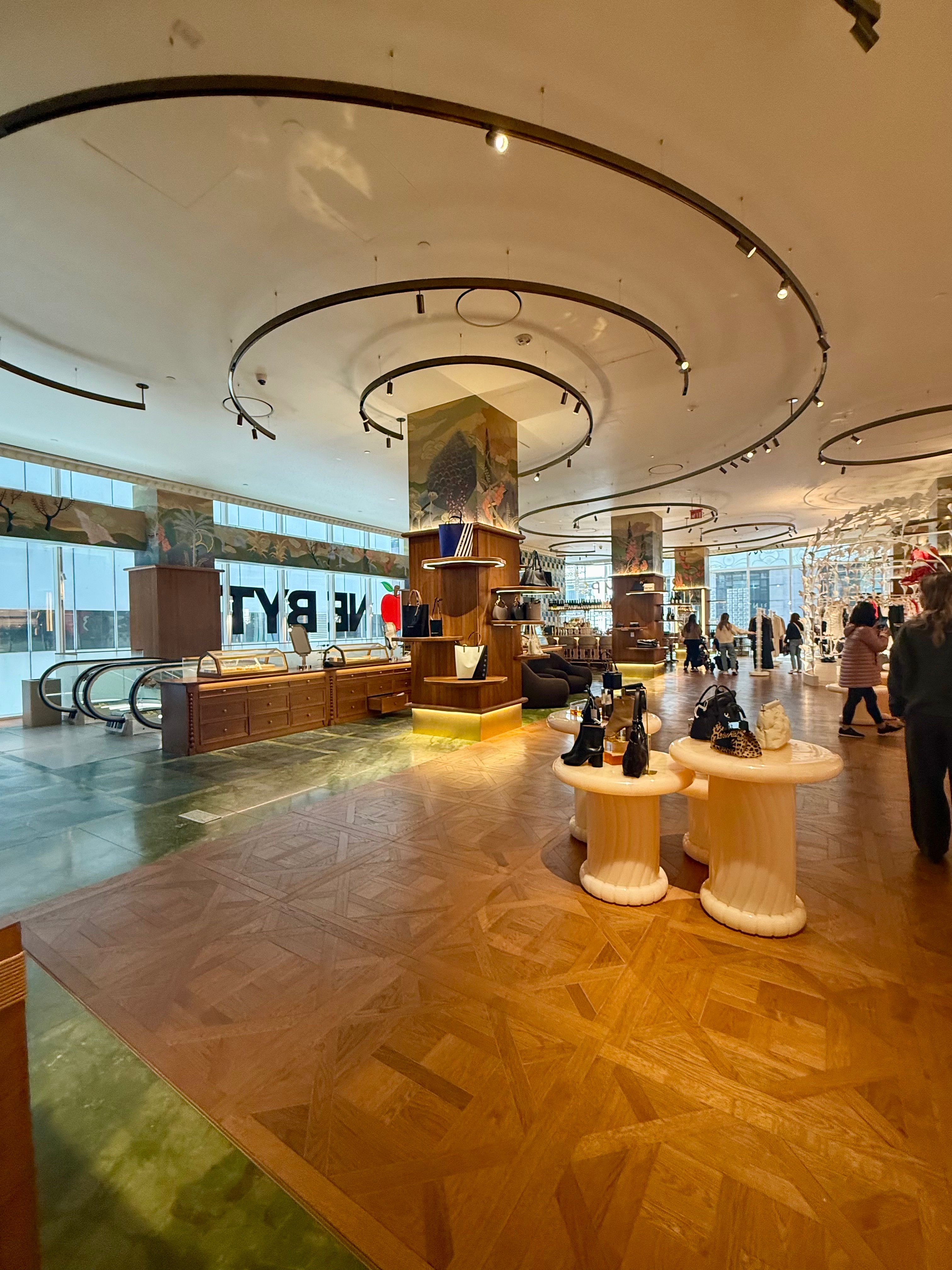
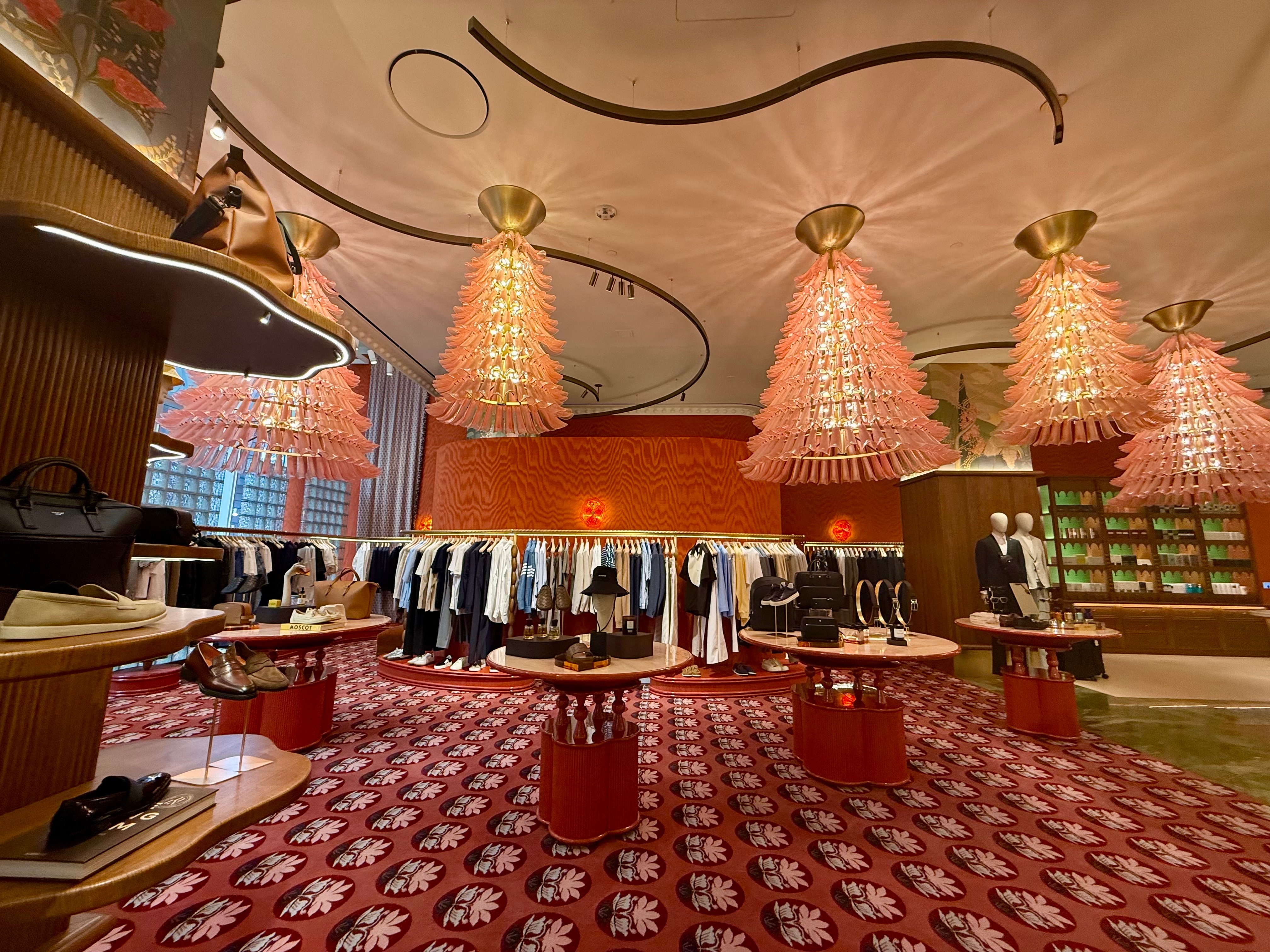
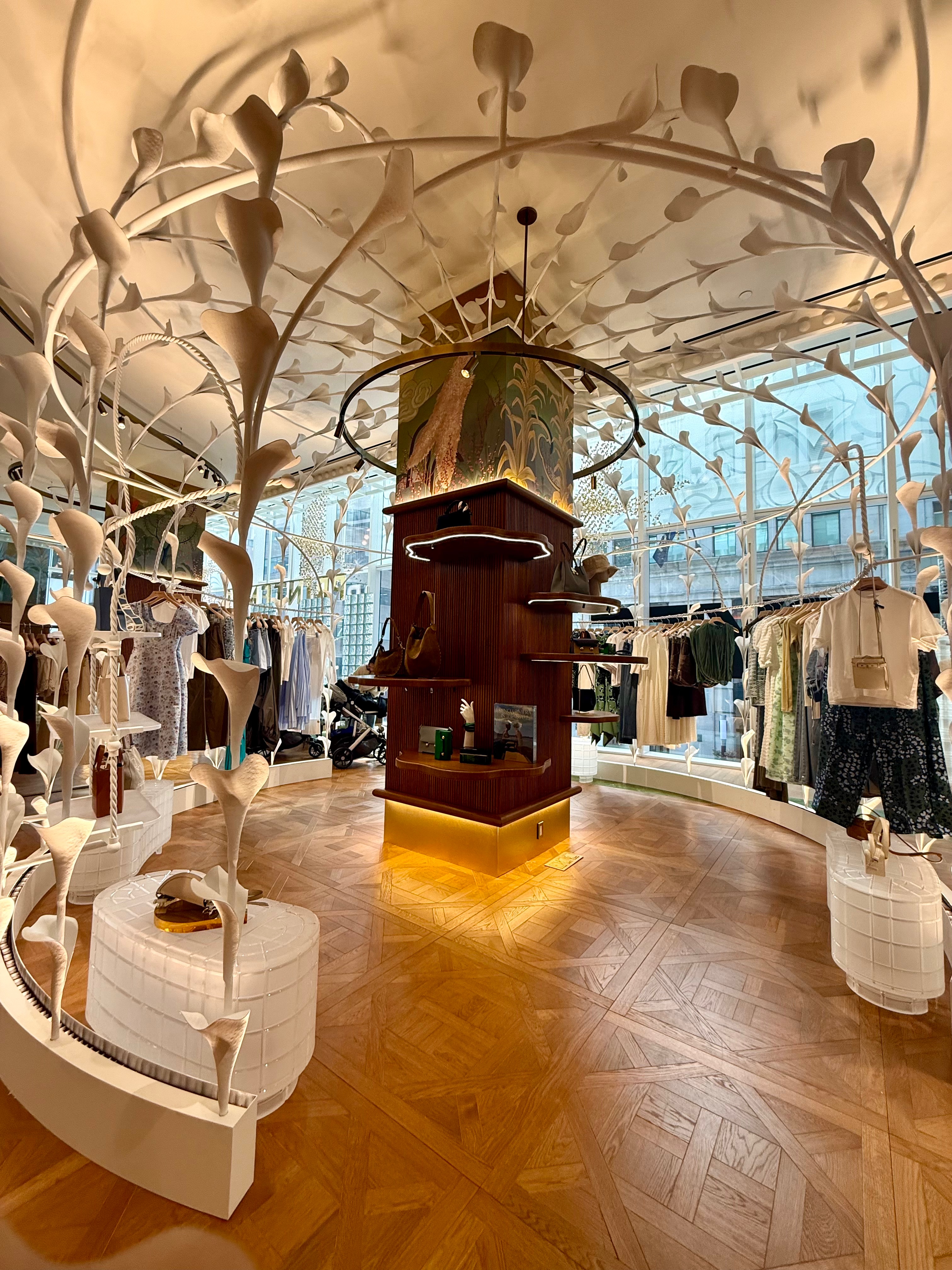
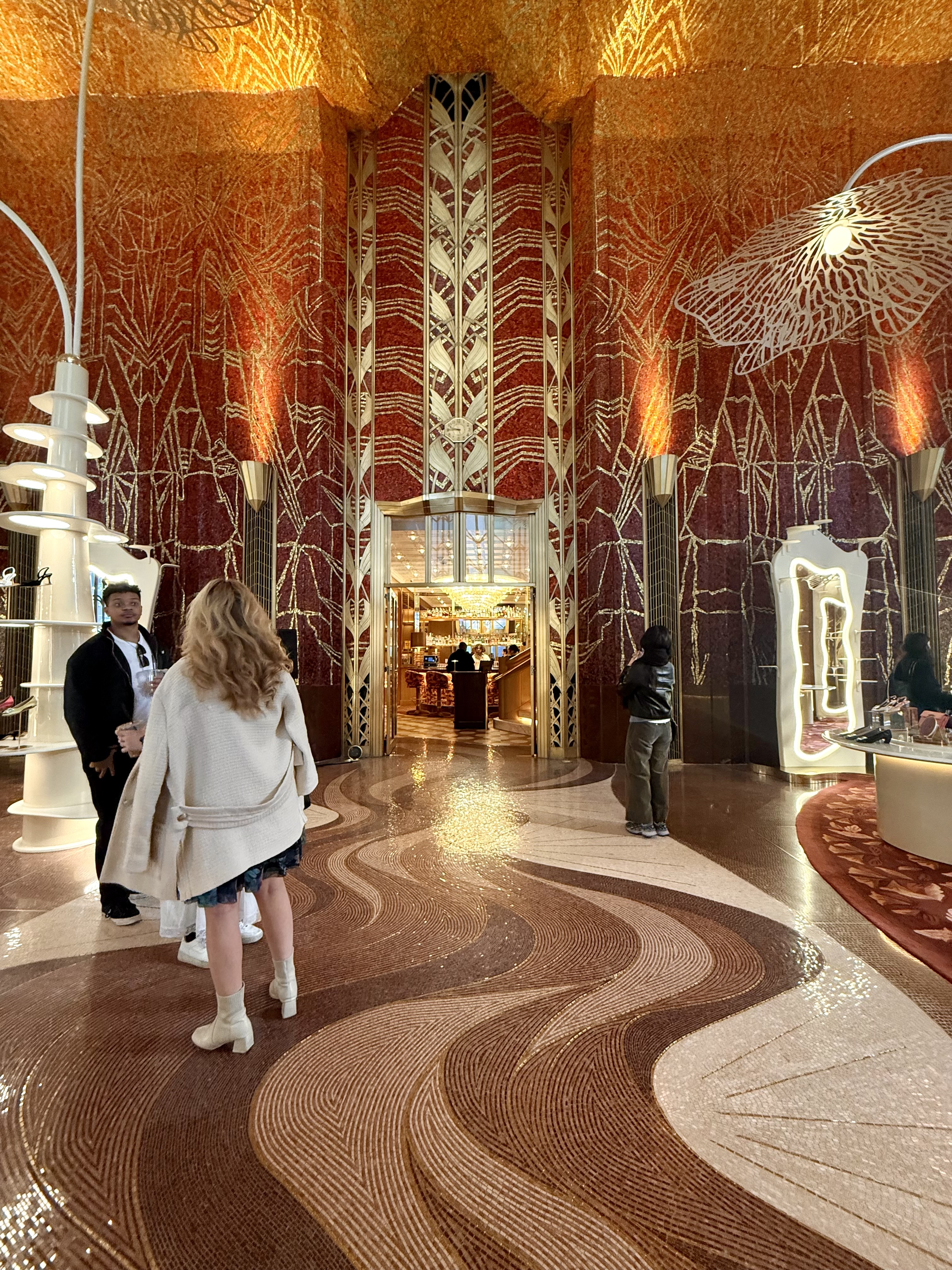
There are two entrances, but I highly recommend for your first visit to enter on Broadway rather than the side entrance on Wall Street (you will see why later). The NYC Printemps is much smaller than the Haussman flagship, but every design detail is exquisite.
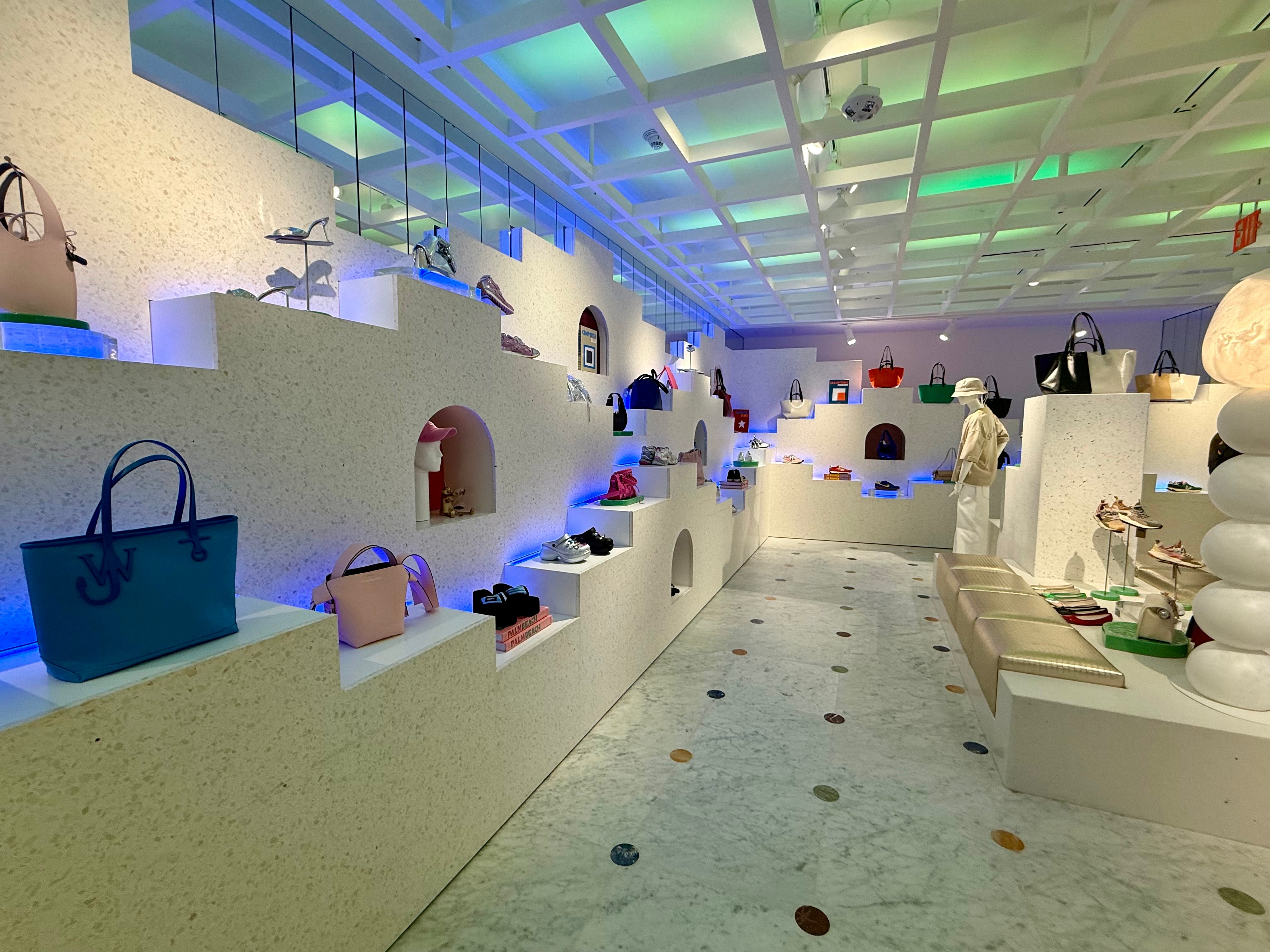
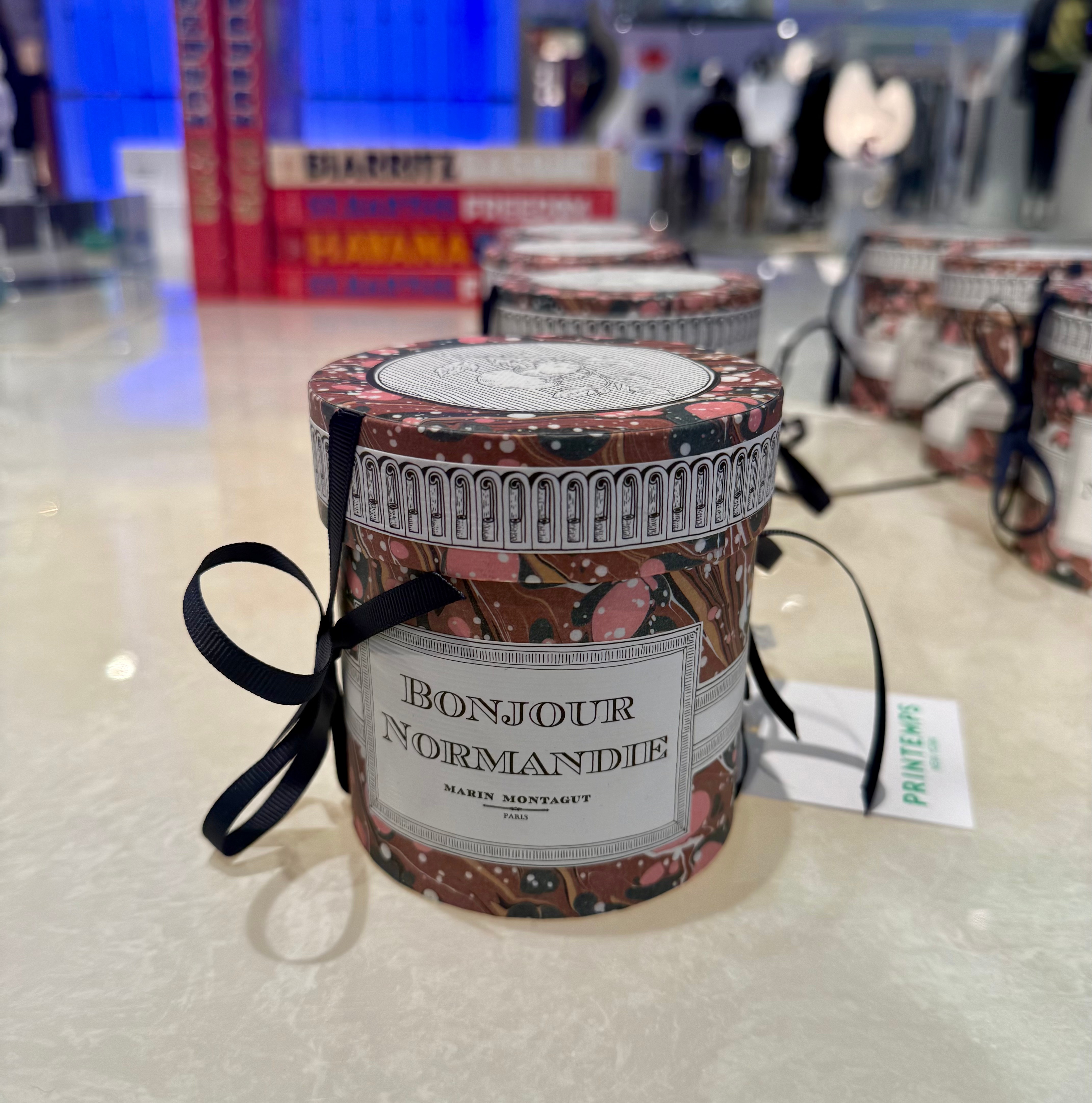
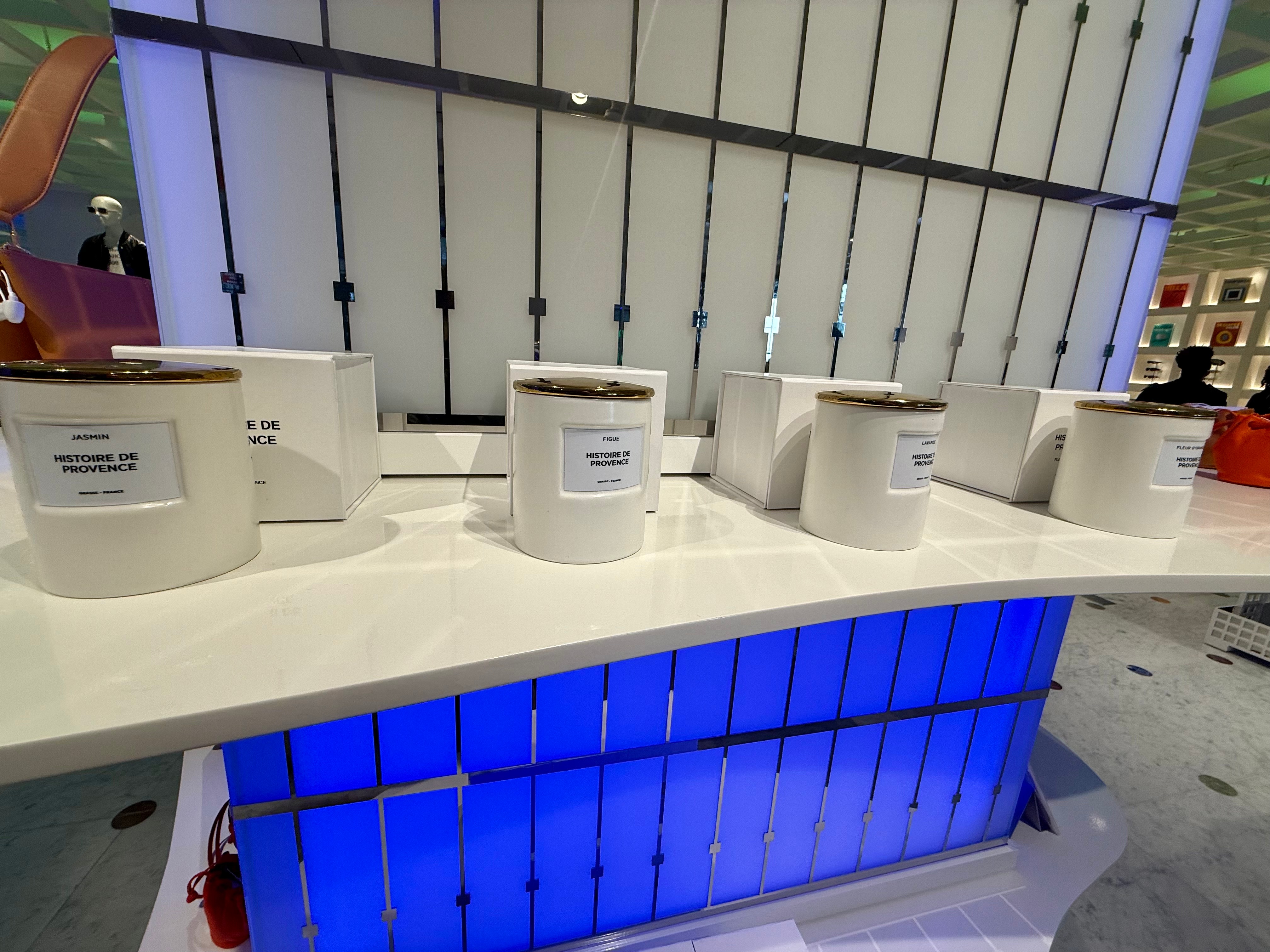
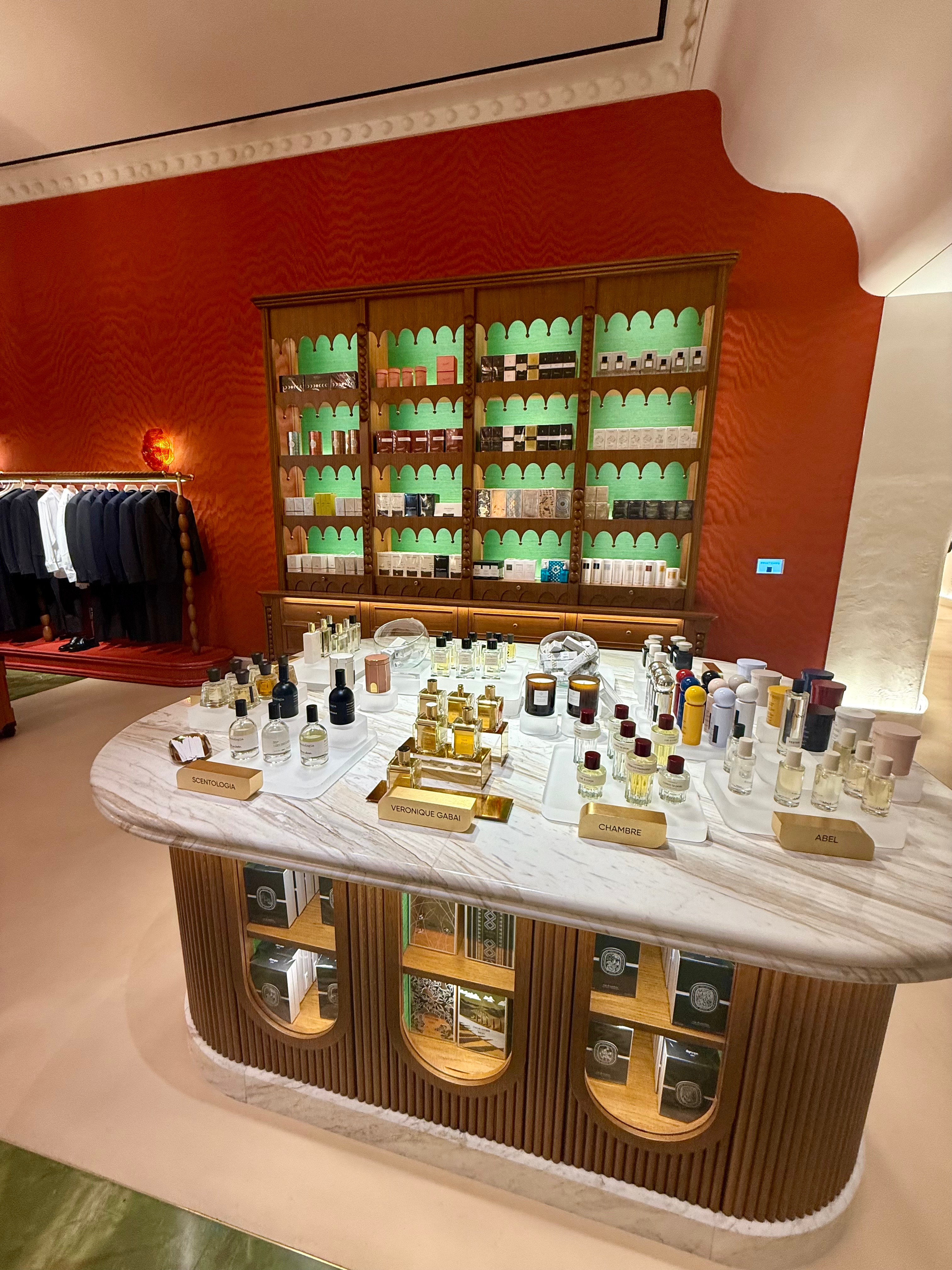
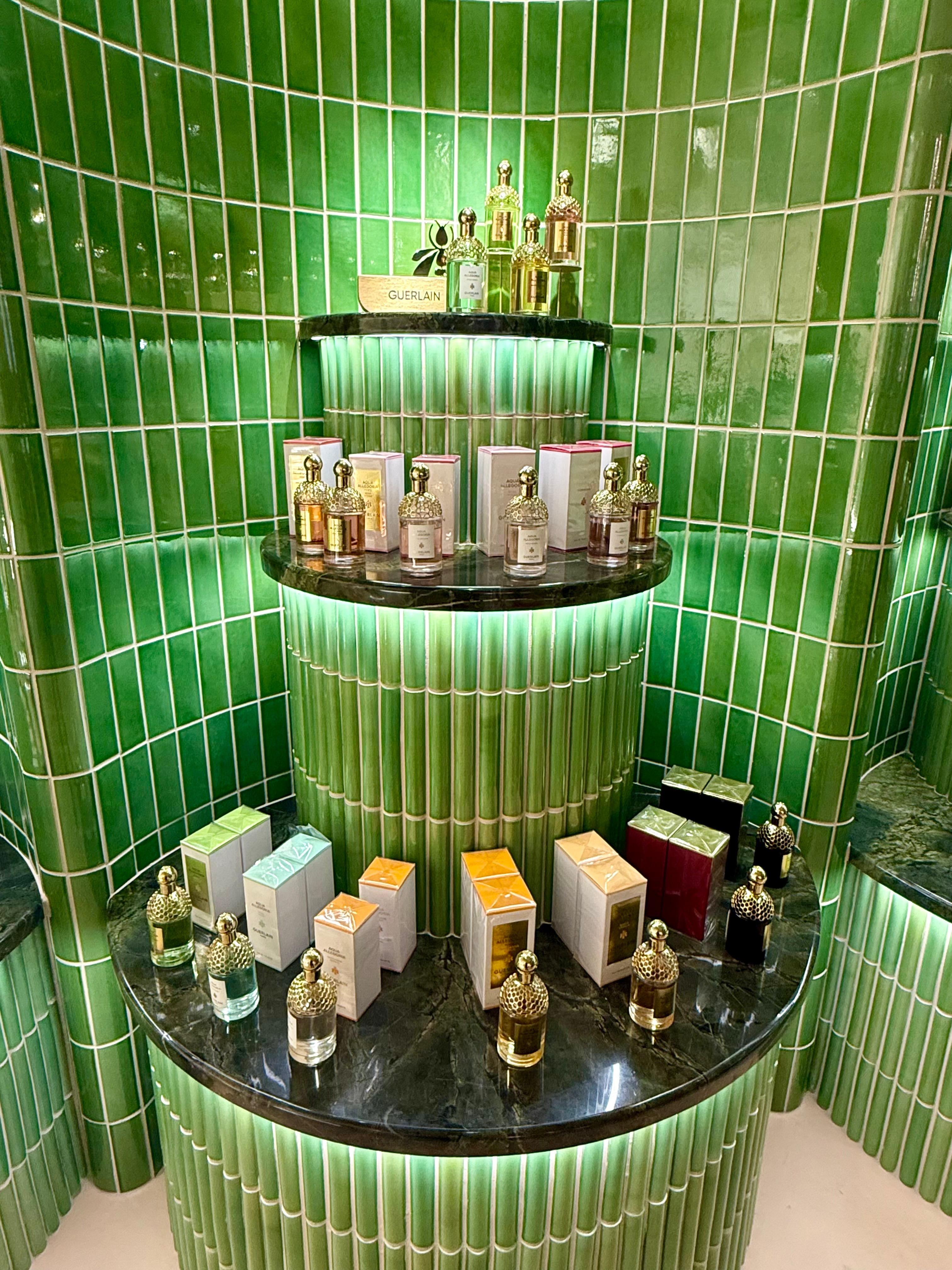
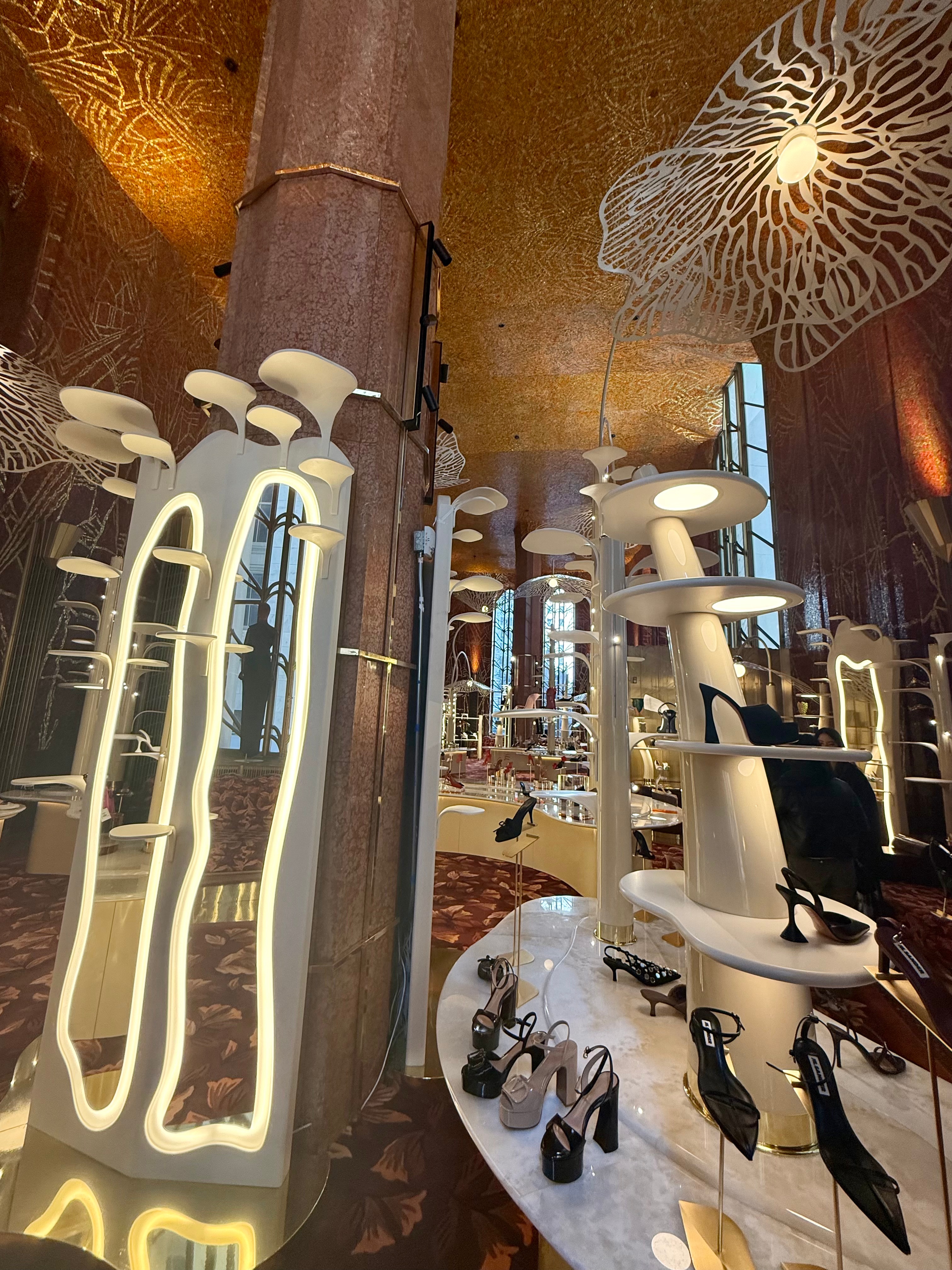
Every item you find as you stroll through the store is French, unique, and presented in a beautiful way.
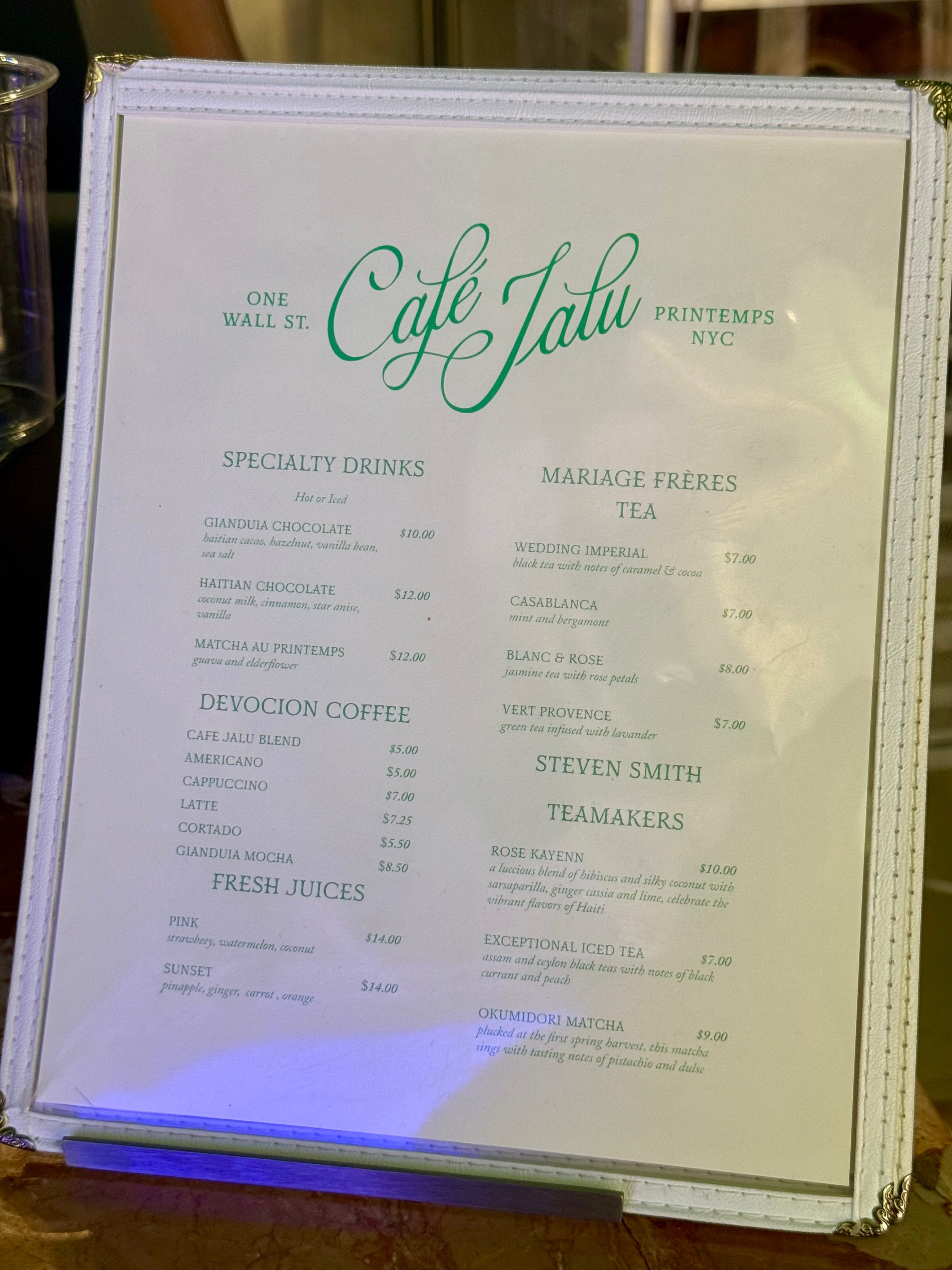
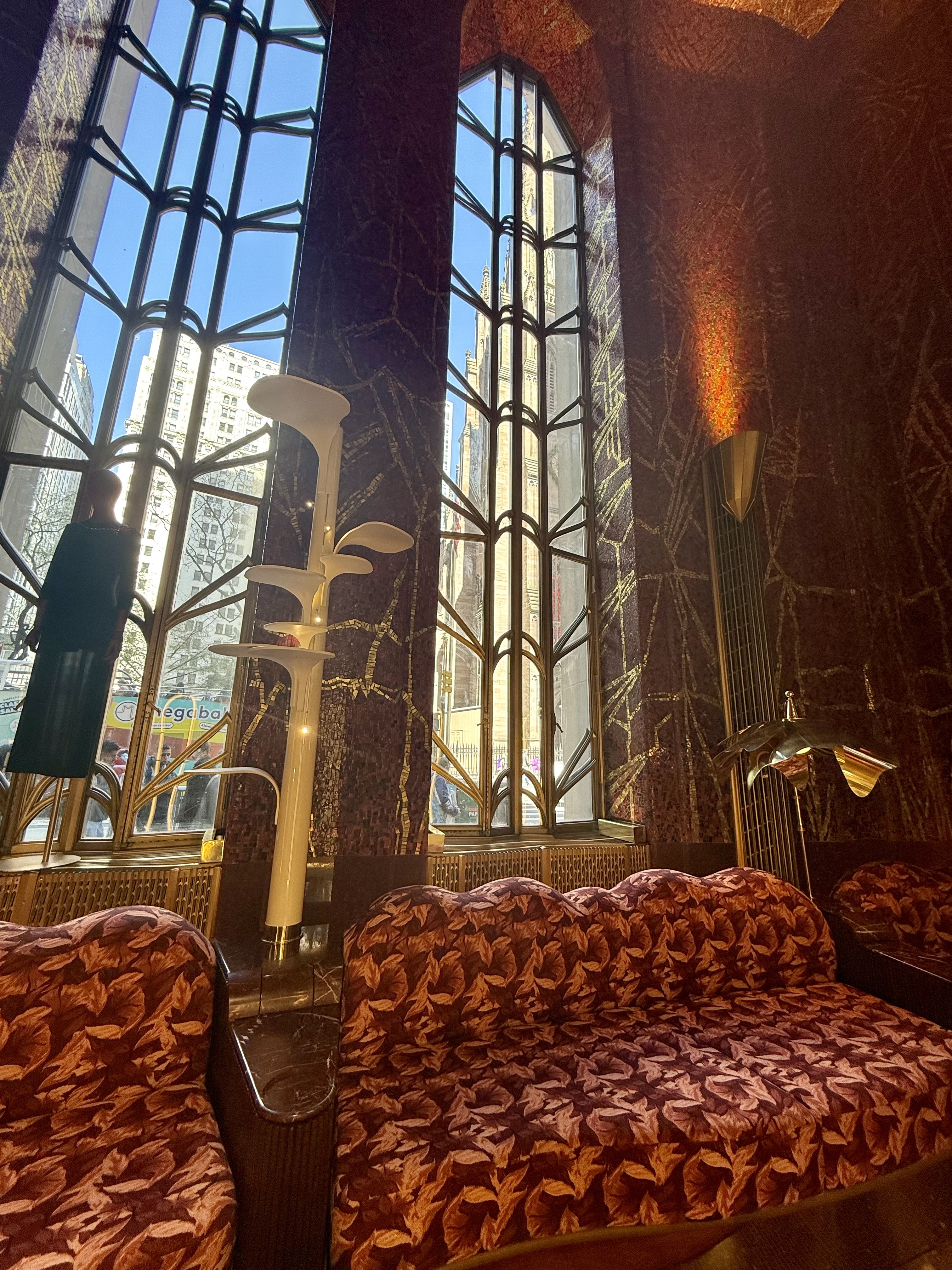
On the ground floor just to the left as you enter off Broadway, there is a lovely cafe with seating.
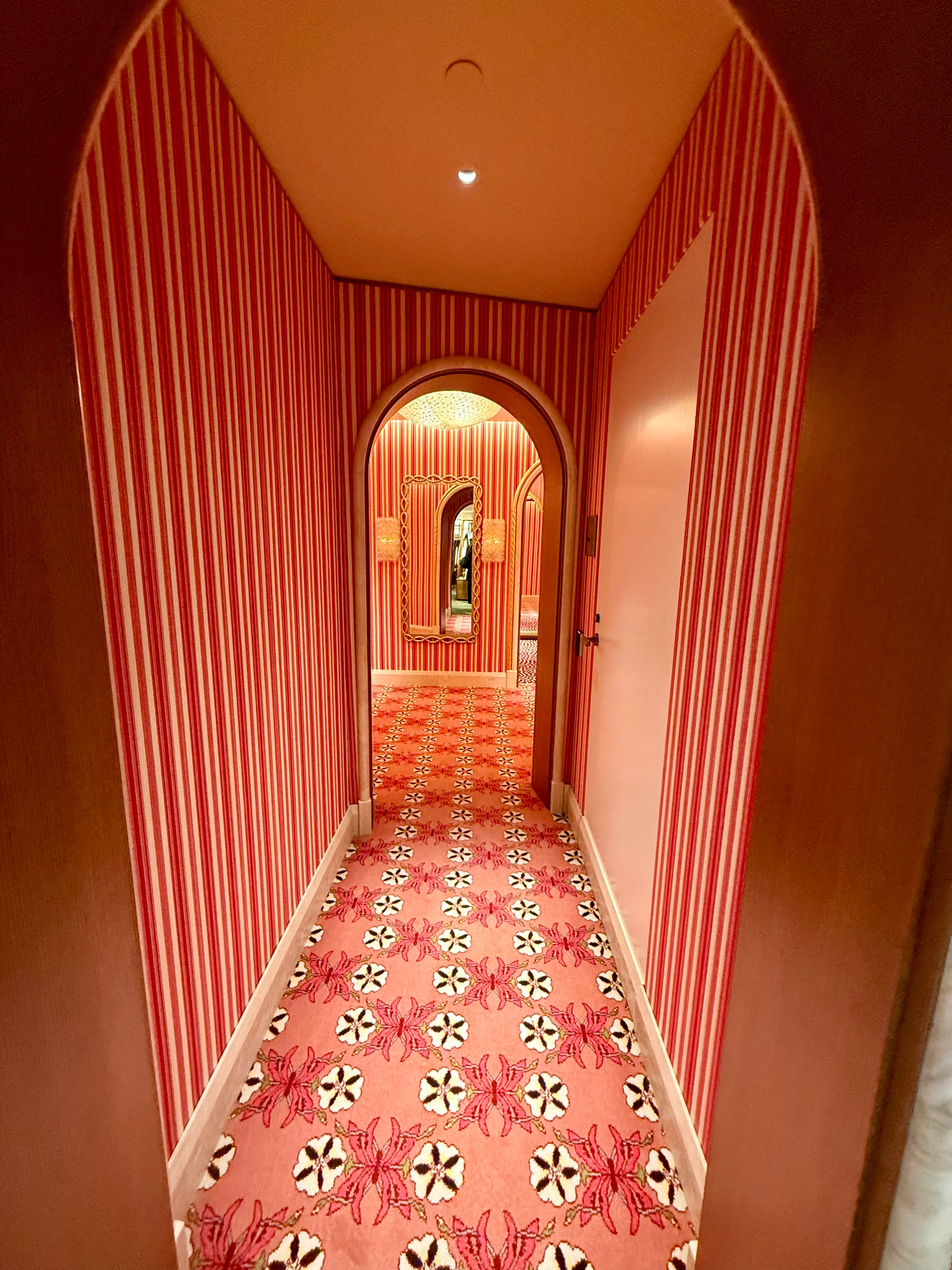
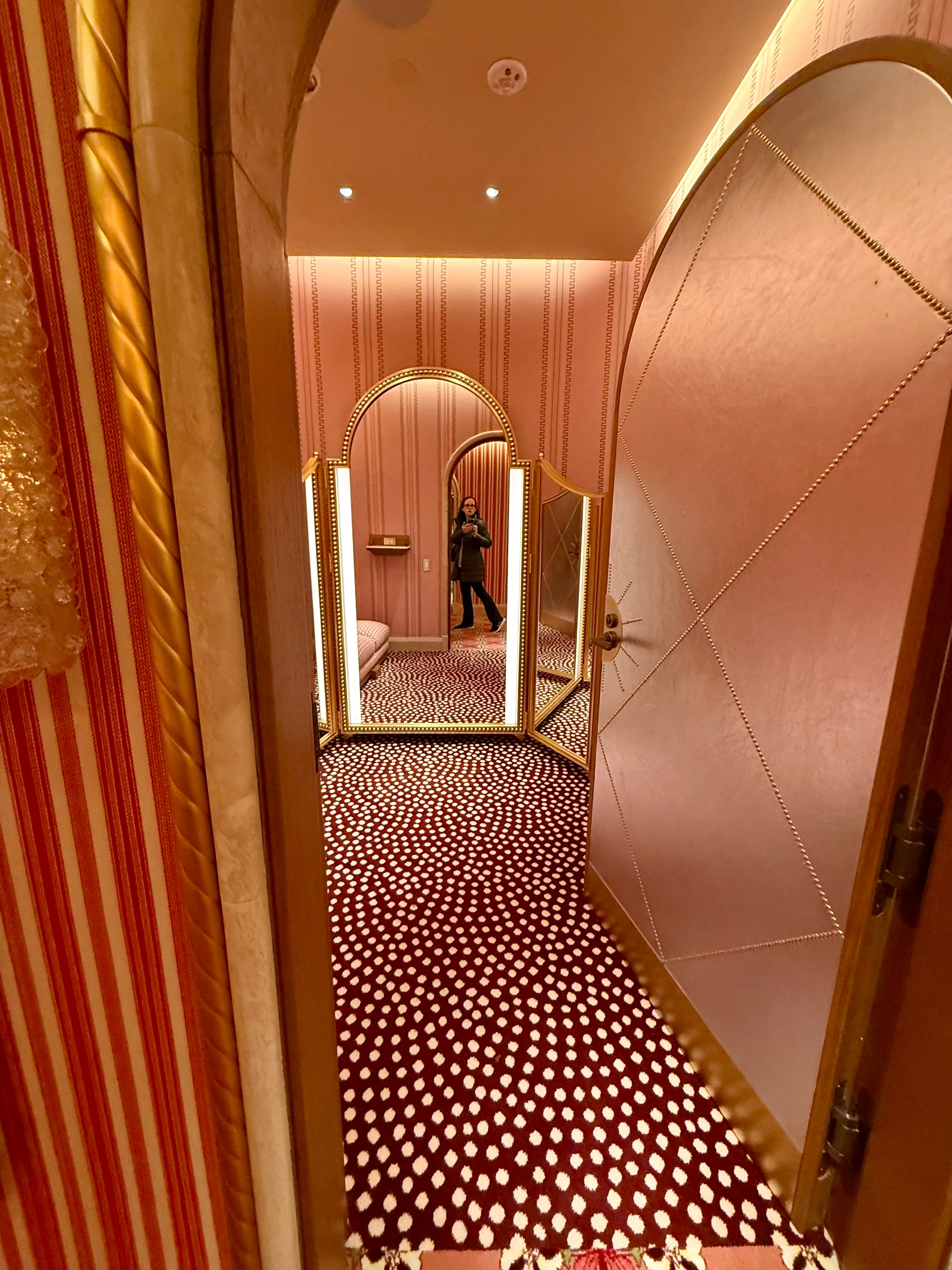
The dressing rooms are lushly and immersively decorated.
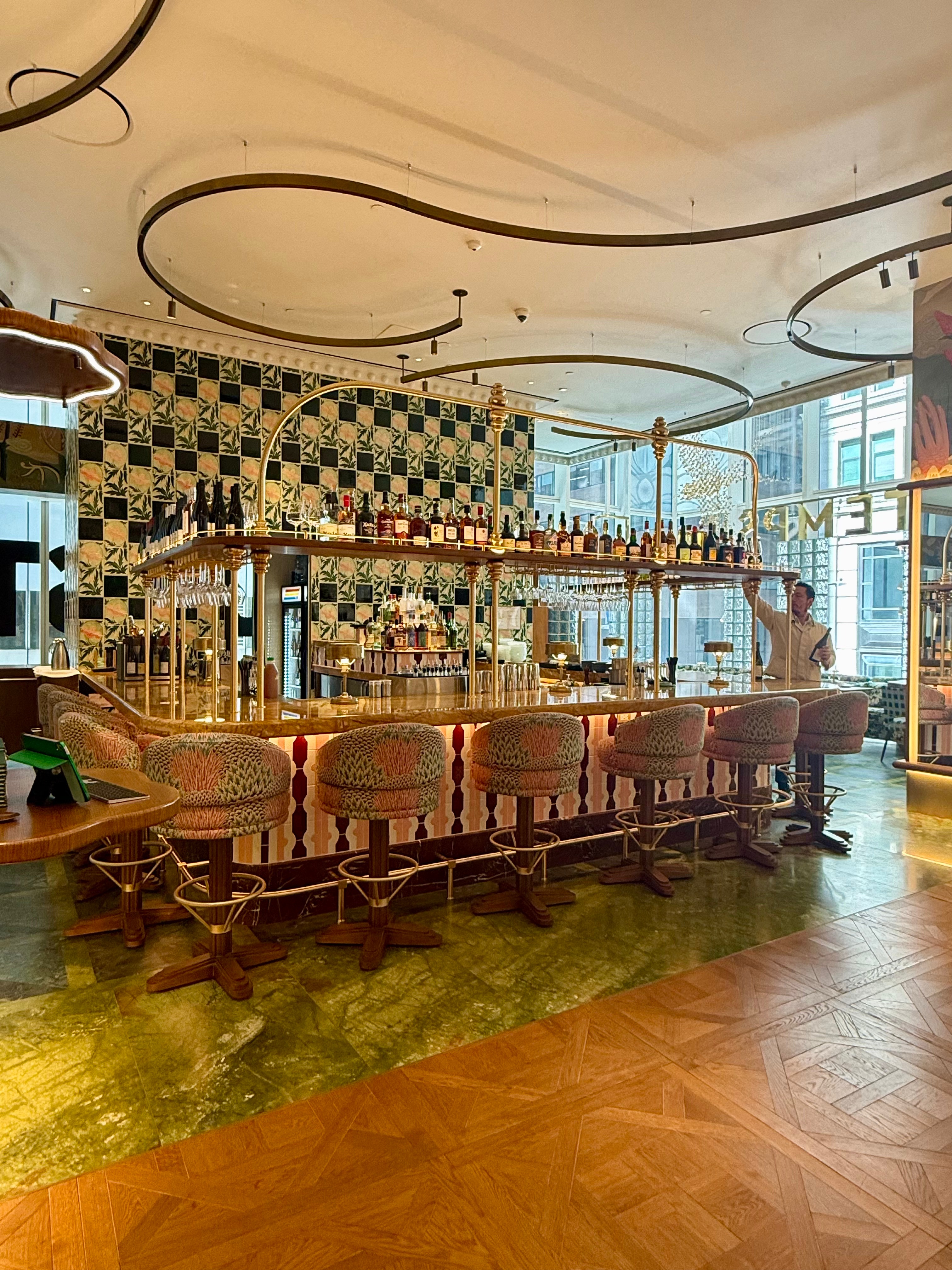
There are multiple bars within the space, this one is just on the second level above the entrance on Broadway.
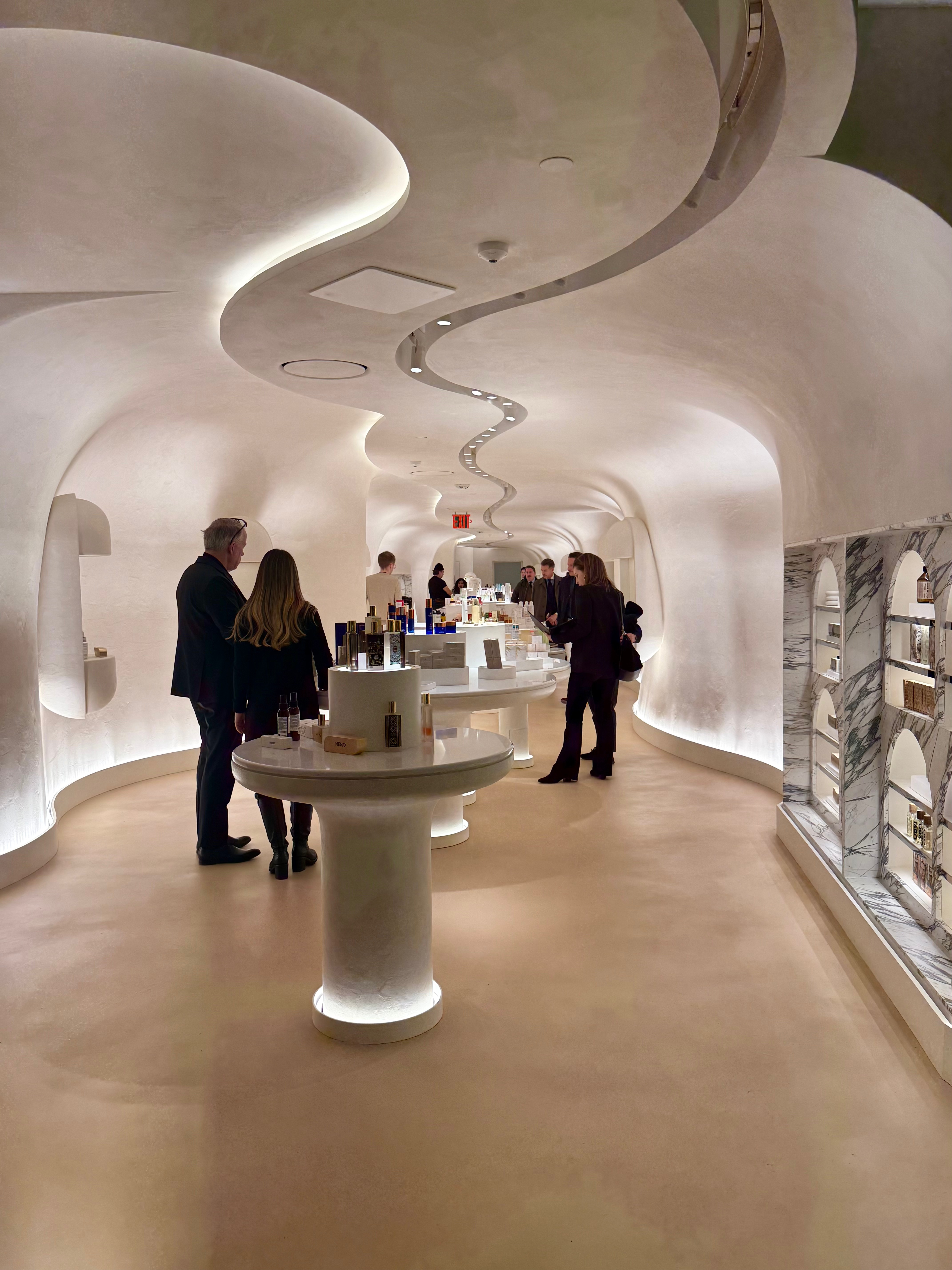
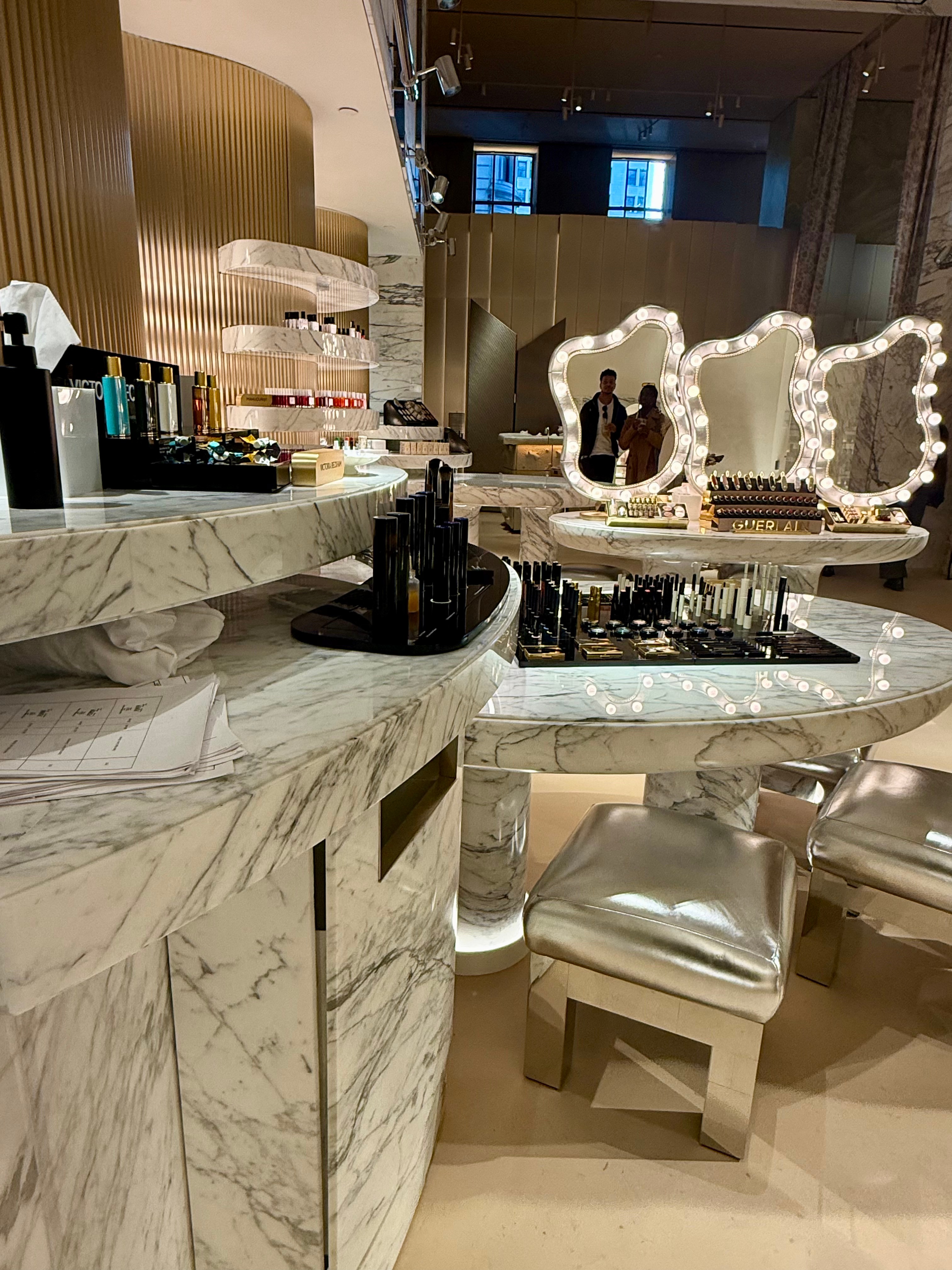
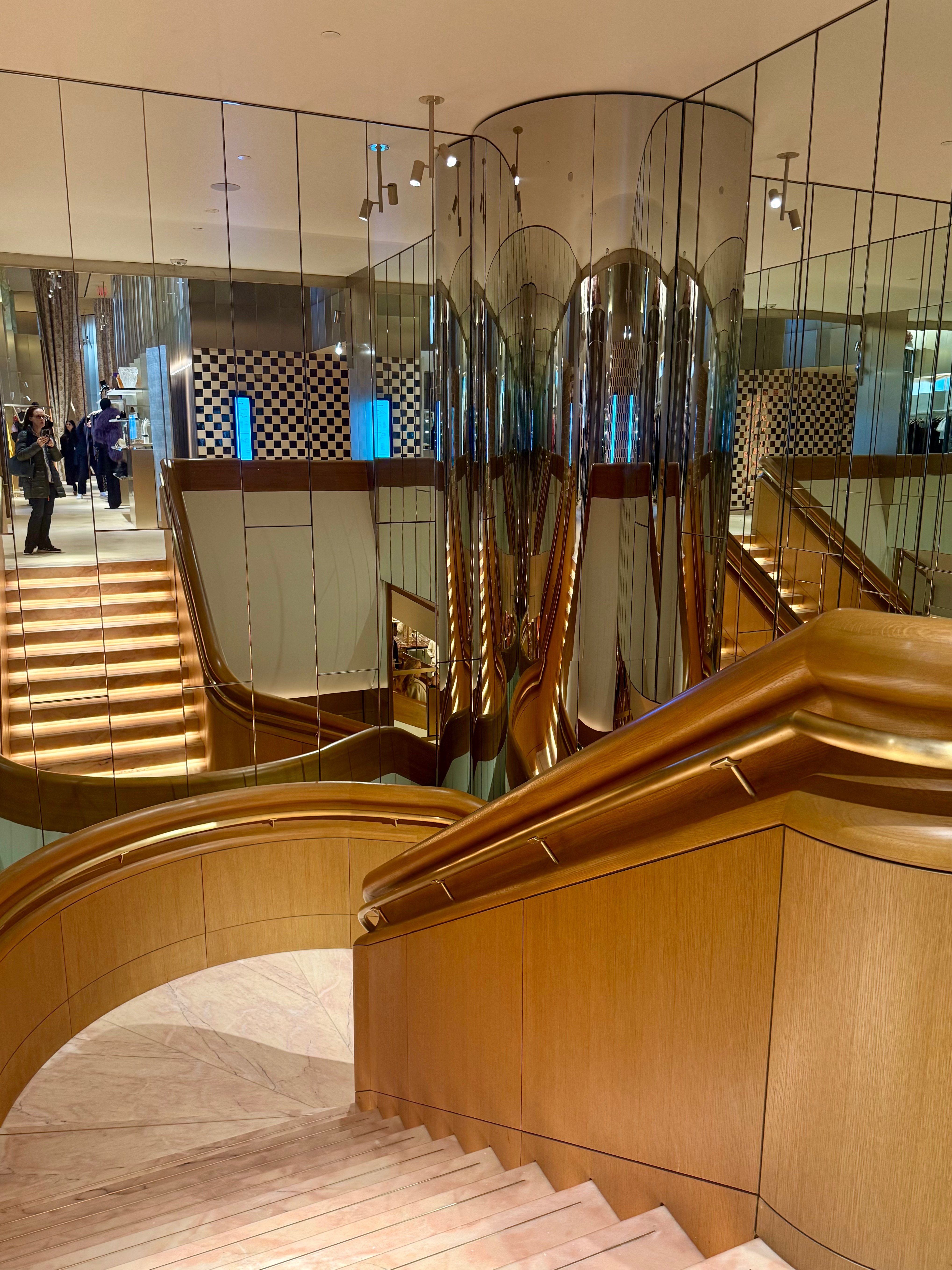
Continuing along on the second level, there is a passageway to get to the part of the store that faces Wall Street. It is set up as the beauty section, including some treatment areas, and a champagne bar.
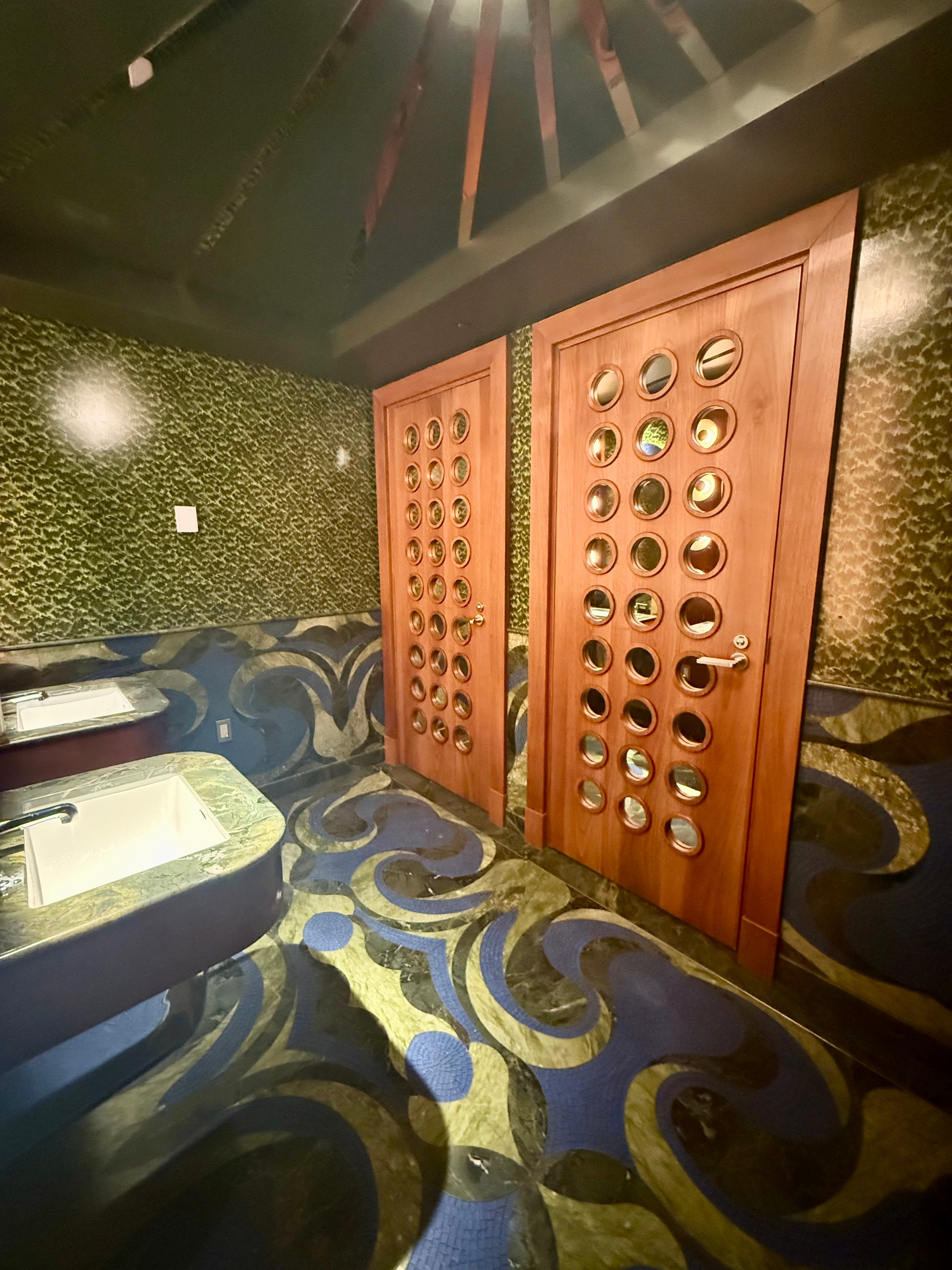
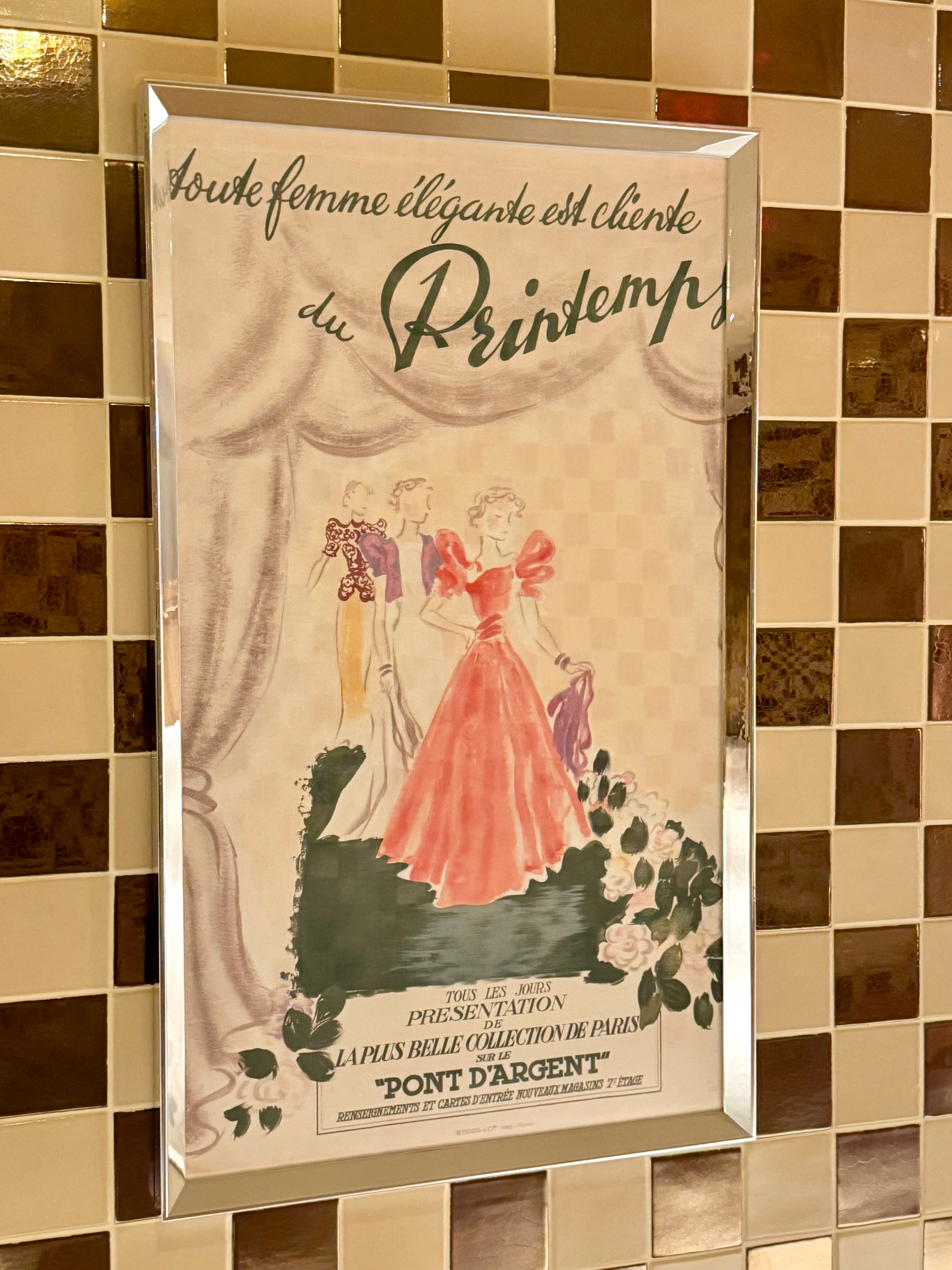
Near the beauty area, you can find the bathrooms. I have never been in such beautiful public bathrooms! Who needs a Maurizio Cattelan golden toilet when you can just visit Printemps?
Past the bathrooms, you find a grand staircase to lead down to the most incredible area of Printemps NYC – the famed Red Room.
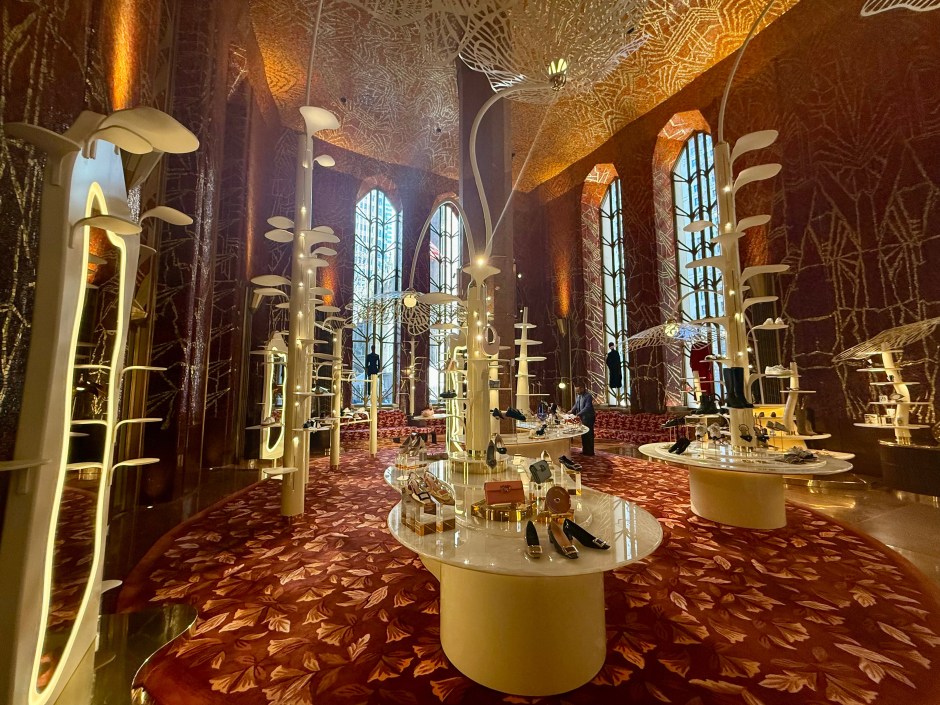
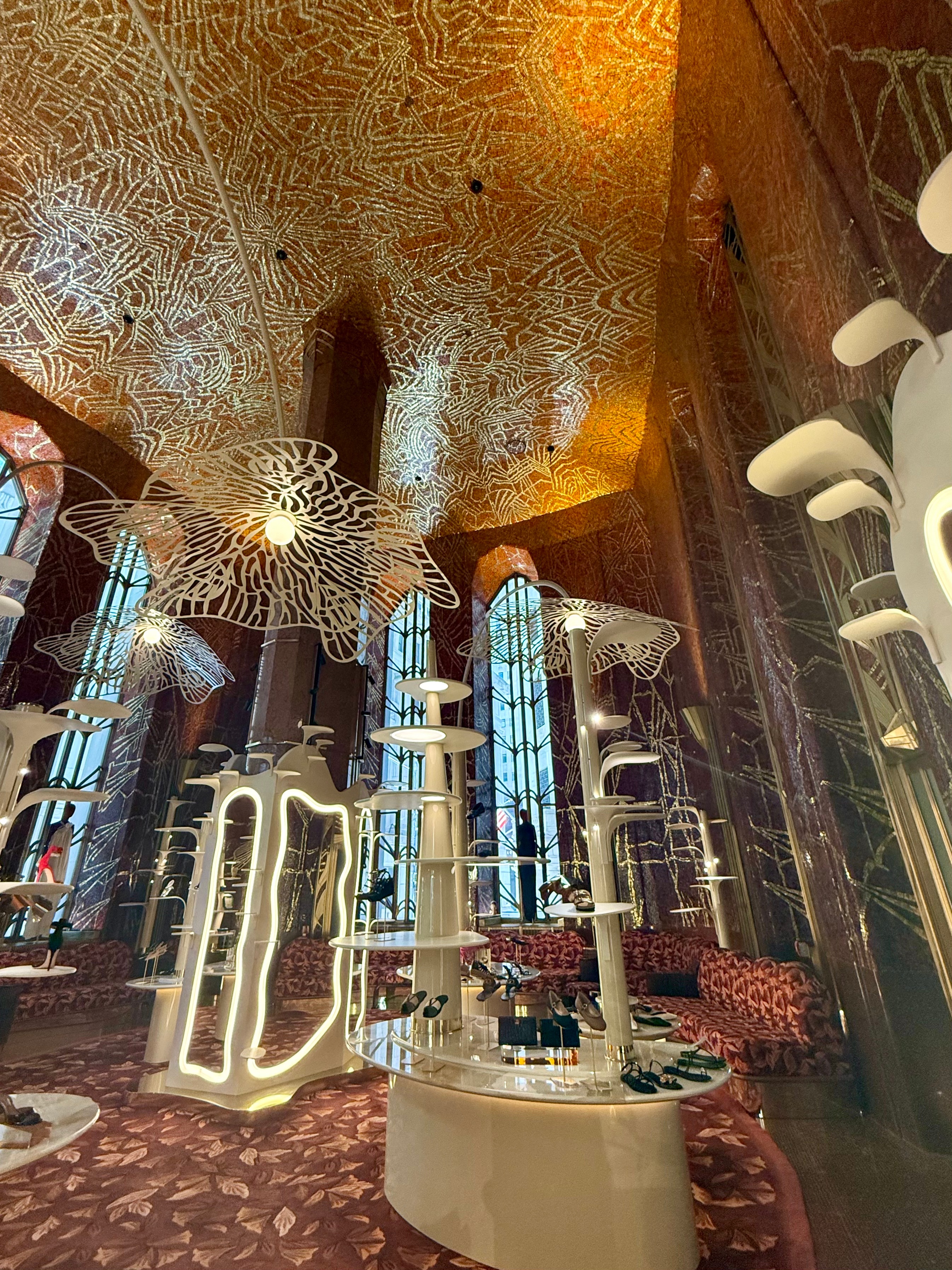
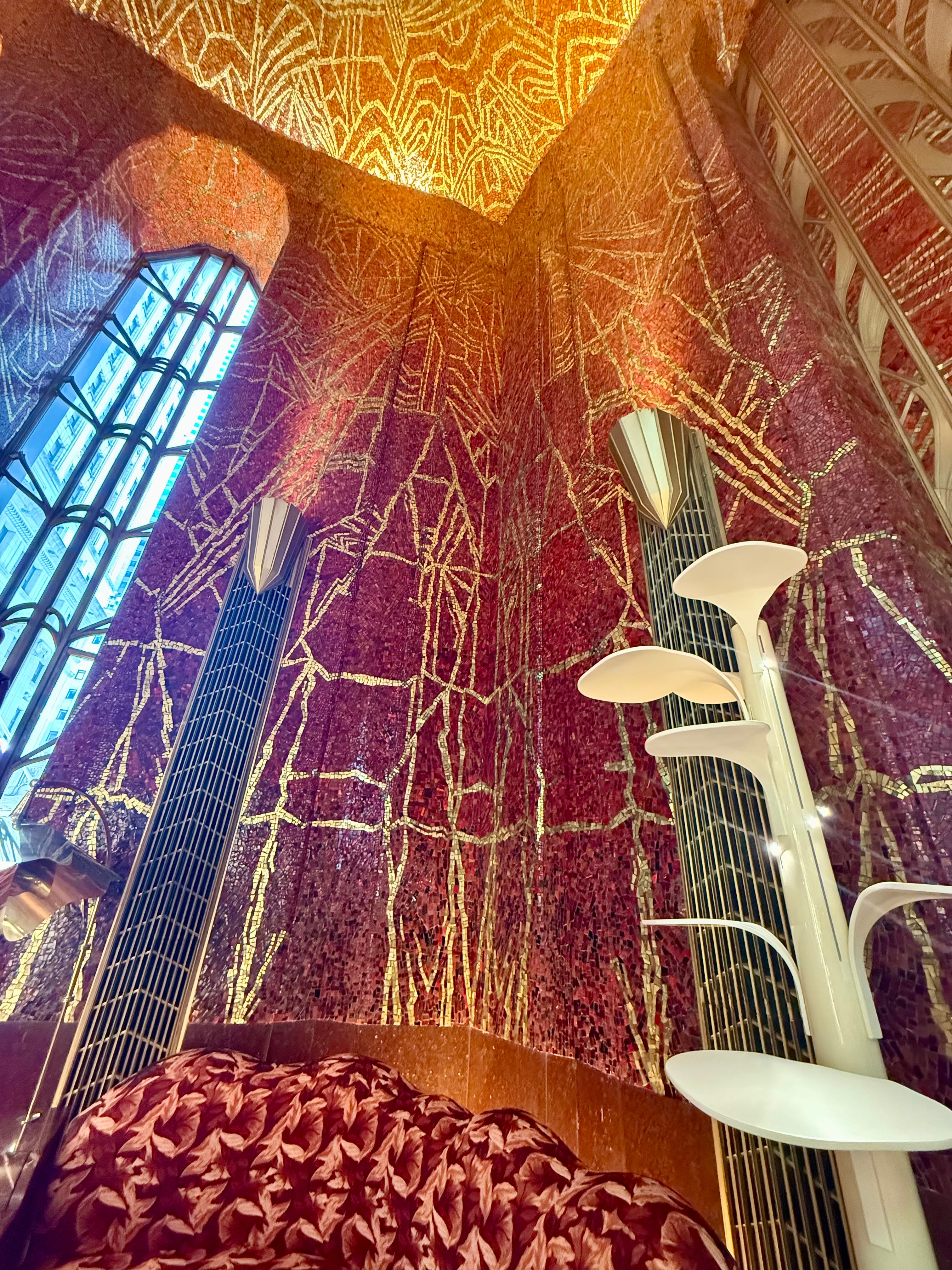
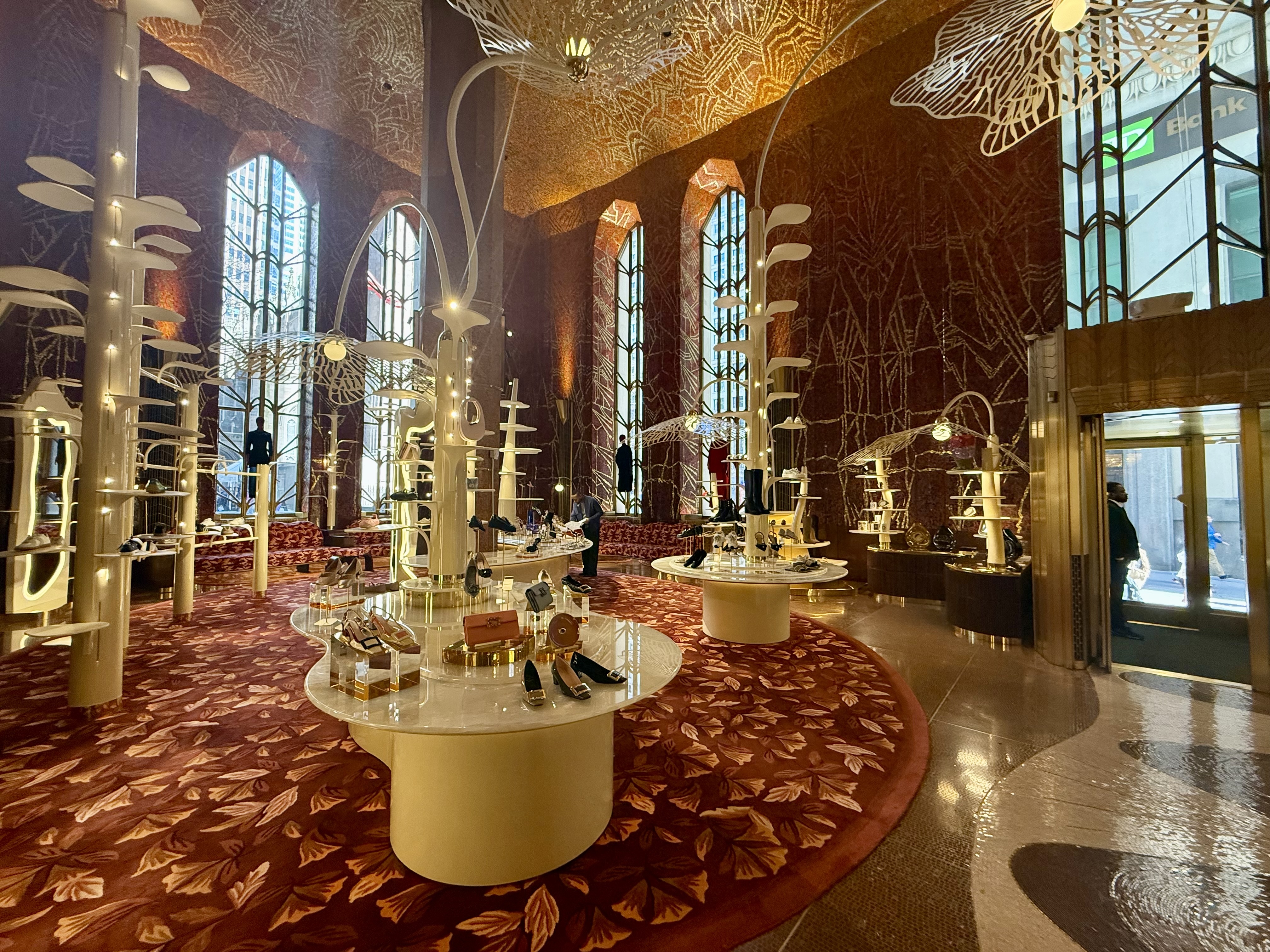
The Red Room, the interior of which is now a New York City Historic Landmark (in addition to the entire exterior of One Wall Street), was once a reception area for the Irving Trust customers. Because this was a private bank, most people would not have been able to enter, and the room was designed to impress its wealthy customers. There would have been no tellers, just some chairs and desks. The Red Room has ceiling heights varying from 30 to 37 feet, and the entire room is 100 by 40 feet. Walker and his associate Perry Coke Smith planned the decor of the room, with artist Hildreth Meière hired as a color consultant. The floor is covered in red terrazzo tiles created in Berlin under the supervision of Walker and Smith. The color scheme of the wall mosaic is red-on-blue which gradually gets lighter as it goes up to draw the eye to the gold-on-black on the ceiling.
The Red Room at Printemps is a functioning shoe store, and I dare you to find a more extraordinary one. Photographs truly don’t do it justice. If you entered Printemps NYC from Wall Street and experienced the Red Room first, the rest of the store – while gorgeous – would be anticlimactic after such opulence. If you visit on a weekend or later in the day, you might actually have to wait on a line to get in and you will see plenty of people taking photos and posing in the entire store, but particularly in the Red Room. My recommendation, if you possibly can, is to get there very soon after opening (hours are 10am-7pm daily) on a week day to avoid crowds. If you go early, it will be easier to enjoy the cafe as well (the cafe opens earlier most days, at 8am). Going later in the day would be an alternate plan, and enjoy a drink at one of the bars for the most elegant happy hour. The Red Room bar is open later, until 11:00pm, and the restaurant Maison Passerelle is open 5pm-10:30pm.
As anyone who has been to Paris knows, there is a particular quality to walking through the city – every turn seems to bring another view more charming than the one before. I found wandering Printemps NYC to be a similar experience – an immersive escape to Paris just off the bustling streets of my beloved NYC.
Bust of Alexander Hamilton, flanked by portraits of Aaron and Theodosia Burr, in the New York Historical Society
In the incomparable new American musical, Hamilton, currently the hottest ticket on Broadway in New York City at the Richard Rodgers theatre, the Schuyler sisters are introduced to the audience as they sing joyfully about living in the “greatest city in the world.” This is my own bias as well, and I do consider myself to be “so lucky to be alive right now” and living in NYC. However, as a real estate agent, I know that being able to live in the city is often a struggle – quite often financially in terms of being able to afford living here, and even for those with the means, difficult in terms of limited inventory. Because of my love for the city, and my day-to-day immersion in the city’s residential real estate market, I have found myself thinking about the different neighborhoods mentioned in Hamilton in terms of real estate availability and value. I have already blogged about many of these areas in terms of taking a dérive, or an unplanned walk in an urban environment (see my initial explanation about this idea here), and I will link to those posts when possible.
Before getting into the fun stuff, a few technical notes about price per square foot measures mentioned below: All stats on sales price per square foot are from the Real Estate Board of New York’s third quarter 2015 report here. Condos and coops are listed separately, as the comparative ease of buying a condo versus a coop is reflected in generally higher prices for condos (20-25% more per square foot). Also, higher prices for condos often reflect differences in types of housing – newer developments tend to be condos. For reference, I will also mention current average listing prices found on streeteasy.com for the different neighborhoods, but keep in mind that listing price averages are always higher than closed sales averages, since half or more of all listings end up selling for less than asking price. Also, I am focusing on sales, although I may mention rentals in each neighborhood as well.
Financial District
When the Schuyler sisters sing about living in “Manhattan,” the area we now know as the Financial District (see my previous blog post here) was almost entirely the area considered to be the city at that time. This is quite fitting, since the Financial District as a business center and home to Wall Street owes a great deal to Alexander Hamilton, who as first Secretary of the Treasury provided much of the foundation for NYC as the financial powerhouse it is today. However, over time, the fashionable residential areas spread north, and this area as a residential neighborhood has only returned in force over the past 10-12 years. Walking these streets is an exciting mix between reminders of our colonial and revolutionary past, and the very new and modern development that is occurring now and transforming the neighborhood.
When Hamilton, Laurens, Lafayette, and Mulligan sing “The Story of Tonight” while drinking in a pub, it might well have been the Fraunces Tavern, since the Sons of Liberty (of which Hercules Mulligan was a member) met there and it was a popular pub at the time. George Washington gave his farewell address to his officers at Fraunces Tavern in 1783. From there, you are a short walk to New York Harbor where Hamilton stole the British cannons at the Battery (as described in “Right Hand Man”), or Trinity Church, where Alexander and Eliza Hamilton are buried near Eliza’s sister Angelica.
How affordable is the Financial District (F.D.)? All city prices would seem unbelievable to those living here at the time of the American Revolution, but for downtown Manhattan, it is relatively affordable. The most recent REBNY numbers showed condos in the F.D. averaging $1207 per square foot (compared to $1593 overall for all of Manhattan, and nearby areas Soho at $2021 and the West Village at $2323 much higher per square foot). Coops average $906 per square foot in the F.D. (compared to $1218 for all of Manhattan, $1509 for Soho, and $1629 for the West Village). I recently did a rental search for a friend wanting to move from Tribeca, and showed her that she could either save about a third in rent if she kept the same size and quality of apartment, or get another bedroom for about the same price or even a little less.
Hell’s Kitchen
Yes, you can call it Clinton if you like, but I think the name “Hell’s Kitchen” is one of the coolest in all of New York City and when I move there I will state the name proudly. No, this area is not mentioned in the musical Hamilton and in fact would not have been populated much at all at the time, but it is very near the Richard Rodgers theatre, currently the home to the musical. The proximity to the theatre district keeps prices down a bit, but would be a plus to me (see my previous blog post about Times Square and Hell’s Kitchen here). There are blocks in Hell’s Kitchen that look just like quiet leafy Chelsea blocks – but at a fraction of the cost – as well as new condo high rises with every amenity and the prices to match.
The REBNY report is for Midtown West, which encompasses a bit more than just Hell’s Kitchen, but lists the average price per square foot at $1734 for condos and $1230 for coops.
Stage door at the Richard Rodgers
The Upper East Side
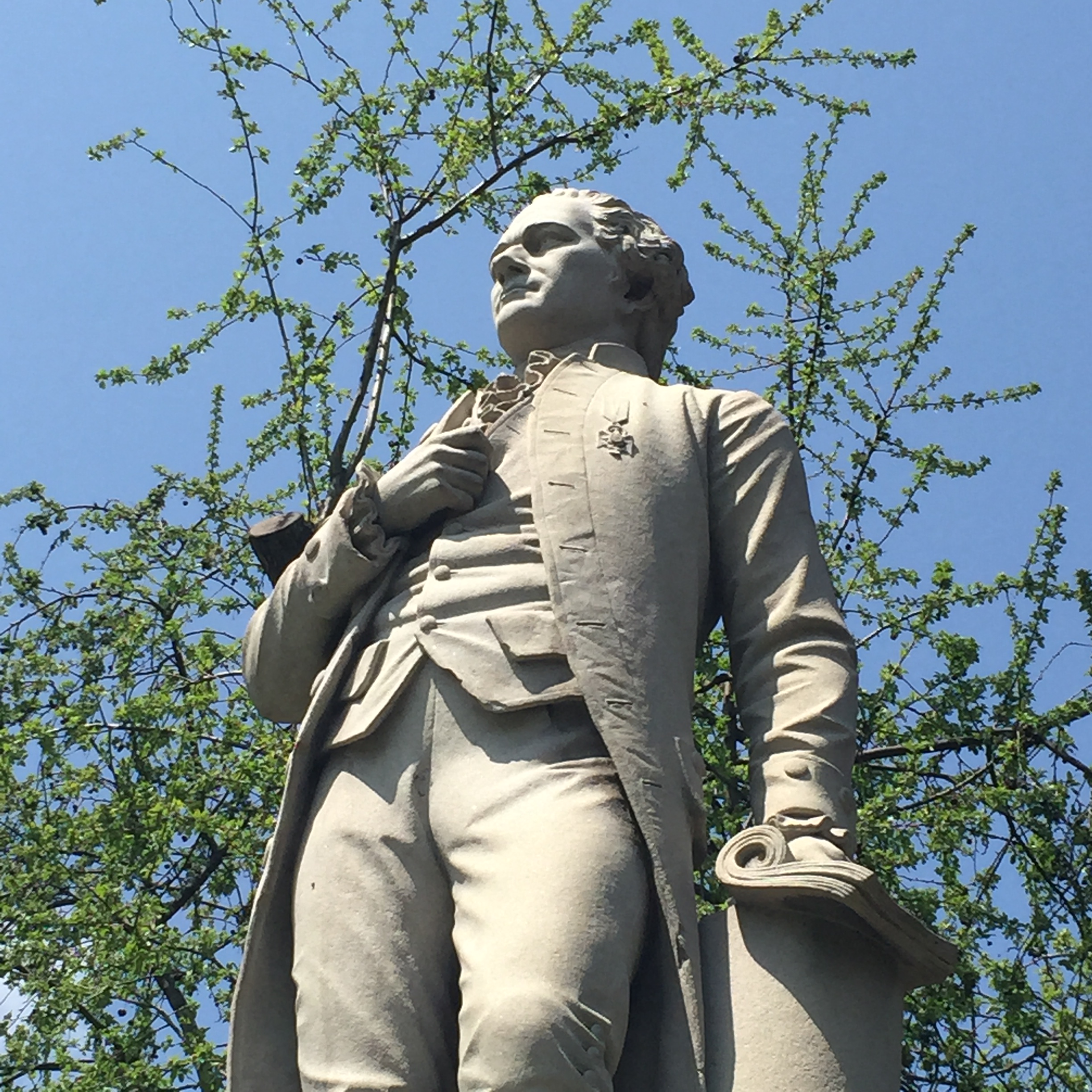
Statue of Alexander Hamilton in Central Park
Again, not mentioned in Hamilton (although a family with the wealth and connections of the Schuylers would have certainly moved to Fifth Avenue along with the robber barons in the early 20th century), but mentioned because of the statue of Alexander Hamilton standing proudly among the trees behind the Metropolitan Museum of Art, in our beloved Central Park (not created until long after Revolutionary times).
The Upper East Side has long been a bastion of wealth, and areas to the west of Lexington Avenue still command a premium due to proximity to Central Park (see one of my many blog posts about the park here, and another about the value of a park view here). However, the far east side (east of Second Avenue, particularly the area called Yorkville, see my post here) still has value, in part because of its perceived remoteness and the construction mess due to the building of the Second Avenue Subway. While overall the Upper East Side averages $1764 per square foot for condos and $1234 for coops, Streeteasy listings show the difference in listing prices for Yorkville ($1693 per square foot, all types) versus Lenox Hill near the park ($2667 per square foot, all types). Rentals in Yorkville are particularly well priced compared to other areas of Manhattan, except for areas of upper Manhattan that will be discussed next.
Harlem and Upper Manhattan
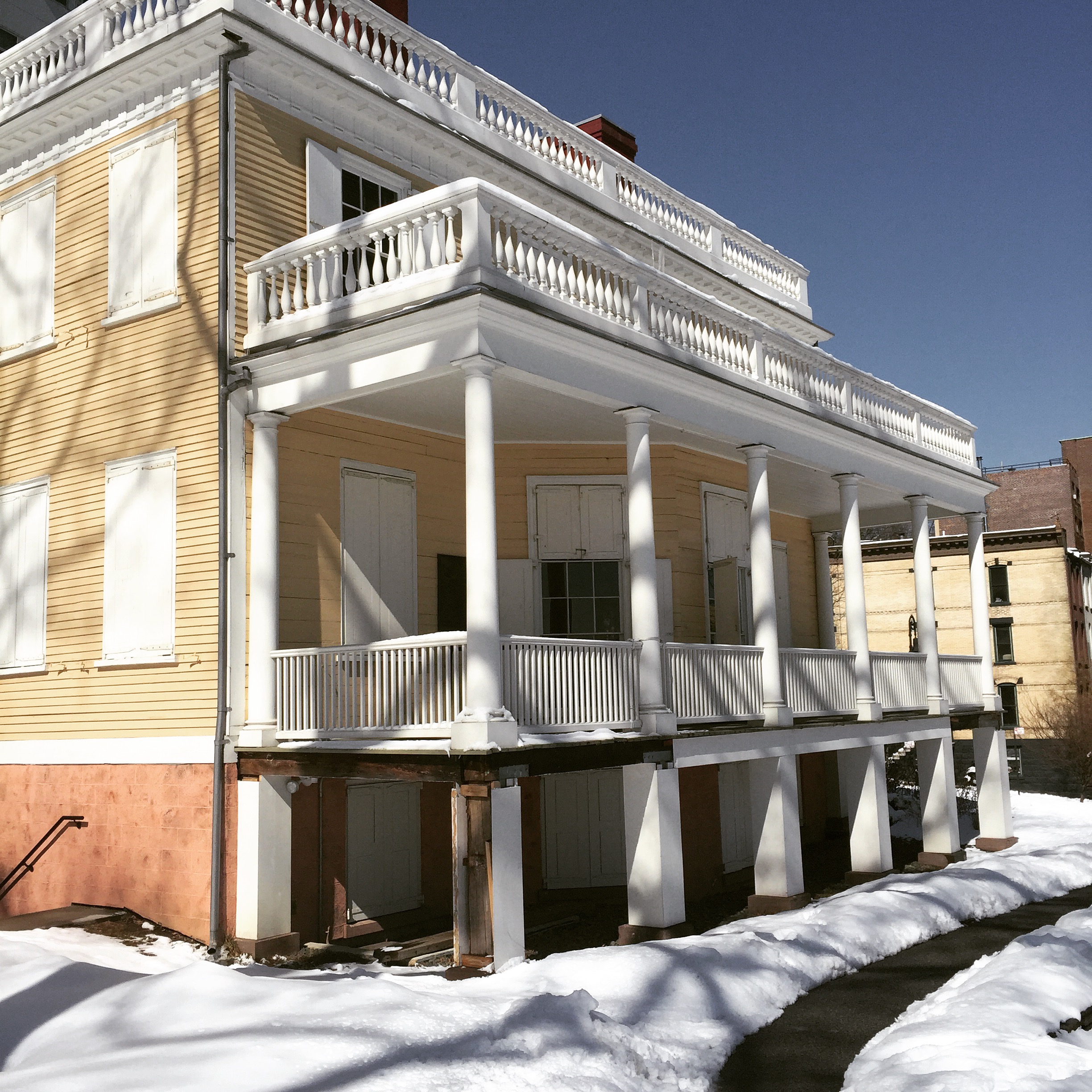
There are plenty of references to Harlem in Hamilton, from Washington’s “run to Harlem quick” in “Right Hand Man, ” Hamilton’s wooing of Eliza with a plan to “get a little place in Harlem and we’ll figure it out” in “Helpless,” and “the Hamiltons move uptown” in “It’s Quiet Uptown.” Moving to Harlem in those days before motorized vehicles and the subway was the equivalent to moving to the remote countryside, and even King’s College (later renamed Columbia, sorry again, King George) was at that time in lower Manhattan, not in its current spot in Morningside Heights (see a previous blog post here). Hamilton Heights, an area of Harlem I wrote about in this blog post, is named for the location of Hamilton Grange, and the Hamilton home can still be seen there (although not in the exact location, still within the farmland owned by the Hamiltons). Even farther north than Harlem is Washington Heights (see previous blog post here), home of the Morris-Jumel mansion – once Washington’s headquarters (and then the British government’s), later the home of Aaron Burr, and most recently the site used by Lin-Manuel Miranda to work on composing Hamilton. This historic home hosted many other notable figures who also live on in the musical by reference or as characters – John Adams, Thomas Jefferson, and yes, Alexander Hamilton.
Harlem and much of upper Manhattan is rapidly appreciating in value, but still represents a relative bargain in Manhattan. The REBNY numbers separate Harlem only by East ($748 per square foot for condos, no figures for coops) and West ($713 for condos, $996 for coops), not a very practical demarcation. Streeteasy listings show average prices as $829 per square foot for trendy Central Harlem (all types), $667 for East Harlem, $661 for Hamilton Heights, $721 for Morningside Heights (the Columbia effect), and $638 for Washington Heights.
There are other areas in NYC mentioned in Hamilton, some vague (“British take Brooklyn” in “Right Hand Man” – likely Brooklyn Heights) and others specific (“abandoning Kips’ Bay,” also in “Right Hand Man”) and those will be future places for my dérives and the subsequent blog posts.
At a recent social event, a friend and I were talking about getting together more often, and I said, “Well, you know how to find me.” Her husband responded, “Yes, at the Hamilton lottery!” (clearly he is following my Facebook posts) and my friend asked what the show was about. After explaining that it is a hip-hop musical based on the life of Alexander Hamilton, and she replied, “You know, that sounds like the craziest thing I have ever heard!” Well, crazy good . . . Yes, finding a place to live in New York City is frustrating, you will always end up spending more than you hoped (even those with more financial resources but especially those with fewer), and it will likely take longer than you want and you will end up compromising, but how lucky we are to be alive right now, in a city filled with creativity and the arts – truly, the greatest city in the world.
Recently I was fortunate enough to see the new musical “Hamilton” at the Public Theater (arriving on Broadway this summer), leading me to my last blog post – a walk through Hamilton Heights, the neighborhood in upper Manhattan where Alexander Hamilton had farmland and lived in his final two years. However, much of Alexander Hamilton’s time in the city was spent in the area now known as the Financial District. Roughly occupying the same space as the original settlement of New Amsterdam, it lies at the very southernmost point of Manhattan, below City Hall Park, excluding the areas of Battery Park and Battery Park City. This neighborhood is a unique mixture of very old (the colonial remnants of New Amsterdam) and very new (it’s only recently become a popular choice as a residential neighborhood and new development buildings abound). With these thoughts in mind, I decided to take my next unplanned walk in an urban environment (a dérive) in the Financial District.
I emerged from the subway at Bowling Green, the traditional starting point of ticket tape parades up Broadway. This tradition with a spontaneous parade associated with the dedication of the Statue of Liberty in 1886, and since has continued with celebrants as diverse as Theodore Roosevelt (upon his return from safari in Africa in 1910), Albert Einstein in the 1920’s, Charles Lindbergh as well as Amelia Earhart following their successful solo trans-Atlantic flights, Jesse Owens after winning four Olympic gold medals in 1936, the pianist Van Cliburn in 1958, the Apollo 11 astronauts, and the New York Yankees (nine times).
Wandering from Battery Park to State Street and on to Pearl Street, I came across what is possibly Manhattan’s oldest building (from 1719), Fraunces Tavern. This building is now a museum and restaurant as well as a National Historic Landmark. Once the meeting place of the secret society the Sons of Liberty, it became the headquarters for General George Washington at one point during the Revolution, and is where he gave his famous farewell address to his officers.
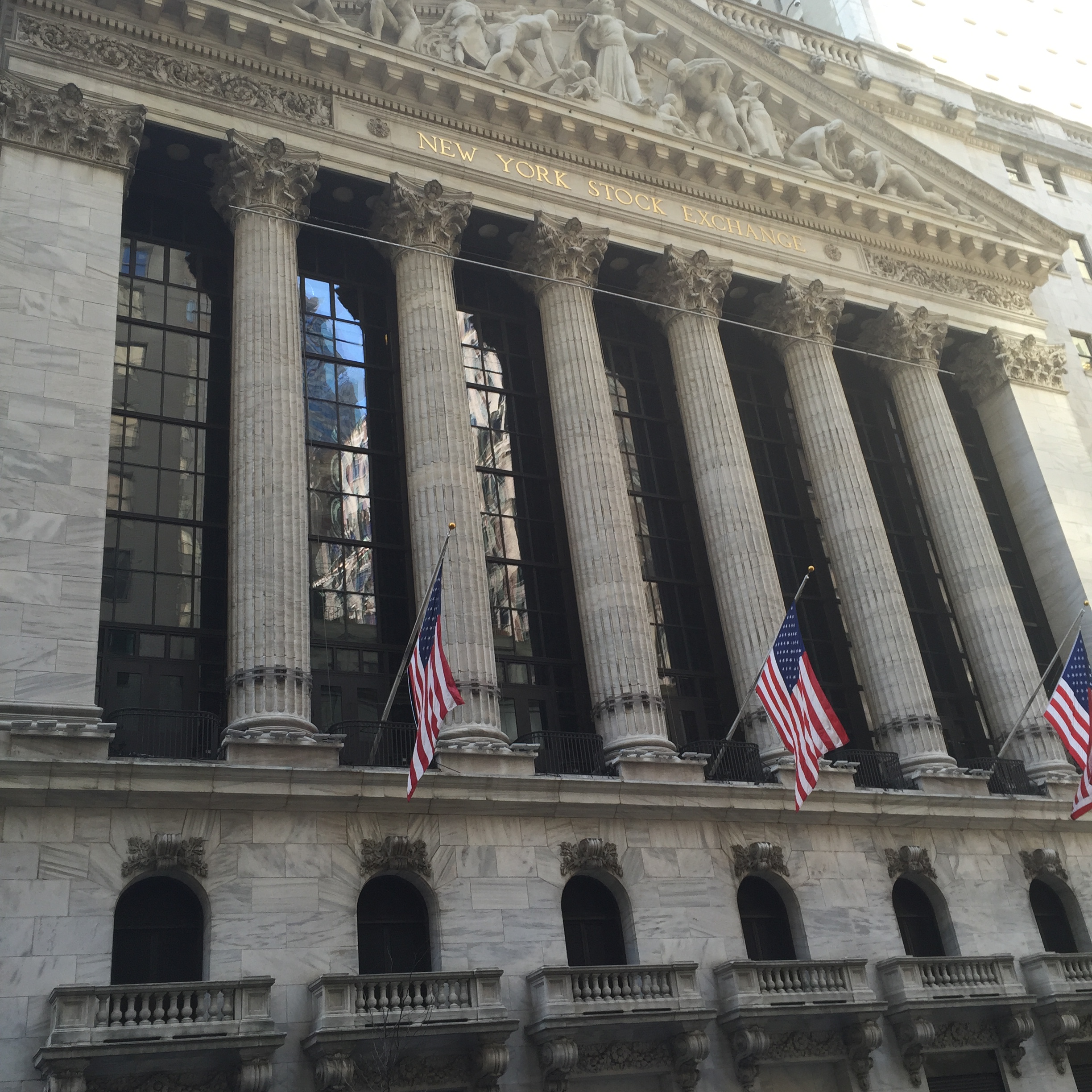
Continuing north on Broad Street, as I approached the intersection with Wall Street it was impossible to miss the imposing façade of the New York Stock Exchange. The roots of this center of American finance go back as far as the years immediately following the Revolution, and the earliest securities traded were War Bonds and stock from the First Bank of the United States (established by the first Secretary of the Treasury, Alexander Hamilton).
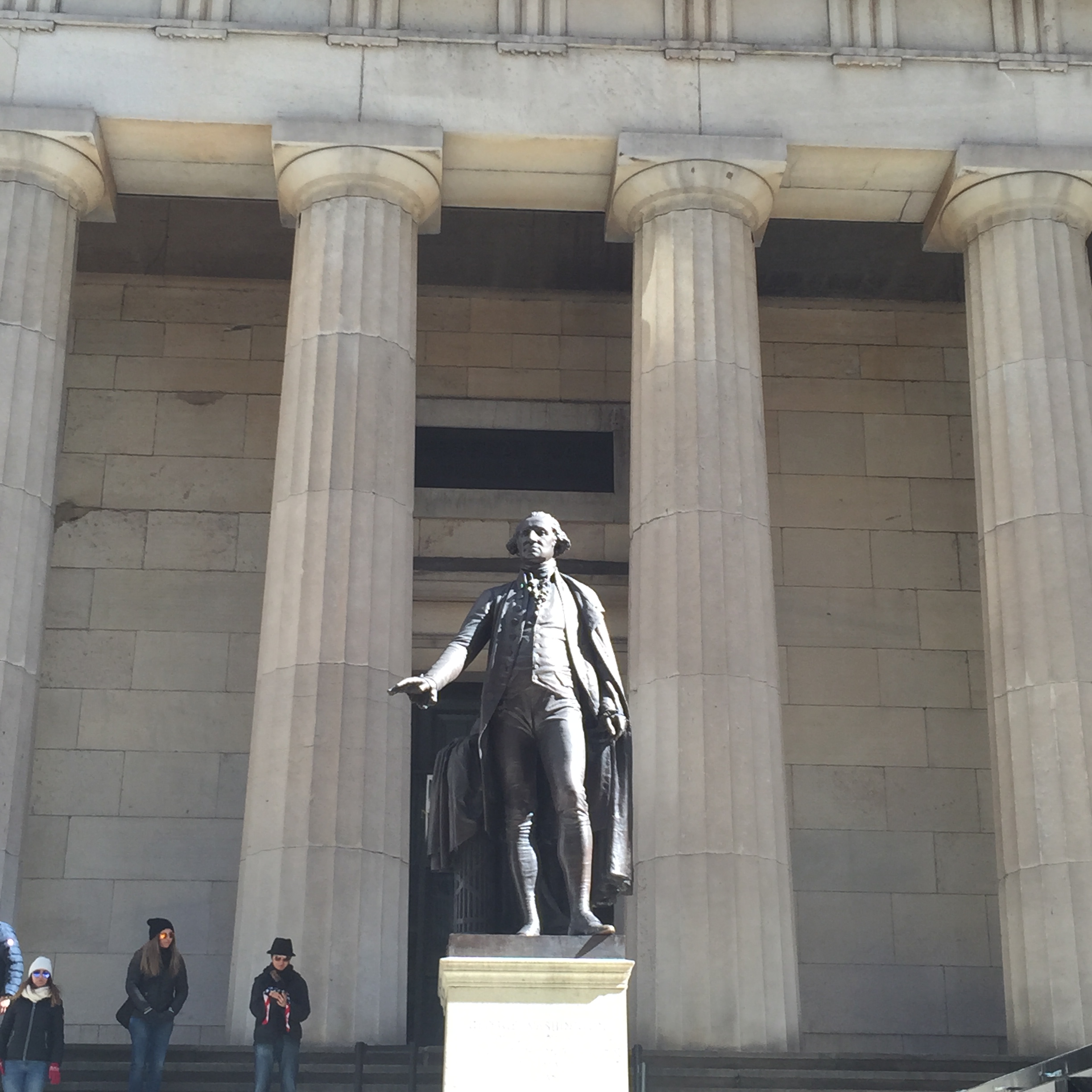
Nearby, on the corner of Wall Street and Nassau Street, is Federal Hall, the site of the first United States Capitol Building and the location of George Washington’s inaugural. A statue of the first President stands imposingly in front, gesturing as if to say “hold your applause.”
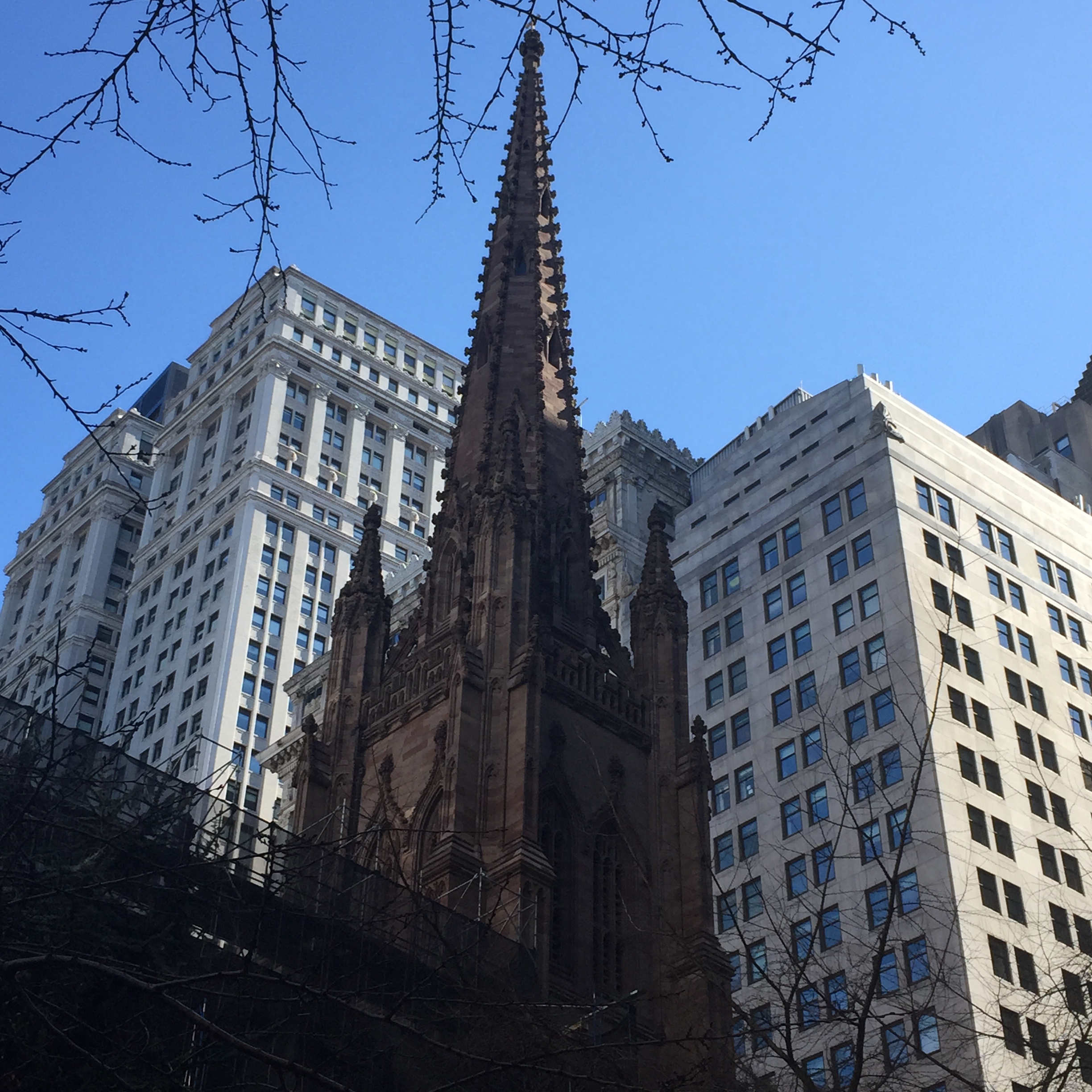
Nearby at Broadway and Wall Street is Trinity Wall Street Episcopal Church, first charted during colonial days (1696) by King William III. The current building on the site dates from 1846, but the cemetery attached to it is much older, and one of the few in Manhattan. It holds several luminaries, including Robert Fulton (inventor of the steamboat) as well as Alexander Hamilton and his wife Eliza Schuyler Hamilton.
Walking behind the cemetery along Church Street, it is impossible to miss One World Trade. Adjacent to the original footprints of the World Trade Center (now reflecting pools) and the site of the 9-11 Museum, it dominates the skyline in the area, and is now open for business. The influx of workers to One World Trade is bringing new shops and restaurants to the area. The new World Trade Center transportation hub is due to open at the intersections of Vesey, West Broadway, and Greenwich Streets at the end of 2015. Designed by famed Spanish architect Santiago Calatrava, it has been the source of controversy over its cost and overruns. However, seeing it soar in such an emotionally impactful area (Calatrava has said it is supposed to look like a bird being released from a child’s hand) was very pleasing to me.
Prior to 2001 and the 9-11 attacks, about 15-20,000 residents lived in the Financial District. Nothing could be more revealing of the strong and resilient nature of New Yorkers (and also of the success of some incentives and tax breaks created by the city to spur growth) than the fact that now there are over 60,000 residents of the neighborhood. In 2014, the average price per square foot in the Financial District was higher than the average in Manhattan for the first time, comparable to that of the Upper West Side and Greenwich Village. Simultaneously historic and fresh, this neighborhood is the closest thing New York City has to the center of Rome, where new buildings are interspersed with views of the Forum or Coliseum.



























 Julie Brannan, NYC residential real estate