Celebrating the Year of the Dog in Chinatown

Several years ago I posted a walk around Chinatown, ending by expressing delight in how a walk of a few blocks in New York City can lead to an environment just as new as you might get by taking a lengthy plane ride. However, in all my time in the city, I had somehow never managed to make it to the Lunar New Year celebration until recently when I went to Chinatown to celebrate the the beginning of the Year of the Dog. My daughter and I arrived about an hour ahead of the parade start on a cold and drizzly day, and were able to be right up against the barricade. By the time the parade started, though, the crowd was packed for at least a block, so I do recommend getting there early if you choose to go.

IMG_9661

Traditions for the Lunar New Year include the color red (symbolizing joy as well as virtue, prosperity, and truth), giving money or presents in small envelopes, and making noise to scare off evil spirits. Dragon or lion dances also represent a way to scare off bad things and welcome in a safe and prosperous new year. All of these are represented at Chinatown’s parade. Being at the front of the crowd, my pockets were stuffed by the end with small envelopes filled with tea or candy, fortune cookies, and even a red folding reusable shopping bag with the year of the dog on it. People watching the parade had bought small popping firecrackers that were set off by throwing them against the ground, and huge tubes that shot confetti for 10 or 20 feet.

IMG_9667

The parade started out with the NYC police and fire departments, including (incongruously, to me at least) firefighters in kilts with bagpipes playing “76 Trombones.” The rest of the parade was much more what I had expected, however.

The Dragon/Lion dances were my favorite parts of the parade. My daughter pointed out that at times the dance seemed to be very similar to twerking!


IMG_9695

The Year of the Dog was prominently celebrated, including a few actual dogs. People born in the Year of the Dog are said to share characteristics with dogs, such as loyalty and exuberance.


I loved this dog made up entirely of balloons.


This group held a series of cut outs of various breeds of dogs.


Another dog, this time a person in costume.

I was interested to find out that this Year of the Dog (a Brown Earth Dog year) is predicted to be a good year, but an exhausting one. The antidote to a stressful year is apparently to wear at least some red every day. I tend to do that already, so here’s to a good Year of the Dog!
Chinatown

Columbuspark1

Taking an unplanned walk through an urban setting (a dĂ©rive) is one of my favorite activities, and New York City – where walking a few blocks can completely change your surroundings – is the ideal city for this. For this dĂ©rive, I got on the subway at Lexington and 86th Street, took the 6 train downtown, and emerged at Canal Street, where the first thing I saw was the typical golden arches of a well-known fast-food restaurant. Indicative of how far I had traveled despite the short subway ride, however, the writing on the sign was solely in Cantonese.

There are many neighborhoods within the five boroughs of New York City with large populations of ethnic Chinese, but this area in lower Manhattan is what most people think of when the term “Chinatown” is used in the city. There are no clearly defined borders, but roughly the neighborhood could be though of as being bordered by Broome Street to the north (there are a few blocks where Chinatown and Little Italy overlap), Chambers Street to the south (touching the Financial District), East Broadway to the east, and Broadway to the west (bordering TriBeCa). Formed during the mid-1800’s, when new laws were enacted on the West Coast limiting participation in some occupations, by 1900 there were 7,000 residents of Chinatown. Most residents were traditionally Cantonese speakers, but Mandarin is beginning to be used as well. Today’s population is estimated to be 90,000 to 100,000, in a relatively small number of blocks and without many high-rise buildings, leading to the packed and bustling nature of the neighborhood.

Starting on Canal Street and Lafayette, for this derive I began walking east along Canal. Chinatown is not a place to walk if you are in a hurry to get somewhere – the streets can be extremely crowded. Canal Street is lined with shops, many of them featuring inexpensive New York souvenirs for tourists. Fruit vendors with good quality and very inexpensive produce also appear along Canal (further limiting the sidewalk for movement of crowds).

Just after Canal Street merges with Walker Street, I took a turn south onto Mulberry Street. As soon as you get off Canal, the crowds thin and it is easier to appreciate the character of the neighborhood. Most signs are in Cantonese as well as English – and some omit English altogether. Restaurants abound in the area. Most New Yorkers have strong opinions of what the best restaurants are in Chinatown, but in my opinion it’s fun to simply decide to stop in at any restaurant that catches your eye. When on jury duty a few years ago, my fellow jurors and I walked to Chinatown during lunch recess, trying a different restaurant every day. Approaching Bayard Street, the Chen Dance Center (http://www.chendancecenter.org/) is on the east side of Mulberry, and holds a school for dance as well as performances of modern dance reflecting Asian aesthetics by its resident company.

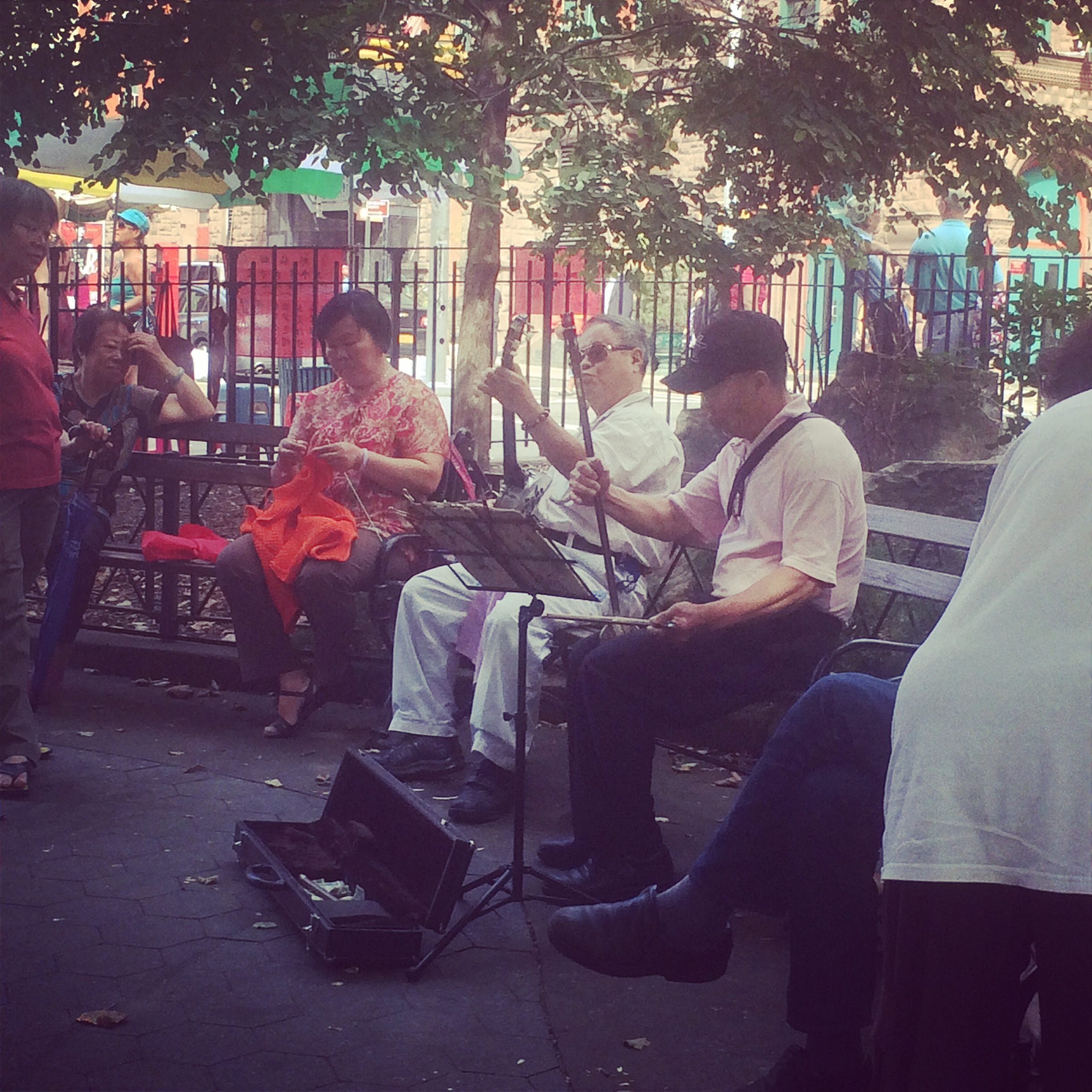
Crossing Bayard Street, Columbus Park beckons to the west. Sitting on land once considered to be the most dangerous area in New York City (Five Points, immortalized in the book and film, “Gangs of New York”) and bordered by Bayard, Mulberry, Worth, and Baxter Streets, I found Columbus Park to be a delight. As soon as I entered the park, I could hear musicians playing the erhu, a Chinese stringed instrument. The park was filled with people playing board games as well as more active sports, reading Chinese newspapers, and practicing tai chi. The park somehow seemed simultaneously bustling yet peaceful, and I found myself completed immersed in the atmosphere of the park.

I was recently visiting New Orleans, and commented to my daughter that one of the things I loved about being there was that I knew instantly that I was in a different place. While walking around Chinatown, however, I realized that I don’t need to go out of the country, or out of the Northeast, or even out of New York City to have that same feeling of being immersed in a completely different environment. That’s one of the tremendous advantages to living here in New York City, where a walk of a few blocks can take you just as deeply into a new environment as landing after a lengthy plane ride.