Early morning in Central Park – from the Metropolitan museum to the Shakespeare Garden

Shakespeare garden

On the first day that New York City felt like spring, I was compelled to take a dérive (an unplanned walk through an urban environment) through Central Park and I wrote about it earlier this year. Yesterday, on the first morning that it truly felt like summer, I was drawn to the park yet again, this time beginning on Fifth and 84th Street, entering the park to the north of the Metropolitan Museum of Art. On this very warm morning, it was hard to imagine the winter days I have been sledding on the sloping grounds next to the museum! Looking through the glassed in enclosure to the Temple of Dendur within the museum is most impressive at night, when there is no glare to prevent the surprising view of a temple built to Isis (and others) around 15 BC, framed by views of grand apartment buildings to the east and skyscrapers off to the south.

Dogs are allowed off leash in Central Park before 9 AM, and if you visit the park during the early morning hours, you are likely to encounter many in the Arthur Ross Pinetum, mid-park between 84th and 86th Streets. Although pine trees were an original part of Olmstead and Vaux’s plan for Central Park, they were eventually replaced by deciduous trees before being reintroduced into the park in the 1970’s. There are 17 different species of trees in the Pinetum, including some from Japan, Macedonia, and the Himalayas.

Continuing west, it is impossible to miss the Great Lawn, a 55-acre green expanse almost exactly in the geographic center of the park. Originally the site of a reservoir, it was filled in using the ground excavated from the construction of Rockefeller Center and opened in 1937 in its present form. Although there are some baseball diamonds around the edge, and a few concerts are still held on the Lawn, it is primarily an open space to relax and enjoy the park during the warmer months.

Heading south around the Great Lawn, to the east is something even older than the Temple of Dendur – Cleopatra’s Needle. An Egyptian obelisk from 1450 BC, it is one of three obelisks (the others are in London and Paris) all similarly named, and all with dubious links to Cleopatra. Our Cleopatra’s Needle is currently covered in scaffolding and is being cleaned of the grime that has accumulated since 1881 from its location in New York City’s open air.

Continuing around the Great Lawn, Turtle Pond appears on your left. A small remnant of the reservoir that once covered the Great Lawn, it does in fact house turtles, believed to be descendants of house pets that outgrew their city accommodations and were sent to the Park to live. Belvedere Castle is visible behind Turtle Pond, and is one of the original buildings created in the park by Calvert Vaux. Its name translates as “beautiful view” and a visit to the castle will in fact reward you with wonderful vistas in all four directions. The National Weather Service official temperature and rainfall amounts for New York City are measured from equipment in and around the castle.

Next to Turtle Pond, on the southwest edge of the Great Lawn, sits the Delacorte Theater, home to Shakespeare in the Park. The Public Theater has been putting on free performances of Shakespeare for over 60 years, and is known for its innovation and stellar casting. I can say personally that the summer nights I have spent in this theater seeing excellent performances as varied as “Hair” and “The Merchant of Venice” have made me feel truly immersed in this wonderful city and its unparalleled artistic offerings. This summer, “Much Ado About Nothing” will run from June 3- July 6, and “King Lear” from July 22- August 17. To get free tickets, line up in the park early or try the virtual lottery on the Public’s website. Financial supporters are given tickets without having to wait, but the Public actually limits the number of supporter tickets available to ensure that free Shakespeare in the Park is available to as many as possible.

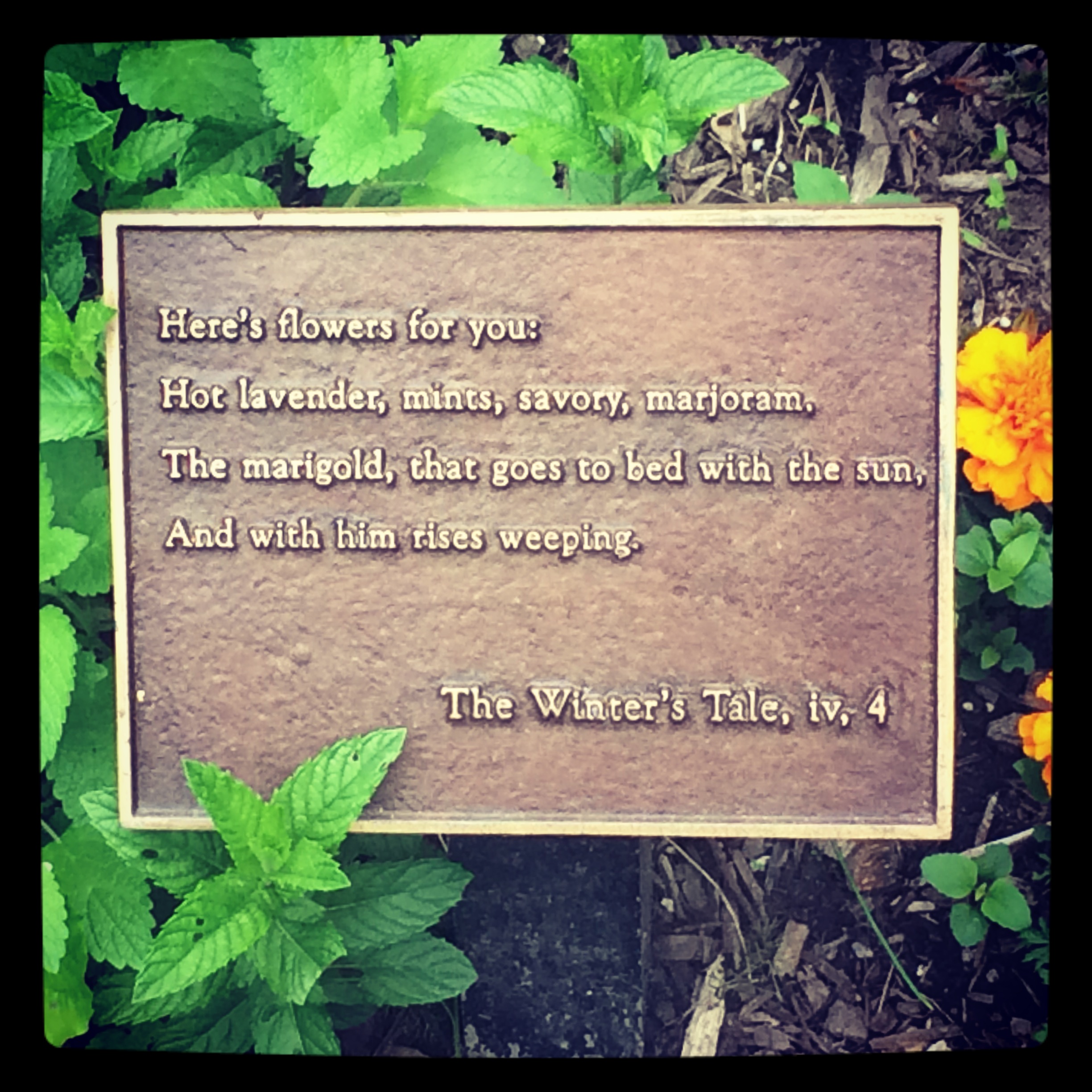
Just north of the Delacorte are large outcroppings of Manhattan schist, the bedrock formed during the ice age and the foundation for many of our skyscrapers.  Behind the Delacorte is the Shakespeare Garden, a four-acre beautiful tranquil space with lovely plantings featuring plants and flowers mentioned in Shakespeare’s works, interspersed with small bronze plaques with quotations from Shakespeare. It’s a rare spot in New York City that allows one to connect with nature and feed your intellect simultaneously, making this one of my favorite hidden spots within the park.

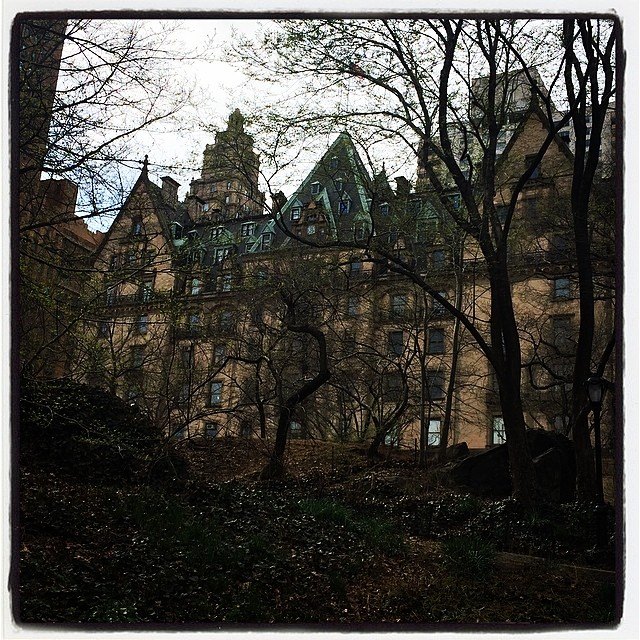
Tucked behind the Shakespeare Garden is the park’s Marionette Theater, a delightfully old-fashioned place to take children during the warmer months. Walking out of Central Park to the west, you find yourself on Central Park West and 81st Street, facing the Beresford apartment building and the Rose Center of the American Museum of Natural History. This dérive ends here, less than a mile from where it began, and illustrates once again the rich variety of experiences packed within the relatively small island of Manhattan.

The value of a view

Recently I had the opportunity to attend a broker’s open house tour, featuring Upper East Side penthouses with terraces. All the apartments included gorgeous interiors, large functional kitchens, and comfortable bedrooms – and yet I found myself constantly drawn to the windows with a view of Central Park. Even walking into another room adjacent to one I had just walked through enjoying the view, I would be unable to resist walking over to the windows to gaze once again at the spectacular scenery. For me, the highlight of each apartment tour was a trip outside to walk along a spacious terrace – even though on that particular day, the temperature was unseasonably cold. Many people think of a park view or terrace as a status symbol, and yet I was drawn to each simply as an observer, with no one there to be impressed (or not). As I finished up a few enjoyable hours at several wonderful buildings, I found myself wondering: what is the value of a view?

Since the apartments I was touring all had Central Park views, with trees, rolling hills, and a large body of water (the reservoir), my mind turned to the work of Diane Ackerman (author of The Natural History of the Senses, among many other works).  I heard her speak many years ago, and was struck by her observation that, as the human animal moves into increasingly artificial environments, we crave adding nature back into our habitats. This could be through cultivating plants in our tiny apartments, keeping companion animals, or spending a premium to see nature unfurl through our windows (or on our terrace). Human-made objects tend to be linear and three dimensional; natural objects tend to be more serpentine and of fractional (fractal) dimensions. The world we have created is fairly static and unchanging, while nature is constantly chaotic and fluctuating. Ackerman proposes that people need nature; we evolved as a part of the natural world and our industrial, mechanical world is too recent a development to completely remove this primal need.

So, is paying a higher price for an apartment with a view worth it? Of course, this is a personal decision for everyone looking to buy a home. For me, I can say that it does have value, and the only way you can be sure if it is worth it to you is to include a few options with views and see how you respond.

While these concepts apply to view of nature (whether Central Park, some other park, or a river), in another post I will discuss the different value of a city view. In my next blog post I will be back with another dérive (an unplanned walk around Manhattan).

Image

Central park : from the boat pond to Strawberry Fields

I had another blog post written for this week, complete with photos. Then, New York City decided to break into spring – finally, after a persistent and painful winter, it was suddenly warm, sunny, and bursting with new blooms. I was compelled to take a dérive in Central Park, as it beckoned a block from my office. A dérive, as described in more length in previous posts, is an unplanned walk within an urban landscape. While Central Park is undeniably beautiful and delivers a much-needed injection of nature into our lives in the concrete jungle, it is still supremely urban. One of the best aspects of Central Park is the way that massive buildings line the edges of the park, like an irregular geometric frame around a lush Impressionistic painting.

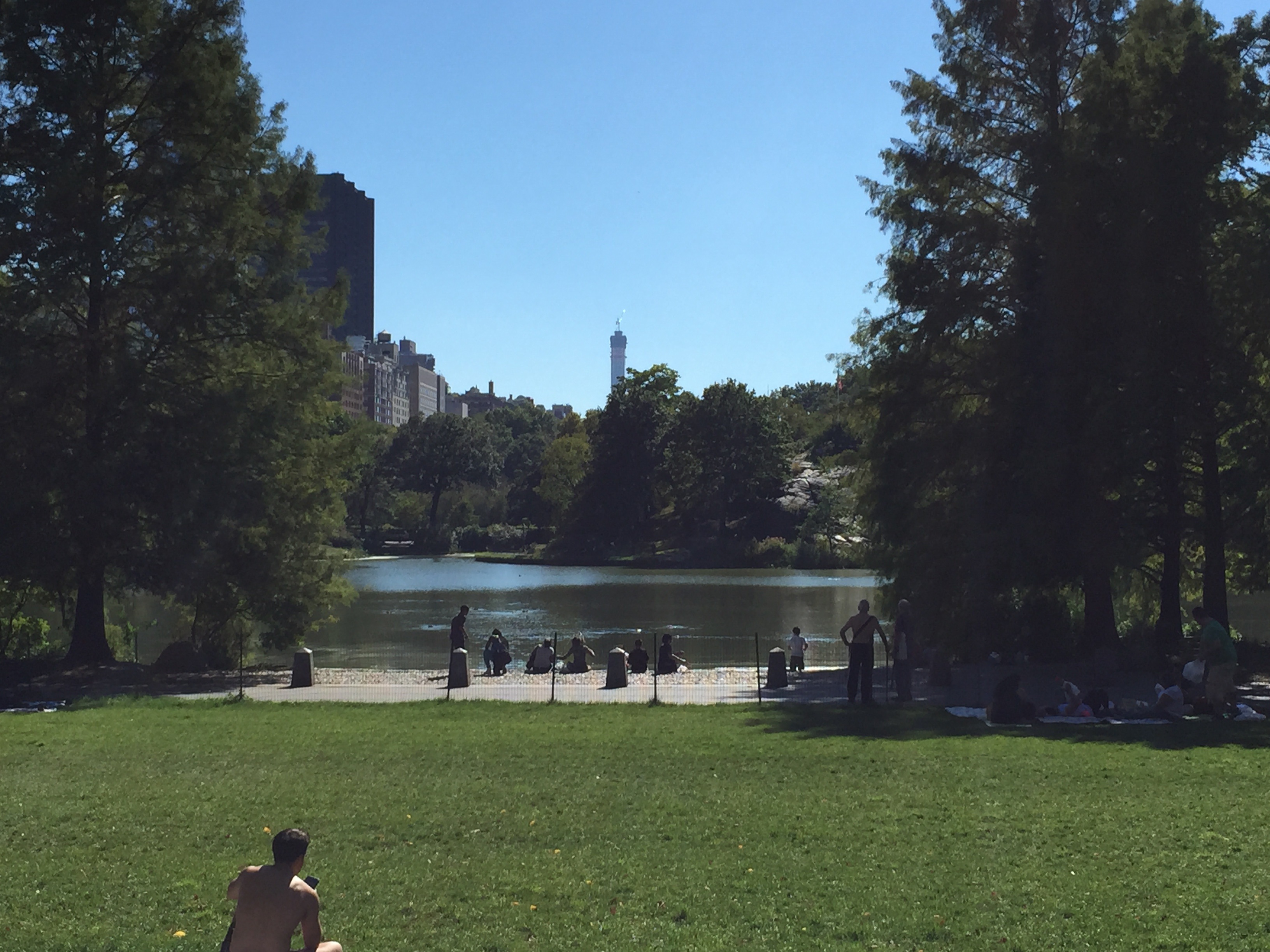
Entering the park at Fifth Avenue and 79th Street, the first thing that struck me was the fields of daffodils in bloom. Something I love about NYC is the way Christmas trees are recycled each year. As depressing as it can be to see dried trees lining the streets waiting to be picked up in January, they are turned into mulch that is used in city parks to protect and fertilize the bulbs that create these oceans of yellow in April! Walking roughly south, eventually you run into the sailboat pond, full of remote-controlled small boats on clear spring and summer days. Gazing at the pond, unless completely covered in climbing children, is the famous Alice in Wonderland statue. Commissioned in 1959 by George Delacorte, whose philanthropy has enriched many areas of the park, it was designed to be interacted with by children. The statue of Alice was based on the sculptor José de Creeft’s daughter, and the face of the Mad Hatter is a sly tribute to Delacorte himself. Also looking at the pond with his back to the west side, is a statue of Hans Christian Andersen absent-mindedly feeding a duck while staring at the apartment buildings on Fifth Avenue (perhaps looking for a hawk’s nest).

Heading west, you soon come across the Loeb Boathouse, an elegant restaurant (and, with Tavern on the Green gone, the only place within the park that deserves getting dressed up for). They even have a shuttle along upper Fifth Avenue for those who are too dressed up to walk to the restaurant through the park. The Boathouse sits on the location of an old functional structure that was used to store the rowboats that have launched from this location since the late 1800’s (and you can still rent them next to the restaurant). There is even a gondola for hire!

Walking past the Boathouse, roughly west, you come across the majestic clearing surrounding the Bethesda Fountain. Unveiled in 1873, Bethesda Fountain was created to commemorate the Civil War dead, based on a passage in the New Testament about a pool that healed anyone who stepped into it. However, to me it is always the symbol of healing from Tony Kushner’s brilliant Angels in America, when Prior says about it, “This angel. She’s my favorite angel. I like them best when they’re statuary. They commemorate death but suggest a world without dying. They are made of the heaviest things on earth, stone and iron, they weigh tons but they’re winged, they are engines and instruments of flight.” (Epilogue.17)

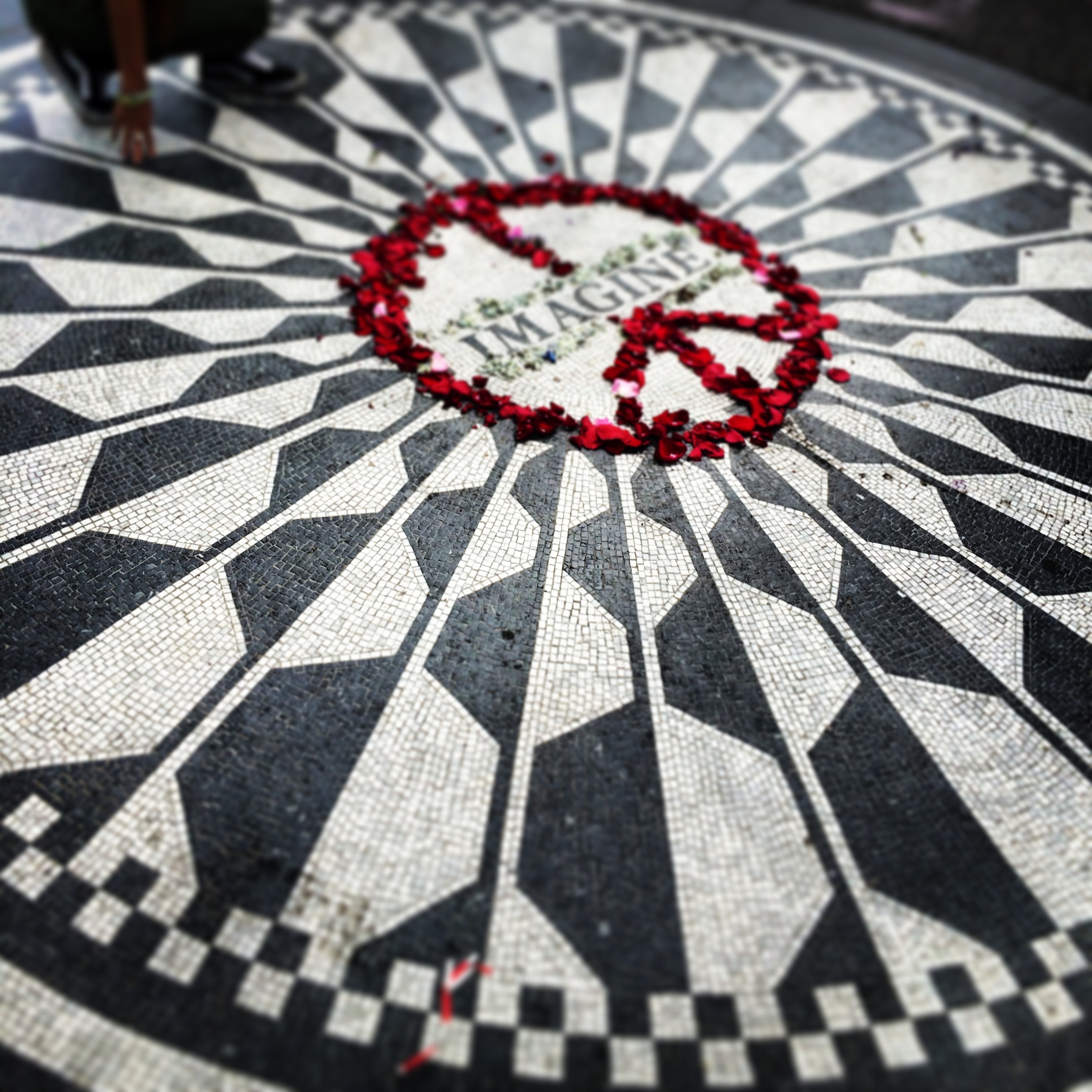
Continuing to head west, you enter Strawberry Fields. Dedicated to the memory of John Lennon and recognized by 121 countries as a Garden of Peace, it is officially a “quiet zone,” but you are likely to come across a performer playing Beatles tunes near the famous Imagine mosaic. The mosaic was given to the city of New York as a gift by the city of Naples, and was dedicated on October 9, 1985, on what would have been John Lennon’s 45th birthday.

So much to see on even such a relatively short walk in Central Park! The Park belongs to all New Yorkers, not just those fortunate enough to look out the windows of their homes and watch the seasons play out throughout the year. If you’re not a New Yorker, you are as always welcome to explore it as our guest; perhaps someone will even offer to take your picture at the Bethesda Foundation.Image