Immersive theatre in NYC (2025)

I wrote quite a while ago (2014, 11 years ago!) about immersive theatre in general. At the time, Sleep No More was going strong, as was The Drowned Man (also by Punchdrunk, the OG of immersive theatre – and to be clear, I mean original GOAT, not Opera Ghost) in London, Then She Fell in Brooklyn, and Queen of the Night in midtown. The two Punchdrunk shows were what I think of as “choose your own adventure” shows, where you wander a space freely and in effect direct your own version of the theatrical experience. Then She Fell was controlled, with viewers ushered into a series of rooms to experience a story. And Queen of the Night had some opportunities to be taken off into different rooms (“one-on-ones”) but the bulk of the evening involved sitting at tables watching a show, and perhaps bartering with other tables for better food.
What a difference a decade (plus) has made! Sleep No More closed at the very beginning of 2025, having struggled after covid lock down (a free-flowing experience like that was even harder to adapt to early covid restrictions once theatre began to re-emerge in September of 2021), and being unable to pay rising rents. (Sleep No More does still have productions currently running in Shanghai and Seoul, who wants to go with me?) The Drowned Man closed (the space it was in near Piccadilly was redeveloped) and Punchdrunk purchased their own space in Woolwich (easily accessible from central London on the new Elizabeth line). Since then they had one traditional show, based loosely on stories in ancient Greece, The Burnt City – which has now also closed (but I was able to see it twice). They have since pivoted to trying one more controlled immersive theatrical experience (Viola’s Room – which is now in NYC, more about that later), and just announced Lander 23, which will merge video gaming with immersive theater.

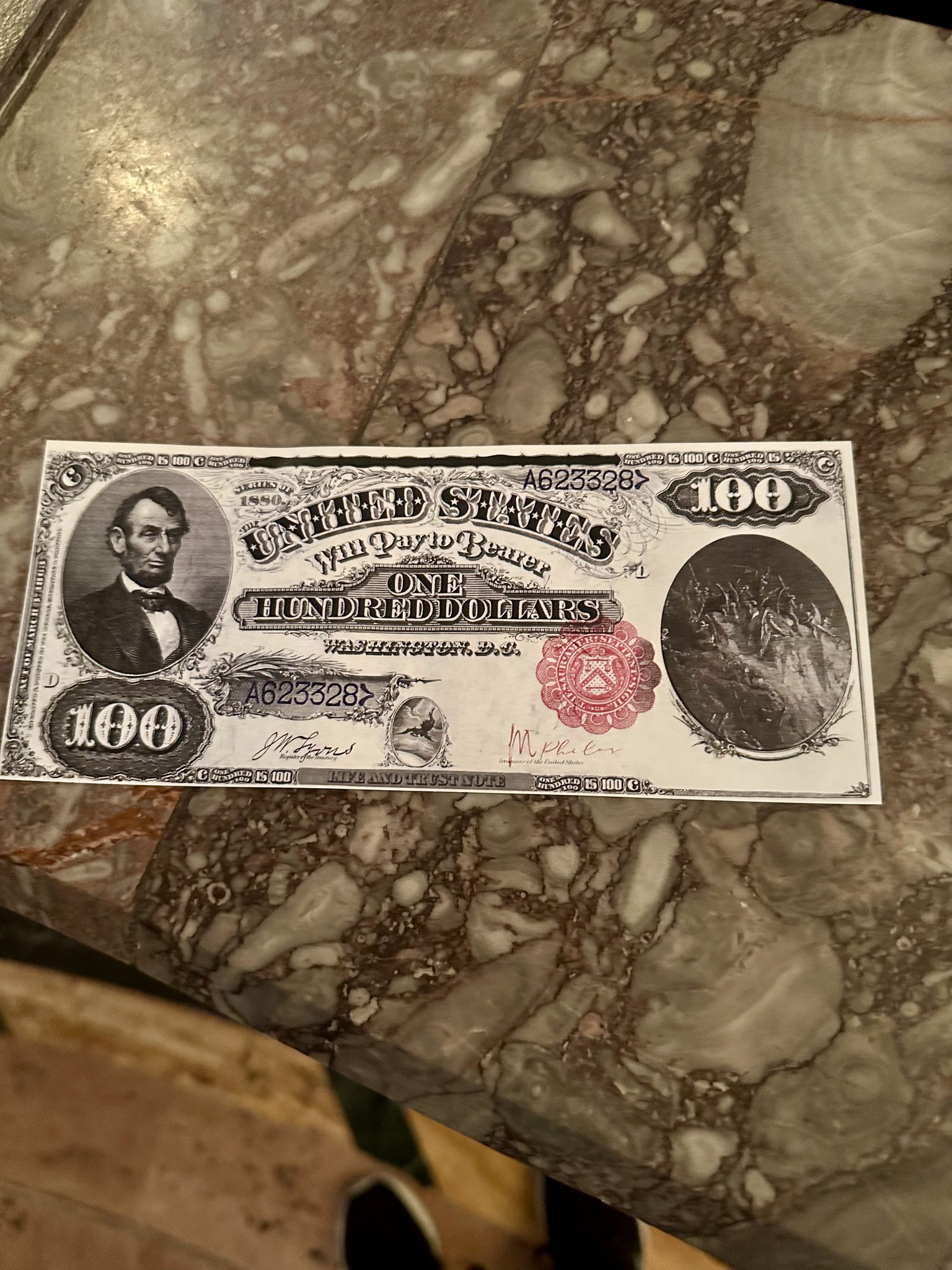
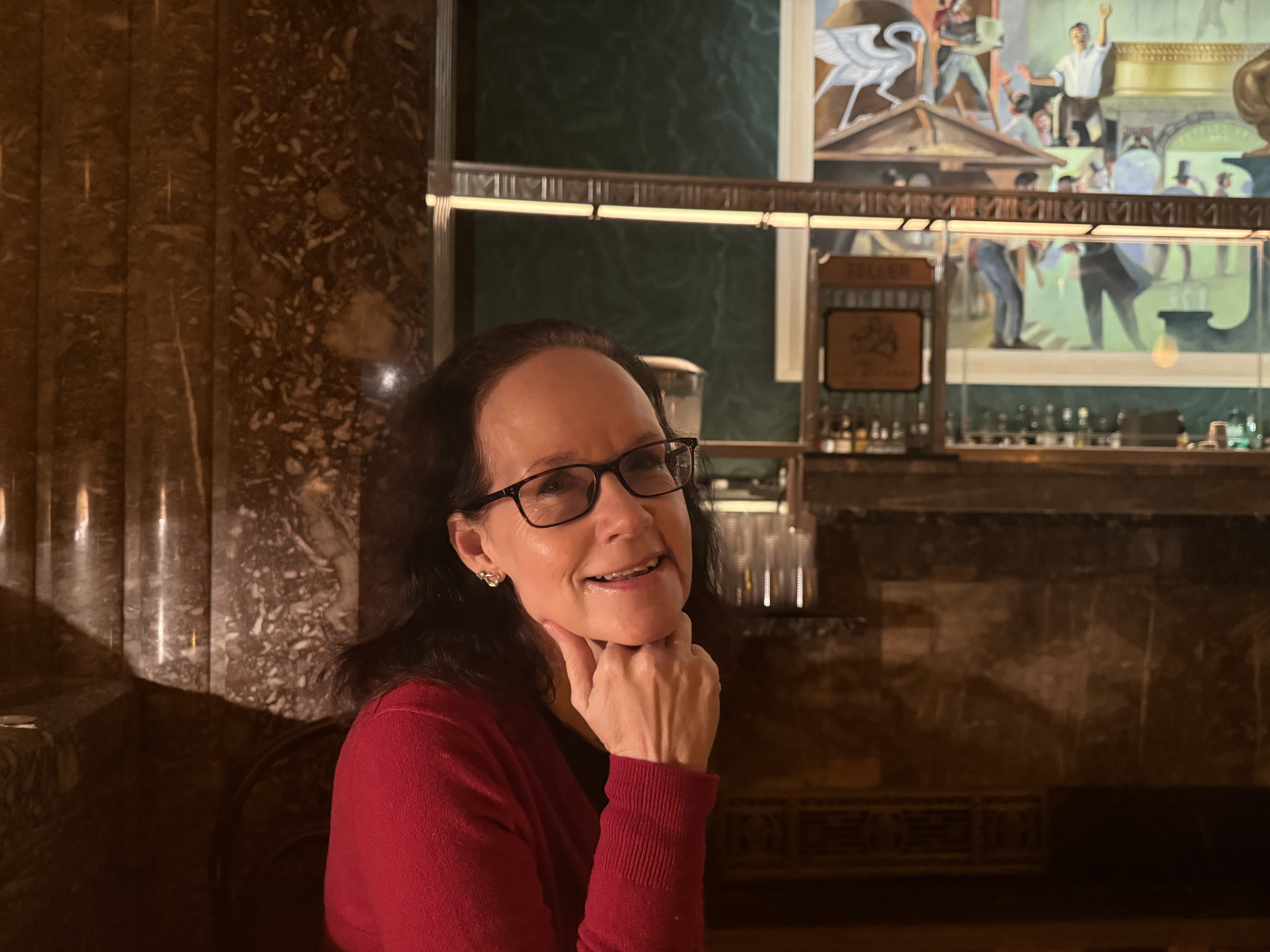
Meanwhile, here in NYC Emursive (the producer but not the creator of Sleep No More) launched an ambitious “choose your own adventure” immersive experience in lower Manhattan last summer. Titled Life and Trust, it was loosely based on the story of Faust, but set just as the great stock market crash of 1929 was about to put an end to the roaring twenties. The set was enormous and detailed, and the story took place on five different levels. In addition to the Faust story (in this case, Conwell vs Mephisto), there were storylines for Oscar Wilde’s Dorian Gray, Evelyn Nesbit, and a host of new characters. There were many extraordinary scenes – two that took place in a boxing ring – and the finale was fantastic. It opened last summer and closed abruptly earlier this year. And I mean really suddenly! They had a show on Saturday night as usual and Sunday morning they took away all social media other than an announcement that they had closed. They certainly were having a hard time making this work financially, but the sudden closing also had me wondering if there was something else going on (because if you are losing money, announcing a closing can spur interest and increase sales, sometimes repeatedly). The people in charge have not made a statement about the closing (that I have heard) but many of the performers are holding a one night event on the Upper West Side next month to discuss the experience of developing and being in the show and I will be there. After this, I wonder if NYC will not see another large-scale traditional immersive theater experience for some time.

Some Broadway musicals have had an immersive element. In my post from 2014, I mention the musical Here Lies Love, with music by David Byrne (see above, he was on the floor for one of the shows I saw in 2023) and Fatboy Slim, about the life of Imelda Marcos. At that point it was a huge hit at the Public Theater, and in 2023 it moved to the Broadway Theatre. Staged with a dance floor where you could move around with performers within an innovative set, becoming part of the crowd in Manila, I loved it and experienced it multiple times. If you were on the floor the show was quite immersive, but there were also fixed seats where there was little immersion. It was not a financial success, closing after 33 previews and 149 regular performances. Currently on Broadway there is an semi-immersive version of Cabaret, which transferred from the West End last spring but has not been received as well here. It is closing in October (if not sooner). Staged in the round, there are cabaret seats at tables where you may have interactions with the actors. The most immersive part of this production of Cabaret occurs before the performance, when musical and dance shows take place all around the public areas of the theater.
One could argue that the famous outside walk taken by the actor playing Joe Gillis in the recent Tony-winning revival of Sunset BLVD, directed by Jamie Lloyd, had an interactive quality. I experienced it multiple times from W 44th Street or Shubert Alley (see below, and here for a photo montage, and here and here for video), as well as seeing the livestream during the several times I attended the musical. Lloyd’s current revival of Evita, almost certain to arrive on Broadway in the next few years, has a similar immersive element, when people outside the theatre become the people of Argentina listening to Eva Peron sing her most famous song.

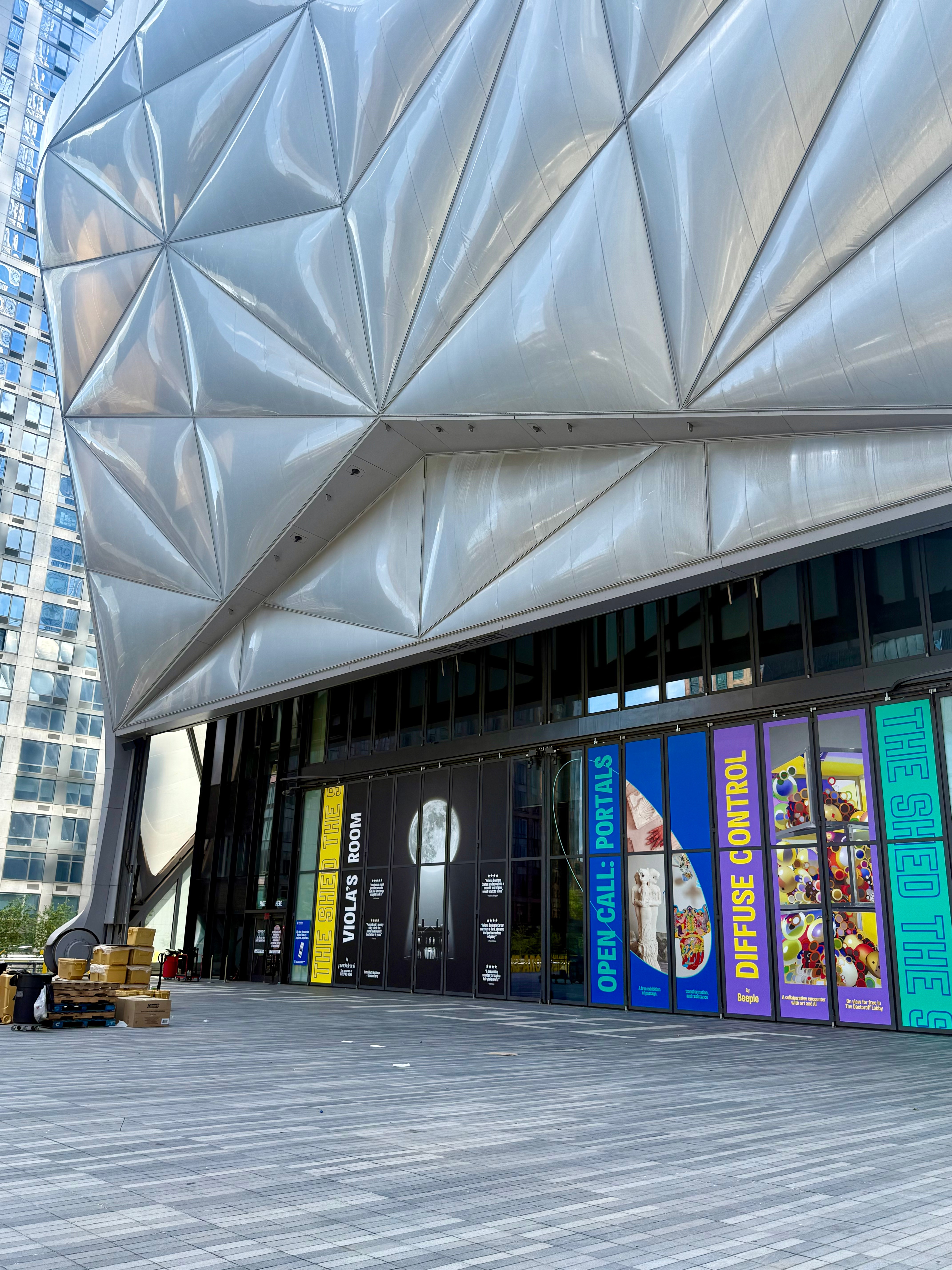
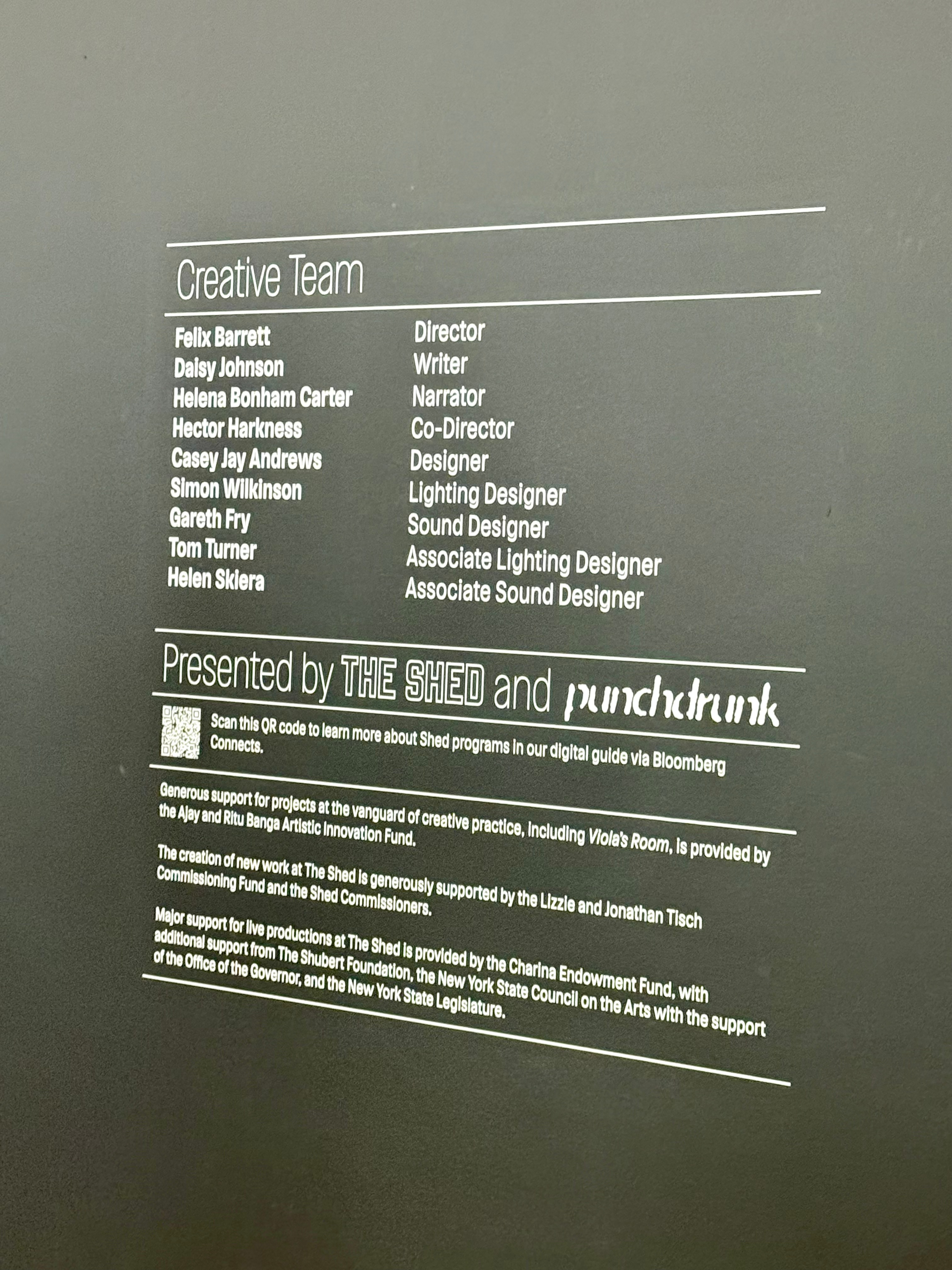
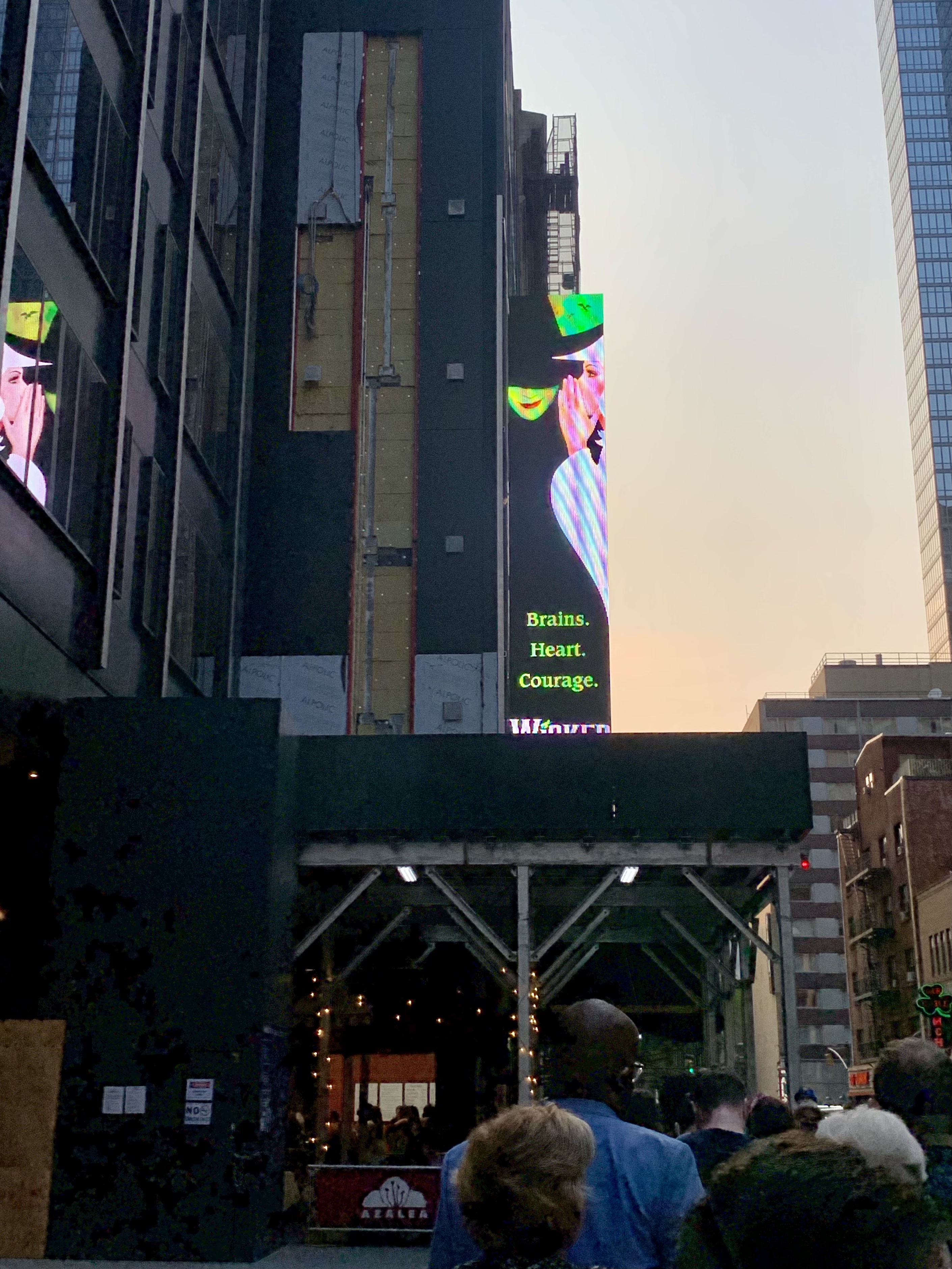
As I mentioned before, Punchdrunk (the OG creator of true classic immersive theatrical experiences, such as Sleep No More) has a current show at the Shed, Viola’s Room. a smaller-scale work by Punchdrunk founder Felix Barrett that invites audience members to move through a labyrinthine installation inspired by Barry Pain’s 1901 gothic short story “The Moon-Slave,” as adapted by the British writer Daisy Johnson. Participants wear headphones and are guided through the 50-minute experience at the Shed via narration in the voice of Helena Bonham Carter. 

One of the more unusual things about Viola’s Room is that you experience it barefoot. There are places to clean and sanitize your feet before and after the experience. They will take your shoes and bags and put them in a box in your first room, and they are waiting for you when you enter the last room. In that first room, you will get headphones and test them out. You are with a small group of people, and instructions are to “follow the light” so you are led by light cues through a series of elaborate rooms that deepen the story being whispered in our ears by Helena Bonham Carter. There are some moments of total darkness, some areas that might bother people with claustrophobia, one instance of crawling (although we were asked in advance if that was doable so there must be an alternate route if it is not), and extremely varied floor surfaces. Like the larger scale Punchdrunk shows, there are scents that change between environments, to immerse multiple senses. Viola’s Room will be at The Shed until October 19th.

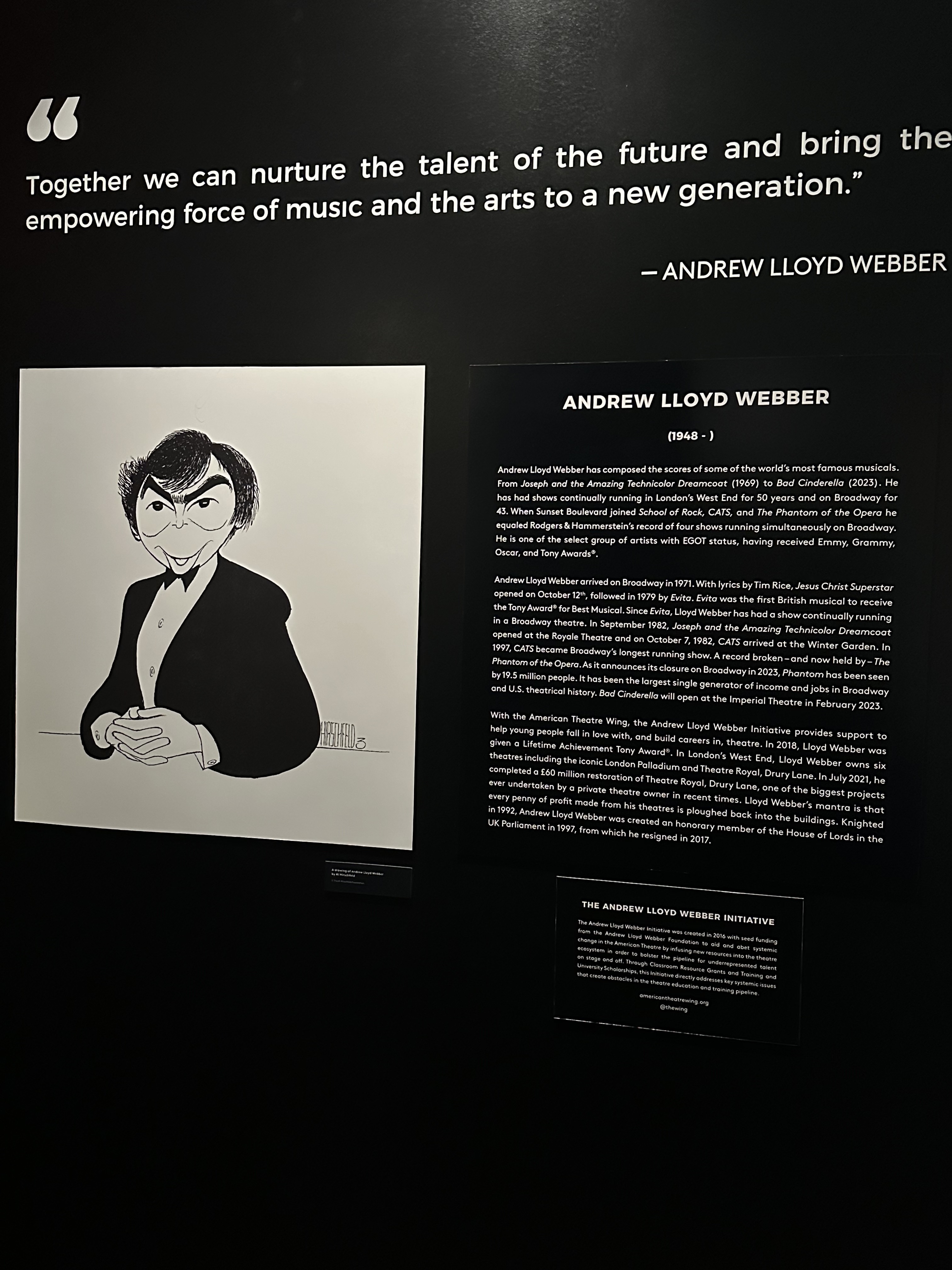
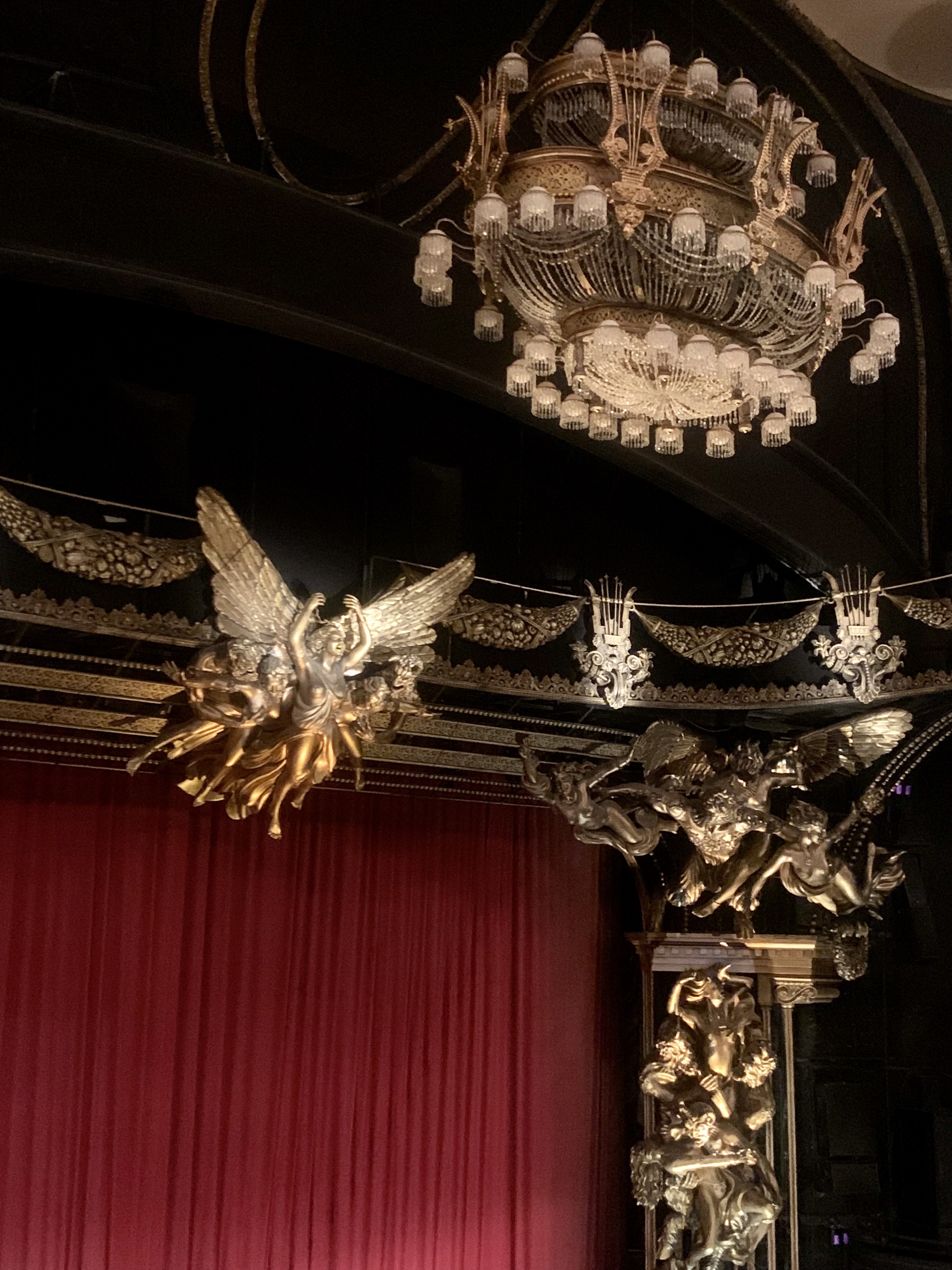
Perhaps the most buzzed about immersive theater taking place in New York City right now is Masquerade, a new immersive version of Andrew Lloyd Webber’s Phantom of the Opera. Set in a completely transformed building that once was Lee’s Art Shop on West 57th Street, this is not a “choose your own adventure” wander but rather a guided experience through the story and songs, in small groups of 50-60 people per 15 minute “pulse.” There are six “pulses” or showtimes for every evening (and matinees on Saturday and Sunday), with different actors playing Phantom and Christine for each time slot.
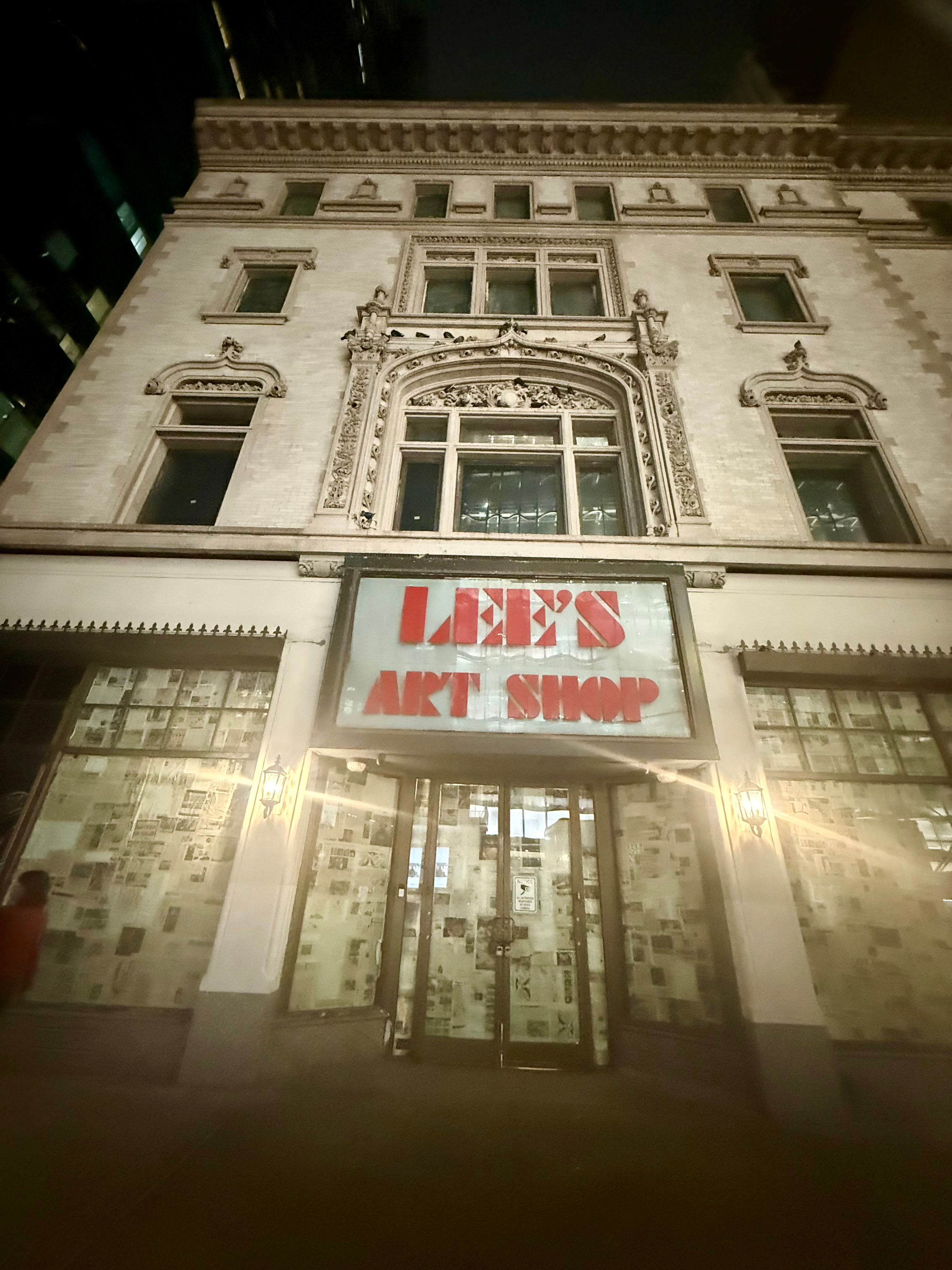
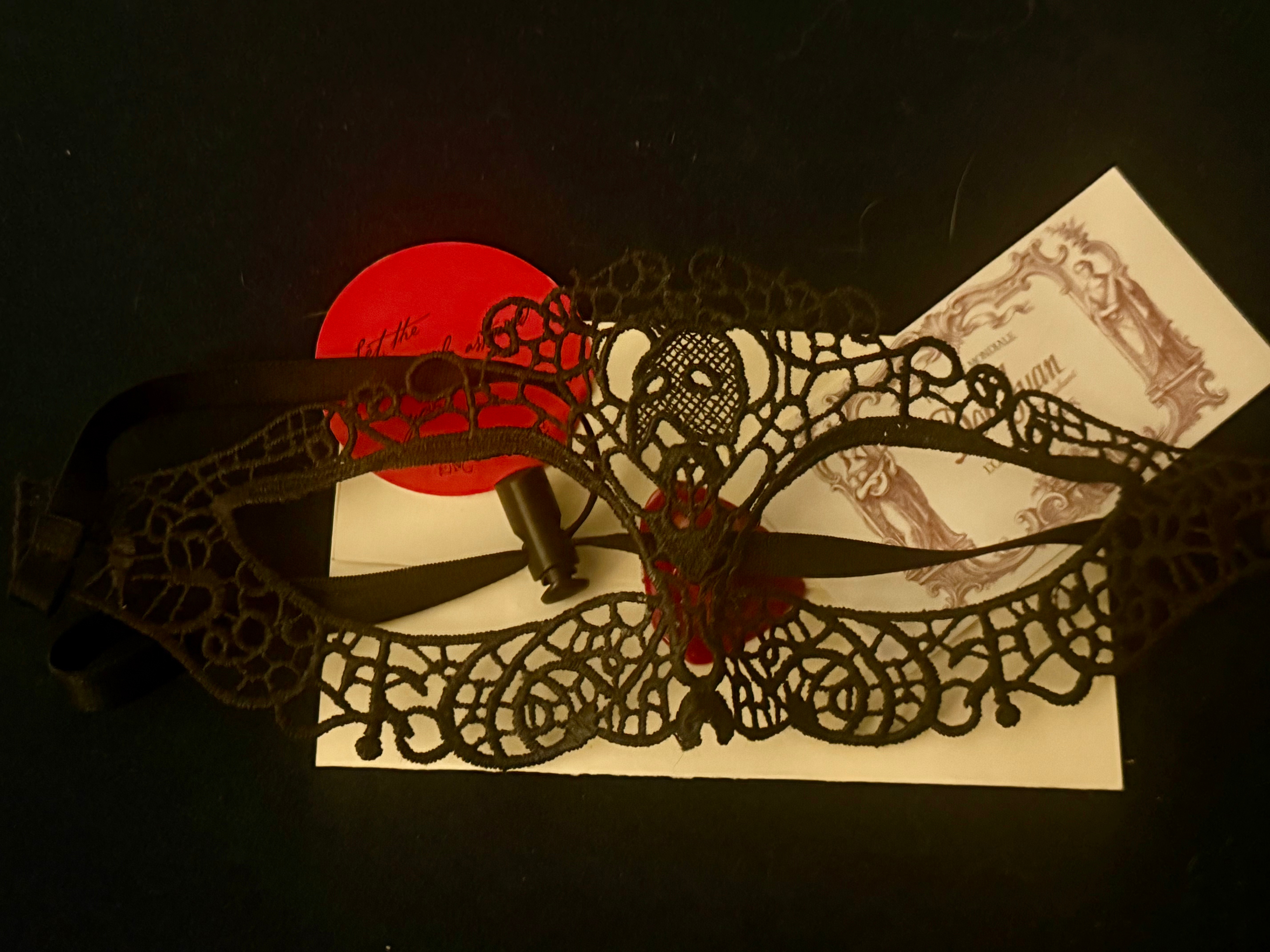
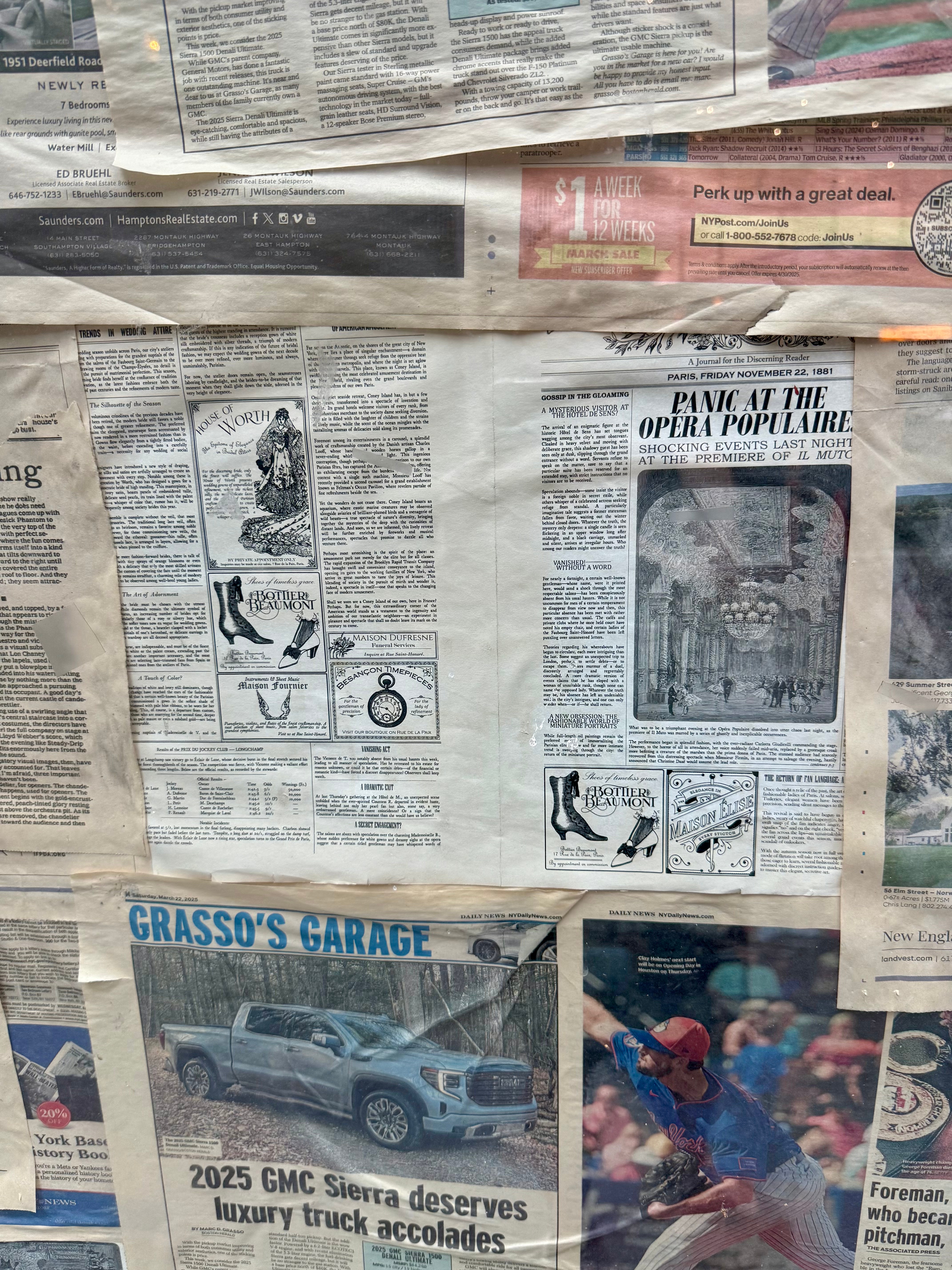
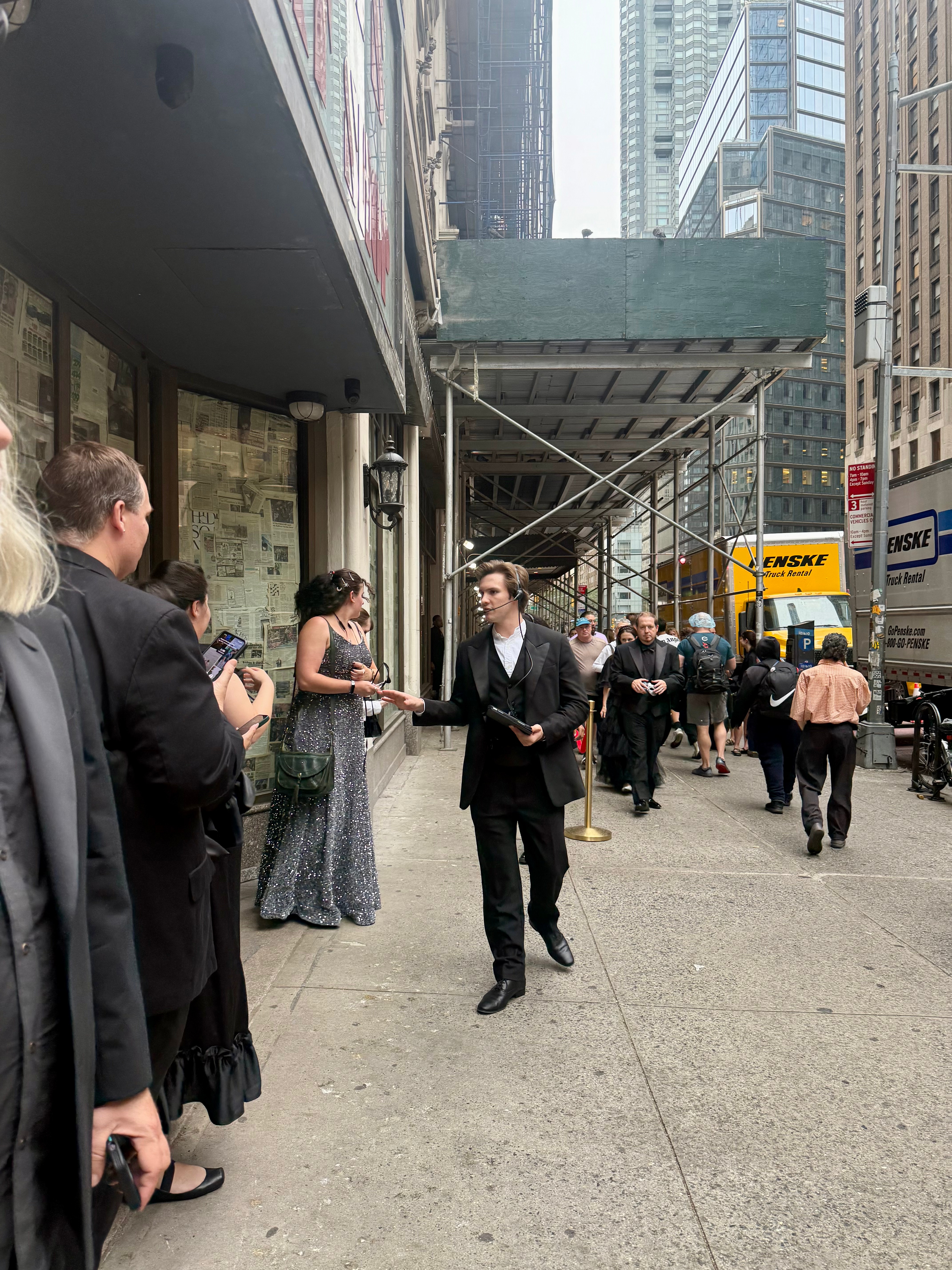
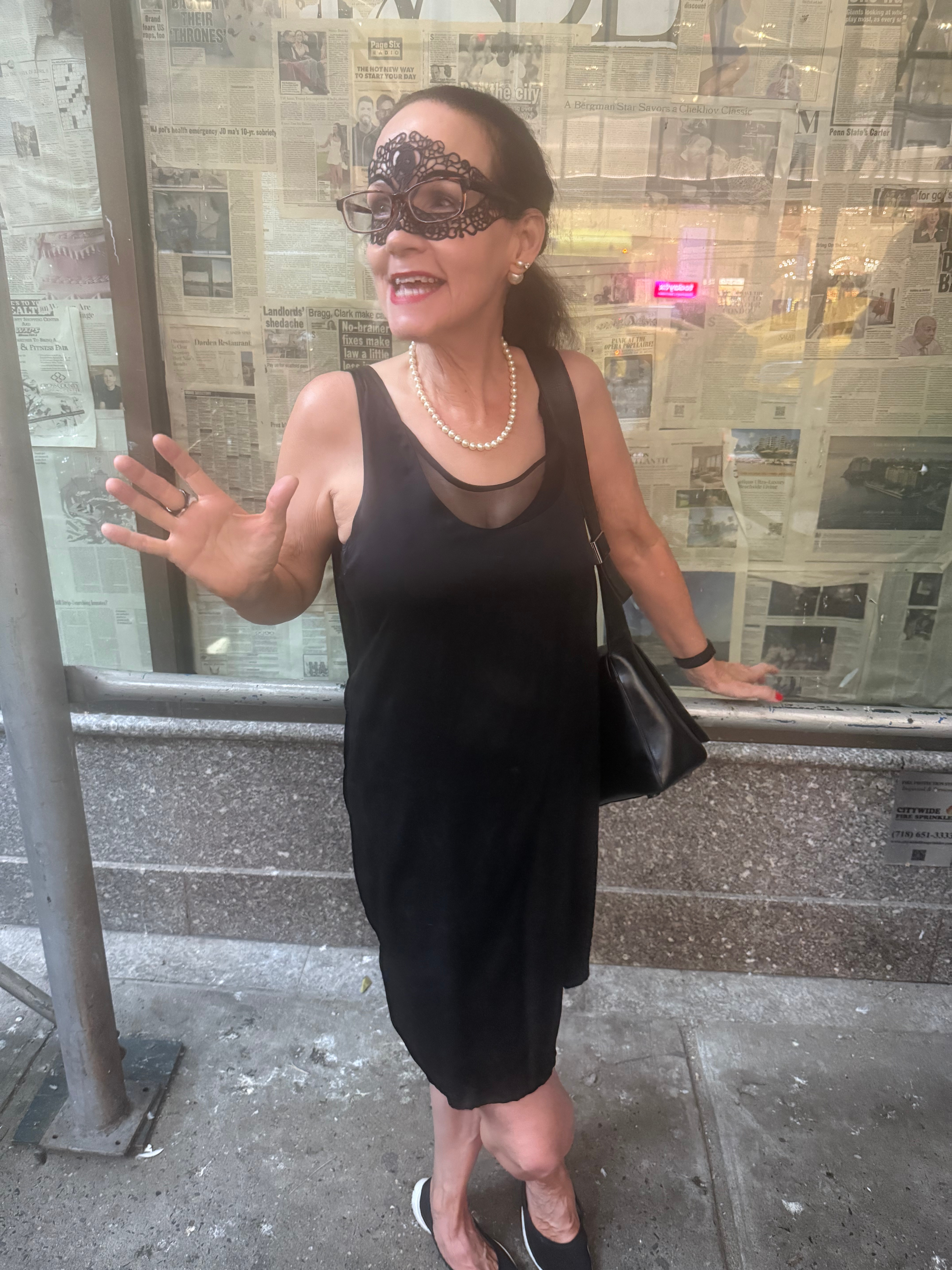
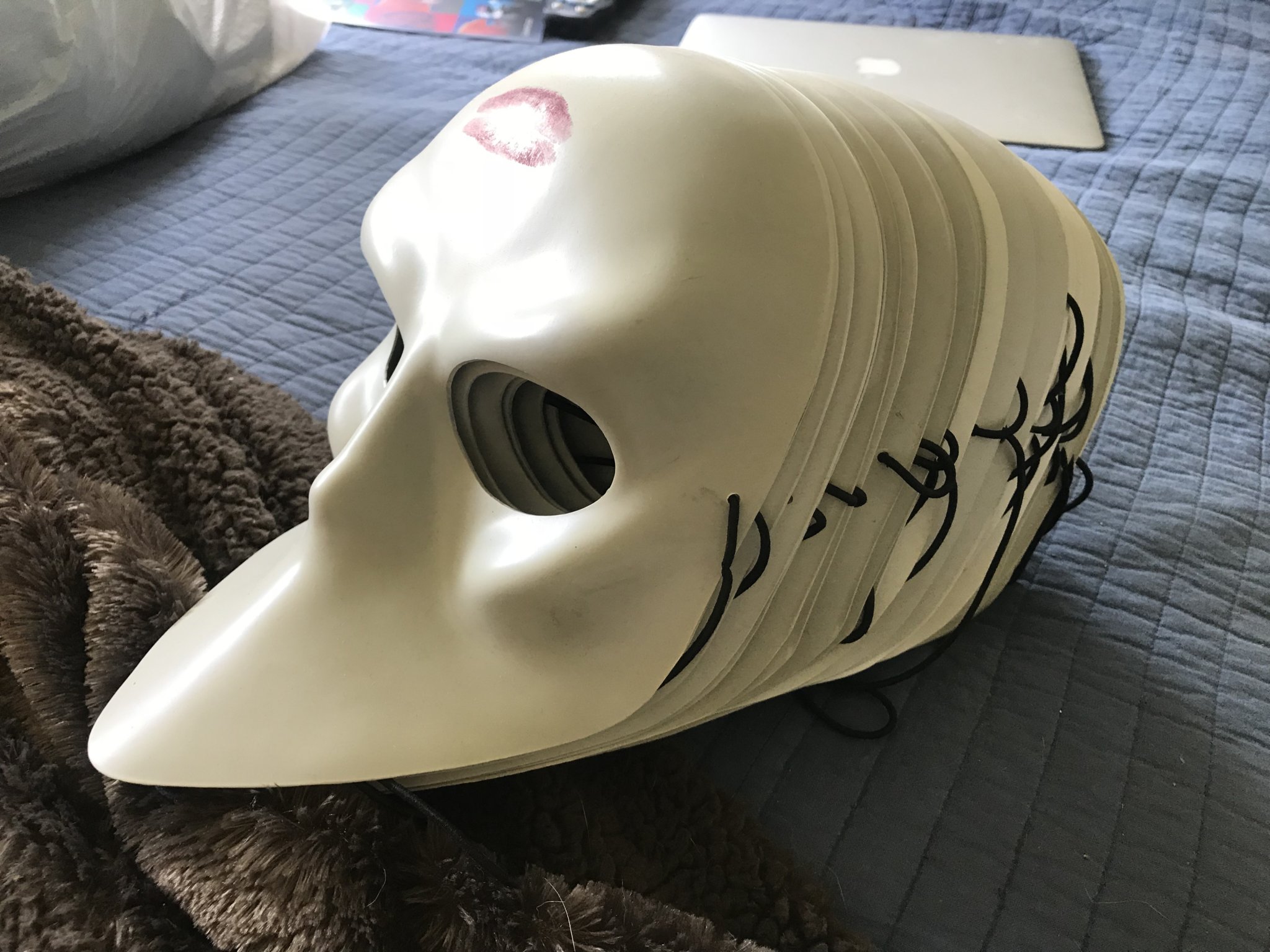
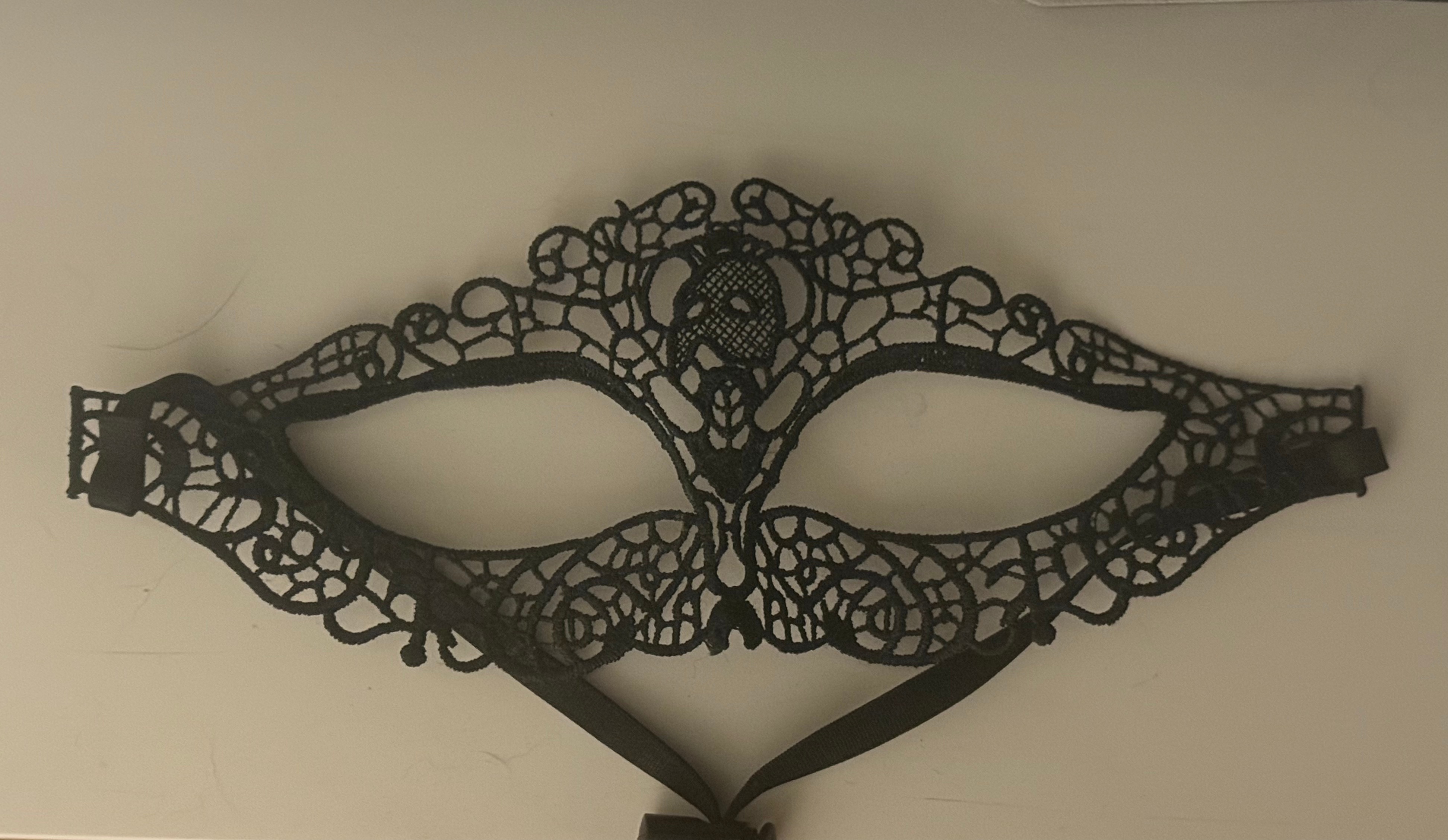
The outside of the building has the windows covered in newspaper, and if you look closer you will see some articles about the original Broadway production of Phantom, and others reporting on the fictionalized goings on at the Opera Populaire that occur during the musical. You line up outside, and if you don’t already have a mask, you can be given one. I quite liked the provided one, it was comfortable, even under glasses, and has a little Phantom mask motif. At least for now, you are asked to dress up and wear black, white, or silver, and you will likely see some people extremely dressed up and wearing their own masks. It does make the entire experience a little more like an “event” to have most people dressed in cocktail (or even ballroom) attire, with the rest at least fairly nondescript in clothing. An important aspect, though, is footwear – stilettos and kitten heels are not allowed, and I recommend flats or even sneakers. This does lead to a certain feeling of disconnect, to be dressed up but wearing “sensible shoes” but the differing floor surfaces (including grates and escalators), sometimes in low light, really do require it. There are also times when you need to rush – more or less – from one room to the next, in a small crowd, and you really don’t need to be worrying about your footing at the same time.
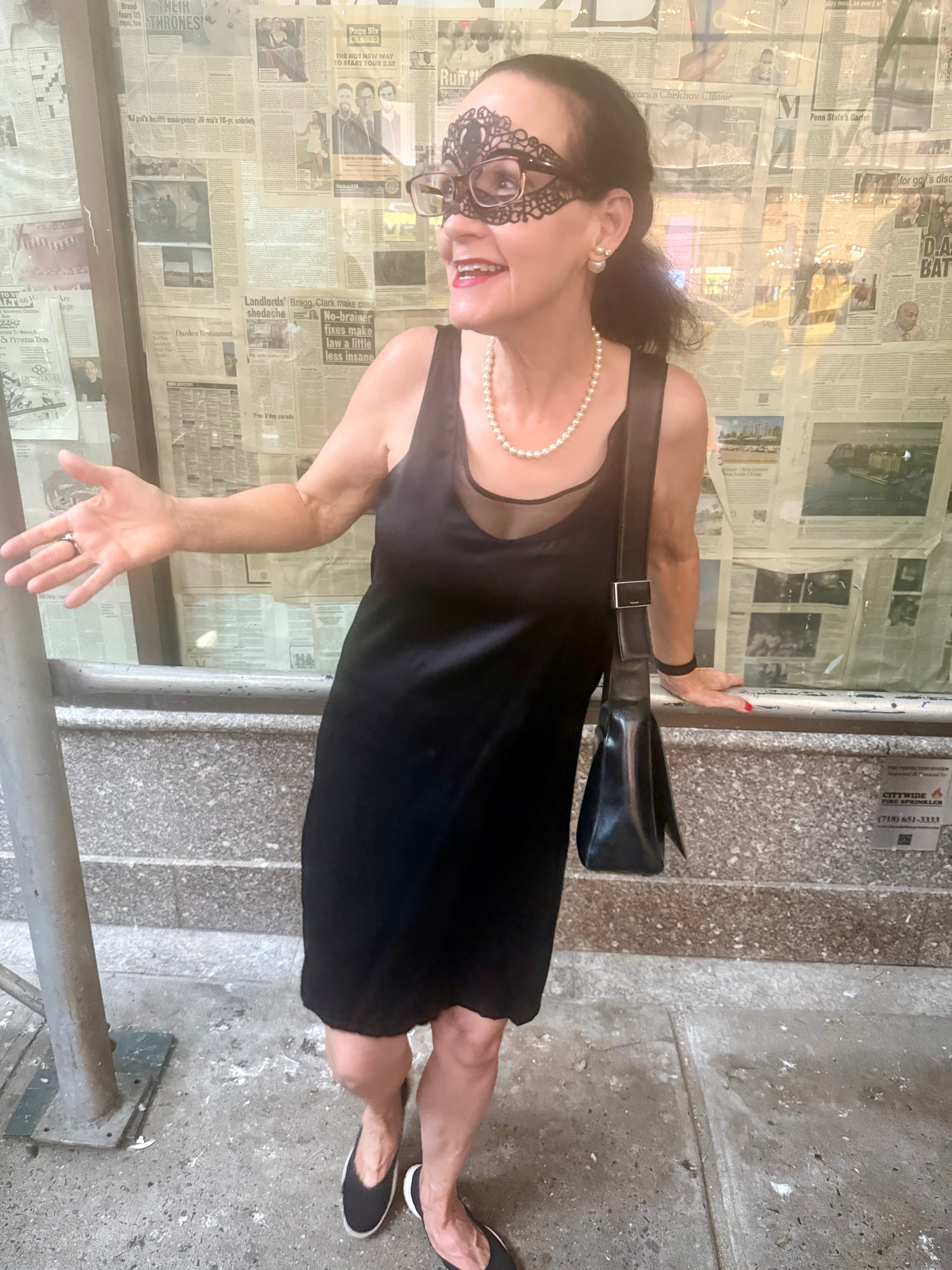
Each time slot or pulse is let in at all at once, and there is no early or late entry, as another group will be experiencing the show just after you. Also, tickets are not resalable, in part because there are no tickets – you show ID that matches the name on the ticket purchase, and in addition you are sent a password the day before to the email used for purchase. While waiting outside, you might have a photographer come by (I did, but have heard of other dates that did not), and if so, you will receive an email later that is password protected by the same password you used for entry. You can download any photo they take at no charge (see mine below).

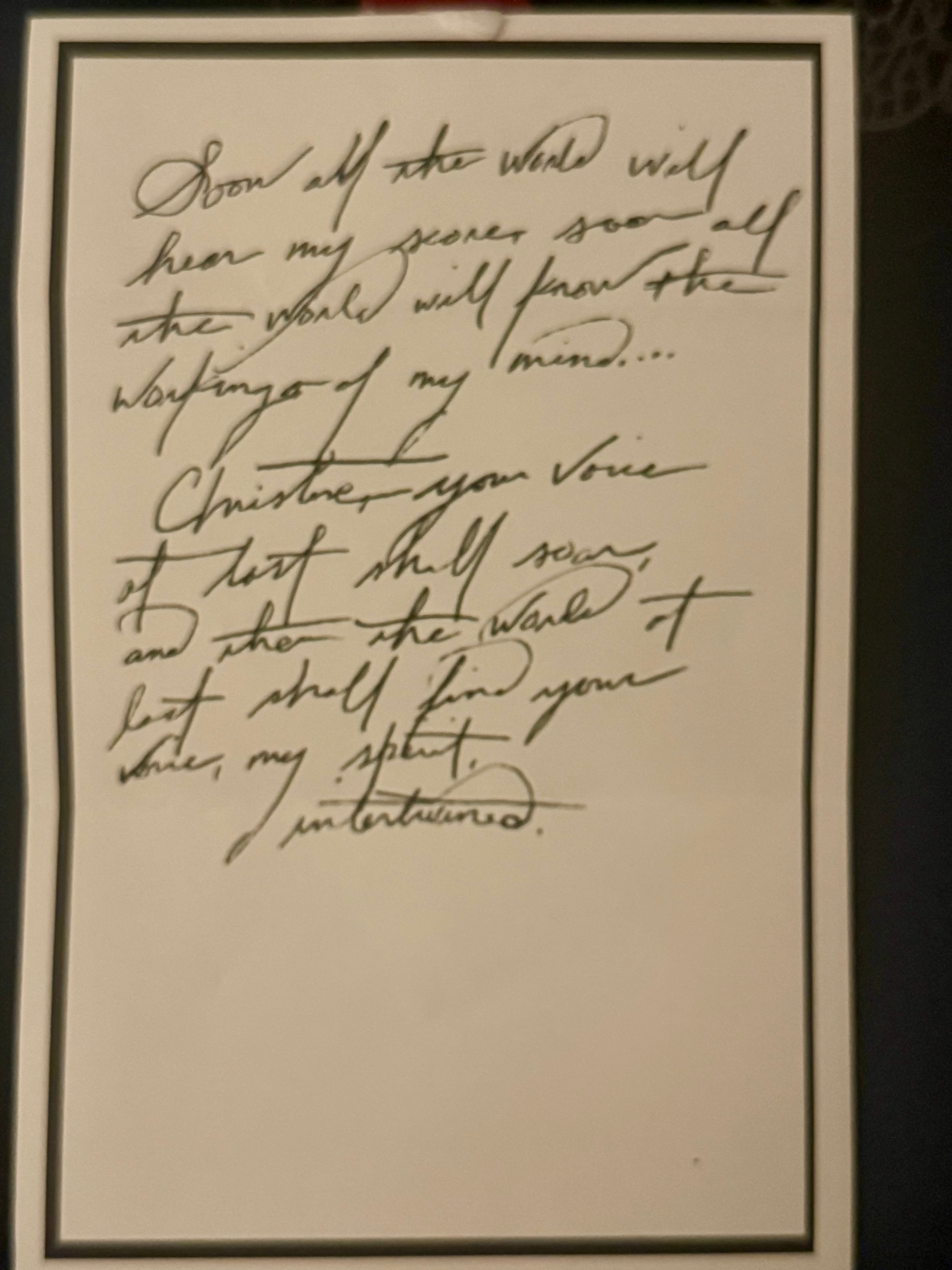
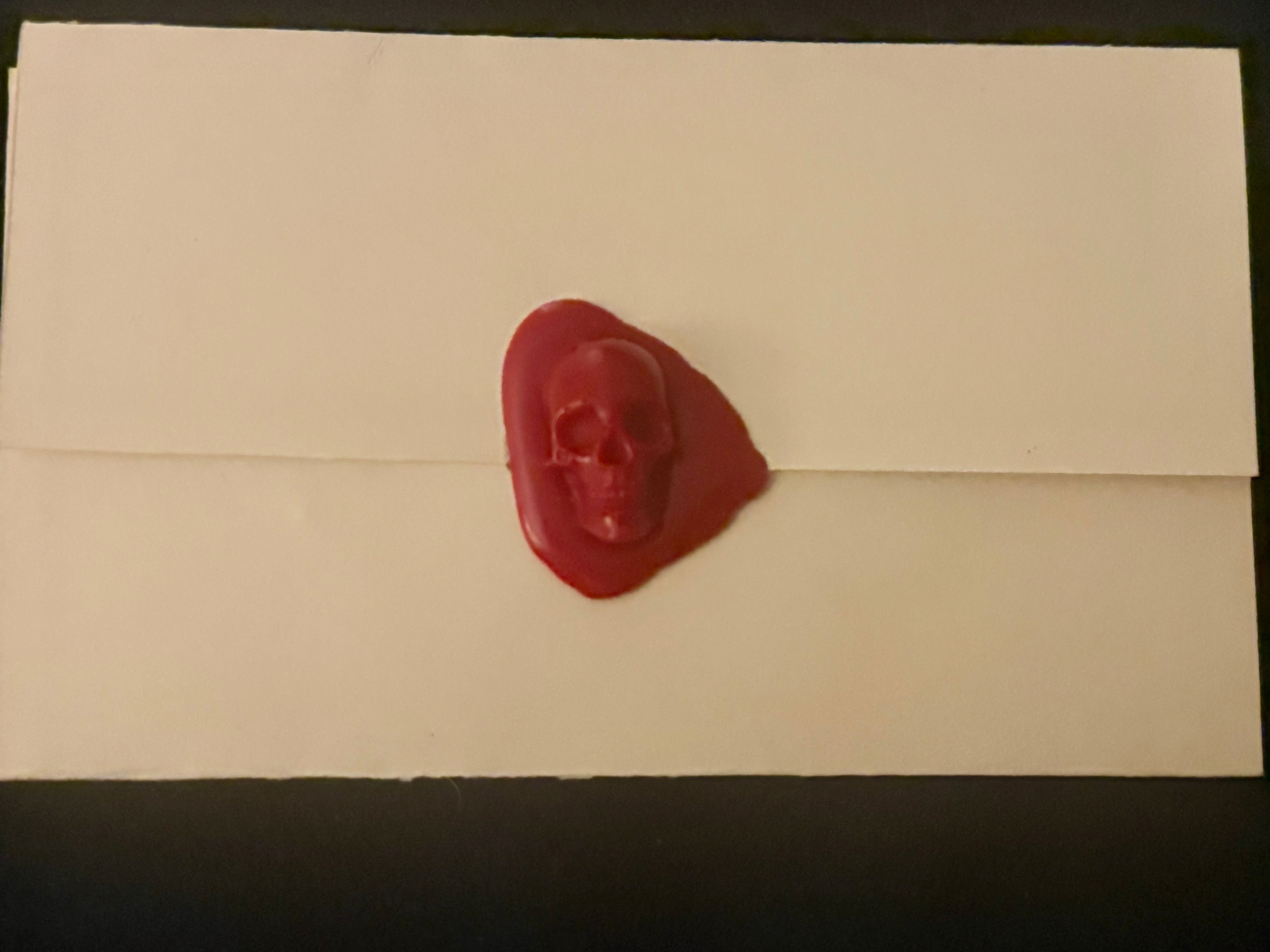
I don’t want to give too many details about the actual experience of being inside Masquerade, and no photos are allowed inside (all bags/coats need to be checked, which is at no charge, and a sticker is put over your phone camera if you have that on you). But I will say that it is the actual Andrew Lloyd Webber music, sung live with a prerecorded instrumental track. The musical has been cut a little, and a few things/songs from the Phantom movie musical added. The order of the story and some of the backstory are different from the original Broadway musical production. Sets and costumes are lavish, and it was thrilling for me to be in the middle of some of these iconic scenes. You are led from space to space, and no loitering or self-exploration is allowed. In terms of interactions, you might have a character address you, ask you to do something, dance with you, or become a supporting character (at one point Carlotta addressed me as Michaela, asked where I had been, and reminded me that I needed to follow her around with throat spray so that I could moisturize her vocal cords now and again – which I did for the rest of that scene). You might even be handed one of the Opera Ghost’s letters after someone had read it – Christine gave hers to me and the seal was thick red wax in the shape of a skull.
More practical issues: 1) You are less likely to be split up from anyone you have come with than in traditional immersive theatre. There is one time when your pulse gets divided up into three groups who each see all three scenes, but just in a different order. But the “butlers” there to move the crowd along seemed sensitive to keeping people from the same party together. 2) In most rooms there are at least some seats, and the butlers will direct people into seats until they are full. If you are the first in one room with a seat, you may be last out of that room and not get a seat. So plan on standing and moving a lot within the two hours. 3) The show is ADA compliant, and you need to contact the show in advance if accommodations are needed. From what I hear, there will be a butler assigned to help you get from place to place, using elevators, and will ensure that you don’t miss anything. 4) There is champagne when you first enter the space (and pro tip – if you drink your glass in that first room, they will refill it in the next room where it is needed for a toast), and you may be offered shots of something (whiskey? brandy?) in a later room, but there are also non-alcoholic options in both instances. 5) If the weather permits, there will be some scenes outside on the roof of the building, but there are alternate places to hold these scenes if the weather is inclement.
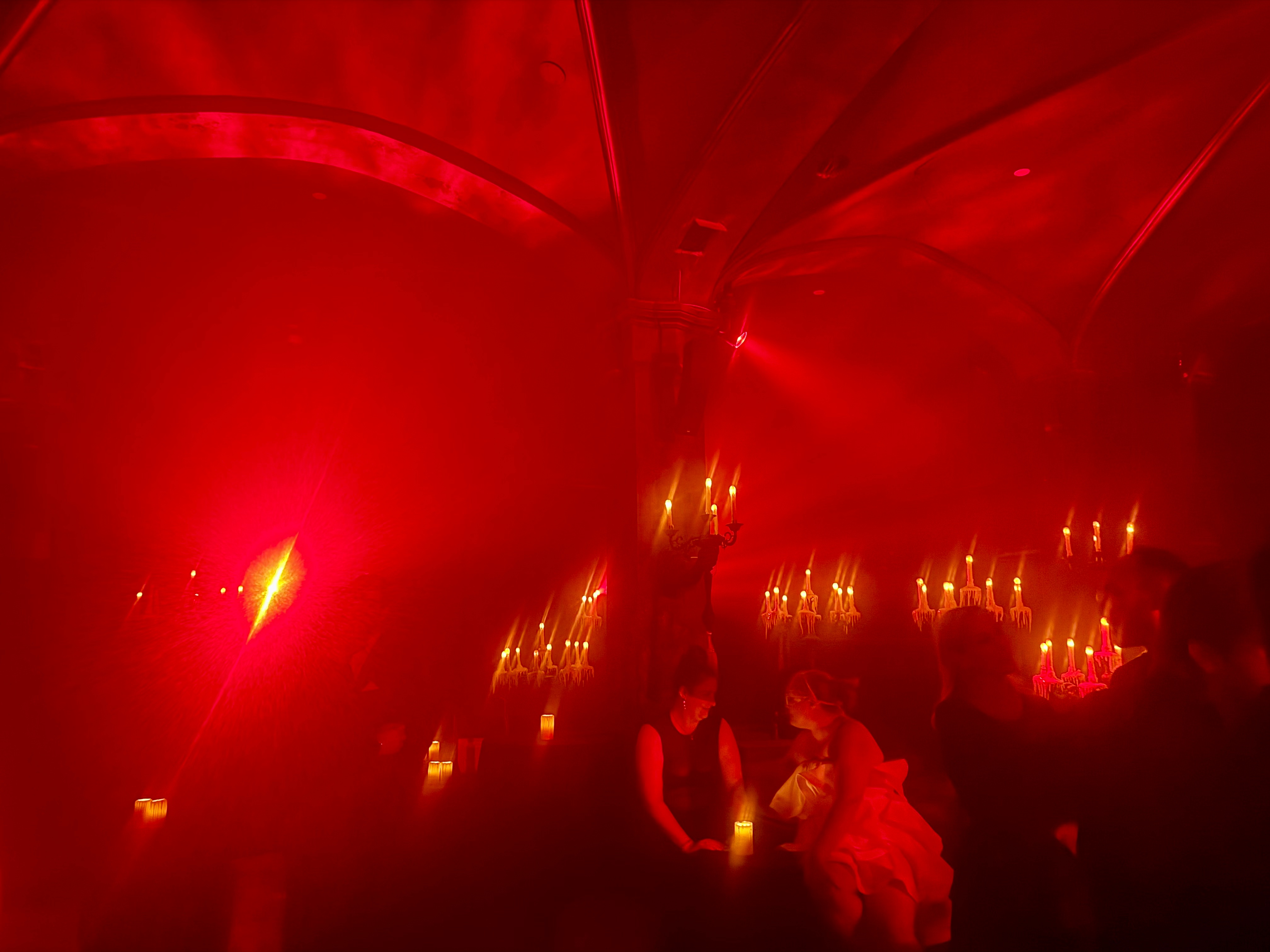
As you leave, there is an elaborately decorated bar space, and you are welcome to stay as long as you would like. You can go back to get your bags if needed and then return to the bar. There is also merch – of course! I found it useful to recap the show and process it a bit in the bar. I thoroughly enjoyed myself, and for me it worked both as someone who enjoys innovative and immersive experiences, and someone for whom the original POTO has a lot of nostalgic positive emotional valence.

As I started to write this post, inspired by exploring Viola’s Room and Masquerade this summer, I started to think more and more about what “immersive theatre” really even means. Certainly the classic Punchdrunk idea of wandering through an immense, richly detailed space, and coming in contact with performers you can choose to follow or not, is exceptionally immersive. Making your way through Viola’s Room while being guided by Helena Bonham Carter’s voice is very different, yet does immerse you into its storytelling world. So does Masquerade, even though your movement through the space and story is tightly controlled. I suppose the areas that are less clear involve a production spilling out into public areas, or having performers break the fourth wall by speaking to attendees. In the end, the definition matters less to me than the experience – and whenever I experience a sense of flow by losing myself in a story, I am immersed in it. This can happen even while sitting in a traditional theatre seat watching something on a  proscenium stage. However it presents, I enjoy experiencing complete immersion into a story, and I seek it out in whatever form it happens to take!
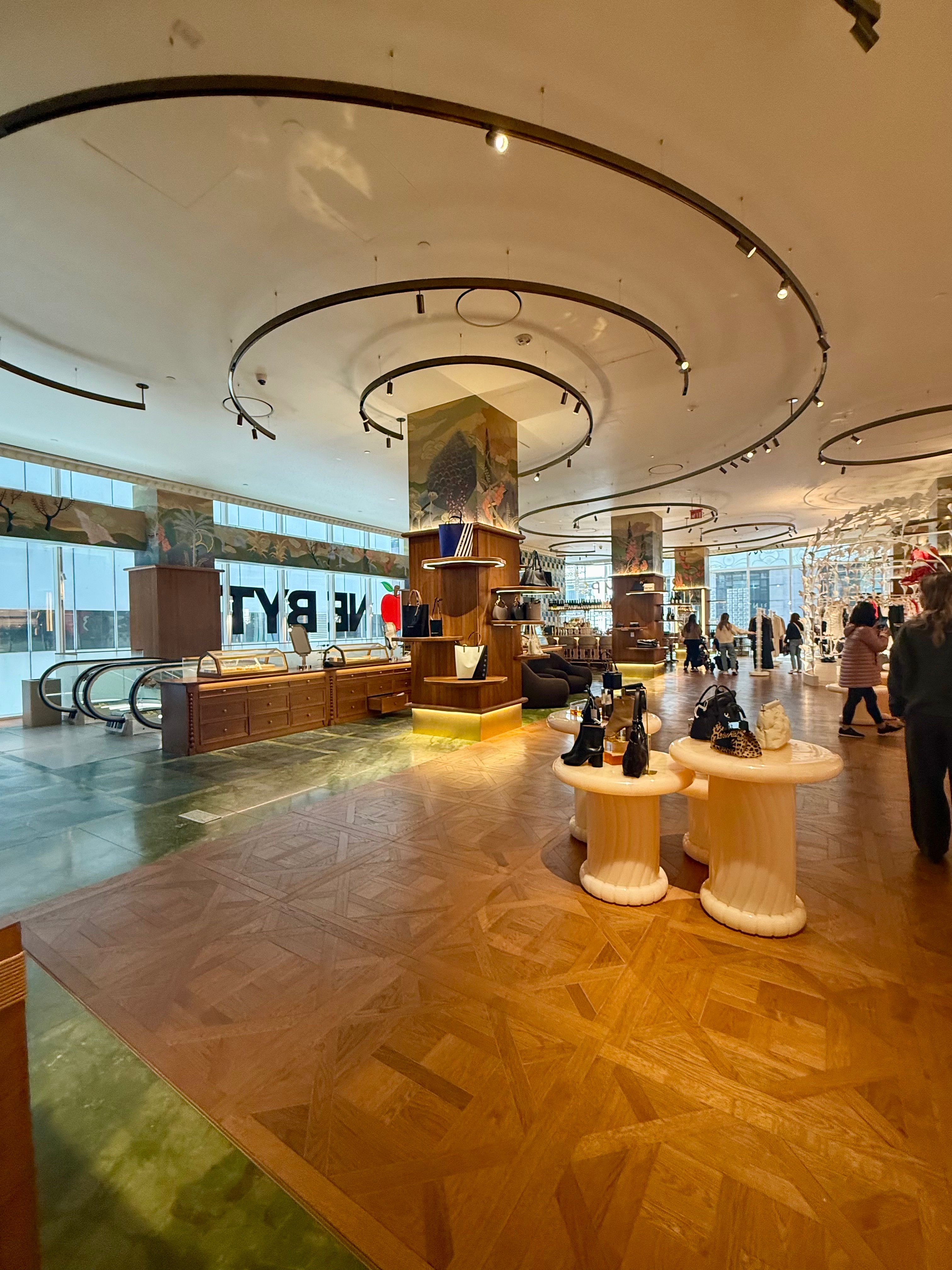
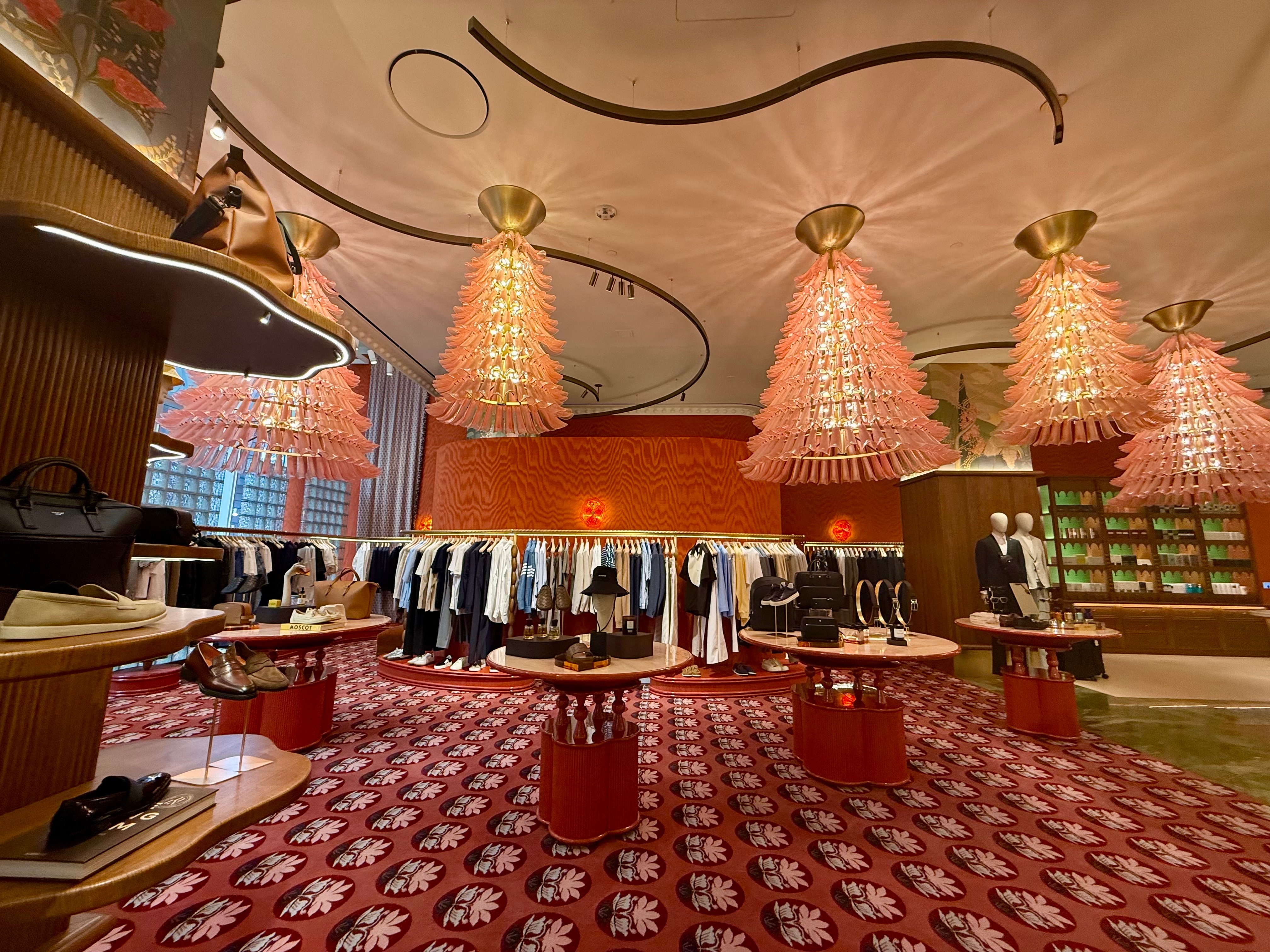
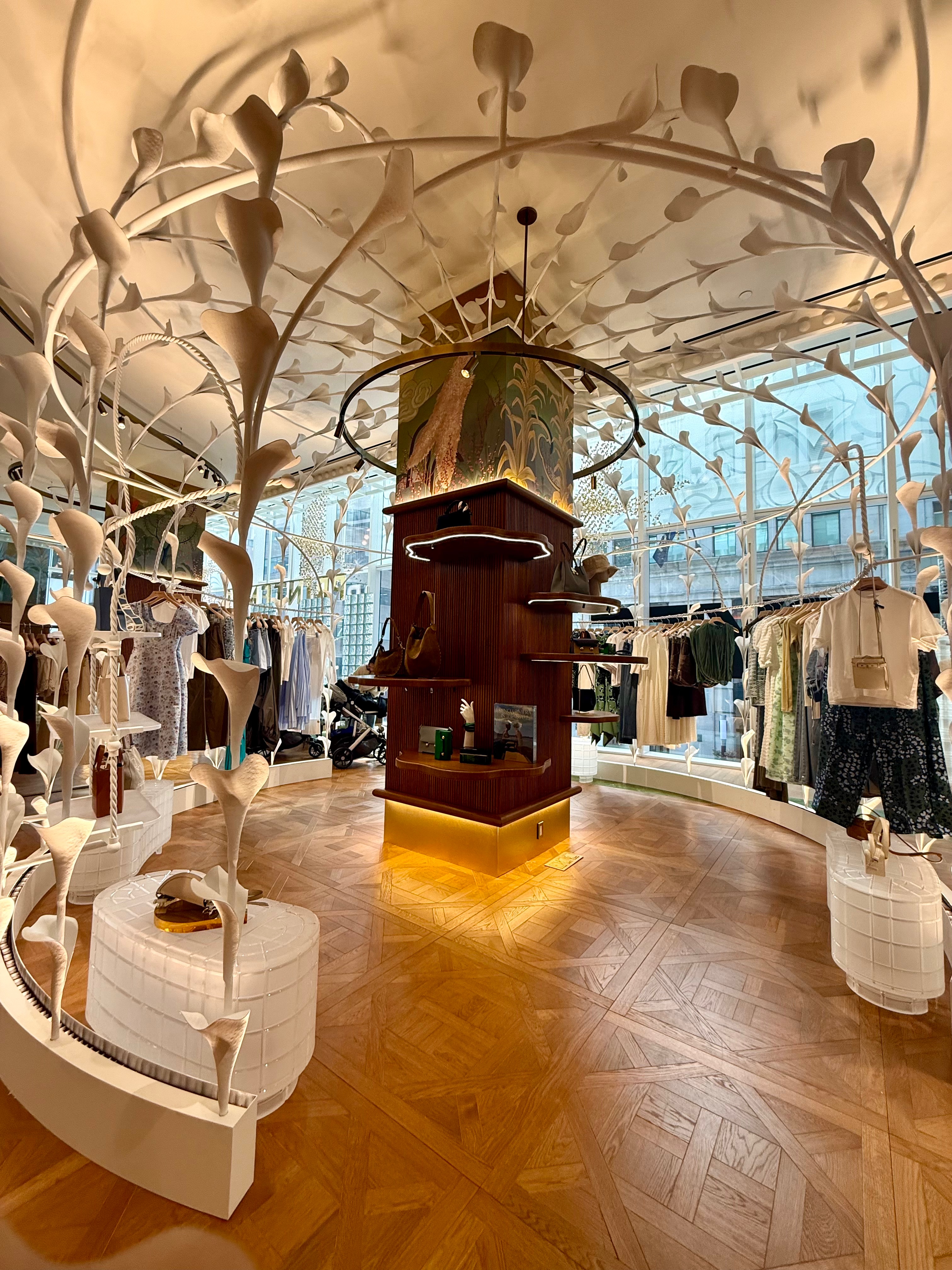
Printemps, a bit of Paris in NYC

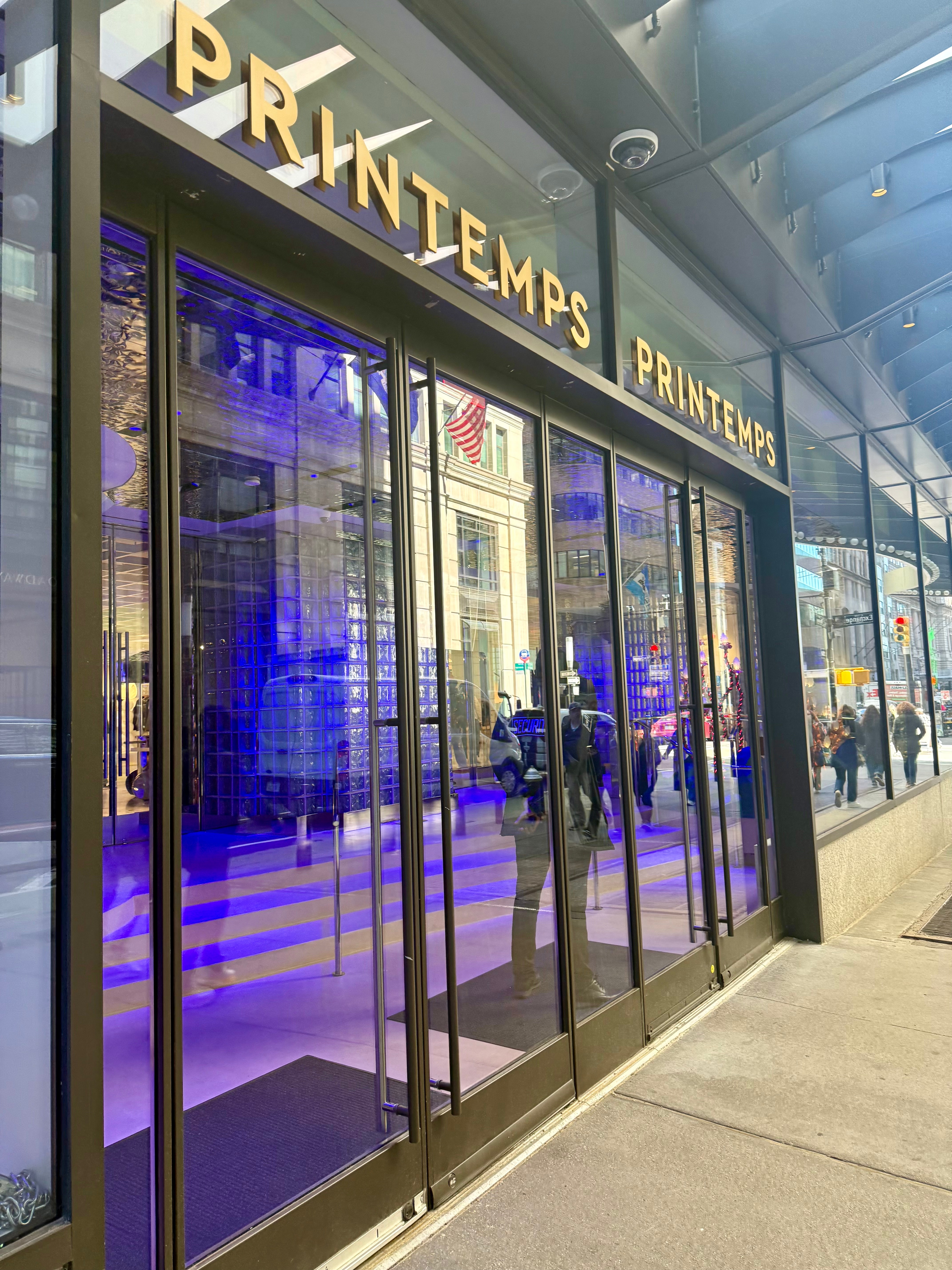
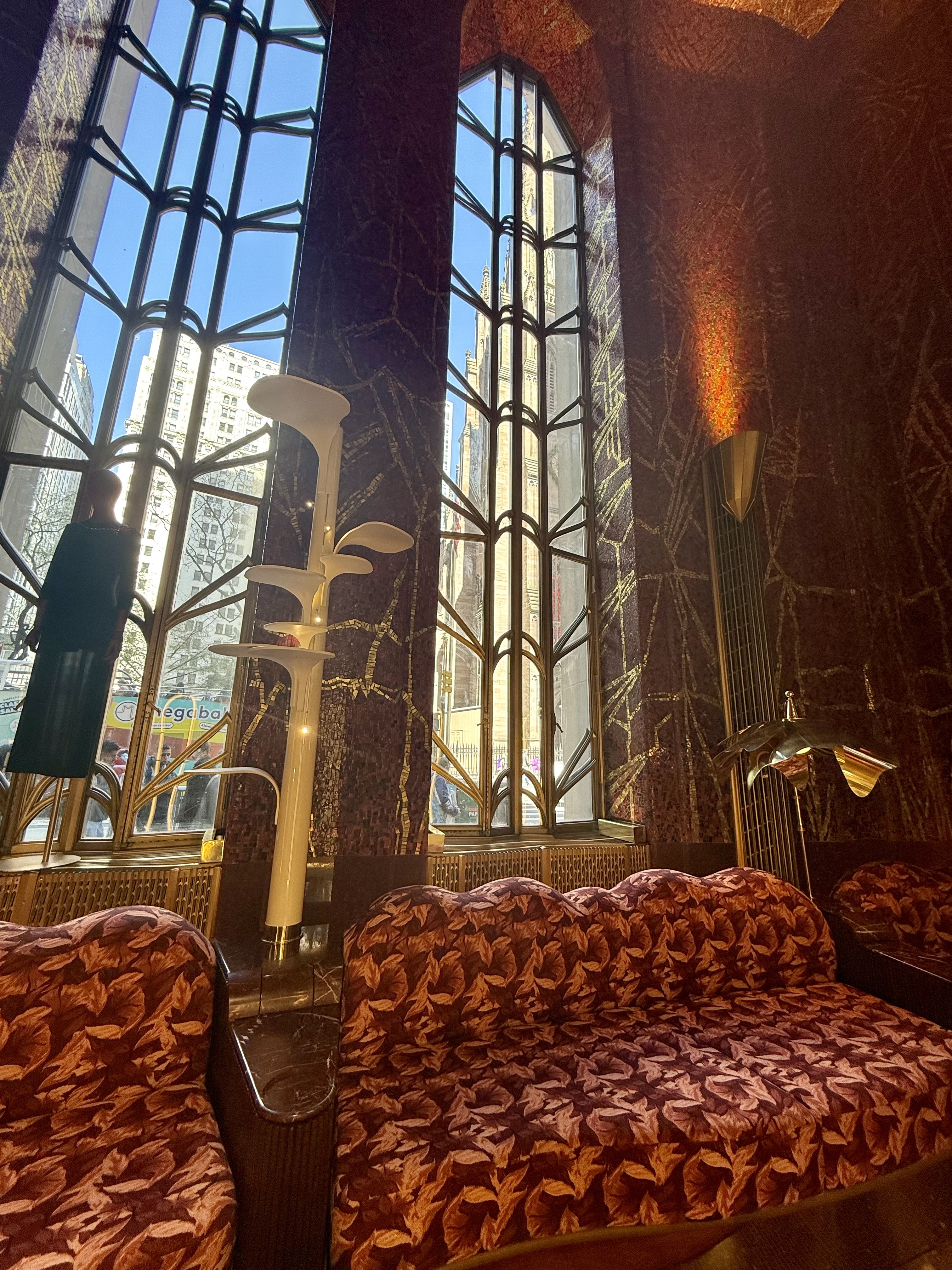
The Art Deco masterpiece One Wall Street, at Wall Street and Broadway in the Financial District, was designed by Ralph Walker and built between 1929 and 1931. First the headquarters of Irving Trust, and later Bank of New York and BNY Mellon, it was sold for residential development in 2015 and converted to condominiums between 2018 and 2023. Commercial space on the lower floors now hosts a Whole Foods, fitness center, and as of late March of 2025, an outpost of famed Parisian department store Printemps.

Printemps is a celebrated French department store chain (with 21 stores in France as well as one in Doha), and its flagship store on Boulevard Haussman in the 9th arrondissement in Paris is an Art Nouveau masterpiece. Sitting next to rival Galeries Lafayette, near the Palais Garnier, it was built in 1865, and was the first public building in Paris to have electrical power installed. For its only store in the United States, it would be important for any Printemps here to be in a building similarly important and beautiful, so One Wall Street was an ideal location.

There are two entrances, but I highly recommend for your first visit to enter on Broadway rather than the side entrance on Wall Street (you will see why later). The NYC Printemps is much smaller than the Haussman flagship, but every design detail is exquisite.

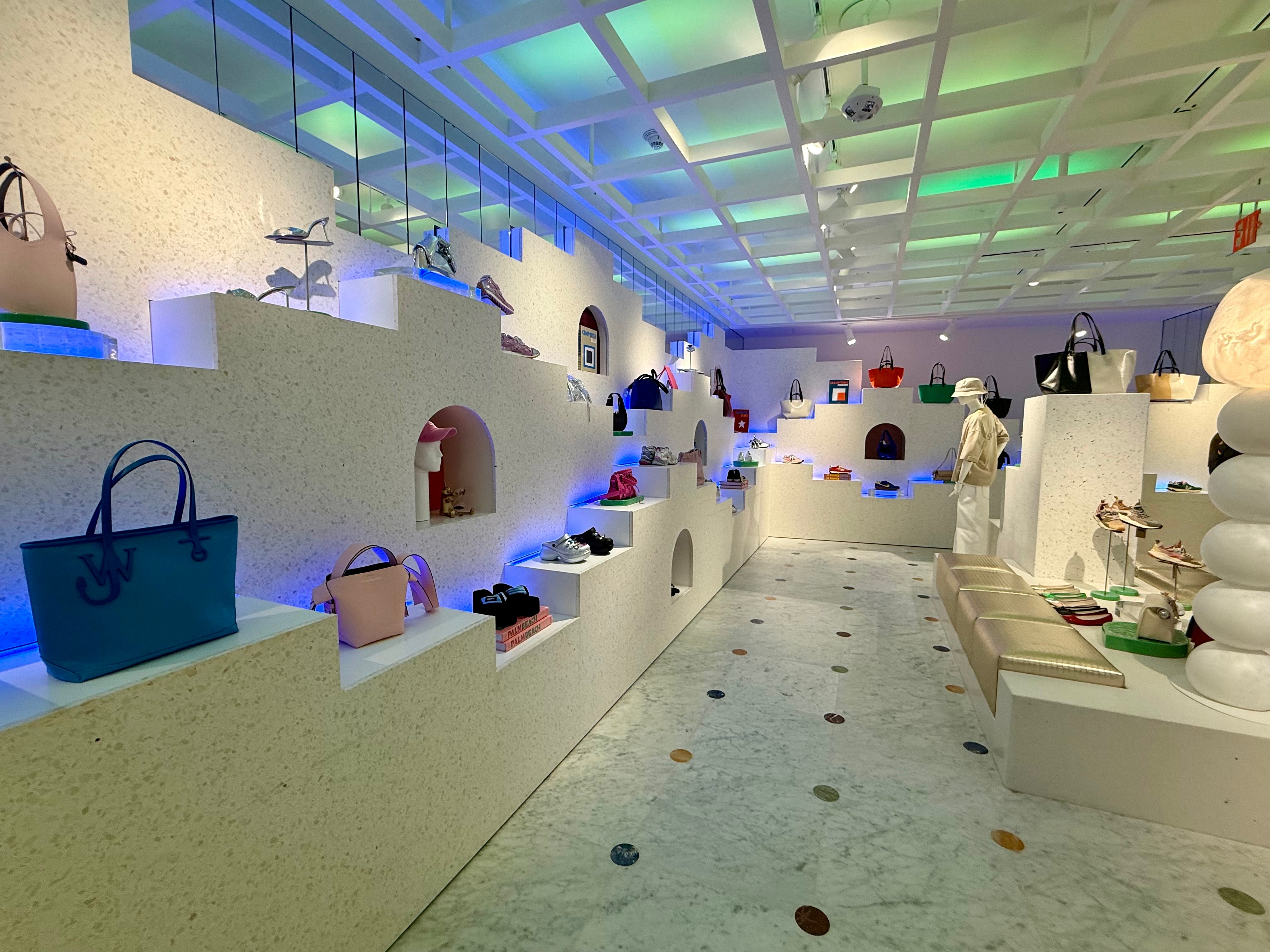
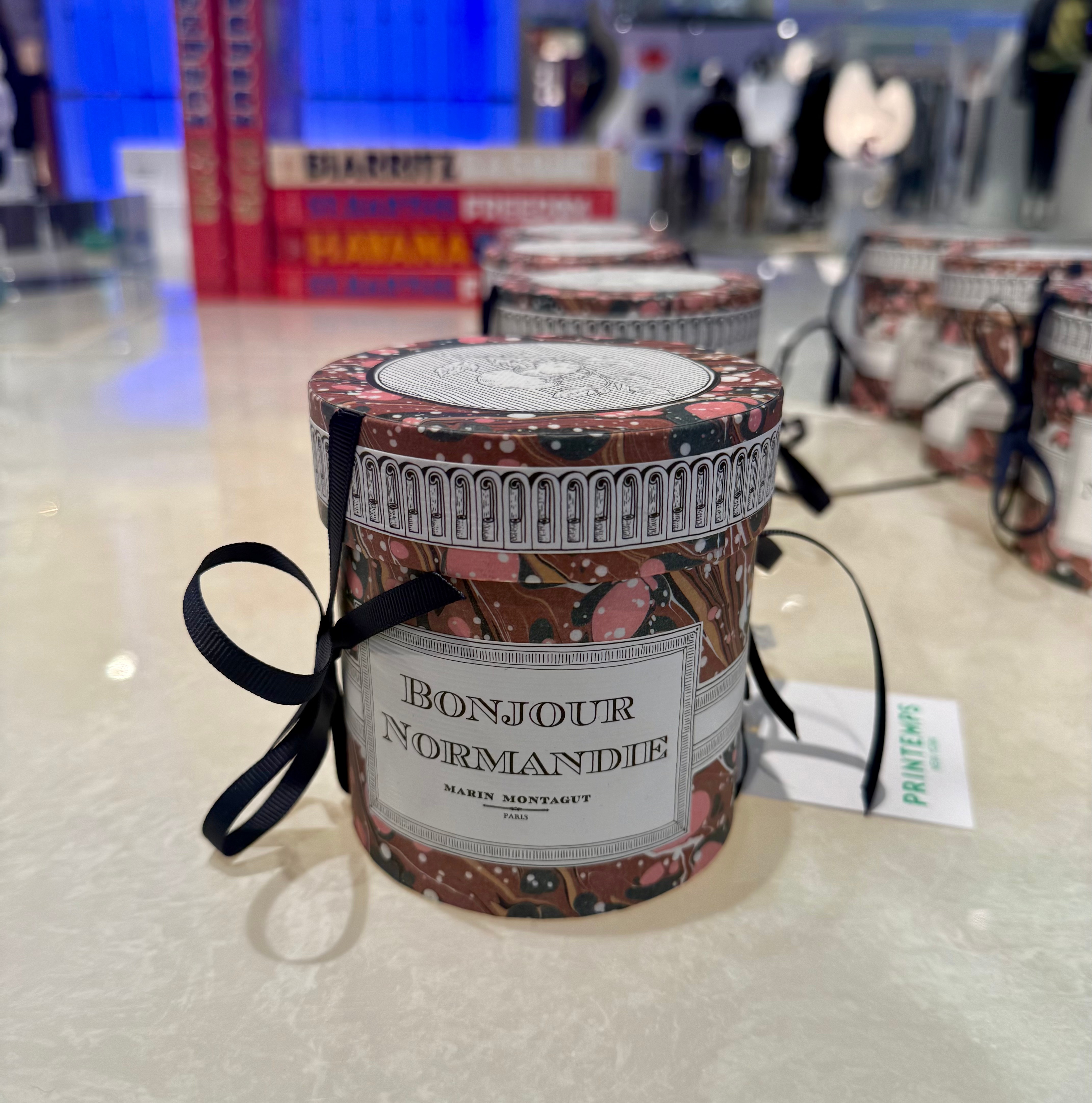
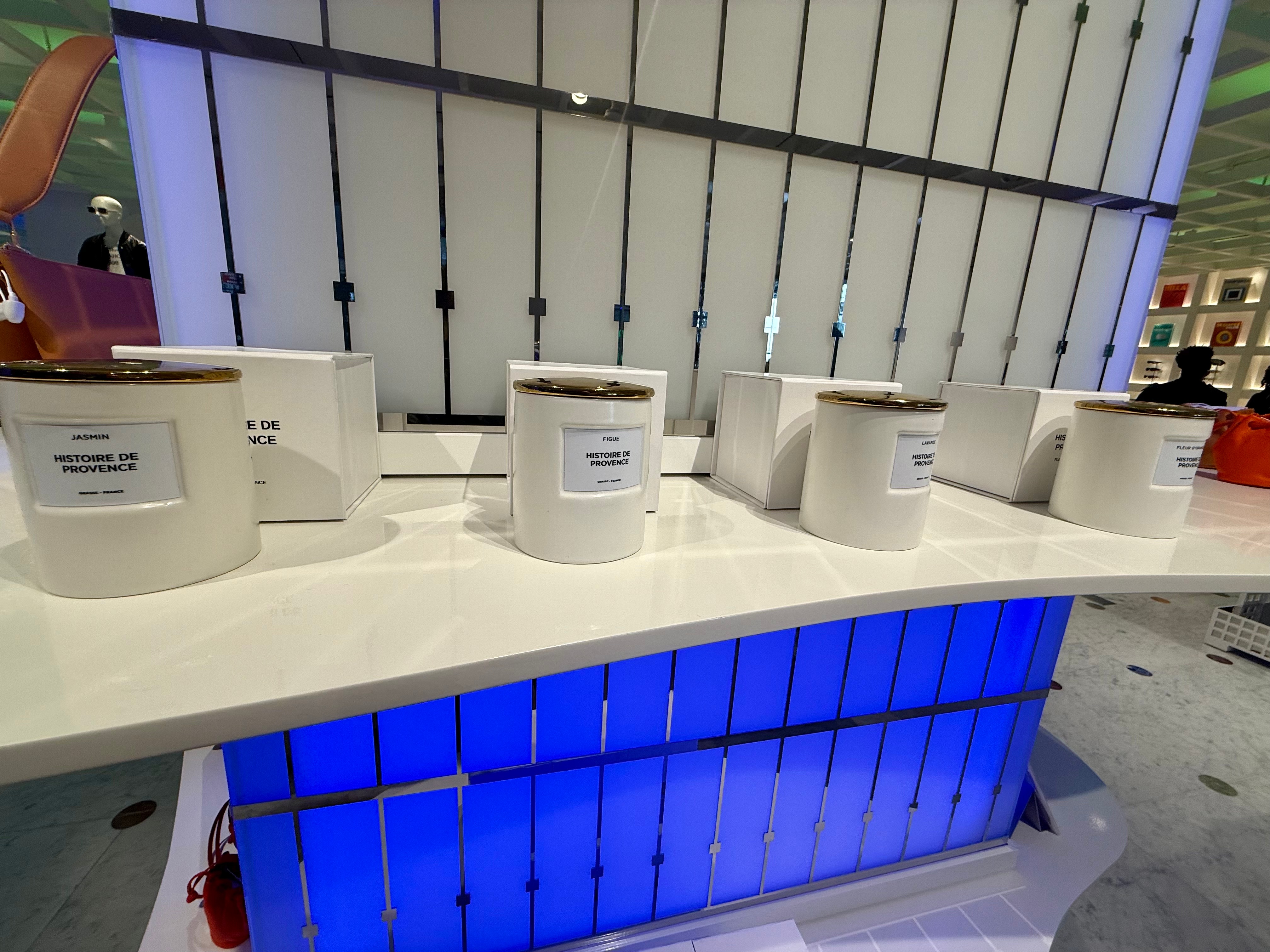
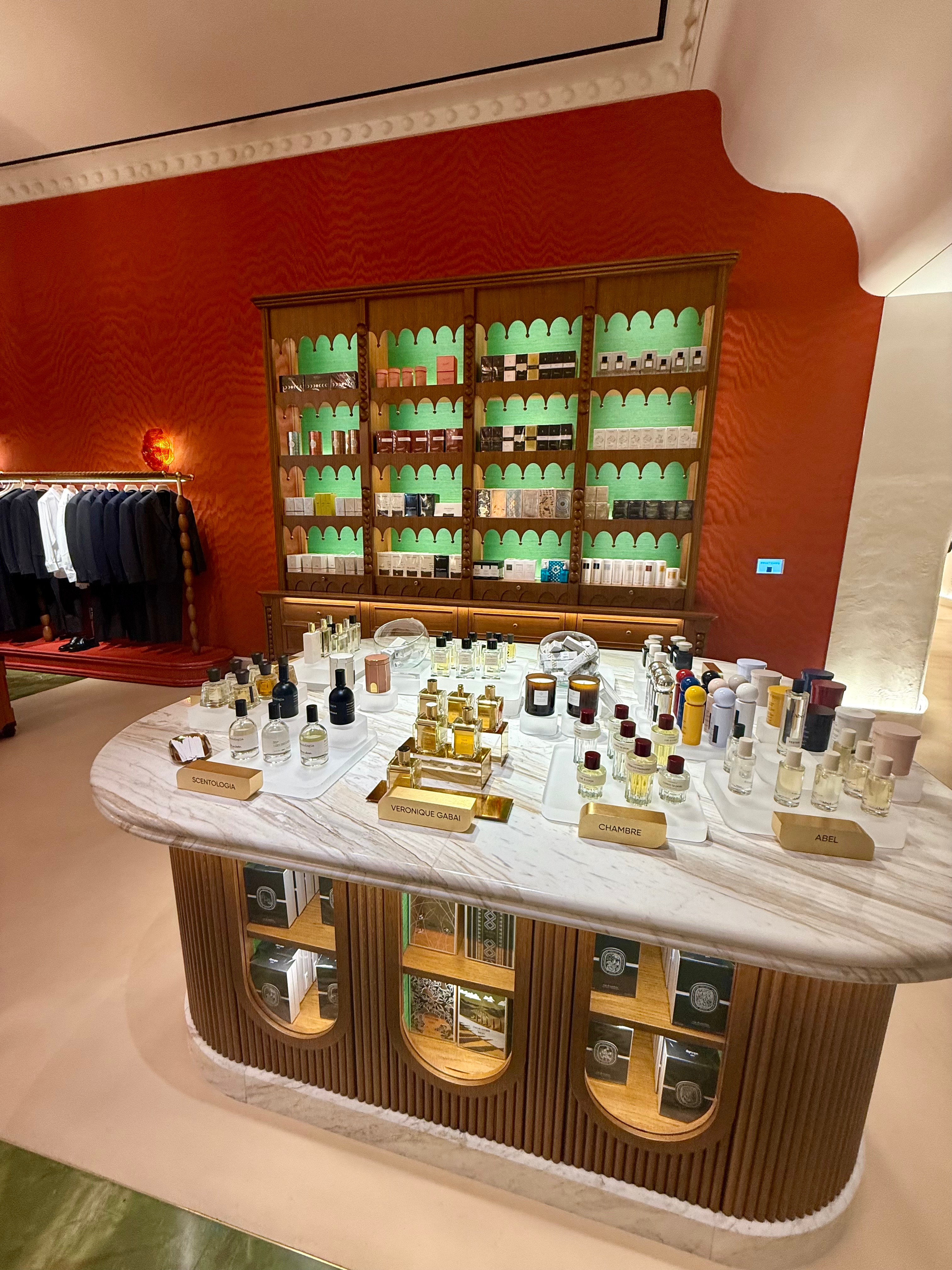
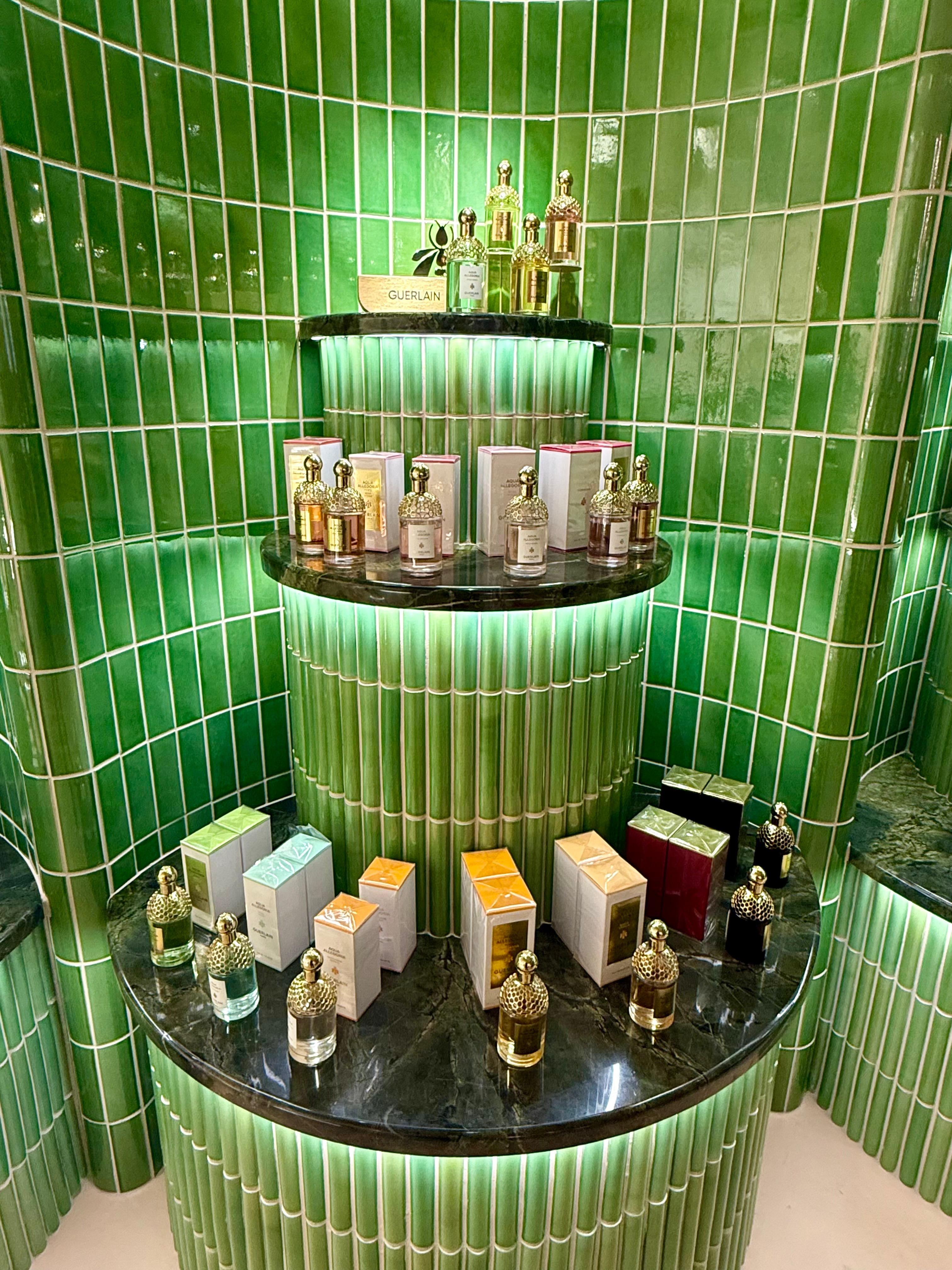
Every item you find as you stroll through the store is French, unique, and presented in a beautiful way.

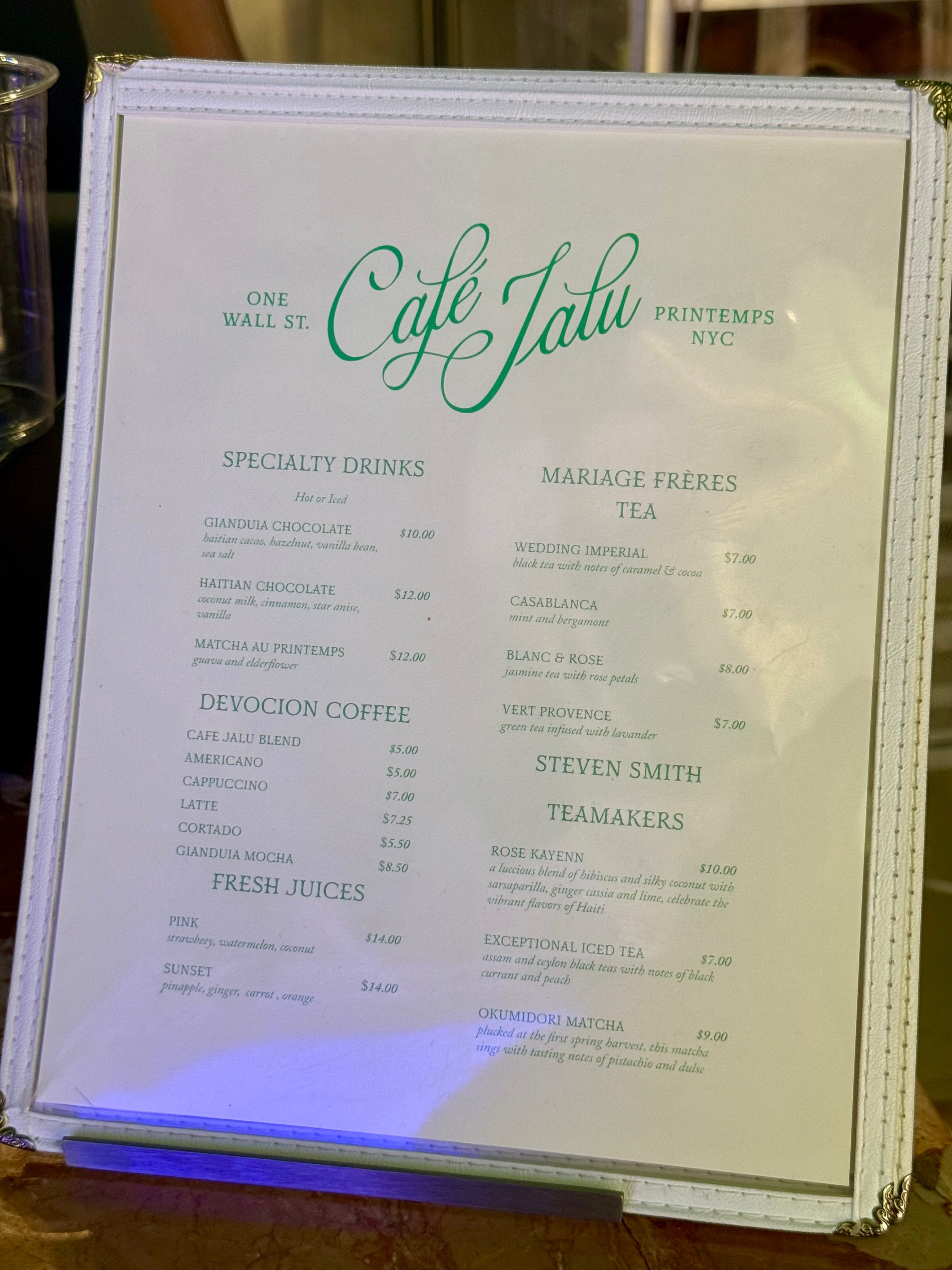
On the ground floor just to the left as you enter off Broadway, there is a lovely cafe with seating.

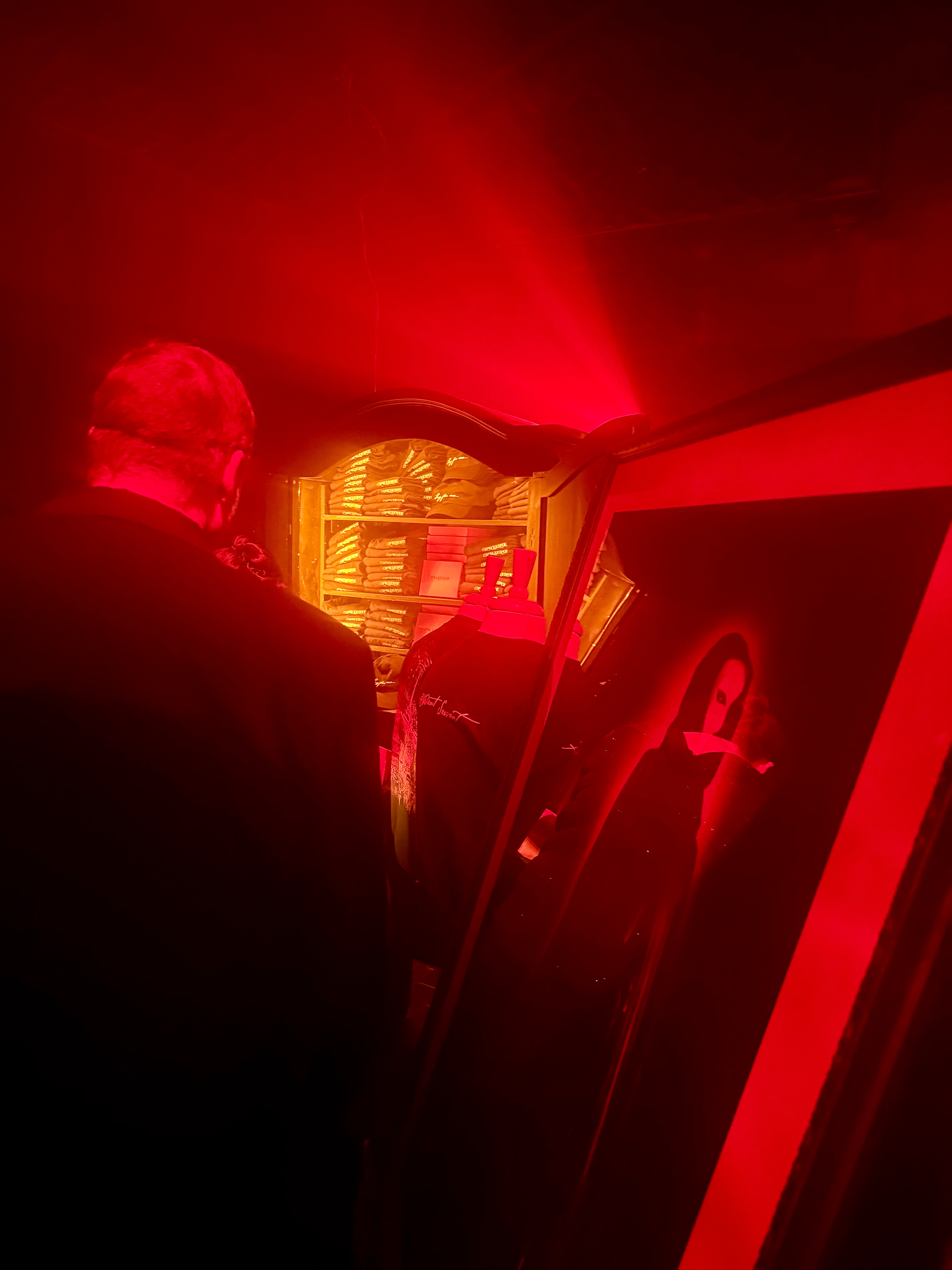
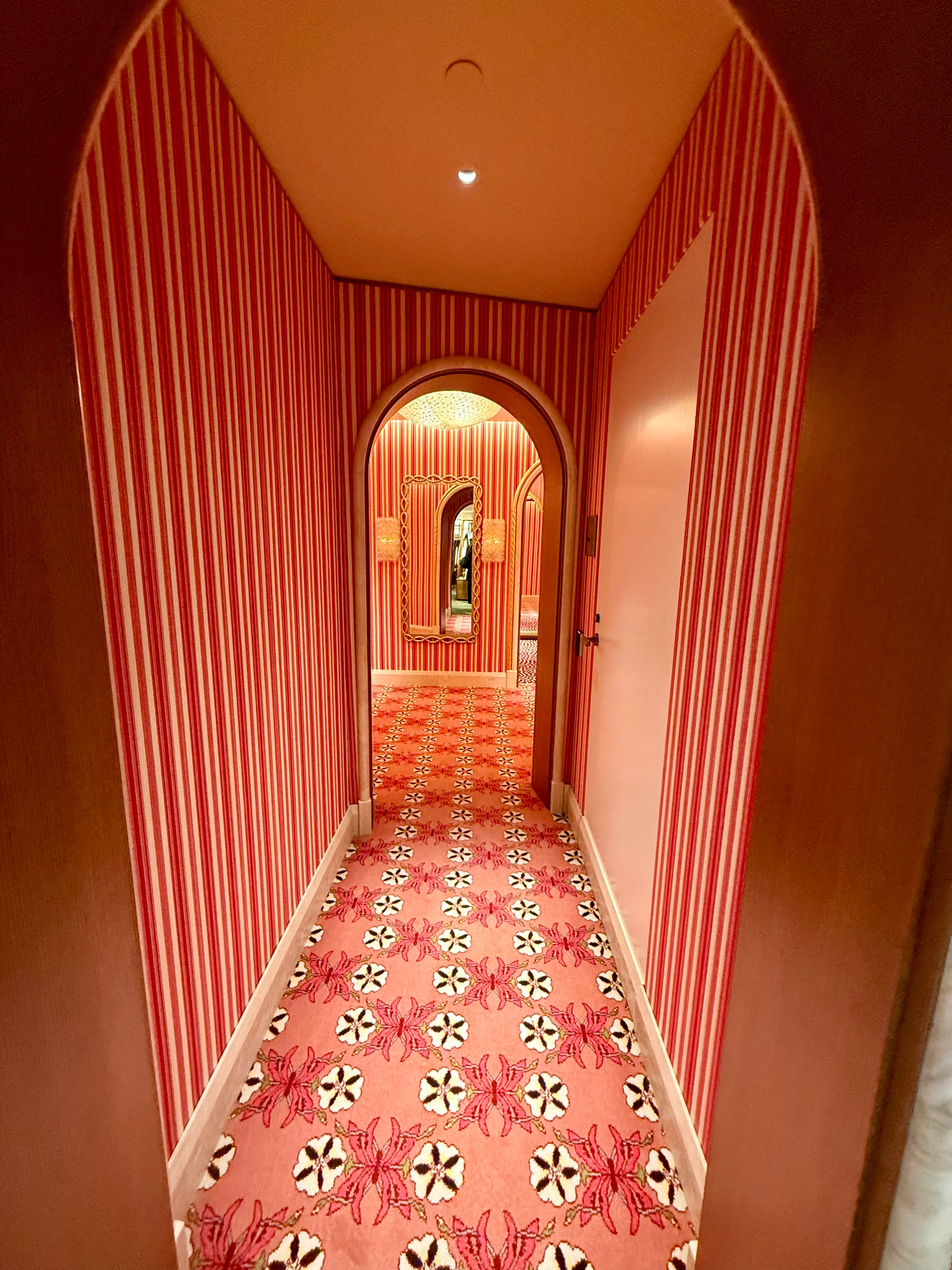
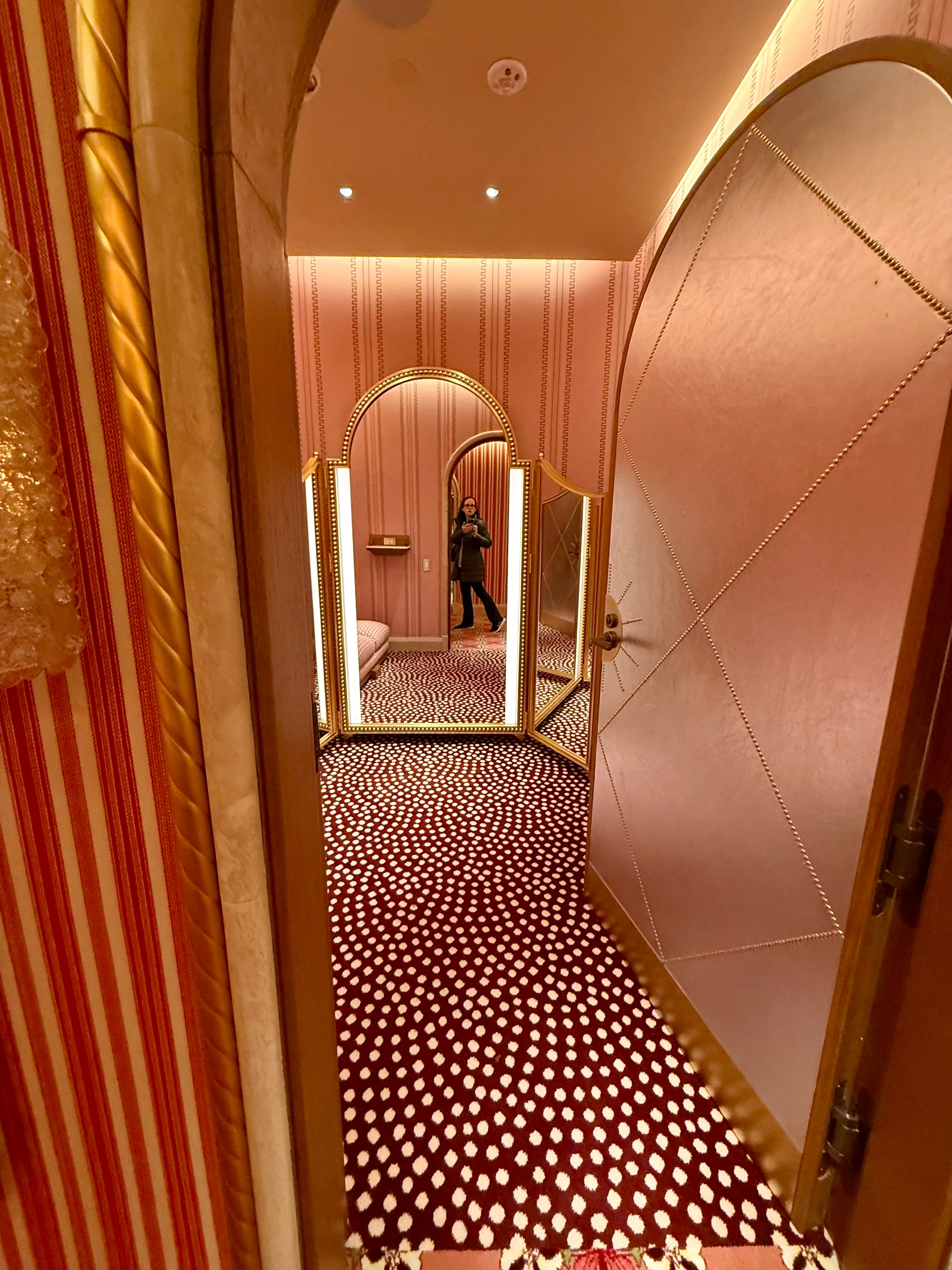
The dressing rooms are lushly and immersively decorated.

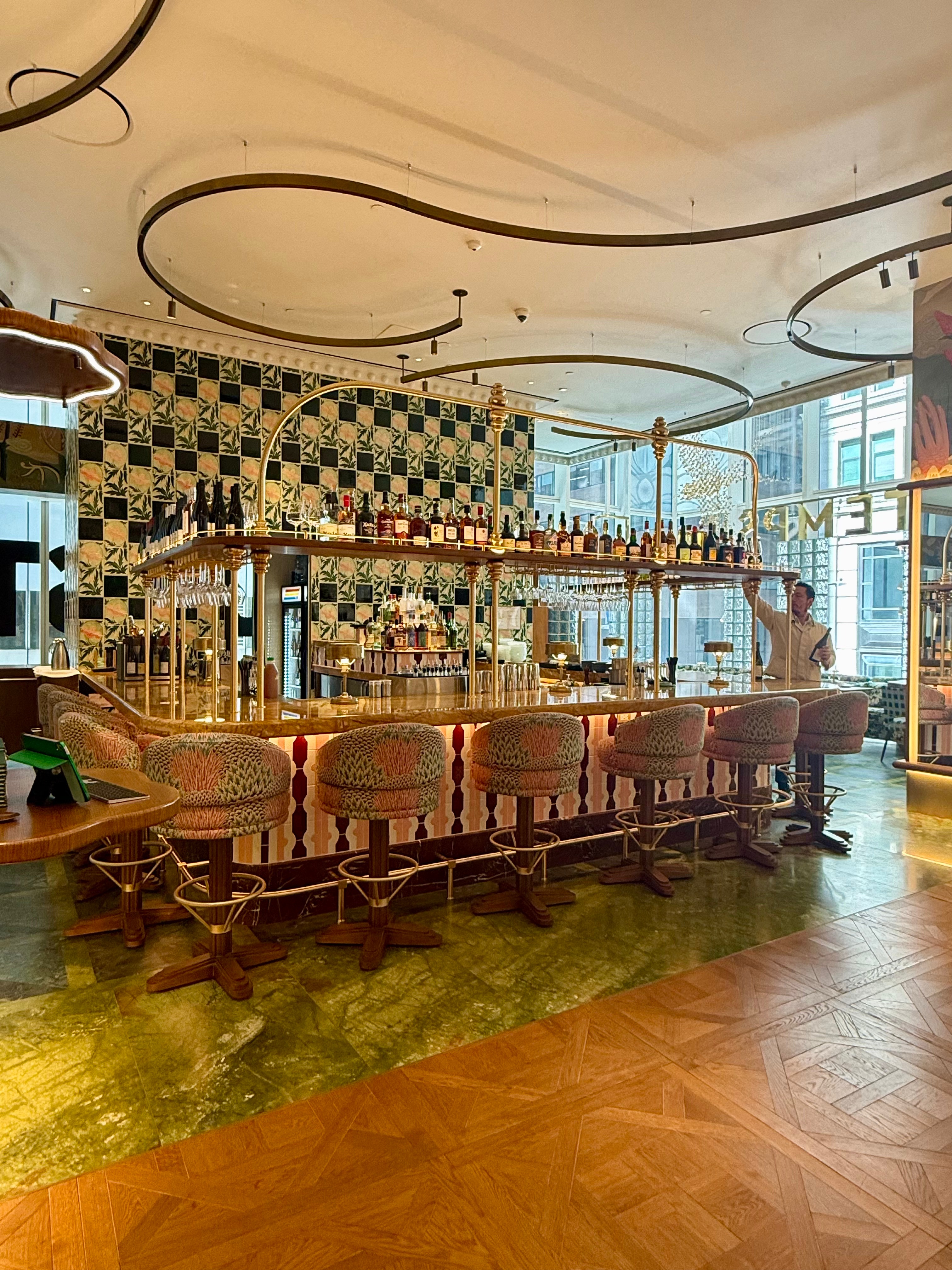
There are multiple bars within the space, this one is just on the second level above the entrance on Broadway.

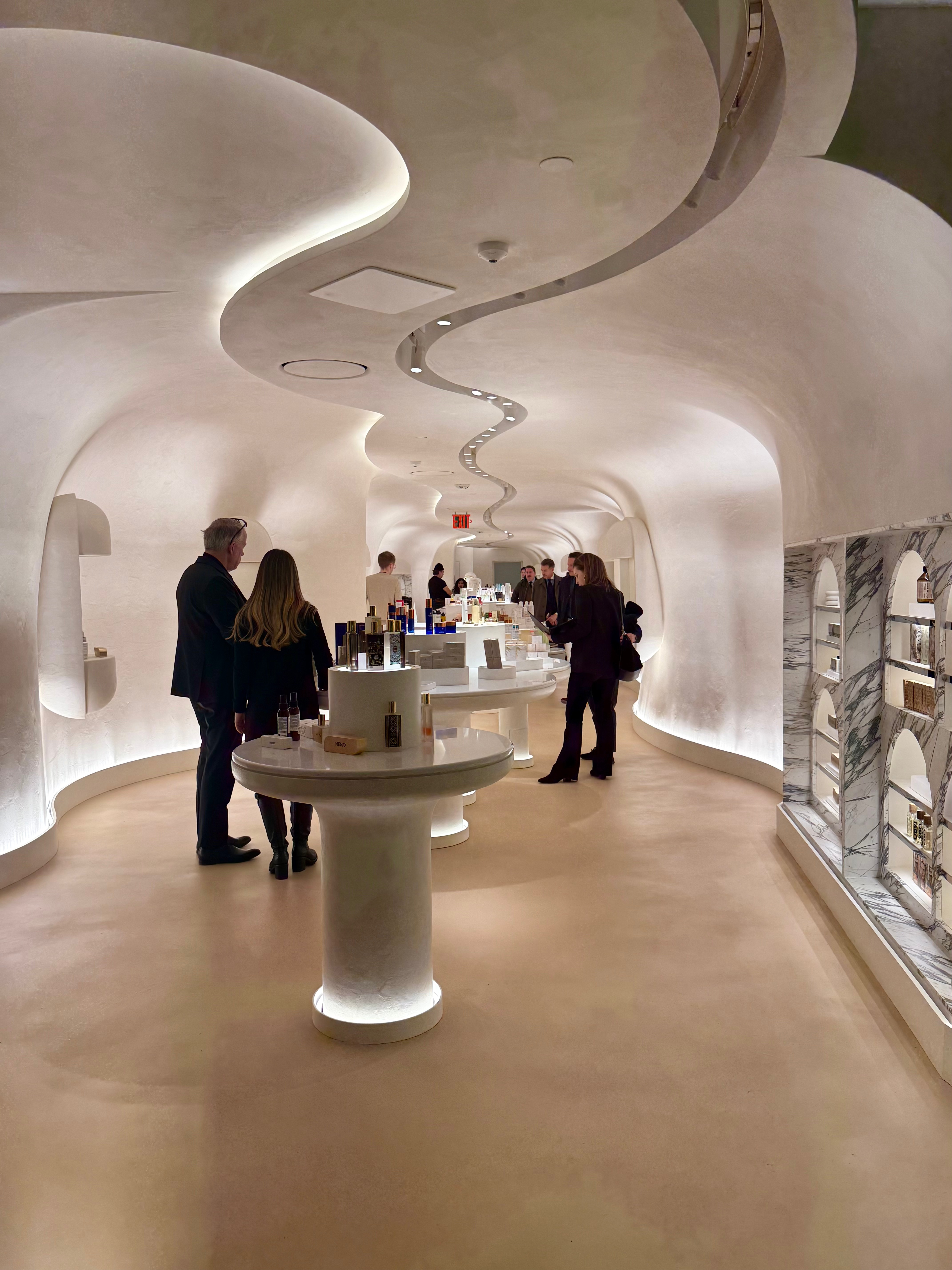
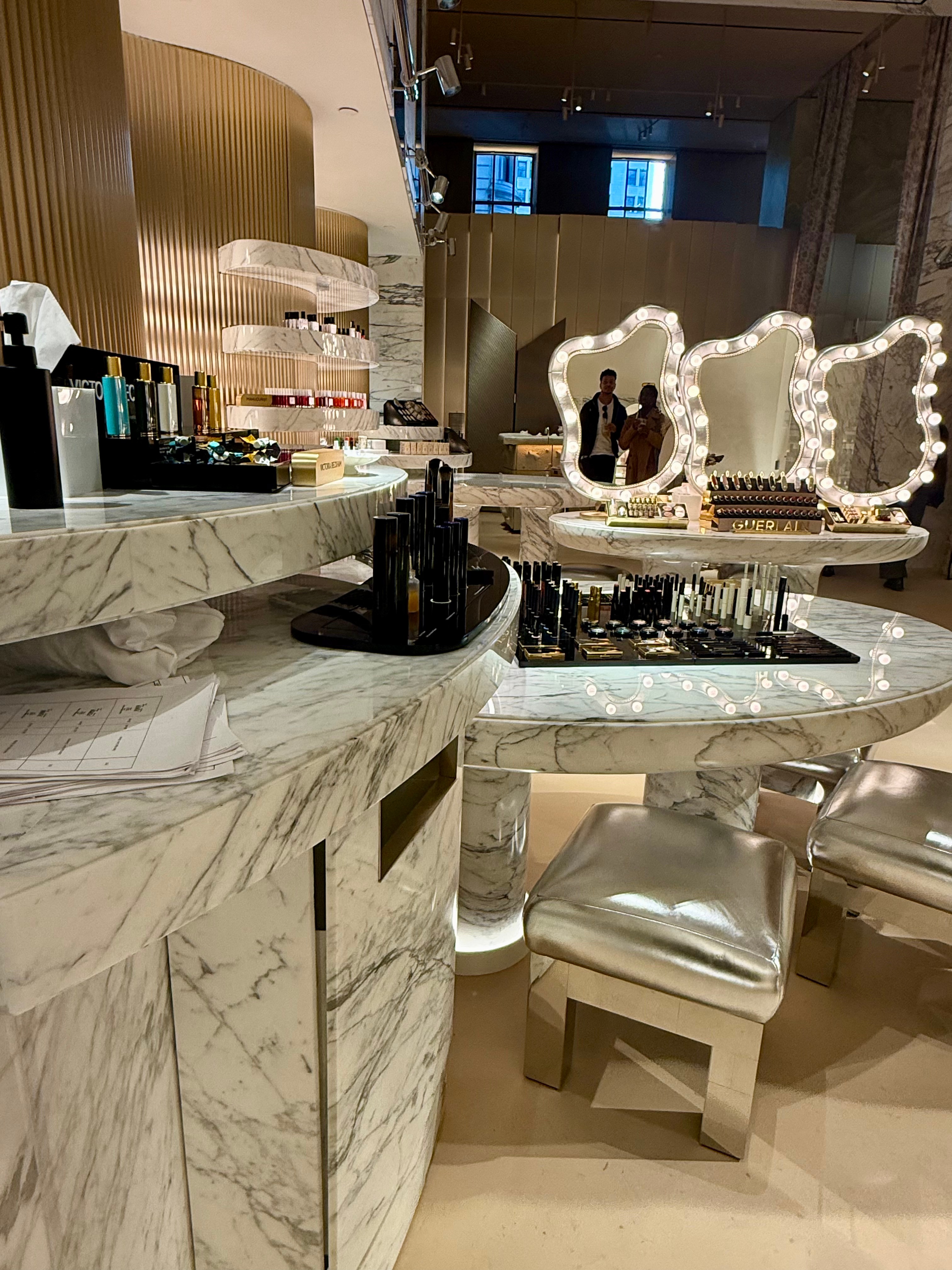
Continuing along on the second level, there is a passageway to get to the part of the store that faces Wall Street. It is set up as the beauty section, including some treatment areas, and a champagne bar.

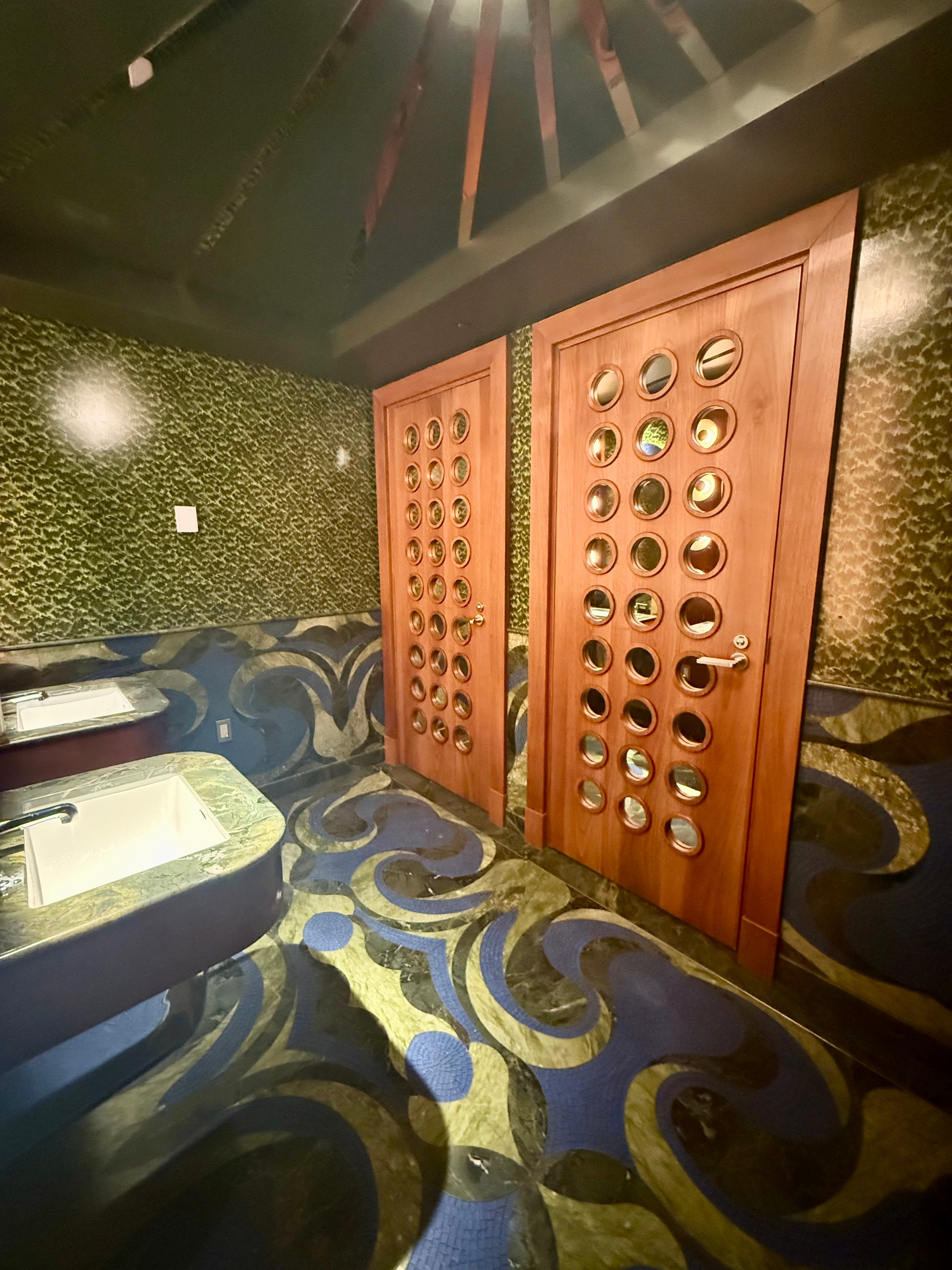
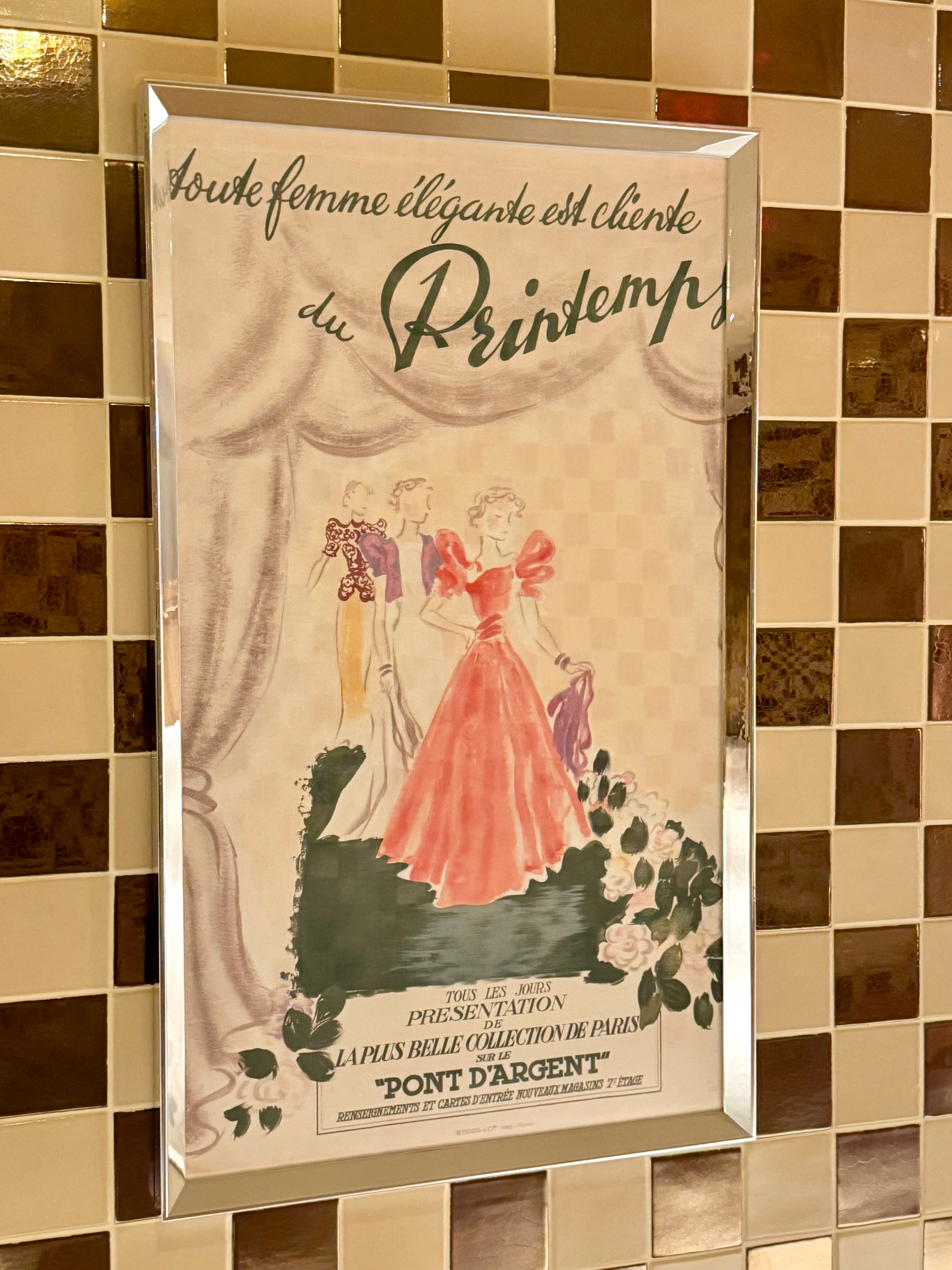
Near the beauty area, you can find the bathrooms. I have never been in such beautiful public bathrooms! Who needs a Maurizio Cattelan golden toilet when you can just visit Printemps?

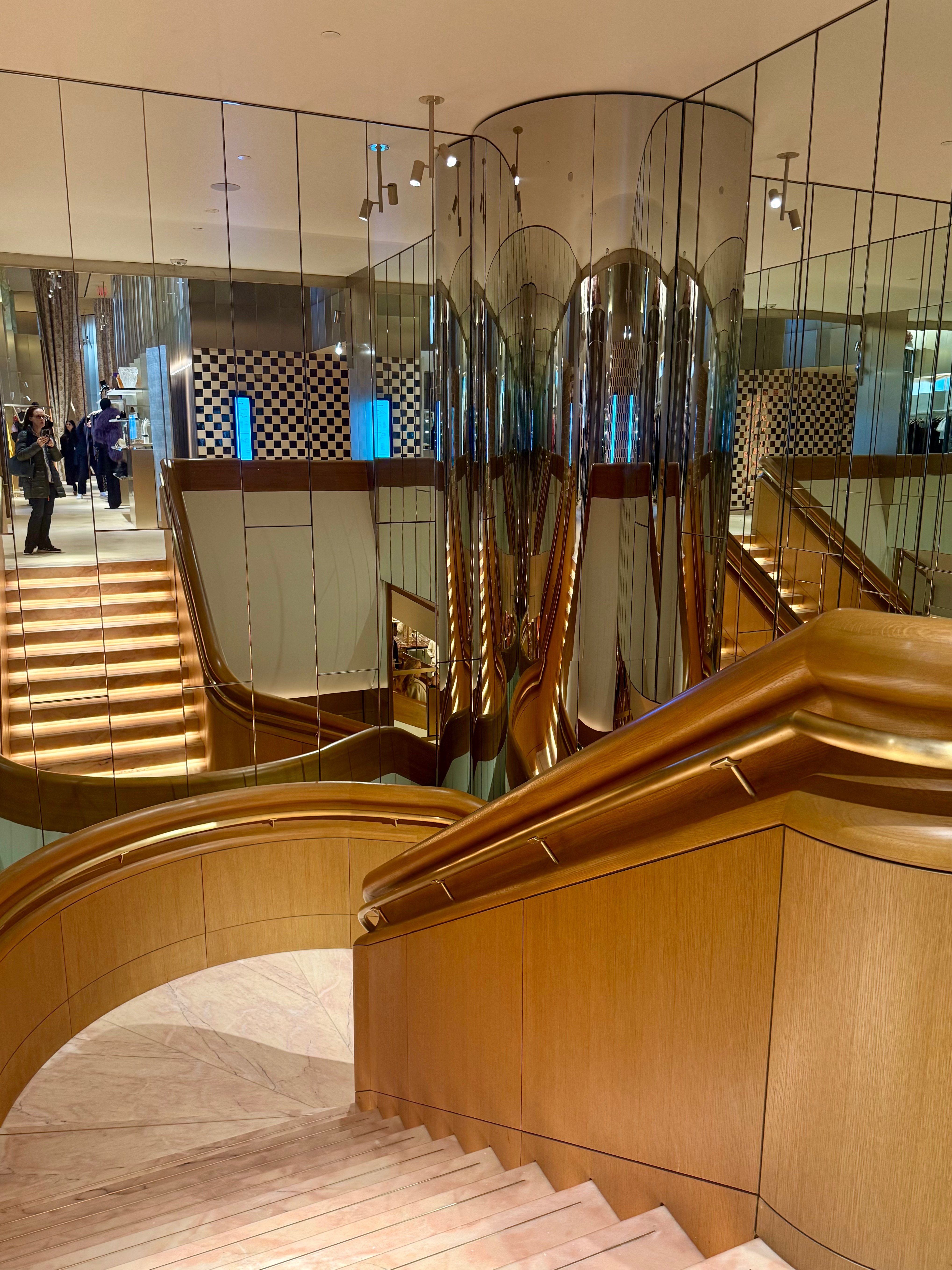
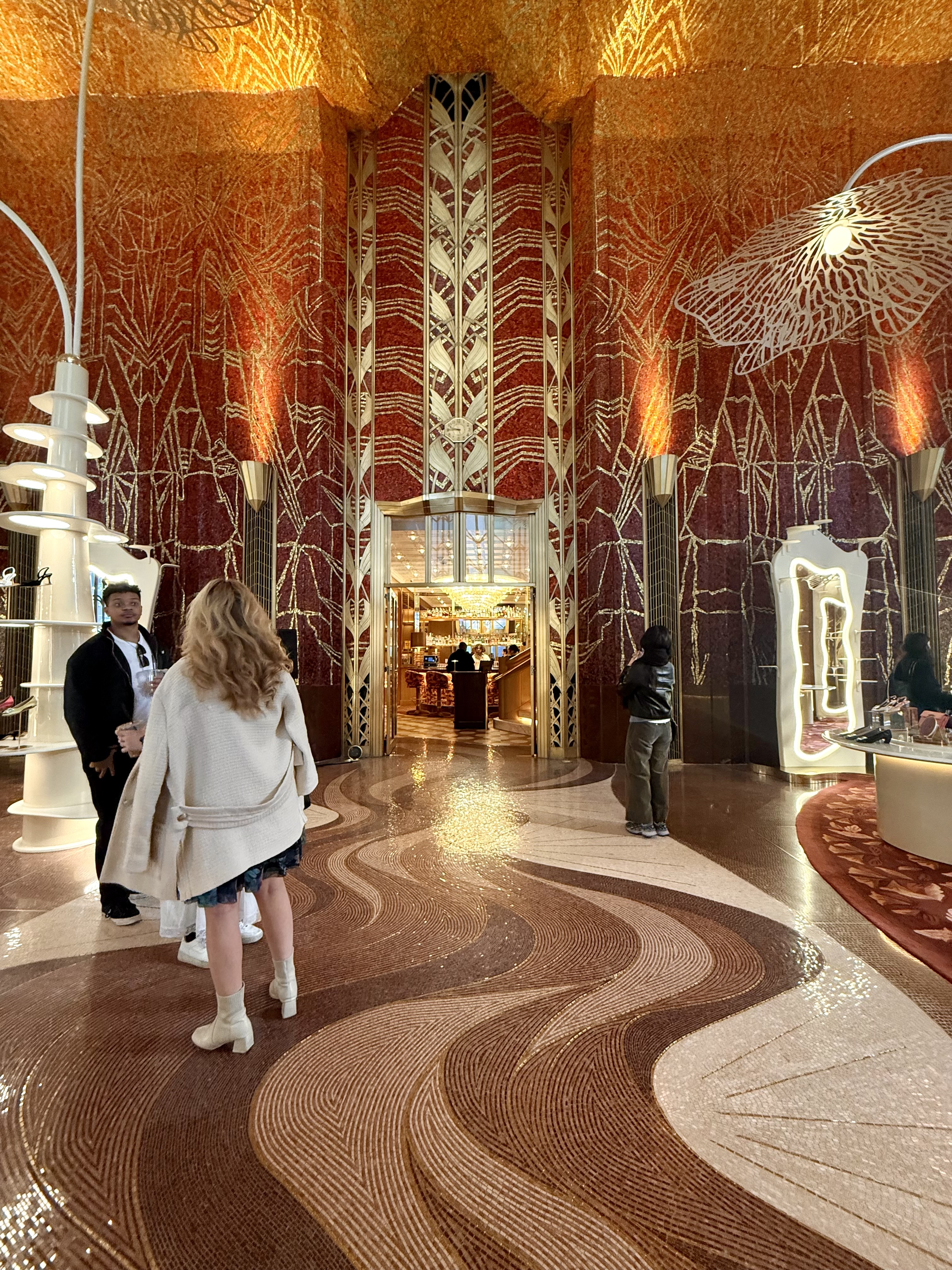
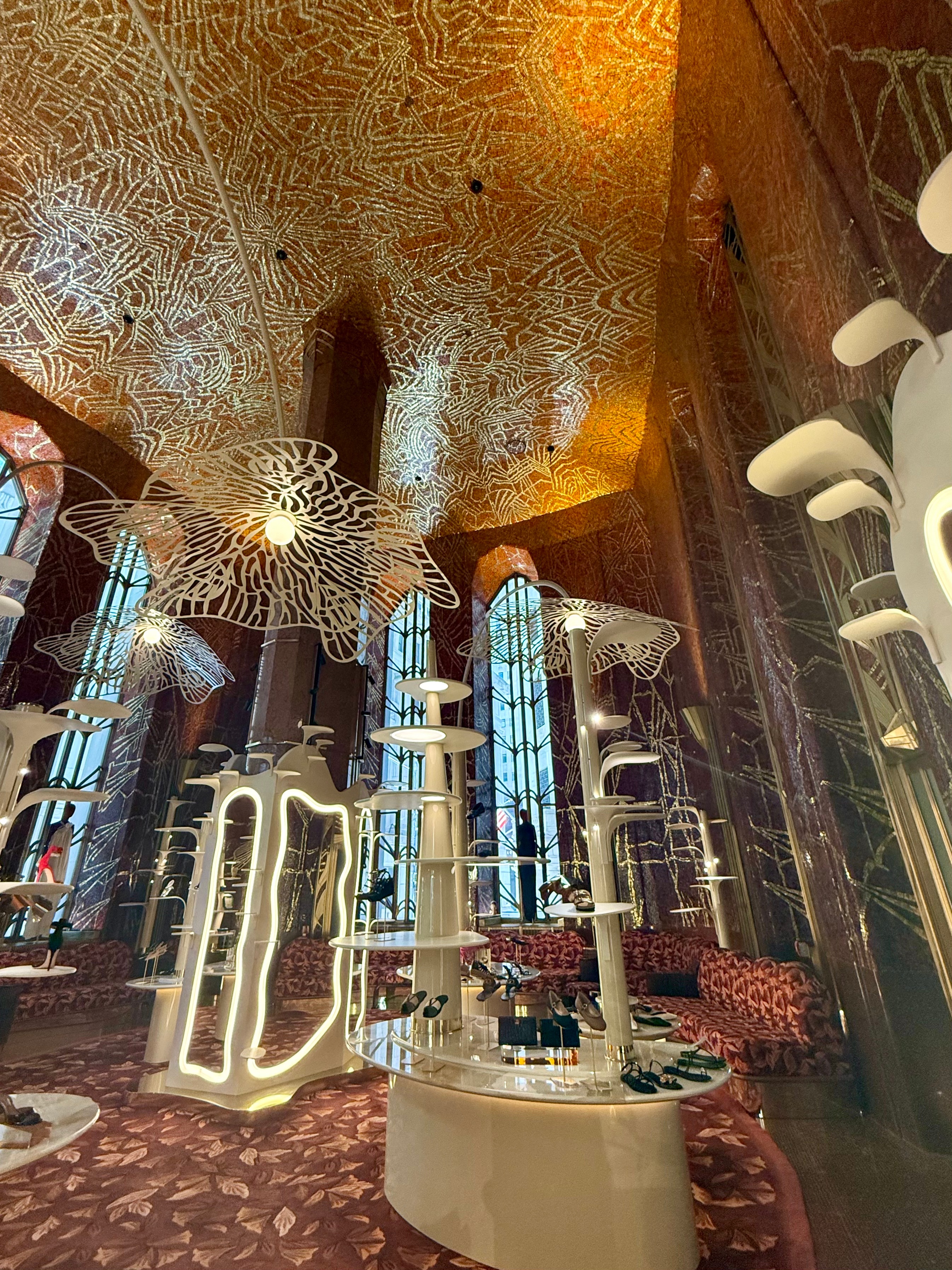
Past the bathrooms, you find a grand staircase to lead down to the most incredible area of Printemps NYC – the famed Red Room.

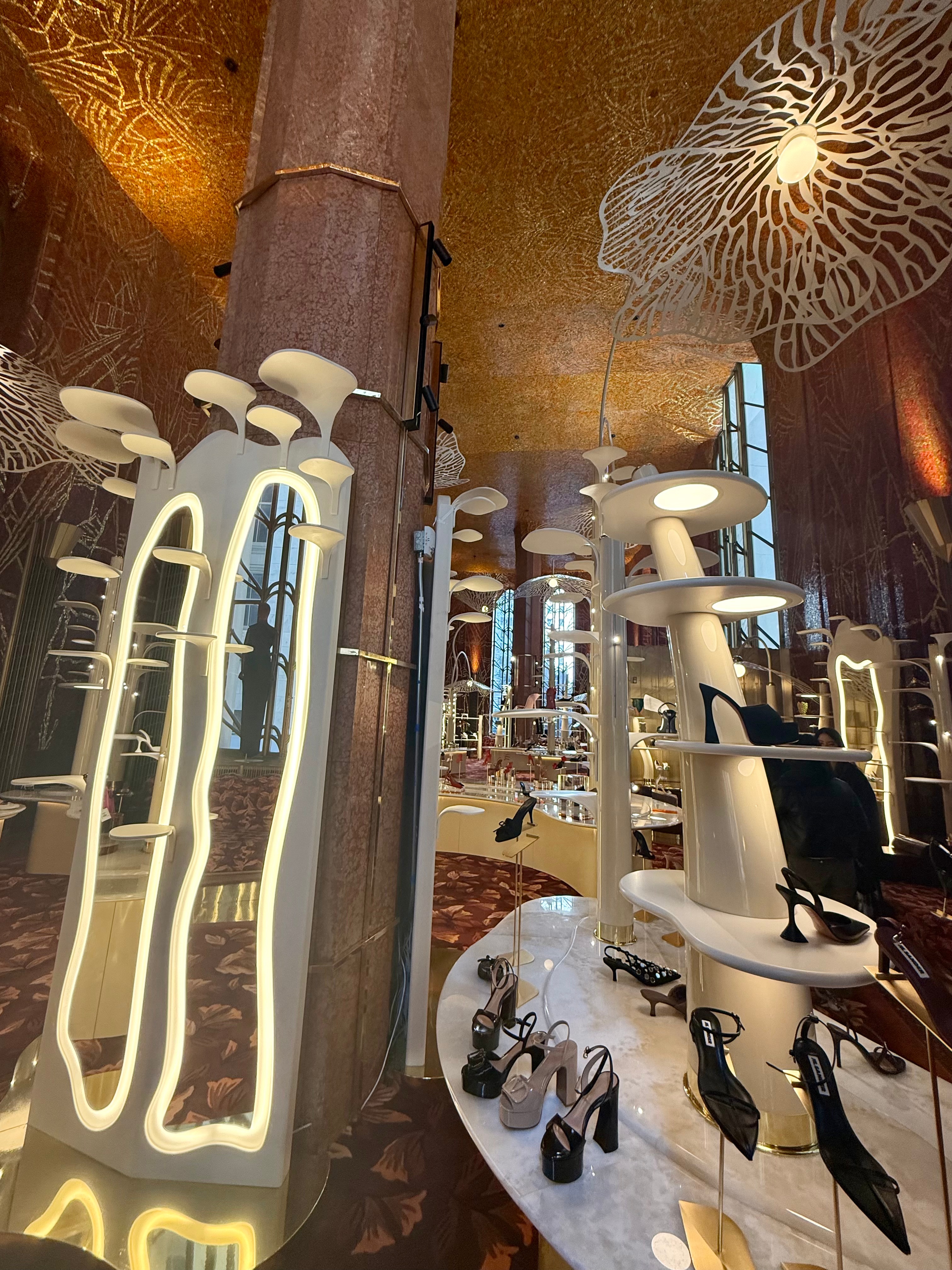
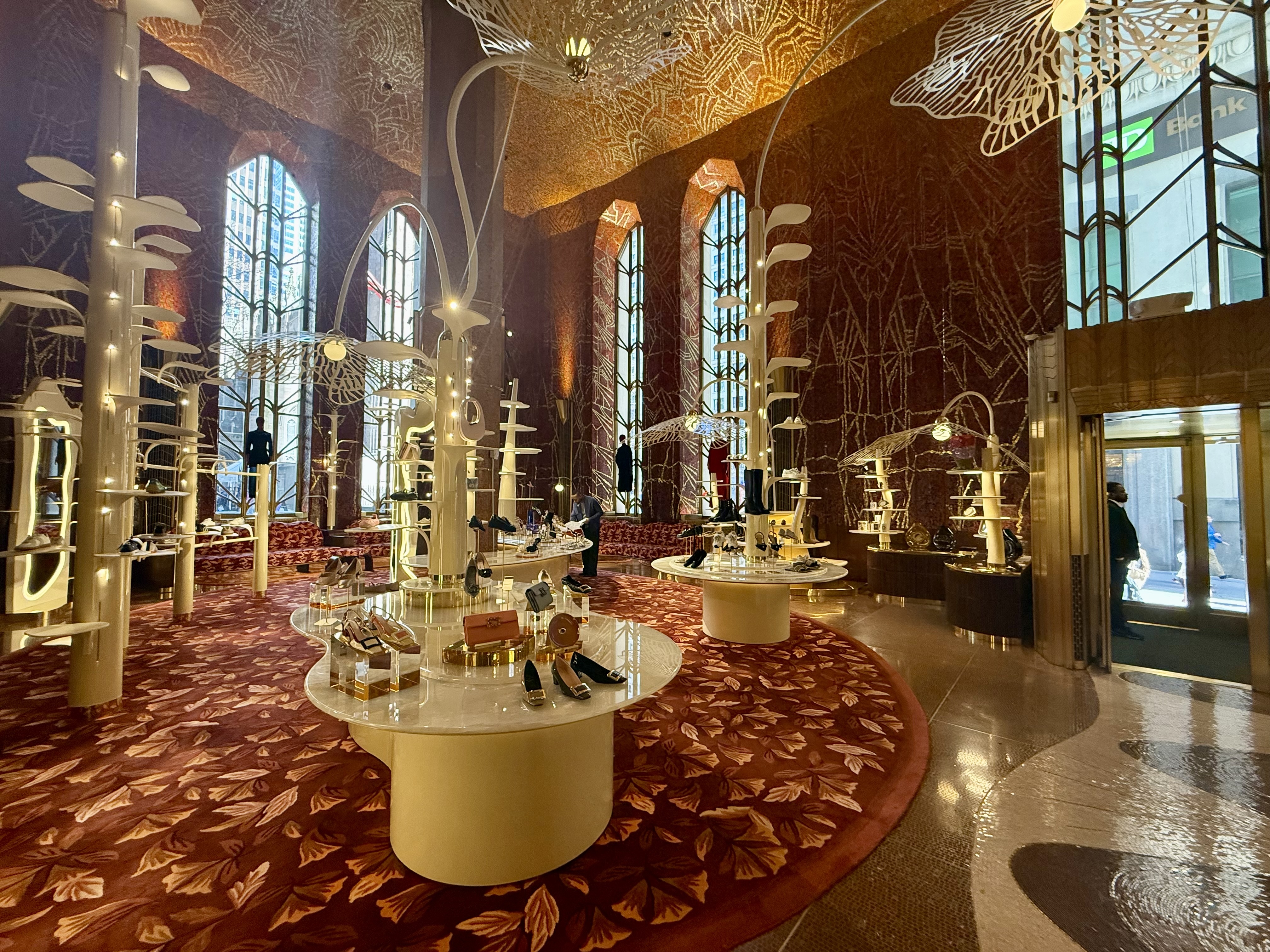
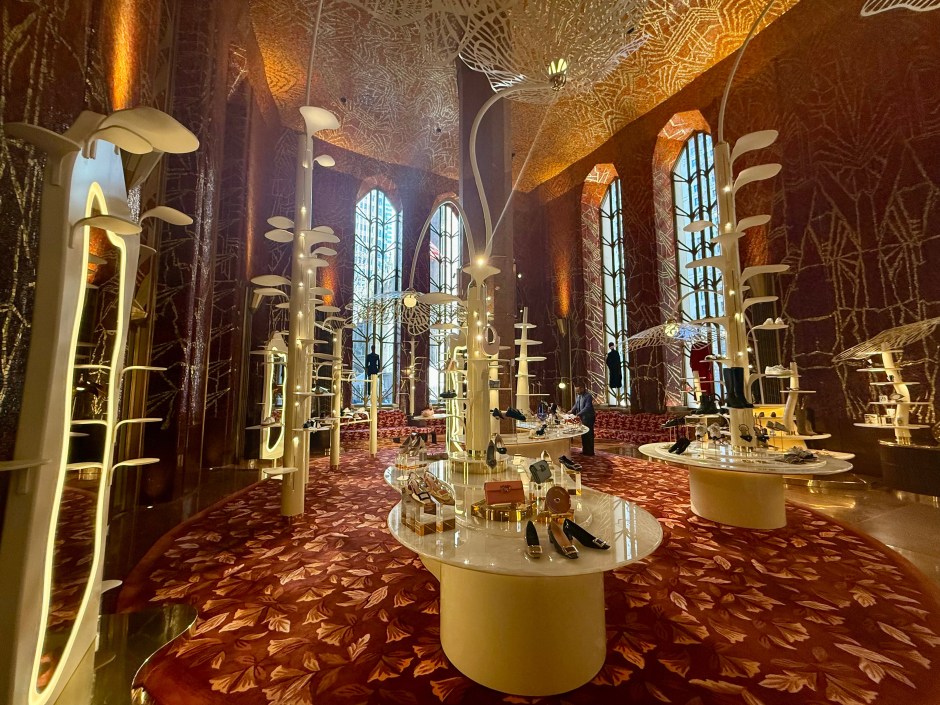
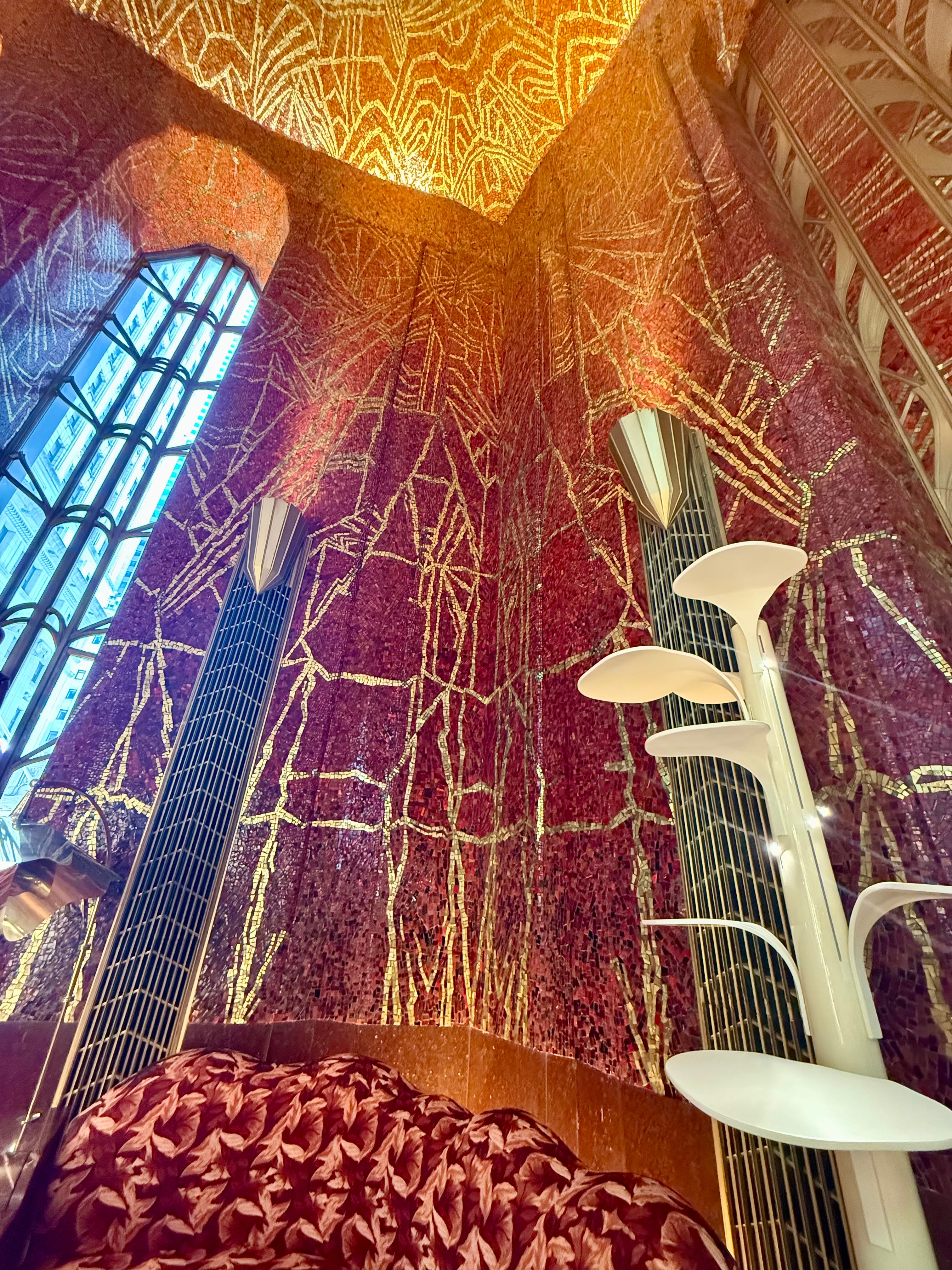
The Red Room, the interior of which is now a New York City Historic Landmark (in addition to the entire exterior of One Wall Street), was once a reception area for the Irving Trust customers. Because this was a private bank, most people would not have been able to enter, and the room was designed to impress its wealthy customers. There would have been no tellers, just some chairs and desks. The Red Room has ceiling heights varying from 30 to 37 feet, and the entire room is 100 by 40 feet. Walker and his associate Perry Coke Smith planned the decor of the room, with artist Hildreth Meière hired as a color consultant. The floor is covered in red terrazzo tiles created in Berlin under the supervision of Walker and Smith. The color scheme of the wall mosaic is red-on-blue which gradually gets lighter as it goes up to draw the eye to the gold-on-black on the ceiling.

The Red Room at Printemps is a functioning shoe store, and I dare you to find a more extraordinary one. Photographs truly don’t do it justice. If you entered Printemps NYC from Wall Street and experienced the Red Room first, the rest of the store – while gorgeous – would be anticlimactic after such opulence. If you visit on a weekend or later in the day, you might actually have to wait on a line to get in and you will see plenty of people taking photos and posing in the entire store, but particularly in the Red Room. My recommendation, if you possibly can, is to get there very soon after opening (hours are 10am-7pm daily) on a week day to avoid crowds. If you go early, it will be easier to enjoy the cafe as well (the cafe opens earlier most days, at 8am). Going later in the day would be an alternate plan, and enjoy a drink at one of the bars for the most elegant happy hour. The Red Room bar is open later, until 11:00pm, and the restaurant Maison Passerelle is open 5pm-10:30pm.

As anyone who has been to Paris knows, there is a particular quality to walking through the city – every turn seems to bring another view more charming than the one before. I found wandering Printemps NYC to be a similar experience – an immersive escape to Paris just off the bustling streets of my beloved NYC.

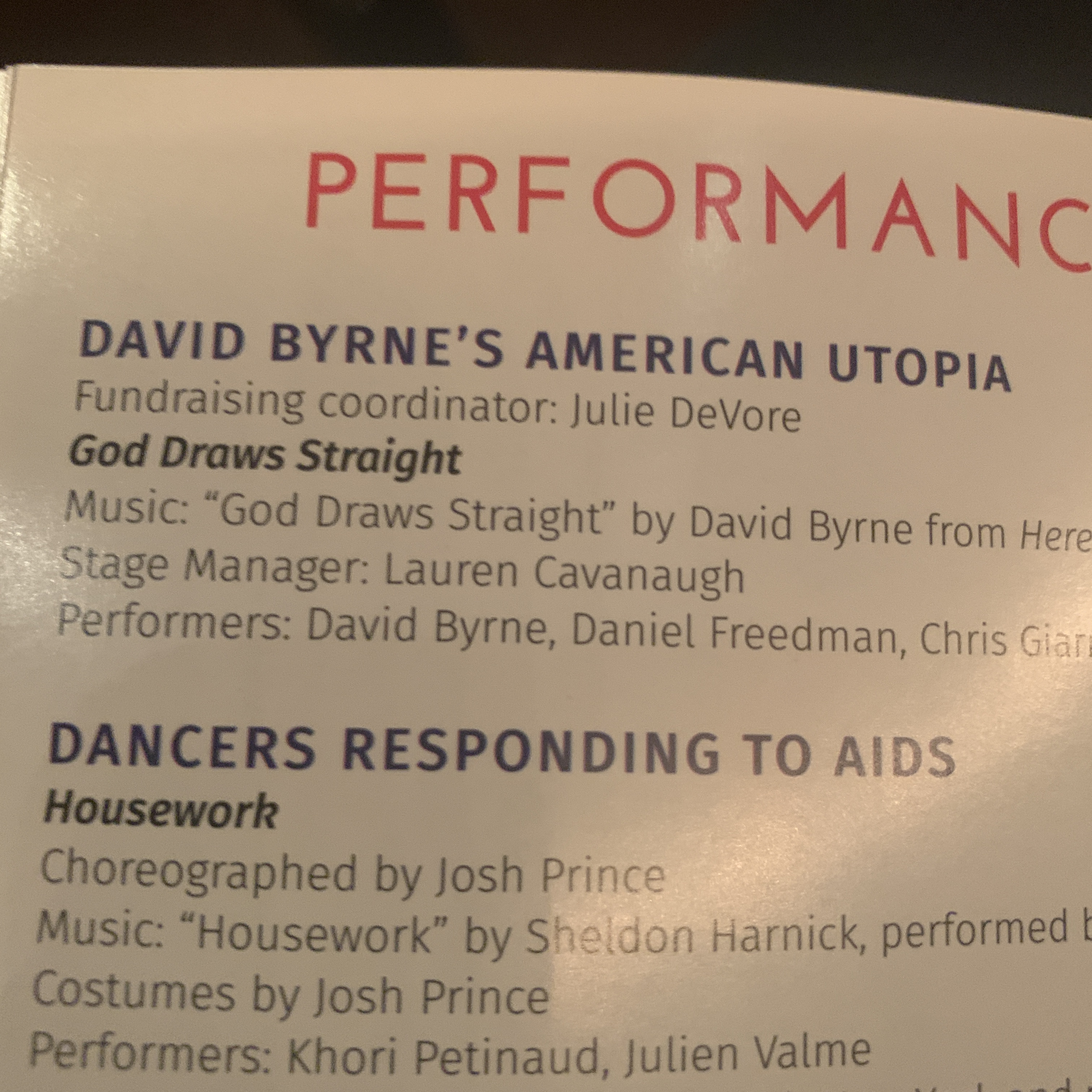
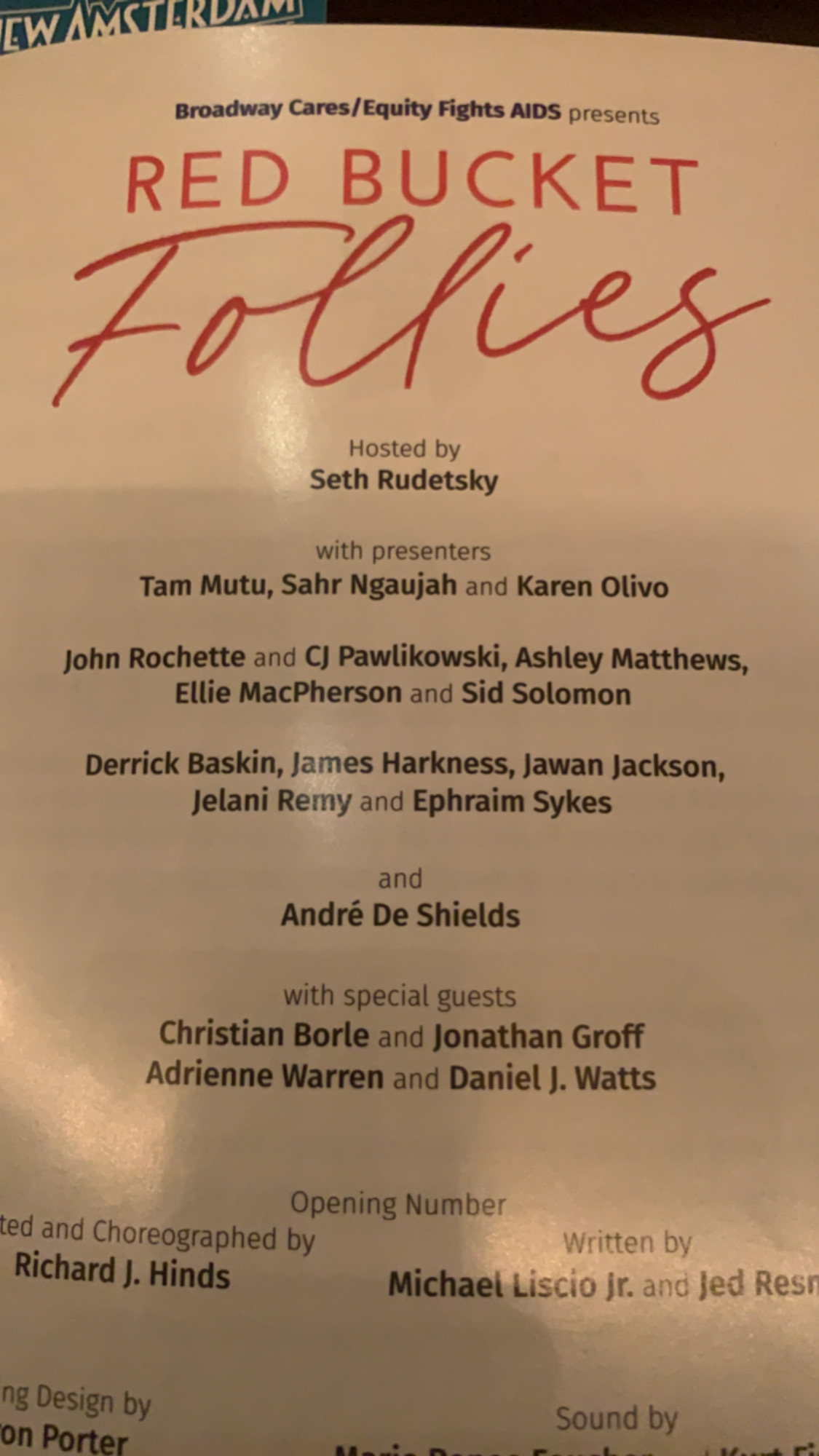
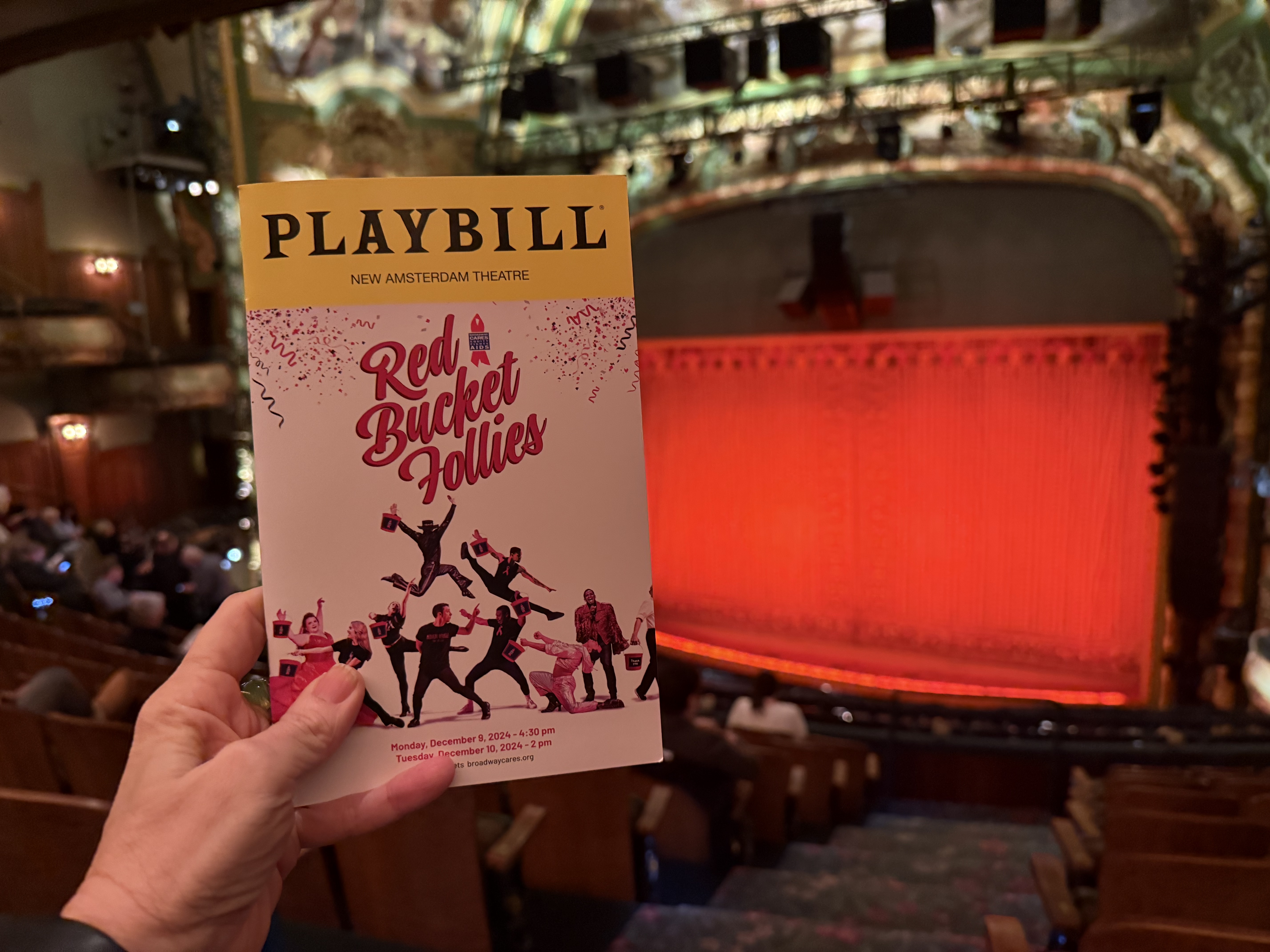
Red Bucket Follies

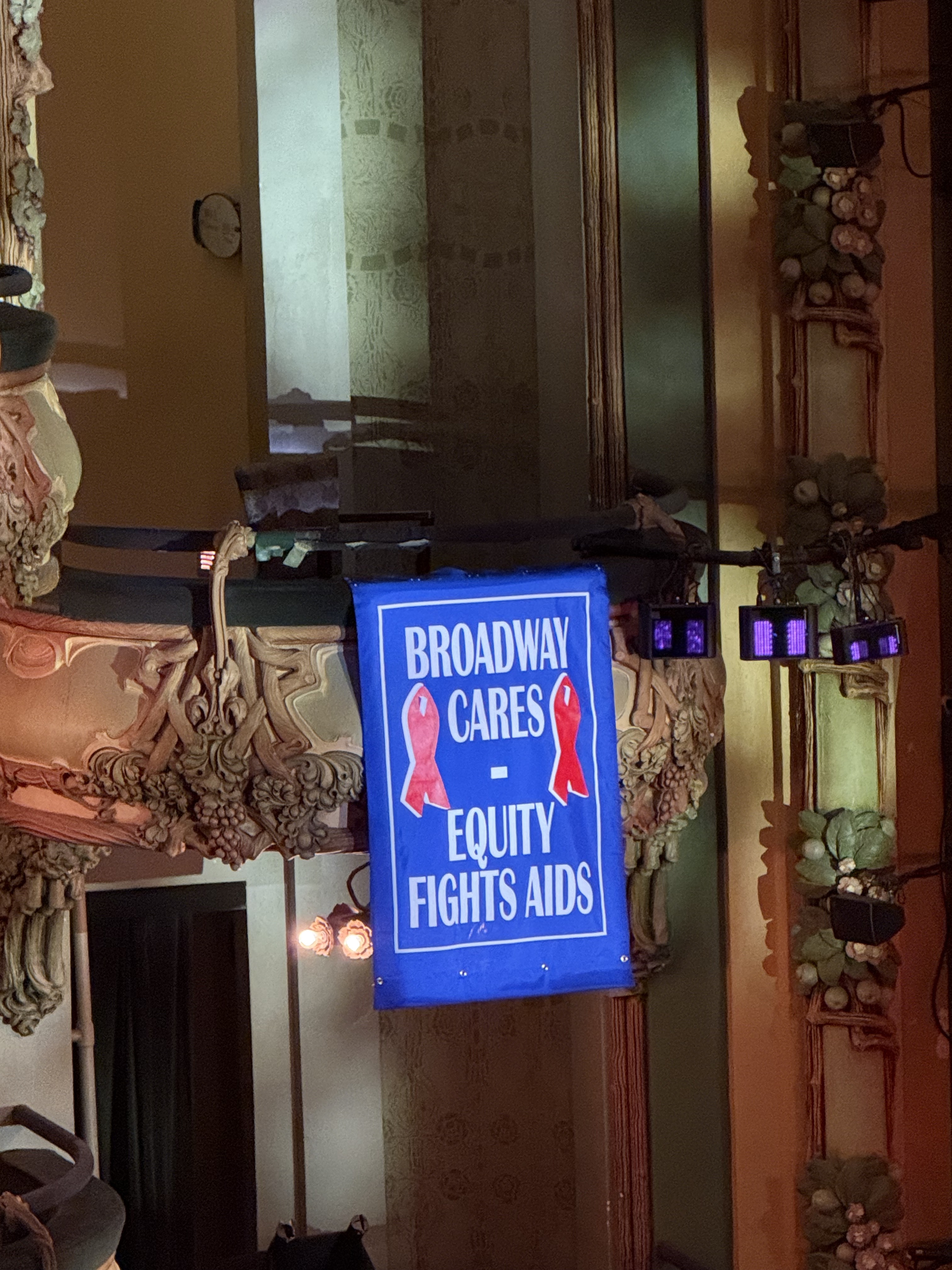
If you have attended a Broadway show in the spring or late fall, you may have experienced an appeal to donate to Broadway Cares/Equity Fights AIDS (BCEFA) after the performers have received applause during their bows. Shows still in previews don’t generally participate, but nearly all shows that have opened do. Often you can purchase Playbills or window cards signed by the entire cast in exchange for a donation to BCEFA, and sometimes there are special items auctioned off to the bidder donating the highest amount. I once watched Glenn Close auction off the false eyelashes she had worn during the last revival of Sunset Boulevard (not to be confused with the currently running Sunset Blvd!), along with a photo opportunity with her, for over $10,000. Daniel Radcliffe has a history of raising quite a lot for BCEFA auctioning things like the literal shirt off his back (in Equus) and a piece of paper he had typed on during the performance (in Merrily We Roll Along). But always during these times of year there are people waiting as you exit with red buckets to receive donations of any size (as I have heard many times, “no donation is too small . . . and no donation is too large!”). They now also have QR codes on the buckets to scan and donate through in these relatively cash-free times.

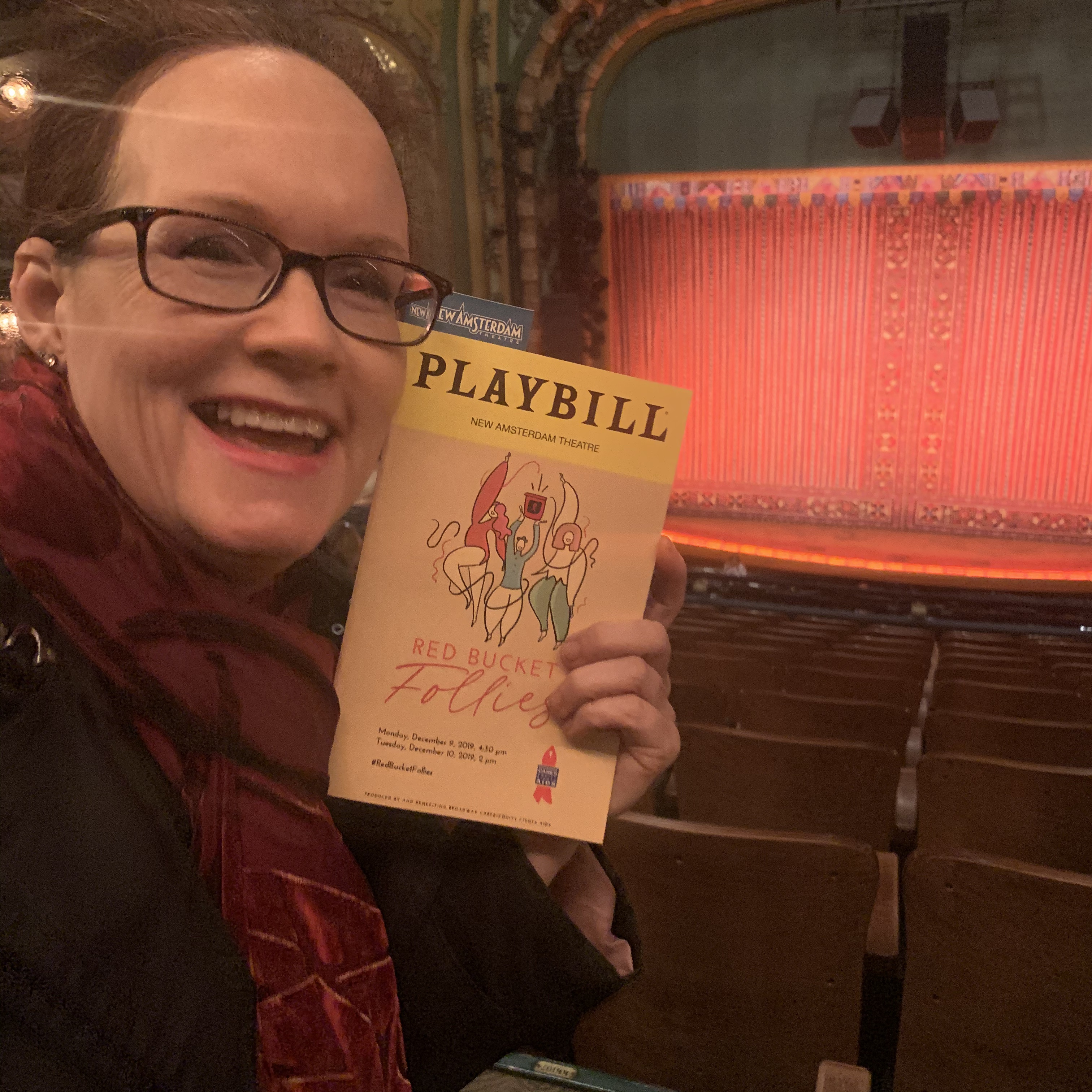
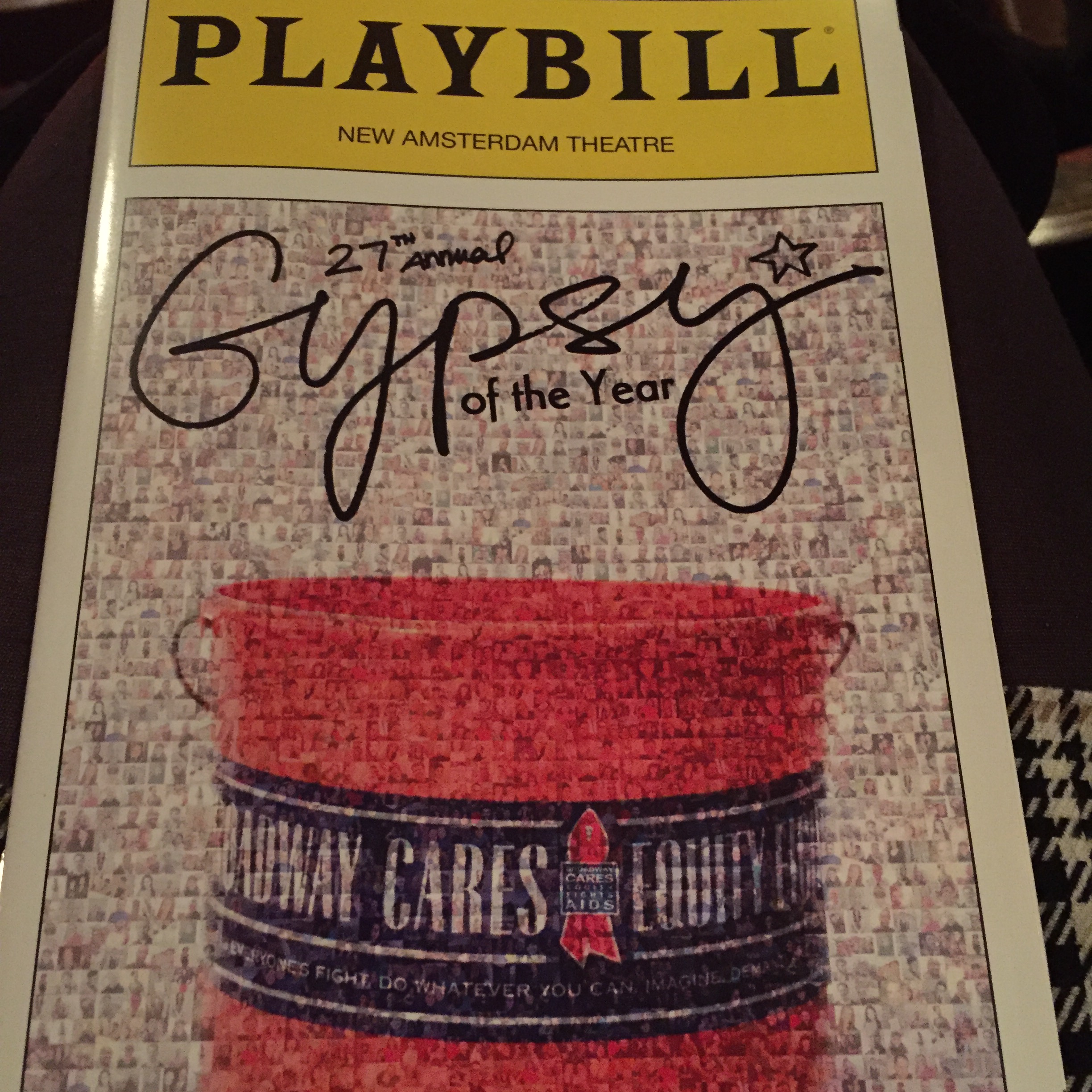
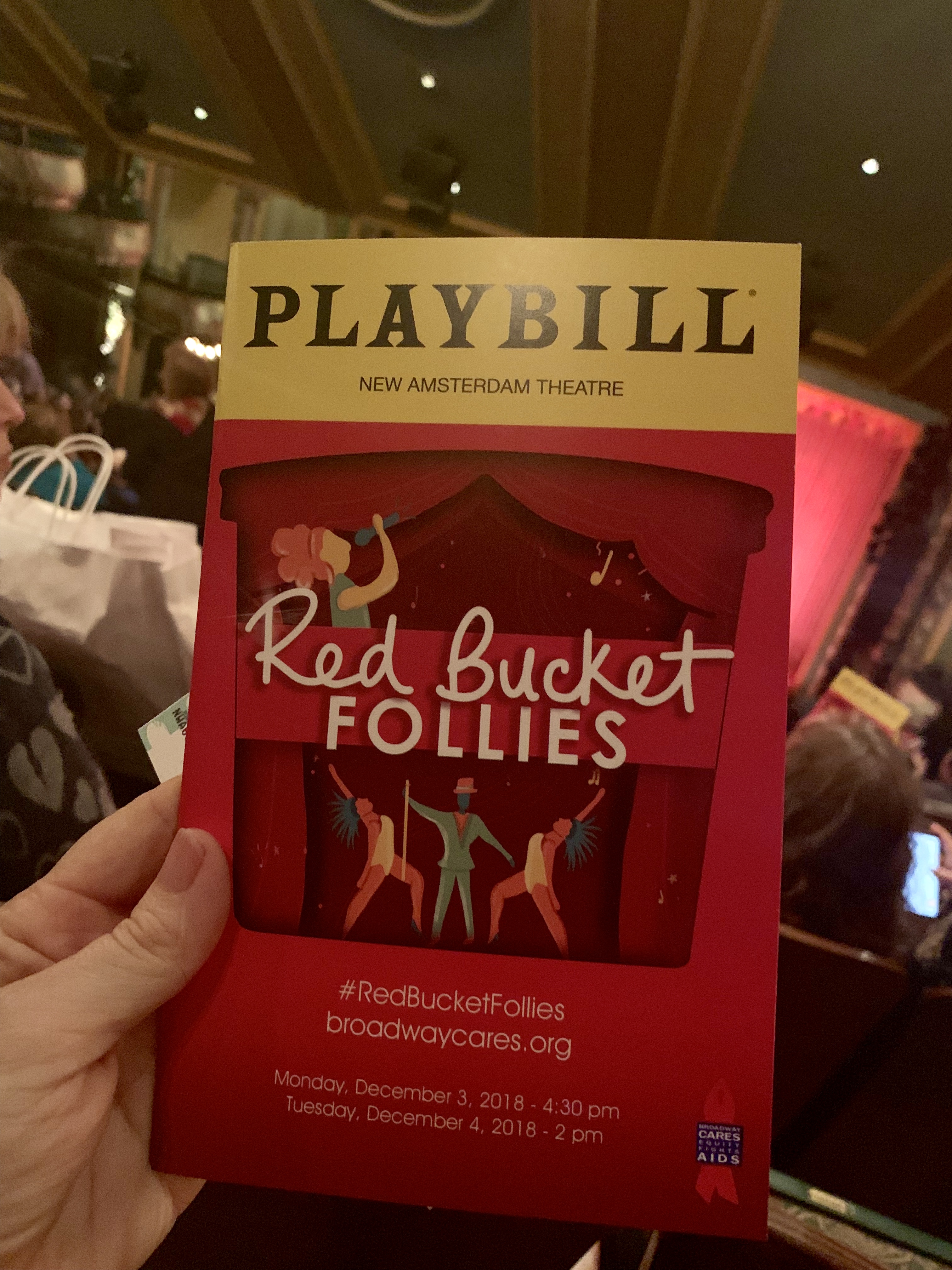
These fund-raising drives were started in 1987, as AIDS was ravaging the theatre community and so many brilliant artists needed assistance with medical costs and social services. Much of the money raised now goes to the Entertainment Community Fund to fund The Friedman Health Center for the Broadway community, the HIV/AIDS Initiative, and The Phyllis Newman Women’s Health Initiative, but also expands to provide grants to AIDS and social service organizations all over the country. With these drives occurring roughly around the Easter season and just before Christmas, BCEFA has held revues since 1989 at the end of each round of fund raising to announce the shows that have raised the most money. In addition, shows that choose to can also perform a short musical skit in front of the Broadway community and a panel of celebrity judges in hopes of winning bragging rights by placing in the top three. The spring drive led to one show being called the Easter Bonnet Competition (and each musical skit ended with one performer wearing an elaborately themed hat) and the one in early December was called Gypsy of the Year until being renamed Red Bucket Follies in 2022. As of this year, Red Bucket Follies was the only show being put on (despite the drives still being twice a year), but perhaps Easter Bonnet will come back!

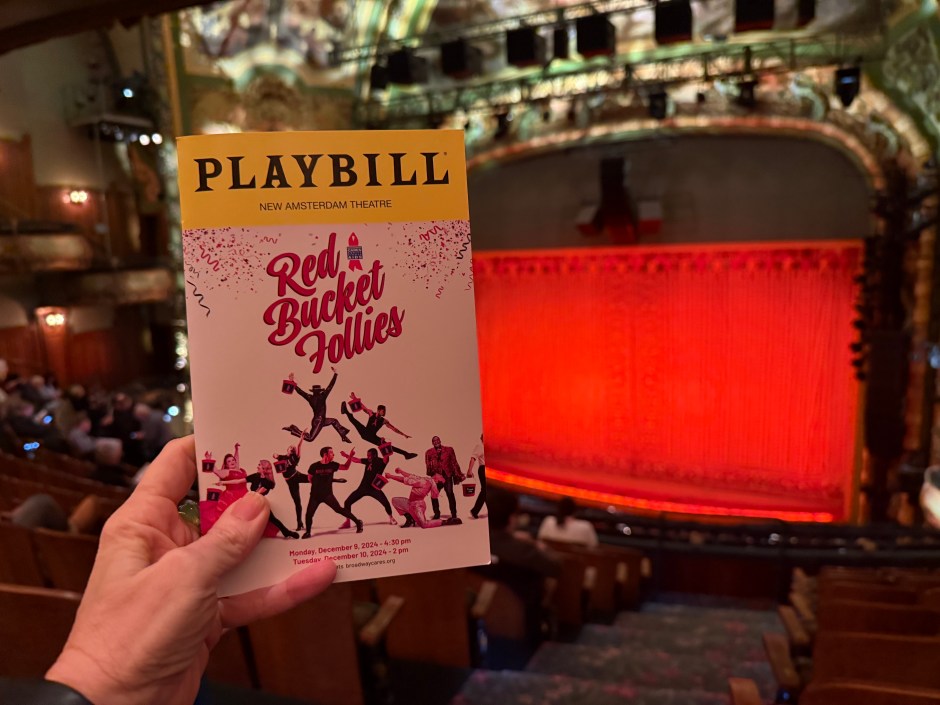
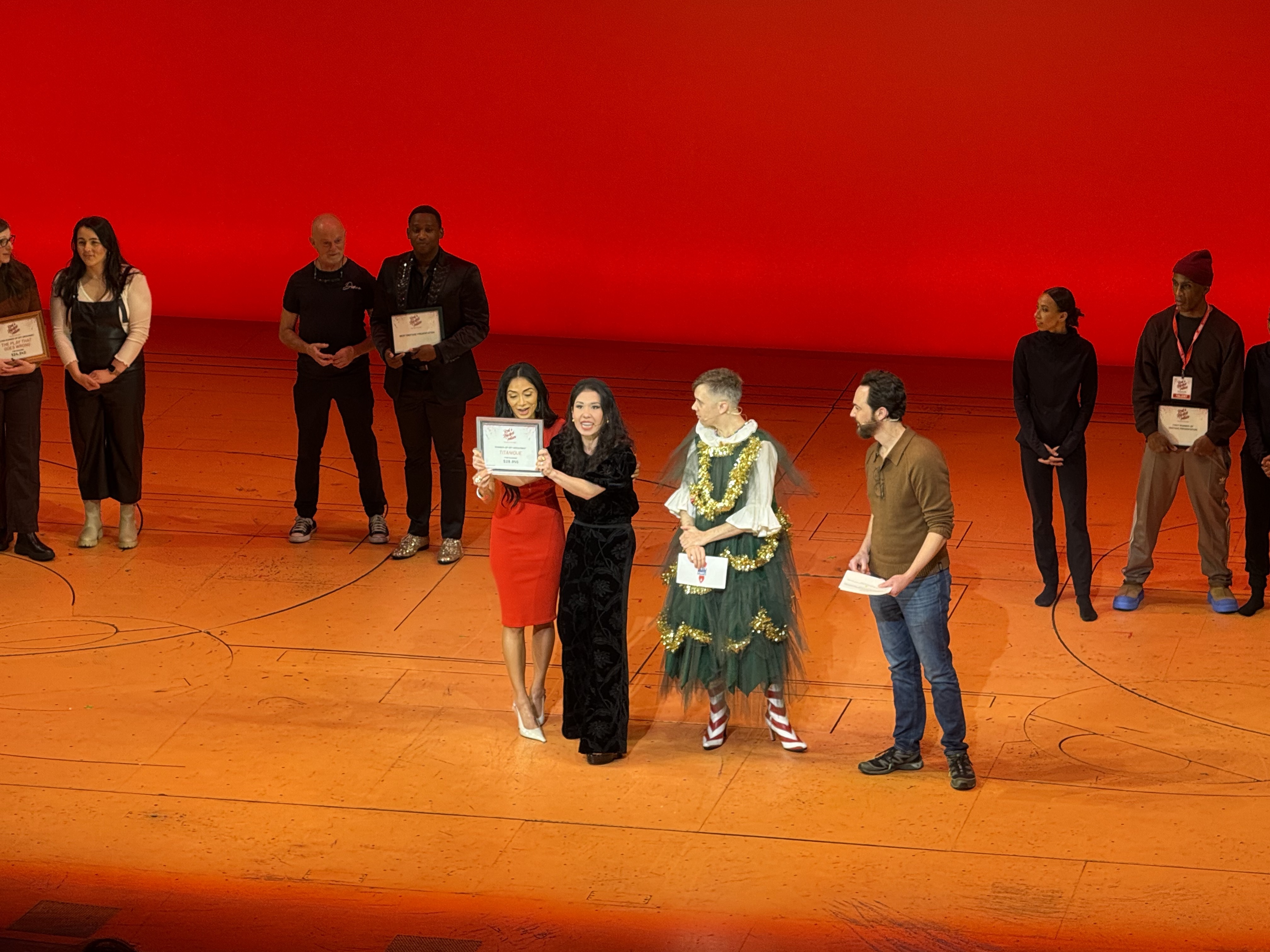
I have been going to these events for years now. The audience is largely made up of the Broadway community, but for a donation to BCEFA some additional tickets are available to the regular public. Generally there are two performances, one on a Monday at 4:30 (think of this as a dress rehearsal, and a way for the judges to decide which skits they plan to award so that there are no delays the next day) and the finale the next day at 2PM (earlier since most attending and performing have a show that night). At the Tuesday performance the fund raising and musical skit winners are announced, as well as the total raised by everyone during the drive.

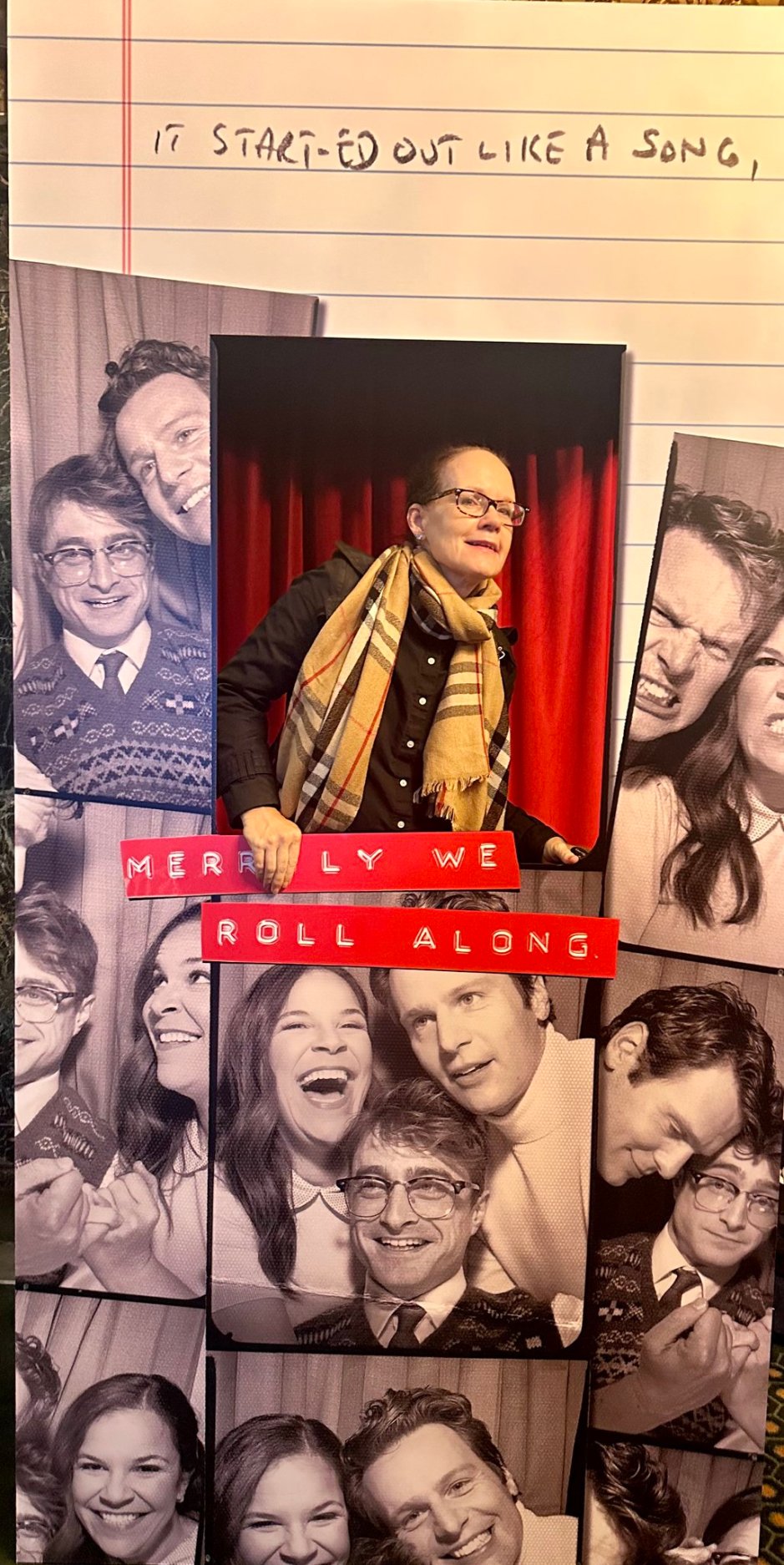
One of the great things about going to these is being at an insider Broadway event where the more shows you have seen, the better you will enjoy the musical skits. For instance, I remember when the original cast of Hamilton retold the story of “Demon Barber Sweeney Todd” to the tune of “Alexander Hamilton.” When Phantom was about to close, cast members going back decades had a skit set in a nursing home for Broadway performers. You also see Broadway performers interact and introduce different skits (above see Daniel Radcliffe and Jonathan Groff from Merrily We Roll Along at the 2023 Red Bucket Follies). The BCEFA YouTube channel has videos from many of the performances over the years.

Often the musical skits are funny (I remember well the opening number honoring the covid testing teams at the first Follies following the covid shutdown – including dancing nasal swabs), but sometimes are quite touching.

The photos above show you the judges and which shows participated in the Red Bucket Follies in December of 2024.

The final total and the shows that had raised the most for the fall drive in 2024 were announced by Jim Parsons (Our Town), Cole Escola (Oh Mary!), Ruthie Ann Miles (McNeal) and Nicole Scherzinger (Sunset Blvd).

The total for the fall drive in 2024 was over $5.3M! As someone who truly loves Broadway theatre, BCEFA is one of my favorite charitable organizations (every year I send their cards, which also represent a donation, to family and close friends). There are other shows during the year to raise money for BCEFA (for example, Broadway Bares, if you are feeling adventurous) and other ways to support BCEFA (they often have Broadway house seats for even sold-out shows available if you are willing to donate twice the face value of the ticket – better than giving the money to a scalper). If you happen to be at a Broadway show during the fund raising periods, please consider being generous. Every single person who participates in the BCEFA drive donates their time, both while collecting and for the Red Bucket Follies. Even the theatre space for Red Bucket Follies is donated by Disney Theatricals. And if you happen to be able to attend Red Bucket Follies next December, let me know – I’ll see you there!

Thoughts on the Tony Awards 2024

On June 16th, the 77th annual Tony Awards will be awarded (and televised on CBS). The ceremony this year is at Lincoln Center for the first time and American Express will be holding a live simulcast at Damrosch Park just behind the David H. Koch Theatre where the awards will be given out (see here for more information about how to attend if this interests you). Two years ago I was fortunate enough to be able to attend the 75th annual Tonys in person at Radio City (see how I wrote up the experience here) but this year I will be watching on television as usual. The awards this year seem harder than ever to predict this very crowded season. Needless to say, with so many new productions, not everything could be nominated, and most musicals and plays rely on the publicity and the “stamp of approval” from the Tonys to fuel sales.

Best New Musical

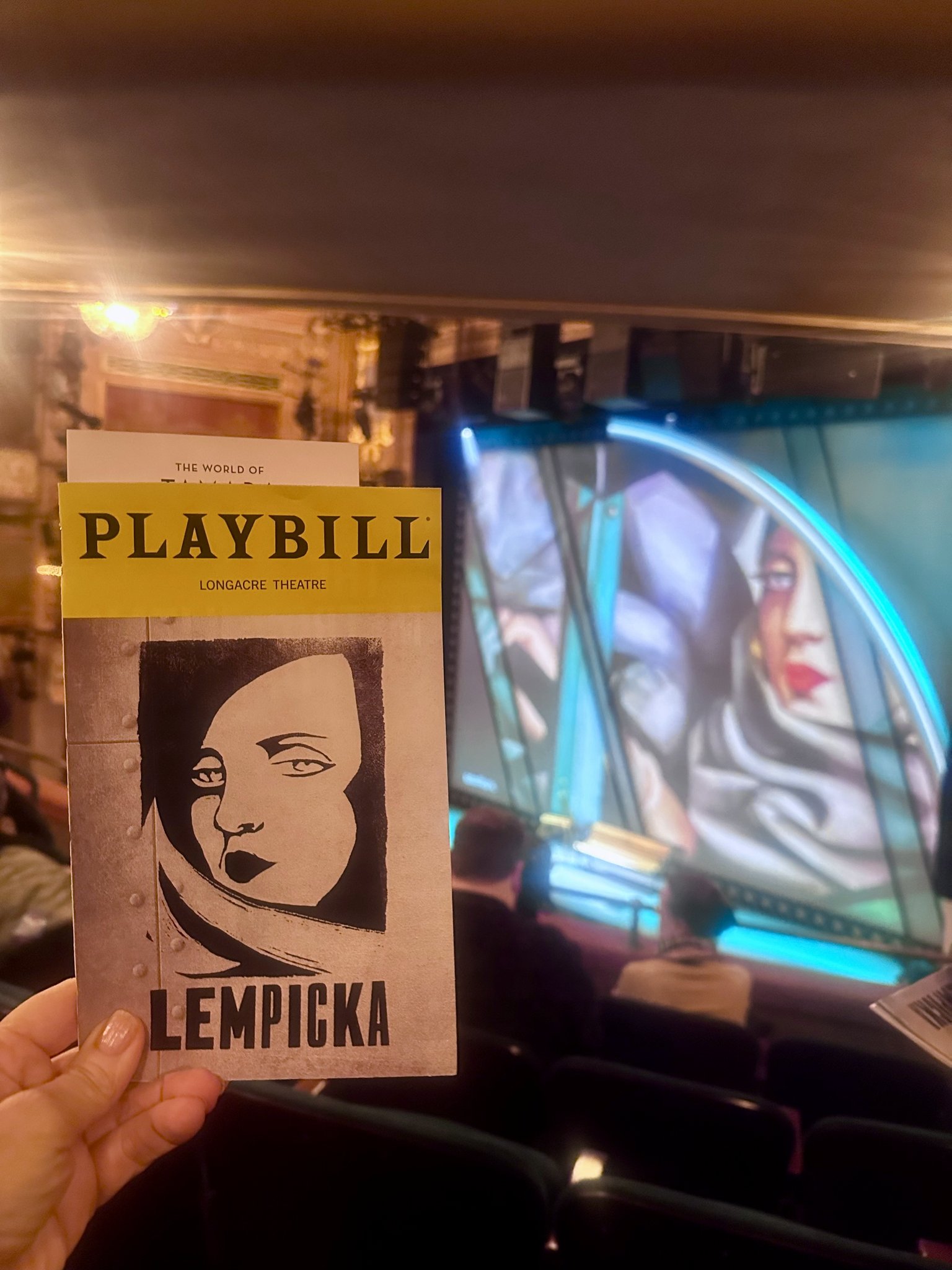
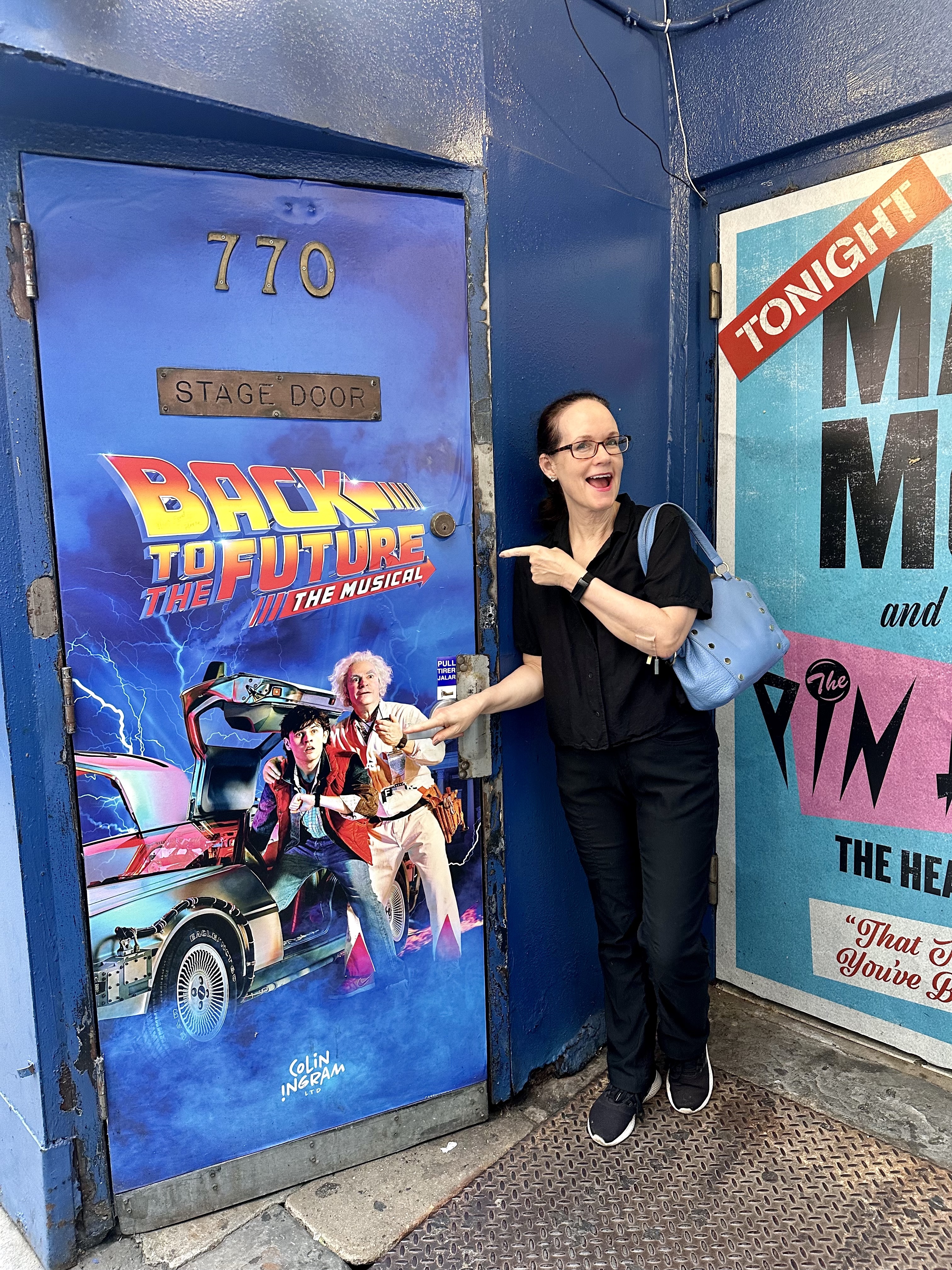
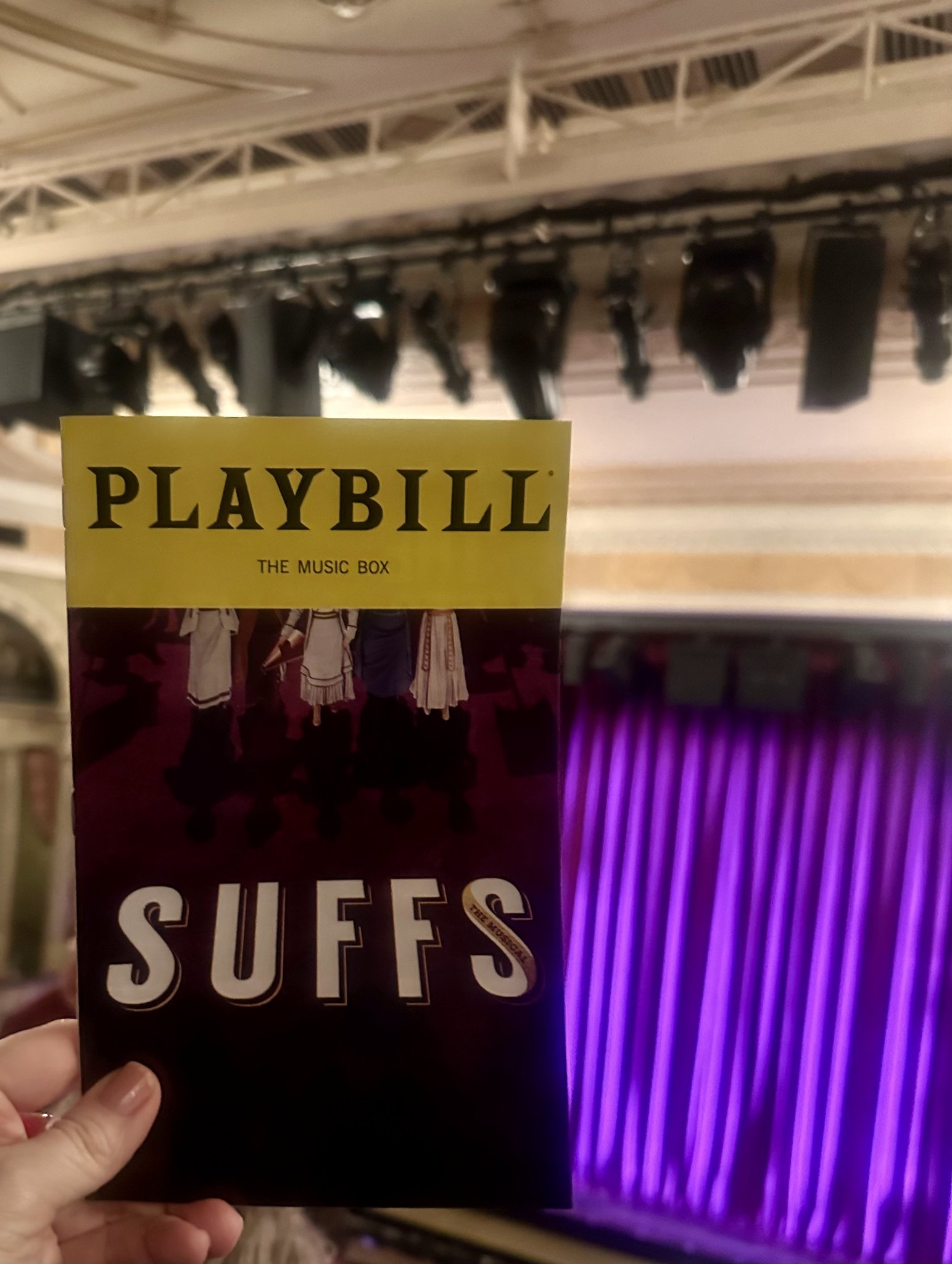
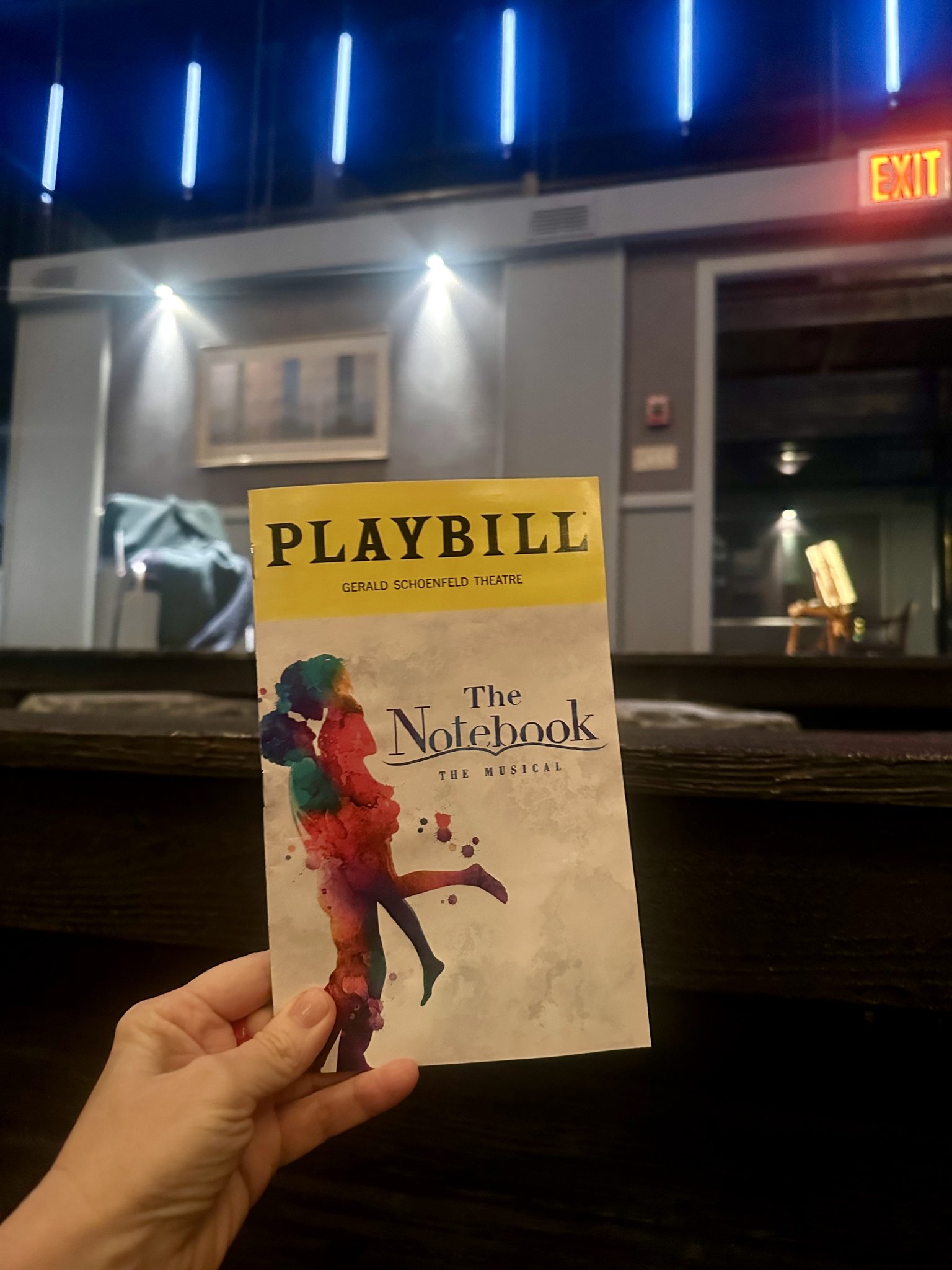
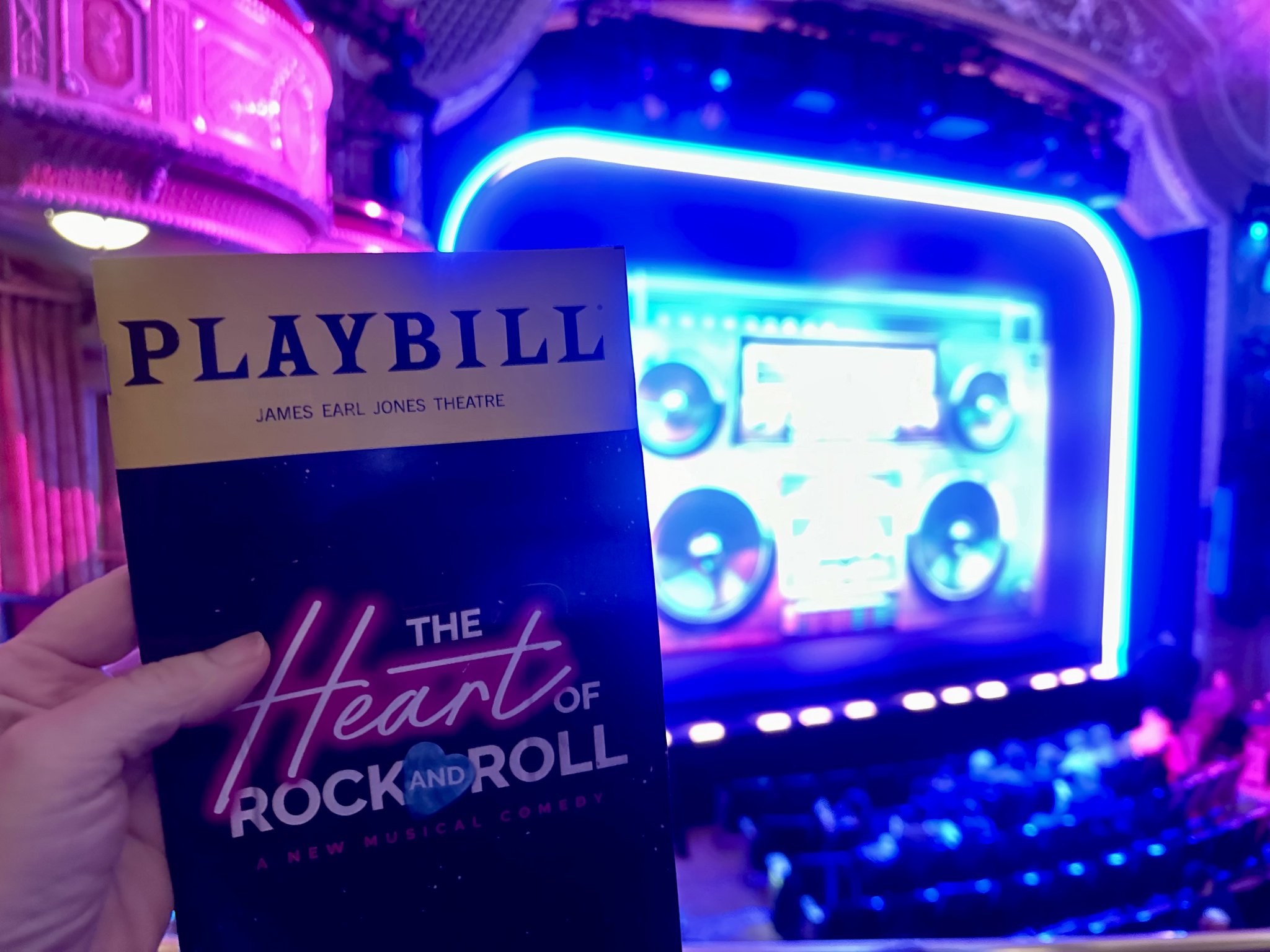
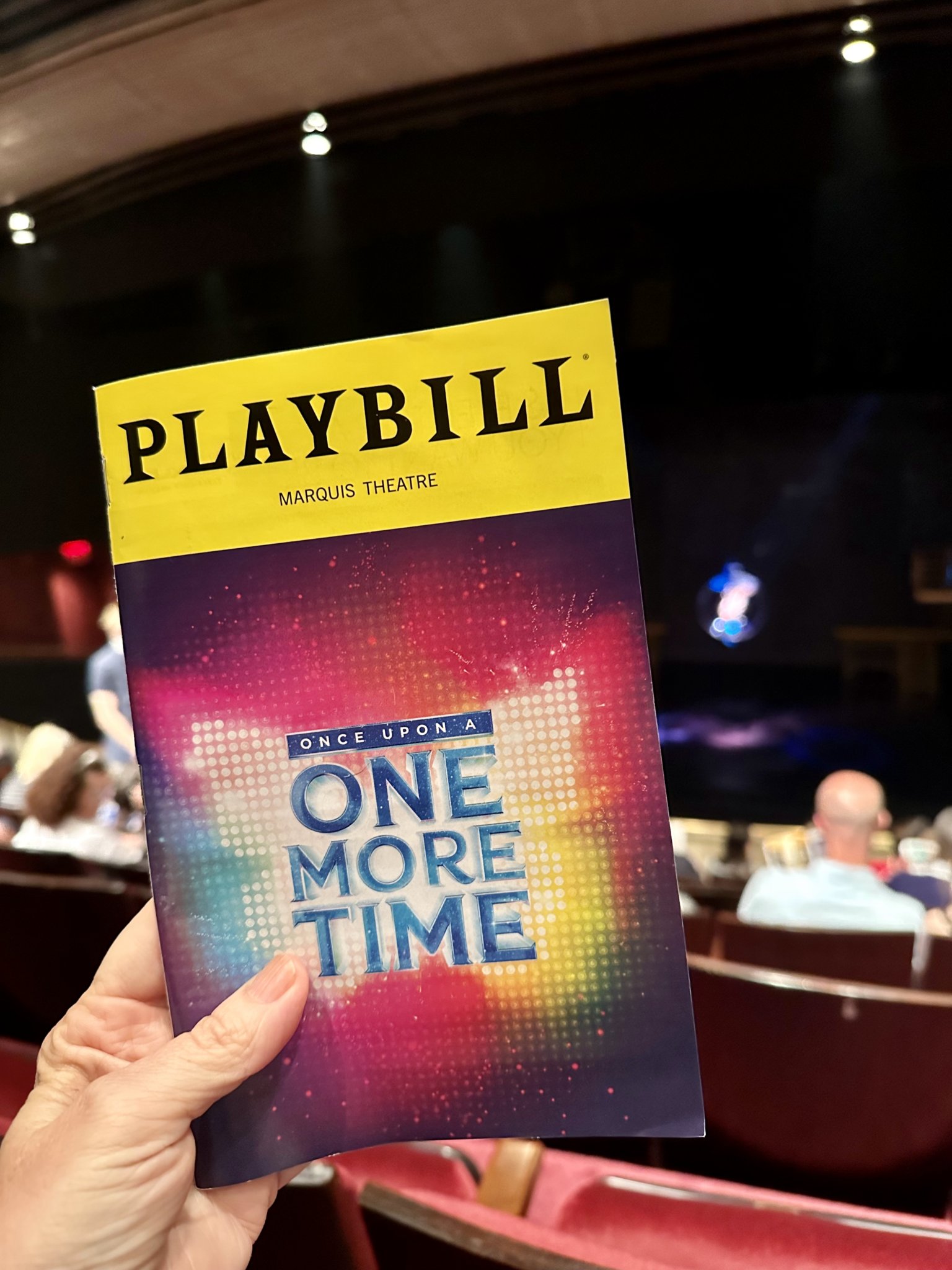
This was an unusually busy season for new musicals on Broadway, which is great for musical lovers – but very tough on producers as there was a lot of competition for the ticket-buying public. Six new musicals have already opened and closed this season:  Once Upon a One More Time, Here Lies Love, How to Dance in Ohio, Harmony, Lempicka, and Days of Wine and Roses. From earlier this season, only Back to The Future (which opened last July) is still running, with most new musicals on Broadway having opened in a very busy spring season. So the eligible original musicals were Back to the Future, Days of Wine and Roses, Harmony, Hell’s Kitchen, Here Lies Love, How to Dance in Ohio, Illinoise, Lempicka, Once Upon a One More Time, Suffs, The Great Gatsby, The Heart of Rock and Roll, The Notebook, The Outsiders, and Water for Elephants. I saw all of them, and correctly predicted which five would be nominated (which is not the same as saying I agreed with the result). The five are:

“Hell’s Kitchen”

“Illinoise”

“The Outsiders”

“Suffs”

“Water for Elephants”

I have to say, this is a year where any one of these could win. The best reviewed by the New York Times were Illinoise, Hell’s Kitchen, and Water for Elephants (all “Critic’s Picks”) but Suffs and The Outsiders are both nominated for best original score as well as best new musical. Illinoise has had perhaps the most rave reviews across the board, but since it is a very unique Broadway musical (the story being told entirely through Justin Peck’s dance and a group of instrumentalists and singers, all based on Sufjan Stevens’ 2005 album) it may be hard for Tony voters to award it best in this category (although I expect it will get best choreography) when it is not nominated for Book or Score. However, Hell’s Kitchen had the most nominations (13; tied with the new play Stereophonic in number of nominations this year).

Best Musical Revival

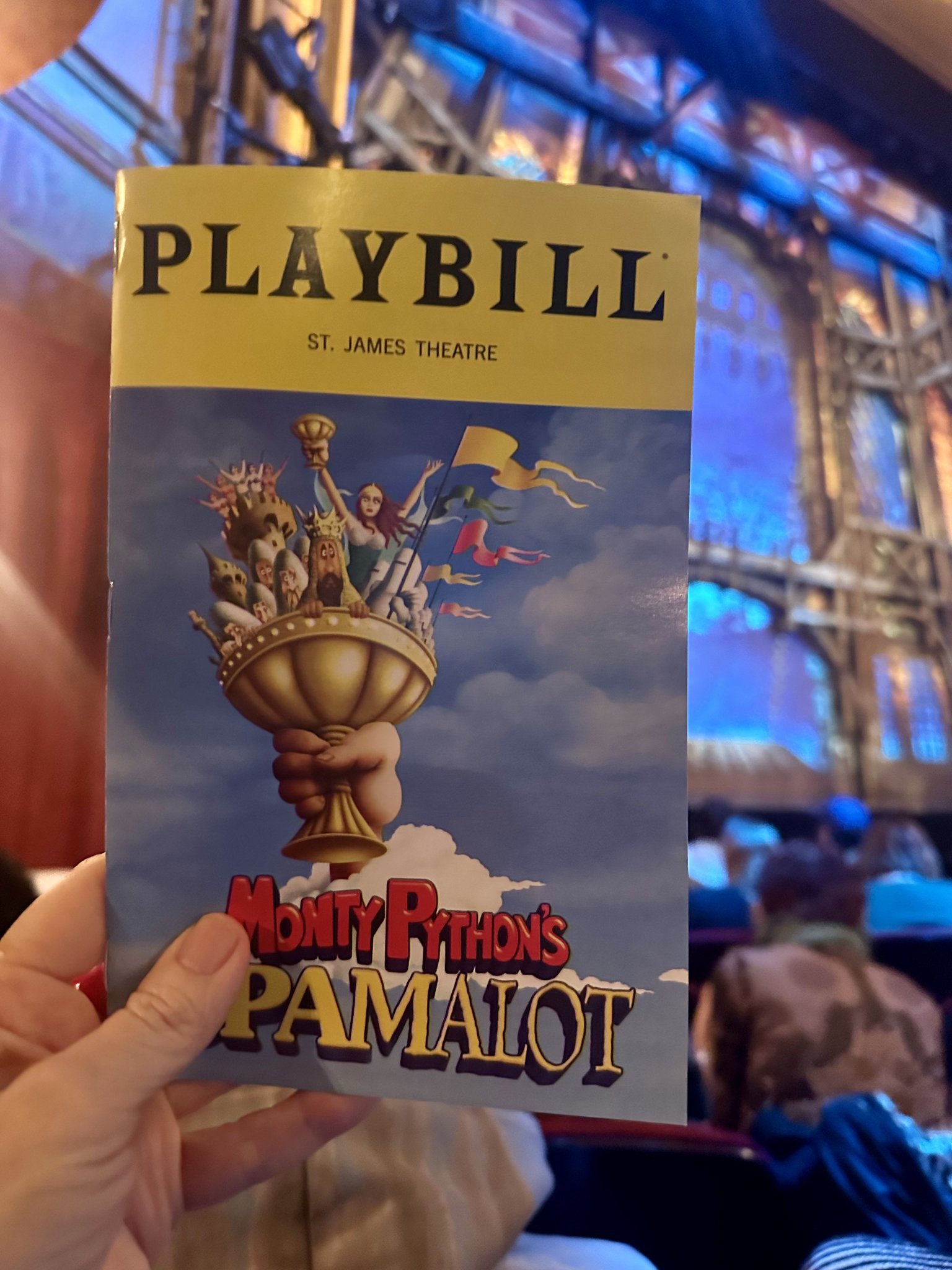
The eligible musical revivals were Cabaret, Gutenberg, Merrily We Roll Along, Spamalot, The Who’s Tommy, and The Wiz. Only four were nominated:

“Cabaret”

“Gutenberg! The Musical!”

“Merrily We Roll Along”

“The Who’s Tommy”

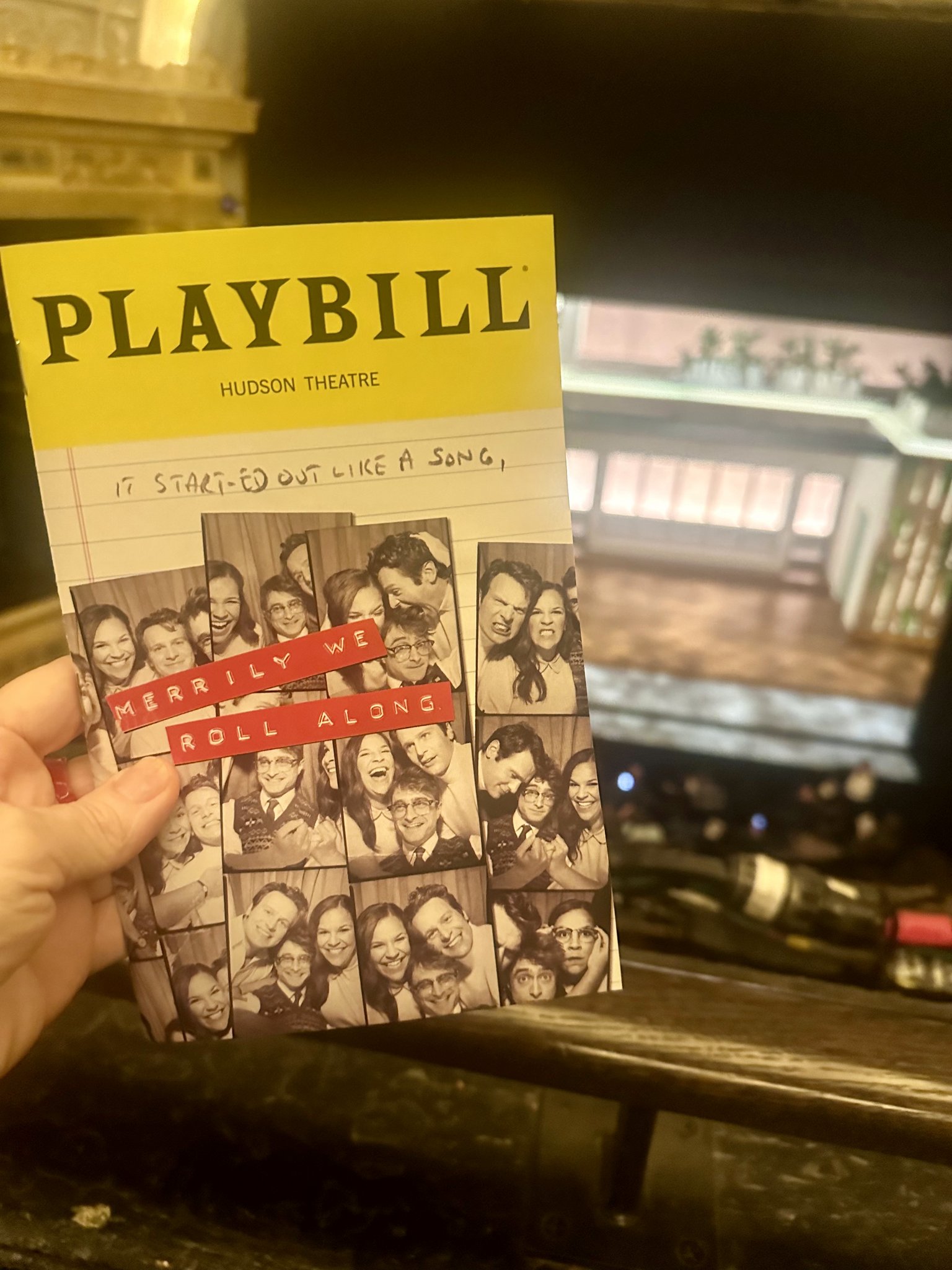
This category definitely comes down to two productions, the transfer from the West End of Rebecca Frecknall’s Cabaret, starring Eddie Redmayne, and the smash hit revival of Merrily We Roll Along, a musical once felt to be Sondheim’s great flop, but transformed by the direction of Maria Friedman and the performances by Jonathan Groff, Daniel Radcliffe, and Lindsay Mendez. The Cabaret revival has not been received as well on Broadway as it was on the West End, so I would expect Merrily to take this award. The same goes for Leading Actor in a Musical – I would be surprised (and very very disappointed) if Jonathan Groff does not win this category over Eddie Redmayne. I love The Who’s Tommy, by the way, but don’t expect it to win.

Best New Play

The nominees for best new play are:

“Jaja’s African Hair Braiding”

“Mary Jane”

“Mother Play”

“Prayer for the French Republic”

“Stereophonic”


I will be very surprised if Stereophonic doesn’t win this category. It’s a “play with music” (and in fact, it is nominated for best original score, which is unusual but not without precedent) by David Adjmi, about a rock band in the 1970s recording an album. It’s over three hours long, takes place entirely in a recording studio with no change of sets, and yet is completely riveting.

Best Play Revival

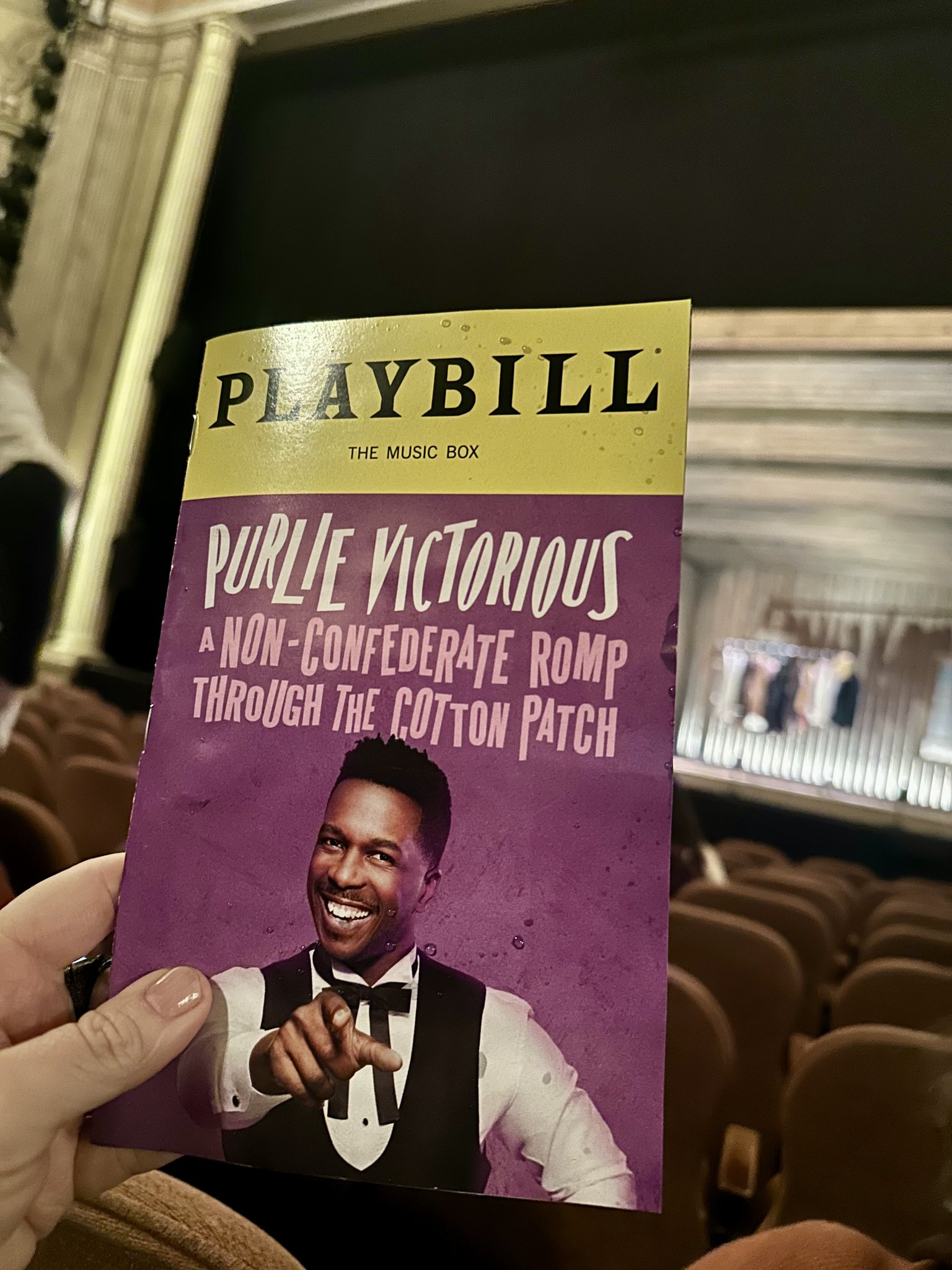
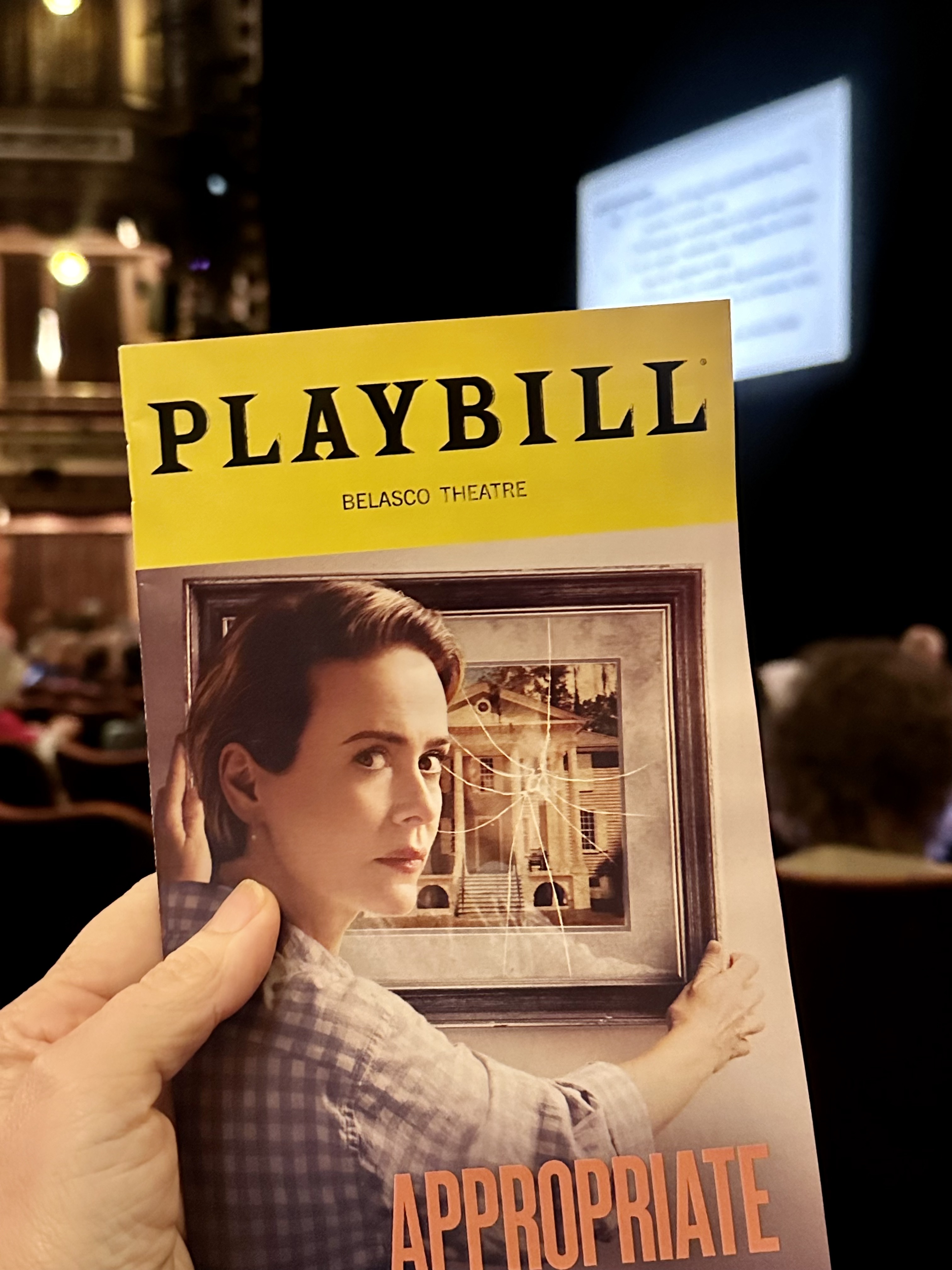
All three of the nominees for best revival of a play are excellent. They are:

“Appropriate”

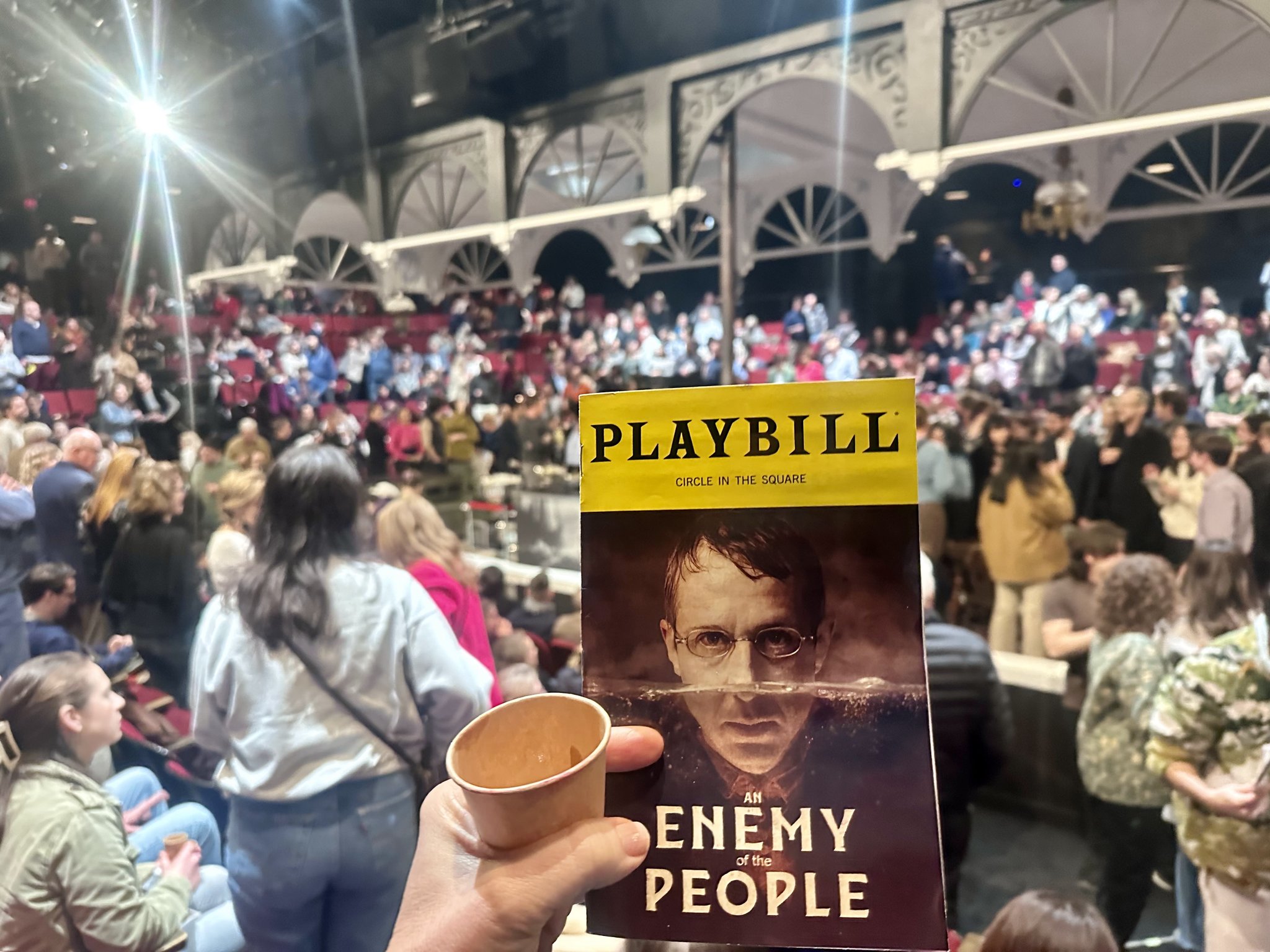
“An Enemy of the People”

“Purlie Victorious”

Despite the strength of all three of these revivals, I would be surprised if Appropriate did not win this category (and I think Sarah Paulsen is a lock for Best Lead Actress in a Play despite being up against Jessica Lange in Mother Play).

Other thoughts

This season not only had a great number and variety of new productions, there were many extremely innovative sets. The category of best scenic design of a musical had seven nominees (for The Outsiders, Hell’s Kitchen, Back to the Future, Lempicka, Water for Elephants, Here Lies Love, and Cabaret) and I was dazzled by all of them. I think the immersive quality of Here Lies Love, which has closed but I absolutely adored, was a stand out in a great field for me – but it is very unusual for shows that have closed to win even if nominated (Here Lies Love is also up for best original score, best choreography, and best sound design).

A shout out to the Director categories this year, with four out of the five musical directors and three out of the five play directors being women.

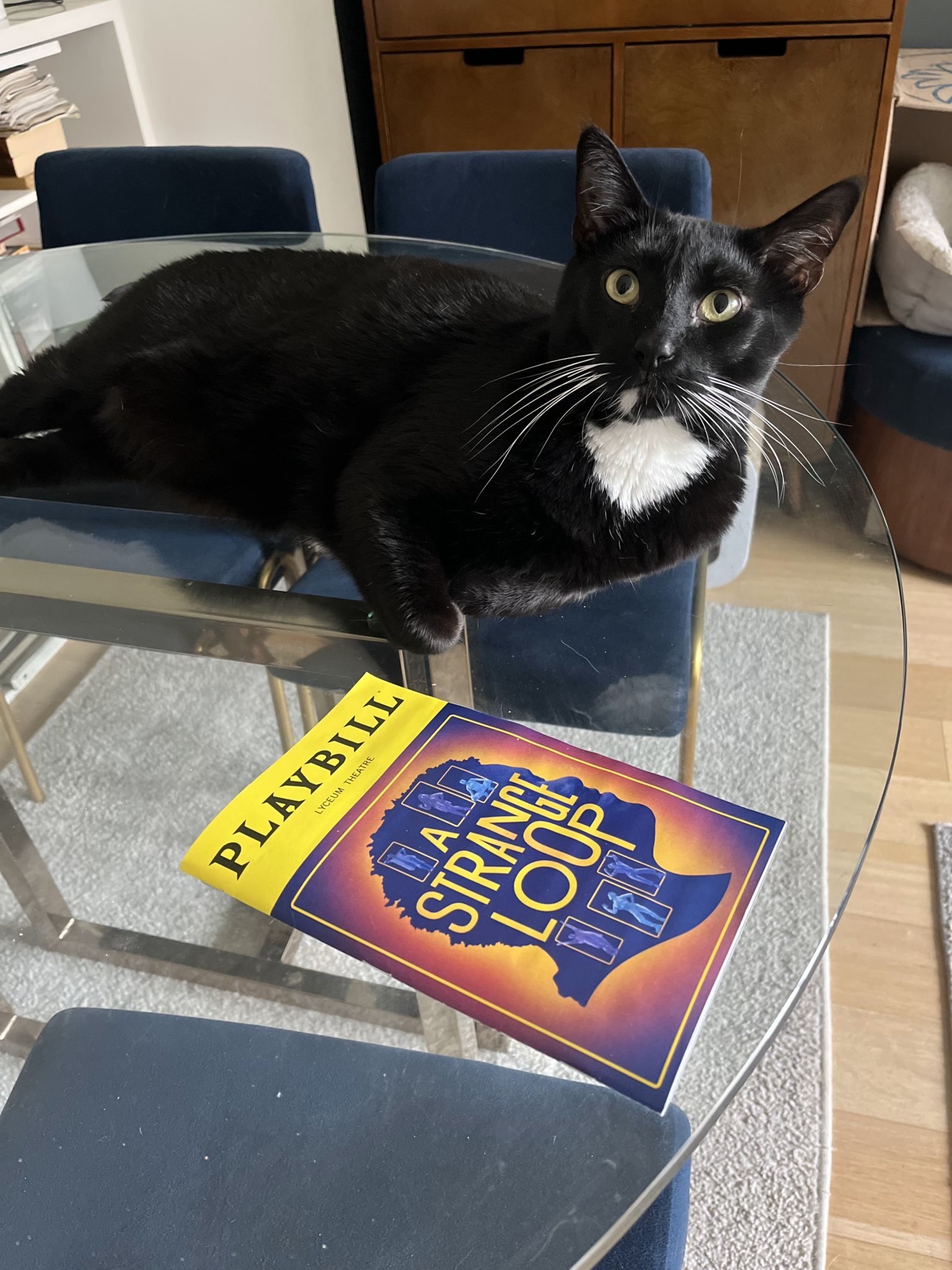
After the Tonys, I expect many shows with disappointing results will post closing notices, either right away or as the summer ends. Tony awards do not guarantee a long run (look at A Strange Loop from 2022) but the lack of awards can be the difference between enough ticket sales to keep going and a decision to close the show. What will keep Broadway alive is not only a wealth of plays and musicals in the pipeline but also the ticket-buying public out there to support them. Go see a Broadway show (or a ton of them!) and keep this very special art form thriving here in New York City.

Walking the length of Broadway – from Battery Park to the top of Inwood

I love walking, and especially walking in New York City, and have written about it often (see old posts here, here, here, and here – among many), and have even compared walking in NYC to walking in London and Paris (see it here) and described walking in the ultimate car city, Los Angeles (see it here). Soon I will be going on a very long walk – I plan to hike Mount Kilimanjaro in Tanzania with a family member (and will be writing about the preparation for that as well as – hopefully – an account of the trip afterwards). (POSTSCRIPT: read about the Kili Climb here, about preparation for it here, and the safari afterward here.) As part of my training as I headed into the final weeks before leaving, I recently did something I have wanted to do for a while – I walked the entire length of Broadway from Battery Park to the tip of Inwood, about 13 miles, with my fully loaded daypack for Kili (including 4 liters of water), wearing my hiking boots, etc. Here’s what my day was like!

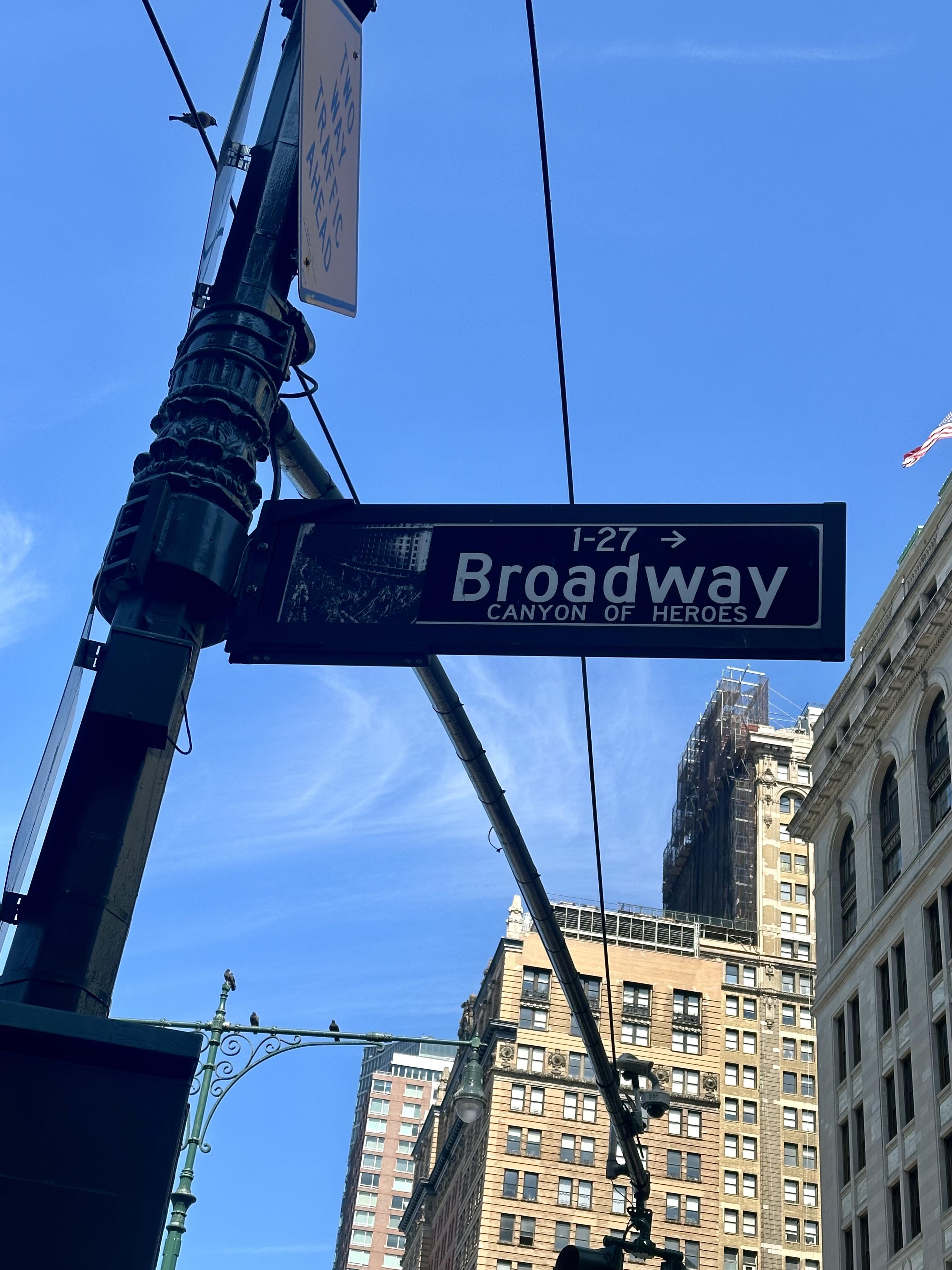
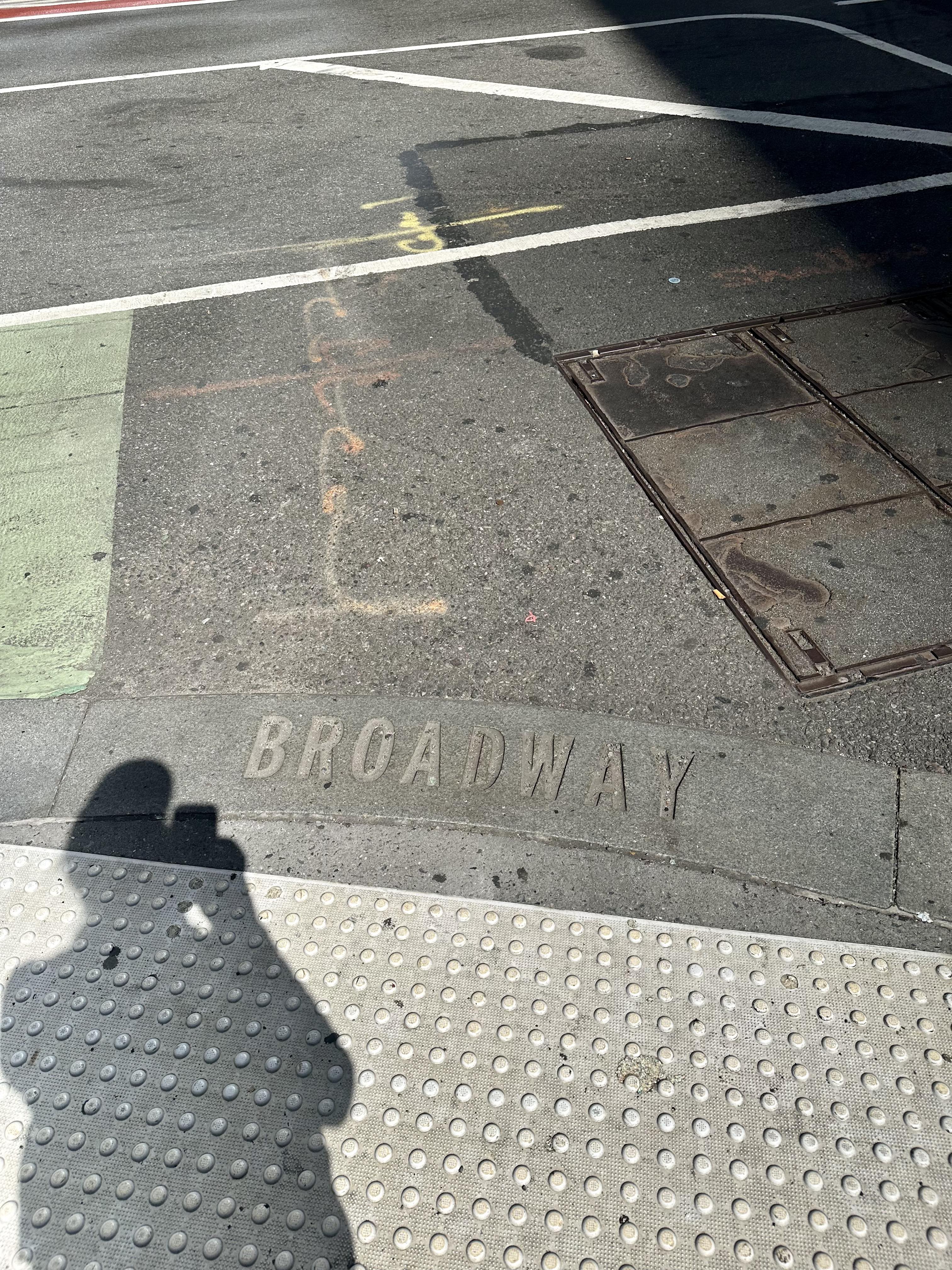
Broadway is the only avenue in Manhattan that runs its entire length (and in fact, continues north for two miles into The Bronx and then runs for 18 miles through Westchester County, through the towns of Yonkers, Hastings-On-Hudson, Dobbs Ferry, Irvington, and Tarrytown). It is also a street that does not follow the grid in Manhattan above 14th Street. Much of it follows the Weckquaesgeek trail, a major thoroughfare long before Europeans arrived. It was then widened by the Dutch, and named the “High Way.” When the British took over it was renamed Broadway because of its unusual width. In the 18th Century, Broadway ended just north of Wall Street, and the section below that was Great George Street, but since 1899 Broadway has begun just north of Battery Park, so that is where I began my walk, on a Saturday in late July that was finally not too hot or humid to contemplate such a long walk.

I took the subway to South Ferry (I had thought about biking down but decided not to test my endurance too much!), and began my walk at One Broadway, just north of the Museum of the American Indian. Before too long I encountered the famous Wall Street bull at Broadway’s intersection with Wall and watched people line up to take photos.

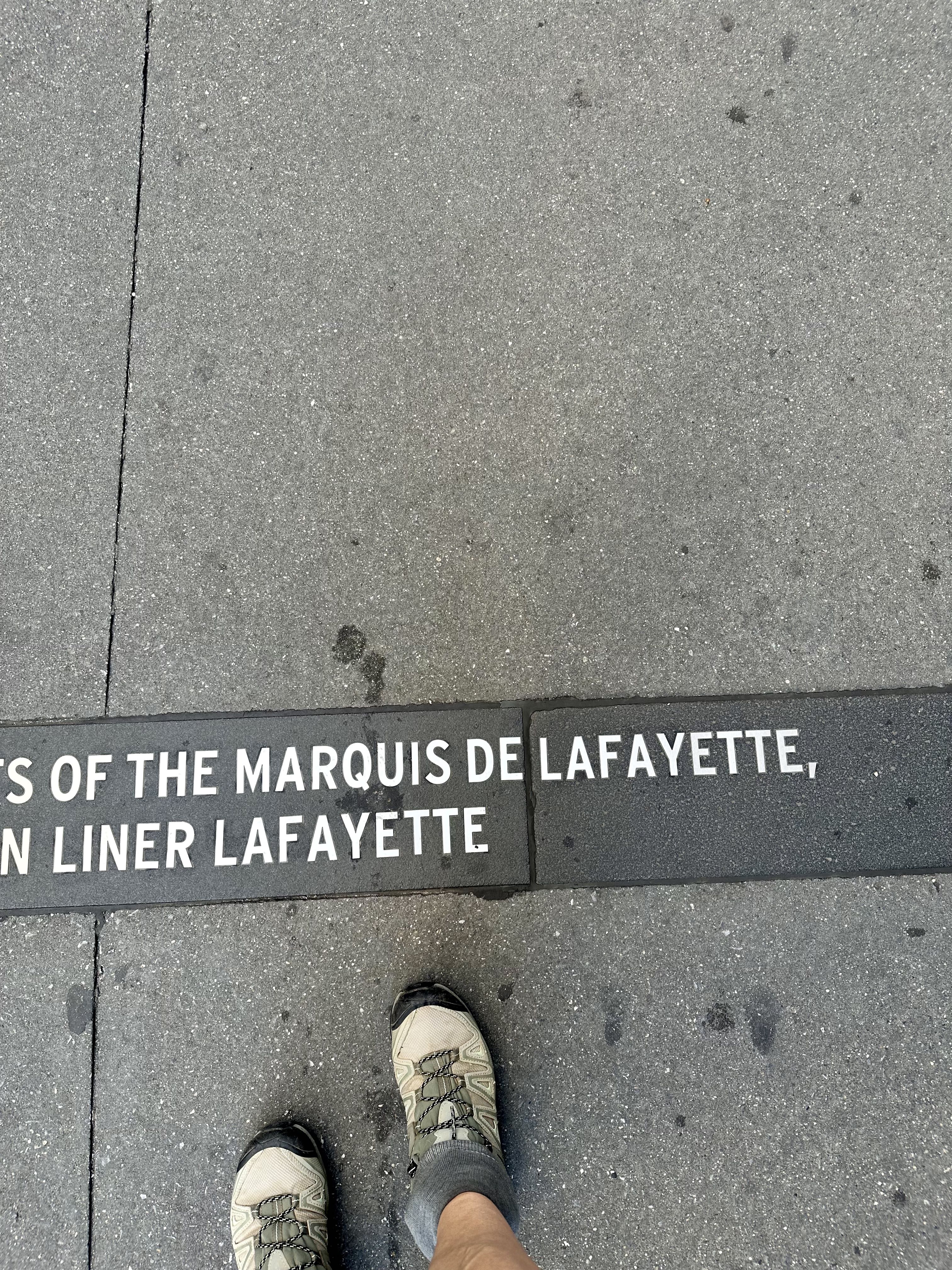
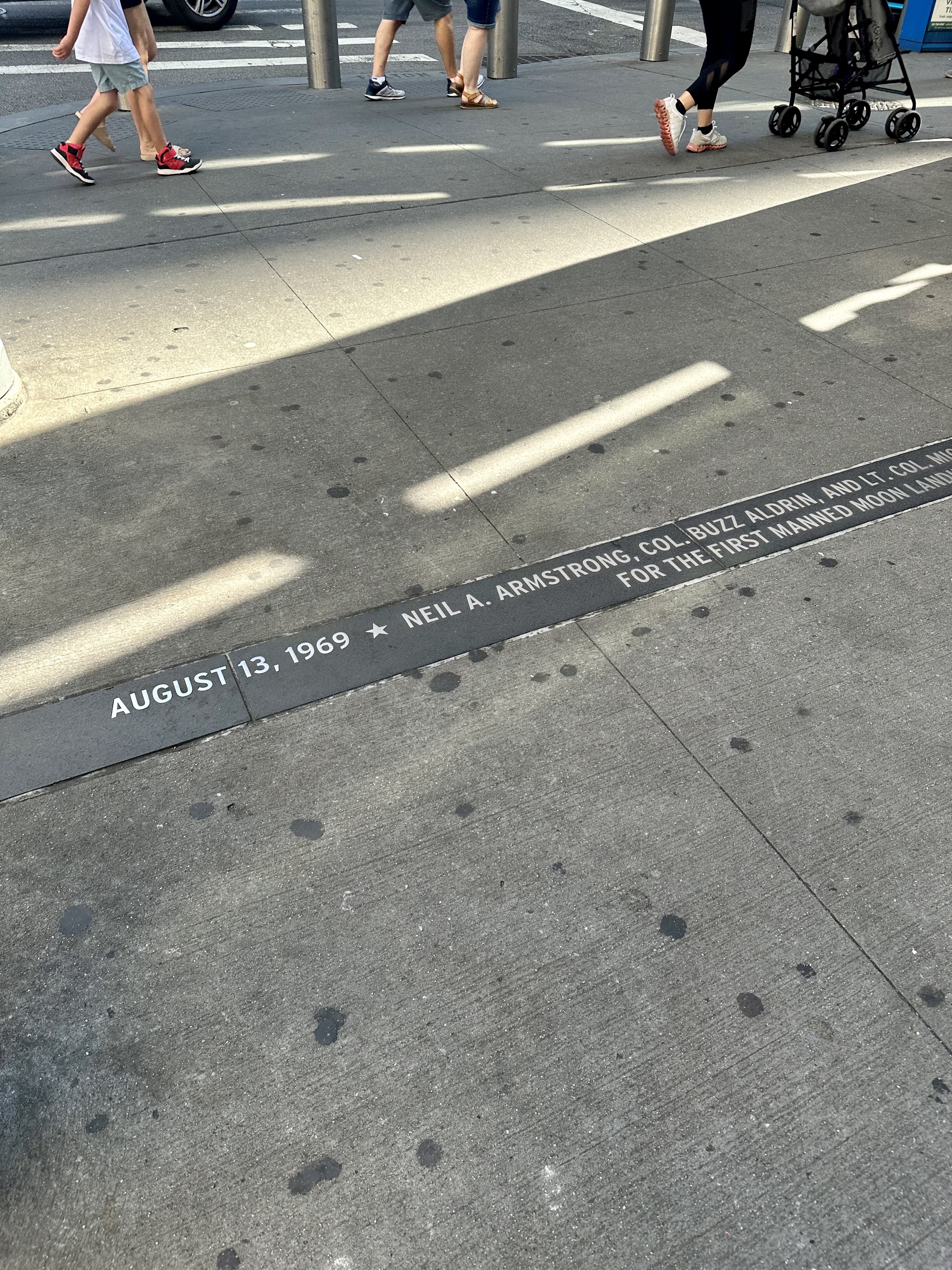
Not too far north from there I began reading the markers for the Canyon of Heroes. This is the section of Broadway where ticker tape (from when the financial district had tons of ticker tape paper as a side effect of doing business) parades have celebrated heads of state, winning local sports teams, and special occasions like the end of World War II or the return of Americans who first walked on the moon. It is fun to read these although you will only read those on one side of Broadway if you are trying to make good time. I stayed on the east side of the street for much of the day to take advantage of shade. I also started from the southern end of Broadway and walked north, rather than starting from the north and walking south (I found out later there is a “Broad City” challenge that starts at the northern tip of Manhattan because it was done in an episode of the show). If you do start from the south, you can read the Canyon of Heroes markers more clearly because they aren’t upside-down, and the sun will be more behind you near the middle of the day rather than in your eyes. On the other hand, as I will describe later, the Inwood section of the hike is much more hilly so you might want to get that over with earlier in the day.

Still in the Canyon of Heroes, be sure to appreciate Trinity Church to your left. Trinity’s first church in Manhattan was built in 1698 and was destroyed in the Great Fire of 1776. There was a second building on Wall Street until Trinity Church as we see it now was built in 1846. It was the tallest building in the United States until 1869, and the tallest in NYC until 1890.

Continuing north, if you look to your left, you can catch a glimpse of the Oculus, first on its own and a block later, with One World Trade rising behind it. (I have written before about the Oculus and about One World Trade.) They aren’t actually on Broadway, but St. Paul’s Chapel, which somehow survived 9/11 and was used as a staging area for helping rescue and recovery workers after 9/11, is on Broadway at Fulton. After George Washington was sworn in as President, he went to St. Paul’s for services and the pew he sat on has a plaque noting this.

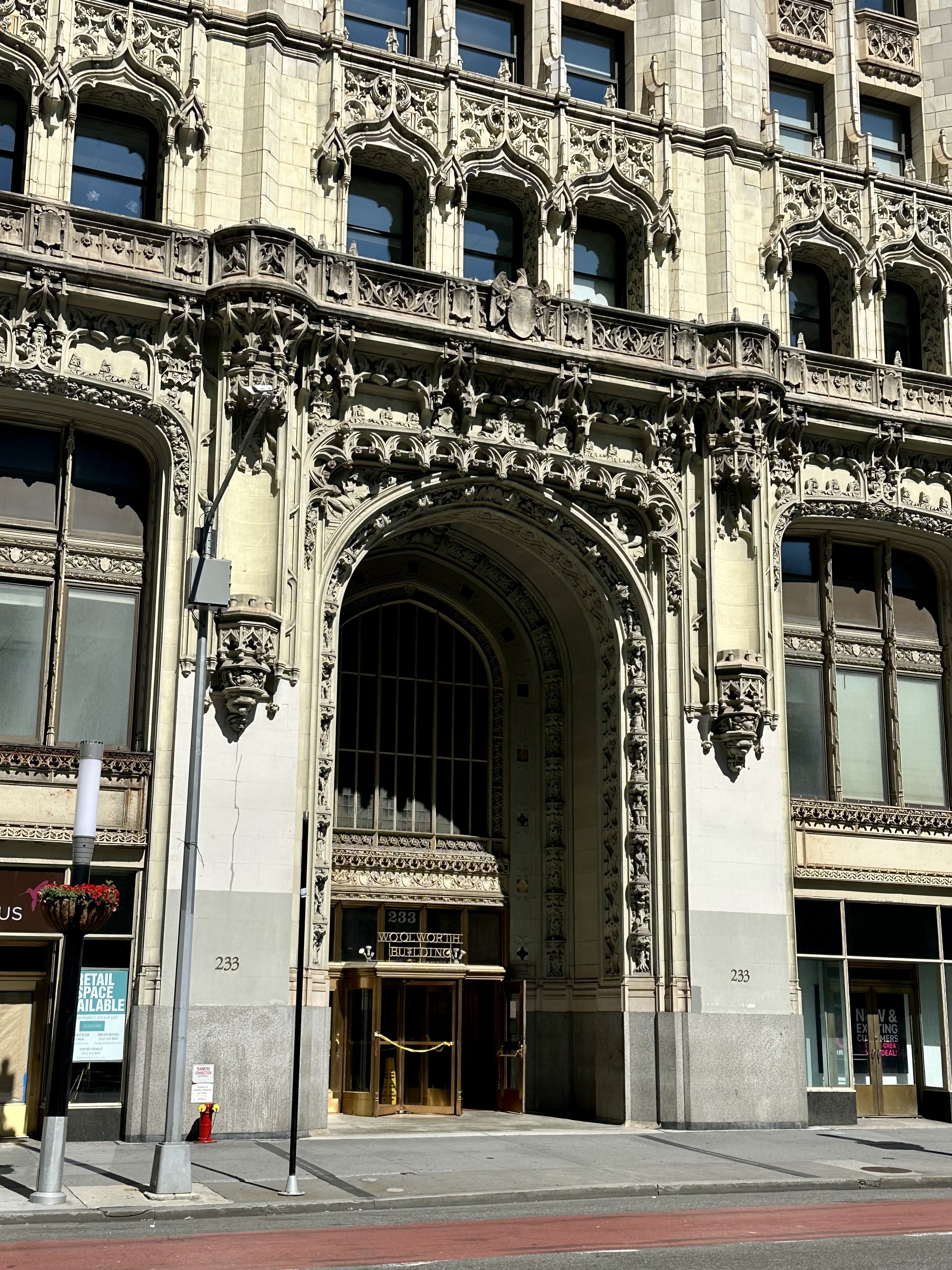
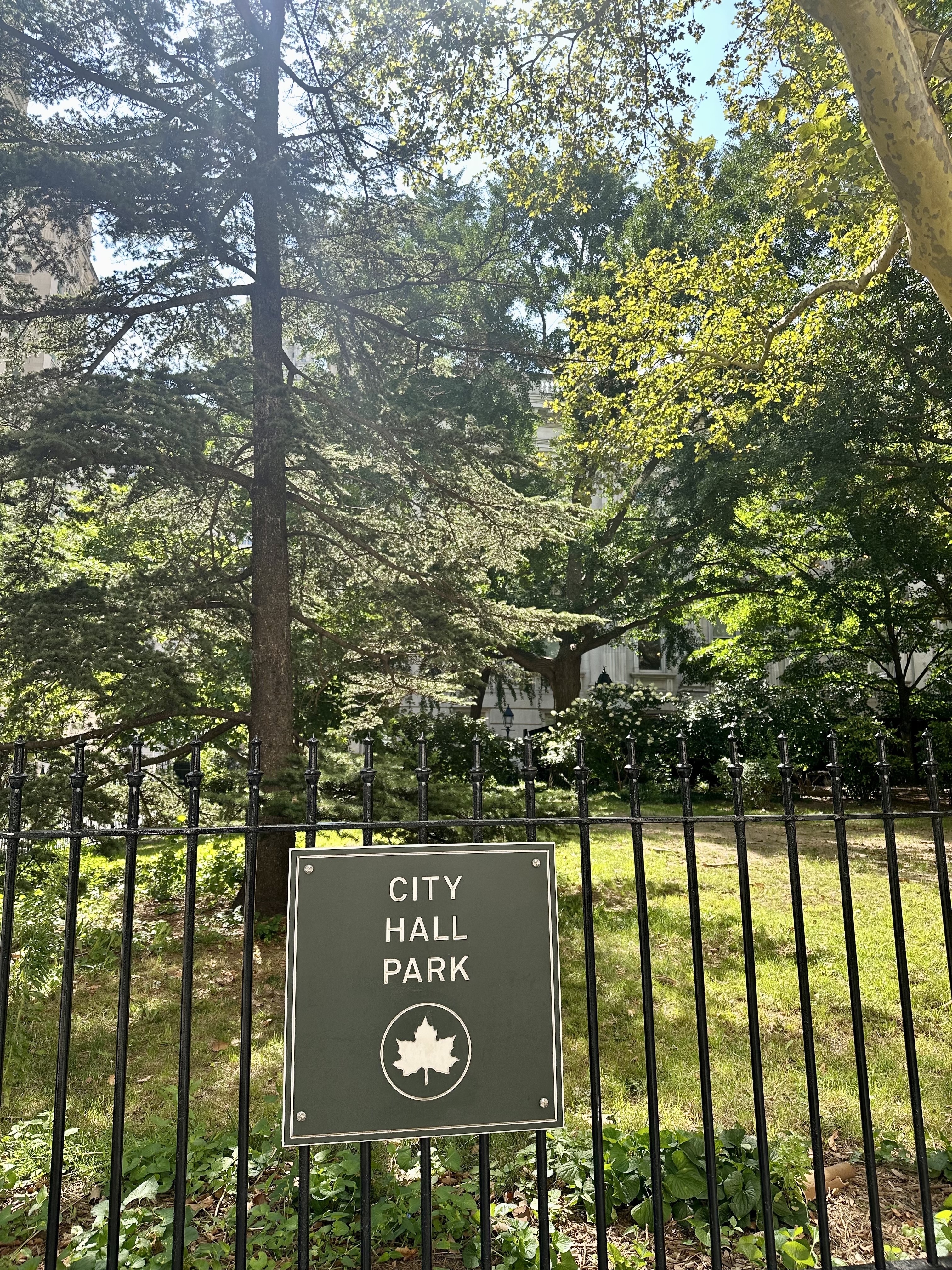
Continuing north, I passed the Woolworth Building, which was the tallest building in the world from 1913 to 1930, with a height of 792 feet. Perhaps more impressively, over 100 years after it was built, it is still one of the 100 tallest buildings in the United States. It has been converted to residential condos, and the penthouse – which is pretty spectacular, to say the least – recently sold for only $30M (down from over $100M when first listed!) in “white box” state, ready for finishing out to the buyer’s taste and use, but is a very unique space. After passing City Hall (which, built in 1812, is the oldest city hall in the US still used for its original governmental functions) and City Hall Park, I couldn’t resist a smile as I passed Zero Bond. This was the location of my work as a background actor for the final season (as it turned out, the final episode) of Succession, and I had scarfed down some craft services for lunch just outside that building standing next to Matthew Macfadyen (“Tom”). You can read more about that experience here.

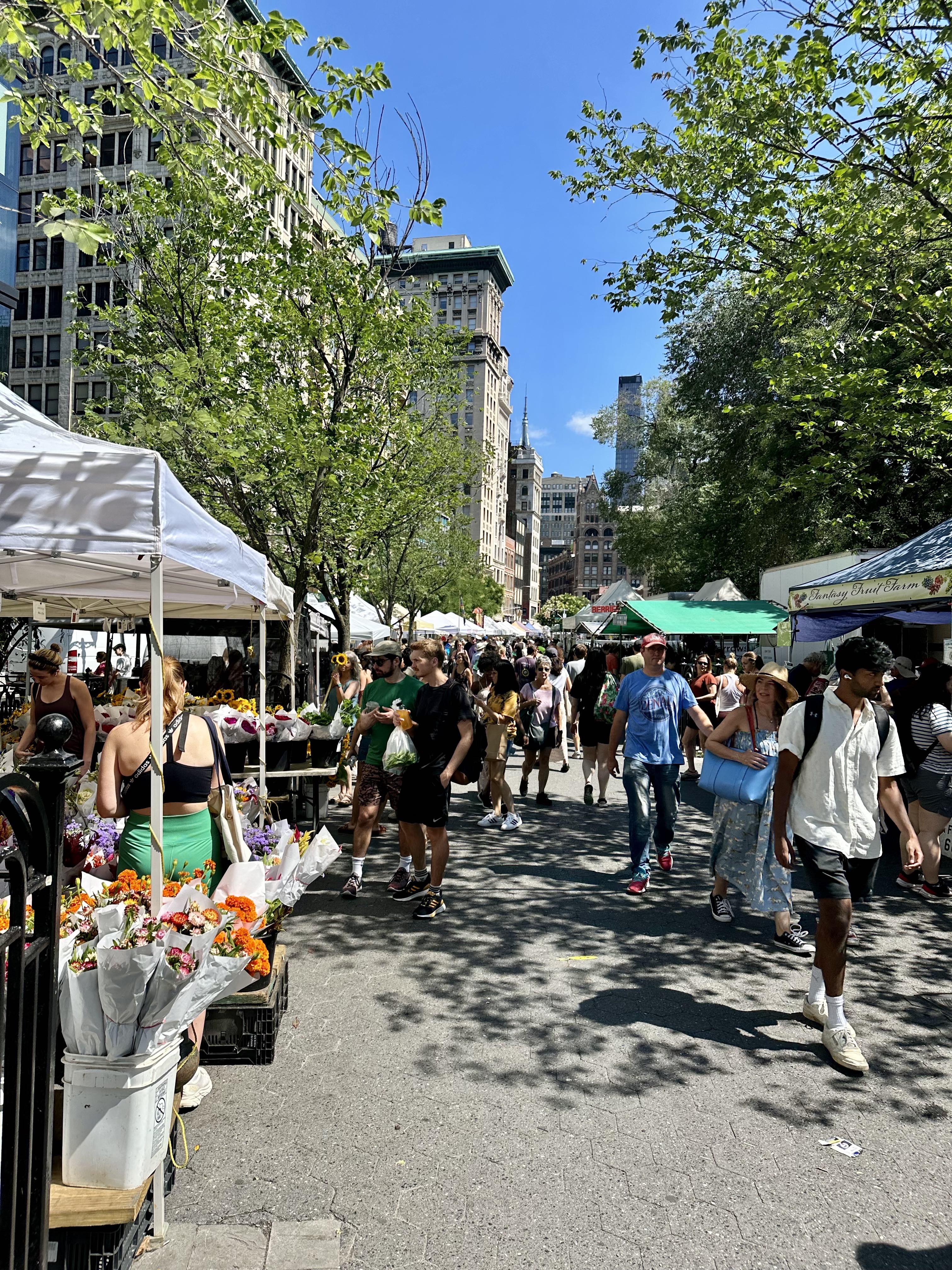
After walking through Greenwich Village, the next big event is Union Square, where Broadway begins to cut across the Manhattan grid, creating interesting little parks or “squares.” I was doing this on a Saturday, so the excellent Green Market was in full swing. I had been hydrating up to this point, but decided to buy some fruit and enjoy it (raspberries and red currants) for my first snack of the day.

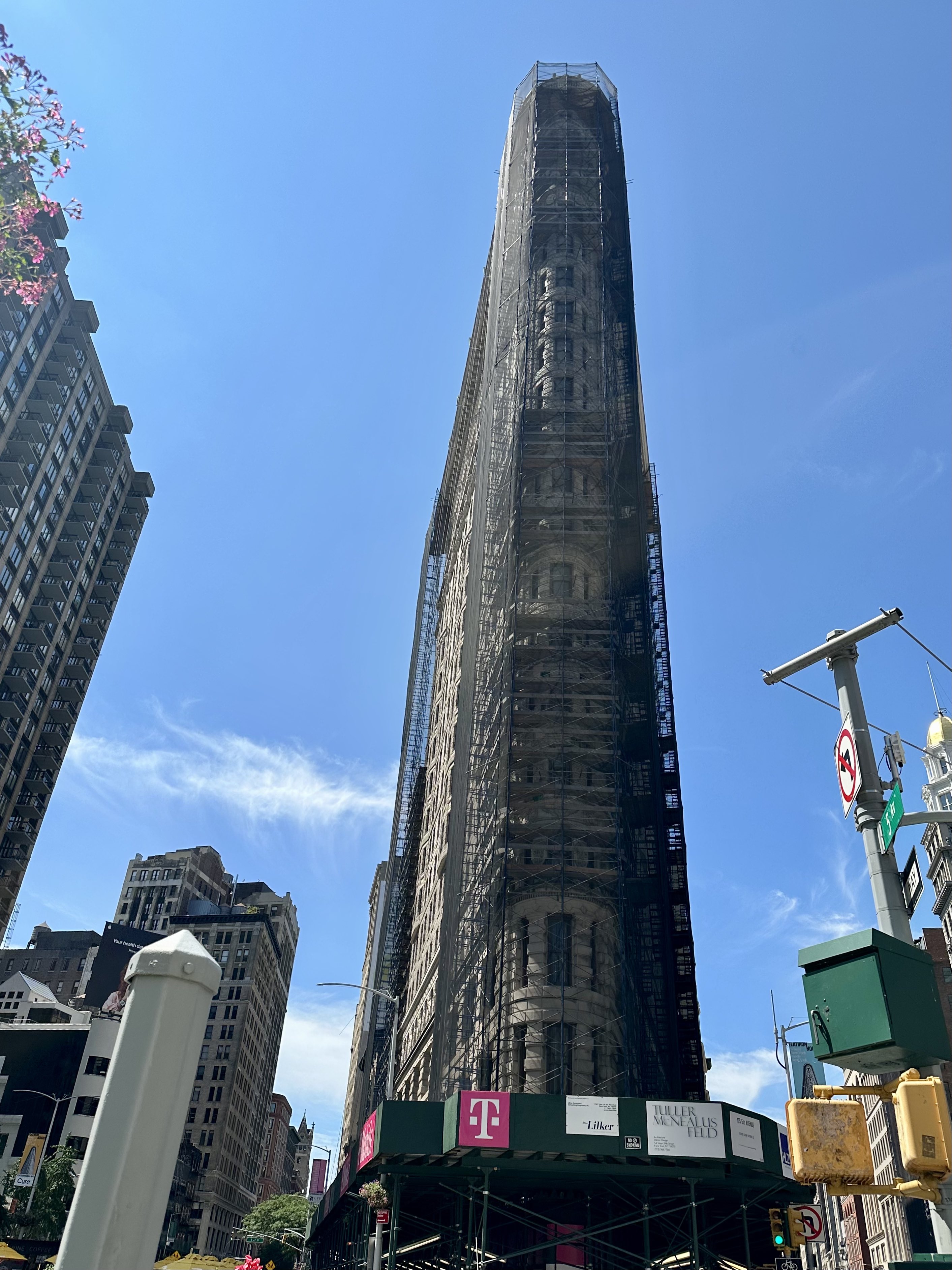
At 23rd Street, Broadway intersects with Fifth Avenue, and you get a great view of the Flatiron Building (unfortunately scaffolded right now for some facade repair). Completed in 1902, at 20 stories it was considered dangerous and a “folly” for the builder. A National Historic Landmark, The Flatiron Building is now universally adored – it was the fourth most loved building in the United States in a survey in 2019 (behind Falling Water, the Empire State Building, and Coit Tower in San Francisco).

Broadway intersects with Seventh Avenue at 34th Street, home of Macy’s flagship store. The real Santa (of course! come on, watch Miracle on 34th Street) hangs out in Santaland every holiday season, and the Thanksgiving Day Parade ends in front of the store. This building was completed in 1902 and is a National Historic Landmark.
When Broadway crosses 42nd Street, you are at the “Crossroads of the World,” Times Square. Full of screens, neon, costumed performers, street theatre, hordes of confused tourists, and surrounded by Broadway theaters, Times Square is a lot, no question. There’s also no place like it. I actually successfully timed my day to avoid the pre-matinee crowds.

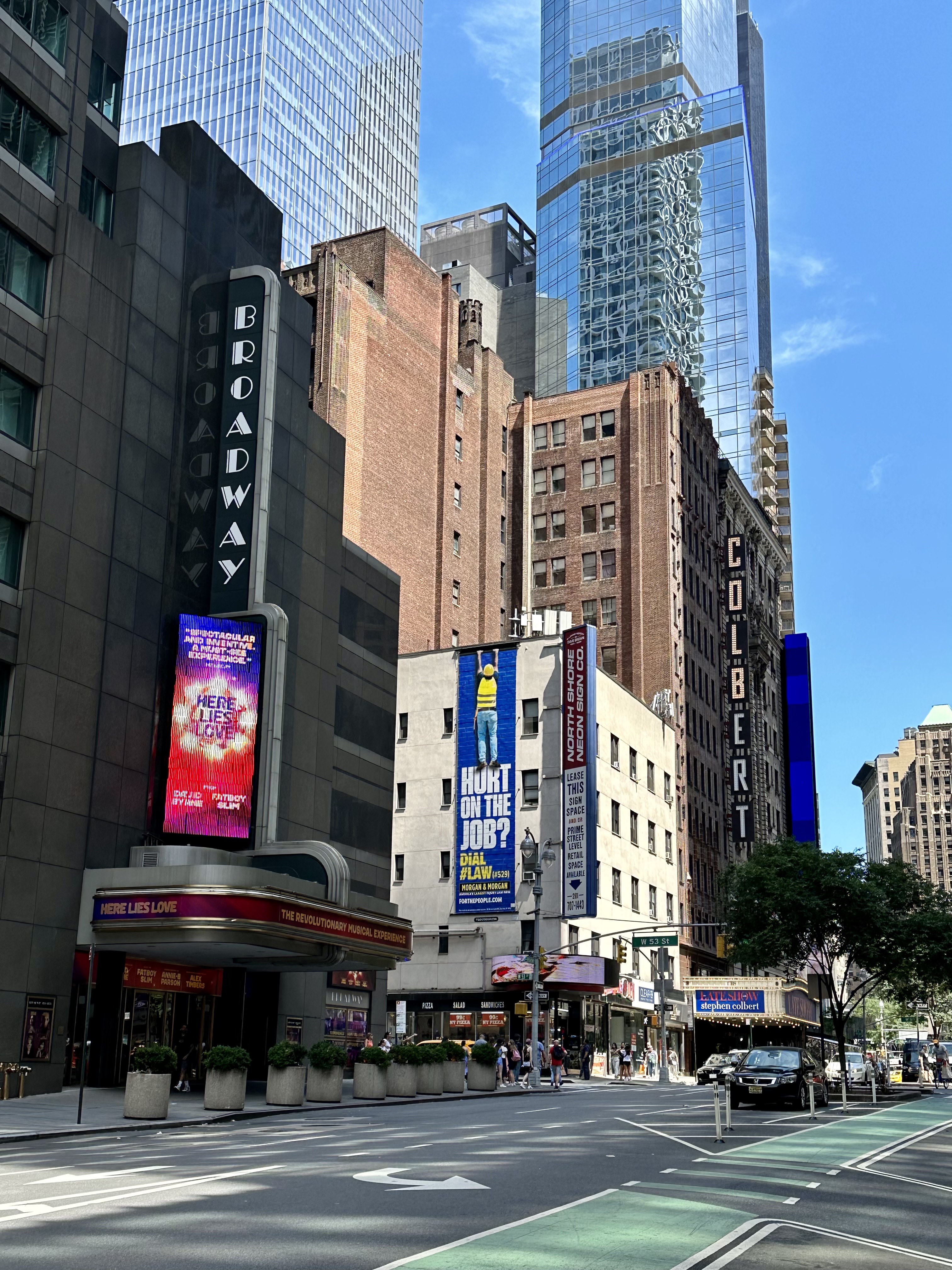
Speaking of Broadway theaters, a few blocks north of Times Square you can see the simply named Broadway Theater, currently the home of Here Lies Love, and the Ed Sullivan Theater, currently home to the Colbert Show. Did you know that most Broadway theaters are not actually on Broadway? There are 41 Broadway theaters (theaters with 500 or more seats, generally between 41st and 54th Streets, with the exception of the Vivian Beaumont a bit north in Lincoln Center at W 65th) but only the Broadway, Winter Garden, and Palace (currently undergoing a multi-year renovation) have addresses on Broadway itself.

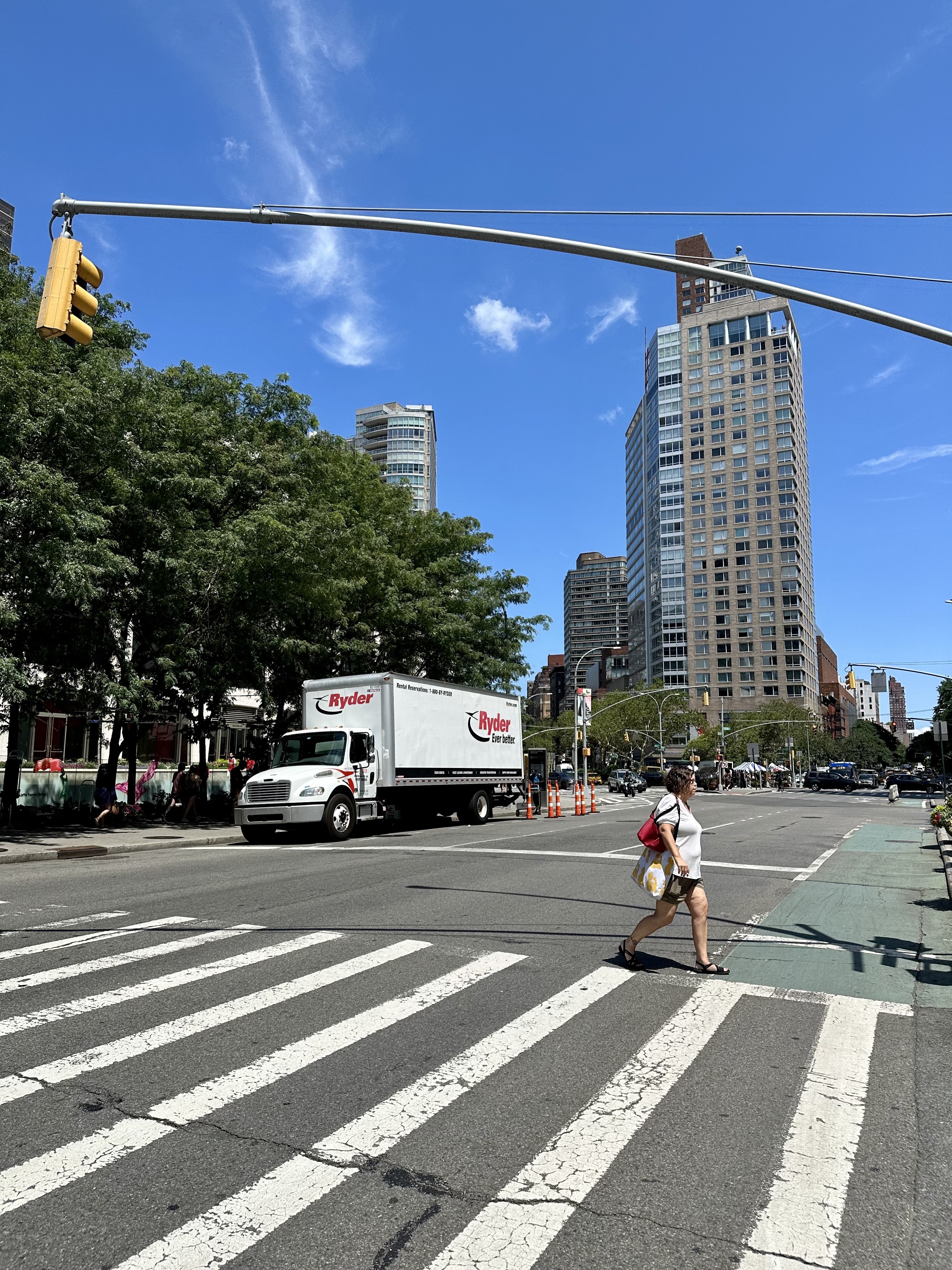
When Broadway crosses Eighth at 59th Street, you are at Columbus Circle, looking to your right at the Southwest corner of Central Park. Broadway will continue to move west on the diagonal, intersecting W 66 (at Lincoln Center), and heading through the relative quiet and residential nature of the Upper West Side.

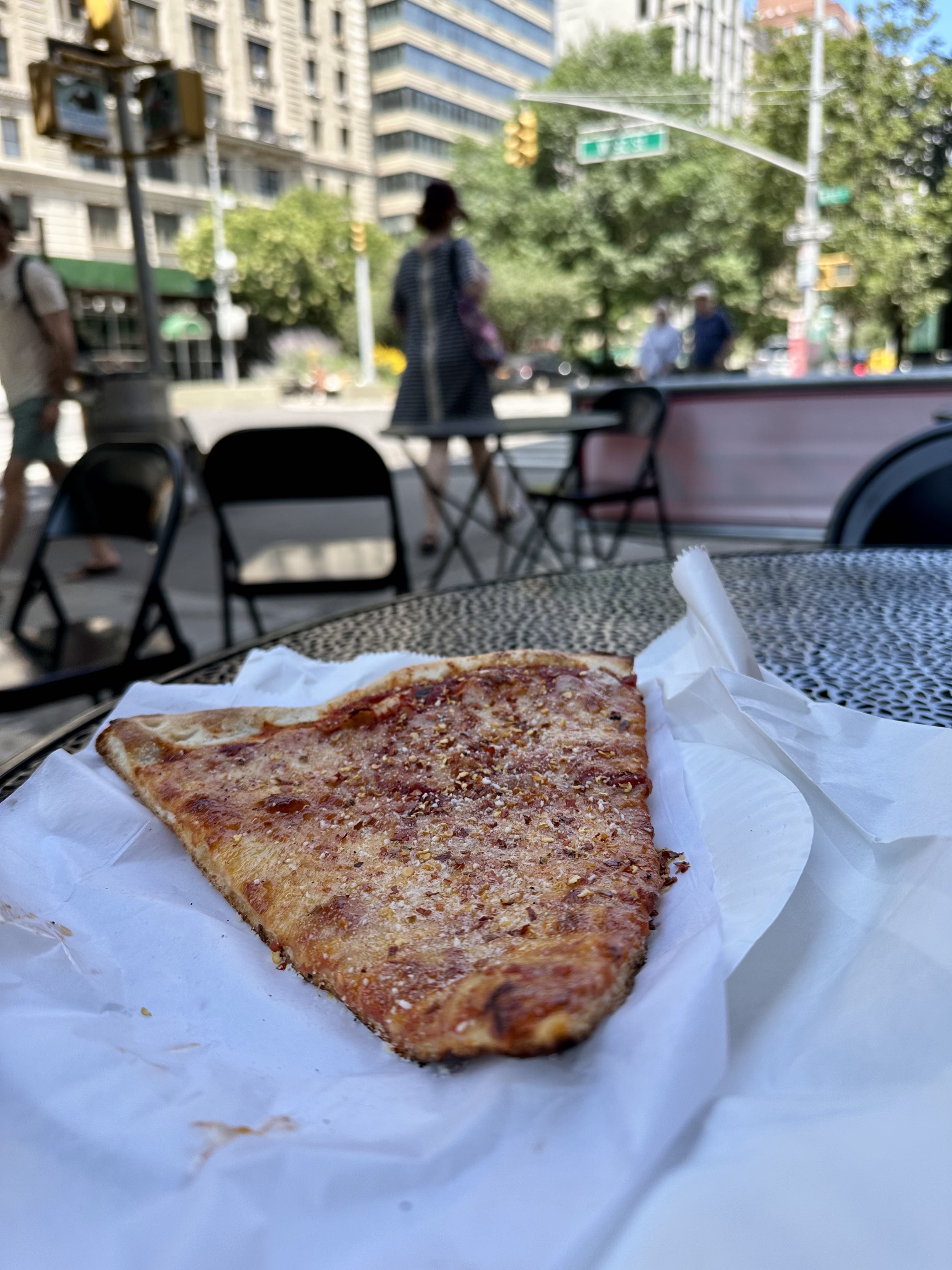
At some point in the W 90s, I stopped in at a random pizza place for a classic NY slice. Around this point I was beginning to tire a bit, but the pizza helped. Later on I stopped at a Mister Softee truck, but as you will see from the rest of this blog post, as I became more tired I took fewer photos.

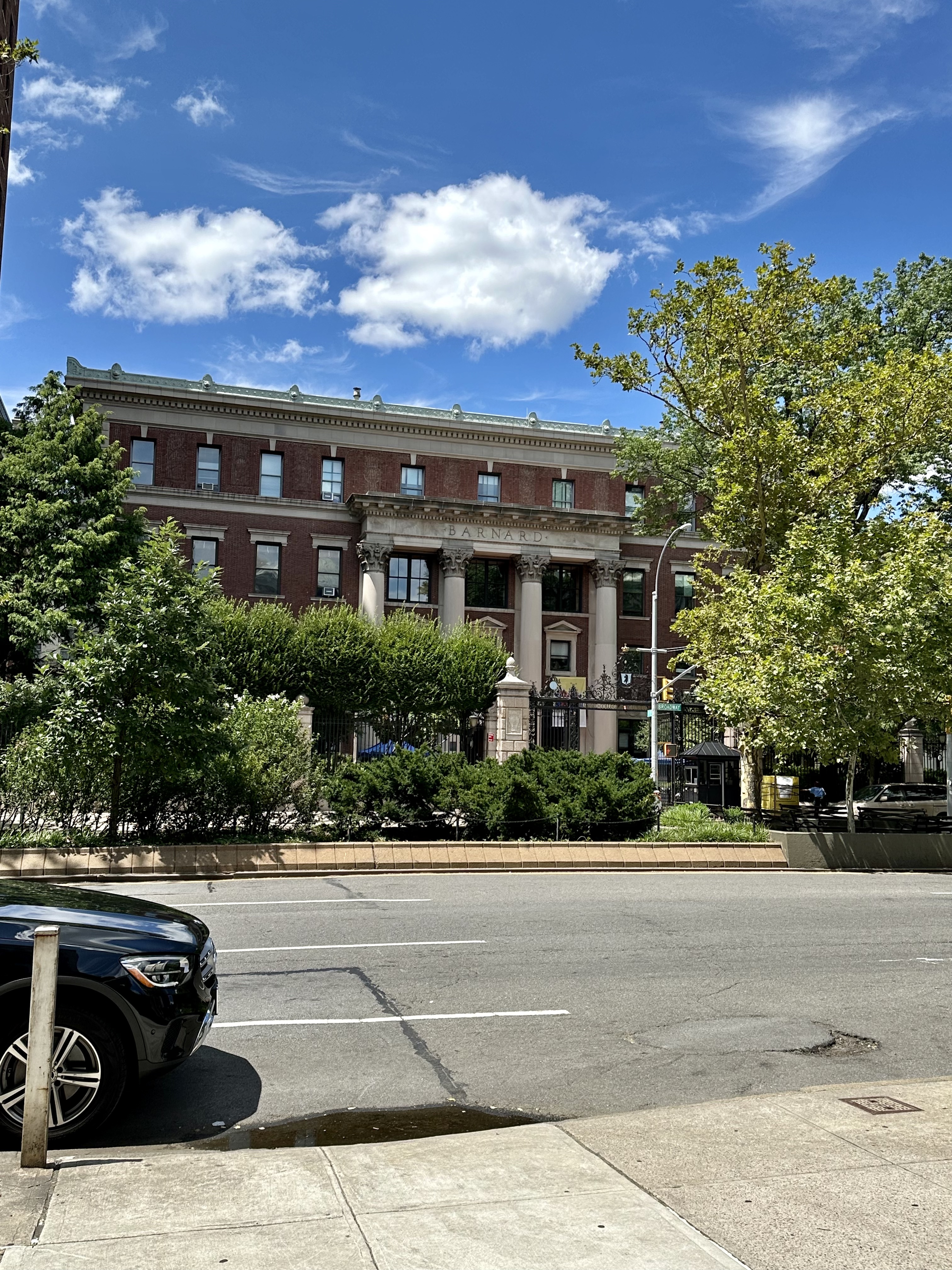
Continuing north along Broadway into Morningside Heights, I passed Columbia University on my right and Barnard College on my left. Columbia was established as King’s College in 1754 on the grounds of Trinity Church in lower Manhattan, and moved to the current campus in 1896. Columbia is the 5th oldest institution of higher learning in the United States (after Harvard, William & Mary, Yale, and Princeton).

After Morningside Heights, Broadway seemed to get very hilly, and although there are plenty of lovely things to see – Inwood Park deserves its own blog post – I began to get more interested in finishing the trip than in taking pictures.

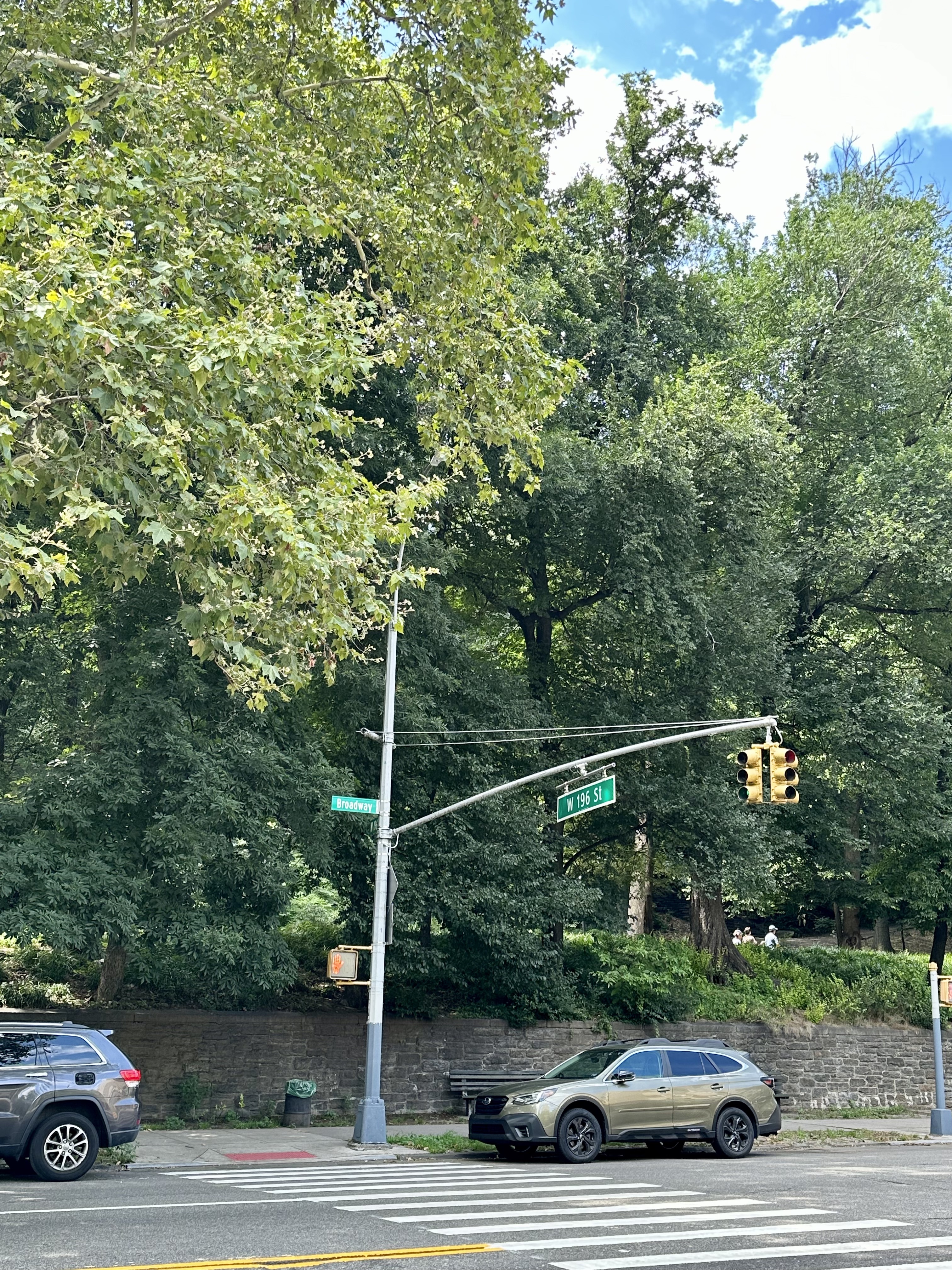
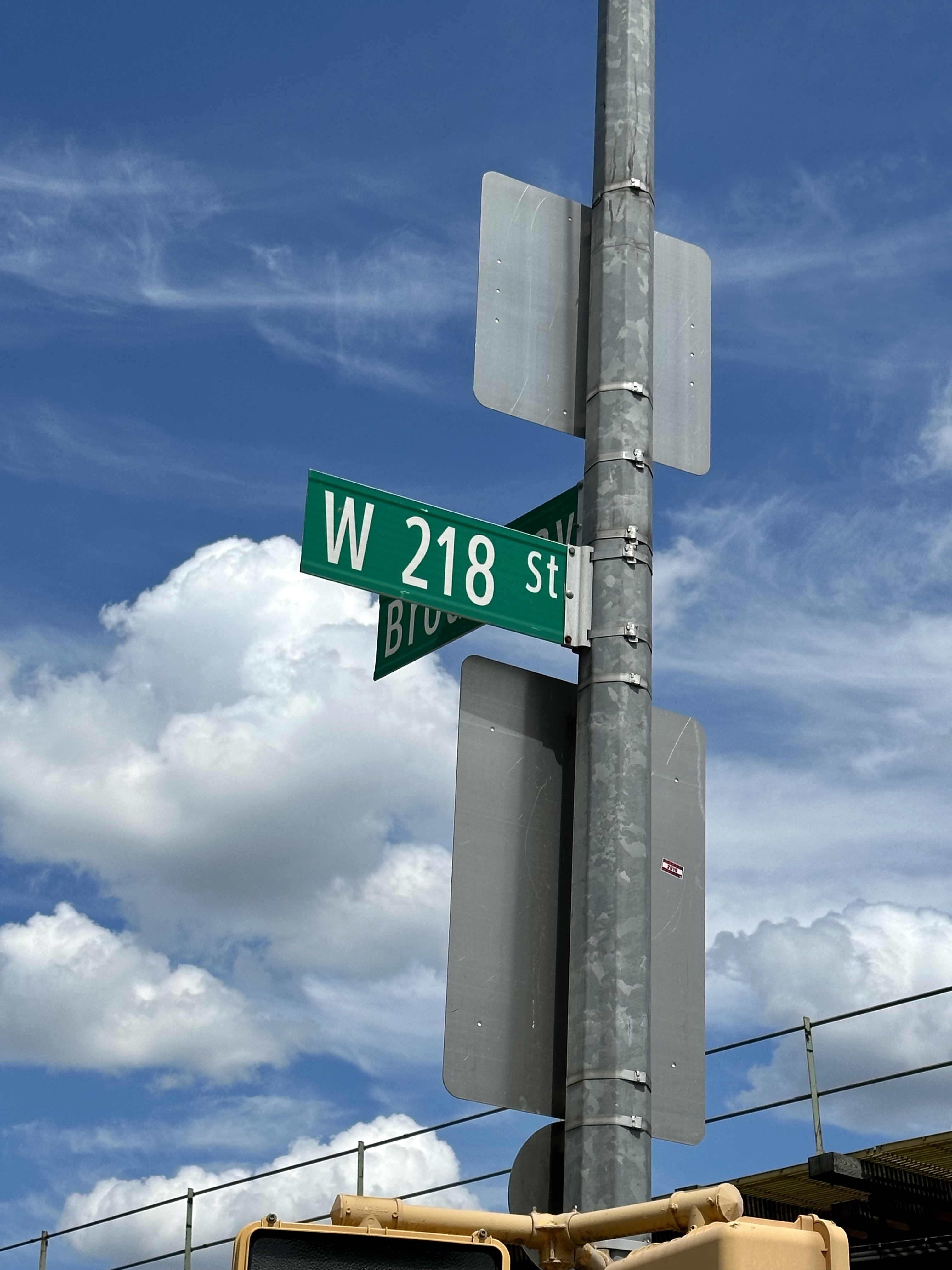
At the very tip of Manhattan Broadway swung east again, preparing to continue into The Bronx after a bridge over the Harlem River. After trudging to 218th Street, not wanting to go across the bridge, I considered myself to have done the walk, and backtracked to the 215th Street MTA station to catch the 1 train. I felt strong the next day, with no sore muscles, so felt good about the trek in terms of trying out my Kili gear on a long hike. The entire trip, including stops here and there for food, or bathroom breaks, took just under 6 hours. I feel the day would be more fun if you did it with someone over the course of an entire day, took more breaks, didn’t mind veering off Broadway now and then, and considered stopping at 125th Street (or starting there if you want to do the trip heading south instead of north). The most interesting thing to me was how different Broadway is in all its varying incarnations and neighborhoods. Walking it was like a microcosm of Manhattan itself; constantly different, never boring, not a city but more like a series of cities. The length and many-sidedness of Broadway illustrates the thing I love most about New York City – its constant variety and reinvention. Samuel Johnson once famously remarked that if you are bored with London you are bored with life – and to me that is true (I would say, even more true!) of my beloved New York City.

The Tony Awards: 2023 and a look back to attending 2022

Every spring in New York City, there is a flurry of new plays and musicals opening on Broadway to beat the deadline for Tony Award nominations. Of course productions do also open other times of the year, but the spring opening season is the busiest time of the theatrical year. Broadway’s importance to the culture and economy of NYC cannot be emphasized enough – in the last year before the pandemic shutdown, 14,077,000 tickets were sold, bringing in $1.83 billion in direct and an estimated $14.7 billion in indirect money into the city’s economy. NYC tourism in general and Broadway theatre specifically continue to rebound since reopening, but estimates are that Broadway revenues are still down 8-10% compared to pre-pandemic numbers. In a business where only one out of every five productions that open on Broadway recoup the investment put in by producers, every move that can increase the probability that a given show will succeed will be taken.

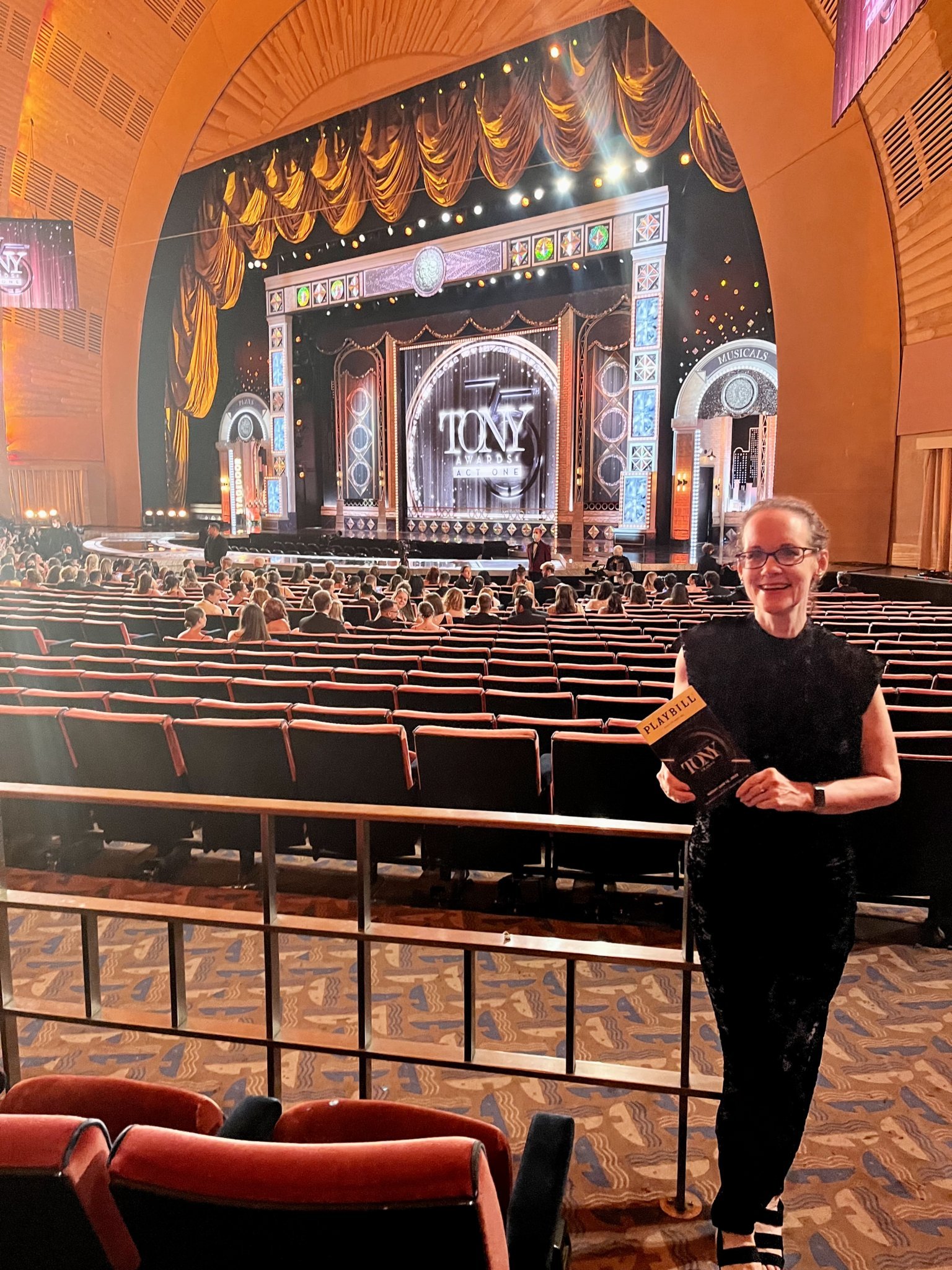
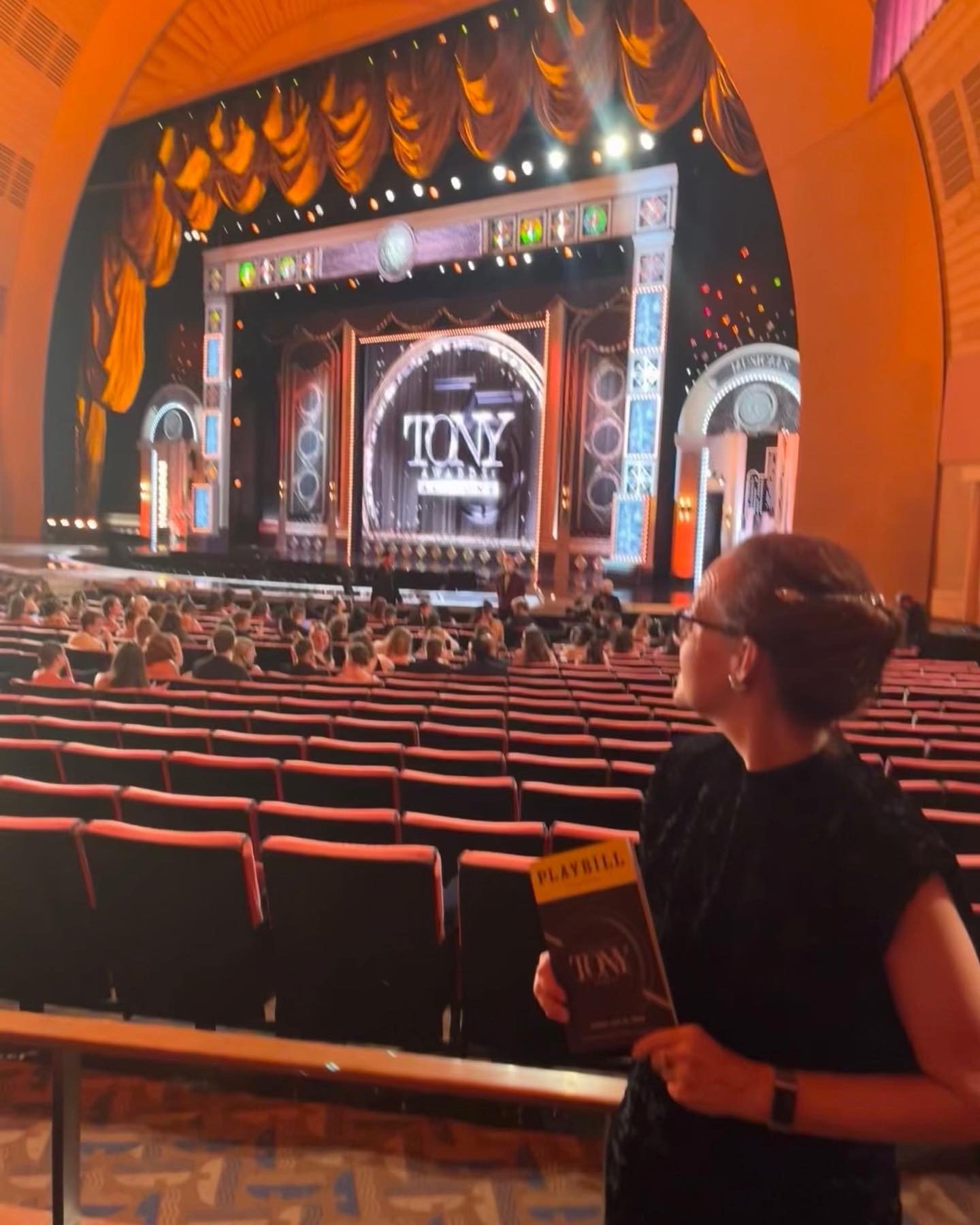
I have watched the Tony Awards on television for decades now, and last year had the thrill of being able to attend. I have been to the Drama Desk Awards before, and really enjoyed, but the Tonys are another experience altogether. How did I manage this? A good friend was involved with the revival of Company (which did in fact win best revival) and was able to get me two tickets to the 2022 Awards – which were also the 75th Anniversary of the Tony Awards. As we approach the 2023 awards, I am looking back on what that experience was like. Spoiler alert: it was fantastic!
Now this year (2023), the televised ceremony – which serves as a way to publicize the new shows in a season in addition to giving out the awards – was in peril due to the WPA (Writers Guild of America) ongoing labor strike. Even though Broadway playwrights are members of The Dramatists Guild (which is a professional organization, not a union), many of them are also members of WPA from working in television or film. Some Broadway performers have written for TV or film and are members of the WPA. In addition, most members of the Broadway community are in their own unions (Actor’s Equity for performers, or Local 802 AFM for musicians, for instance) and would be unlikely to cross a picket line from another union. At one point it was announced that the Tony Awards would not be televised this year. But several writers who work both on Broadway and in TV/film (Martyna Majok, David Henry Hwang, Tony Kushner and Jeremy O. Harris among them) reached out to the WPA and asked them not to picket the ceremony – and they were successful (see this New York Times article for the details). It’s still not clear how the ceremony will be impacted by the strike, as members of the WPA who are nominees (and there are quite a few) have been asked not to attend and to pre-tape acceptance speeches. But there will be performances by nominated shows, and the awards will be given out.

Even before the strike, there were going to be some differences between this year’s ceremony and those in the past. It has been held at Radio City Music Hall for a long time, with a few interruptions (the Beacon Theater in 2011 and 2012, the Winter Garden Theatre when the first post-pandemic awards were handed out in September of 2021), but this year will be held far uptown in Washington Heights. The United Palace Theater, where it will be held on June 11, 2023, has far fewer seats than Radio City (3400 vs. 6000) but more than the Beacon or the Winter Garden. On the plus side, though, covid restrictions are much less rigorous than the procedure in place last year.

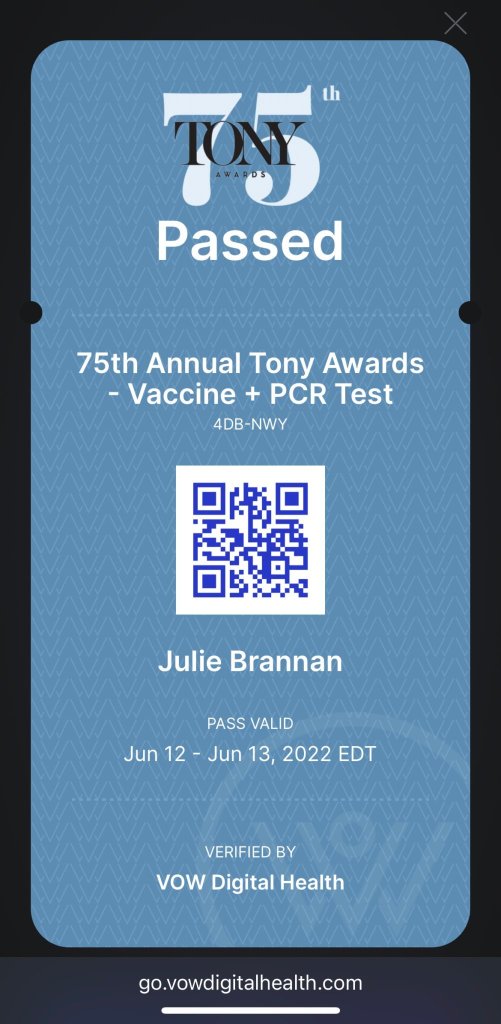
Last year, there were two sets of protocol in place. Those of us in the orchestra section, who could potentially be seen on camera, had to prove vaccination status, get a PCR covid test in advance and upload to get a digital health pass that would allow us into the venue. Then masks were optional for those in the orchestra (and from what I saw, most were not masked). For those in one of the mezzanines, proof of vaccination was acceptable, and masks were mandatory.

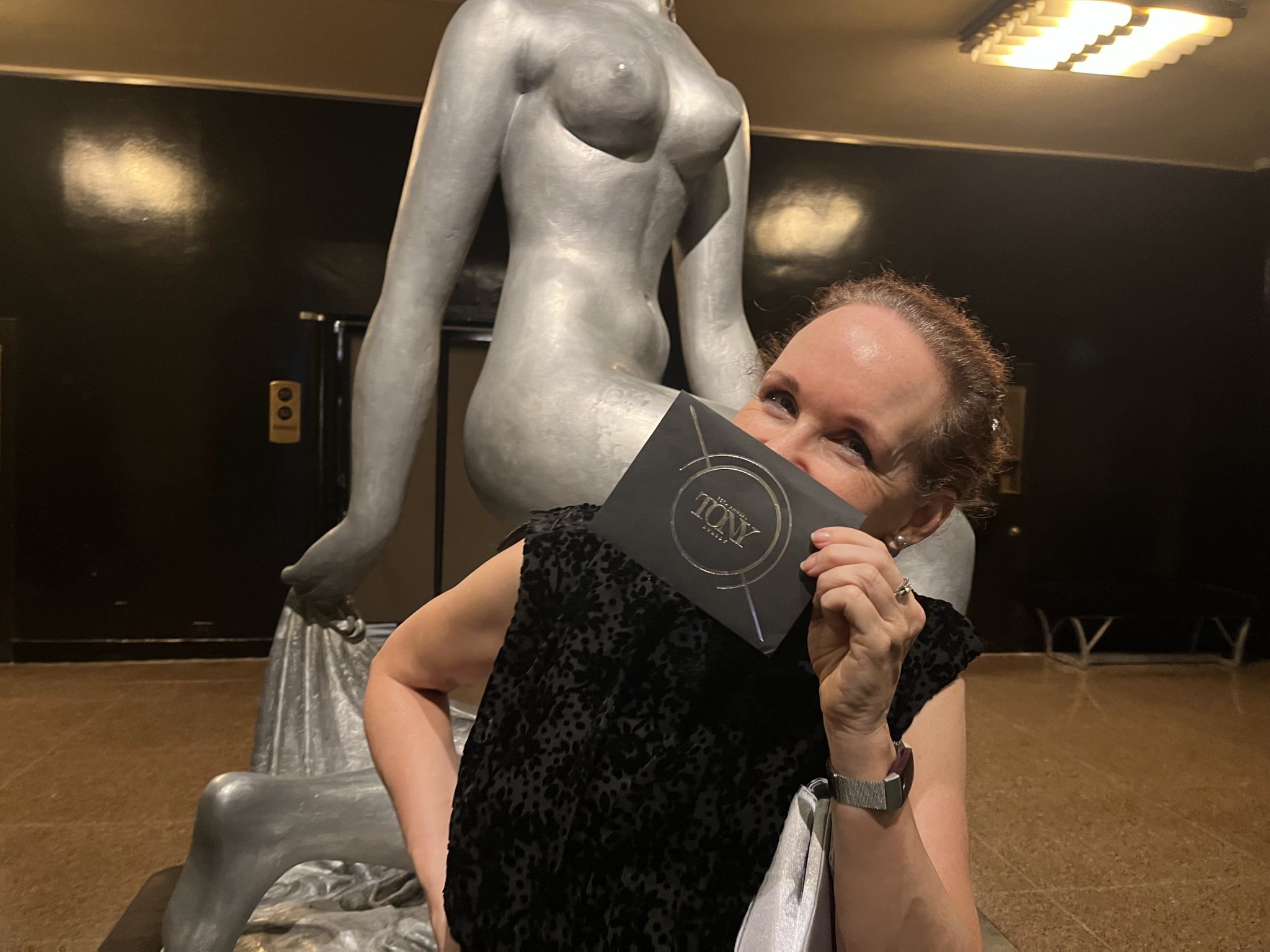
Also – and I only know this because I saw someone’s ticket who was trying to get in the main entrance but was in the mezzanine so was instructed to go along the side – not all the tickets were like the ones I had. The tickets for those in the orchestra were thick heavy embossed tickets in a black and silver envelope! The ticket I saw for someone who was going to the mezzanine looked like a regular Ticketmaster print out with a bar code. It was so exciting to get the fancy tickets a few days before the ceremony. Most years there are a limited number of tickets available for purchase by the way, but they are expensive (I looked, and for this year they were $775 and $575 – not scalped prices, the actual tickets from the Tony site) and you will be far away from the show. The orchestra level was for people directly involved in the nominated shows, or for presenters.

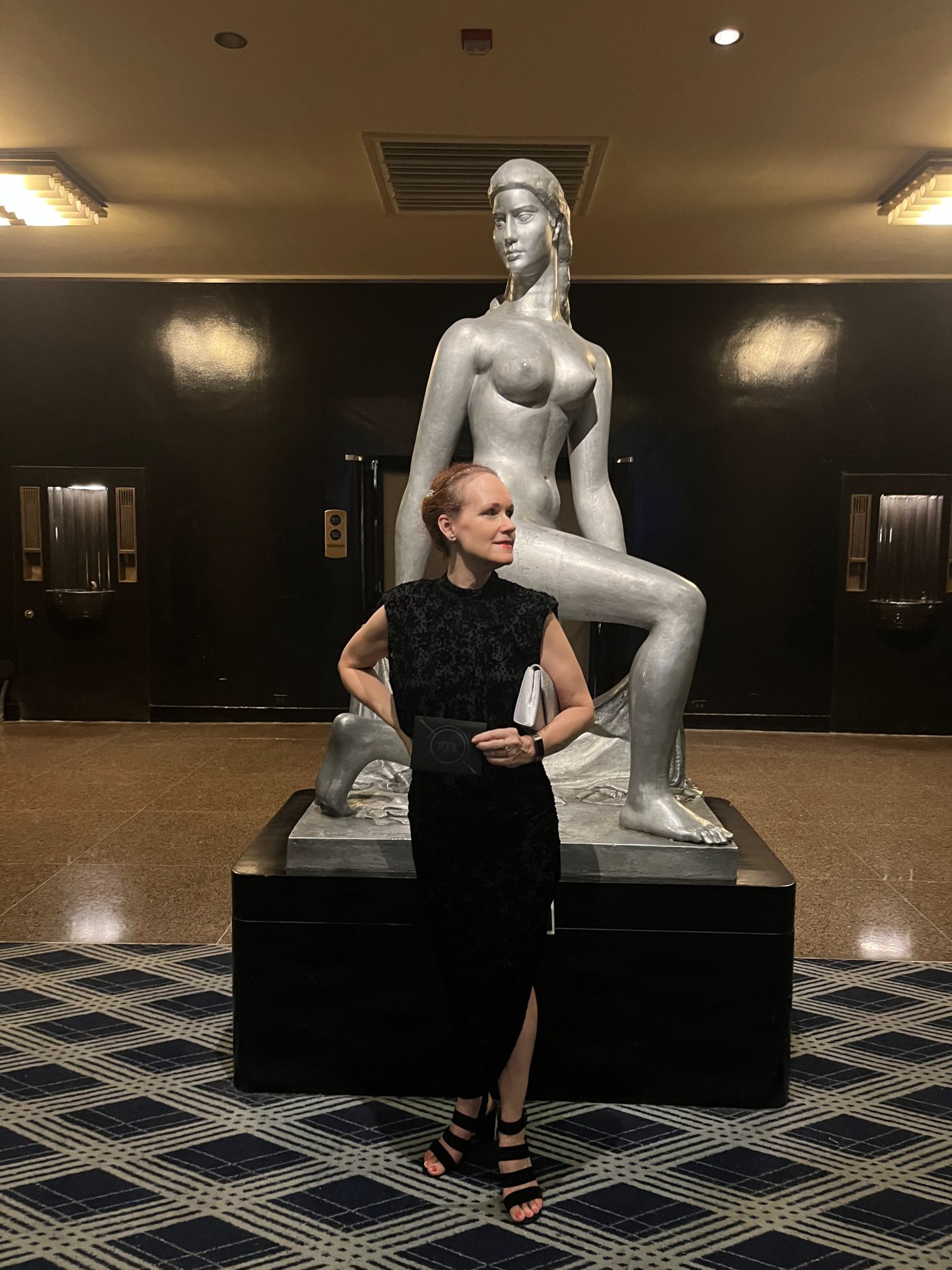
In addition, those in the orchestra had a required dress code – as our fancy ticket said, “Black Tie Only” – and a separate entrance (the main front entrance of Radio City) from those going to the mezzanines. Only those in the orchestra were allowed in the main lobby or the (really spectacular!) lower level bathrooms. There are bathrooms in the mezzanine, but not as opulently Art Deco, or as fun to pose in front of.

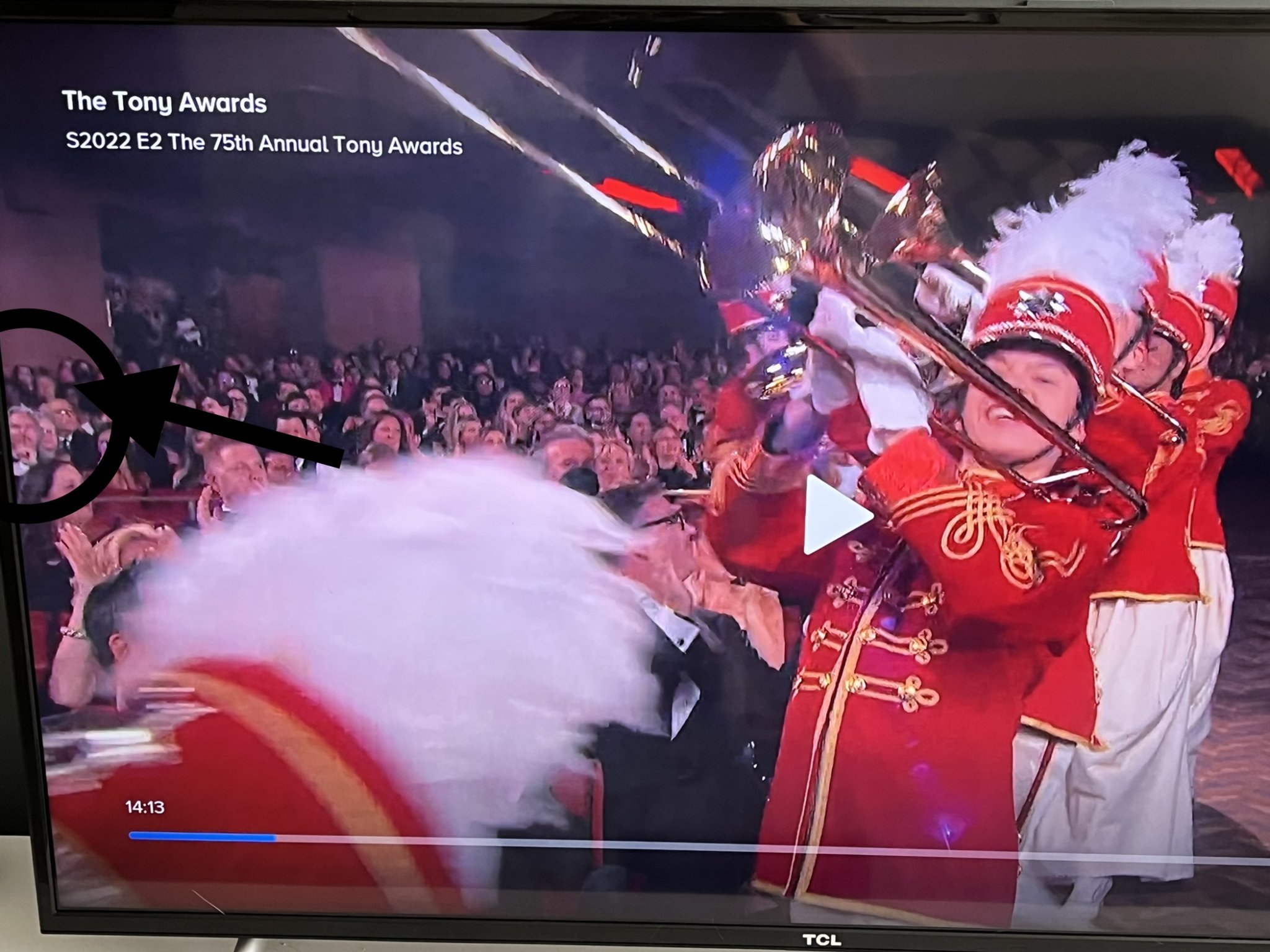
The section of the orchestra I was in was in the middle but far house right. The cast of A Strange Loop was in front of our Company section, and MJ the Musical behind us. Nominees from any show were seated closer to the stage, but would occasionally come by to say hi to their cast mates. Three rows in front of us, in a kind of Spring Awakening reunion, were Steven Sater, Jonathan Groff, and Lea Michele. I took a screenshot of the opening when The Music Man cast marched in, and circled my location:

I have been to other televised shows, so some of the aspects of how that works was familiar to me. But the Broadway-specific nature of the entire evening was a dream come true. Before the show began, they were playing Broadway songs. In commercial breaks they would show montages of things like this year’s shows, past Tony acceptance speeches, past Tony dance numbers, etc. They would then count down and when they got below five ask for applause as we came back live. People watching was so much fun, as during breaks people would get up to see their friends. It’s also a chance for people in the industry to meet or express appreciation for those they haven’t worked with. For instance, Philippa Soo and Renee Elise Goldsberry (Hamilton OBC) came and took selfies with some of the performers from A Strange Loop.

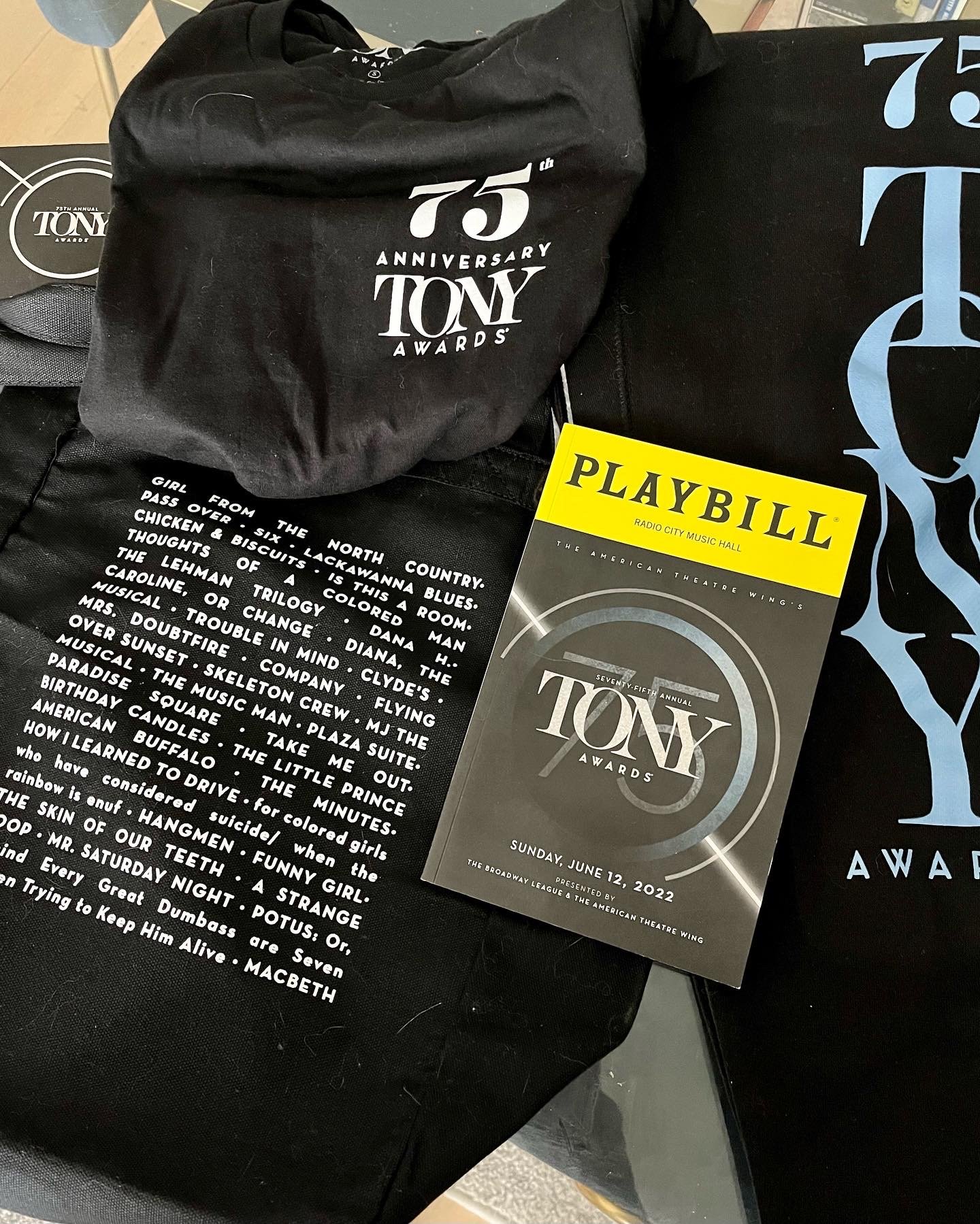
We all received a thick souvenir Playbill and there was merchandise you could only get there. I bought a tote bag and t-shirt that had the 75th Anniversary logo on the front and all the shows that had opened that season on the back, as well as sweatpants with the Tony Awards logo.

This year I will be watching at home again. I don’t know if I will ever be able to attend the Tony Awards in person in the future, but I certainly hope so! But if not, I will always have the memories of what it was like to be a part of that special crowd on the most important night of the entire Broadway season in June of 2022.
The Museum of Broadway

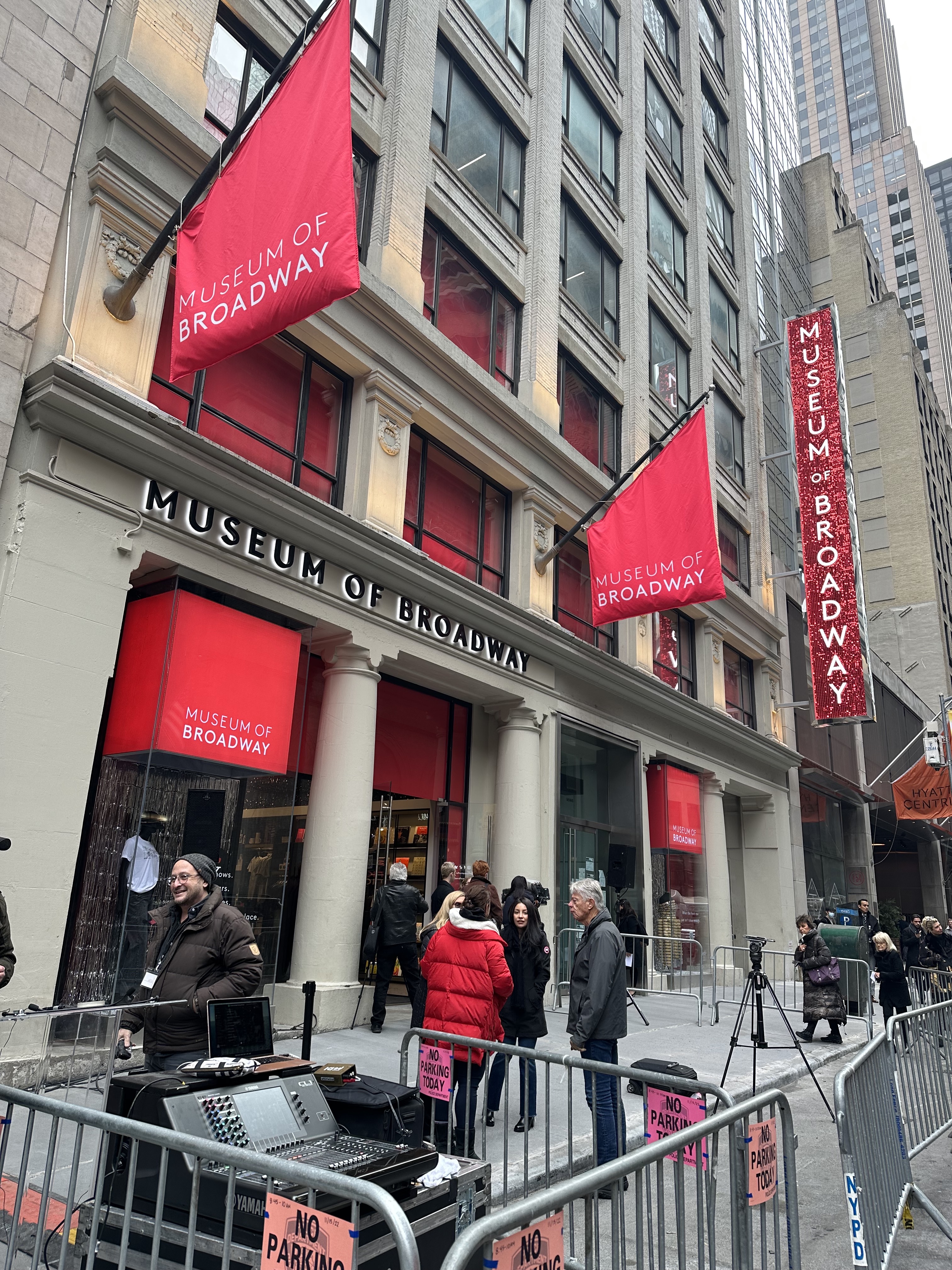
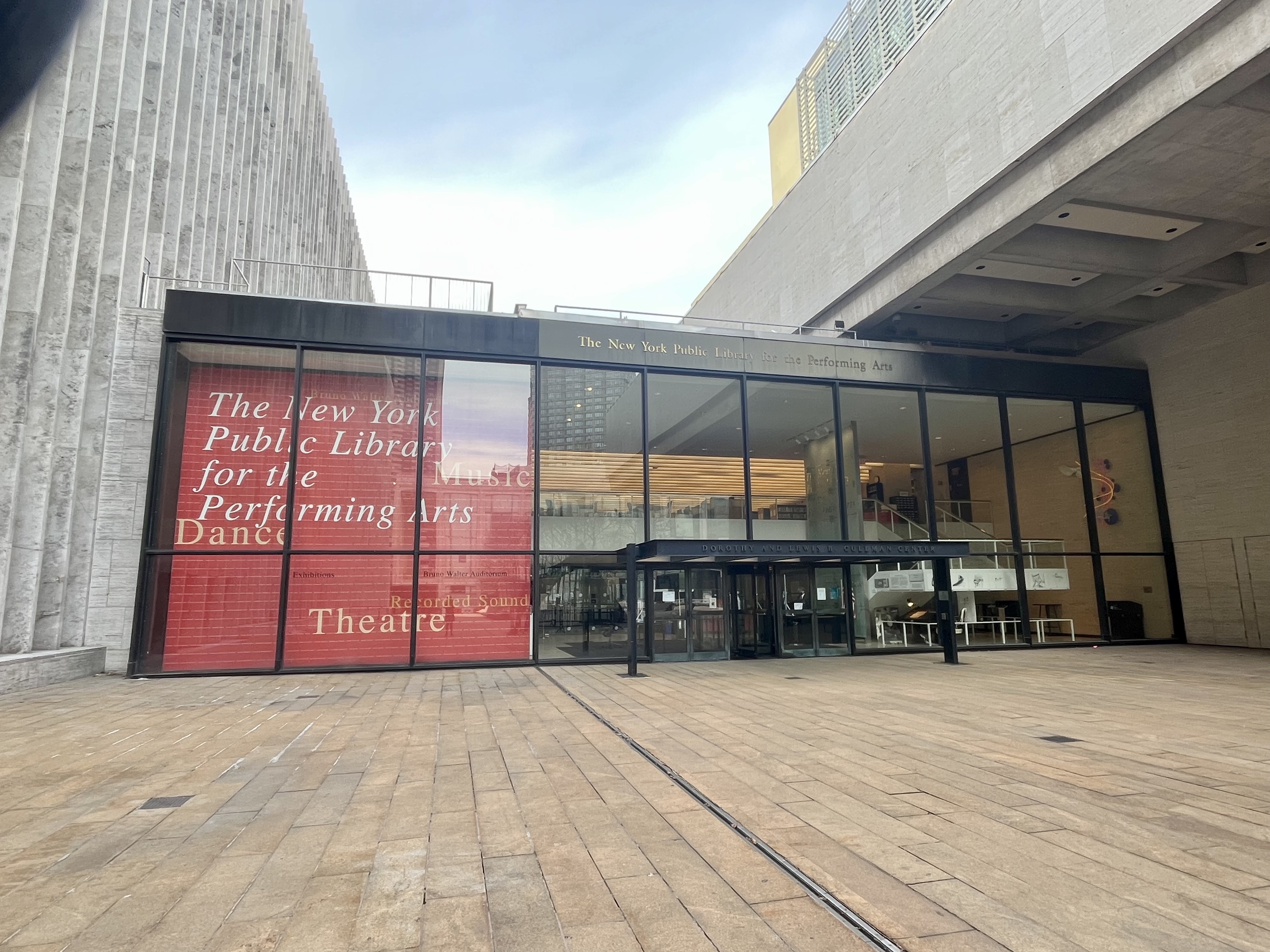
There have always been good exhibits about Broadway theatre around the city that come and go. The Performing Arts Library has excellent displays – some more elaborate, like the Hal Prince exhibit a few years ago, and some as quick pop-ups like the one honoring Stephen Sondheim via his correspondence set up after his death almost a year ago. There was a terrific temporary exhibit about costumes around the time Broadway reopened after pandemic. And many theatres themselves have displays of old show art or even props or costumes from productions that have been in that theatre. But when I heard people were planning to create a permanent Museum of Broadway, I thought that was a splendid idea and knew I wanted to be there as soon as they opened. I was fortunate enough to be there on opening day, and thoroughly enjoyed myself.

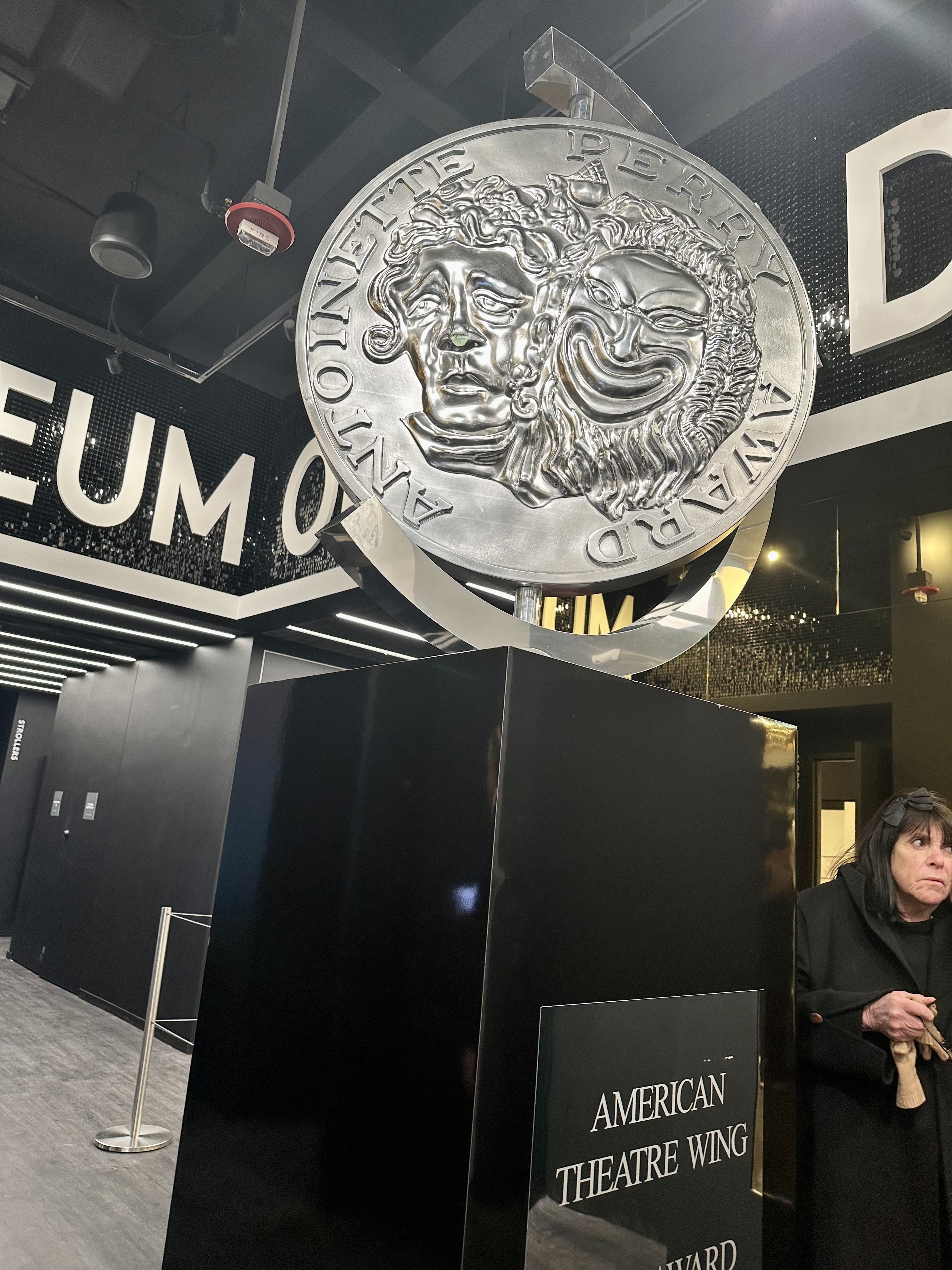
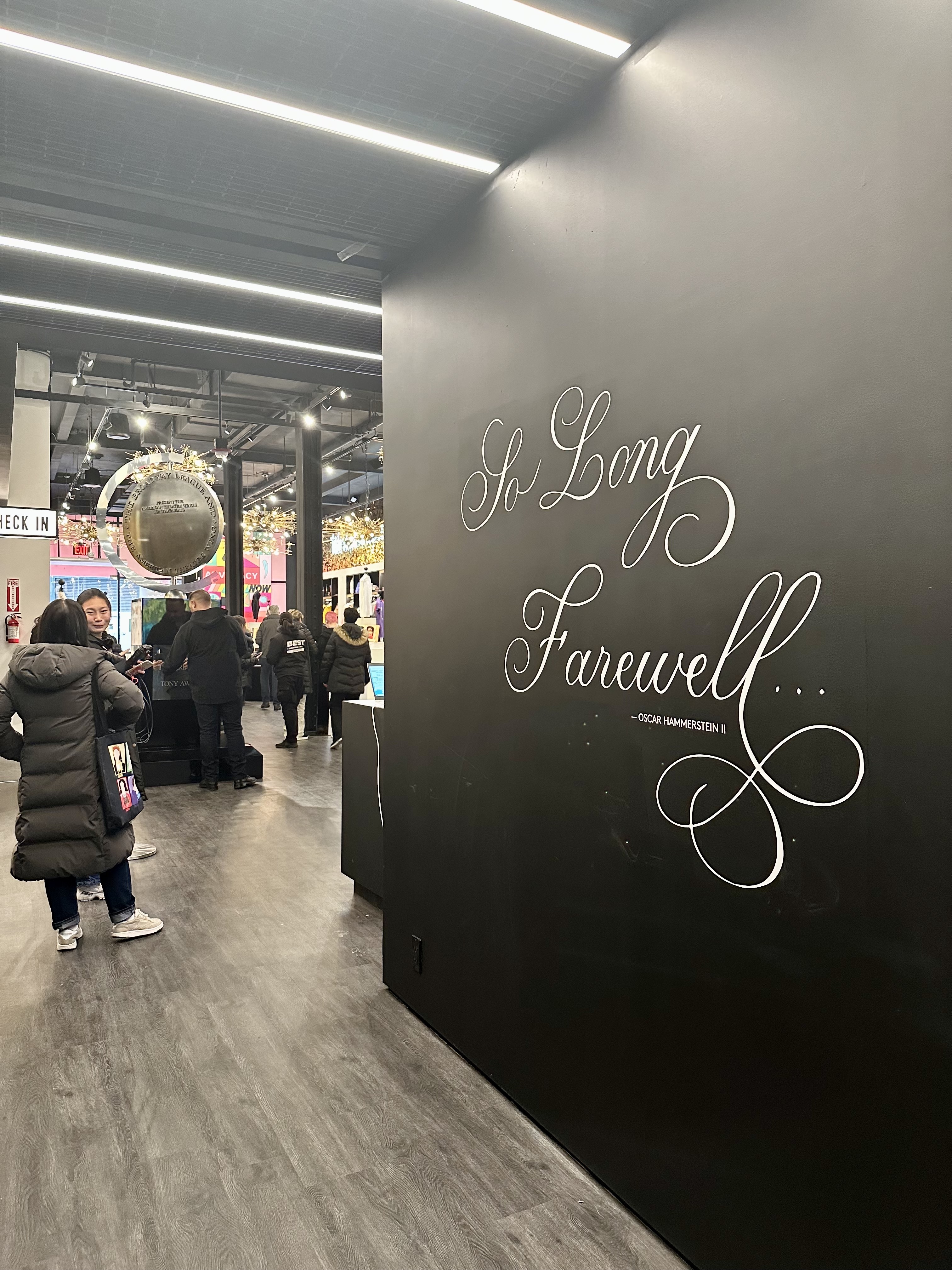
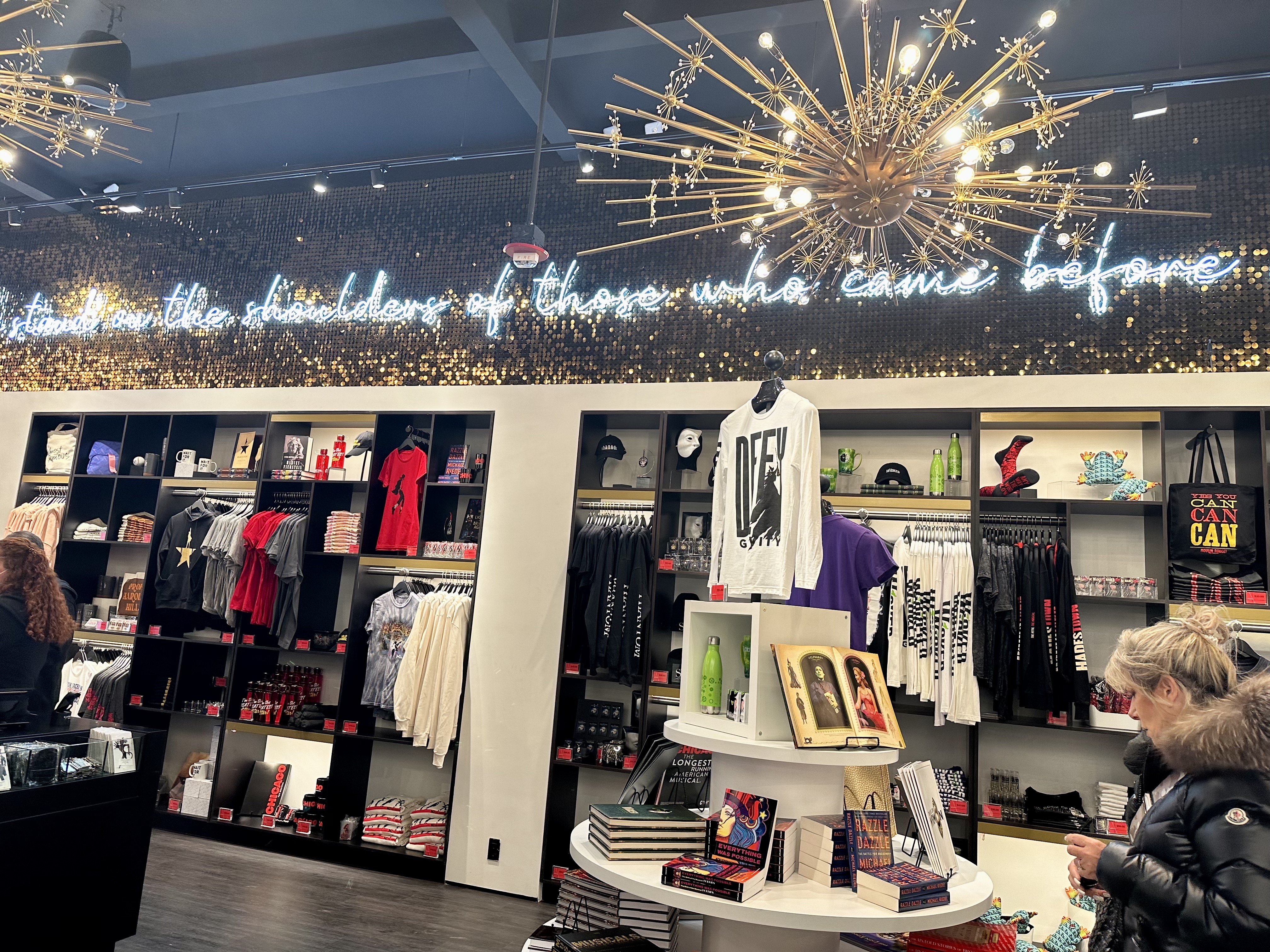
The museum is on West 45th between Seventh and Sixth Avenues, right next to the Lyceum. You walk in through the gift shop (will exit there as well, two chances to shop!), head toward the giant Tony Award, and either purchase a ticket or scan in if you have purchased in advance.

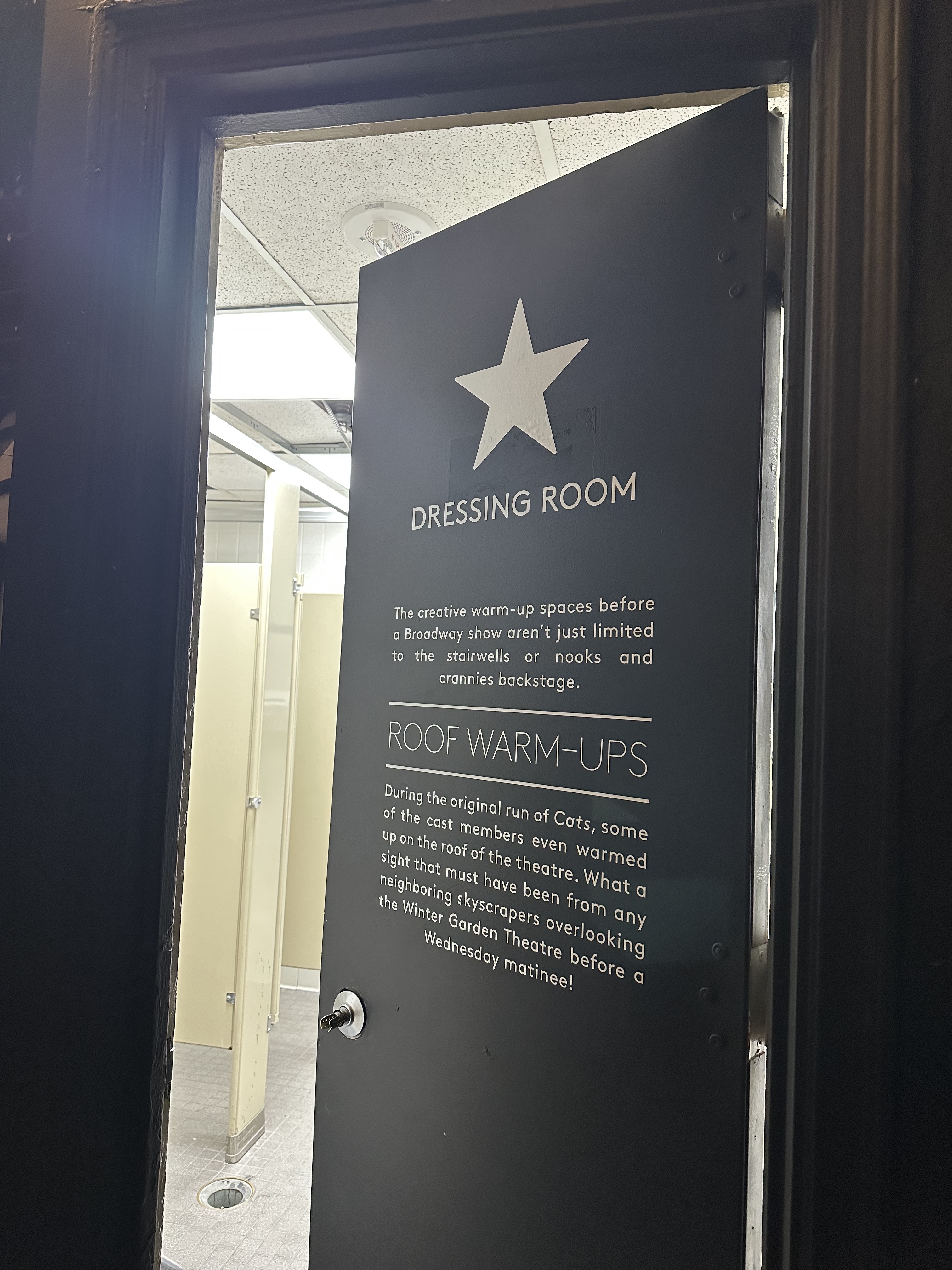
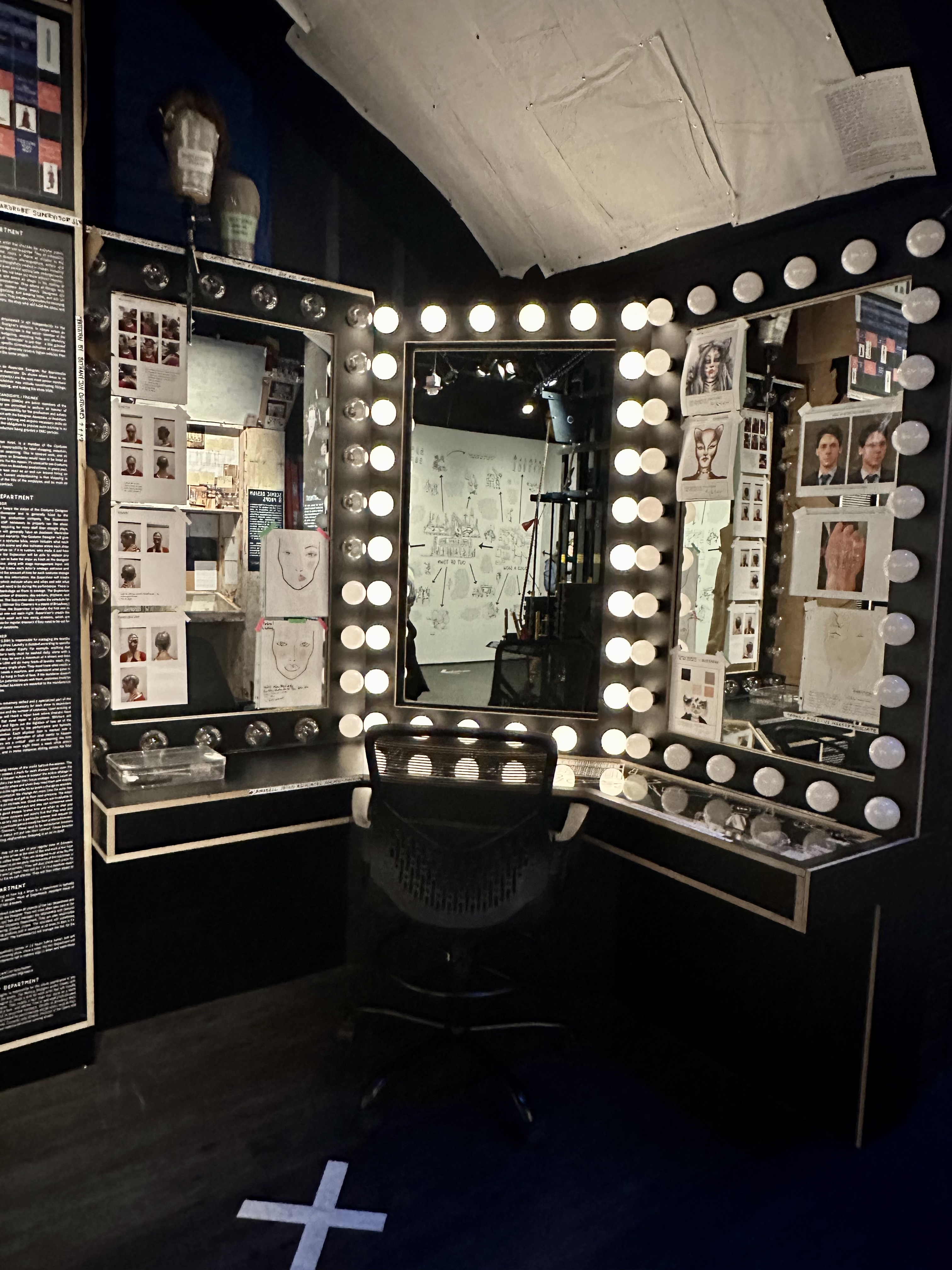
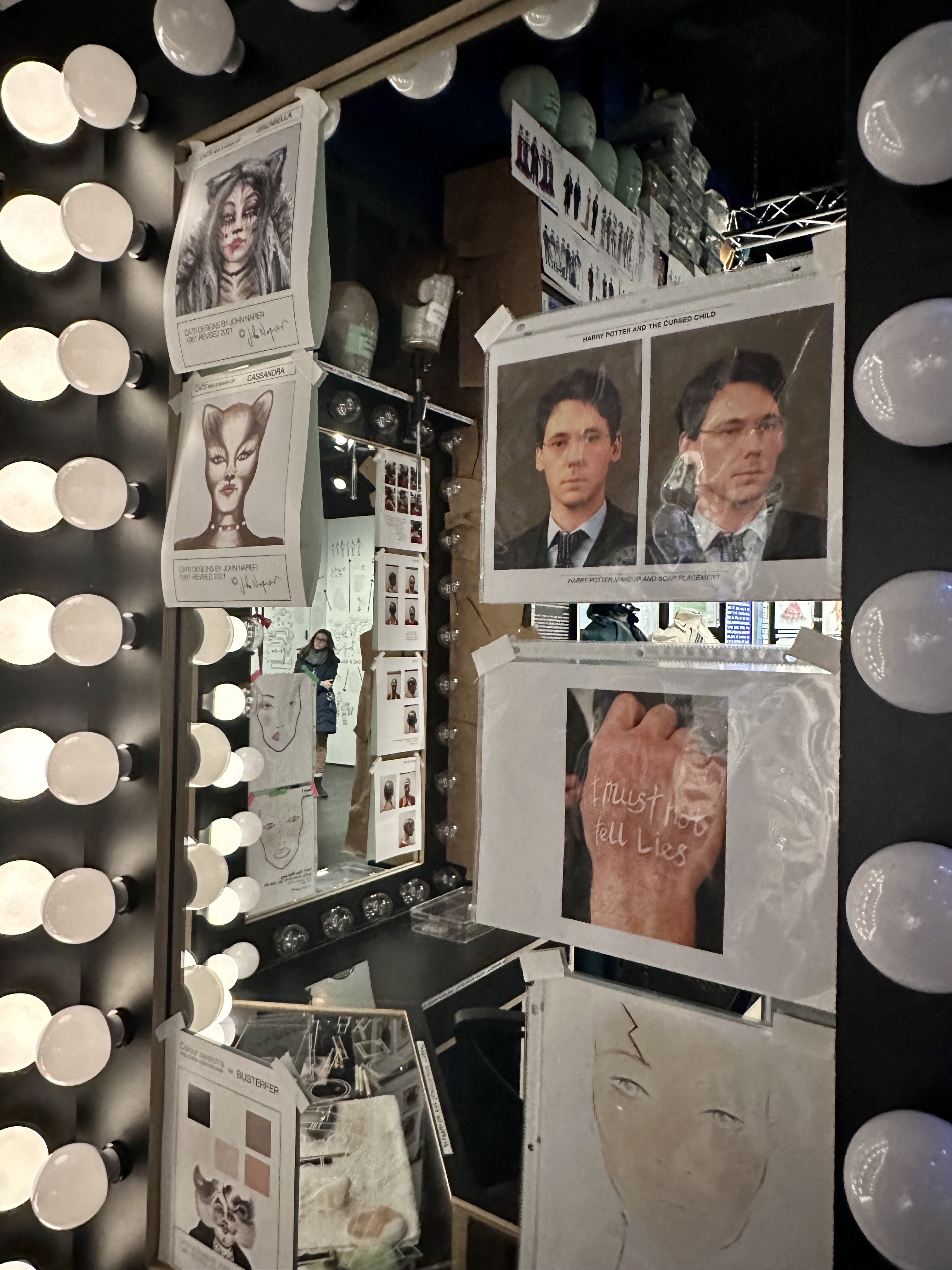
Everything is completely themed – so when you are entering through a stairwell, you see information about warmups in stairwells before a show, backstage traditions, and even the bathrooms are disguised as dressing rooms.

The first room has a poster for every Broadway theatre, and information about the show currently there, as well as a QR code to go through to purchase tickets to the show. If an theatre is currently empty, the poster is blank, so this room will need to be constantly updated as shows come and go. You can see a video of this room here. I noted that the small group of people who saw 15 or more shows in a given year (and I am quite definitely in that group!) account for 28% of all tickets sold. And only 35% of tickets sales on Broadway are to New Yorkers like myself, so you quickly realize the importance of tourist dollars to the Broadway economy.

You might wait a bit to be let into the next room, as it features a lovely short film about the history of the Times Square theatre area. They let groups of people in at a time so that those enjoying the film aren’t constantly interrupted by people coming or going, and I appreciated that.

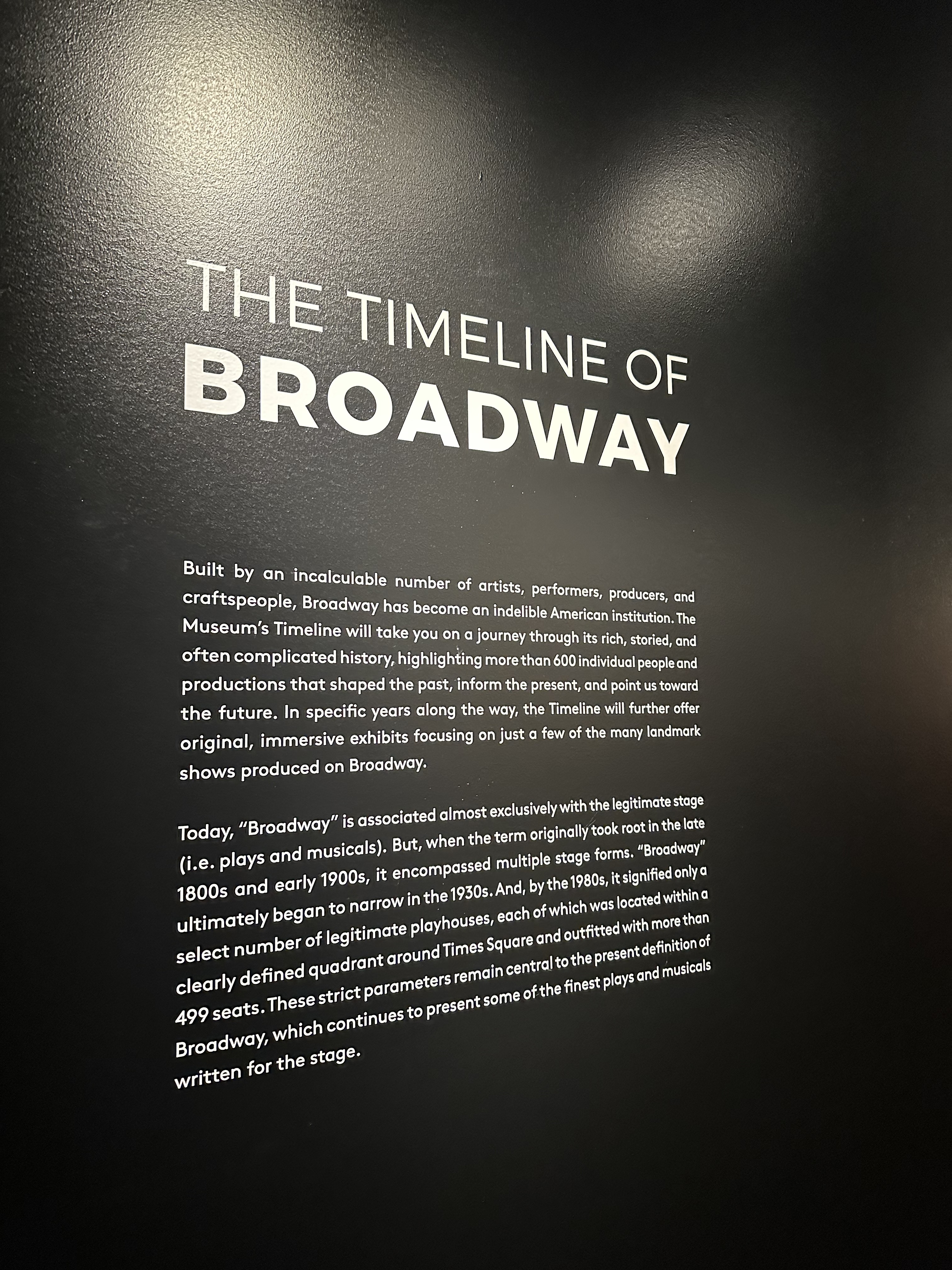
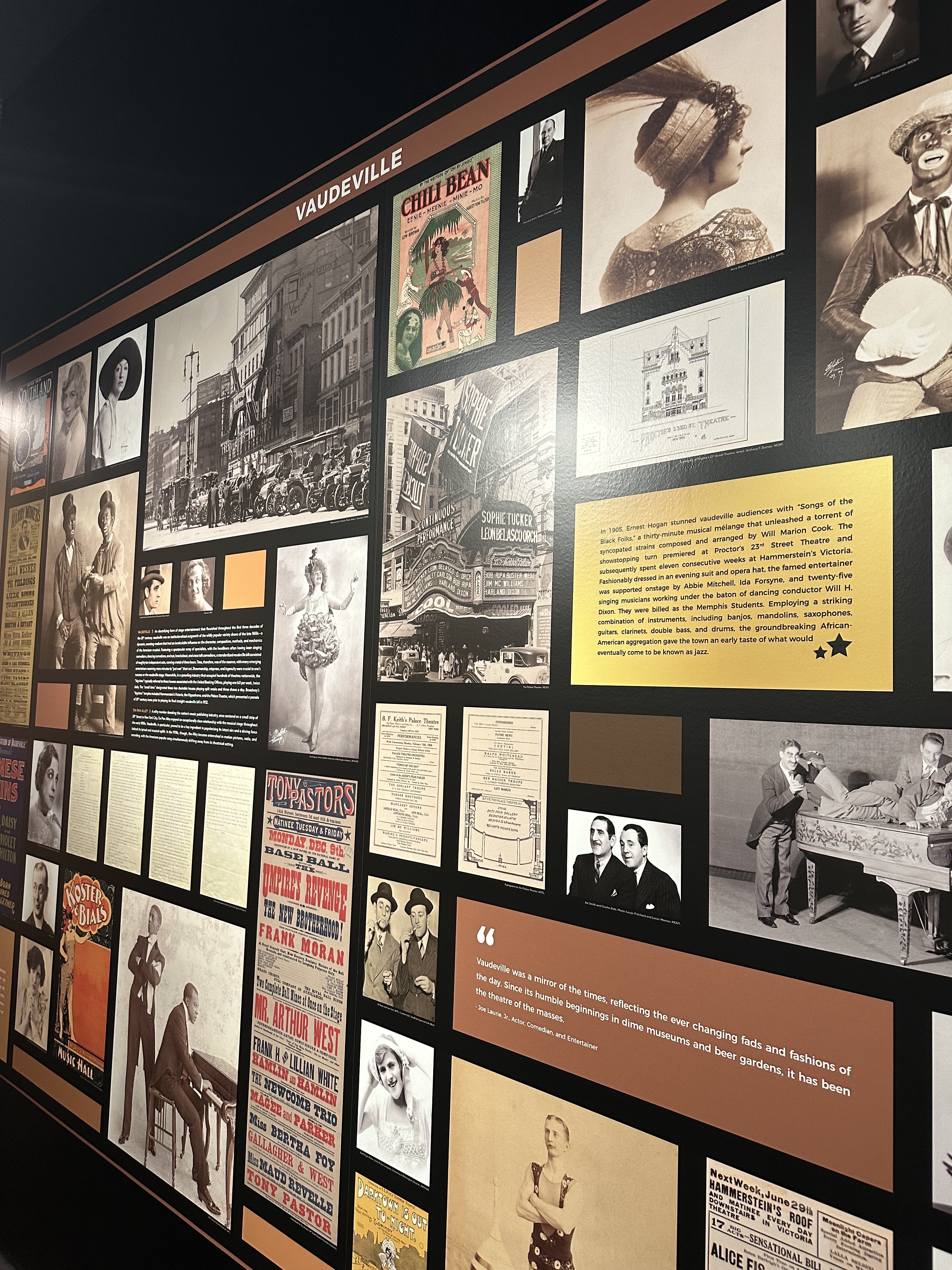
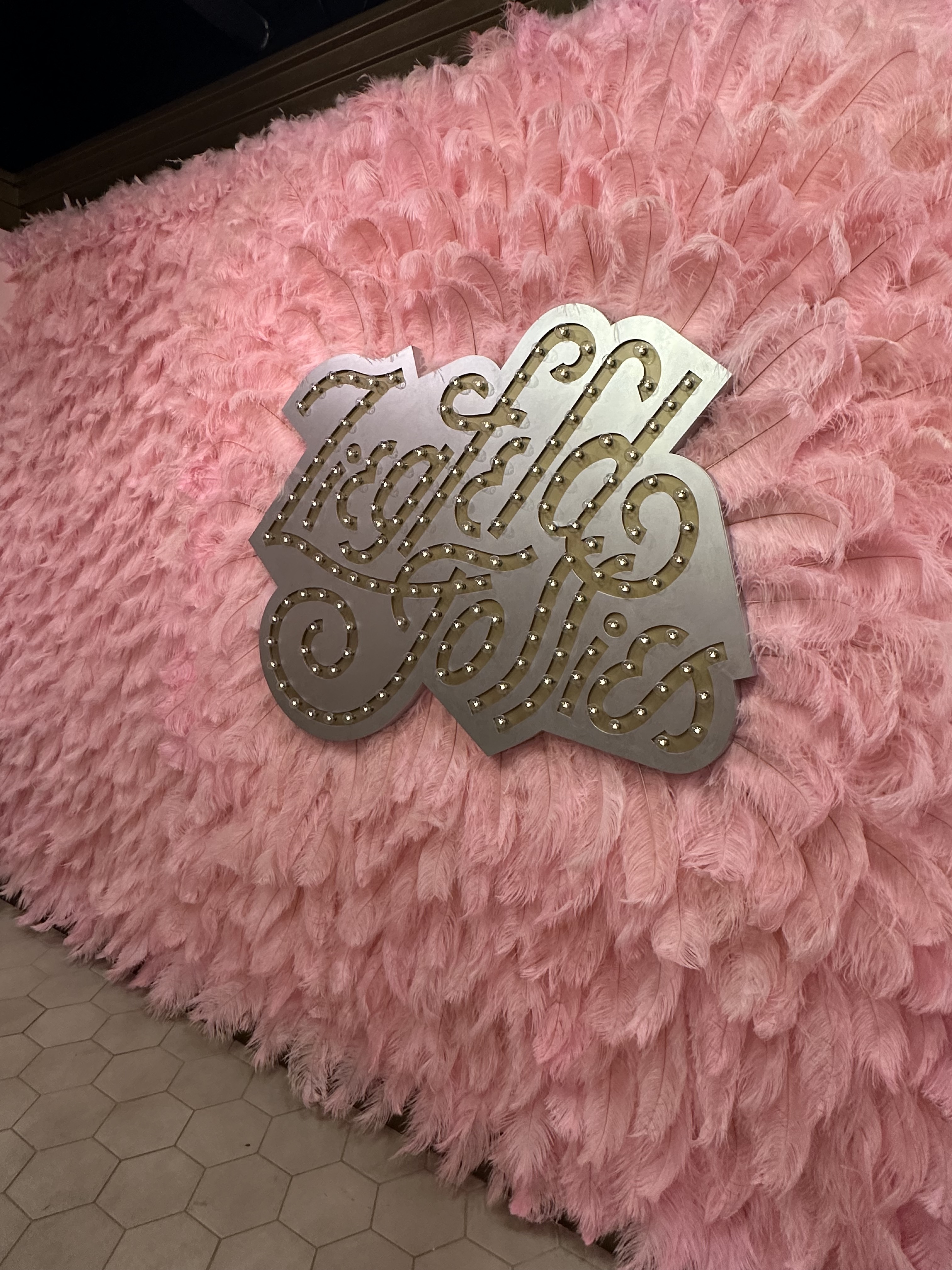
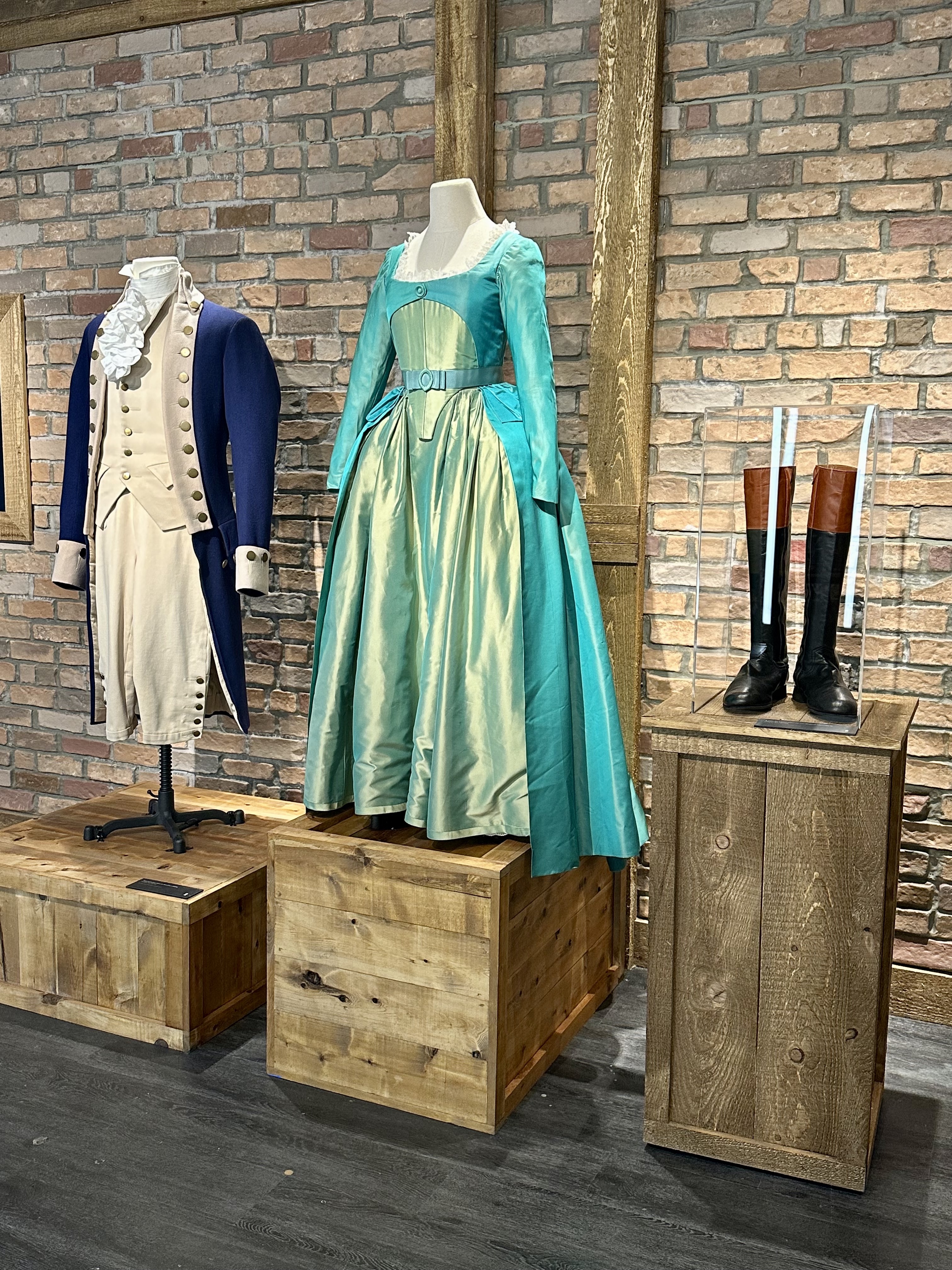
Then you begin the main portion of the museum, which is a timeline of Broadway. Each time period features costumes, props, information, and interactive displays with which to explore that era. The first was of course the vaudeville/Ziegfeld Follies period.

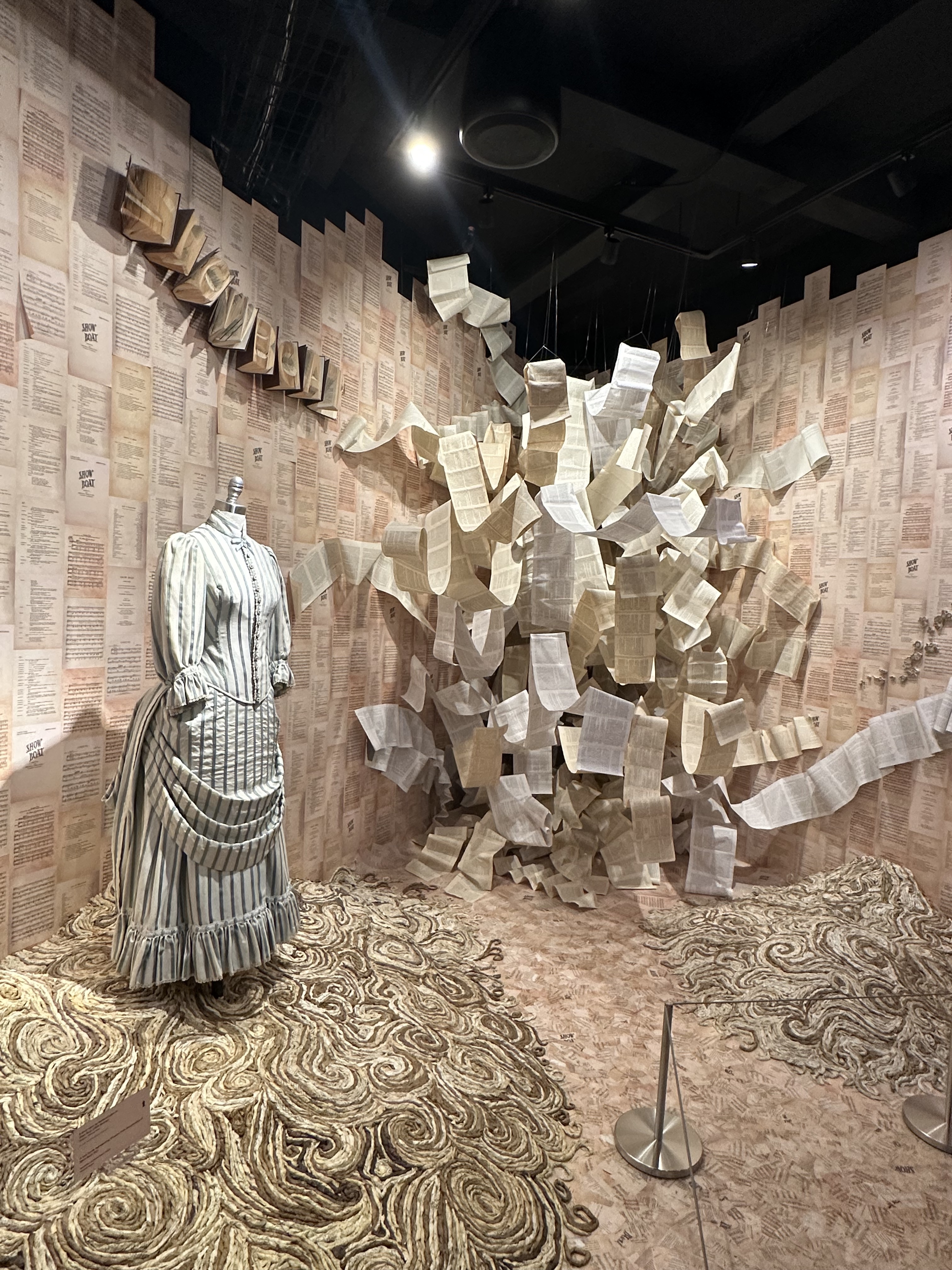
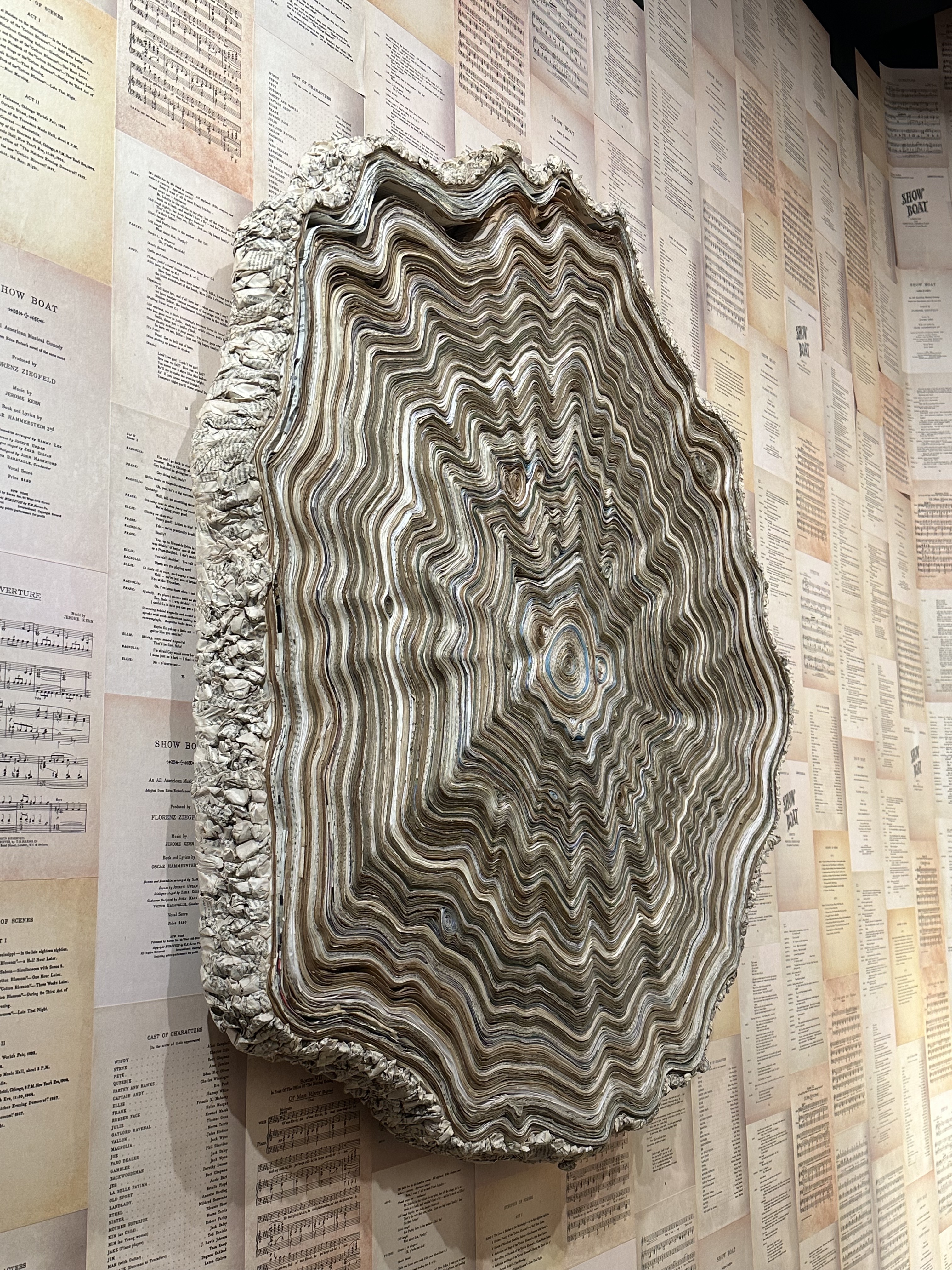
The next section featured Show Boat, often considered to be the first true musical theatre piece (rather than a revue). The cross section is of a tree trunk showing the time between 1927 when Show Boat first was produced, and 2022, the opening of the Museum of Broadway

The next section featured the “golden age” musicals such as Oklahoma, and the beginning of the Tony Awards.

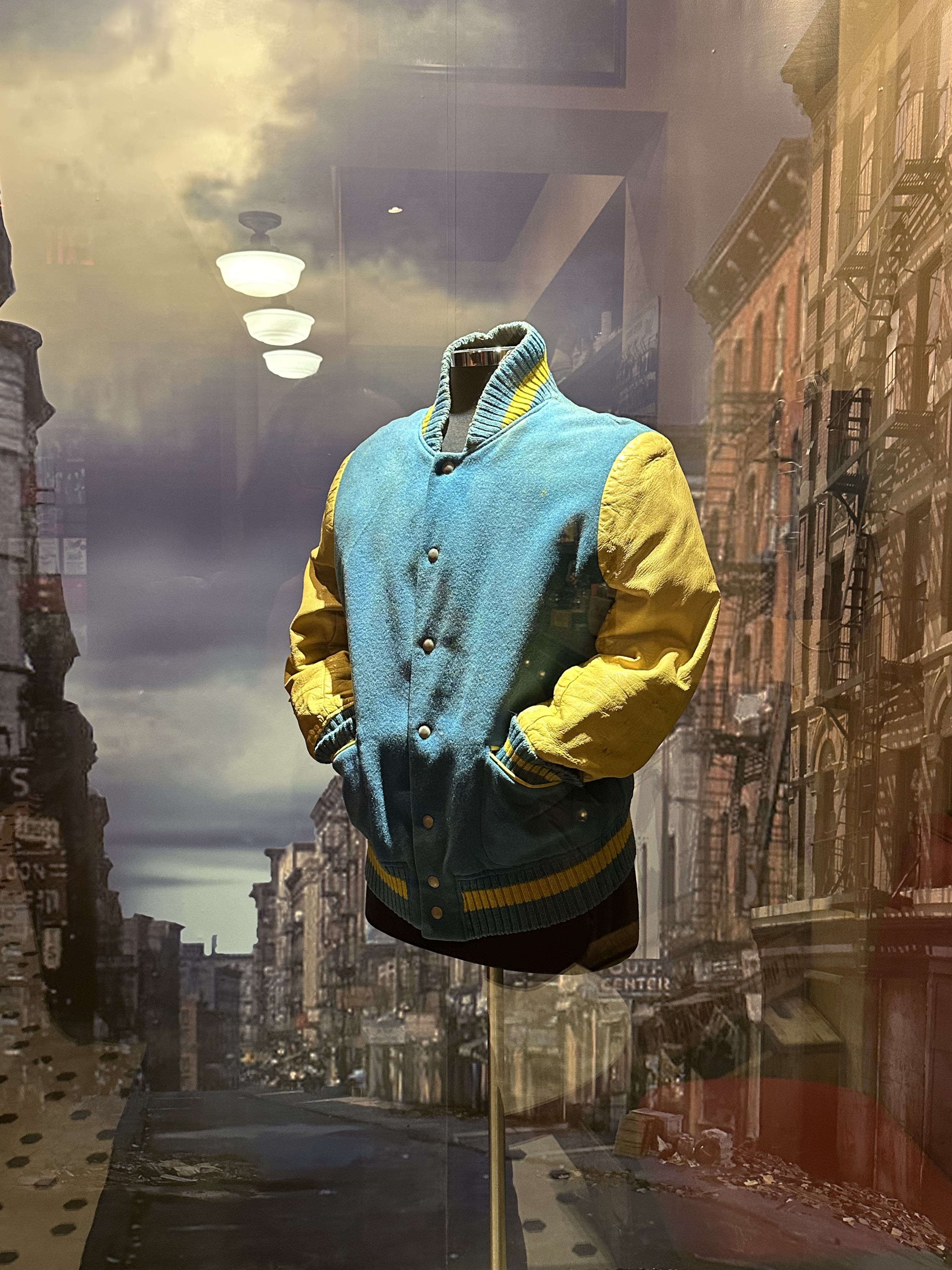
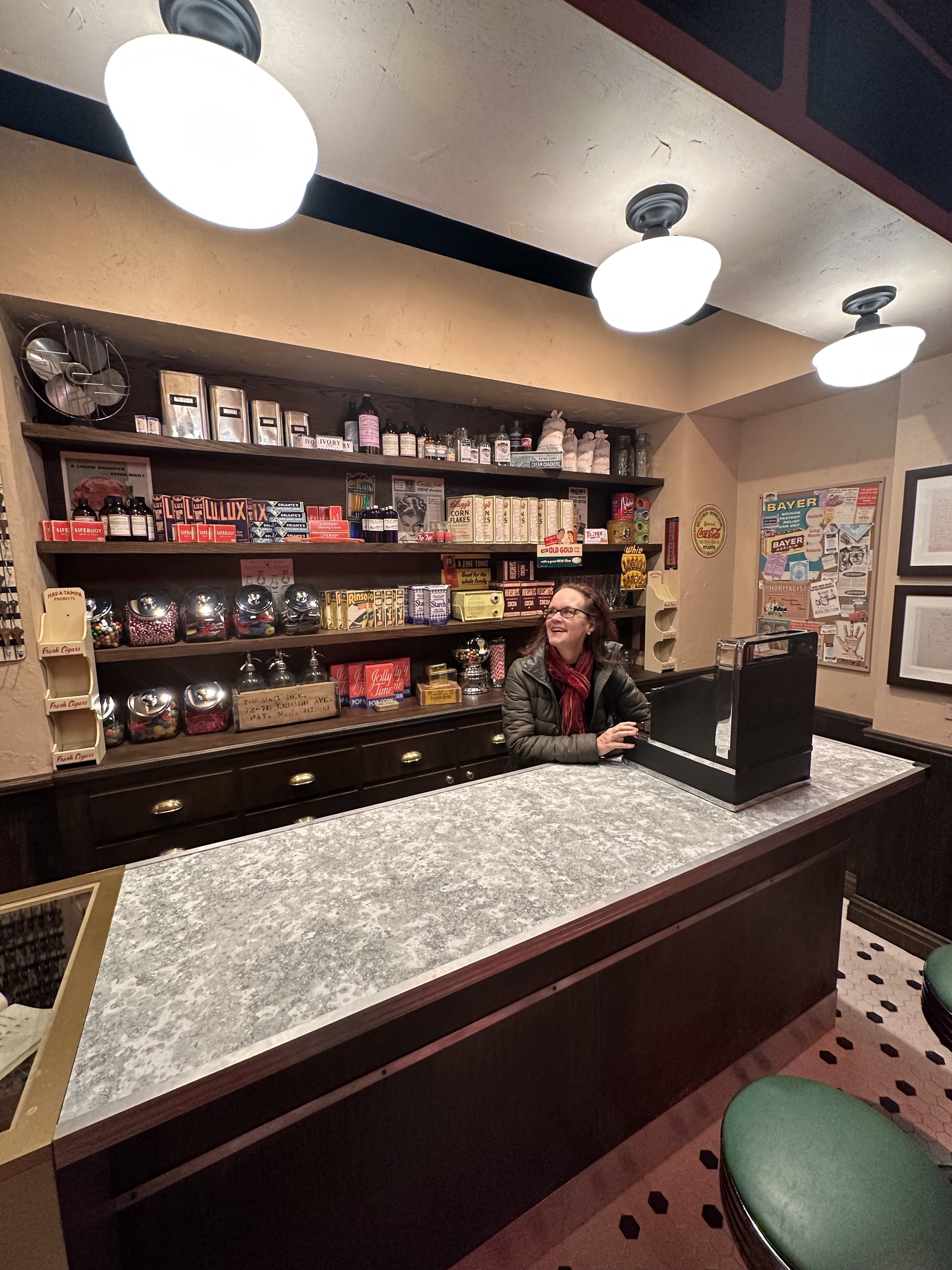
Moving forward in time, there was a wonderful room dedicated to West Side Story, including a video highlighting the choreography. This was one of the many places you could insert yourself into the set, here behind Doc’s counter.

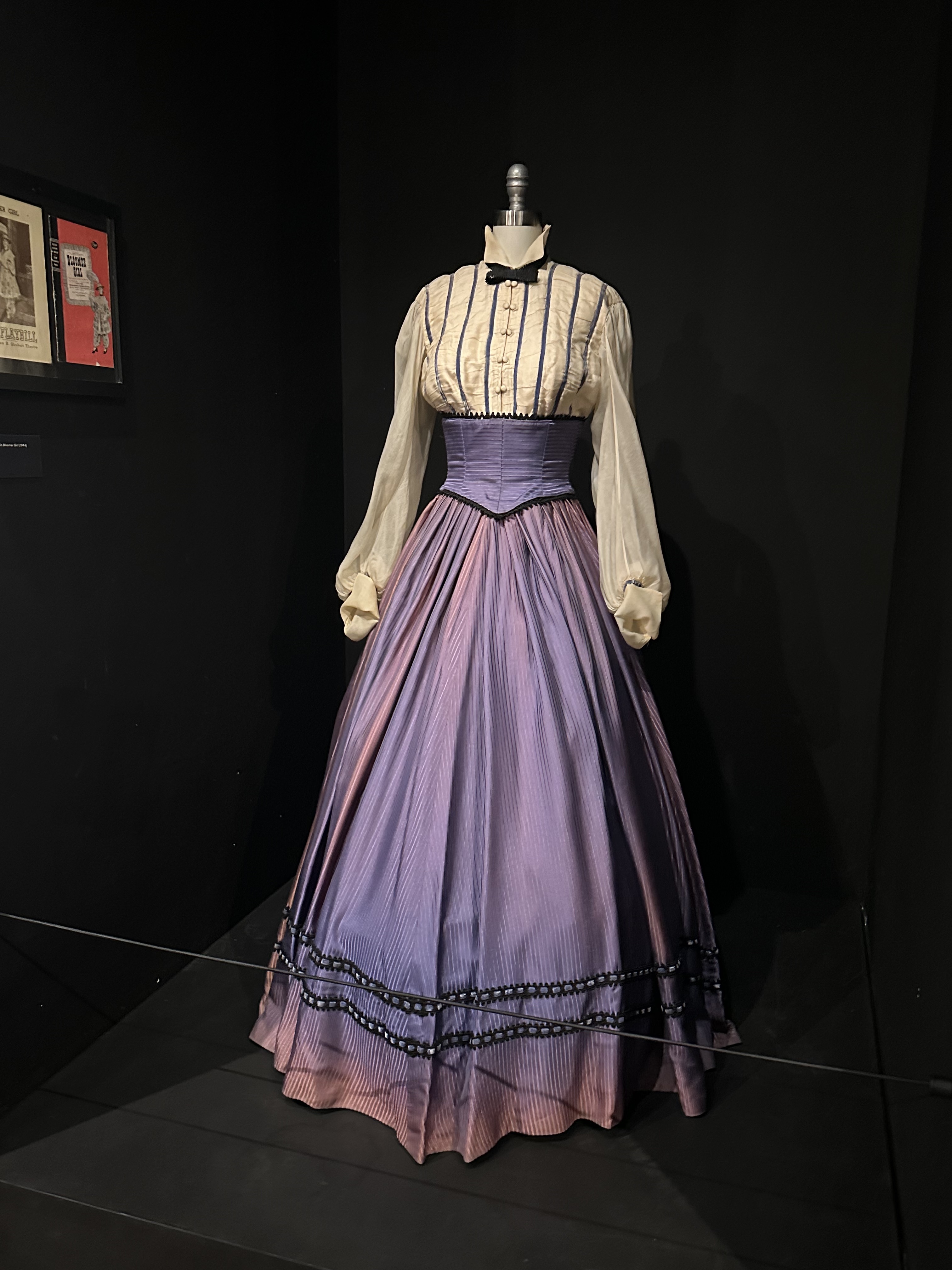
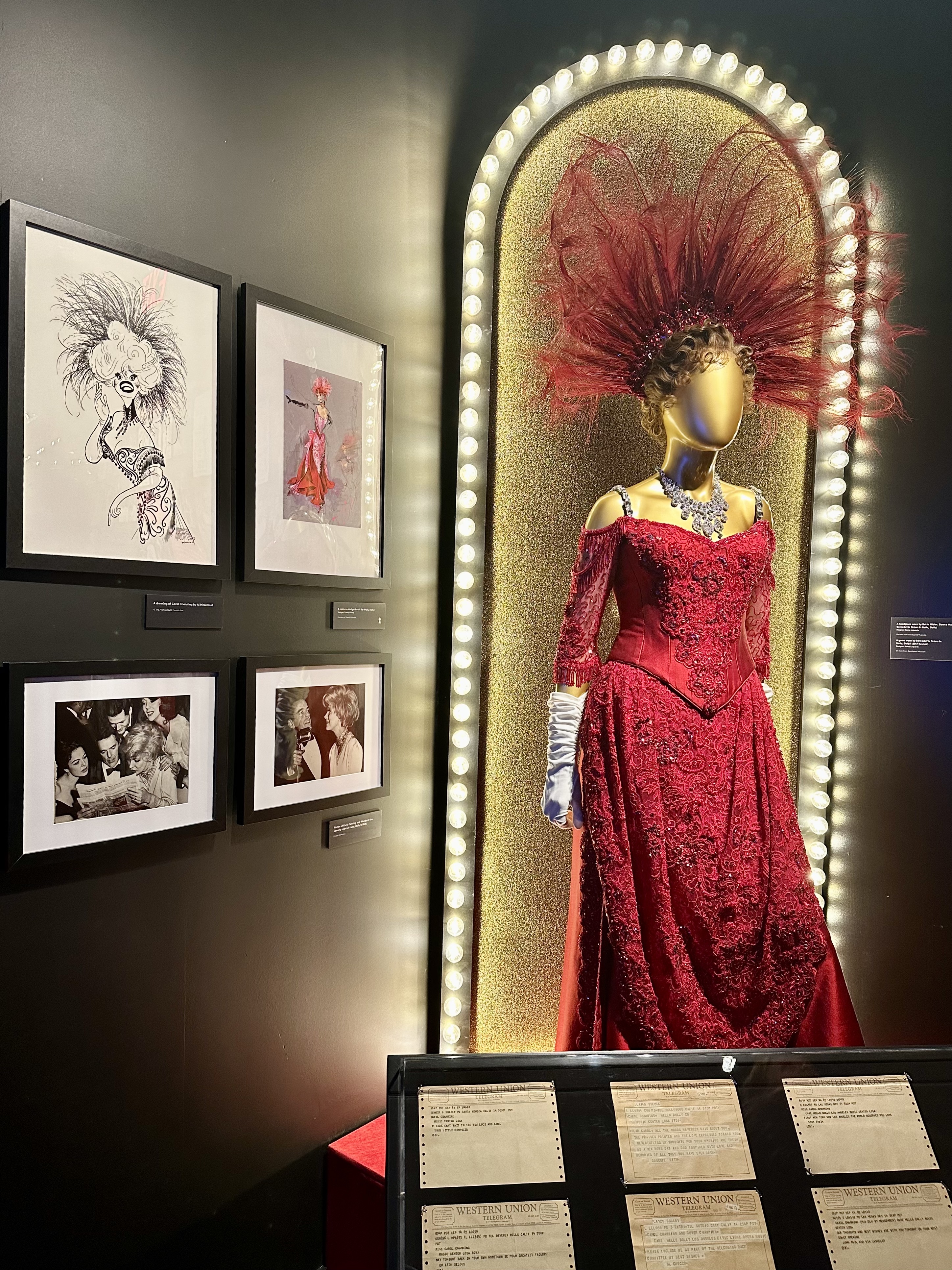
The next era included Cabaret, Hello Dolly and Hair (these costumes from the 2009 revival).

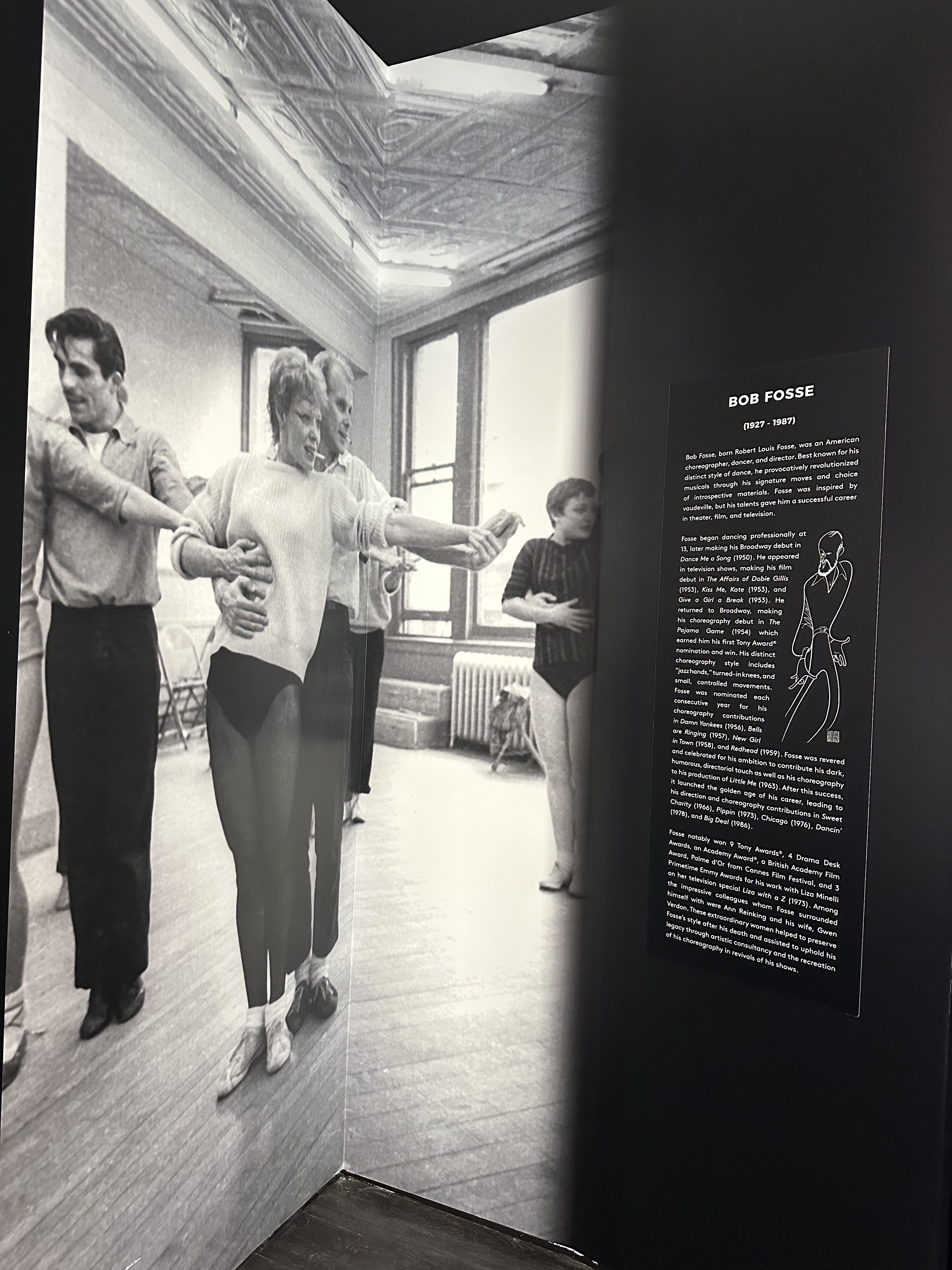
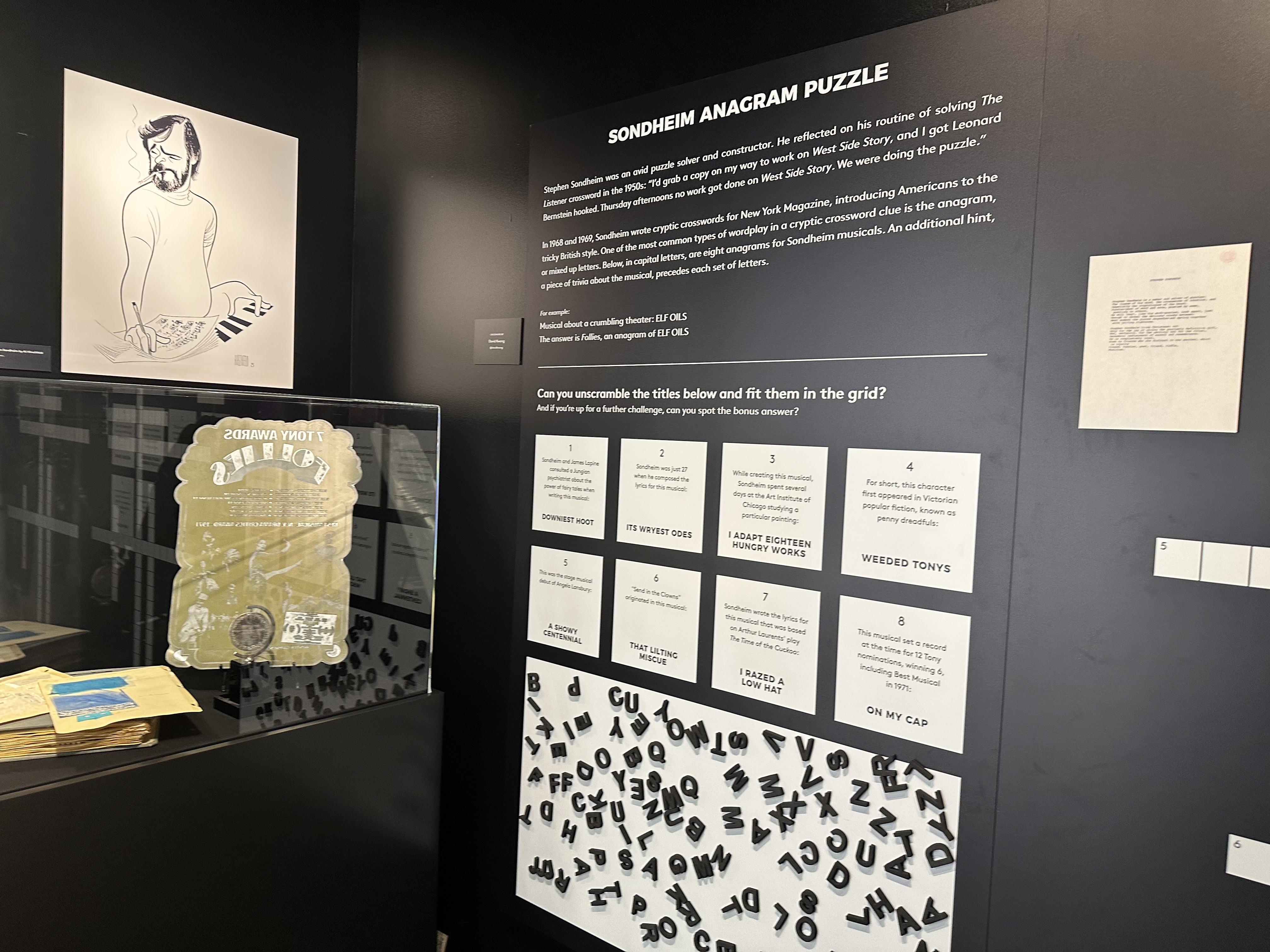
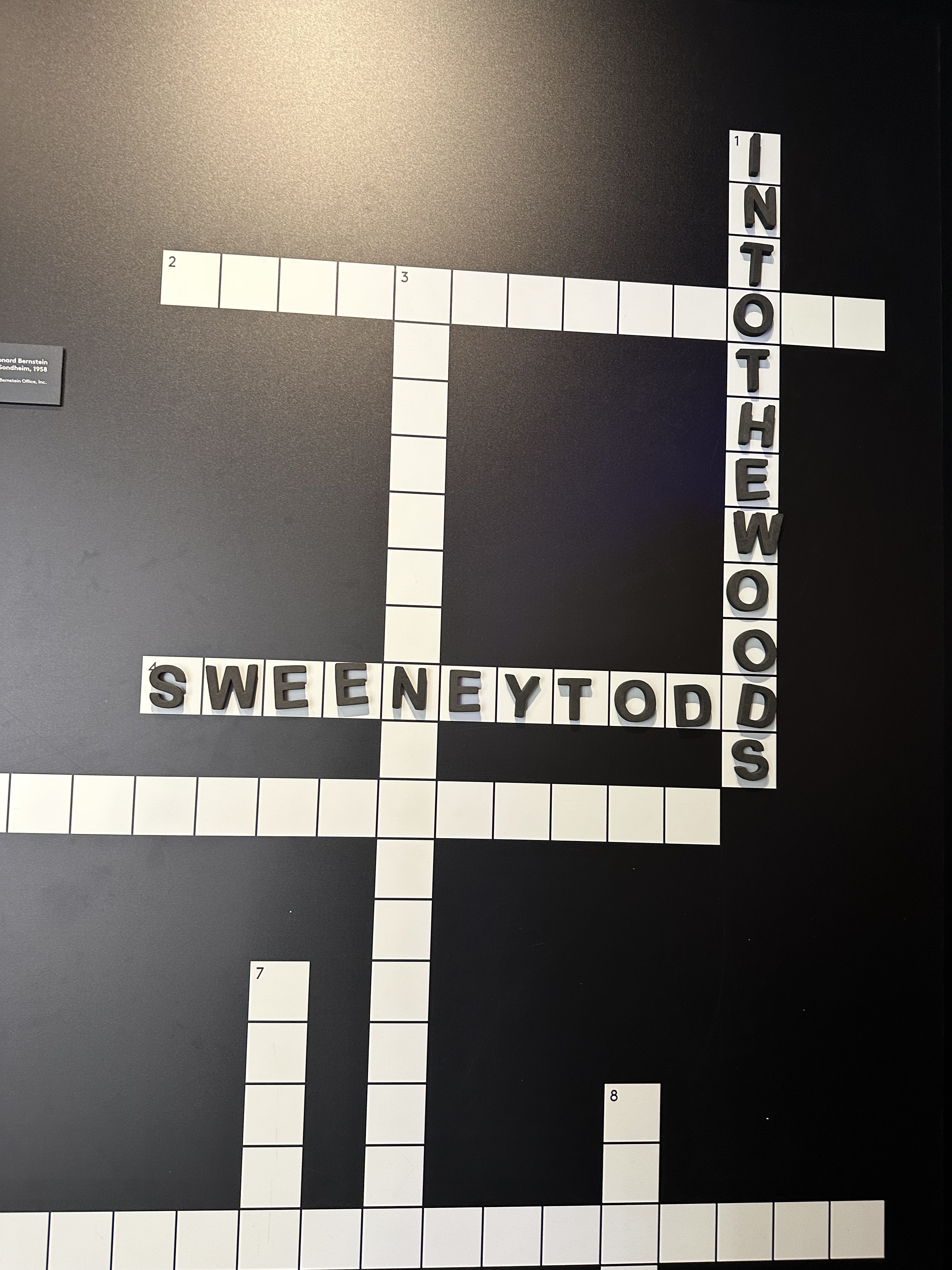
Interspersed with shows of the time were information and interactive exhibits about people who did important work in the time being portrayed (Hal Prince above, for example, or Bob Fosse and Stephen Sondheim here).

The large interactive exhibit about Company was in the timeline associated with when Company was first produced, but the sets shown here are from the recent Tony Award-winning revival (see a video of this room here.)

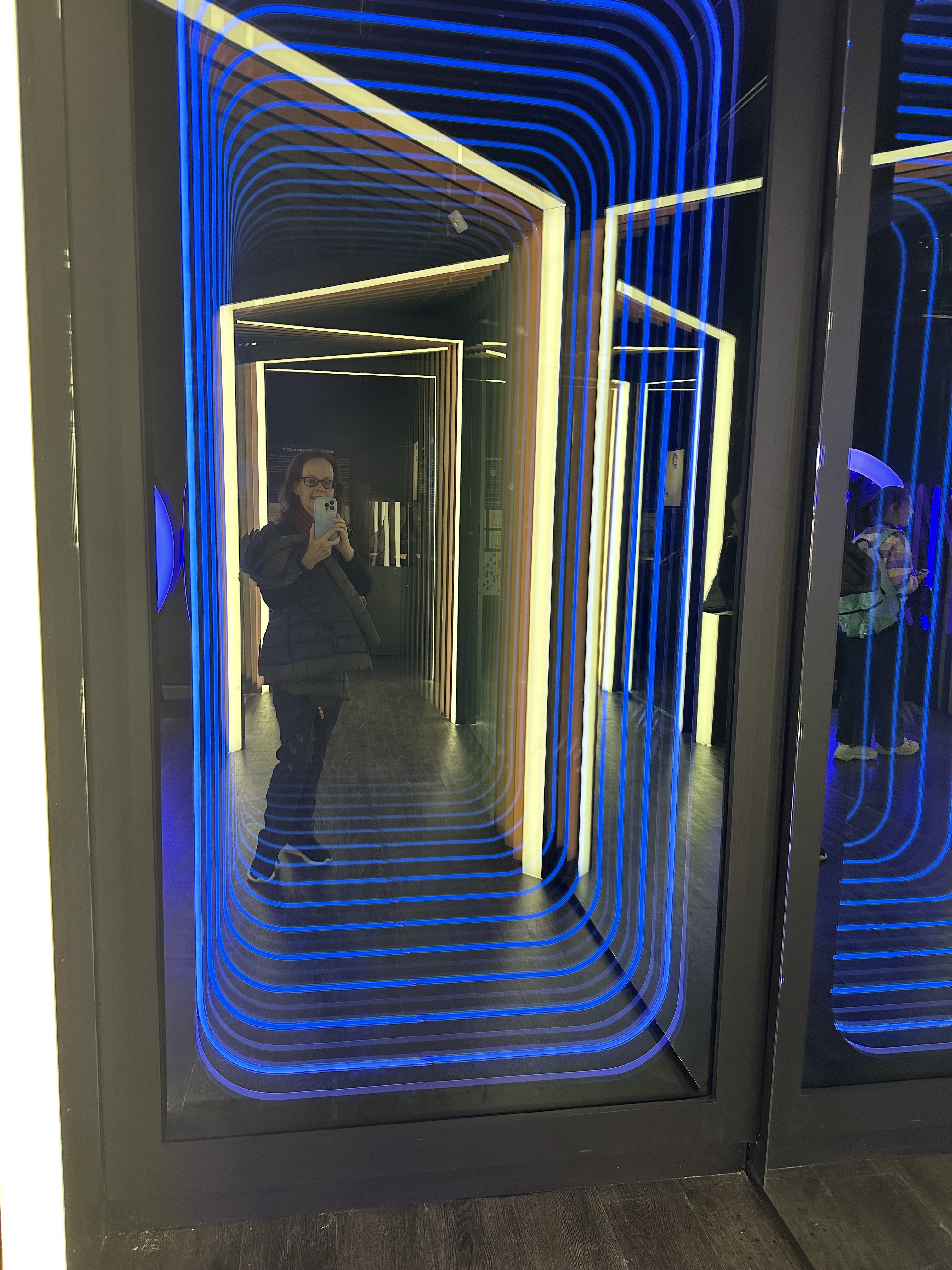
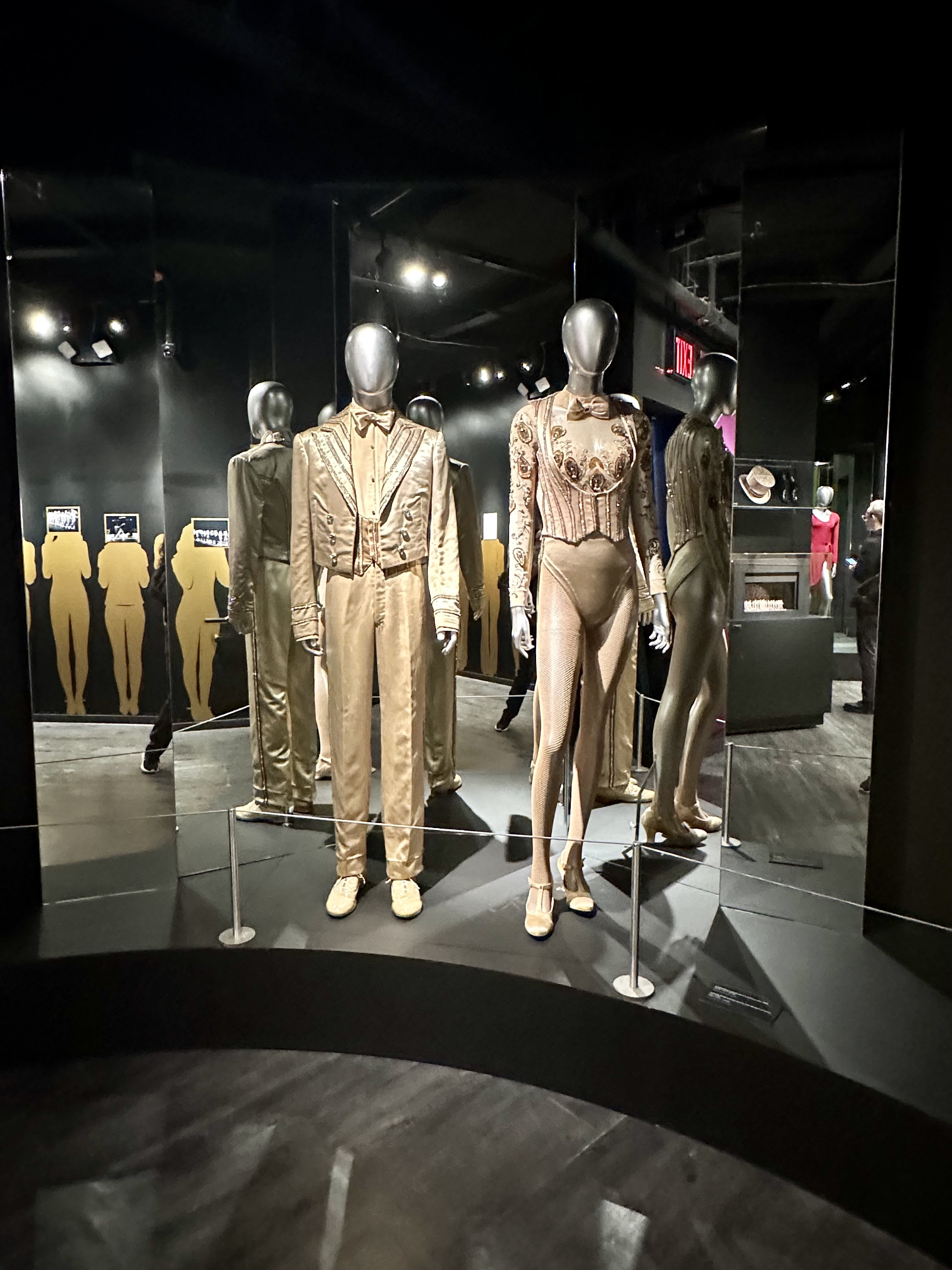
After “easing on down the road” from The Wiz, there was a large display about A Chorus Line, including this mirrored room, seen here on video.

After Annie, there was an interesting area about jukebox musicals, which are not all the same. As pointed out in the chart above, some are based on movies, others not, some feature the music of only one person/group (Mamma Mia, Jersey Boys MJ, A Beautiful Noise) and others of various artists (Moulin Rouge, Rock of Ages). They had a video screen showing clips from several of the jukebox musicals currently playing on Broadway that I expect will be changed out over time.

While Off-Broadway, The Public Theater has been an incubator for several shows that have gone on to Broadway. Continuing in time, there were small displays for Cats and La Cage Aux Folles.

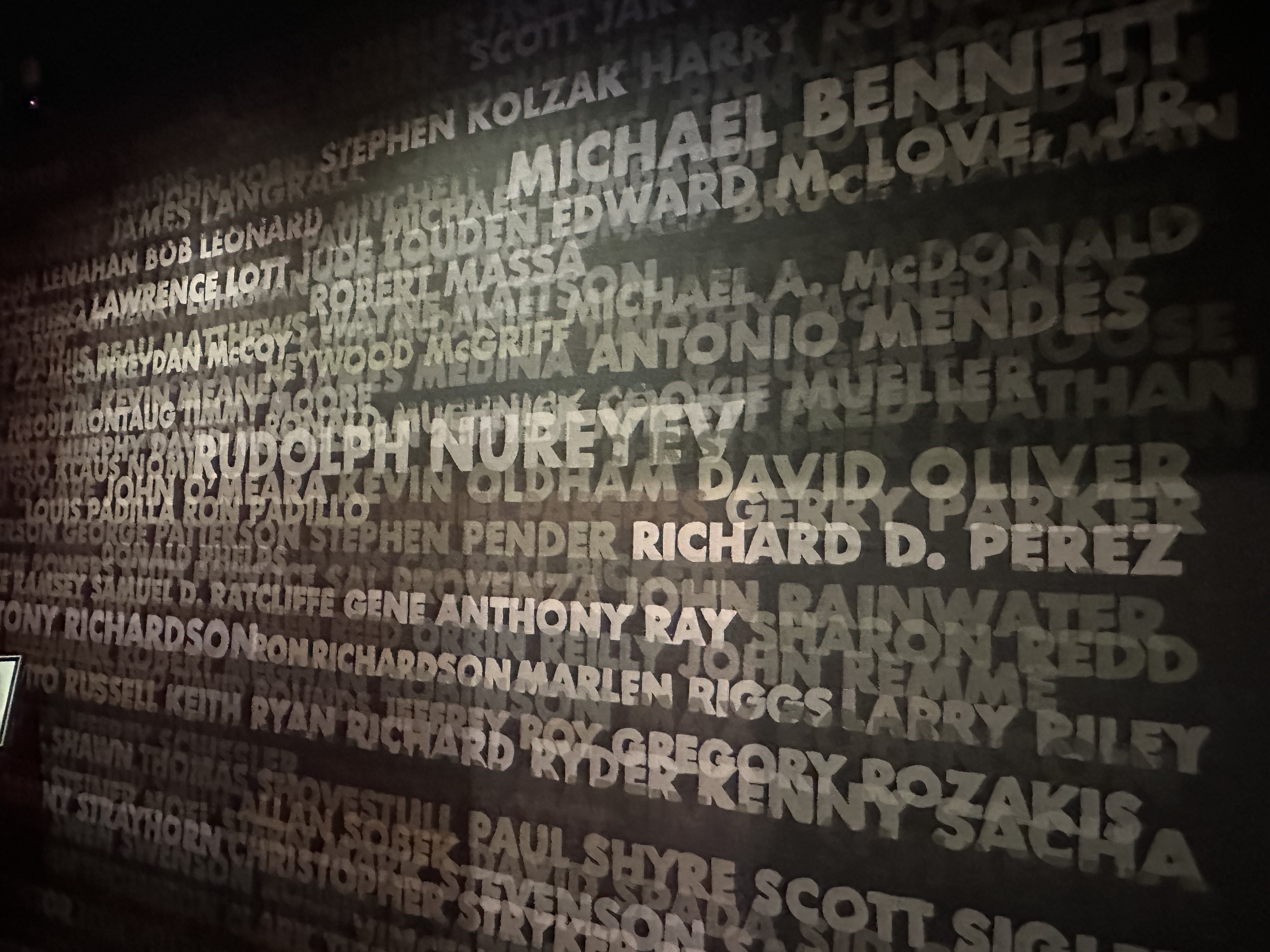
The next room underlines the impact of the AIDS crisis on the Broadway community, and the creation of Broadway Cares/Equity Fights AIDS. Red ribbons cascade down next to a two walls filled with names of those who died of AIDS in the creative community.

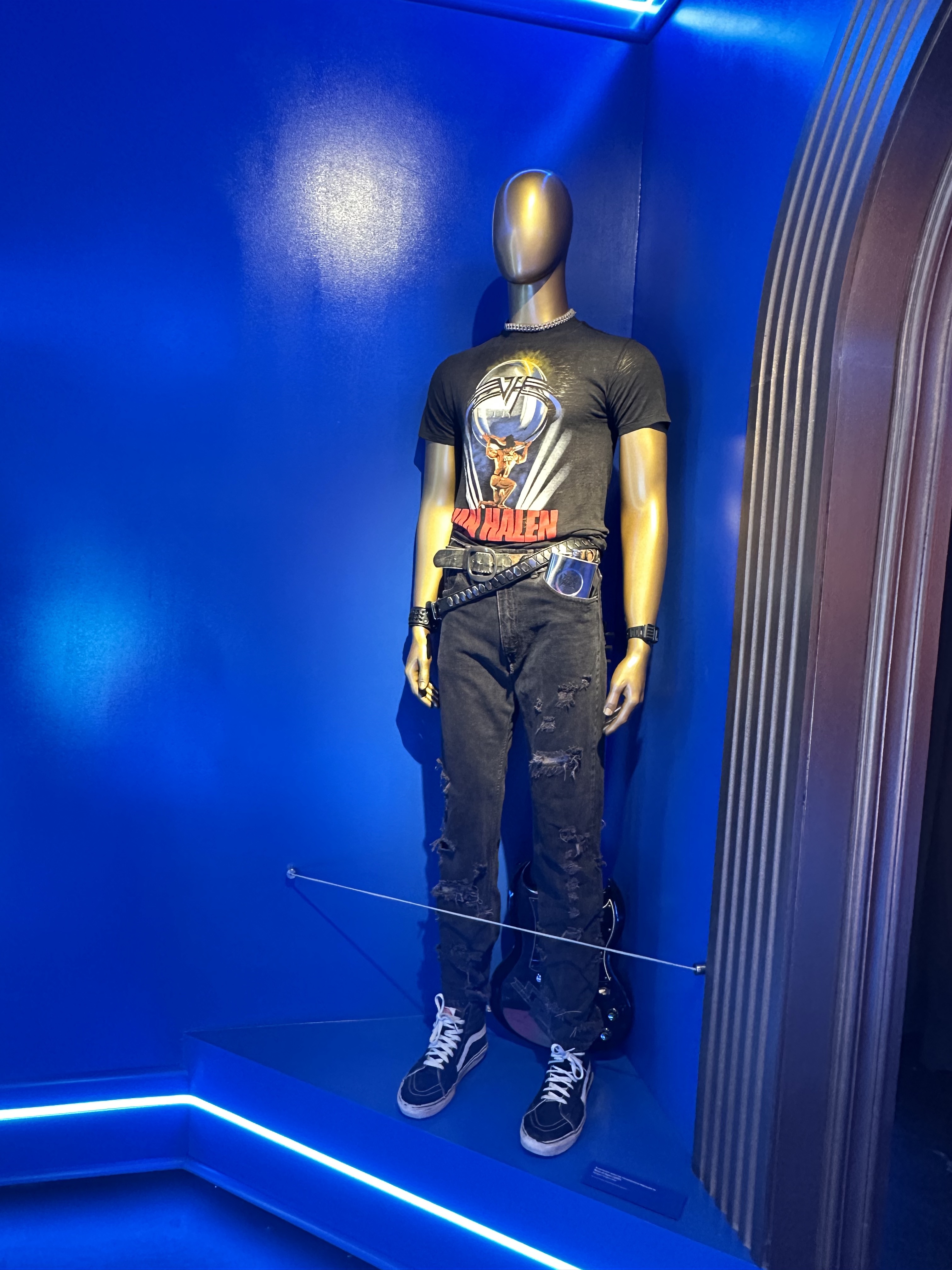
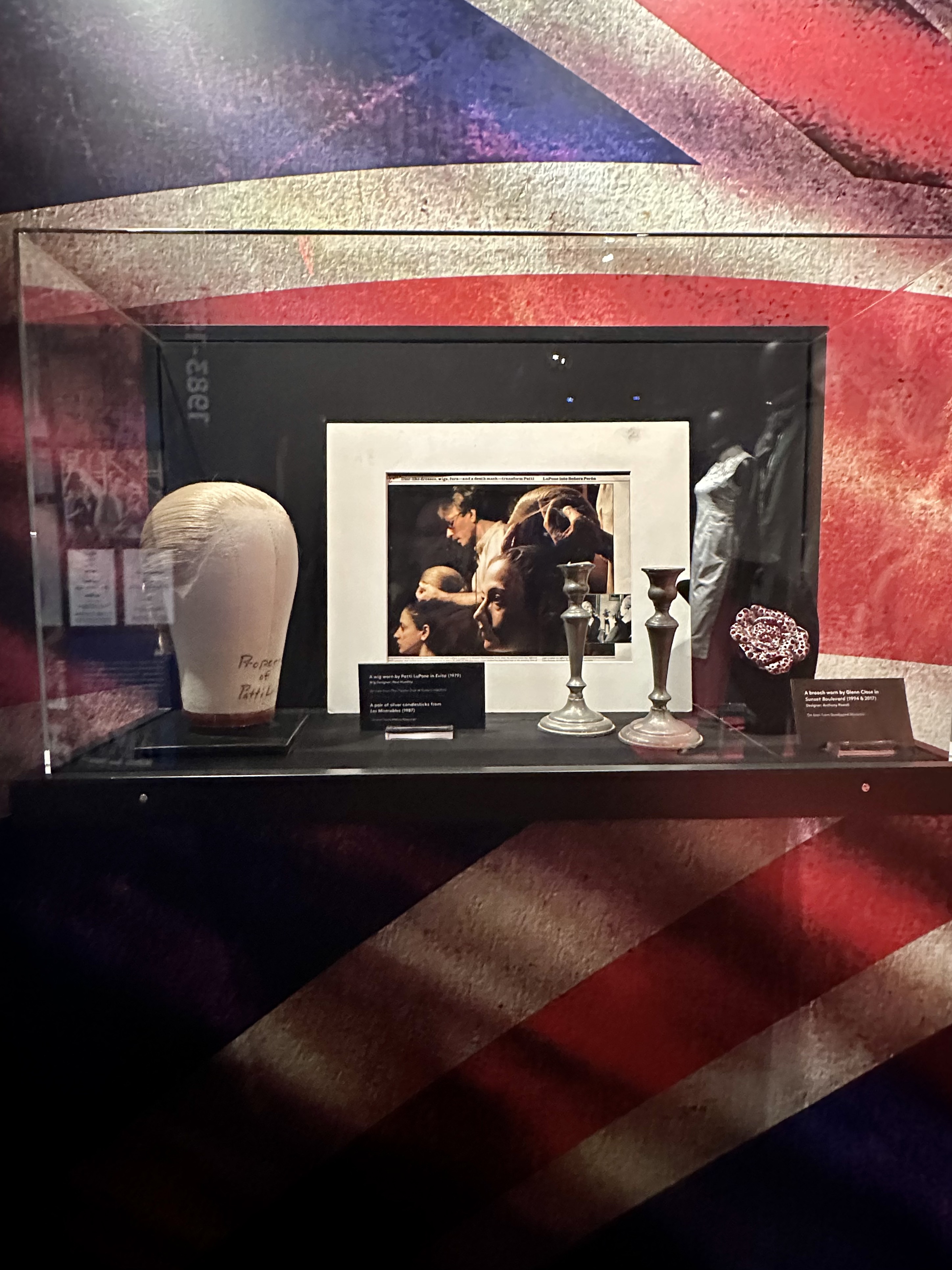
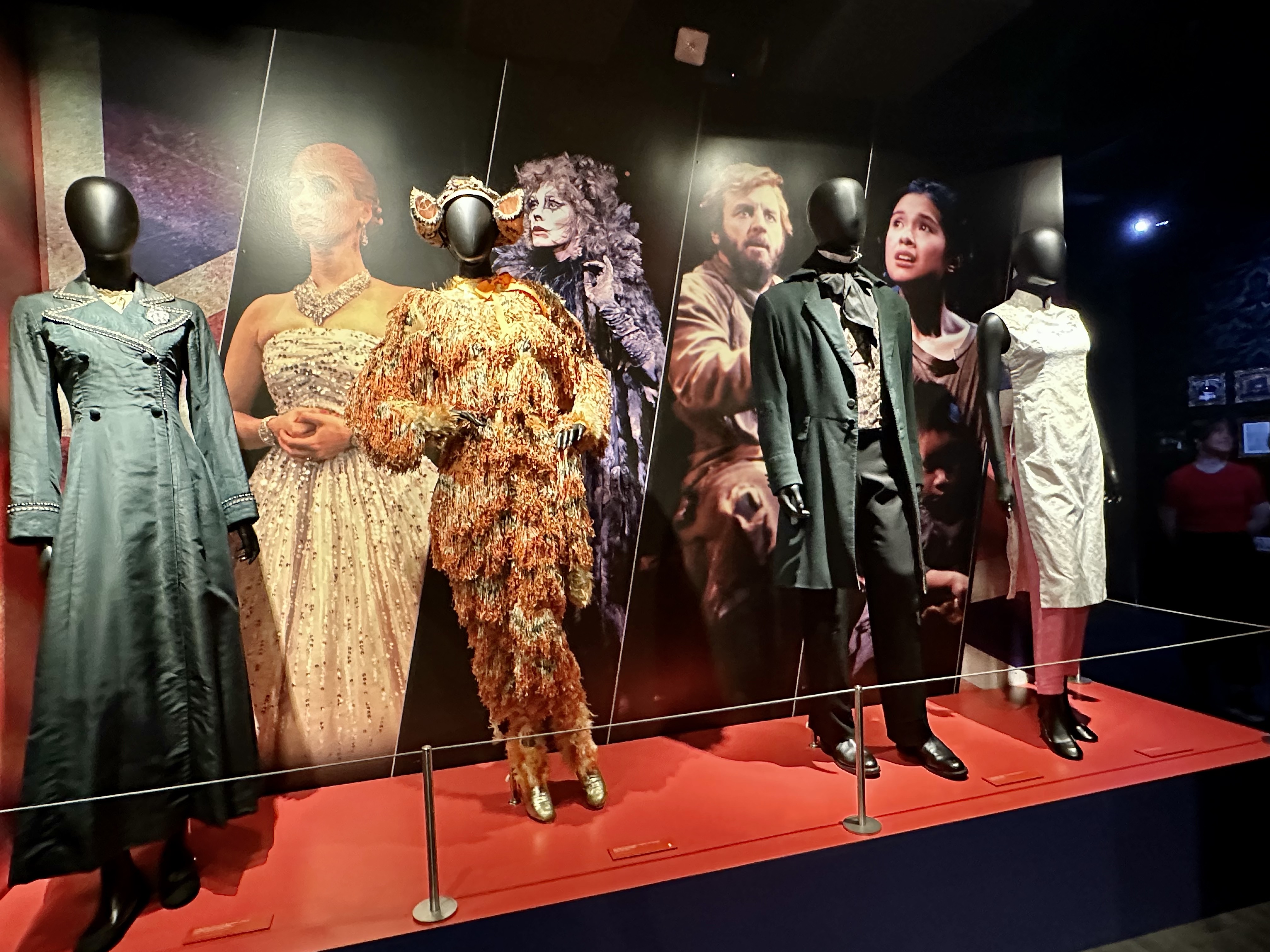
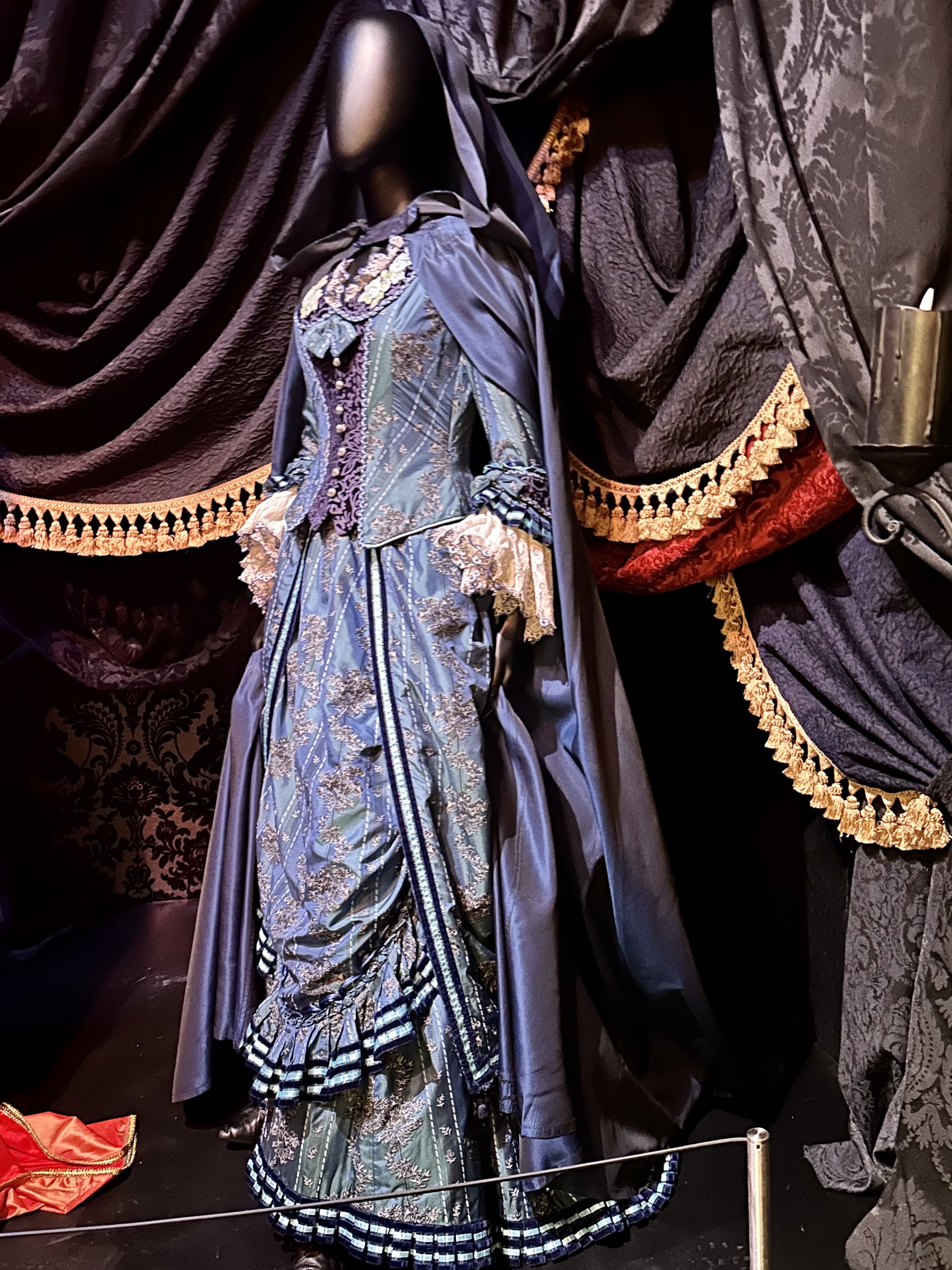
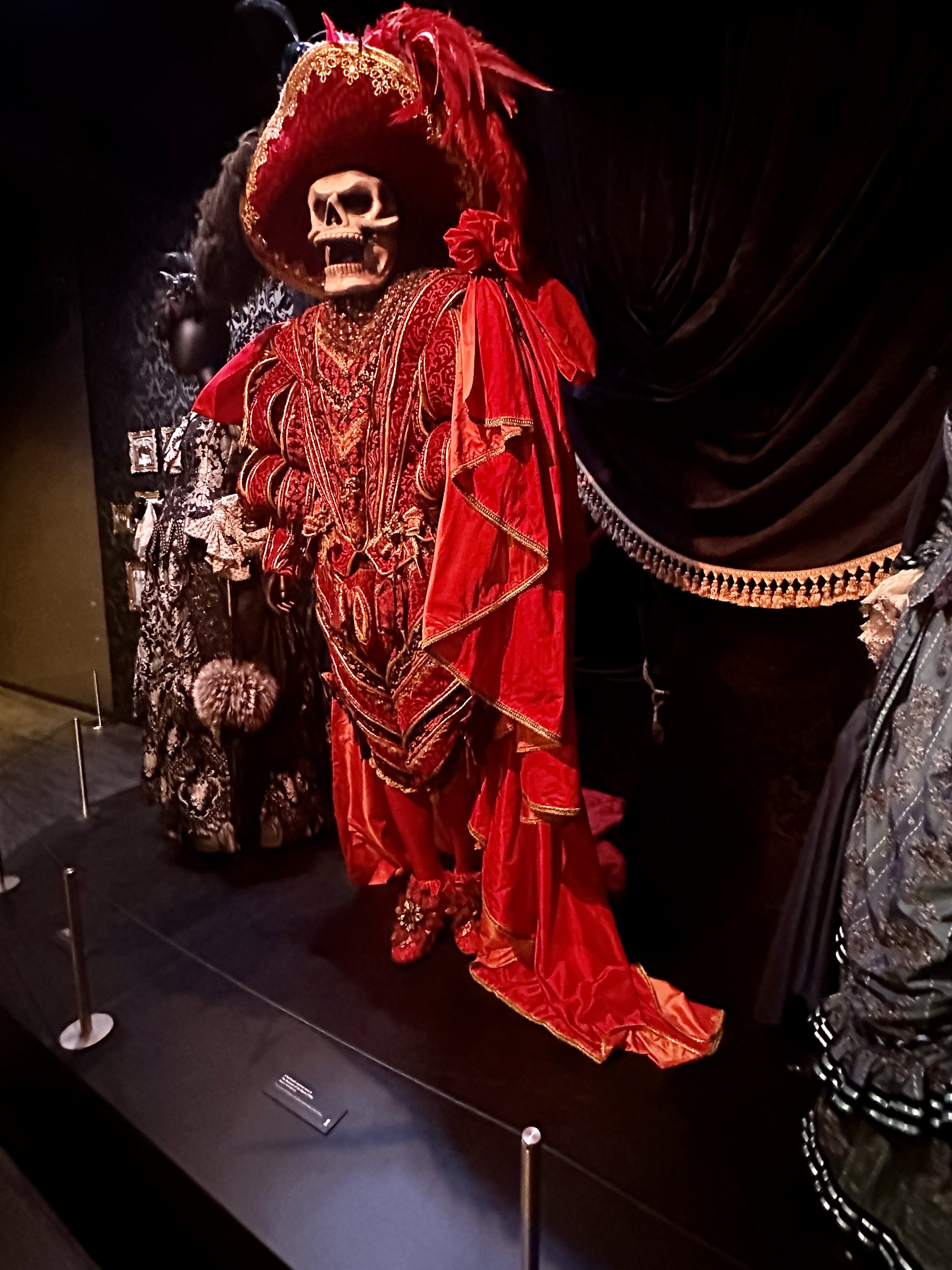
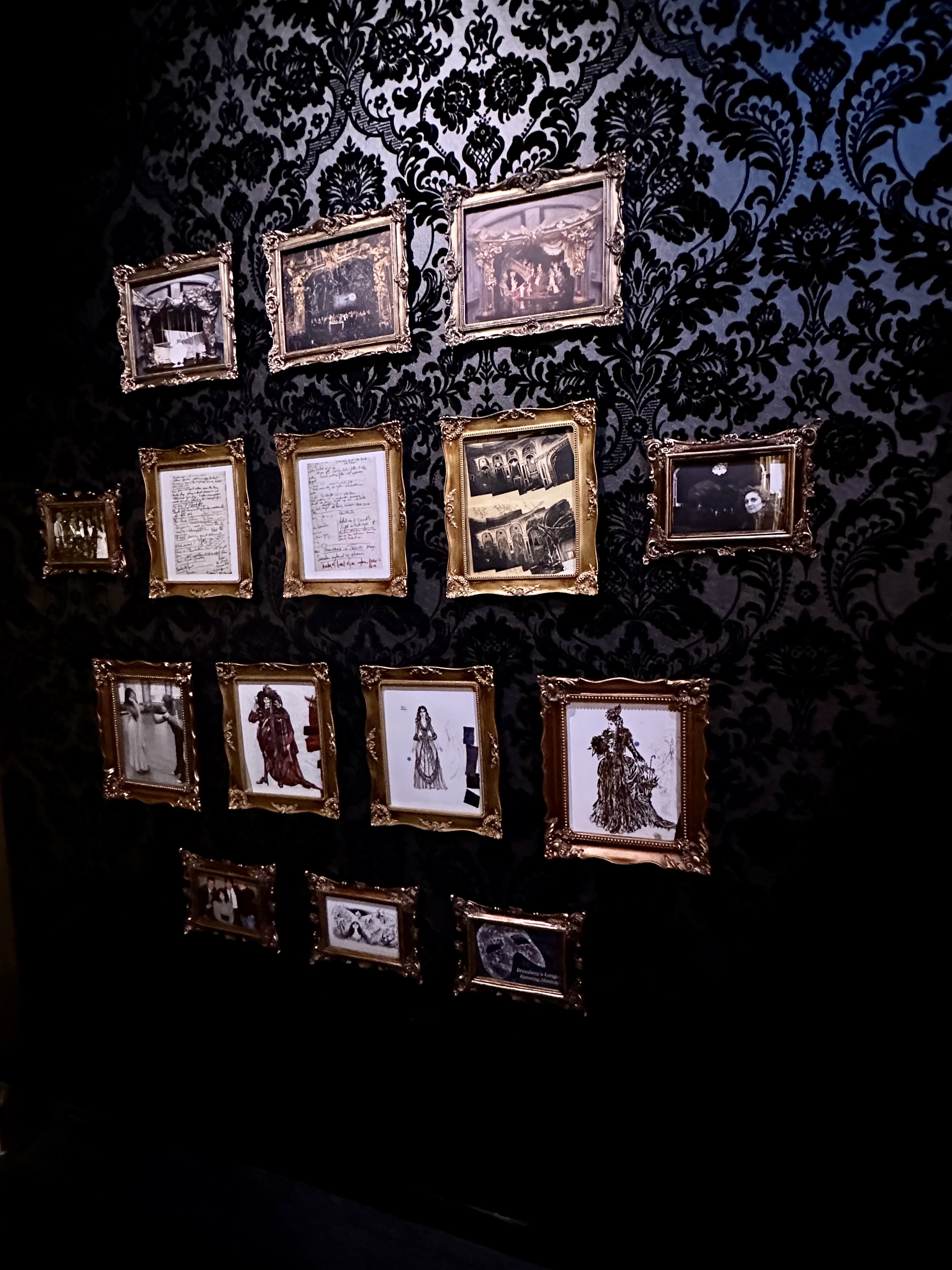
Heading into the 80’s, there are displays for Evita, Les Miserables, Miss Saigon, and of course the Phantom of the Opera. A large beaded curtain features a hidden Phantom mask that you can only see from a particular angle (see it here).

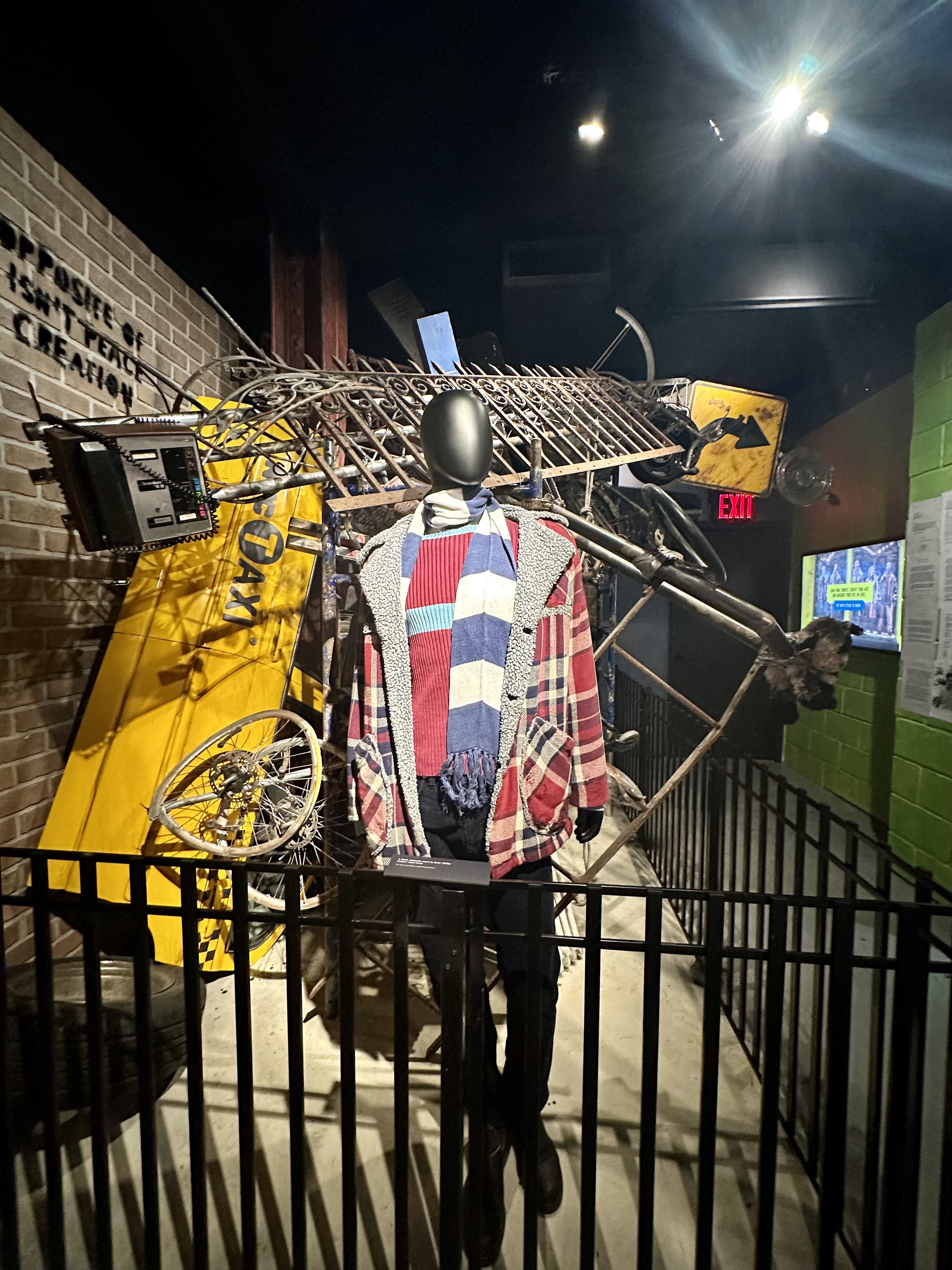
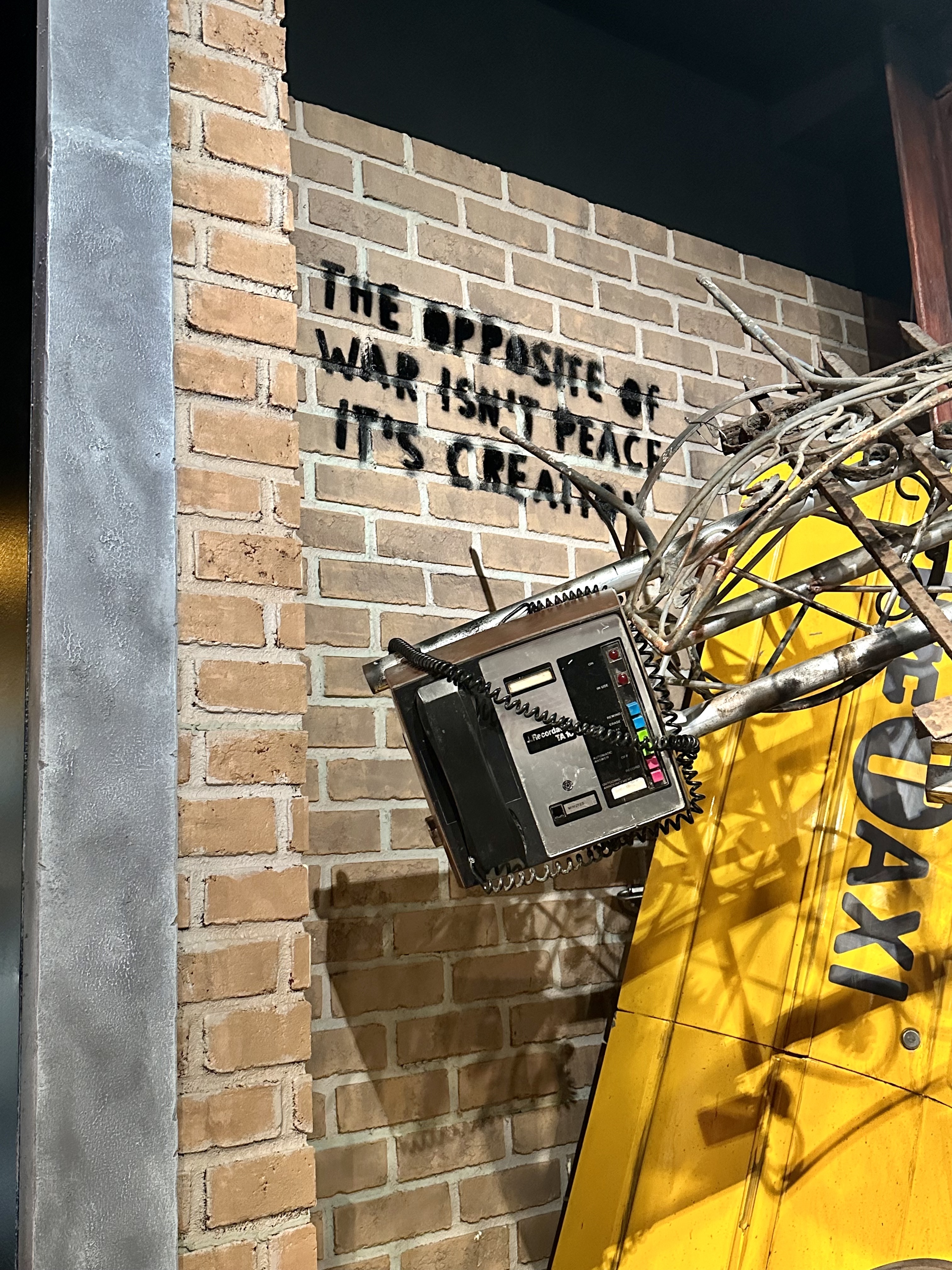
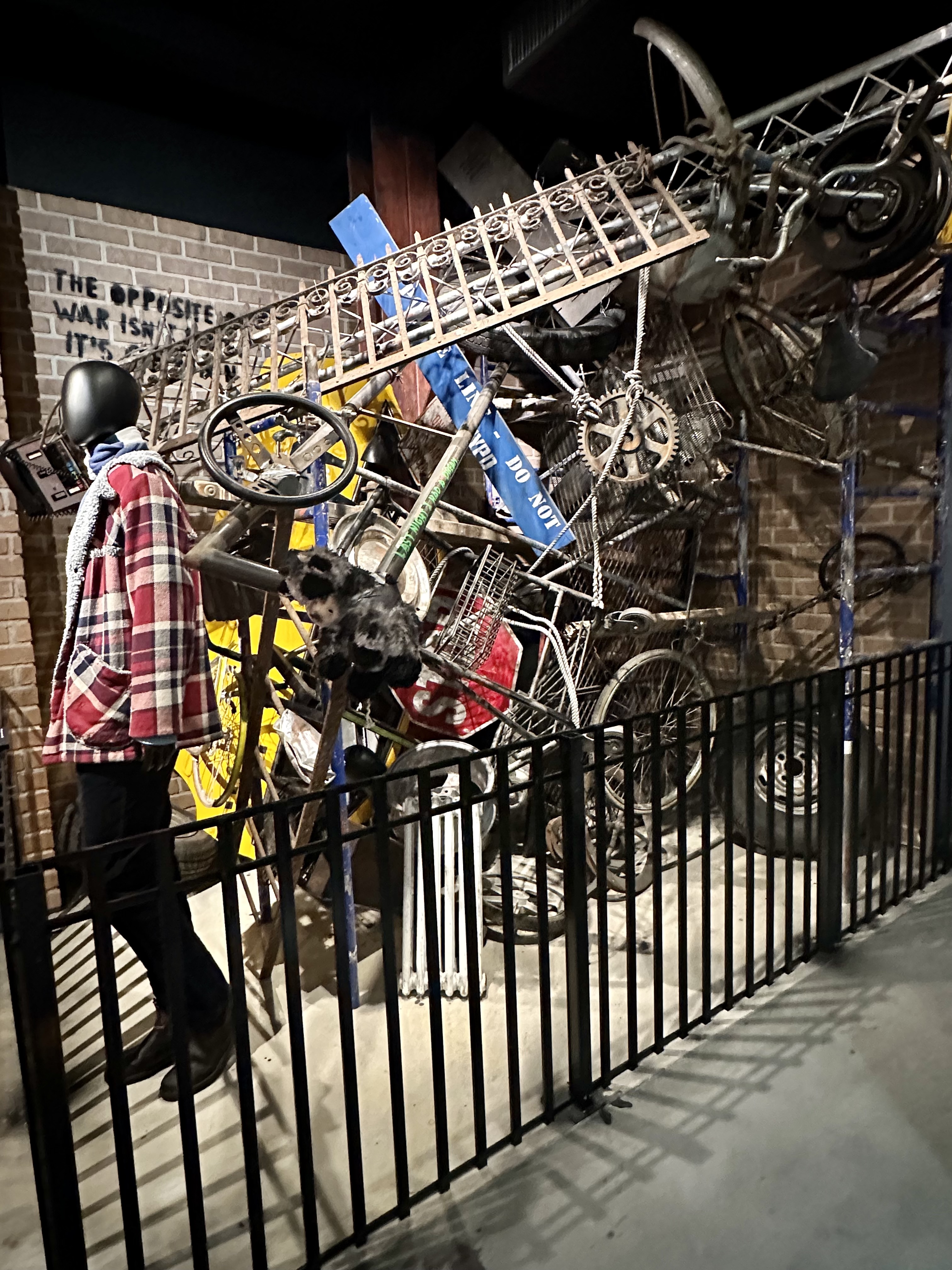
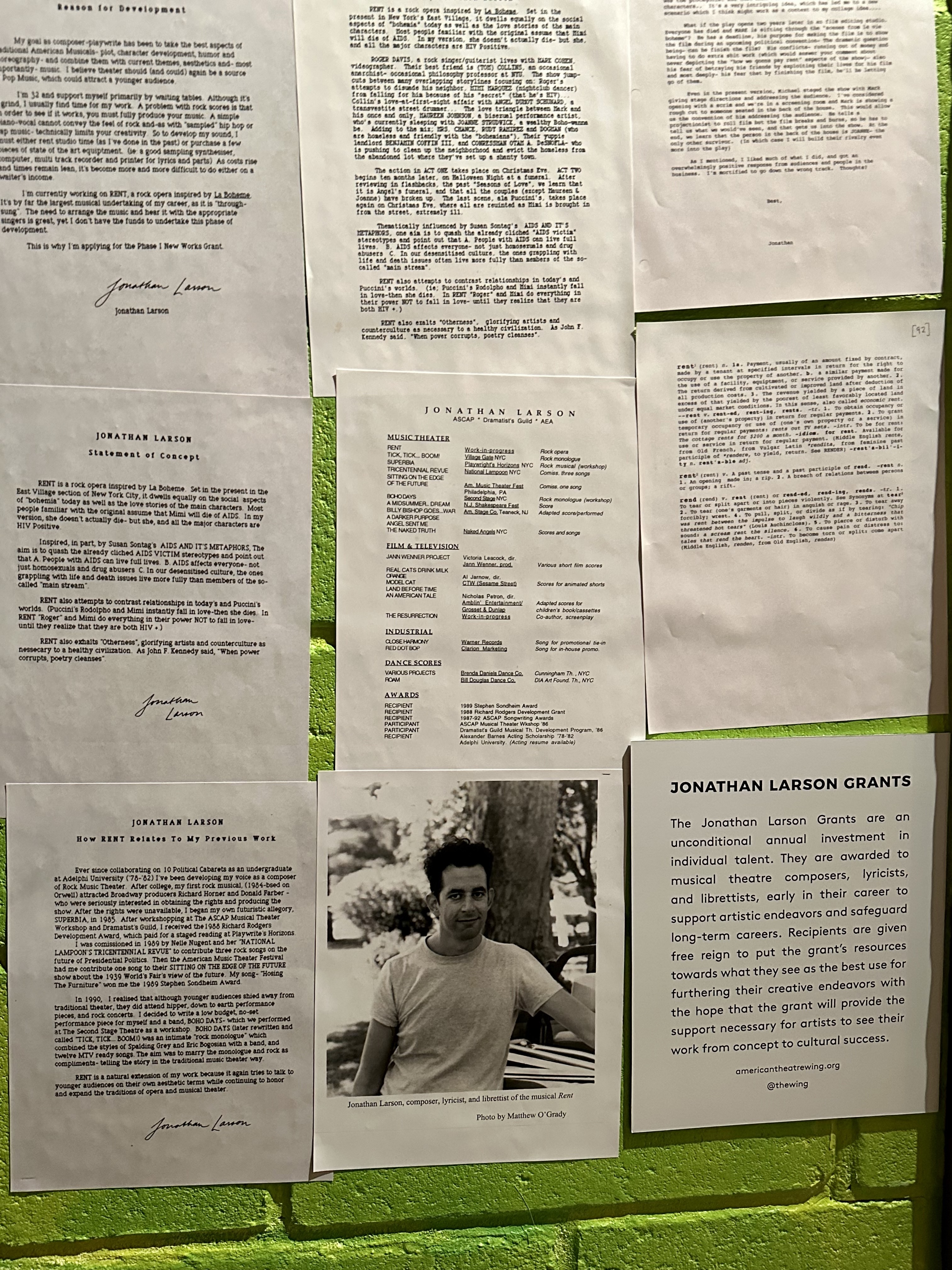
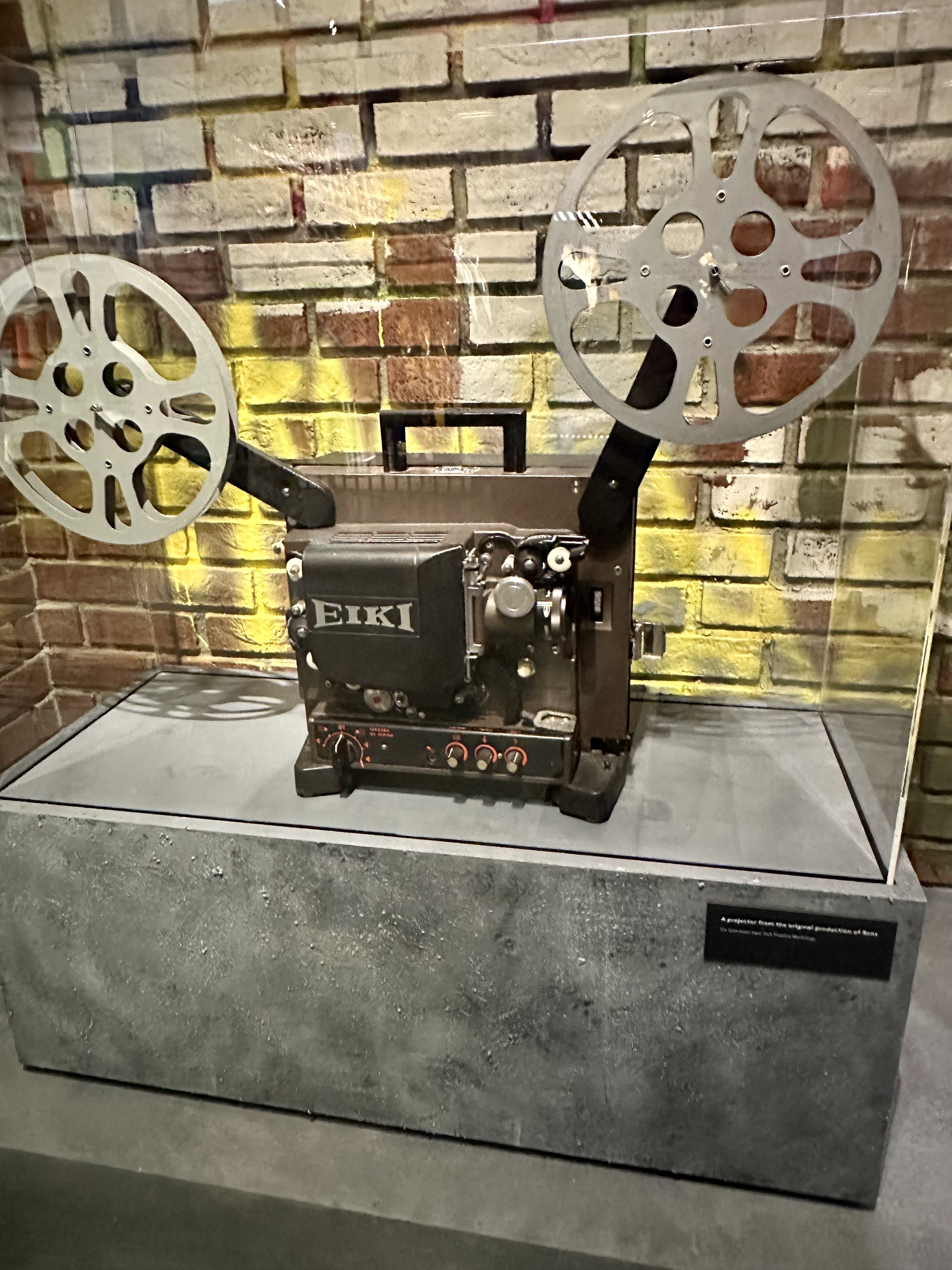
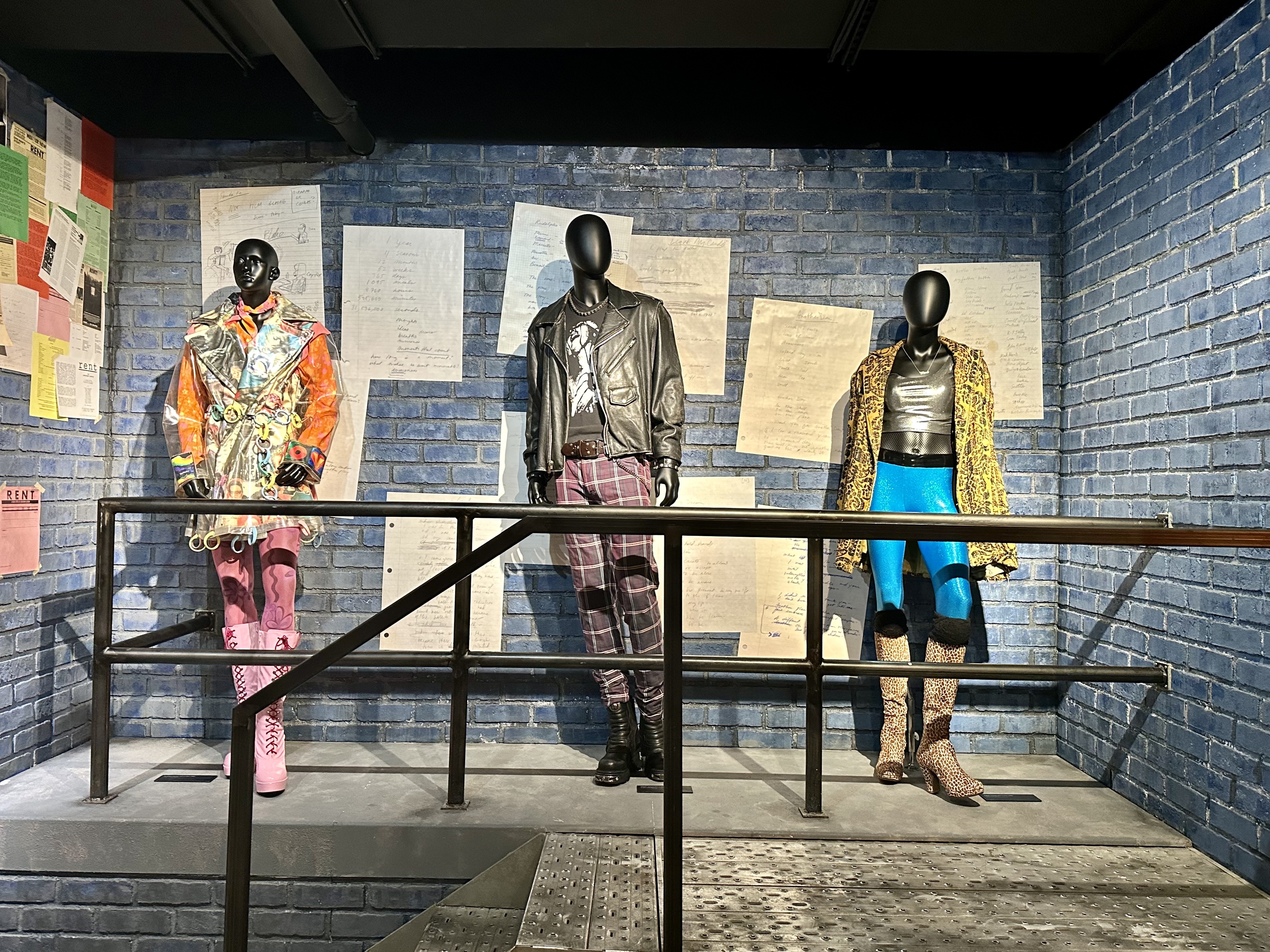
The next, large, room highlights Rent. I really enjoyed this room, as it had costumes, sets, props, cute interactive aspects (ring a doorbell and see who shows up at the door), a telephone where you can listen in to casting recollections, and a place to draw your own recollection and add it to the digital tribute wall.

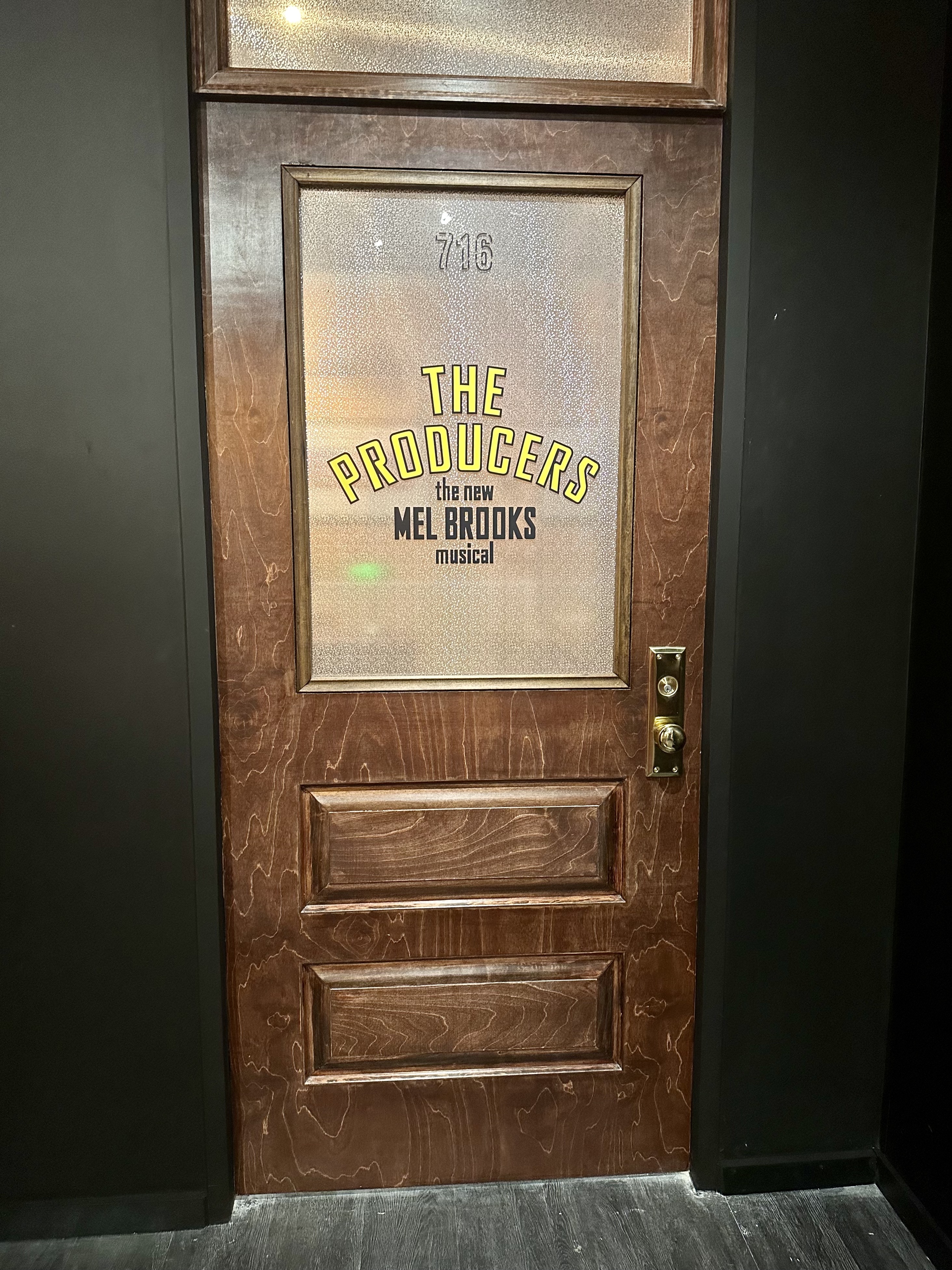
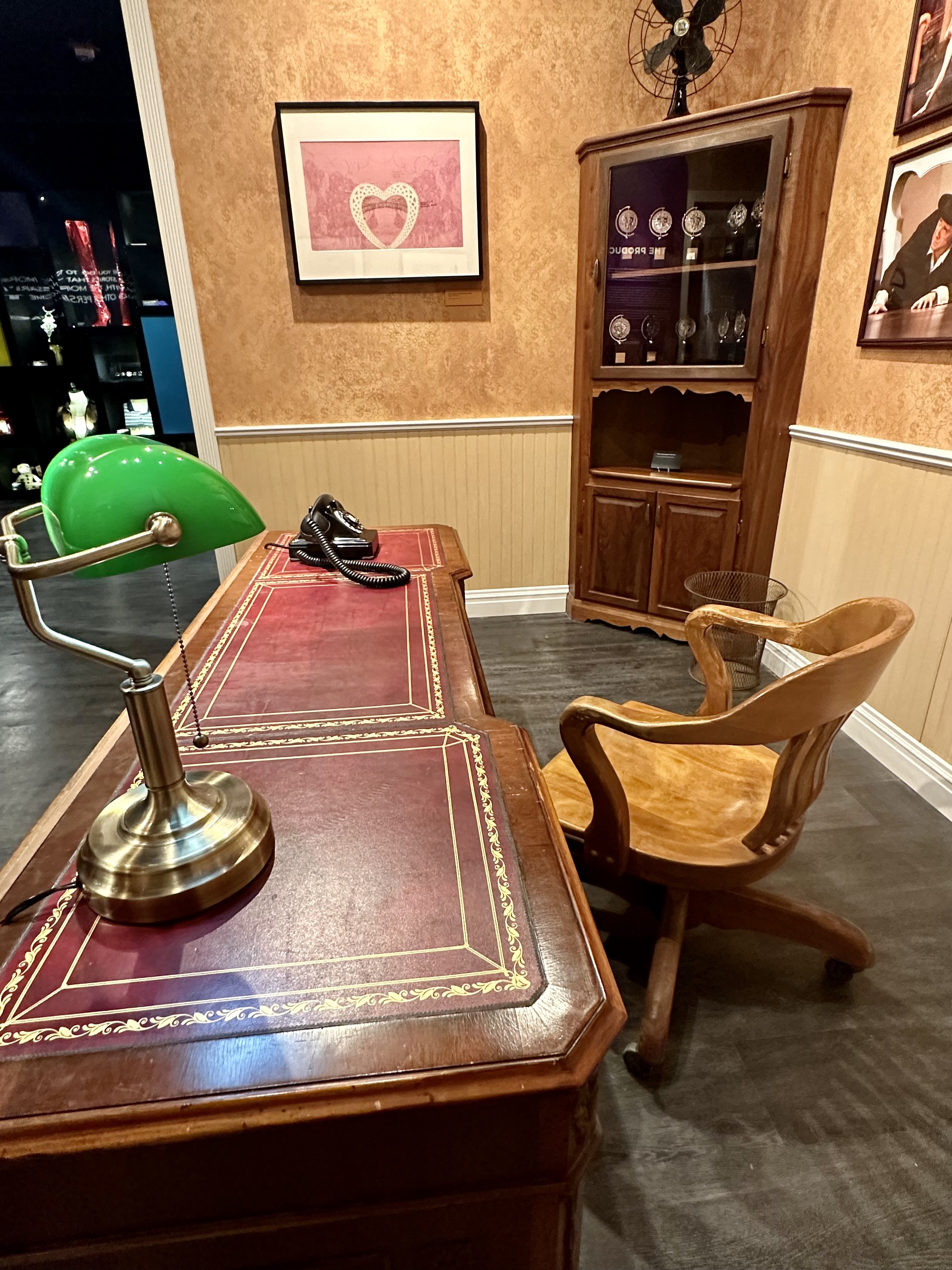
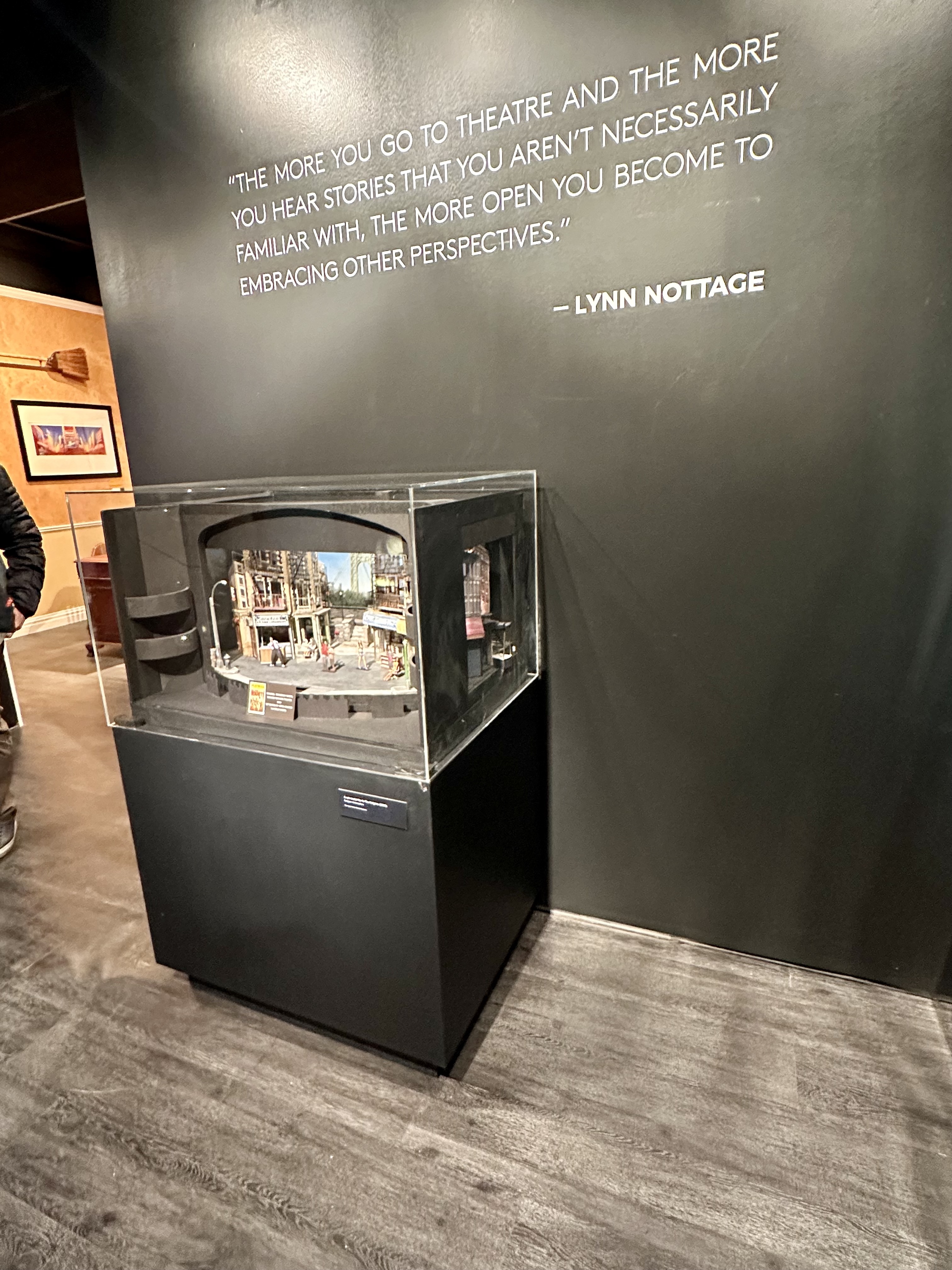
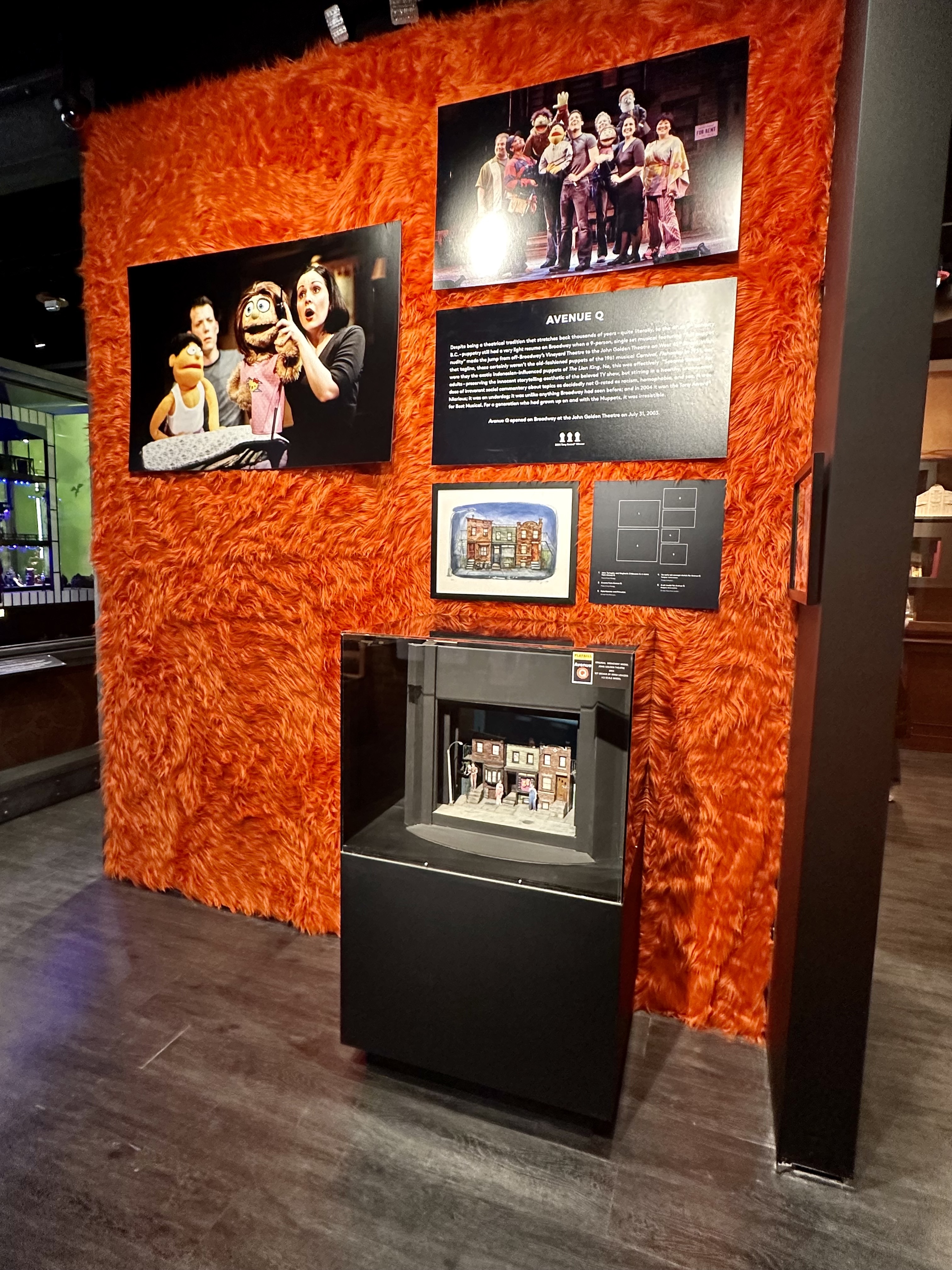
Moving forward, you can see props from The Lion King, Avenue Q, and The Producers (you can sit behind the desk).

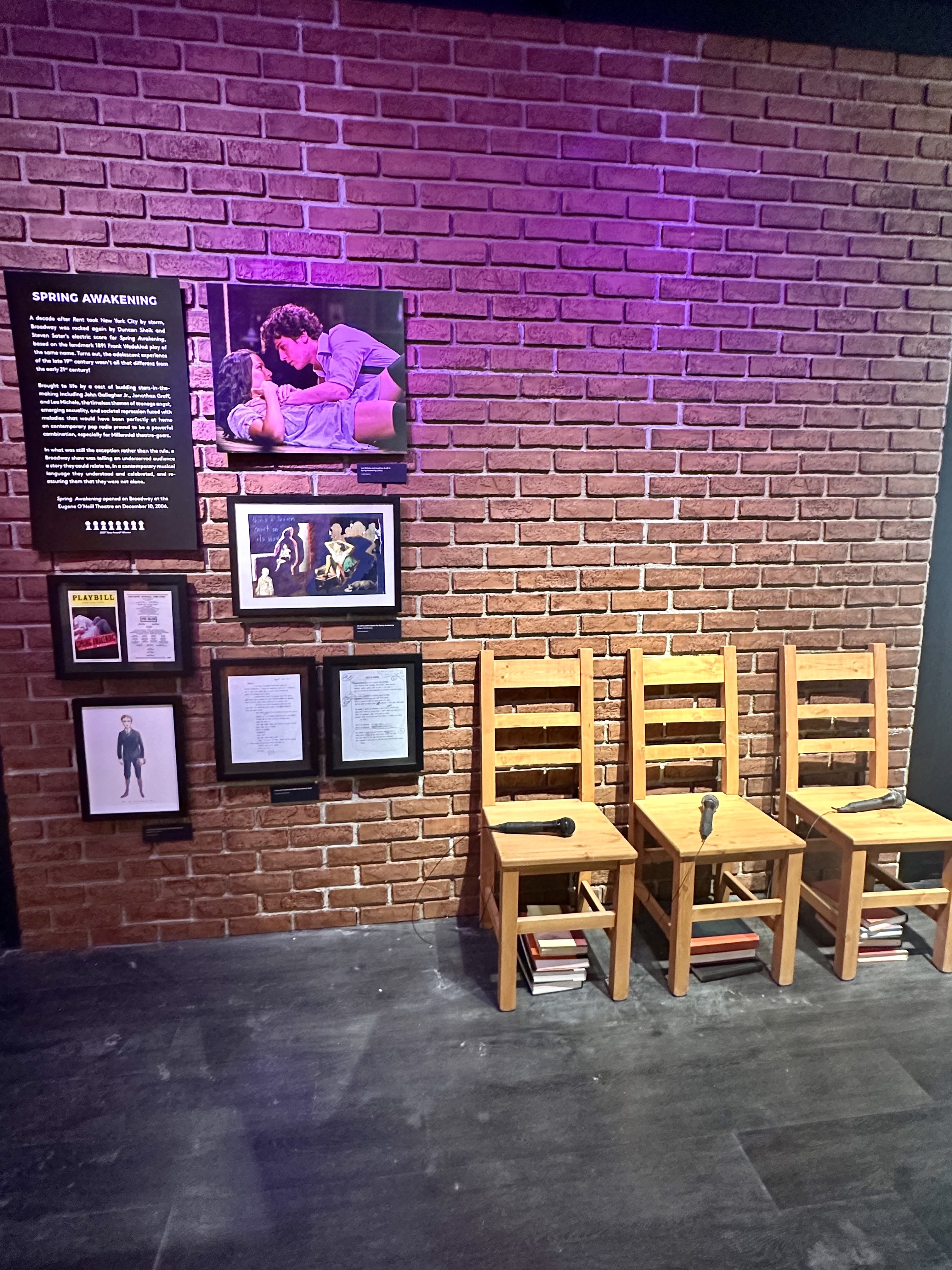
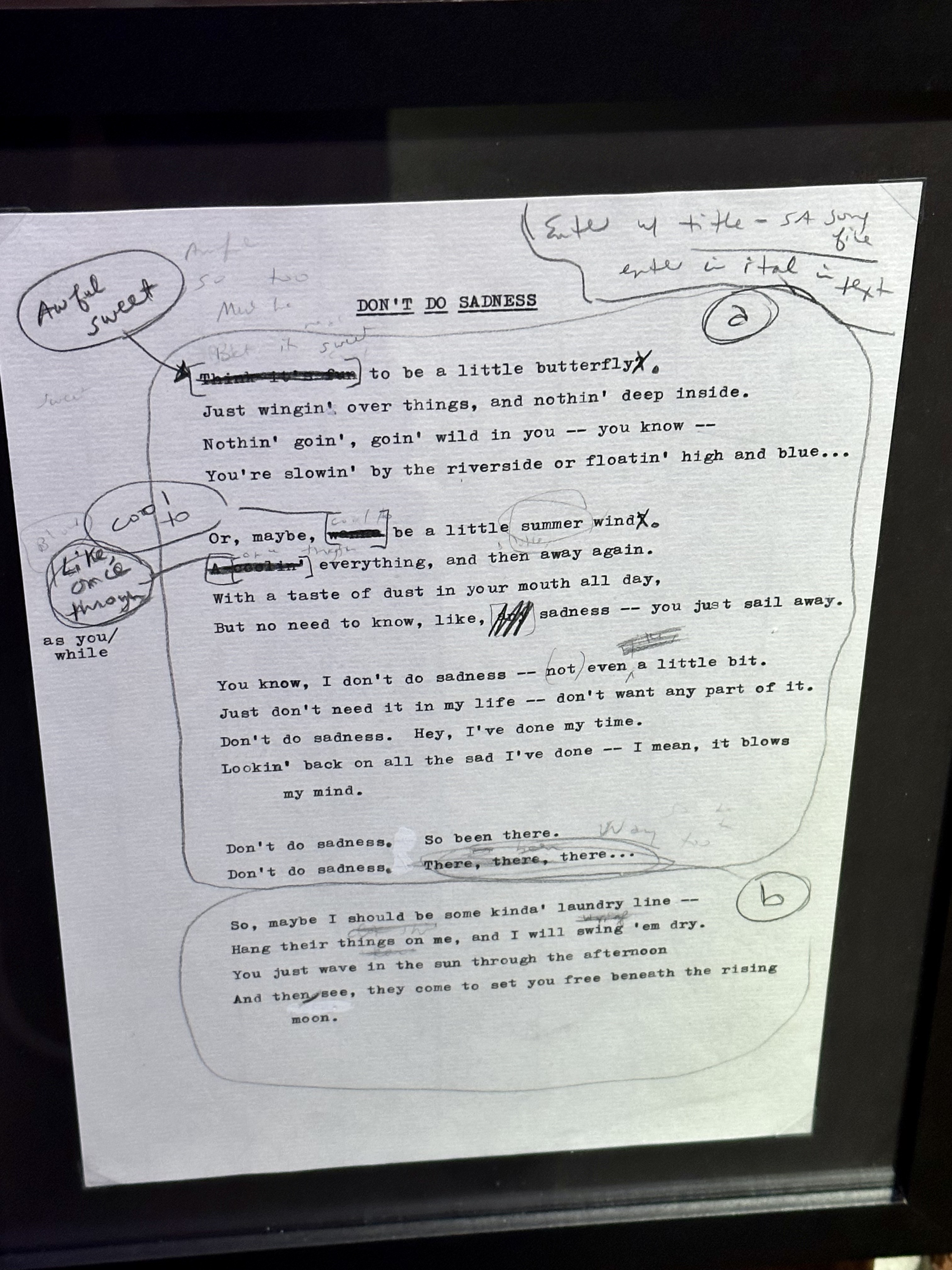
While not one of the larger exhibits, I enjoyed this section about Spring Awakening.

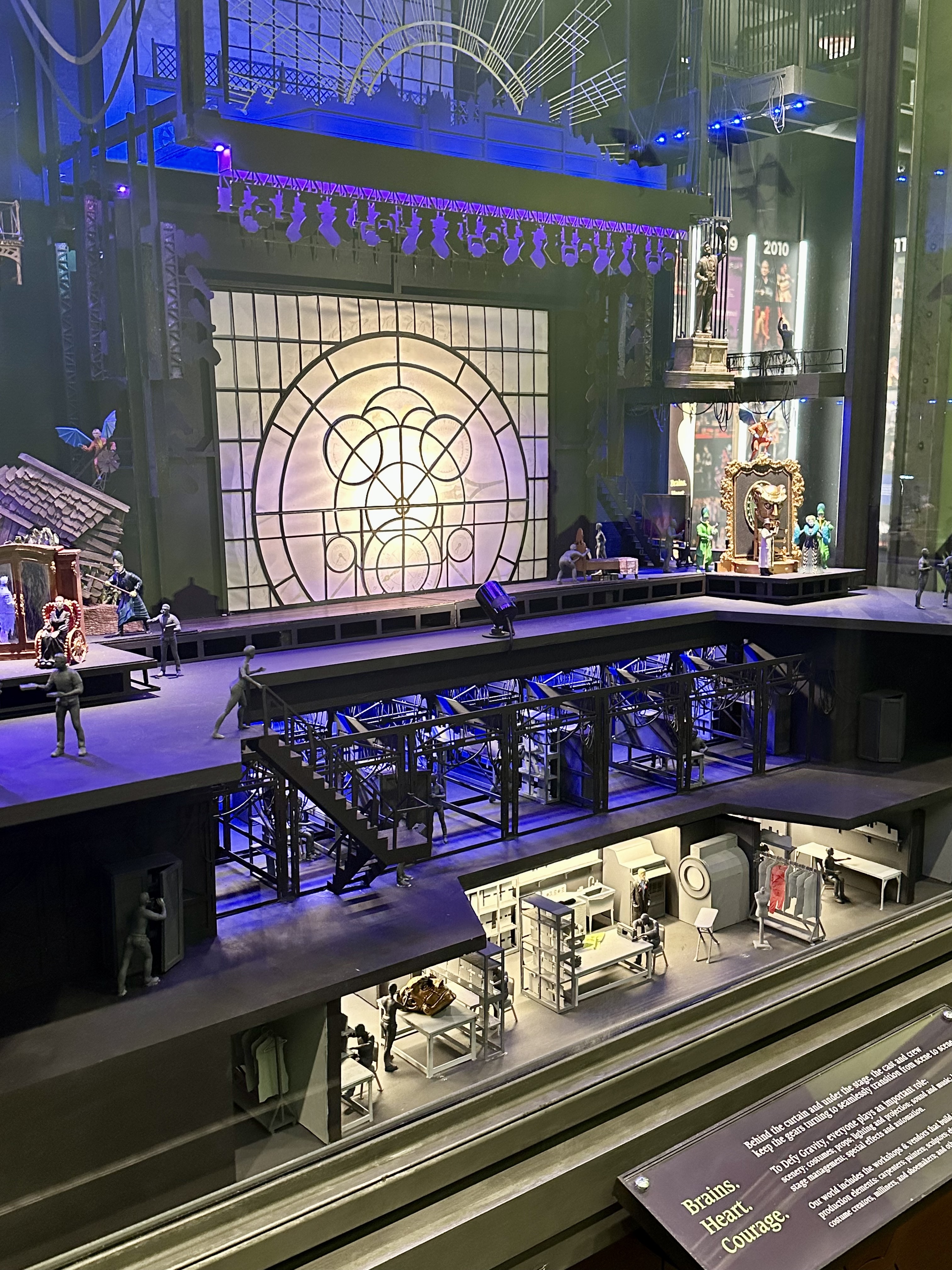
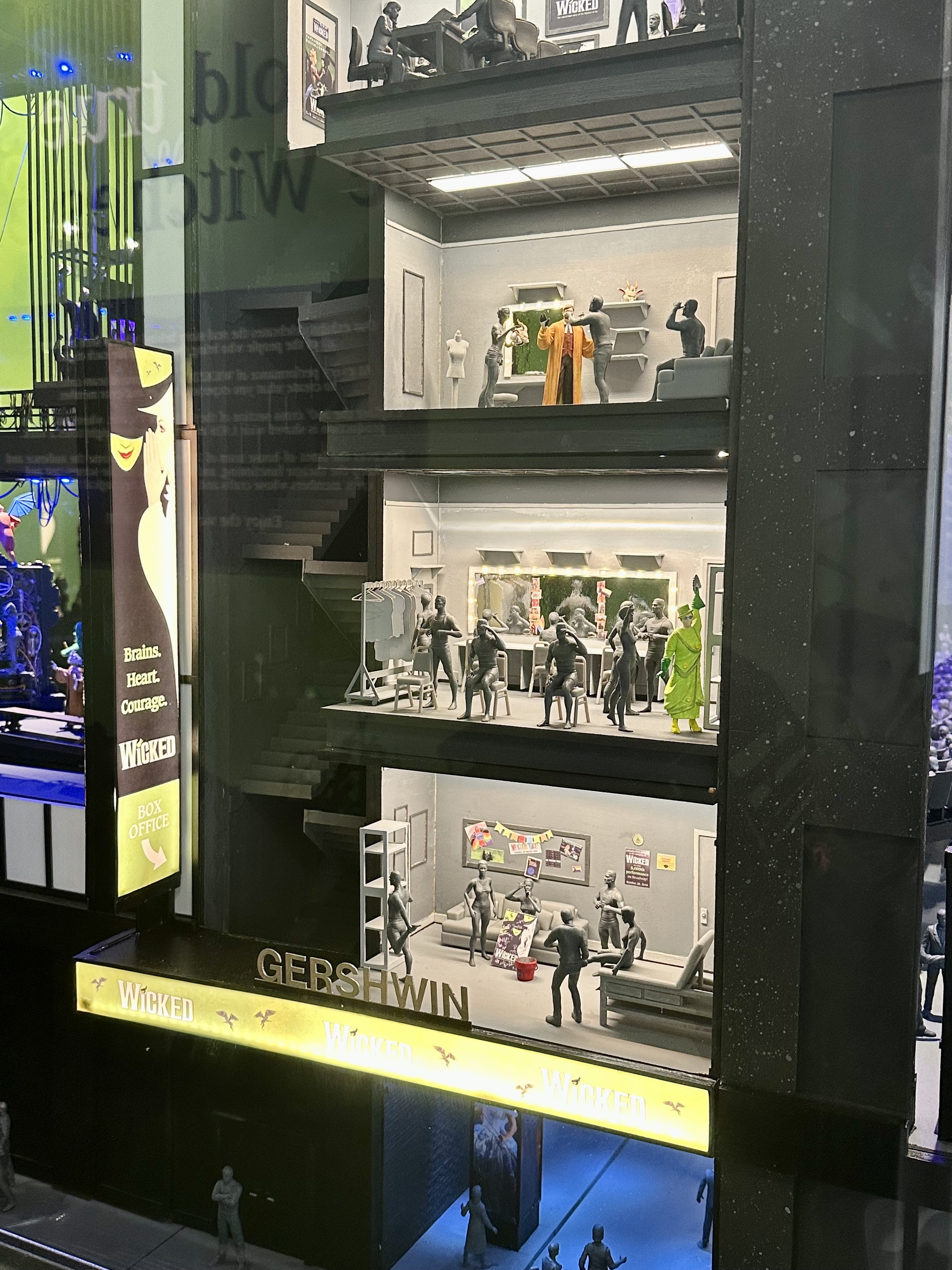
I loved the 360-degree set showing Wicked inside the Gershwin Theatre. You can see the public areas but also the backstage areas for warm ups and dressing rooms, and the backstage machinery that makes the set pieces move.

After a small display for Hamilton, there are panels for shows that opened each year, and I really loved that there were blank panels for the next several years. It’s exciting to think of what might lie ahead for us on Broadway!

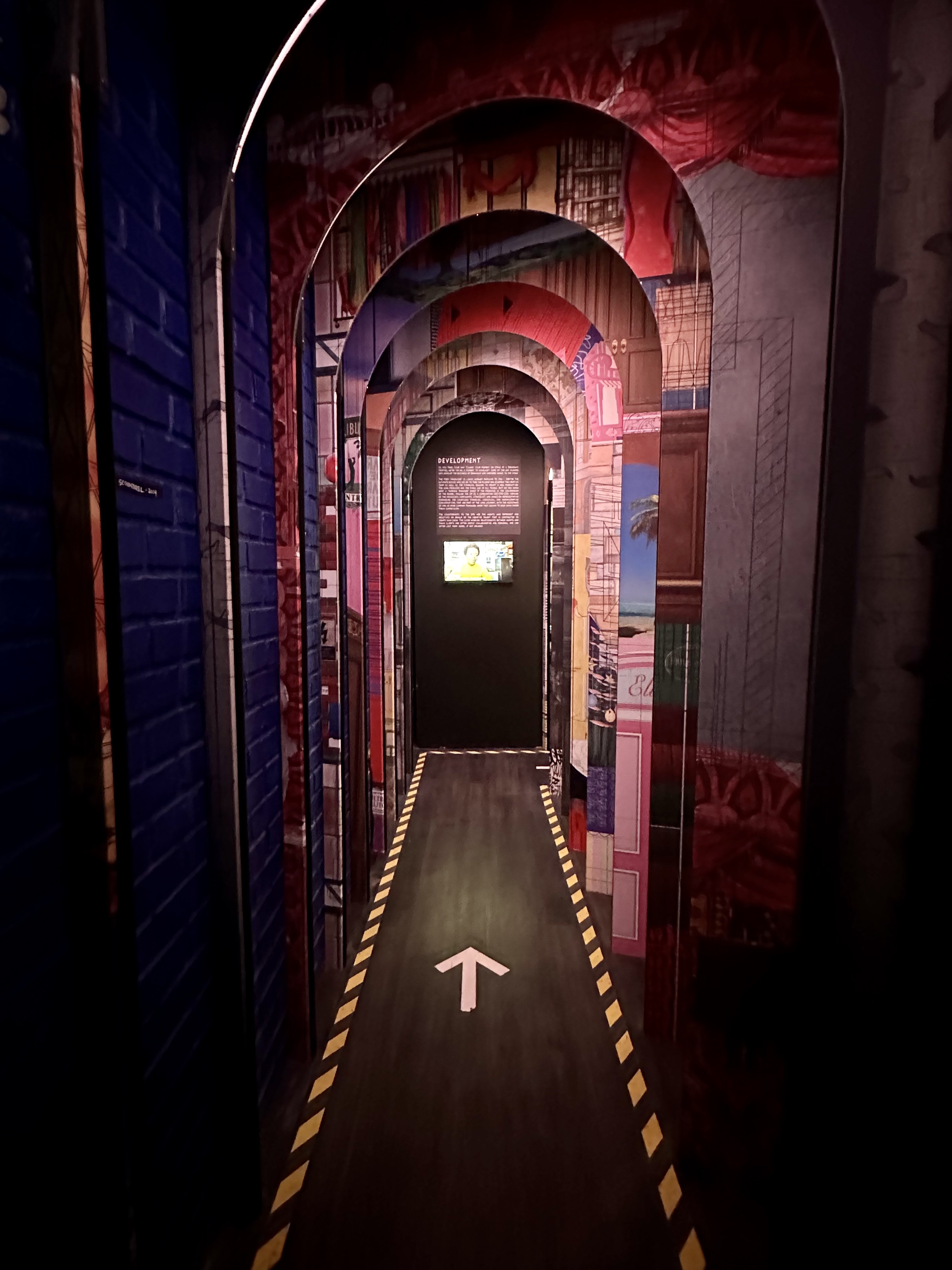
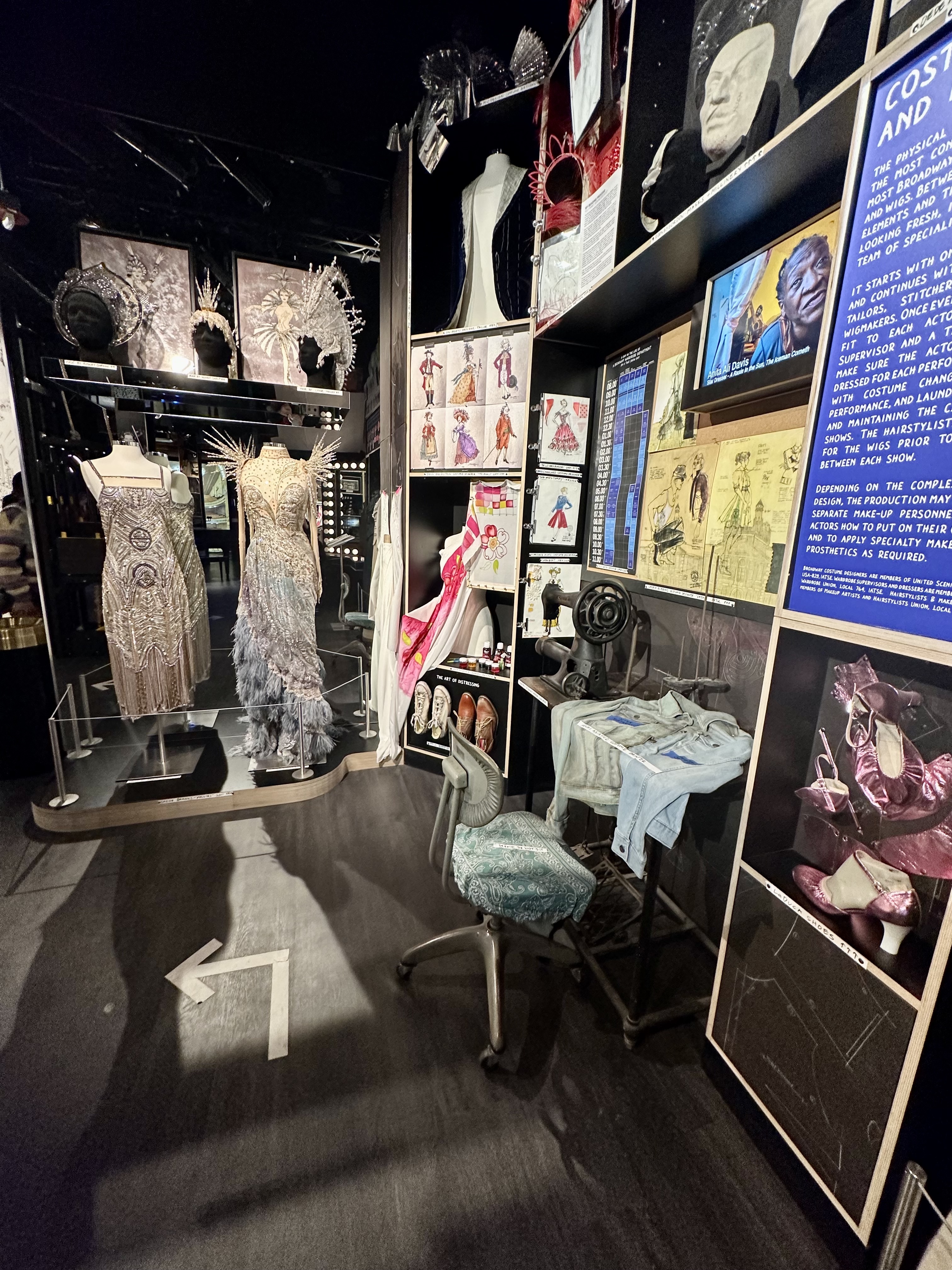
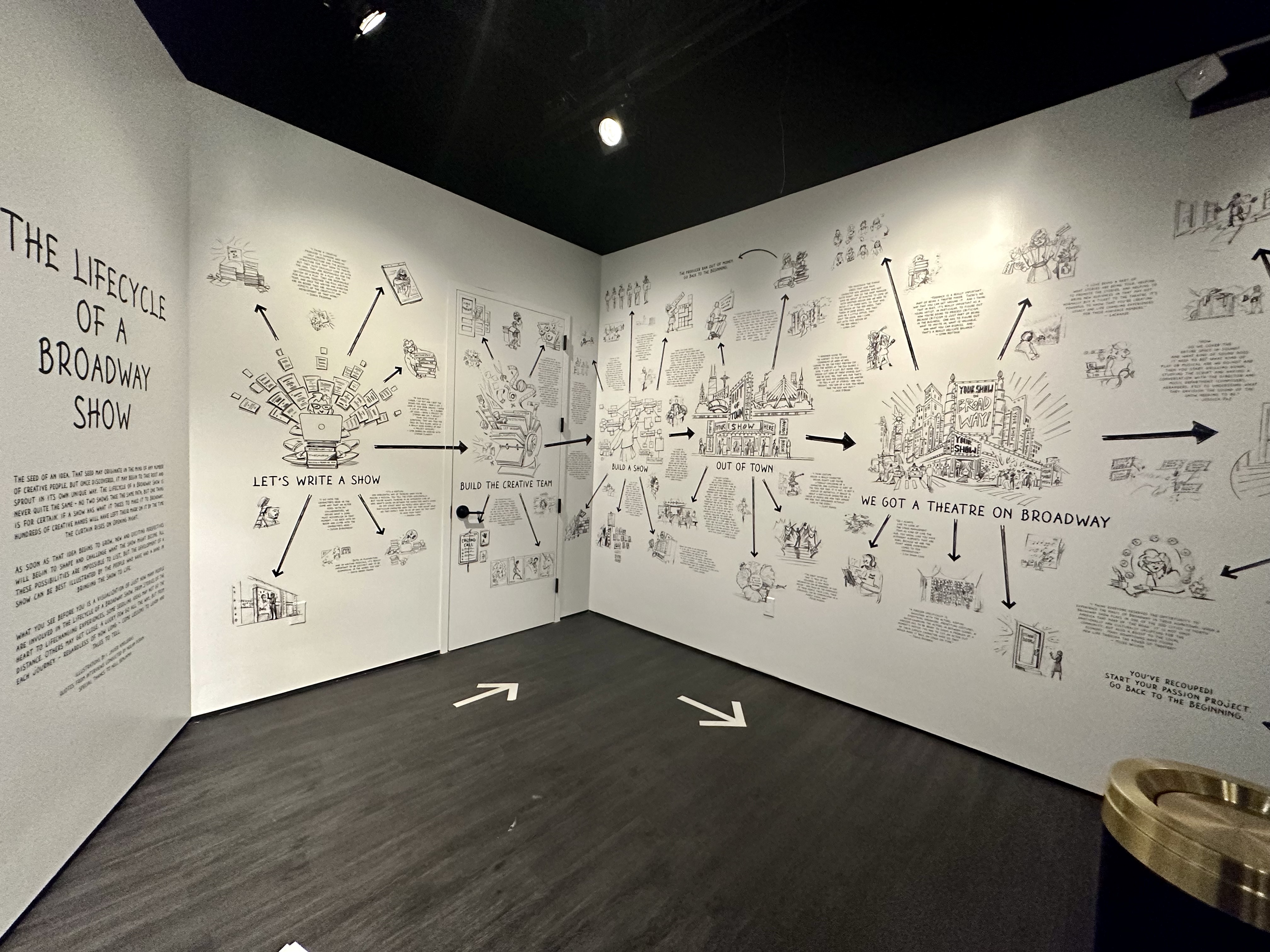
Leaving Broadway through the years, you enter a very informative session about the creation of a Broadway show, from initial playwriting, to production and design, casting, out-of-town tryouts, and arrival on Broadway. There are many video interviews with creatives explaining how stage managers/stagehands/makeup artists, etc., work.

There is a section after this which will have special exhibits that switch out over time. The first one is about the art of Al Hirschfeld, and even has a fun interactive way to create your own Hirschfeld caricature.

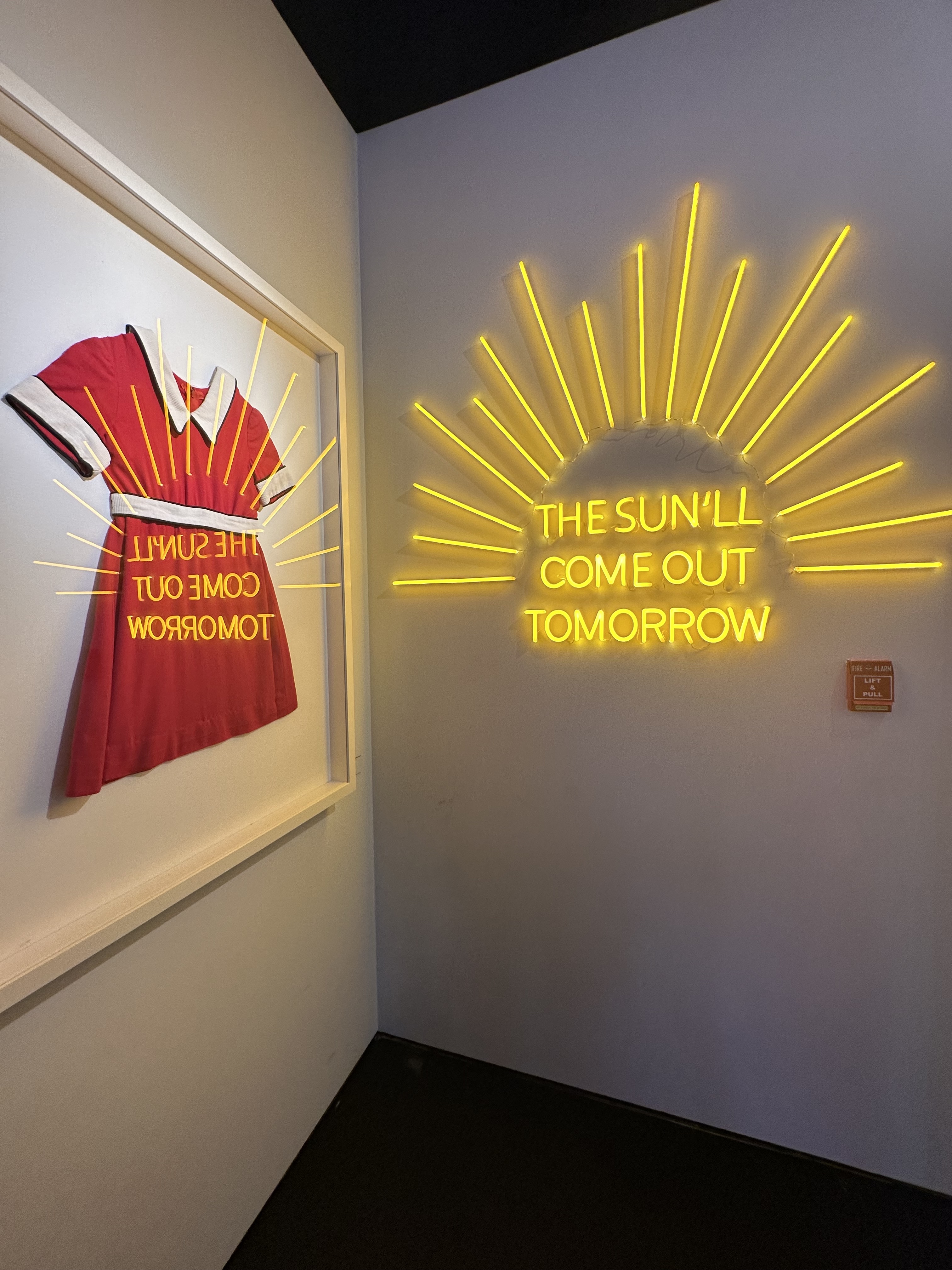
Exiting again through the gift shop, I left happy with what I had experienced. I already have plans to bring someone else to the museum in the next several months, and this is the kind of place that you can spend as long or as little as you want while there. I would say the bare minimum of time would be about 90 minutes, and more if you want to really watch the videos, read and listen to information presented, and study the props and costumes. Tickets are $39 and up, and a portion of every ticket sale goes to Broadway Cares. Broadway is the heart of New York City, and I think a museum dedicated to this art form fills a need. Also – it’s fun . . . don’t forget to enjoy and let the sun shine in!

Tony Nominations 2022

The Tony Awards given out next month will represent Broadway’s lurching progress toward normalcy (with periodic covid positivity shutdowns continuing) after the pandemic shutdown from March 2020 to September 2021. The Tony Awards for the truncated 2019-2020 season were held last September, and also served as a way to promote the reopening of live theatre in New York City to a wider audience. Those awards were anything but typical, however, since many new musicals and plays open in the spring to capitalize on the Tony nominations and awards, and the shutdown occurred before many had been able to open. “Six,” for instance, was set to open the very night Broadway was closed (March 12, 2020). Because of the shortened season, some categories had no nominations at all (Best Revival of a Musical, for instance) and Best Actor in a Musical had only one nomination (Aaron Tveit – and while that is not a guarantee of winning as over 50% of voters need to actively vote yes instead of no, fortunately he did win!).

While this season again was an unusual period (to be eligible, shows had to open between February 20, 2020 and May 4, 2021), the time included encompassed the normal seasonality of openings and the Tony nominations for 2021-2022 are robust. Out of 34 eligible productions this year, 29 received at least one nomination (even “Diana” received a nomination in costume design). All categories are competitive, with one even having seven nominees, and several with six. Since I have seen the majority of the nominees, I thought I would weigh in a bit on the bigger categories, both with my own opinion and what the general buzz is.

New Play

“Clyde’s”

“Hangmen”

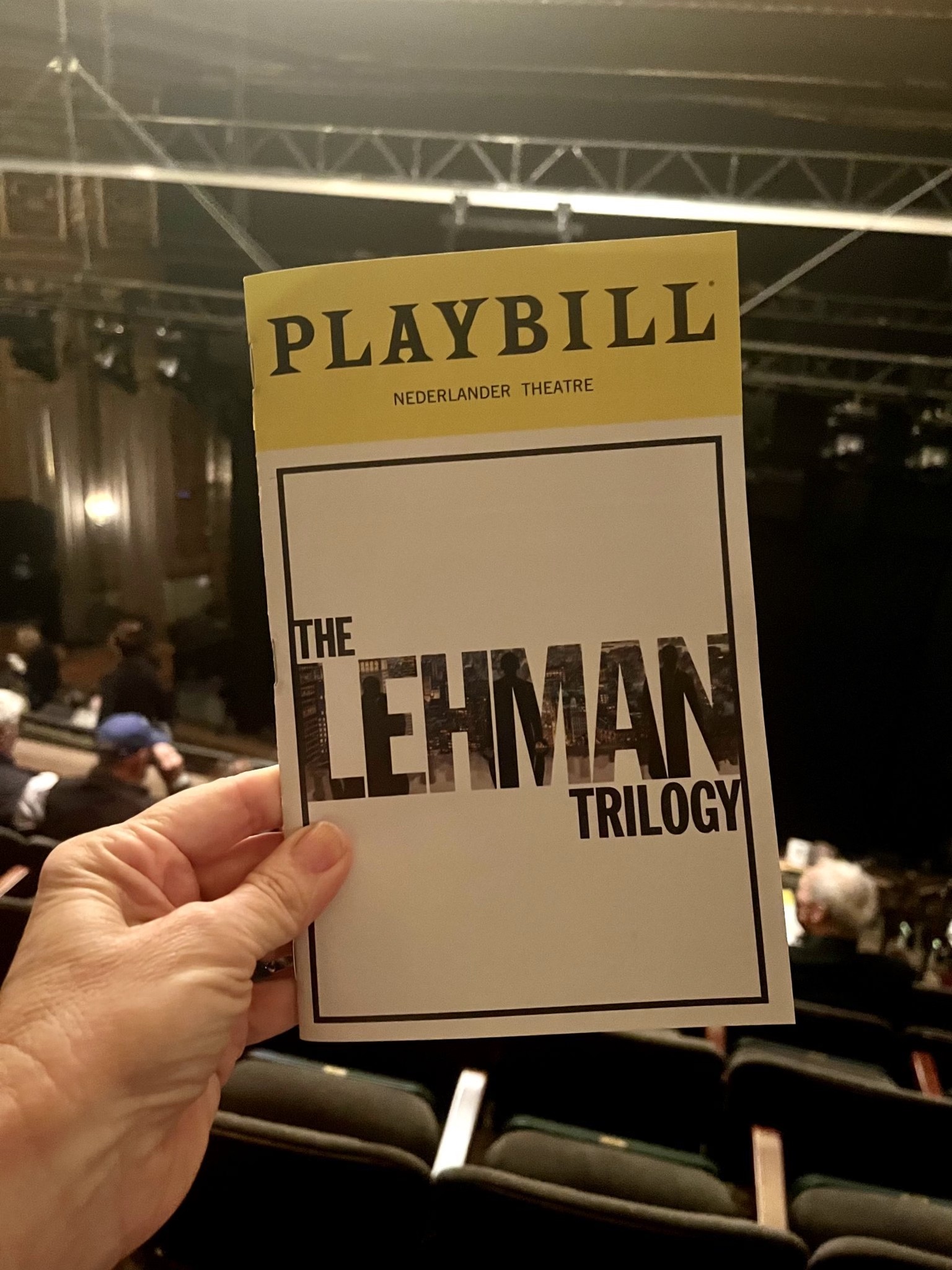
“The Lehman Trilogy”

“The Minutes”

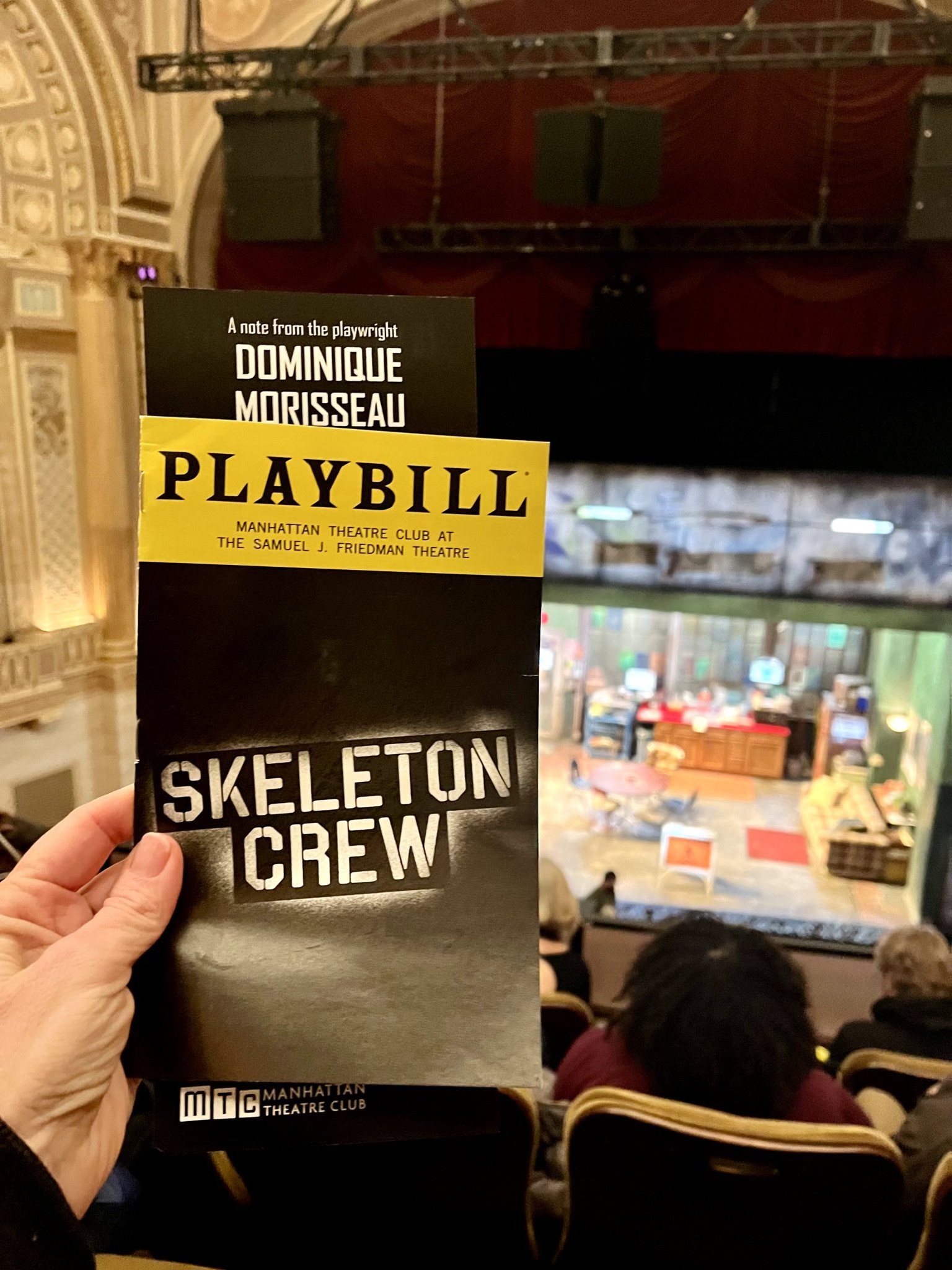
“Skeleton Crew”

I think it’s going to be hard for anyone to beat “The Lehman Trilogy” here, and it would get my vote. The only new plays nominated here that are still running are “The Minutes” (which I saw in previews pre-pandemic when Armie Hammer was still in it) and “Hangmen” (which is set to close mid-June) so I don’t think that “Lehman” having only run last fall will be a factor against it.

Revival of a Play

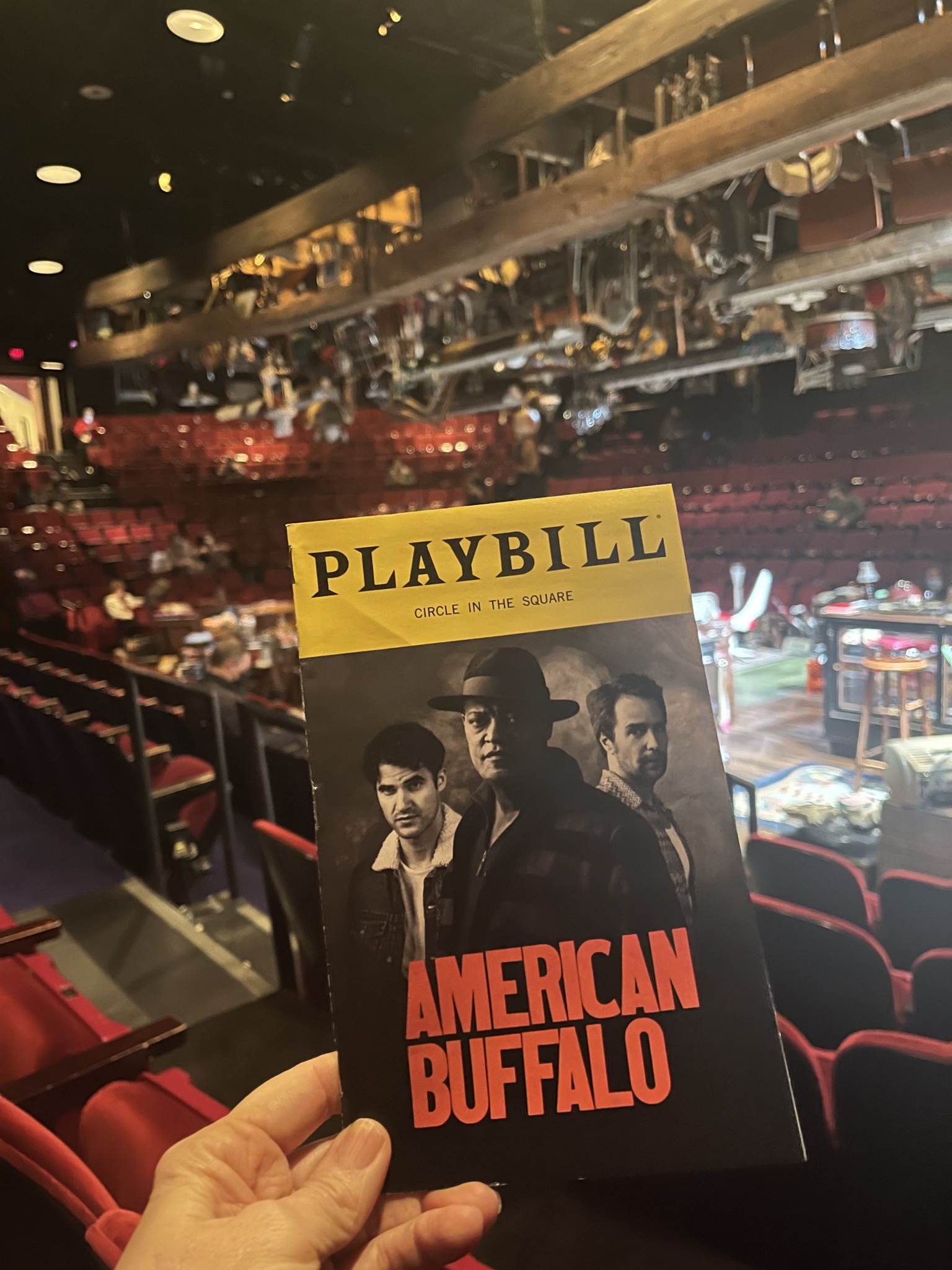
“American Buffalo”

“For Colored Girls Who Have Considered Suicide/ When the Rainbow Is Enuf”

“How I Learned to Drive”

“Take Me Out”

“Trouble in Mind”

Again, it seems that “How I Learned to Drive” will be hard to beat, and it would certainly get my vote. Simply brilliant.

Actress in a Musical

Sharon D Clarke, “Caroline, or Change”

Carmen Cusack, “Flying Over Sunset”

Sutton Foster, “The Music Man”

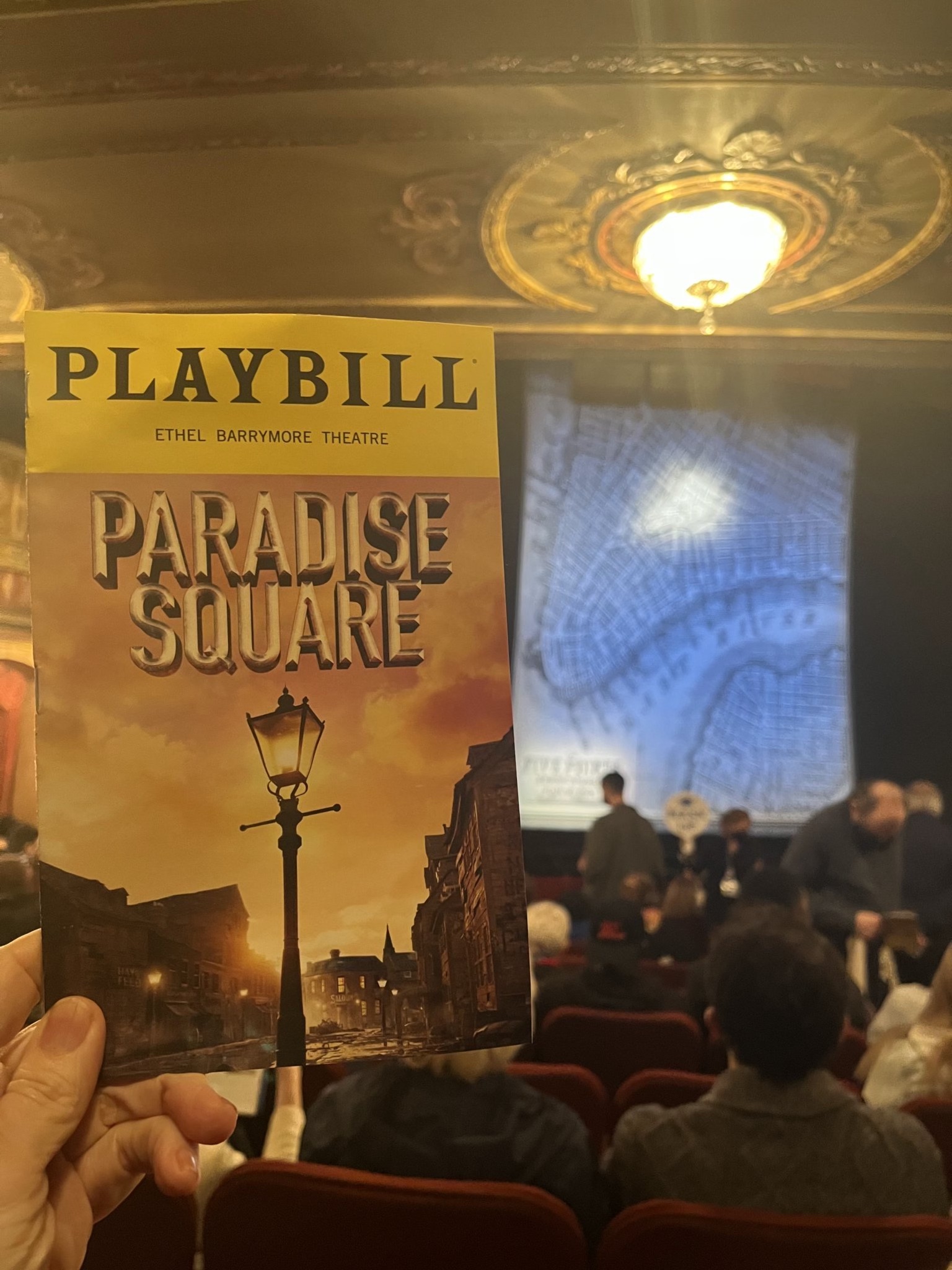
Joaquina Kalukango, “Paradise Square”

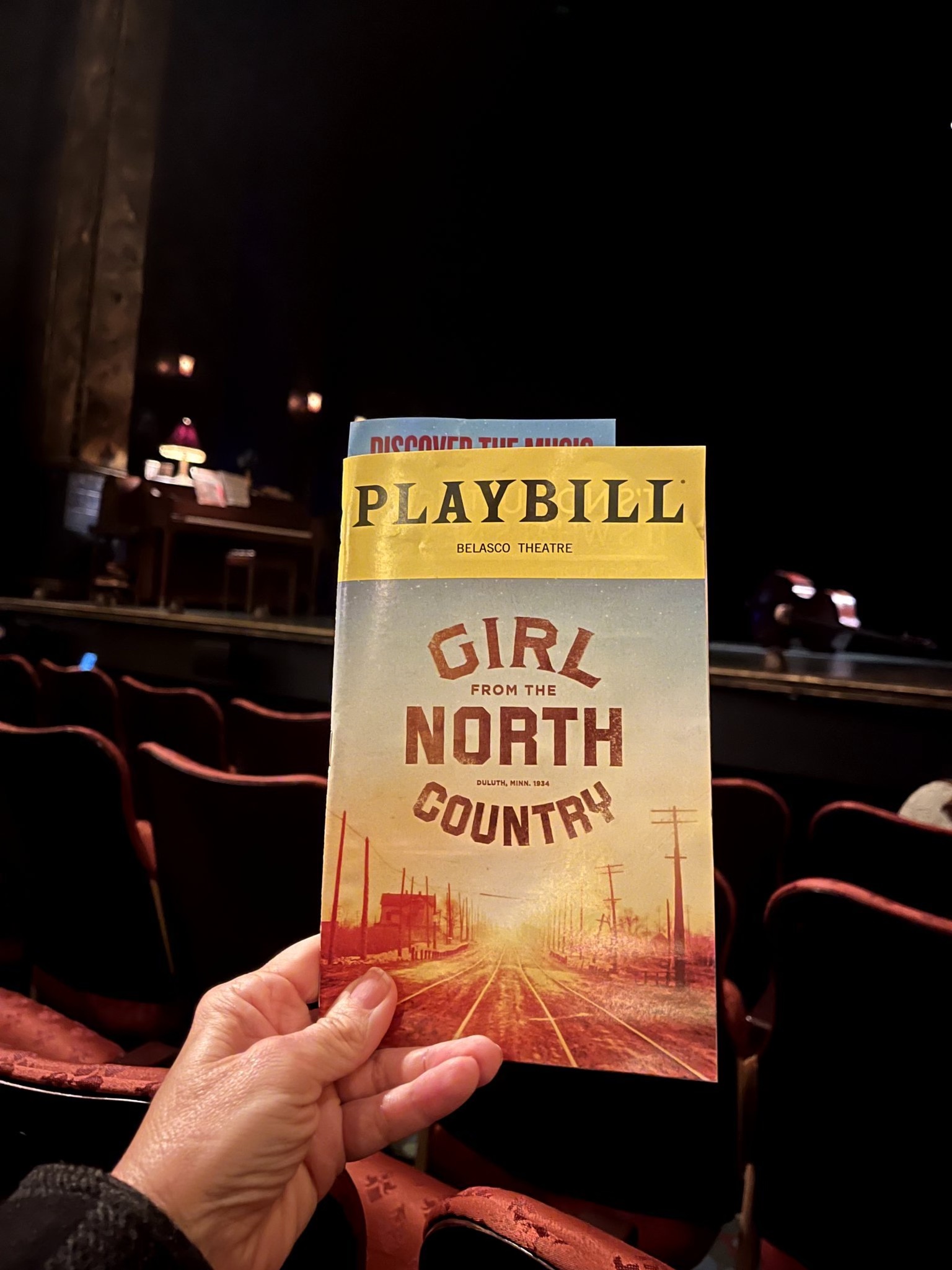
Mare Winningham, “Girl From the North Country”

While I absolutely loved Carmen Cusack in “Flying Over Sunset” (check out the cast recording!) and Joaquina Kalukango is giving a bravura performance that is perhaps the best thing about “Paradise Square,” if I had a vote I would cast it easily for Sharon D. Clarke in “Caroline or Change.” This was a Caroline whose simmering anger over the state of her life boiled over in a thundering “Lot’s Wife.” It would be wonderful if they could bring her back to do this for the Tonys.

Leading Actor in a Musical

Billy Crystal, “Mr. Saturday Night”

Myles Frost, “MJ”

Hugh Jackman, “The Music Man”

Rob McClure, “Mrs. Doubtfire”

Jaquel Spivey, “A Strange Loop”

Rob McClure’s nomination here is the only one for “Mrs. Doubtfire,” Crystal and Jackman are the old pros, but I think this comes down to two newcomers in their first role on Broadway: Myles Frost and Jaquel Spivey. My vote would go for Spivey, who carried me through Usher’s journey with intelligence, heart, and tremendous vocals.

Featured Actor in a Musical

Matt Doyle, “Company”

Sidney DuPont, “Paradise Square”

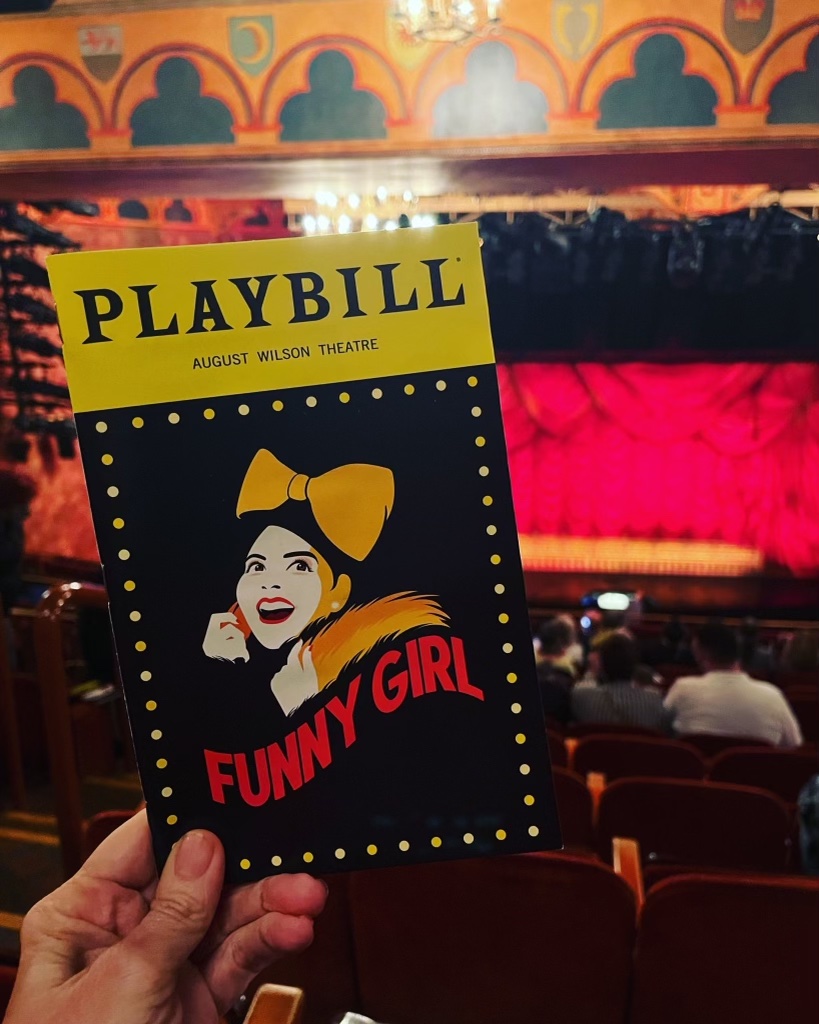
Jared Grimes, “Funny Girl”

John-Andrew Morrison, “A Strange Loop”

A.J. Shively, “Paradise Square”

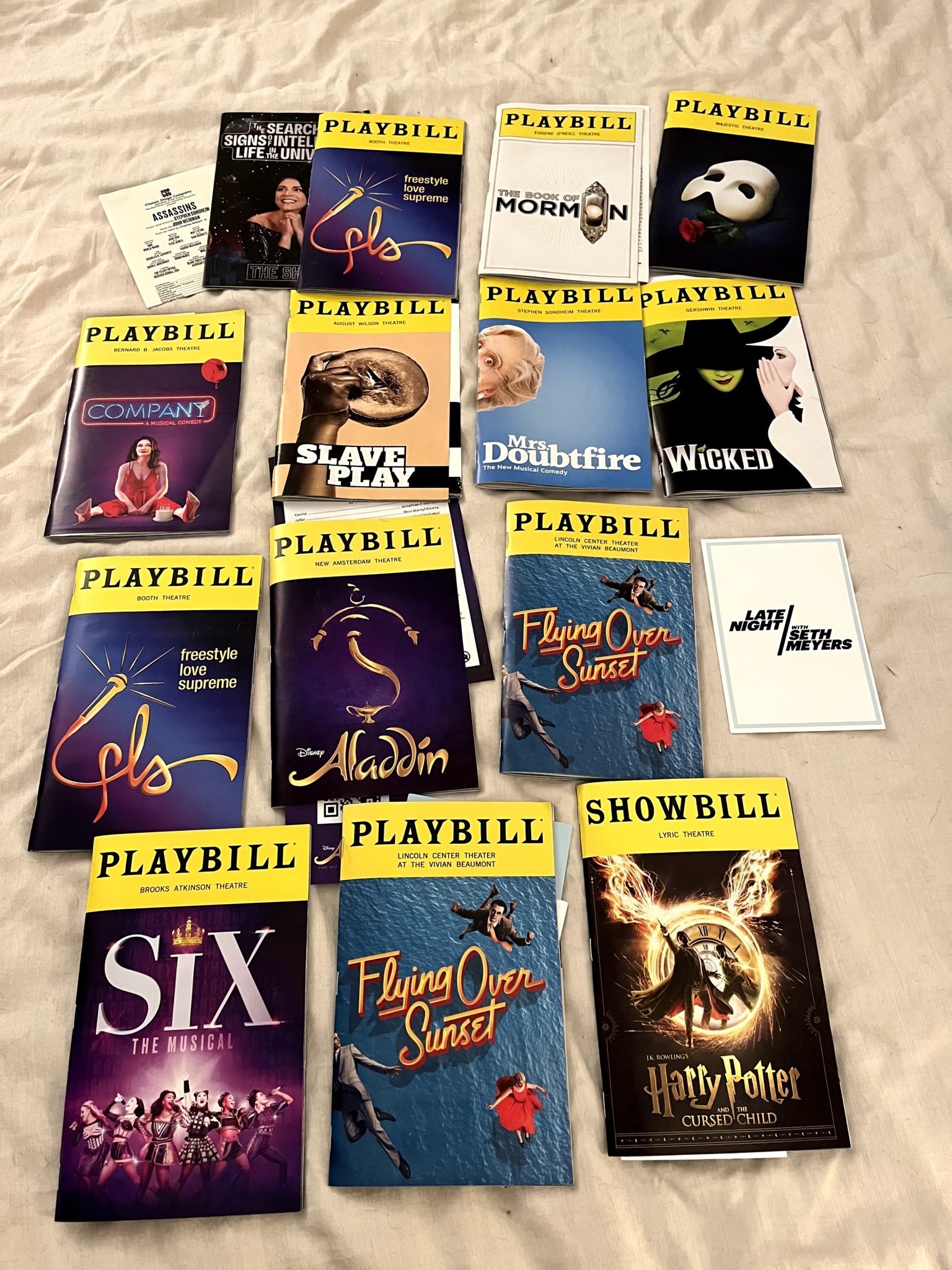
I posted the playbill from “Funny Girl” above because this category features its only nomination, and I am glad to see Grimes singled out. I will also note that I love John-Andrew Morrison in “A Strange Loop” and it was hard for him to stand out in the six excellent performances being given by Usher’s Thoughts (L. Morgan Lee was also recognized in Featured Actress). For me, though, this award has gone to Matt Doyle in “Company” from the first time I saw his bravura performance of “Not Getting Married Today” as Jamie (changed from Janie in the original) less than a week before Broadway shut down for the pandemic. I’ve seen it twice since and he never fails to dazzle me with his ability to make the lyrics so clean and acted out so clearly – while going so incredibly fast.

Featured Actress in a Musical

Jeannette Bayardelle, “Girl From the North Country”

Shoshana Bean, “Mr. Saturday Night”

Jayne Houdyshell, “The Music Man”

L Morgan Lee, “A Strange Loop”

Patti LuPone, “Company”

Jennifer Simard, “Company”

I’m glad to see L. Morgan Lee and Jennifer Simard recognized in this category, but Patti LuPone is just SO GOOD as Joanne in the revival of “Company” I would be unable to resist casting a vote for her.

Leading Actor in a Play

Simon Russell Beale, “The Lehman Trilogy”

Adam Godley, “The Lehman Trilogy”

Adrian Lester, “The Lehman Trilogy”

David Morse, “How I Learned to Drive”

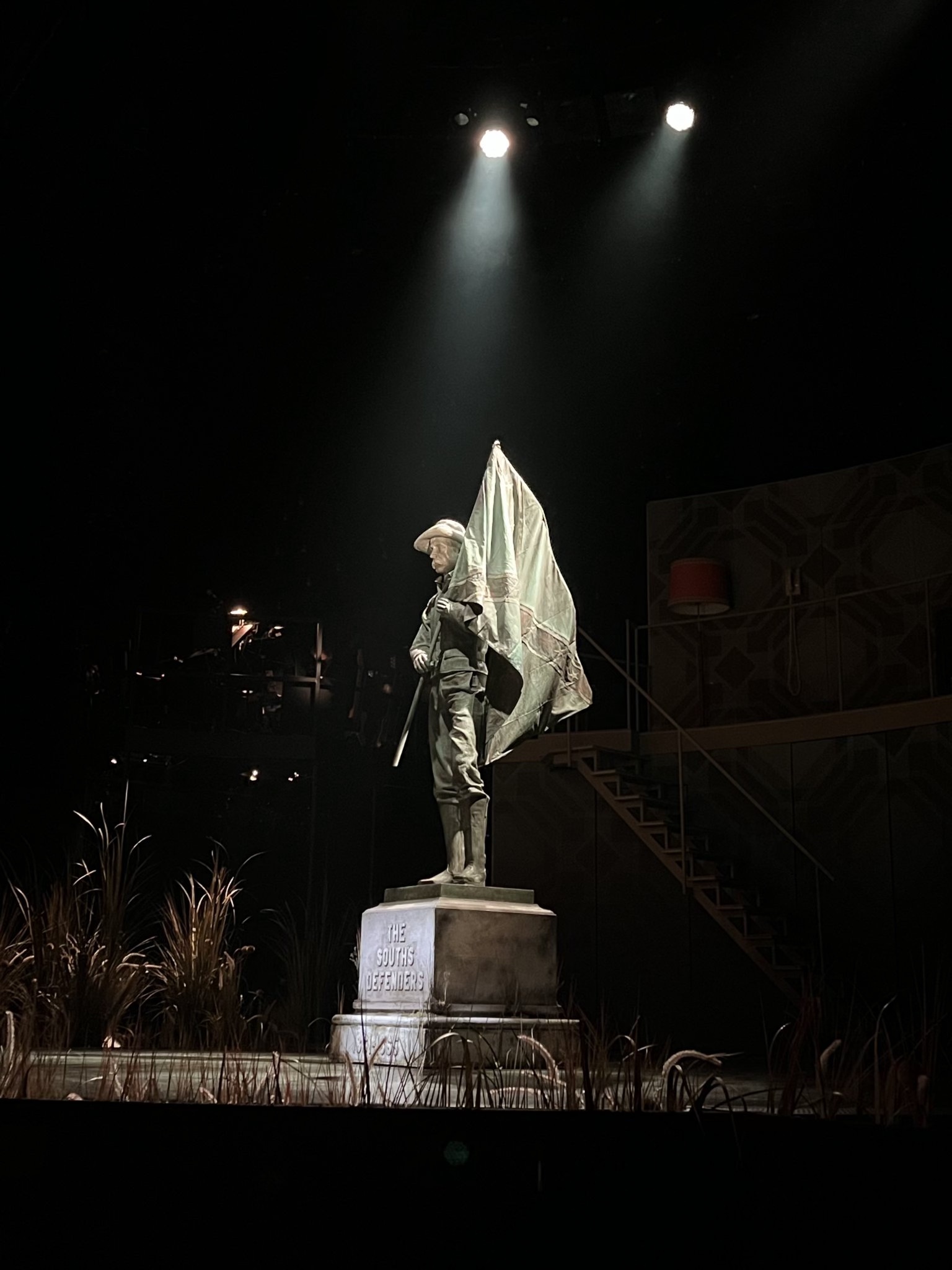
Sam Rockwell, “American Buffalo”

Ruben Santiago-Hudson, “Lackawanna Blues”

David Threlfall, “Hangmen”

Look at this category – seven nominees! All three actors from “The Lehman Trilogy” are nominated, which might split votes and lead to none of them winning (although I could see Simon Russell Beale doing it). Sam Rockwell fully inhabited the character of Teach in “Buffalo.” But my vote would go to David Morse in “How I Learned to Drive.”

Featured Actor in a Play

Alfie Allen, “Hangmen”

Chuck Cooper, “Trouble in Mind”

Jesse Tyler Ferguson, “Take Me Out”

Ron Cephas Jones, “Clyde’s”

Michael Oberholtzer, “Take Me Out”

Jesse Williams, “Take Me Out”

Six nominees in this category, and no clear favorite. I would probably vote for Michael Oberholtzer in “Take Me Out,” although again, you have three nominees from the same play which might split that vote and lead to another actor taking the award.

Leading Actress in a Play

Gabby Beans, “The Skin of Our Teeth”

LaChanze, “Trouble in Mind”

Ruth Negga, “Macbeth”

Deirdre O’Connell, “Dana. H”

Mary-Louise Parker, “How I Learned to Drive”

All worthy performances, but I will be shocked if Mary-Louise Parker doesn’t win for “How I Learned to Drive.”

Featured Actress in a Play

Uzo Aduba, “Clyde’s”

Rachel Dratch, “POTUS”

Kenita R. Miller, “For Colored Girls Who Have Considered Suicide/ When the Rainbow Is Enuf”

Phylicia Rashad, “Skeleton Crew”

Julie White, “POTUS”

Kara Young, “Clyde’s”

I put the picture of the “POTUS” Playbill above because two in the ensemble were nominated here. By the way, I agree with the recent article in The New York Times that the Tonys need an ensemble category – none of the wives in “Six” were nominated singly but as a group they might have won. I might vote for Rachel Dratch in “POTUS,” or Uzo Aduba in “Clyde’s” – but anyone could win here.

Revival of a Musical

“Caroline, or Change”

“Company”

“The Music Man”

I would vote for “Caroline,” but with it having been a limited run and closing just after New Year’s, sometimes it is harder to stay fresh in the Tony voters’ minds. If so, then I think “Company” will win – although it is possible that Marianne Elliott might win (deservedly) for best director and “Caroline” win for Best Revival.

New Musical

“Girl From the North Country”

“MJ”

“Mr. Saturday Night”

“Paradise Square”

“Six: The Musical”

“A Strange Loop”

Until “A Strange Loop” arrived this spring, my vote would have been for “Six,” which I saw twice before the pandemic and have seen three times since. But having seen “A Strange Loop” twice now this spring, it would have my vote for Best New Musical without any hesitation. I also hope that Michael R. Jackson, who has been working on this musical for about two decades, wins for best book of a musical. It is possible that “Six” might win for best score. “Girl From the West Country” also has some critical acclaim so I would say it is likely the only dark horse if this win doesn’t go to “A Strange Loop” or “Six.”

Notable Snubs

As mentioned before, the revival of “Funny Girl” garnered only one nomination, for Featured Actor. “Plaza Suite,” the revival of Neil Simon’s play starring Sarah Jessica Parker and Matthew Broderick, had no acting nominations. The lead of the revival of “Company, ” Katrina Lenk, was not nominated for Lead Actress. I don’t necessarily disagree with these snubs, but I would have liked to have seen “Flying Over Sunset” – flawed as it was, it also was often quite brilliant and certainly original -nominated for Best Musical over “Mr. Saturday Night” and “Paradise Square.”

The Tony Awards will be held at Radio City Music Hall on Sunday, June 12, starting at 7pm on Paramount+ and continuing from 8-11pm on CBS. Hosted by Ariana DeBose, recent Academy Award winner and Broadway veteran, look for an abundance of musical numbers as Broadway hopes to lure the casual theatre-goer back. Whether casual or devoted, go support the Broadway community, so integral to the very spirit of New York City, and don’t forget the established productions that have made it back from the pandemic as well!

Sondheim at NYPL: “No One is Alone”

When Stephen Sondheim died on November 26 of last year, we lost a towering figure in musical theatre. The New York Public Library for the Performing Arts at Lincoln Center quickly put together a pop-up installation of some of his correspondence from their archives, which proved to be so popular that they have recently enlarged it, adding set models from several of his musicals, and highlighting Sondheim’s interactions with collaborators. This exhibit will be on display through February 12, and if you are able to stop by, I believe it is well worth it (as with everything at the library, there is no charge). To me, the most interesting aspects were the way his playfulness and humor showed up in his correspondence with others. It’s easy to be so intimidated by someone’s talent that they seem more than human, but in this exhibition Stephen Sondheim’s personality and humanity shone through.

If you have never visited the Performing Arts Library, you need to put it on your radar. They often have very informative and entertaining displays about various areas of the performing arts. They also hold panel discussions and interviews with well-known artists. They are located just to the south of Lincoln Center Theatre. Bookmark their website!

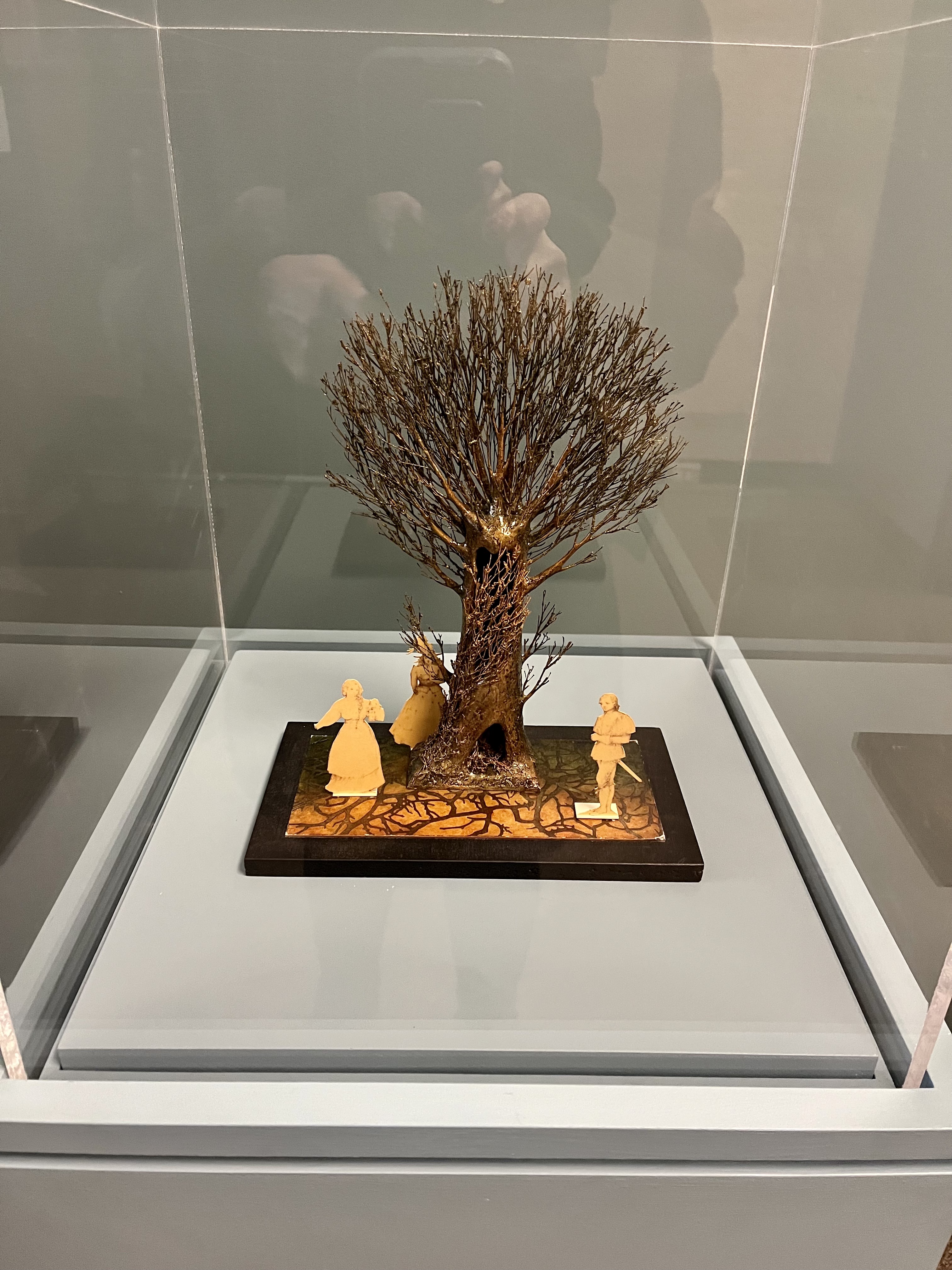
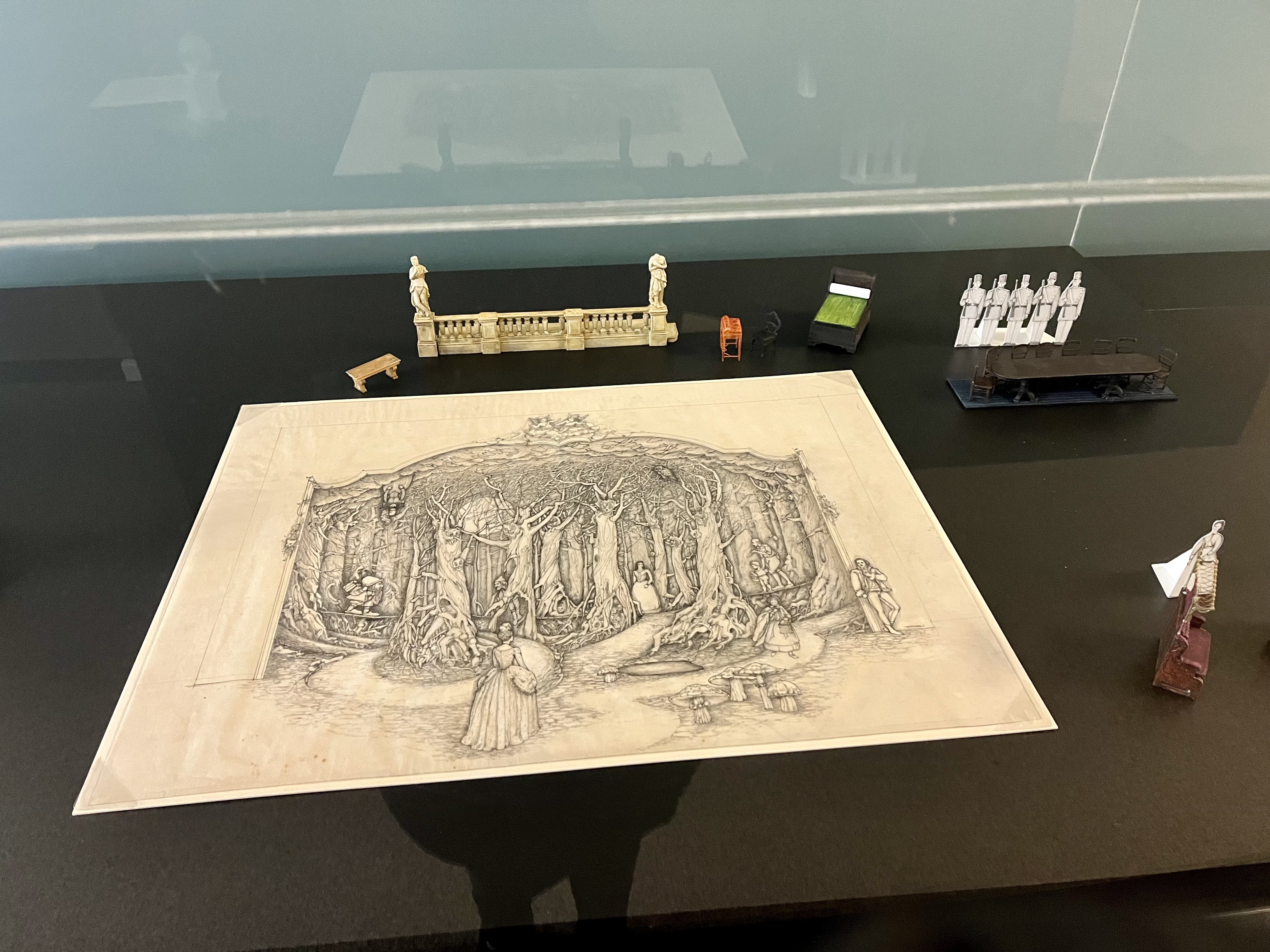
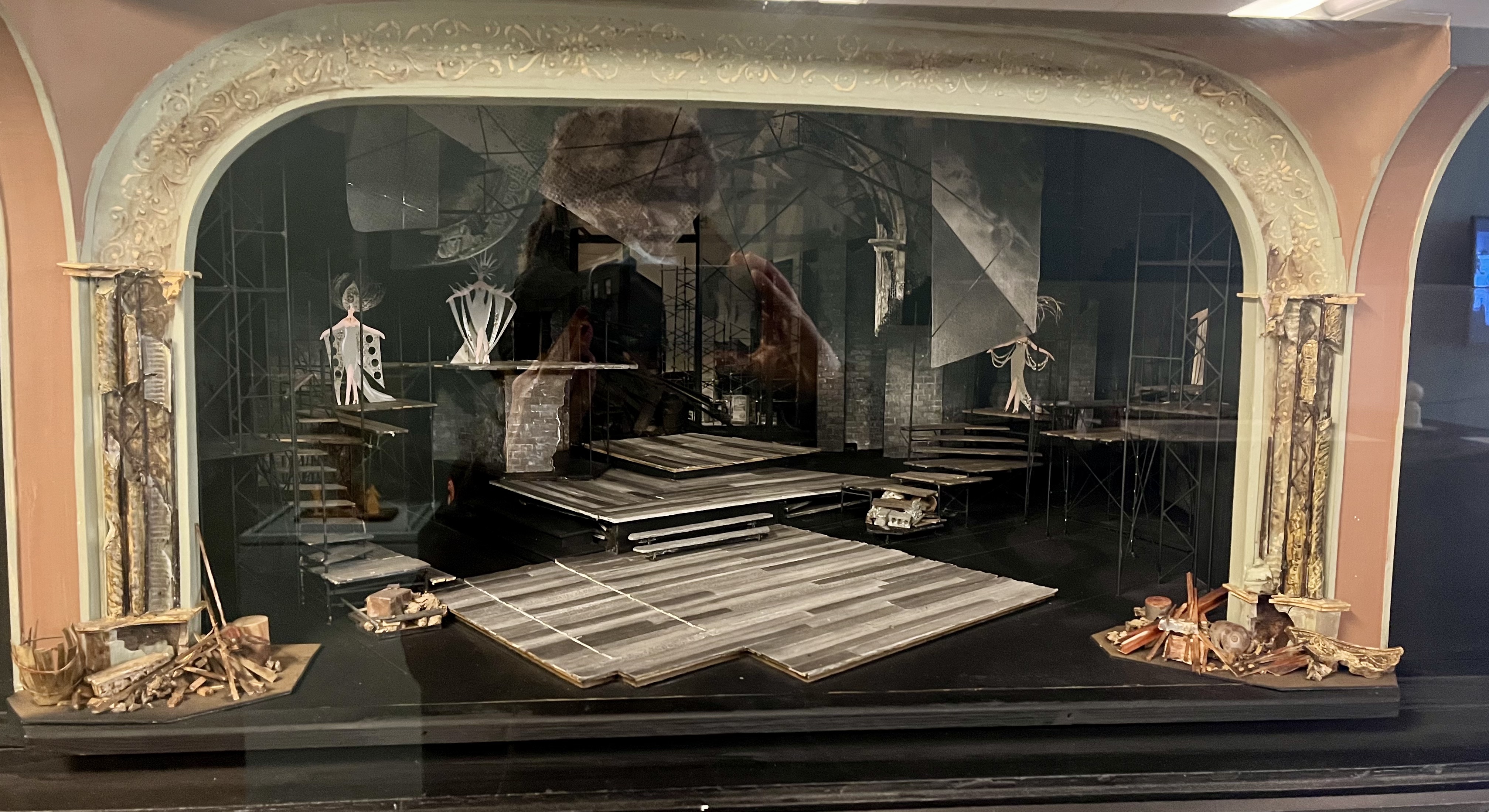
The photos above show some of the additions made to the original display of Sondheim’s correspondence. The library has an interactive screen that allows you to go through and look at Playbills and production notes from many Sondheim musicals. In addition, they had an early design for a tree for Into the Woods, as well as early design sketches and models for the set design for Company and Follies.

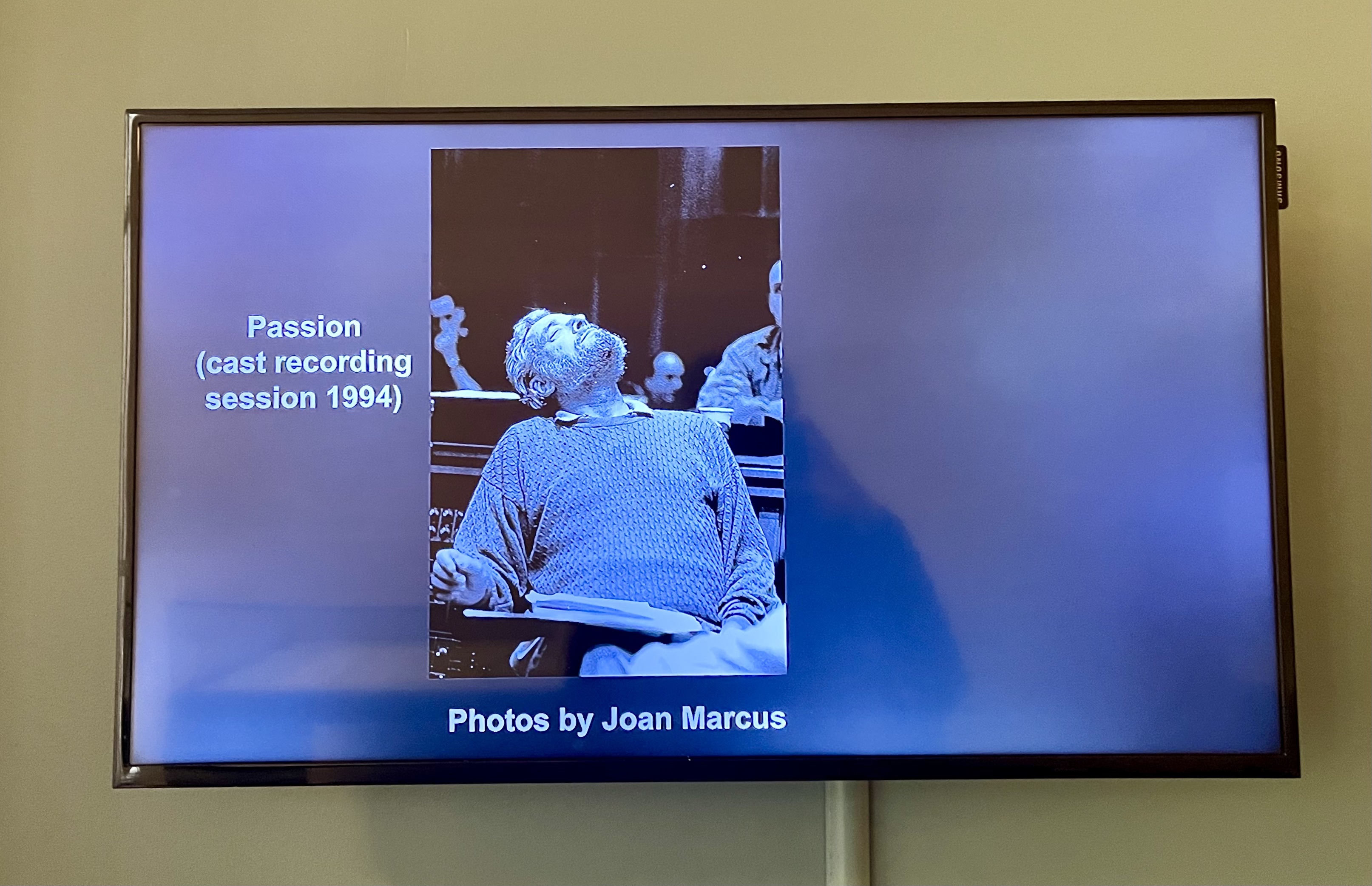
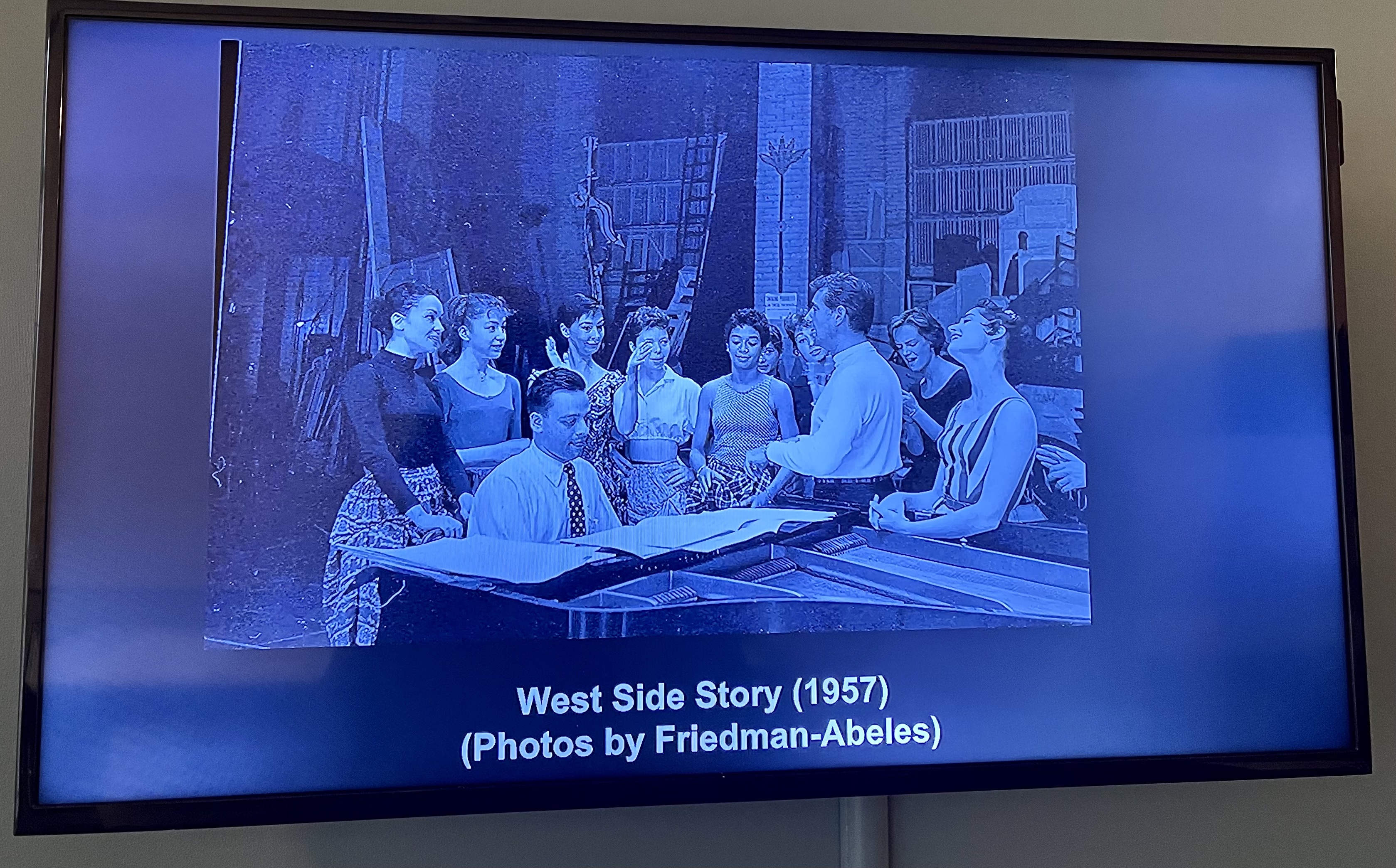
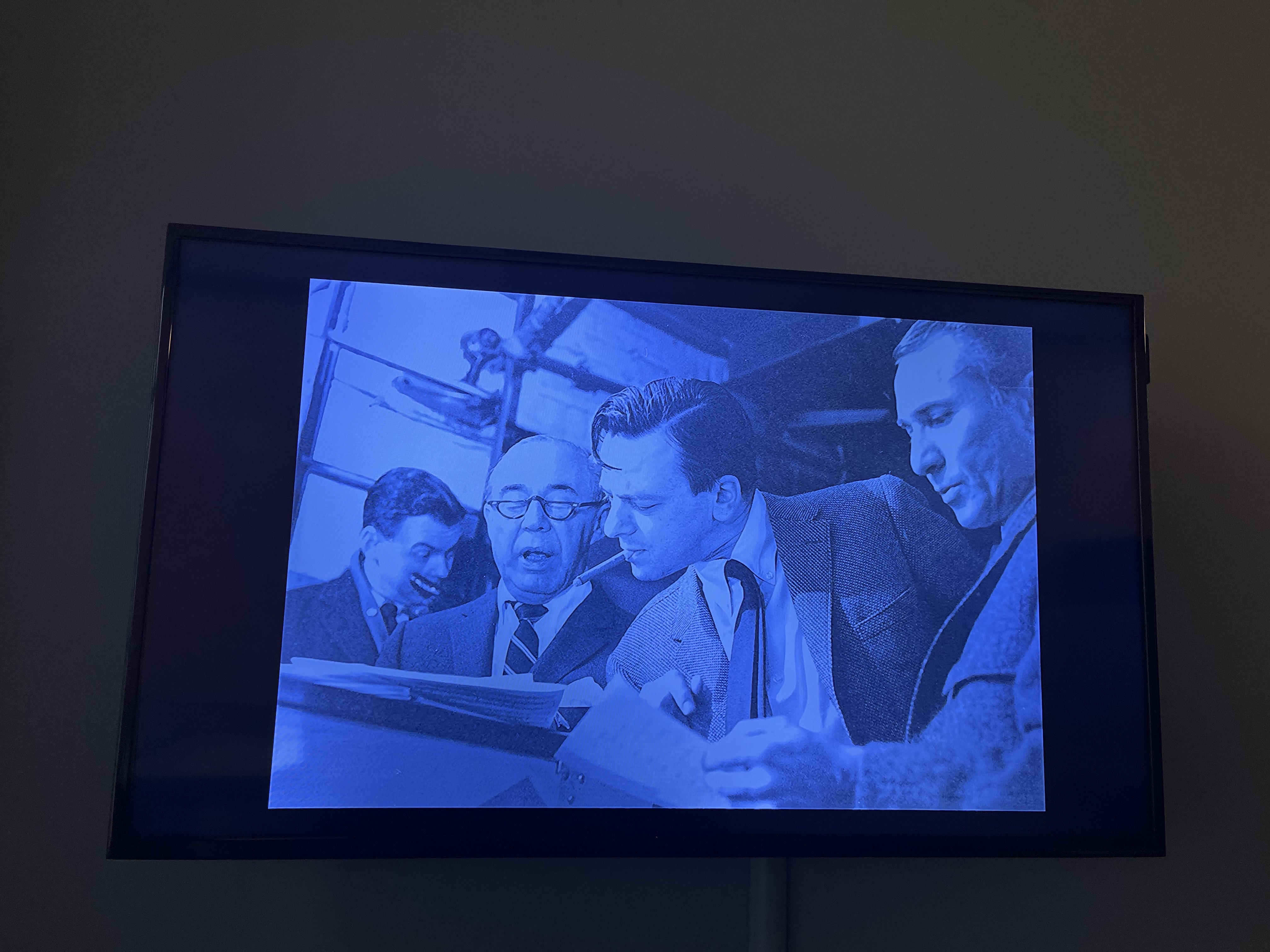
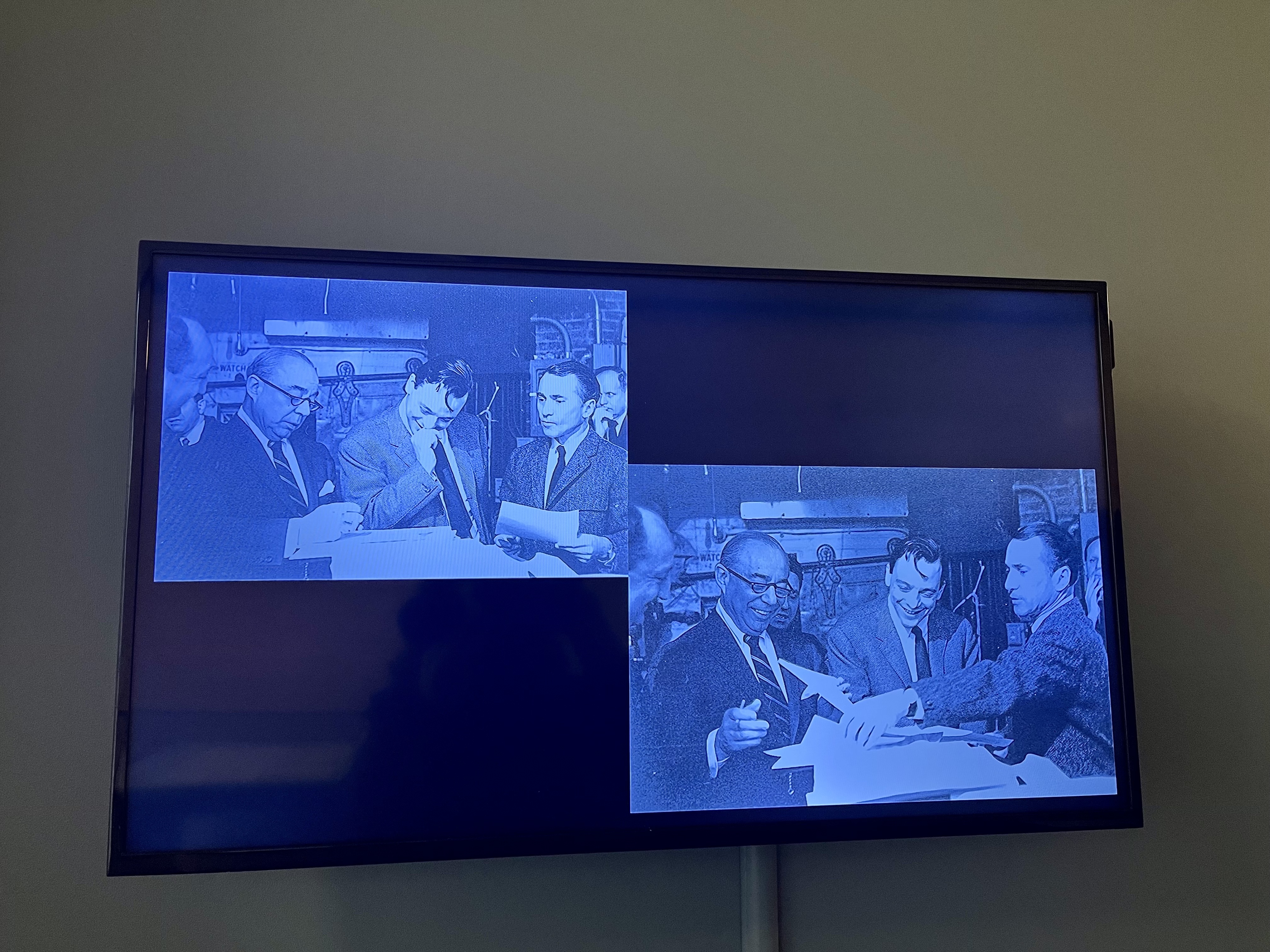
On a screen, images of Sondheim with his collaborators, going all the way back to Gypsy and West Side Story, rotate through candid photos over the years.

The real heart of the display continues to be Sondheim’s correspondence, however.

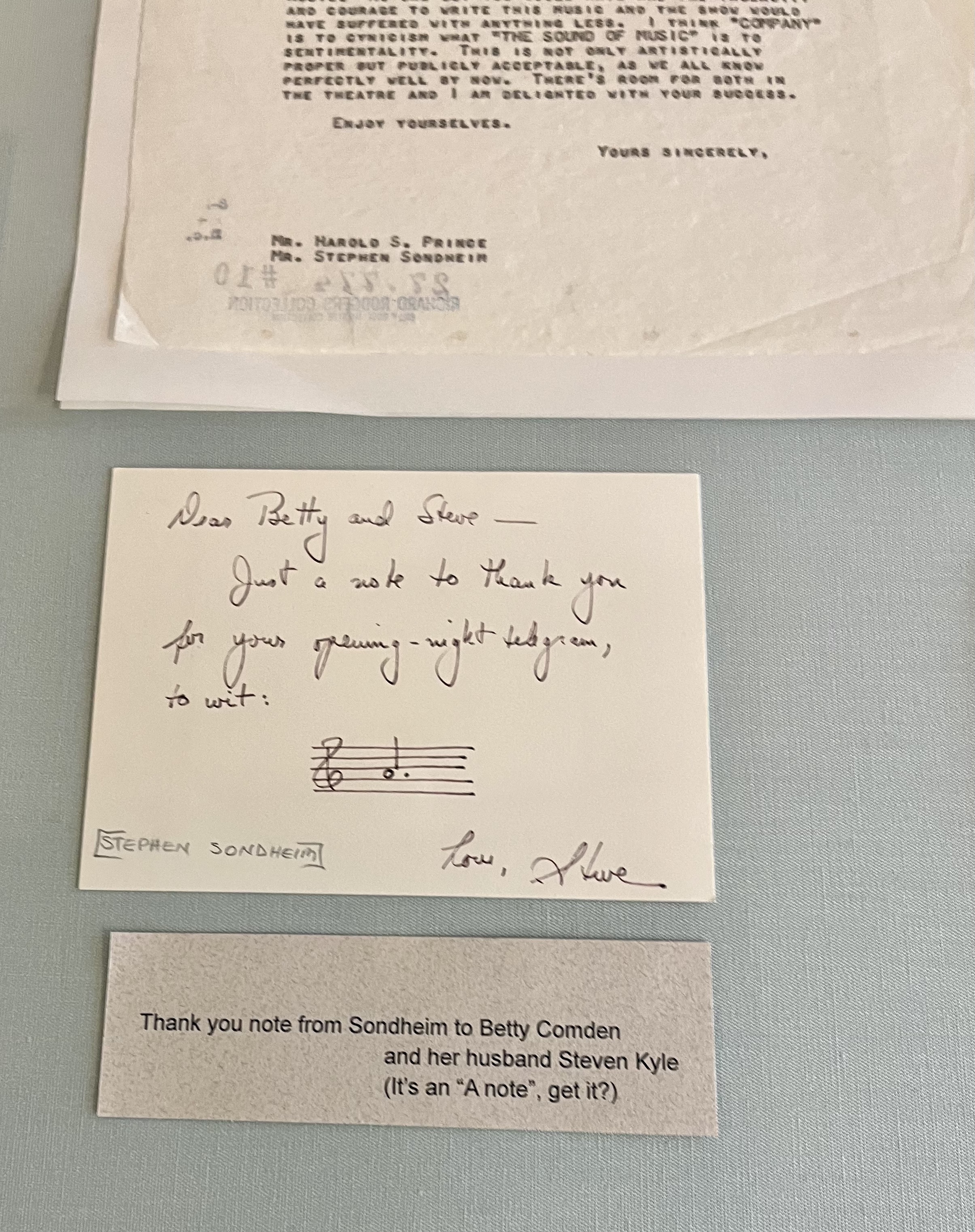
Look at this thank you note to Broadway lyricist Betty Comden and her husband, “just A note” included!

I loved the personality shining through these notes to playwright Peter Stone and his wife, Mary. Given the date of the one on the left, he was presumably referring to A Little Night Music. After asking them whether they had seen it, he added,” If you adored it so much that you can’t keep away, come again as my guests. And if you didn’t like it, f*** off. Love, Steve.”

Here you can see lyrics written by Michael John LaChiusa in honor of Sondheim’s 80th birthday, and a congratulatory letter from Richard Rodgers to Sondheim on the opening of Company, with Sondheim’s reply (“no letter I have received on the show has meant more”).

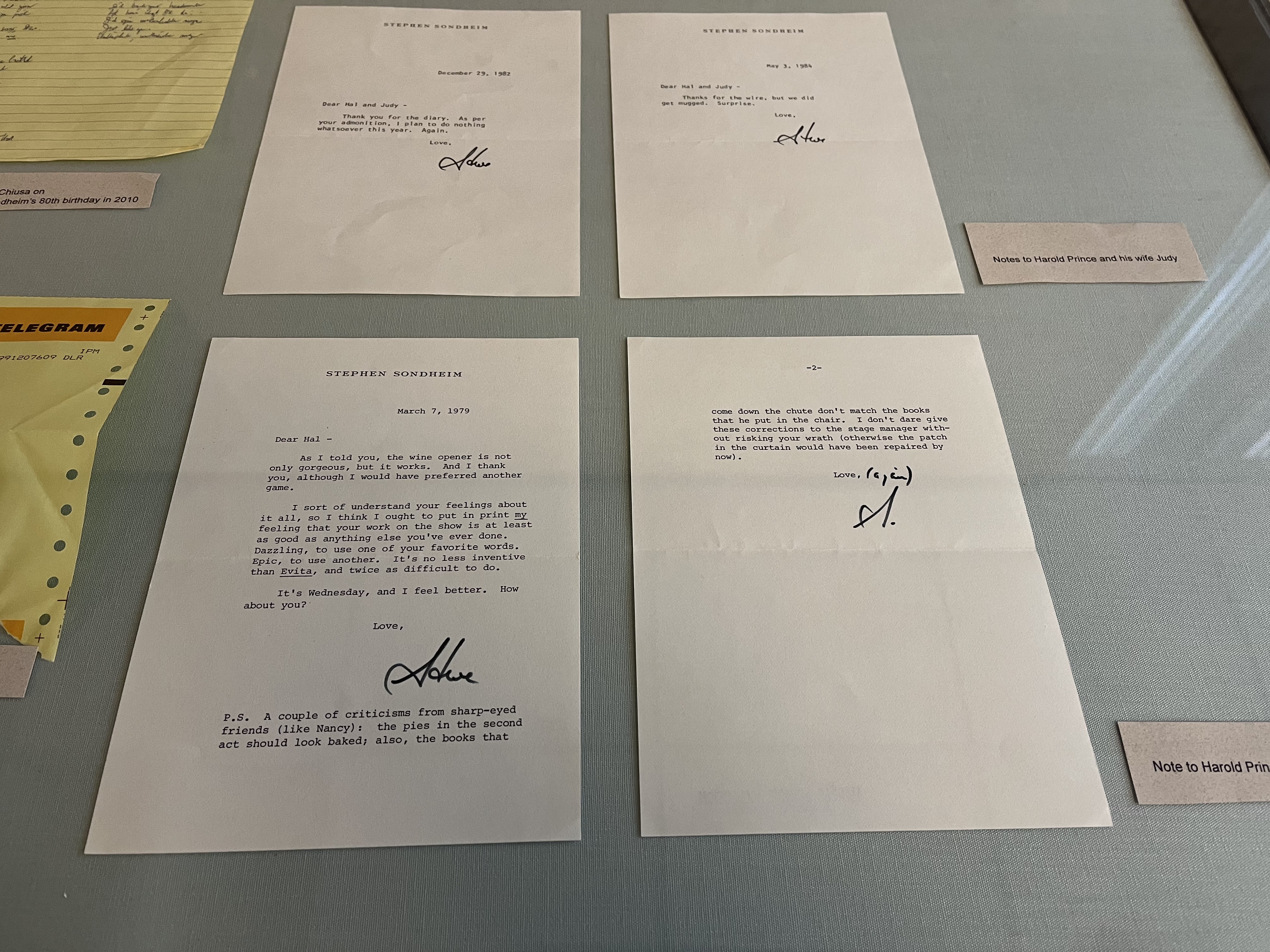
I love these notes. In the upper right, he expresses thanks for the gift of a diary from Hal Prince and his wife, Judy, and then claims “I plan to do nothing whatsoever this year. Again.” In the upper left, he thanks them for a wire but says ” . . . we did get mugged. Surprise.” (Presumably, given the year, a bad review for Sunday in the Park with George?) And at the bottom, to Hal alone, notes on Sweeney Todd, which would have just opened a week before. After noting that the pies in the second act should look baked, and that the books coming down the chute when trying out the “special” barber chair should match the ones put in, he claims he dares not risk Hal’s wrath by giving the notes directly to the stage manager.

Stephen Sondheim won eight Tony Awards and a Presidential Medal of Freedom, and has theatres named after him in both New York City and London. He died at the age of 91 on a Friday, after having seeing both a matinee and an evening show on Broadway on Wednesday, and celebrating Thanksgiving with friends on Thursday. A few days later – on a Sunday – the Broadway community gathered on the red steps in Times Square to celebrate his life (I was there, and posted a clip on Instagram that you can see here). As they sang “Sunday” from Sunday in the Park with George the word that rang out was “forever.” Just as the people immortalized in the painting “A Sunday Afternoon on the Island of La Grande Jatte” by Georges Seurat will be viewed forever, Stephen Sondheim – the icon, and the man – has changed musical theatre and will be remembered with respect and affection forever.

Broadway Reopening

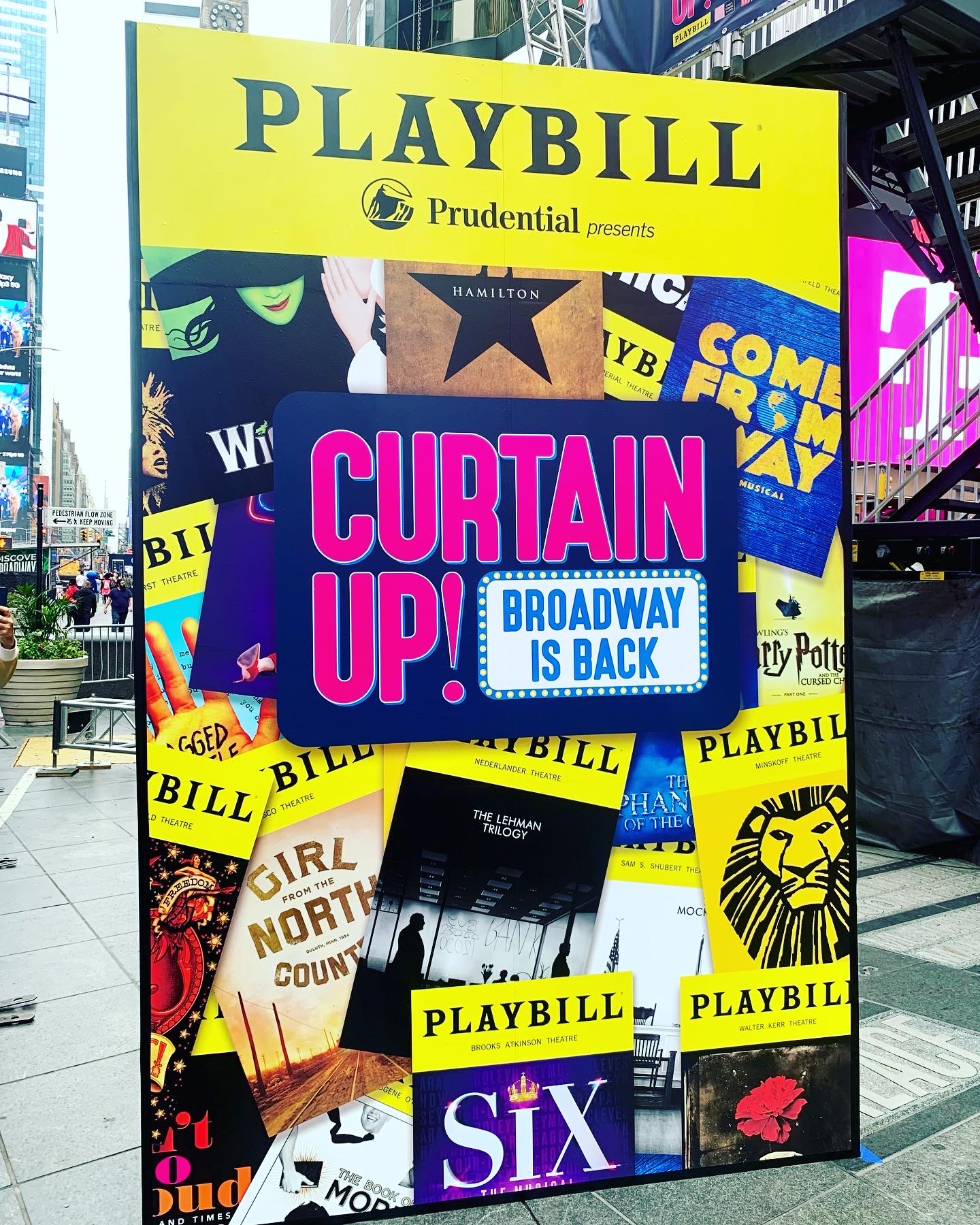
I’ll never forget hearing on March 12, 2020, that Broadway was going to be shut down until the week of April 13th. It seemed inconceivable to me that it could be true – after 9/11 it was shut for two days, and here and there a blizzard would shut down shows for a day. The idea that there would be no Broadway theatre for over a month was stunning. If someone had told me at that point, as I struggled to process this unprecedented shut down, that in reality Broadway theatres would be closed for at least 18 months, I would not have been able to believe it (or, perhaps, take it). Even when I was taking photos in an entirely empty Times Square that spring (the experience of which I wrote about in this blog post), it still seemed impossible to believe that Broadway, the heart of NYC’s pulsing vitality, would be shuttered for so long. But now the sleeping beauty is waking up, and it’s exhilarating. This is my perspective on Broadway’s reopening, as of the end of September, 2021.

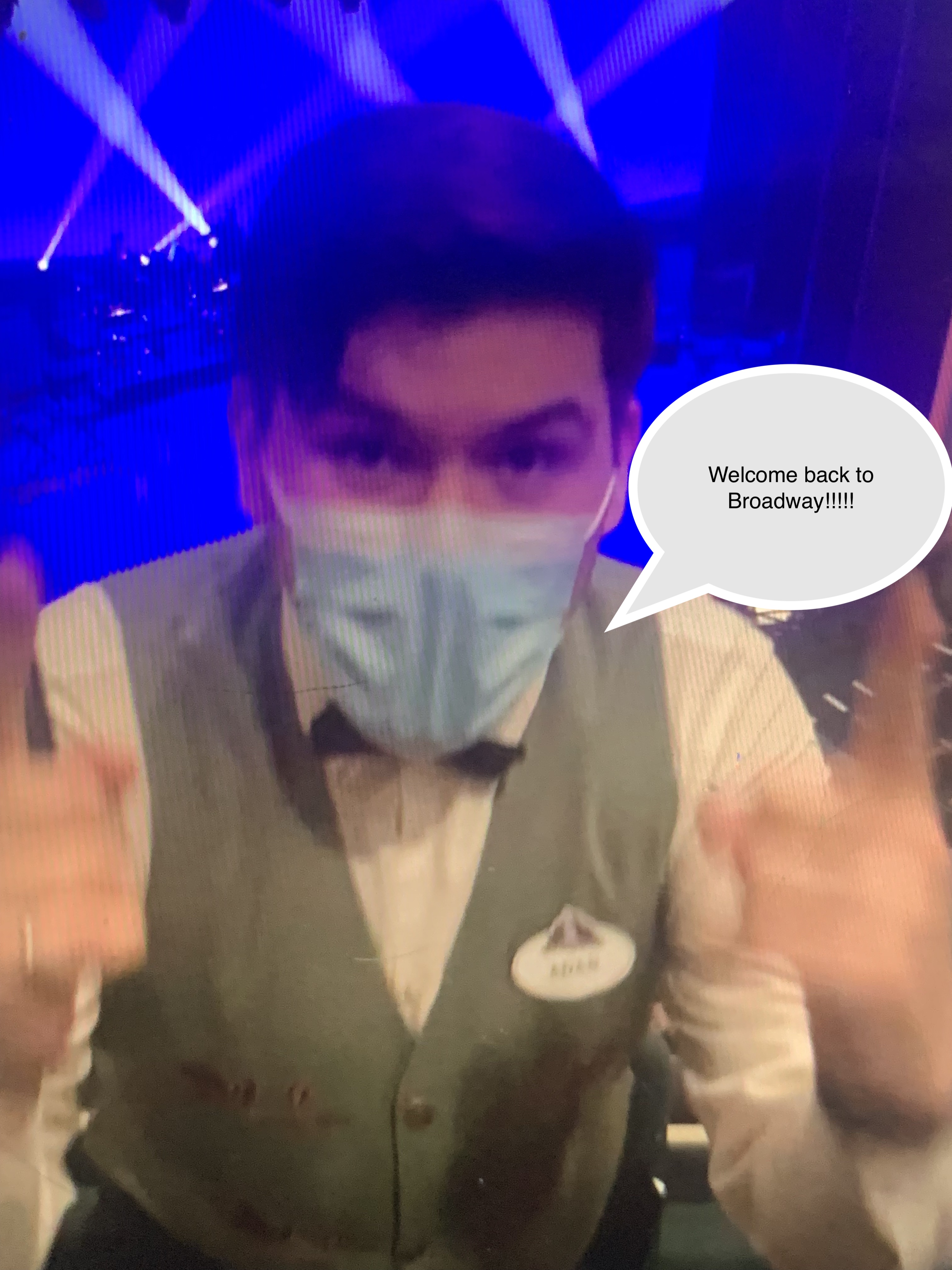
The first time I walked into a Broadway theatre was to see a Disney on Broadway concert (Live at the New Am) at the New Amsterdam theatre. Vaccination checks were in place before the normal security screen. To hear the sound of a ticket being scanned was a delight. When the usher (above) declared “Welcome back to Broadway!” it was almost too emotional. The concert was fantastic, and so many lyrics of Disney on Broadway songs took on new meaning and the performers and audience reacted (for instance, “In the First Time in Forever,” the following: There’ll be actual real live people/It’ll be totally strange/But wow, am I so ready for this change!/’Cause for the first time in forever/There’ll be music, there’ll be light.

The first Broadway play to open after pandemic shutdown was the new play Pass Over, by Antoinette Nwandu. The opening night of previews, August 4, the crowd stood and applauded with stage manager Cody Renard Richards made the preshow announcements (you can see his experience here). After the first preview, the block of West 52nd between Broadway and Eighth was closed off and there was a jubilant block party with DJ.

The next time I was in a Broadway theatre was the Majestic, to see the premiere of a documentary about the Broadway shutdown and a few touring companies that managed to stay open in South Korea. The entire experience was terrific, from being welcomed with Josh Groban singing “Can’t we start again please” (from Jesus Christ Superstar), though the film. But when the end credits were over, the screen rose to reveal the iconic Phantom’s lair, and a bevy of Broadway divas (including Adrienne Warren, Ariana Dubose, and Sierra Boggess) singing “As If We Never Said Goodbye” from Sunset Boulevard.

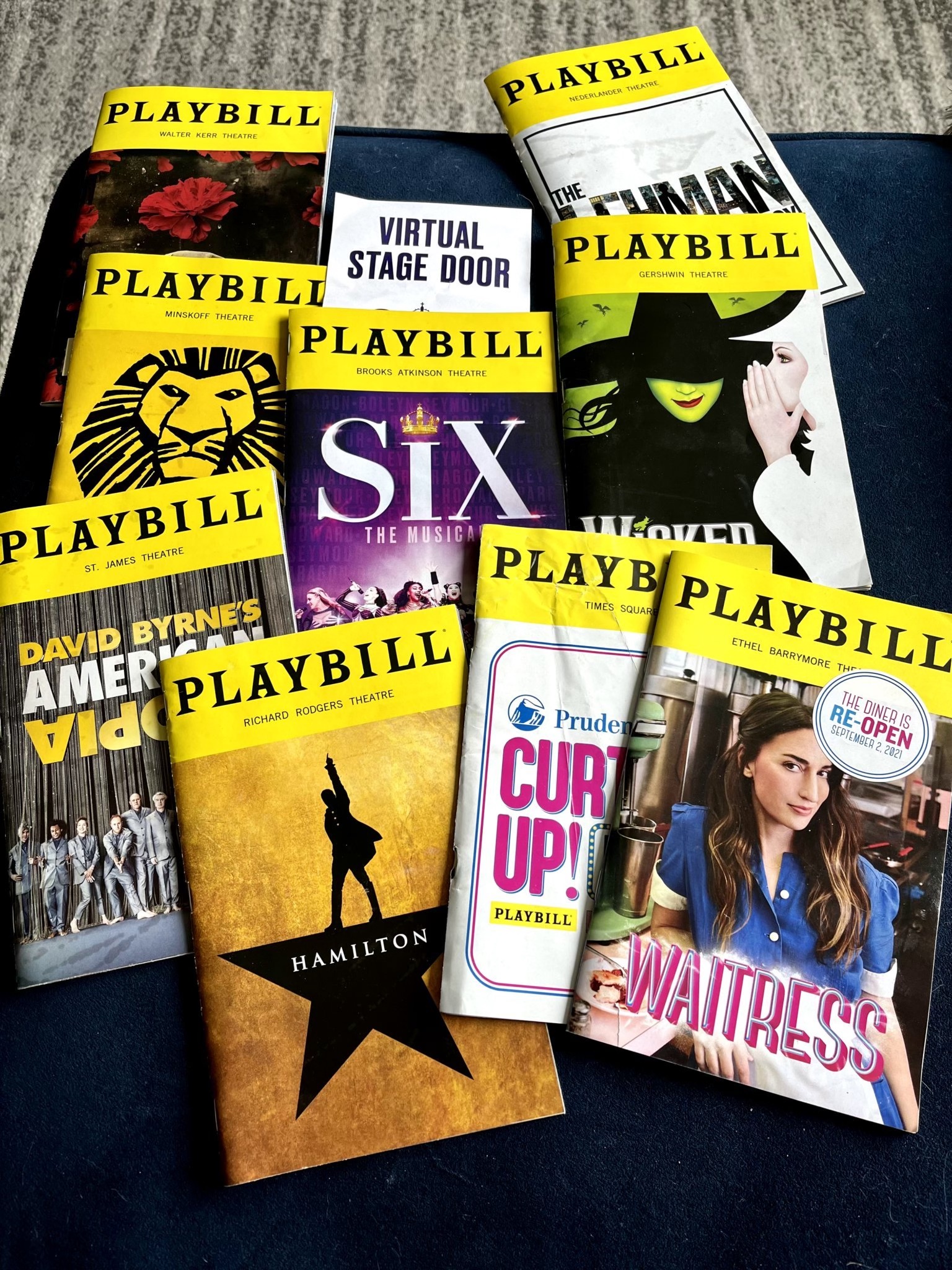
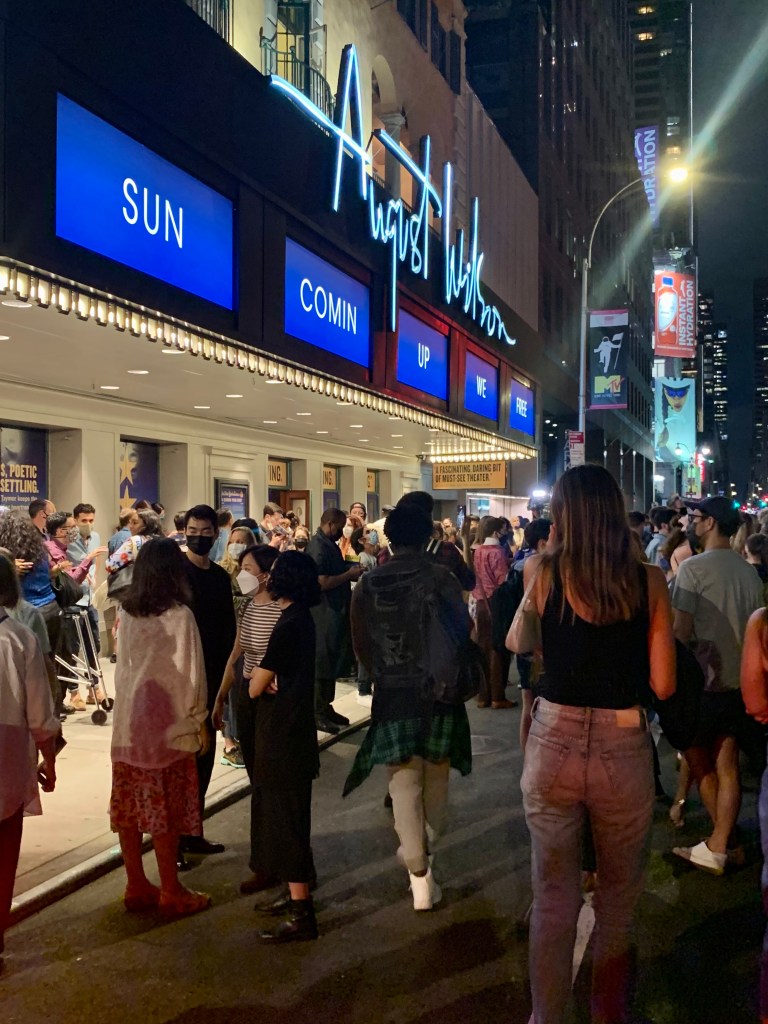
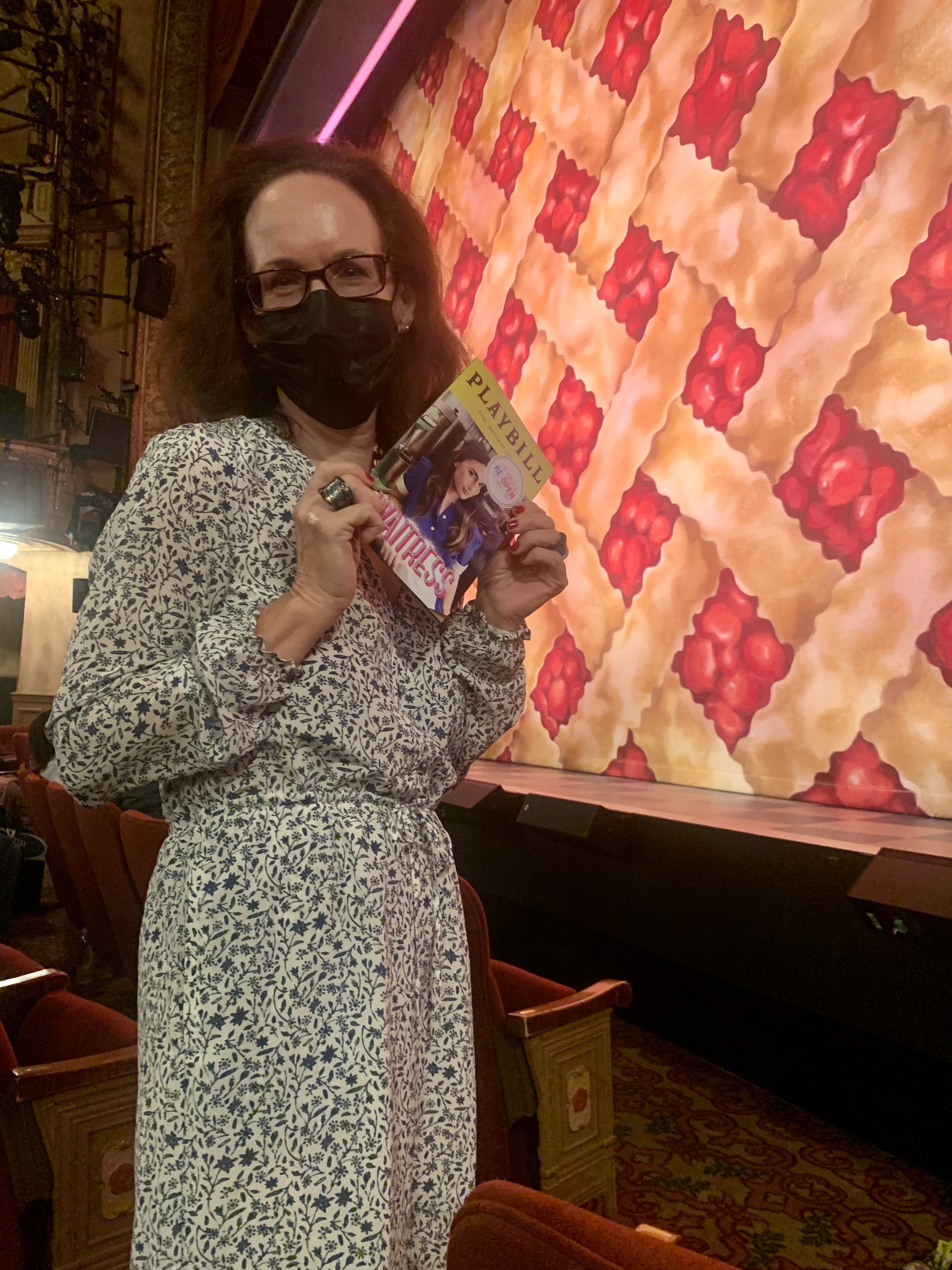
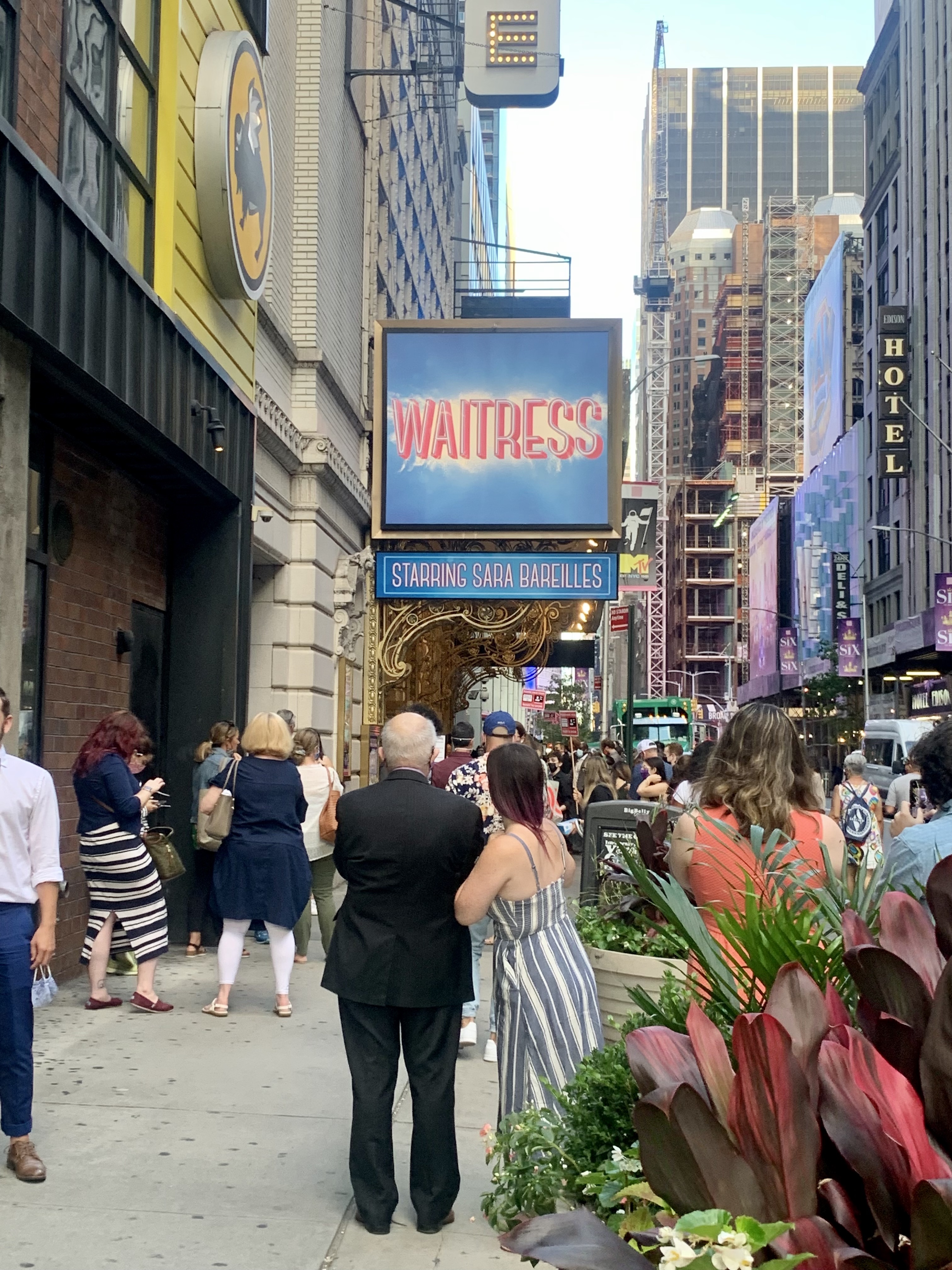
On September 2, the first Broadway musicals reopened: Waitress, with composer Sara Barielles stepping back into the lead for six weeks, and reigning Tony Best Musical Hadestown. I was at the first night for Waitress, and enjoyed the sticker on the front of the playbill saying “The Diner is Re-Open” along with the date. The audience gave a standing ovation (the first of perhaps 10 or 12 that evening) for the “turn off your cell phones” announcement – which at Waitress is a song. After initial bows, Amanda Kloots, the widow of original cast member Nick Cordero (who lost his battle with Covid-19 last year) came on the stage and everyone sang Nick’s song “Live Your Life.” His song is now also permanently included as one of the pies on the menu board on stage.

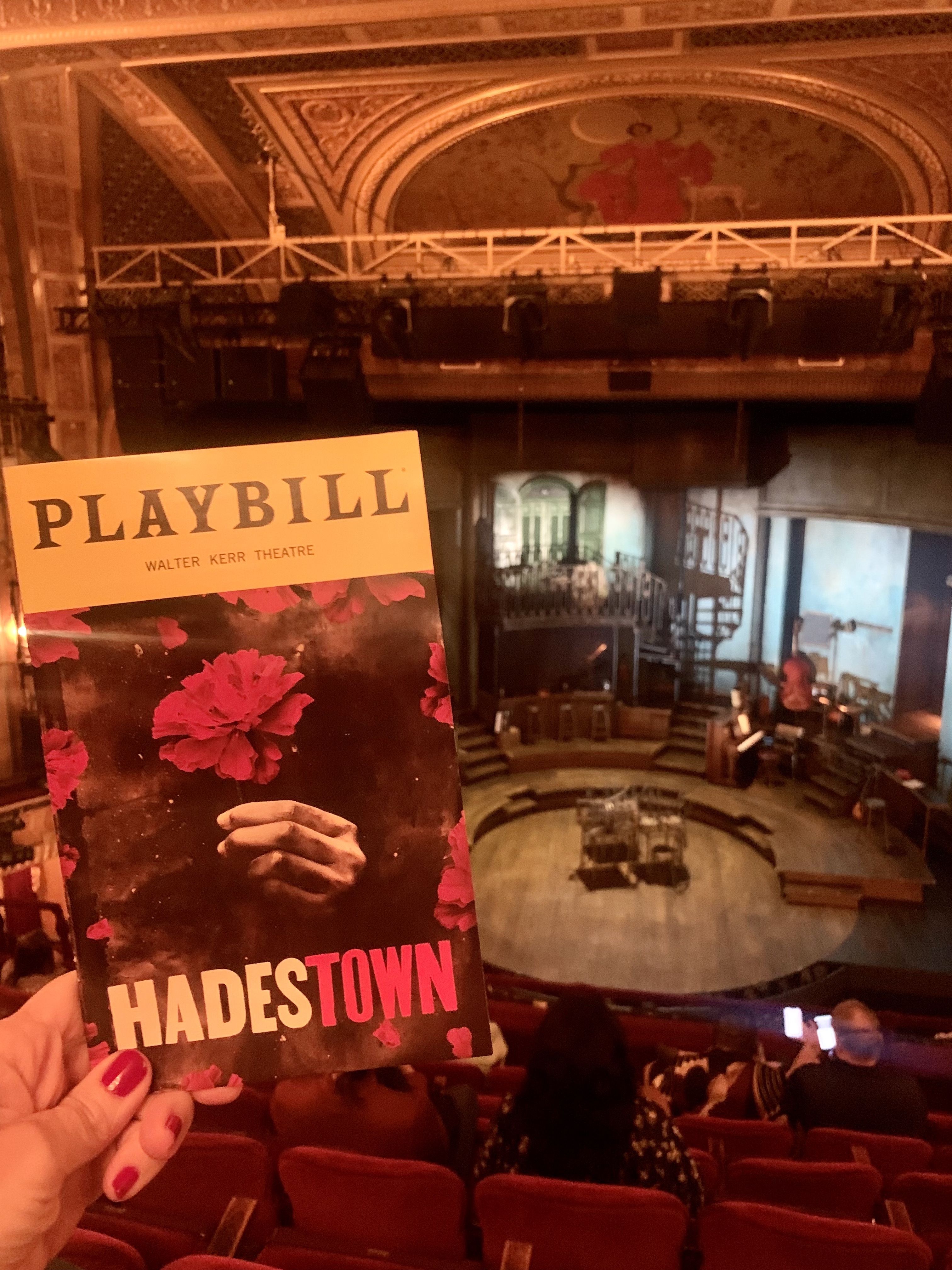
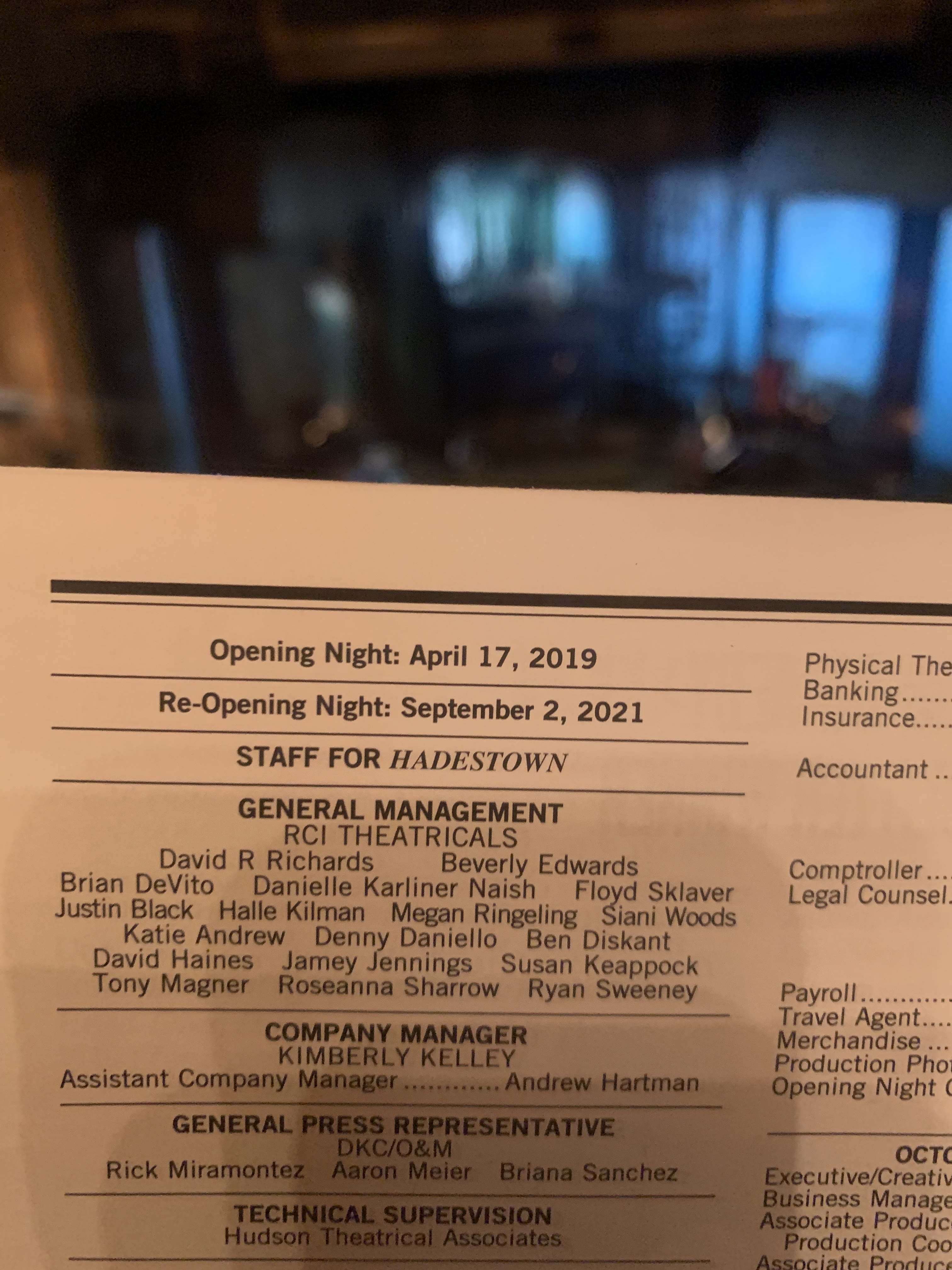
I was at the third reopening performance of Hadestown, and loved that their Playbill lists reopening night as well as opening night. The outside of the theatre is enrobed in the red flowers that feature so prominently in the production. Here they represent that “spring will come again” to Broadway as it returns and flourishes.

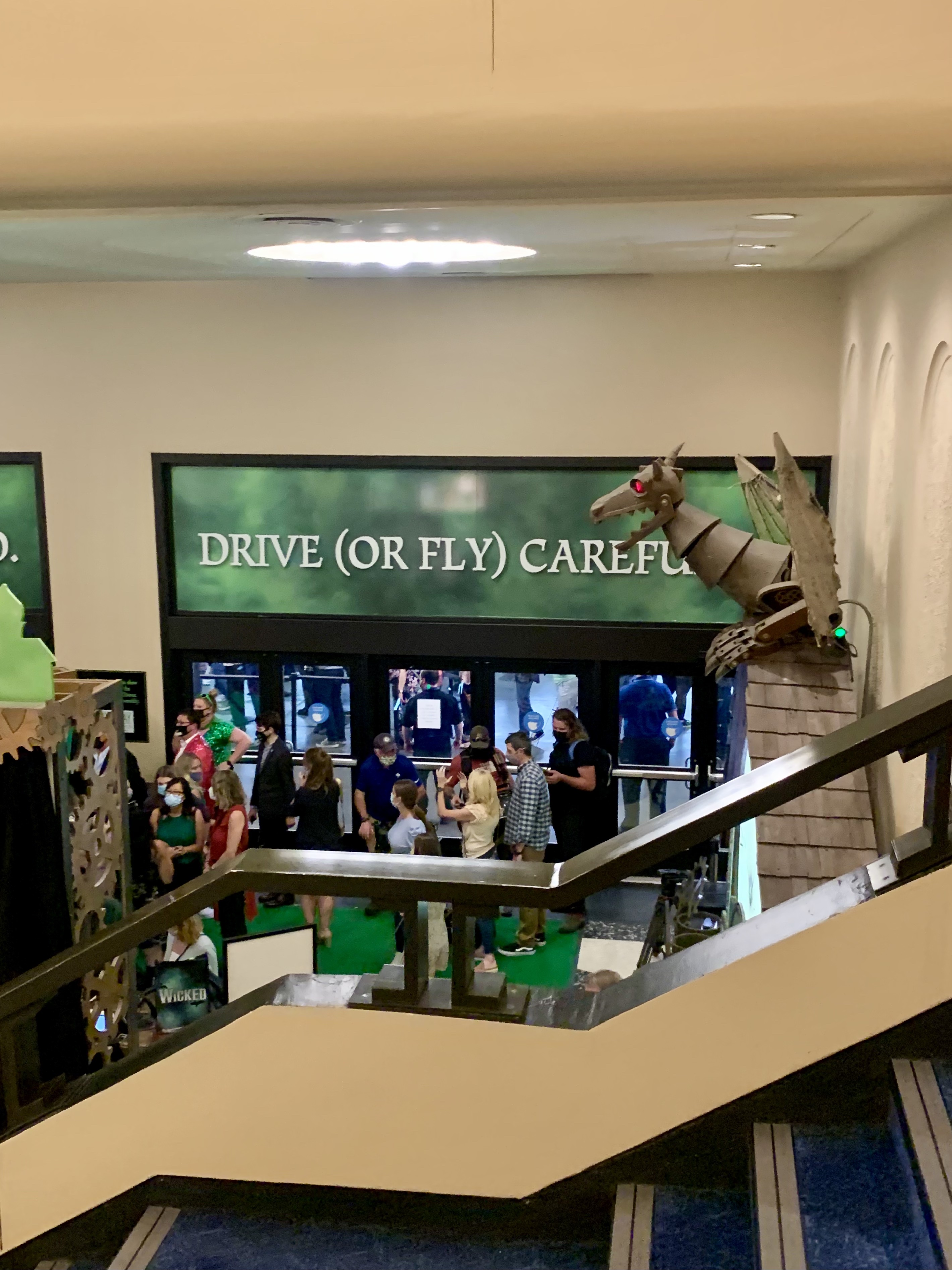
On September 14, Hamilton, The Lion King, Wicked, and Chicago all reopened. At 5PM that day, casts met in front of the Richard Rodgers Theatre and, led by Lin-Manuel Miranda, delivered a rousing version of “New York, New York.”

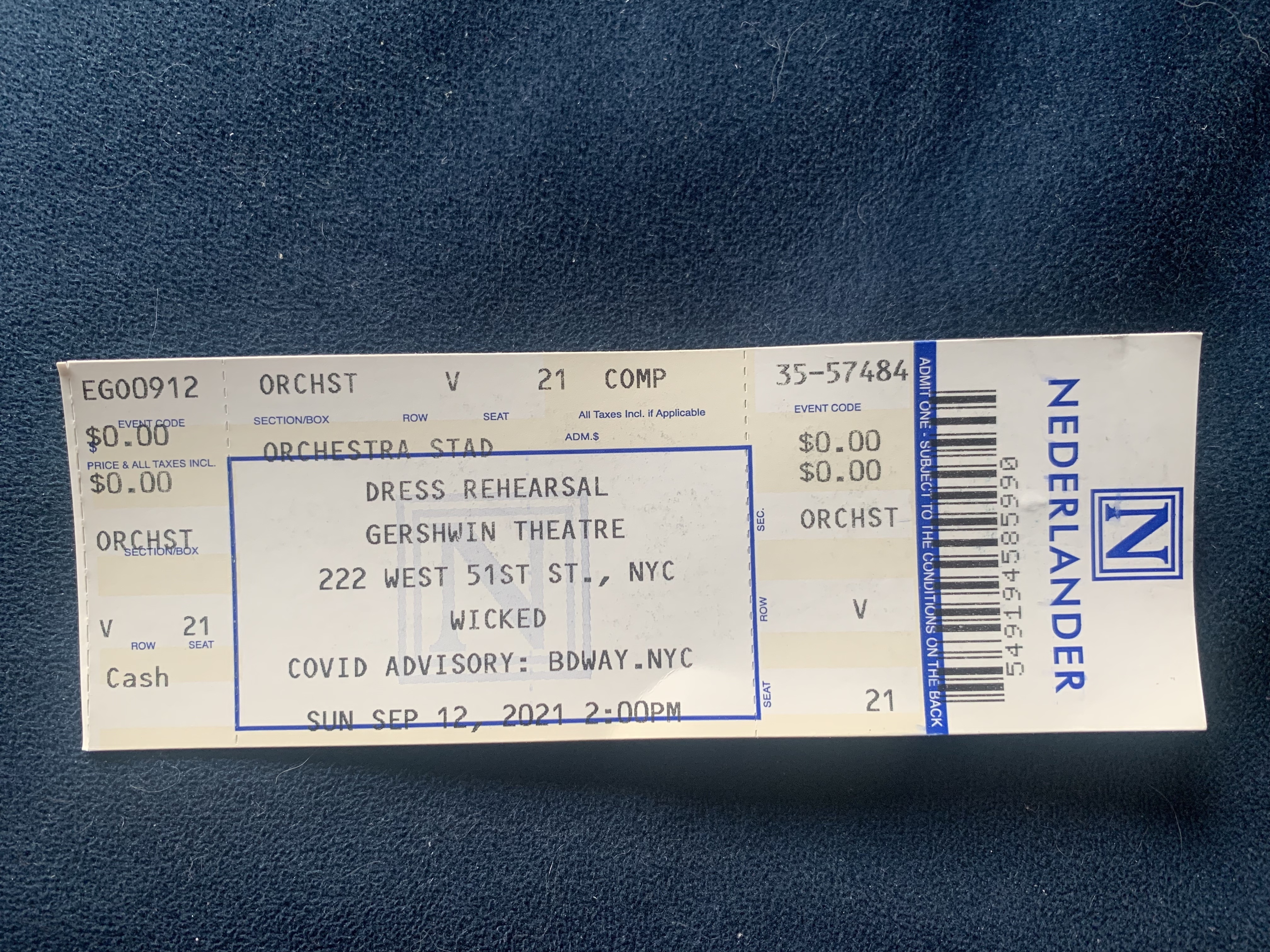
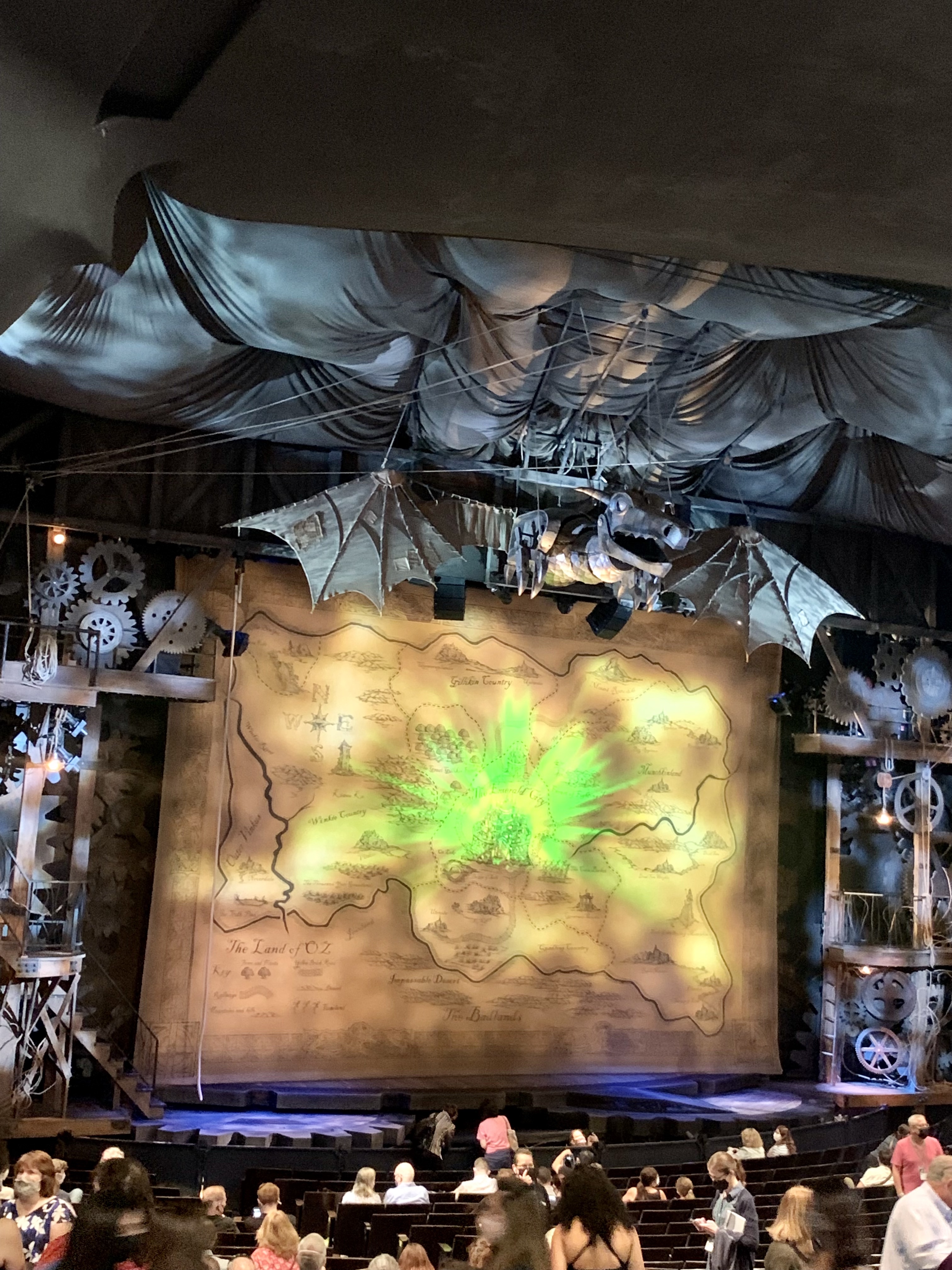
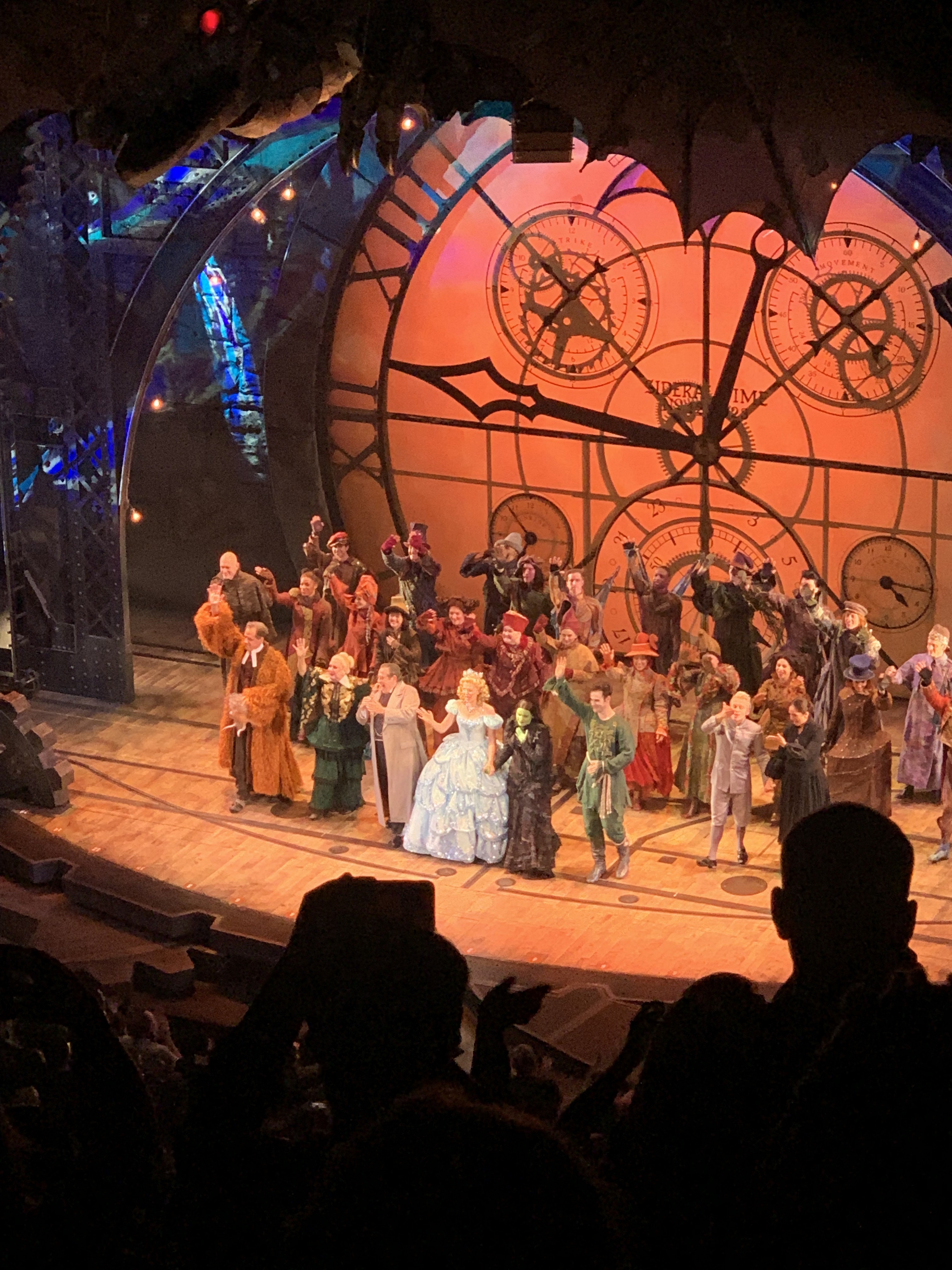
Two days before that, however, I had been very fortunate to be allowed to attend the final dress rehearsal of Wicked before reopening. These invited dress performances are not for purchase, and allow the show to run through with costumes, lighting, etc., with a crowd of friends and family. These are always special (I have been to a few) in part because what elicits applause is often very different for these crowds of insiders. I was able to compare that directly when I also attended the first reopening performance of Wicked on September 14. The audience for this was electric, from Kristin Chenowith’s welcome (including a witty “There’s no place like home!”) through bows. After the curtain came down and the lights went up, the audience refused to leave, however, applauding and standing for minutes until the curtain rose again. This time the cast was joined by composer Stephen Schwartz, who seemed unsure whether to say anything before finally stepping forward – almost to be hit by the curtain coming down!

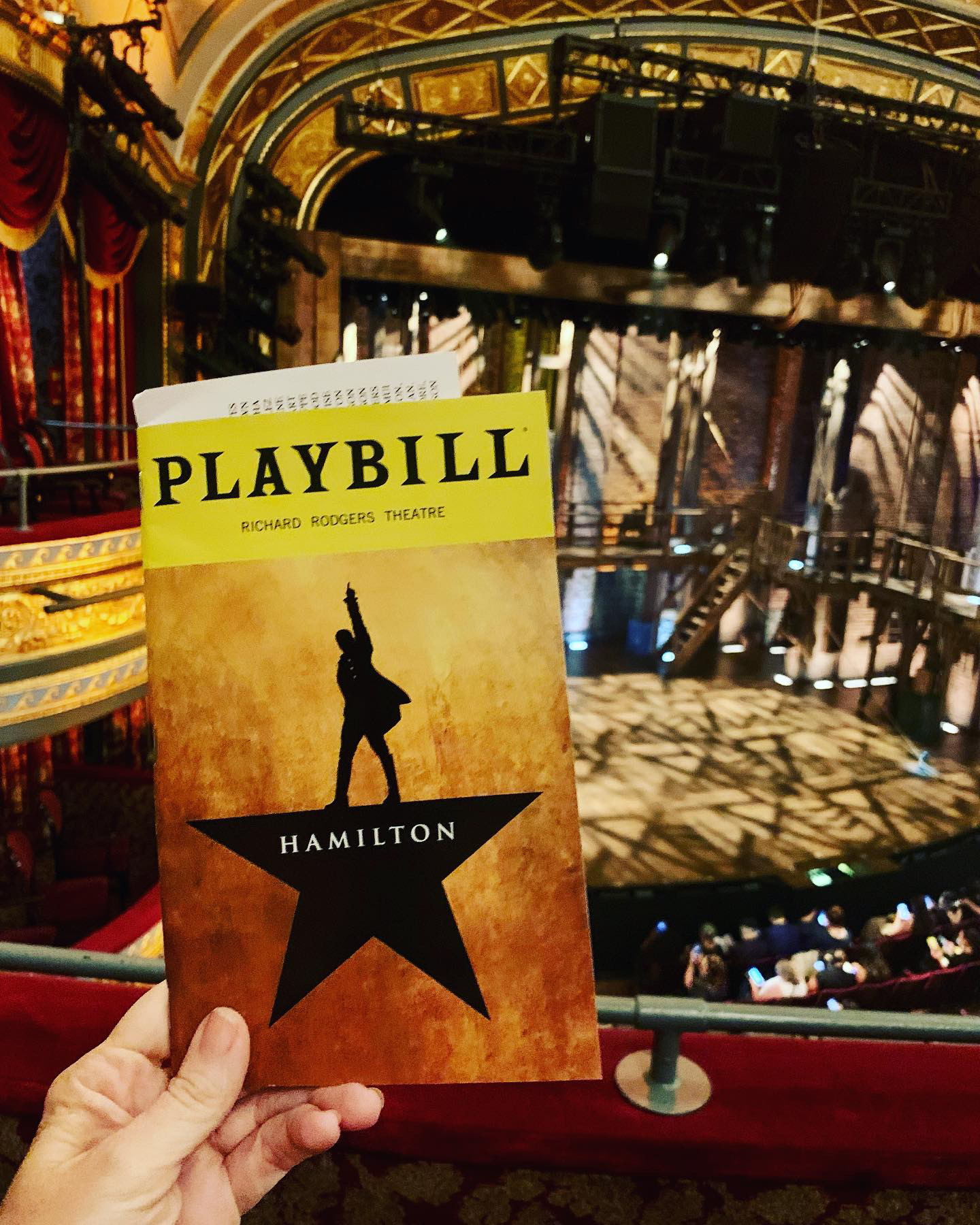
I was at Hamilton at the second reopening performance on September 15. The cast is tight, and the energy level high. I could tell that the conductor was trying to prevent protracted applause from drawing out the show, however, as we can’t keep having shows that go three hours or more when they should clock in at 2 hours, 40 minutes!

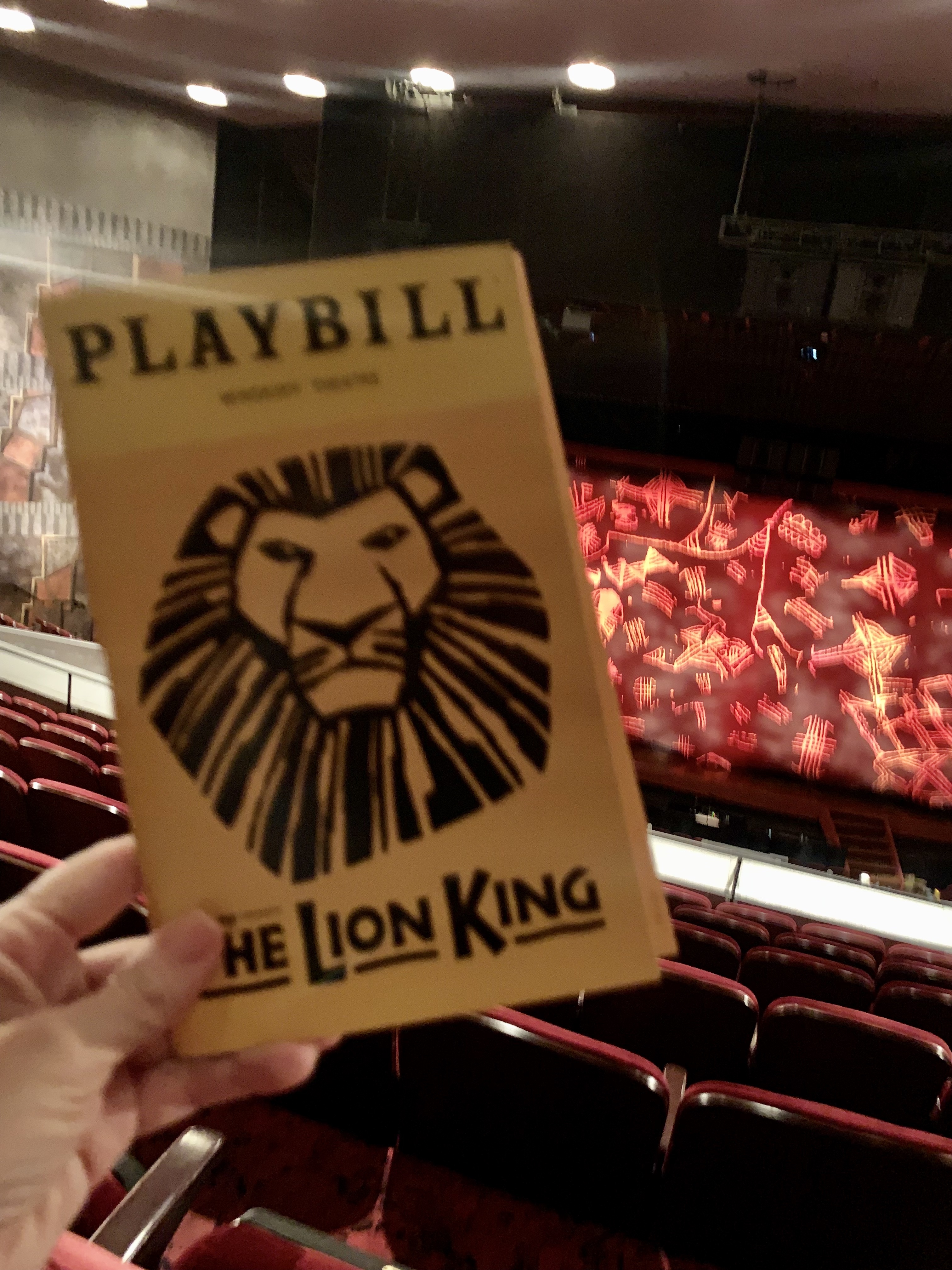
Then I was at the third reopening performance of The Lion King. The energy level was still very high, and I liked the Welcome Back insert with an invitation to give feedback.

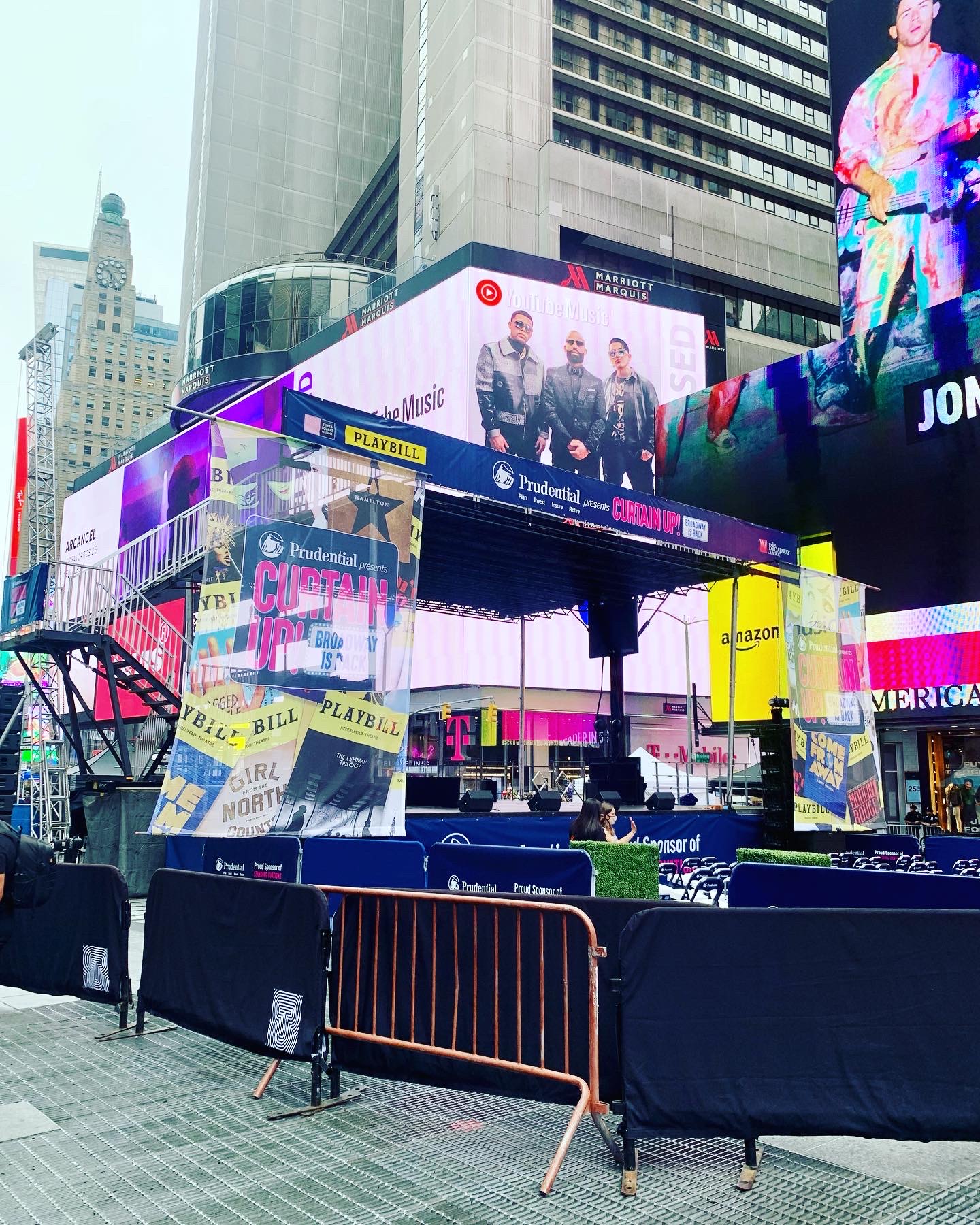
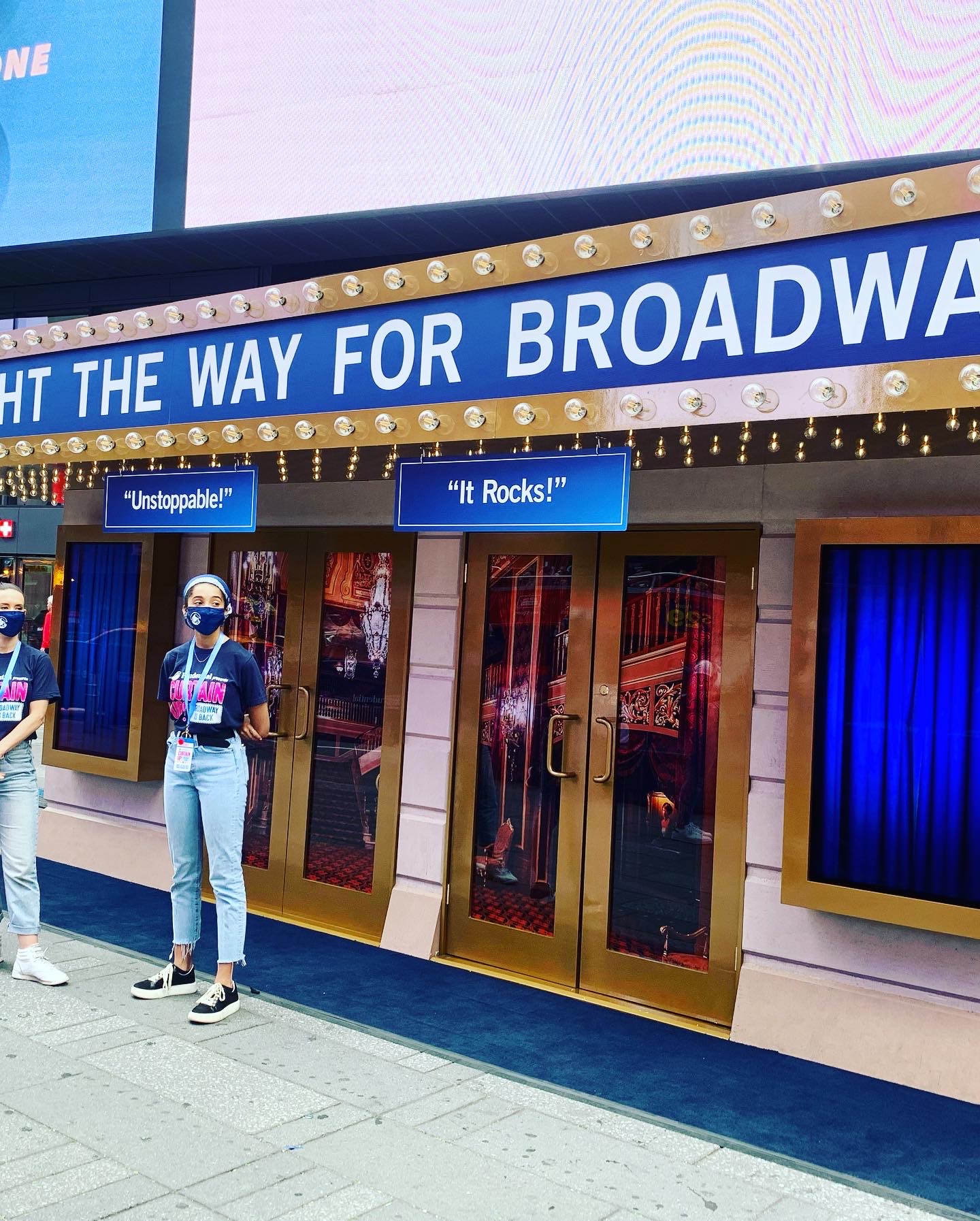
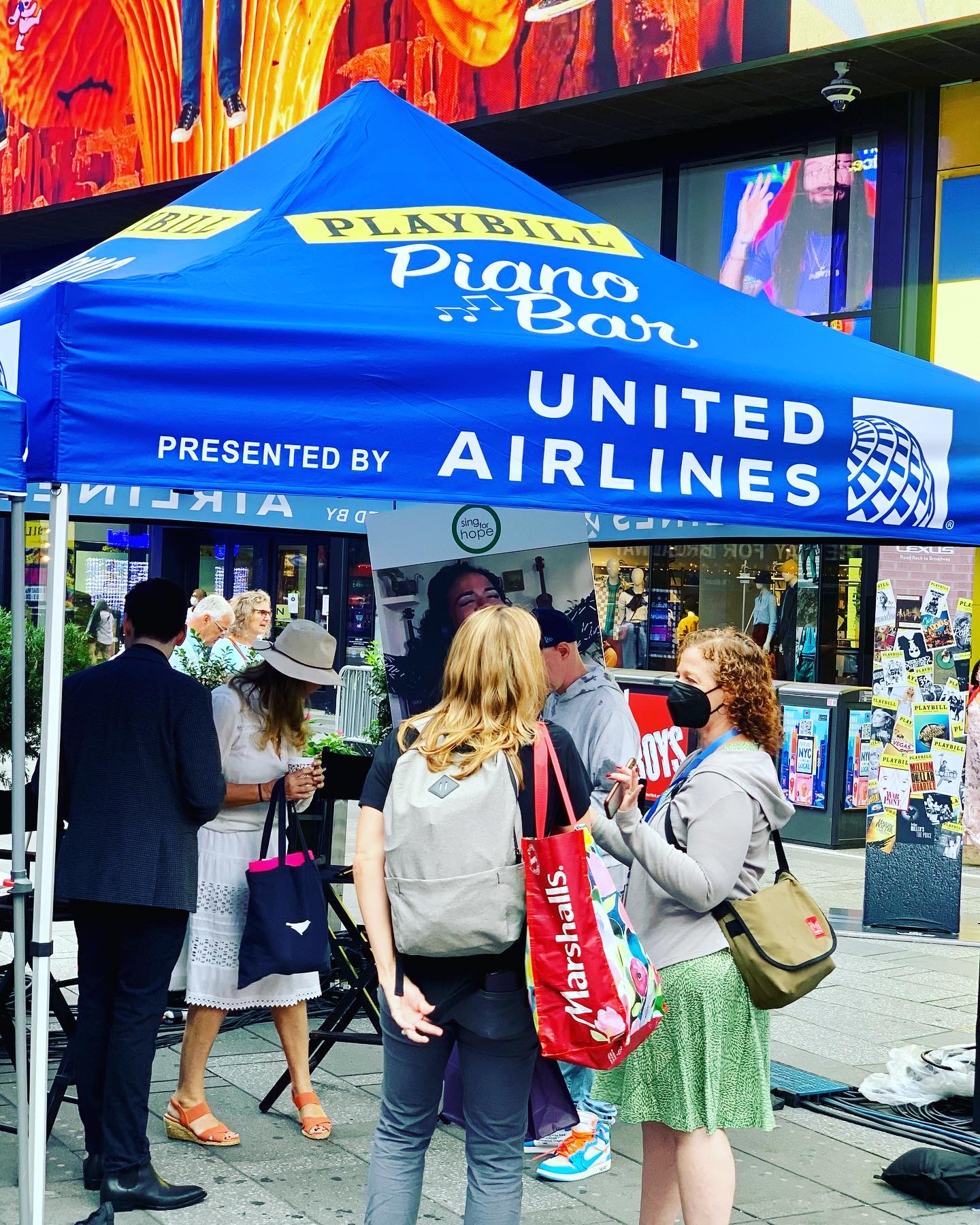
That weekend, September 17-19, Times Square hosted a huge outdoor welcome back to Broadway, with some performances at the large mainstage, and others at a more intimate outdoor cabaret space. The final two hour concert on September 19 featured most of the shows open or that will open this fall. A highlight was a performance of “Music of the Night” with the current Phantom as well as three previous ones.

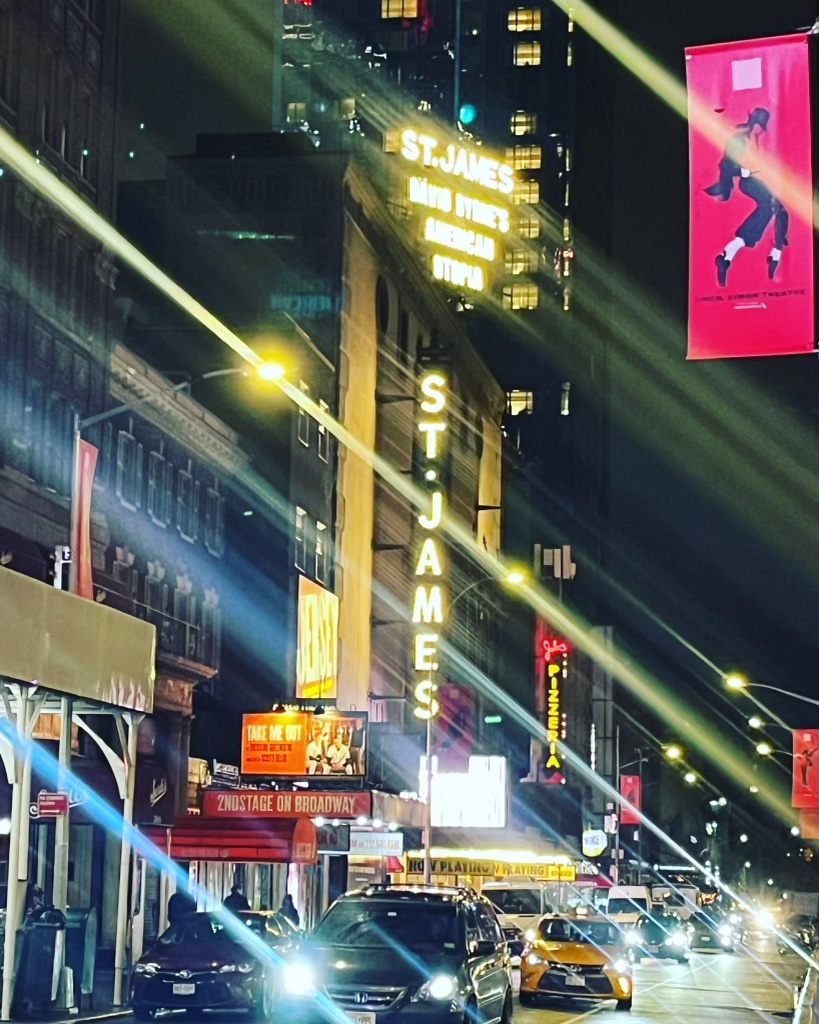
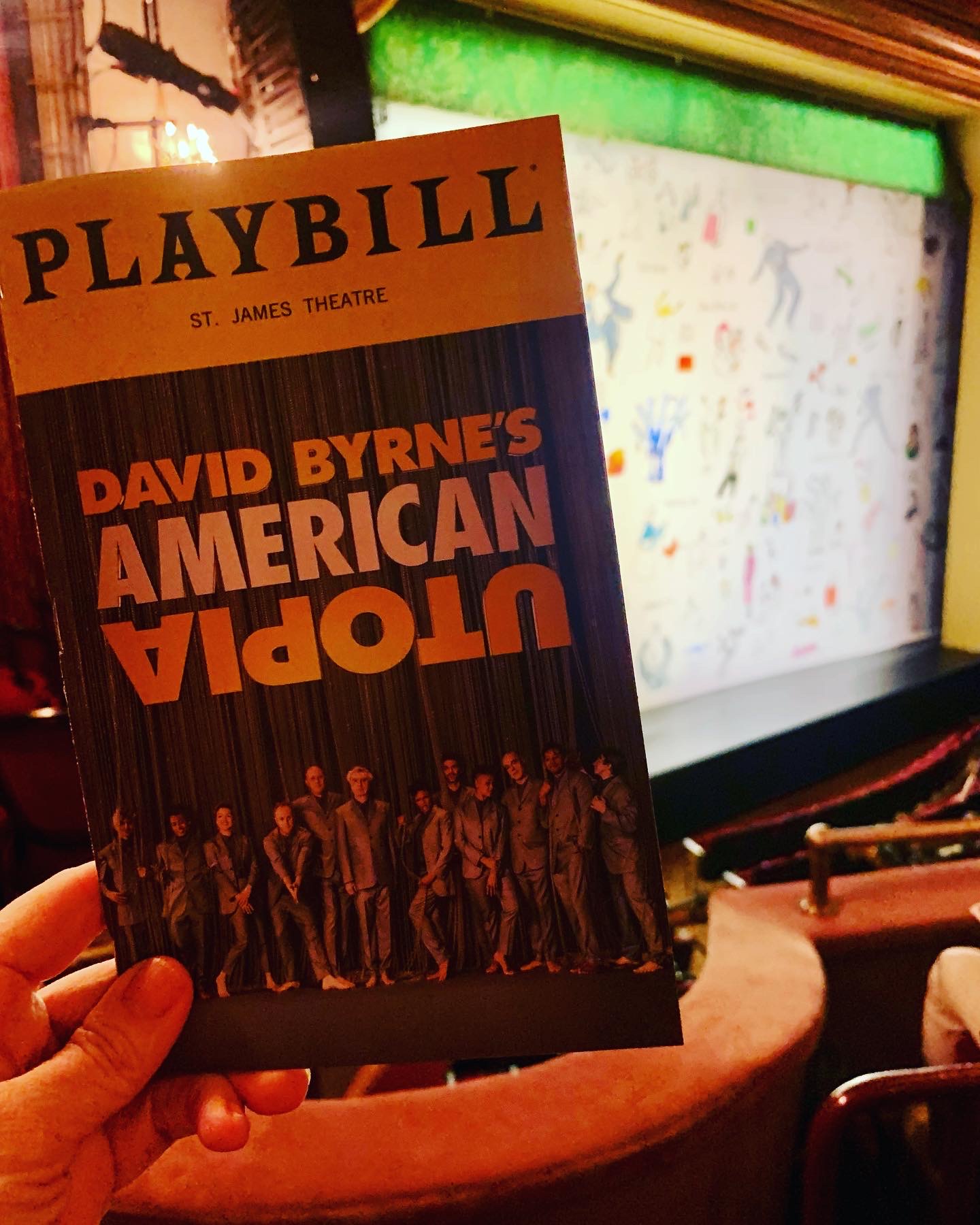
That same weekend I went to see David Byrne’s American Utopia, which I had seen four times pre-pandemic at the Hudson Theatre. Now at the St. James, some of the narration has changed to reflect our changed times (his words “Thank you for leaving your homes” has an entirely new significance now!) but the joy and uplifting message remain the same.

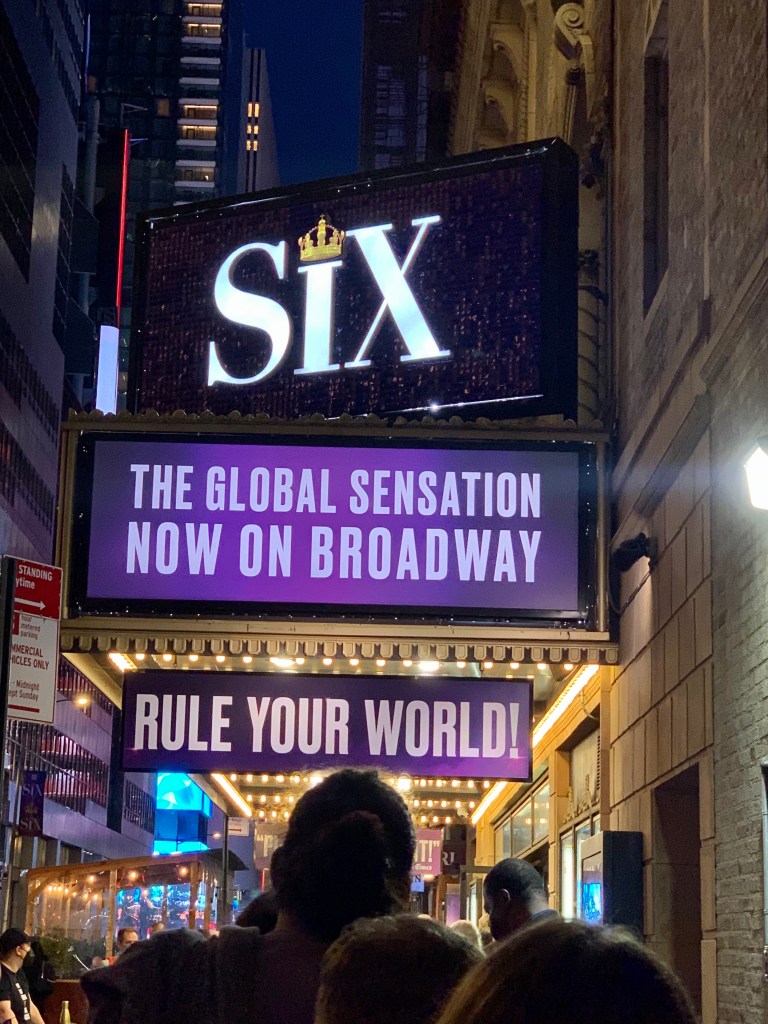
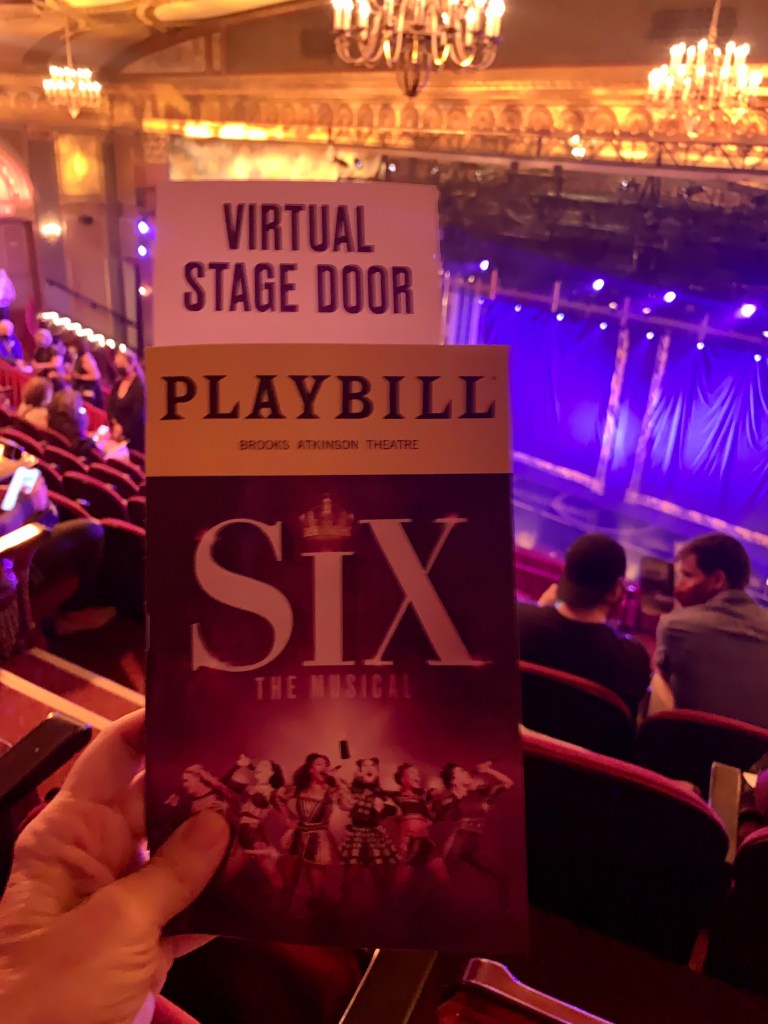
On September 21, I was back to see Six, which I had seen twice in previews – and which was hours from opening night when Broadway was shuttered. Now back in previews as of September 17, all six original Broadway queens are back, and the energy level is always high at this show! I loved that they had a “virtual stage door” QR code, since normal stage door interactions and signing of Playbills is not prudent in terms of Covid protocol.

So, speaking of Covid, how is Broadway different due to the need to keep us as safe as possible? First of all, to attend a Broadway show you must show proof of full vaccination and a photo ID to match. Because of this, arrival times need to be earlier than usual. Doors always opened on Broadway about 30 minutes before showtime, but now are opening from 45 minutes to an hour early to allow for vaccine checks as well as the normal security screening. Then, you must wear a mask at all times while inside. Theatres I have been to so far all have “Covid safety teams” and I have seen them roaming the aisles to monitor and ask people to raise their mask when necessary. Meanwhile, every person on Broadway has to be vaccinated, wear masks when possible (obviously it’s not possible for performers on stage) and get tested regularly.

But isn’t any inconvenience worth it??? The exhilaration of being in an audience with other people, experiencing the live performance of these talented people, experiencing emotions together – this is unique and its absence left a huge void during those 18 months away. Even walking home after a show, I have had that thrill of having had somewhere to go, something to do, with other people, after so many nights watching “Bridgerton” or “Tiger King” and trying to set up zoom cocktail parties with friends. Please go and support live Broadway performances! We need it, as a city and as individuals – and they need us.