“The greatest city in the world” – a real estate perspective

Bust of Alexander Hamilton, flanked by portraits of Aaron and Theodosia Burr, in the New York Historical Society

In the incomparable new American musical, Hamilton, currently the hottest ticket on Broadway in New York City at the Richard Rodgers theatre, the Schuyler sisters are introduced to the audience as they sing joyfully about living in the “greatest city in the world.” This is my own bias as well, and I do consider myself to be “so lucky to be alive right now” and living in NYC. However, as a real estate agent, I know that being able to live in the city is often a struggle – quite often financially in terms of being able to afford living here, and even for those with the means, difficult in terms of limited inventory. Because of my love for the city, and my day-to-day immersion in the city’s residential real estate market, I have found myself thinking about the different neighborhoods mentioned in Hamilton in terms of real estate availability and value. I have already blogged about many of these areas in terms of taking a dérive, or an unplanned walk in an urban environment (see my initial explanation about this idea here), and I will link to those posts when possible.

Before getting into the fun stuff, a few technical notes about price per square foot measures mentioned below: All stats on sales price per square foot are from the Real Estate Board of New York’s third quarter 2015 report here. Condos and coops are listed separately, as the comparative ease of buying a condo versus a coop is reflected in generally higher prices for condos (20-25% more per square foot). Also, higher prices for condos often reflect differences in types of housing – newer developments tend to be condos. For reference, I will also mention current average listing prices found on streeteasy.com for the different neighborhoods, but keep in mind that listing price averages are always higher than closed sales averages, since half or more of all listings end up selling for less than asking price. Also, I am focusing on sales, although I may mention rentals in each neighborhood as well.

Financial District

Financial district 3

When the Schuyler sisters sing about living in “Manhattan,” the area we now know as the Financial District (see my previous blog post here) was almost entirely the area considered to be the city at that time. This is quite fitting, since the Financial District as a business center and home to Wall Street owes a great deal to Alexander Hamilton, who as first Secretary of the Treasury provided much of the foundation for NYC as the financial powerhouse it is today. However, over time, the fashionable residential areas spread north, and this area as a residential neighborhood has only returned in force over the past 10-12 years. Walking these streets is an exciting mix between reminders of our colonial and revolutionary past, and the very new and modern development that is occurring now and transforming the neighborhood.

When Hamilton, Laurens, Lafayette, and Mulligan sing “The Story of Tonight” while drinking in a pub, it might well have been the Fraunces Tavern, since the Sons of Liberty (of which Hercules Mulligan was a member) met there and it was a popular pub at the time. George Washington gave his farewell address to his officers at Fraunces Tavern in 1783. From there, you are a short walk to New York Harbor where Hamilton stole the British cannons at the Battery (as described in “Right Hand Man”), or Trinity Church, where Alexander and Eliza Hamilton are buried near Eliza’s sister Angelica.

Financial district 5

How affordable is the Financial District (F.D.)? All city prices would seem unbelievable to those living here at the time of the American Revolution, but for downtown Manhattan, it is relatively affordable. The most recent REBNY numbers showed condos in the F.D. averaging $1207 per square foot (compared to $1593 overall for all of Manhattan, and nearby areas Soho at $2021 and the West Village at $2323 much higher per square foot). Coops average $906 per square foot in the F.D. (compared to $1218 for all of Manhattan, $1509 for Soho, and $1629 for the West Village). I recently did a rental search for a friend wanting to move from Tribeca, and showed her that she could either save about a third in rent if she kept the same size and quality of apartment, or get another bedroom for about the same price or even a little less.

Hell’s Kitchen

19707290382_262abb03b1_o

Yes, you can call it Clinton if you like, but I think the name “Hell’s Kitchen” is one of the coolest in all of New York City and when I move there I will state the name proudly. No, this area is not mentioned in the musical Hamilton and in fact would not have been populated much at all at the time, but it is very near the Richard Rodgers theatre, currently the home to the musical. The proximity to the theatre district keeps prices down a bit, but would be a plus to me (see my previous blog post about Times Square and Hell’s Kitchen here). There are blocks in Hell’s Kitchen that look just like quiet leafy Chelsea blocks – but at a fraction of the cost – as well as new condo high rises with every amenity and the prices to match.

The REBNY report is for Midtown West, which encompasses a bit more than just Hell’s Kitchen, but lists the average price per square foot at $1734 for condos and $1230 for coops.

Stage door at the Richard Rodgers

The Upper East Side

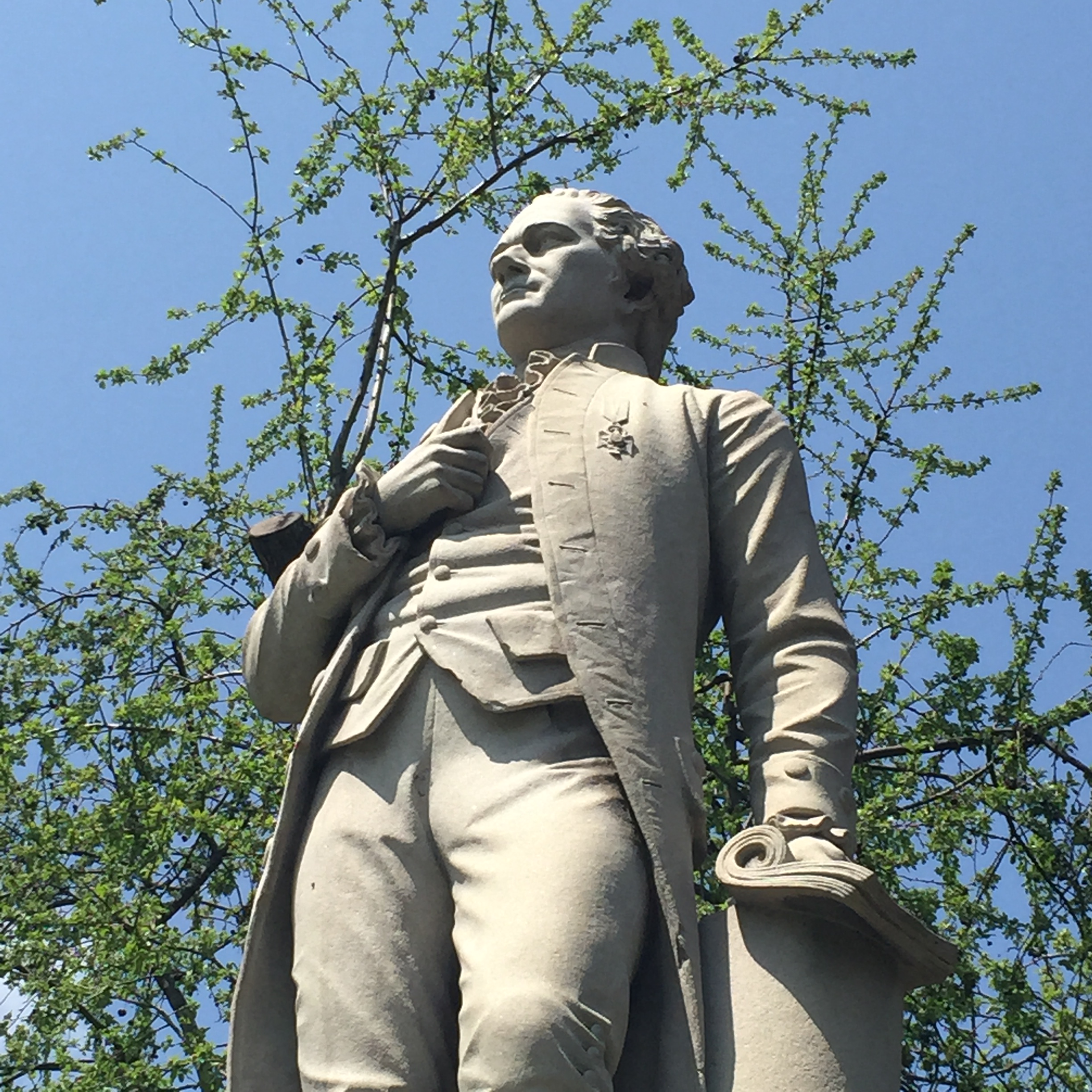
Statue of Alexander Hamilton in Central Park

Again, not mentioned in Hamilton (although a family with the wealth and connections of the Schuylers would have certainly moved to Fifth Avenue along with the robber barons in the early 20th century), but mentioned because of the statue of Alexander Hamilton standing proudly among the trees behind the Metropolitan Museum of Art, in our beloved Central Park (not created until long after Revolutionary times).

The Upper East Side has long been a bastion of wealth, and areas to the west of Lexington Avenue still command a premium due to proximity to Central Park (see one of my many blog posts about the park here, and another about the value of a park view here). However, the far east side (east of Second Avenue, particularly the area called Yorkville, see my post here) still has value, in part because of its perceived remoteness and the construction mess due to the building of the Second Avenue Subway. While overall the Upper East Side averages $1764 per square foot for condos and $1234 for coops, Streeteasy listings show the difference in listing prices for Yorkville ($1693 per square foot, all types) versus Lenox Hill near the park ($2667 per square foot, all types). Rentals in Yorkville are particularly well priced compared to other areas of Manhattan, except for areas of upper Manhattan that will be discussed next.

Harlem and Upper Manhattan

HamiltonHeights1

There are plenty of references to Harlem in Hamilton, from Washington’s “run to Harlem quick” in “Right Hand Man, ” Hamilton’s wooing of Eliza with a plan to “get a little place in Harlem and we’ll figure it out” in “Helpless,” and “the Hamiltons move uptown” in “It’s Quiet Uptown.” Moving to Harlem in those days before motorized vehicles and the subway was the equivalent to moving to the remote countryside, and even King’s College (later renamed Columbia, sorry again, King George) was at that time in lower Manhattan, not in its current spot in Morningside Heights (see a previous blog post here). Hamilton Heights, an area of Harlem I wrote about in this blog post, is named for the location of Hamilton Grange, and the Hamilton home can still be seen there (although not in the exact location, still within the farmland owned by the Hamiltons). Even farther north than Harlem is Washington Heights (see previous blog post here), home of the Morris-Jumel mansion – once Washington’s headquarters (and then the British government’s), later the home of Aaron Burr, and most recently the site used by Lin-Manuel Miranda to work on composing Hamilton. This historic home hosted many other notable figures who also live on in the musical by reference or as characters – John Adams, Thomas Jefferson, and yes, Alexander Hamilton.

Harlem and much of upper Manhattan is rapidly appreciating in value, but still represents a relative bargain in Manhattan. The REBNY numbers separate Harlem only by East ($748 per square foot for condos, no figures for coops) and West ($713 for condos, $996 for coops), not a very practical demarcation. Streeteasy listings show average prices as $829 per square foot for trendy Central Harlem (all types), $667 for East Harlem, $661 for Hamilton Heights, $721 for Morningside Heights (the Columbia effect), and $638 for Washington Heights.

There are other areas in NYC mentioned in Hamilton, some vague (“British take Brooklyn” in “Right Hand Man” – likely Brooklyn Heights) and others specific (“abandoning Kips’ Bay,” also in “Right Hand Man”) and those will be future places for my dérives and the subsequent blog posts.

At a recent social event, a friend and I were talking about getting together more often, and I said, “Well, you know how to find me.” Her husband responded, “Yes, at the Hamilton lottery!” (clearly he is following my Facebook posts) and my friend asked what the show was about. After explaining that it is a hip-hop musical based on the life of Alexander Hamilton, and she replied, “You know, that sounds like the craziest thing I have ever heard!” Well, crazy good . . . Yes, finding a place to live in New York City is frustrating, you will always end up spending more than you hoped (even those with more financial resources but especially those with fewer), and it will likely take longer than you want and you will end up compromising, but how lucky we are to be alive right now, in a city filled with creativity and the arts – truly, the greatest city in the world.

Turtle Bay

Turtle Bay 3

Walking to show two apartments in the 400 block of East 52nd (not in the actual building Greta Garbo lived in for decades, but the same block), I was struck by the nomenclature “Turtle Bay” for the area (roughly from 42nd Street to 53rd Street, from Lexington Avenue to the East River) and vowed to find out whether there had in fact been turtles in a bay here a long time ago. What I discovered was one of those funny mistranslations that sometimes occurs: the Dutch called this area “Deutal” (Knife) Bay after a sharp turn in the East River (the reason why York Avenue/Sutton Place disappears at 54th Street) but the English-speaking later settlers misheard it as “Turtle.” My interest piqued, I decided to take my next dérive (an unplanned walk in an urban environment) in this area.

Turtle Bay 2

Initially farmland (including that of the Beekman family, who gave their name to Beekman Place), Turtle Bay evolved into an industrial neighborhood, noted particularly for its slaughterhouses. In the early 20th Century, Charlotte Hunnewell Sorchan bought and renovated a series of houses in the area, and sold to friends, including Maria Bowen Chapin, who founded the Chapin School. This began the evolution of Turtle Bay into a residential neighborhood, which was cemented when the last of the slaughterhouses was torn down to make way for the United Nations building.

MurrayHillChrysler

I began my dérive at my favorite skyscraper in New York City, the Chrysler Building. Finished in 1930, it was the world’s tallest skyscraper for 11 months before being ousted by the Empire State Building, and is still the world’s tallest brick building (although it does have a steel skeleton). An Art Deco masterpiece, to me it has an airy fairy-castle quality that contrasts markedly with the more aggressive forms of most NYC skyscrapers.

Turtle Bay 1

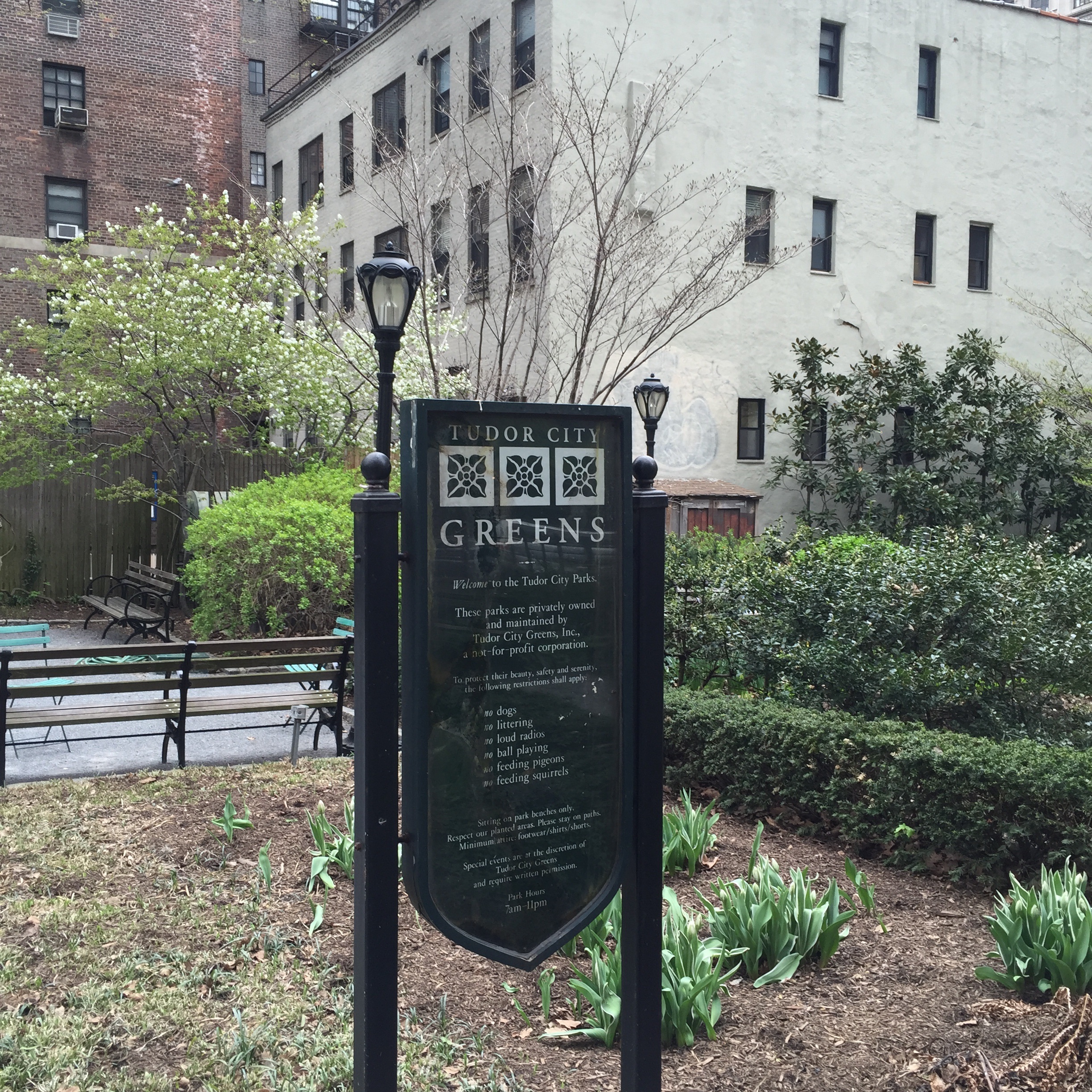
Walking east on 42nd Street, the distinctive Tudor City sign dominates the eastern view. The first residential skyscraper complex in the world, it was built in the 1920’s by a real estate developer with dreams of keeping middle-class people in the city rather than taking flight to the suburbs. Despite the name “Tudor,” the architecture is neo-Gothic in style. Most of the apartments face away from the East River, since when they were built the slaughterhouses, and their accompanying smell, still operated along the river. Many Tudor City apartments have wonderful views of the Chrysler and Empire State Buildings, but few face the United Nations for this reason.

Turtle Bay 4

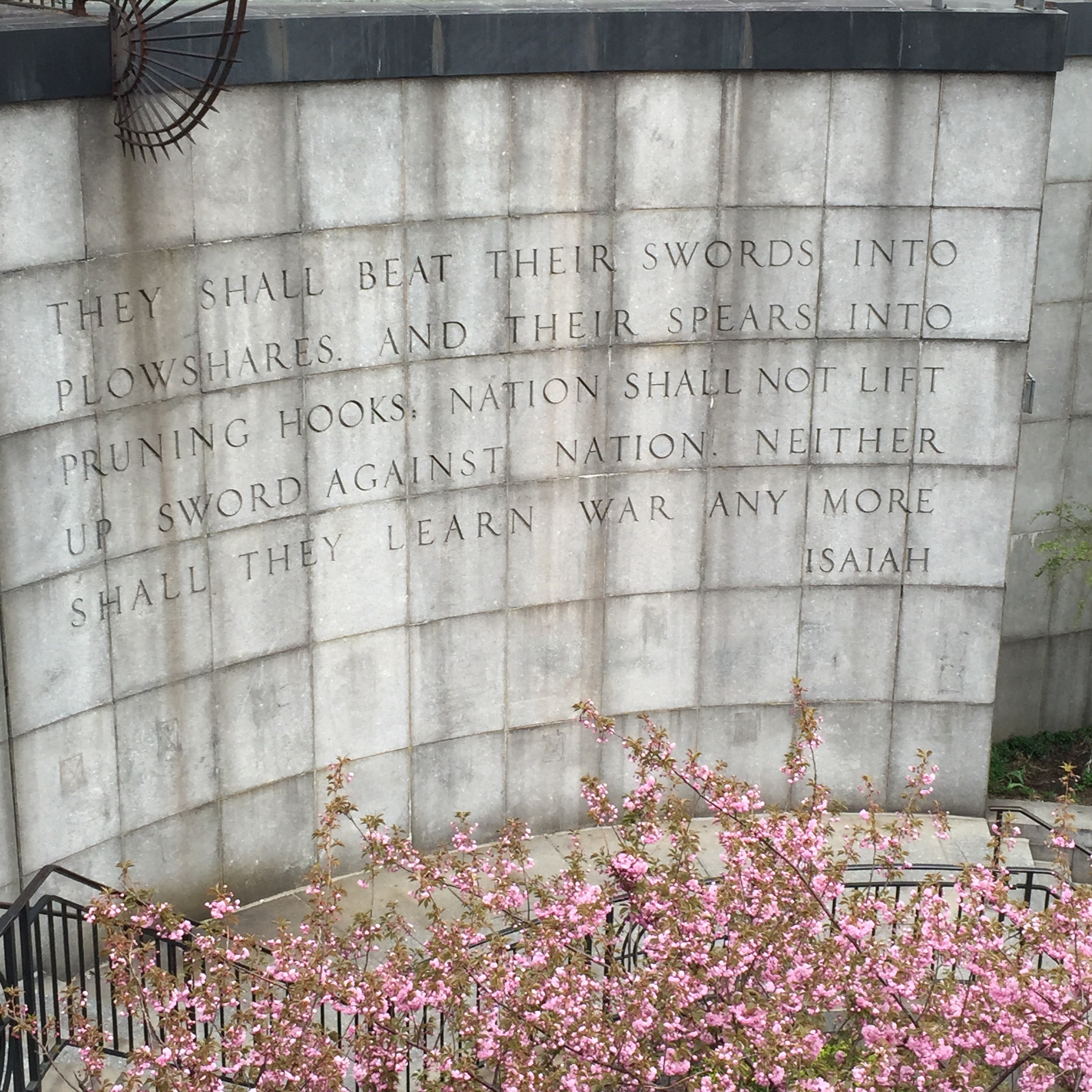
Taking a set of steps down from Tudor City to First Avenue, the United Nations (as well as multiple diplomatic missions) now dominates the area of Turtle Bay between First Avenue and the East River. Established after World War II to promote cooperation between the nations of the world and winner of the Nobel Peace Prize in 2001, the organization is imperfect but the quote across the street from the UN from Isaiah (“ . . . neither shall they learn war any more”) reveals the hope behind creating such an assembly. On a lighter note, I remember my young daughters once asking where aliens would land on earth if they were to try to reach the “leader” and I said it would have to be Manhattan because of the UN. Whether this was good news or bad news to them, I will have to ask and find out.

Turtle Bay 5

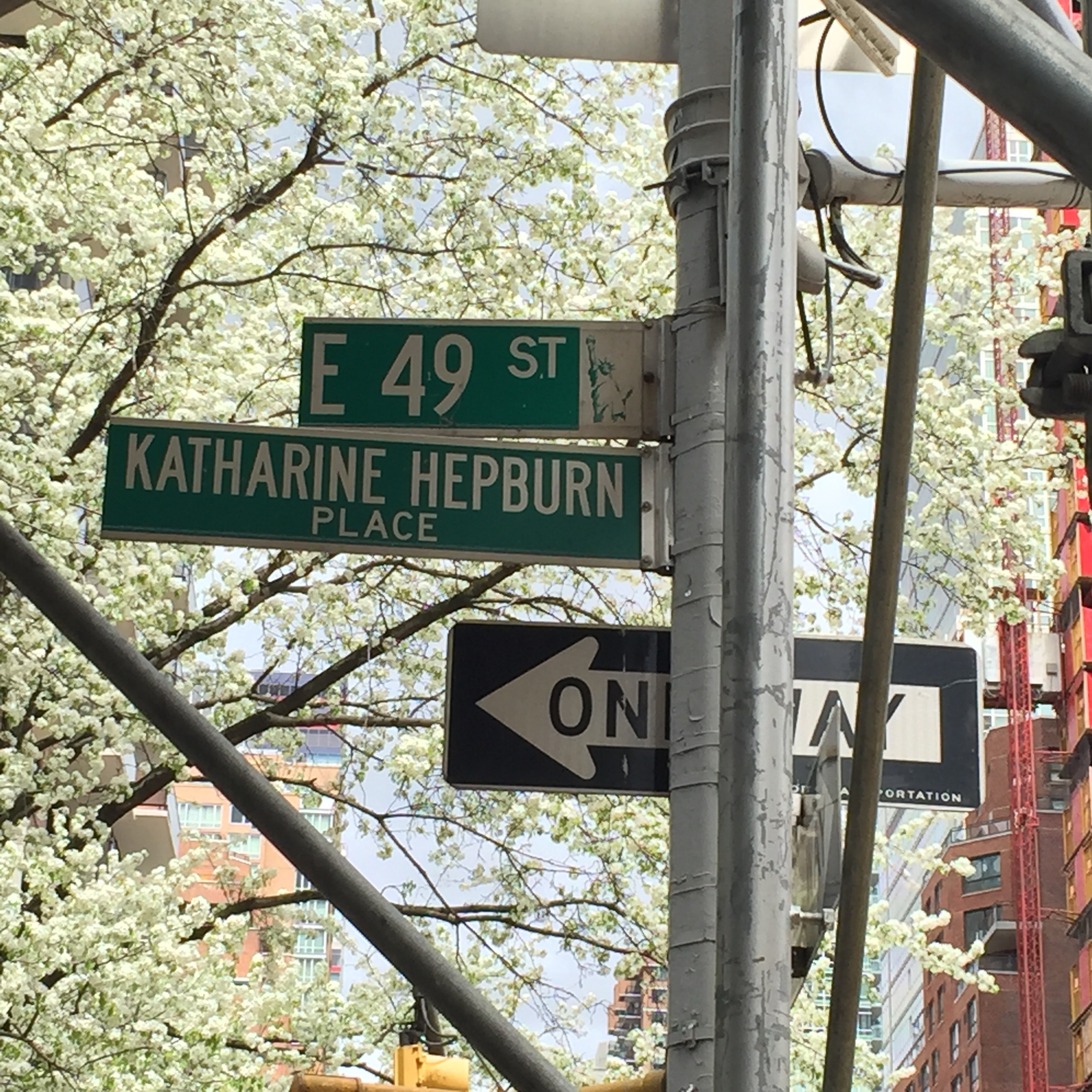
Continuing north on First from the UN, I passed Mitchell Place, one of New York’s micro-streets (comprising just one block between First and Beekman Place, next to E. 49th Street). Turning west on 49th Street, I thought of E.B. White writing Charlotte’s Web in this neighborhood (he was living on E. 48th at the time) and stopped to admire the signage for “Katharine Hepburn Place” on the corner of Second and 49th). She lived in a beautiful townhouse between Third and Second on 49th Street for most of her adult life, and that block is a gracious quiet row of townhouses.

Turtle Bay 6

Turtle Bay, unlike some more cohesive neighborhoods in NYC, has a wide variety of experiences represented: from the bustle of the shops and restaurants along the Avenues, to the quiet of Beekman Place, or from the gardens of Tudor City surrounded by neo-Gothic residences, to the international nexus of the United Nations. It is, however, a place where it is possible to find an apartment on a dead-end block with little to no traffic noise, but only a few blocks from everything midtown Manhattan has to offer.

Turtle Bay 7

Real estate and the human creative spirit

Dakota

Recently I was at the Association for International Photography Art Dealers (AIPAD) show at the Park Avenue Armory. The abundance, diversity, and quality of the art shown in one space almost created a feeling of sensory overload, and I started to think about how thrilling it is to be in any place where the creative impulse is expressed by people, whether it be visual art, theater, dance, music, or architecture and design. The need for creative expression is fundamental to how we see ourselves as humans – the recognition we feel when we view the cave paintings from Paleolithic people living 40,000 years ago in Lascaux, France, emotionally spans the gap in time between us and them.

After leaving AIPAD, my thoughts turned to how we express our creativity when it comes to where we live. It might be a more efficient use of valuable real estate space to have every building in Manhattan exactly the same, with apartments only differing in how much space and how many rooms someone needed (and perhaps whether or not you felt the need for a doorman). The gables, terracotta ornaments, and decorative gargoyles at the Dakota (seen above) have no practical purpose. However, we all instinctively recoil when imagining Manhattan as a series of uniform buildings, neighborhoods identifiable only by street names as boundaries, not because you see the San Remo or a series of cast iron buildings. Rather than selecting an apartment near our workplace, many of us choose to live instead in neighborhoods farther away that express who we are as a human being. A person walking through the Art Deco lobby of the Century on Central Park West on the way to their apartment is surrounded by an esthetic that fits their own, and that is different but no less personally valid than that of someone entering their loft in Metal Shutter Houses in West Chelsea.

Real estate involves money and can be thought of as an investment, but unless you are buying solely to invest, the choice of what apartment you decide to live in speaks to so much more than a rational financial decision. We as humans need to express ourselves creatively, and we do so when we decide only to look at pre-war apartments with working fireplaces and moldings, or only on the Upper West Side park block with a terrace, or only downtown in a modern building with a view of the High Line. A good real estate agent will listen to what you want in the way that a search engine cannot. You can run a search for a two bedroom/ two bathroom apartment in a certain price range in a certain neighborhood and come up with some possibilities, or a good agent can listen to the creative desires being expressed and select apartments that are an excellent place to start looking. Sometimes you may even be introduced to a new neighborhood that you didn’t initially consider but that the agent thought you might like, based on what kind of apartment, and building, and neighborhood, you are looking for.

Pablo Picasso once said, “The purpose of art is washing the dust of our daily lives off our souls.”  I can’t imagine a better way to wash this daily life debris off our souls than returning at the end of our day to a home that reflects our own sense of what is beautiful, from the external architecture of our building to the layout and décor of our personal space.

A ride on the Staten Island Ferry

StatenIsland8

How much would you expect to pay for an iconic boat ride with spectacular views of lower Manhattan, Ellis Island, and the Statue of Liberty? If you want to pay, there are vendors who will allow you to do that, but a ride on the Staten Island Ferry, which delivers those views roughly every 30 minutes (more often during rush hours) throughout every day and night of the year, is entirely free. Twenty-one million people take this trip every year, and most are residents of Staten Island, which may be the borough in New York City most likely to fly under the radar. Whether you take the ferry ride to explore Staten Island as a potential home within the city, are a visitor to NYC looking for fantastic photo ops, or are a New Yorker with the need to experience the sensation of feeling a sea breeze blow past your face as a boat sways under your feet, this bargain experience is not to be missed.

StatenIsland2

For my trip on the ferry, I began by emerging from the Battery Park subway stop and walking a block or so to the Whitehall Terminal. Redesigned in 2005, the terminal is bright and airy – I particularly like the quotes on the walls by Edna St. Vincent Millay (“We had gone back and forth all night on the ferry”). There aren’t too many places to eat at this terminal, but there are benches and restrooms, and it’s very easy to figure out when the next ferry is coming and from which area you will embark.

StatenIsland3

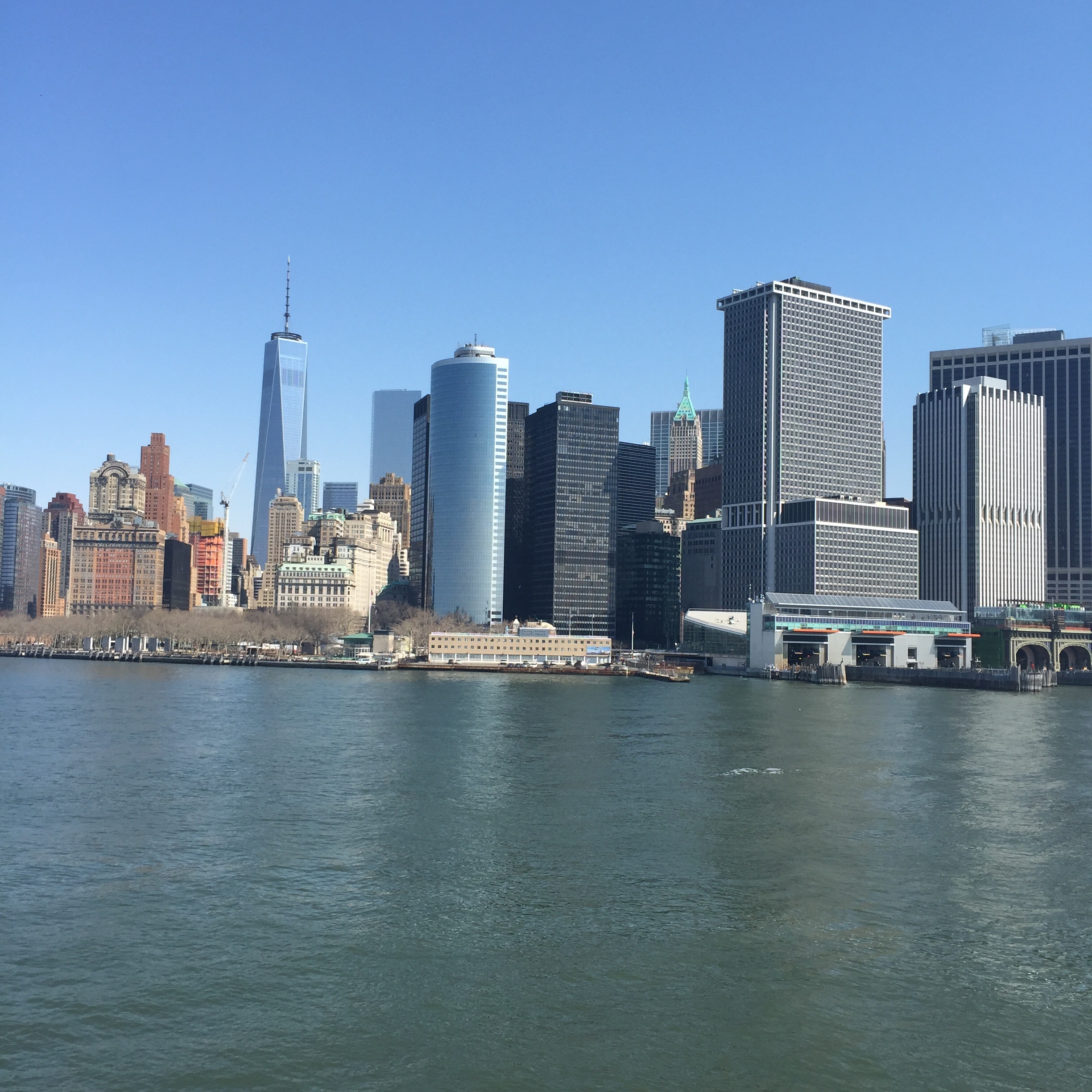
Walking onto the ferry, if you are looking for photo ops of the Statue of Liberty and Ellis Island, head up the stairs (the windows on the lower level are foggy) and go outside, to the right of the ferry as you enter. As the ferry pulls away, look behind you for fantastic views of lower Manhattan. If you happen to instead be on the left side of the ferry, you will also get views of the East River and the bridges – most famously, the Brooklyn Bridge – connecting Manhattan to Brooklyn. On the right side of the ferry, however, are the views most people are on the ferry to appreciate.

StatenIsland4

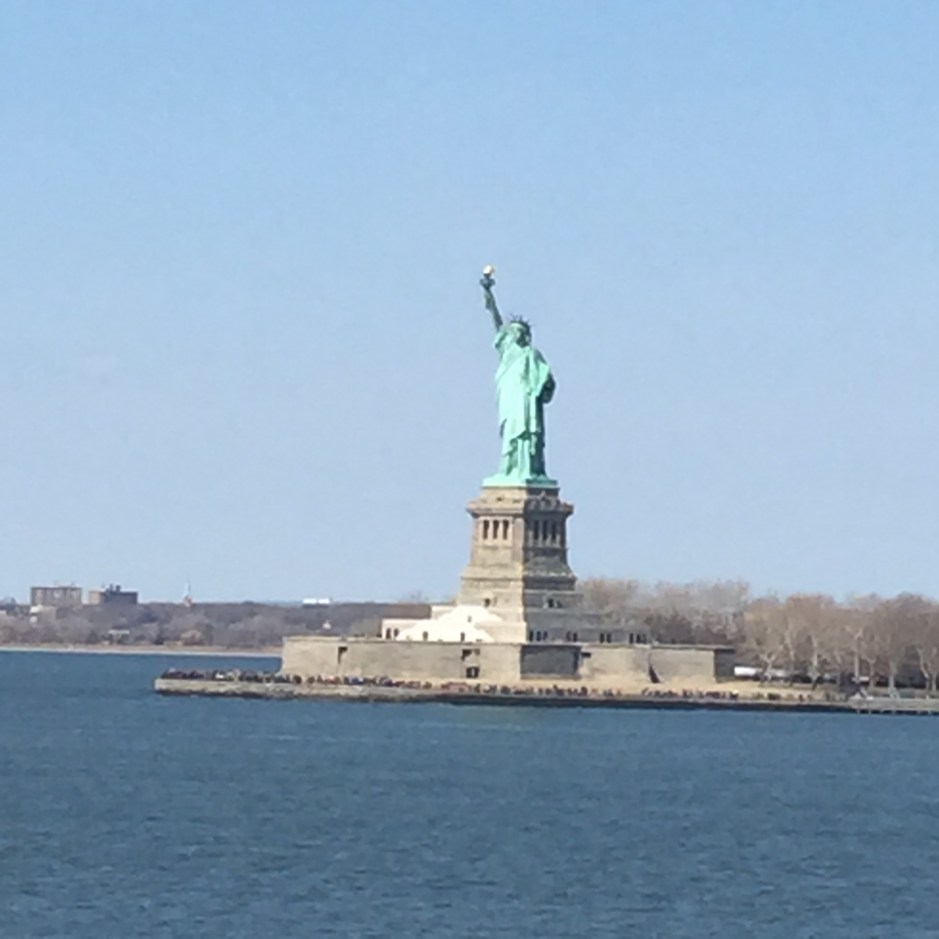
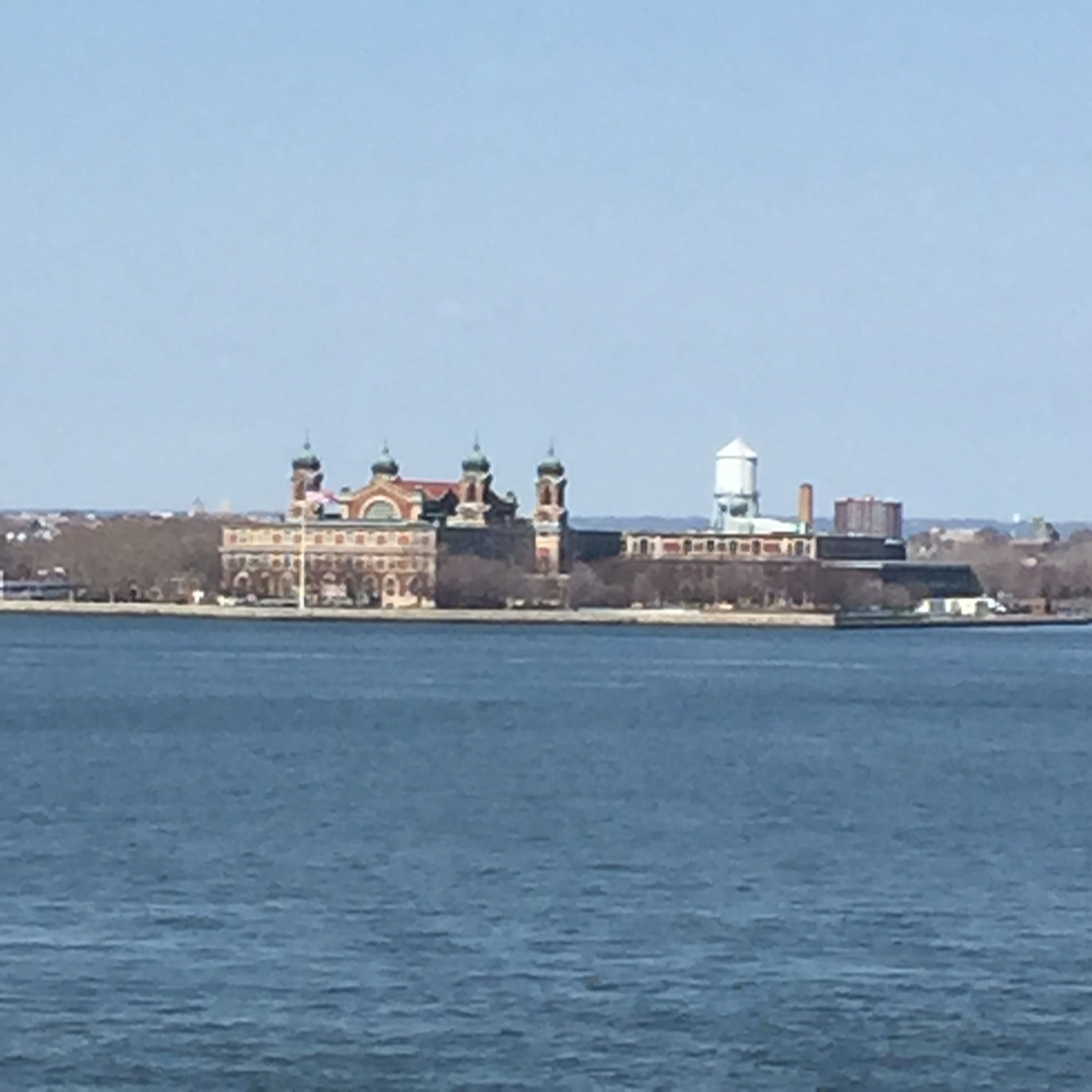
First you can see Ellis Island, processing center for scores of immigrants entering the United States, now a museum celebrating the immigrant experience and contribution to American life. Continuing on from Ellis Island is the symbol that represents New York, and in a larger sense, the United States, to so many: the Statue of Liberty. A gift from France (its official name is La Liberté éclairant le monde, or Liberty enlightening the world), this statue (actually much closer to New Jersey than to New York!) is described in Emma Lazarus’ famous poem as one that “glows world-side welcome” to immigrants all over the world. Whether that has always been the case or not, it is certainly a noble and aspirational sentiment for this ultimate melting-pot city.

StatenIsland5

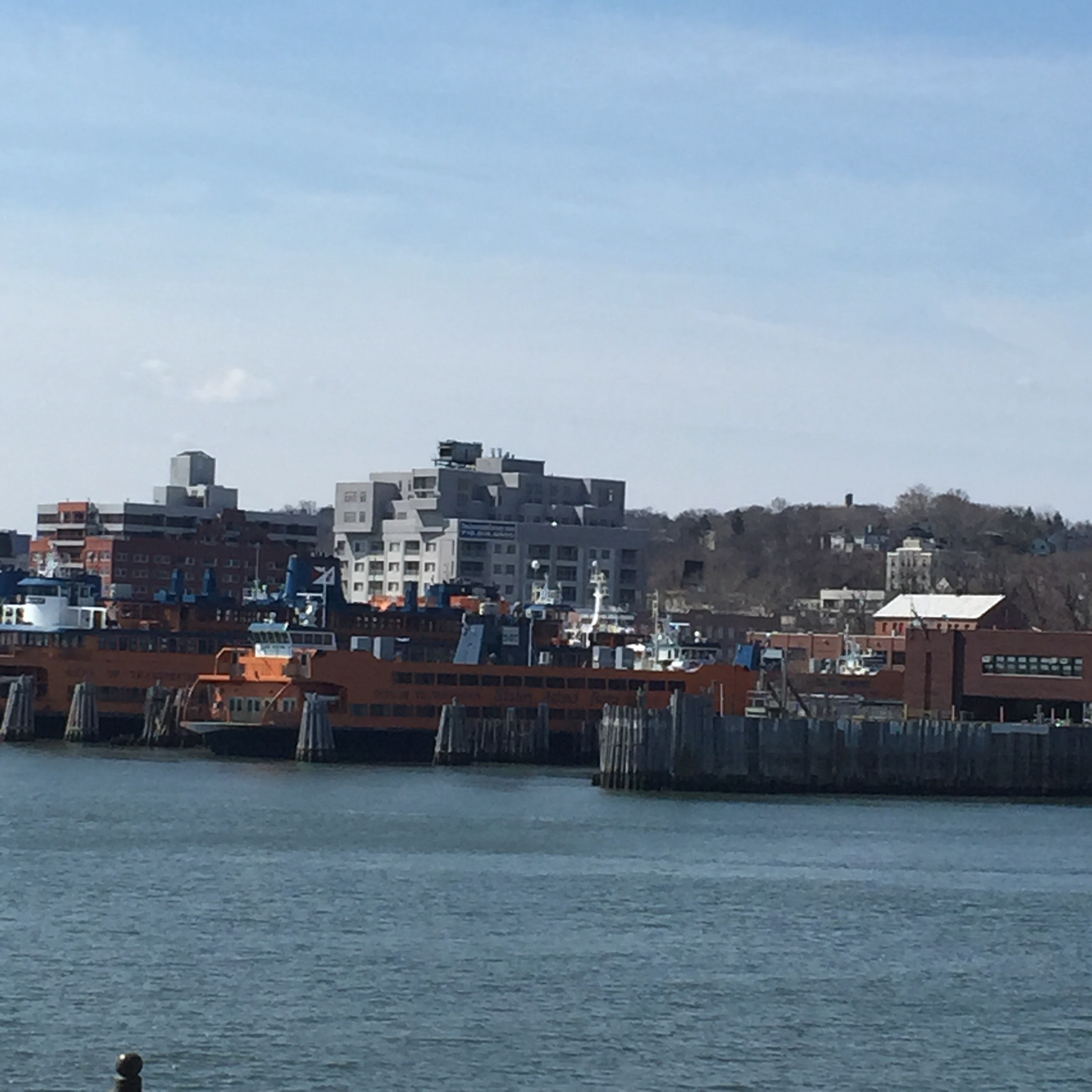
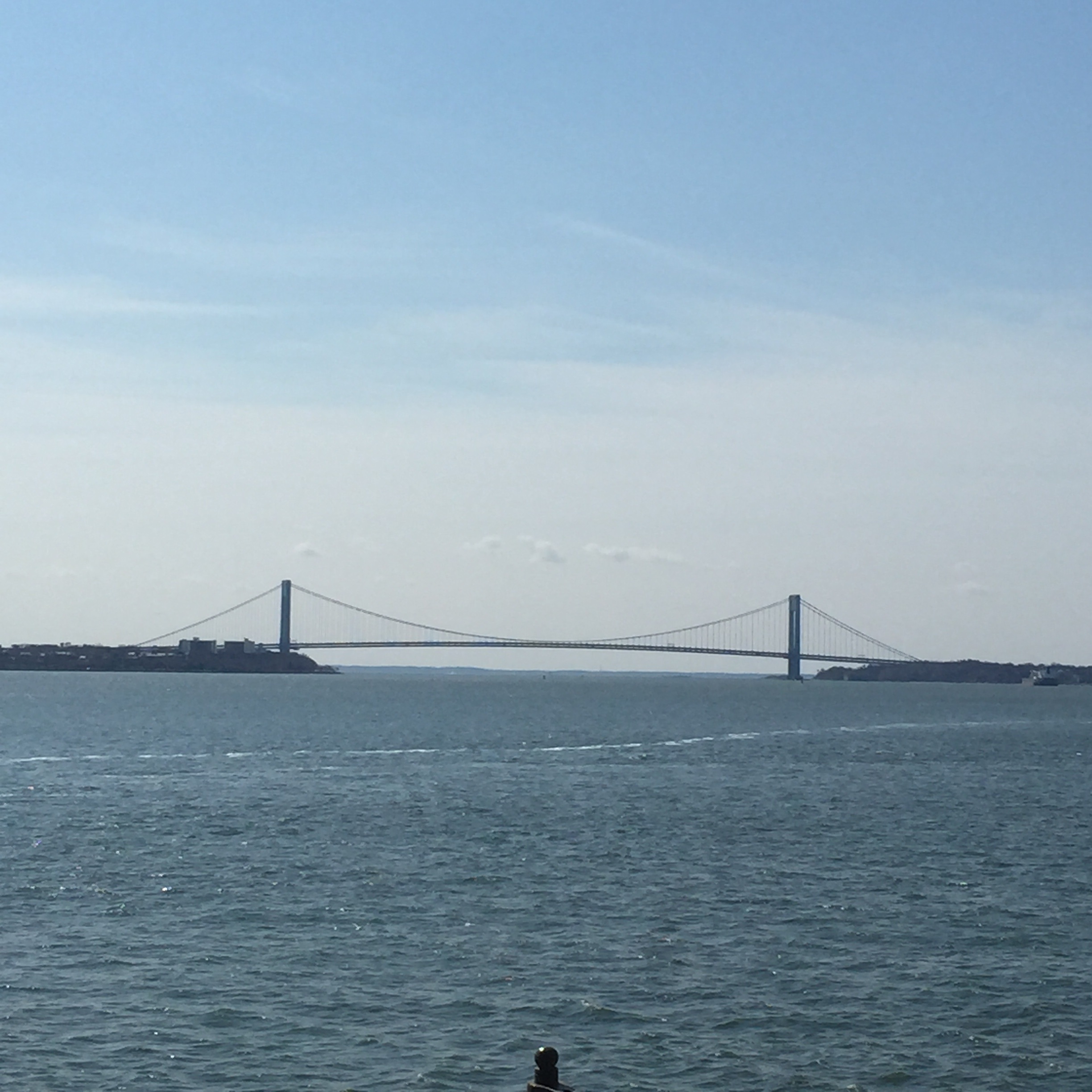
Approaching Staten Island’s St. George ferry terminal, the 5.2 mile, 25 minute ride slows as the boat docks, giving one a great opportunity to photograph the Verrazano-Narrows Bridge, connecting Brooklyn to Staten Island. It is almost impossible to catch the next ferry immediately (and you are required to get off the boat and re-enter), so consider having a bite to eat in the terminal. Staten Island is best accessed by car, so without one (and they aren’t allowed on the ferry any more) there isn’t much to do or see outside the terminal itself.

StatenIsland6

When making the trip back, go to the opposite side of the ferry to see what you missed on the way over. The Staten Island Ferry is featured on so many TV shows and movies (“Sex in the City” and “Working Girl” as examples) that you feel a bit like an extra on a TV or film shoot while feeling the breeze blow your hair with such iconic views to be seen. New York City can be an expensive place, but the Staten Island Ferry is one of the few classic city experiences that only costs you a few hours of your time.

Financial District

Financial district 7

Recently I was fortunate enough to see the new musical “Hamilton” at the Public Theater (arriving on Broadway this summer), leading me to my last  blog  post – a walk through Hamilton Heights, the neighborhood in upper Manhattan where Alexander Hamilton had farmland and lived in his final two years. However, much of Alexander Hamilton’s time in the city was spent in the area now known as the Financial District. Roughly occupying the same space as the original settlement of New Amsterdam, it lies at the very southernmost point of Manhattan, below City Hall Park, excluding the areas of Battery Park and Battery Park City. This neighborhood is a unique mixture of very old (the colonial remnants of New Amsterdam) and very new (it’s only recently become a popular choice as a residential neighborhood and new development buildings abound). With these thoughts in mind, I decided to take my next unplanned walk in an urban environment (a dérive) in the Financial District.

I emerged from the subway at Bowling Green, the traditional starting point of ticket tape parades up Broadway. This tradition with a spontaneous parade associated with the dedication of the Statue of Liberty in 1886, and since has continued with celebrants as diverse as Theodore Roosevelt (upon his return from safari in Africa in 1910), Albert Einstein in the 1920’s, Charles Lindbergh as well as Amelia Earhart following their successful solo trans-Atlantic  flights, Jesse Owens after winning four Olympic gold medals in 1936, the pianist Van Cliburn in 1958, the Apollo 11 astronauts, and the New York Yankees (nine times).

Financial district 1

Wandering from Battery Park to State Street and on to Pearl Street, I came across what is possibly Manhattan’s oldest building (from 1719), Fraunces Tavern. This building is now a museum and restaurant as well as a National Historic Landmark. Once the meeting place of the secret society the Sons of Liberty, it became the headquarters for General George Washington at one point during the Revolution, and is where he gave his famous farewell address to his officers.

Financial district 2

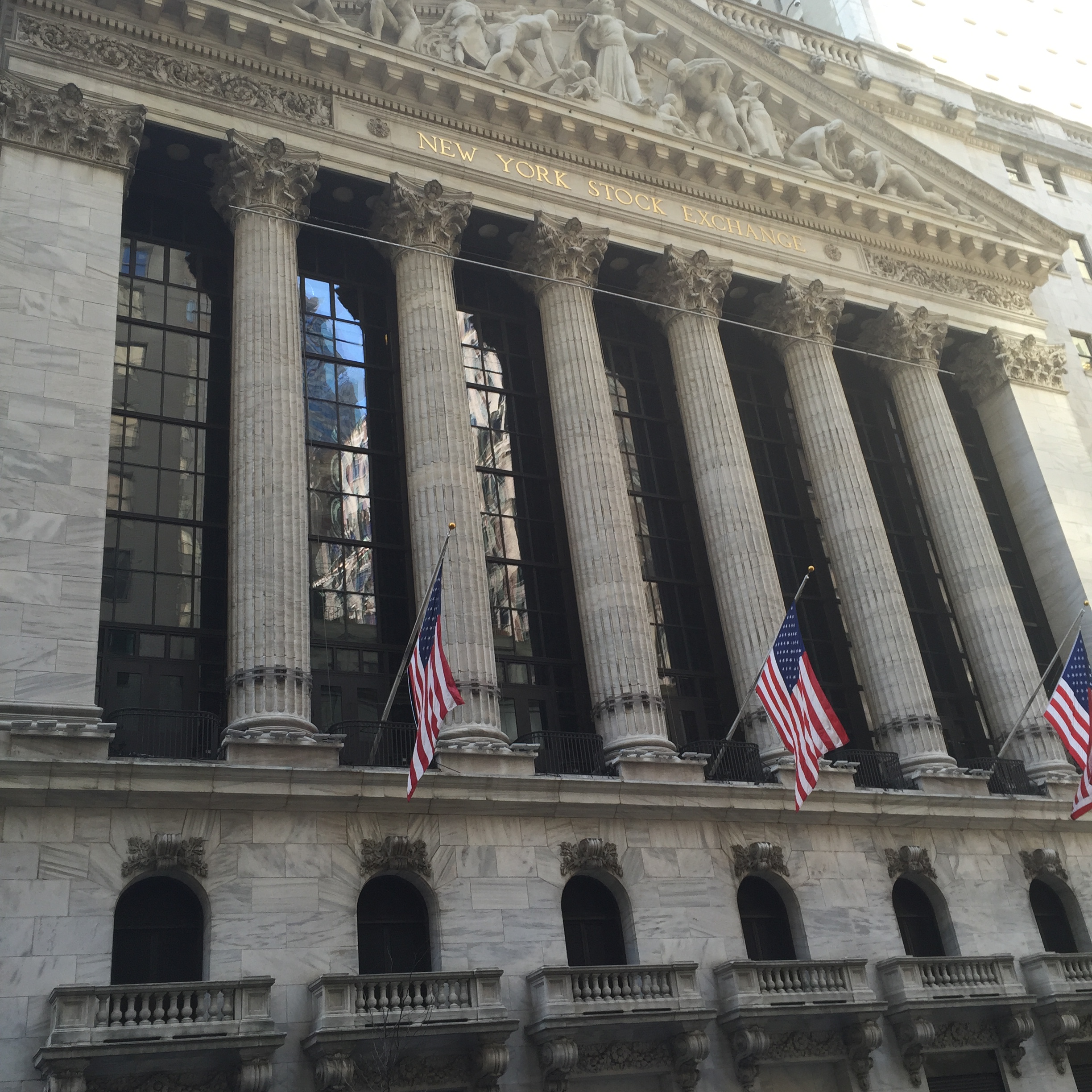
Continuing north on Broad Street, as I approached the intersection with Wall Street it was impossible to miss the imposing façade of the New York Stock Exchange. The roots of this center of American finance go back as far as the years immediately following the Revolution, and the earliest securities traded were War Bonds and stock from the First Bank of the United States (established by the first Secretary of the Treasury, Alexander Hamilton).

Financial district 3

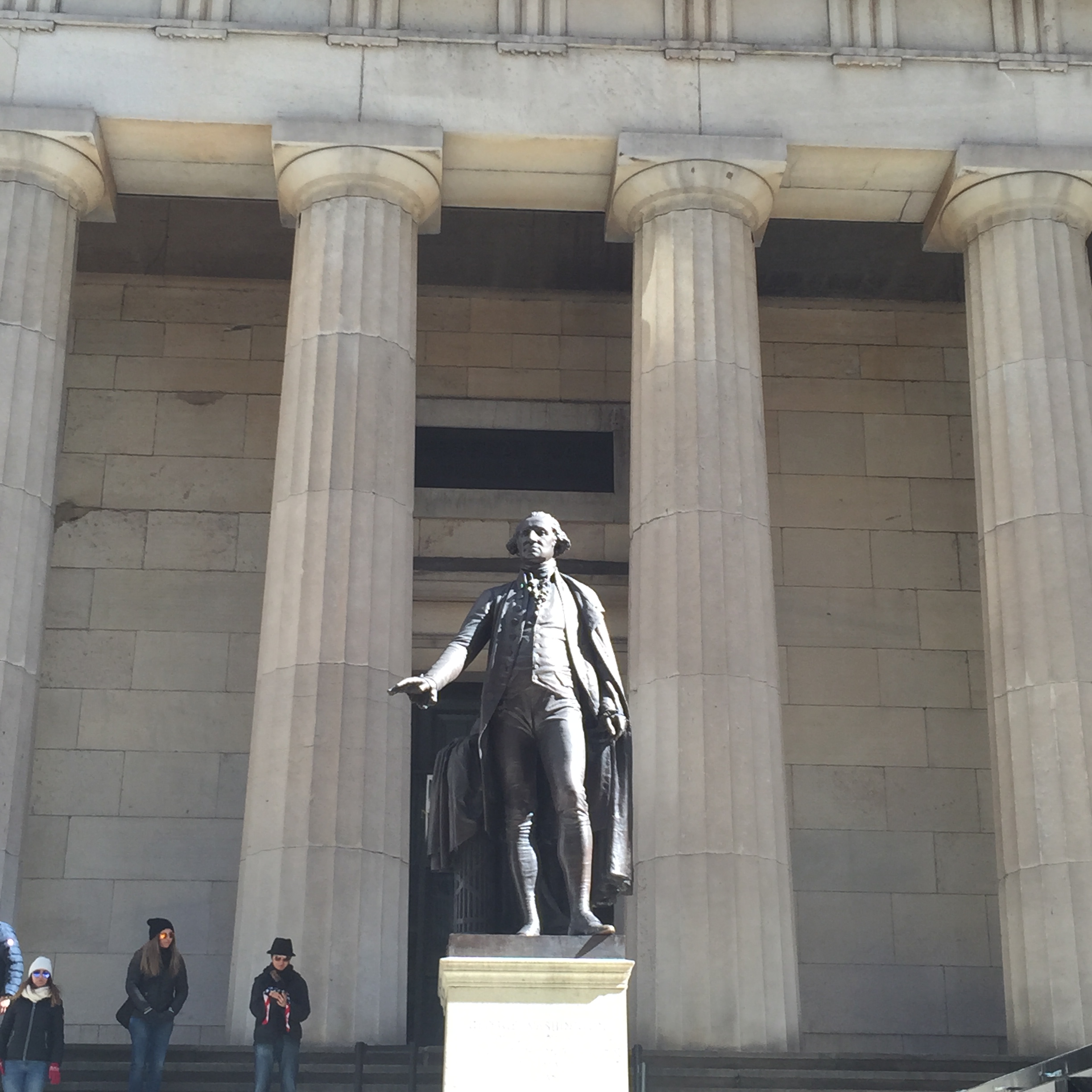
Nearby, on the corner of Wall Street and Nassau Street, is Federal Hall, the site of the first United States Capitol Building and the location of George Washington’s inaugural. A statue of the first President stands imposingly in front, gesturing as if to say “hold your applause.”

Financial district 4

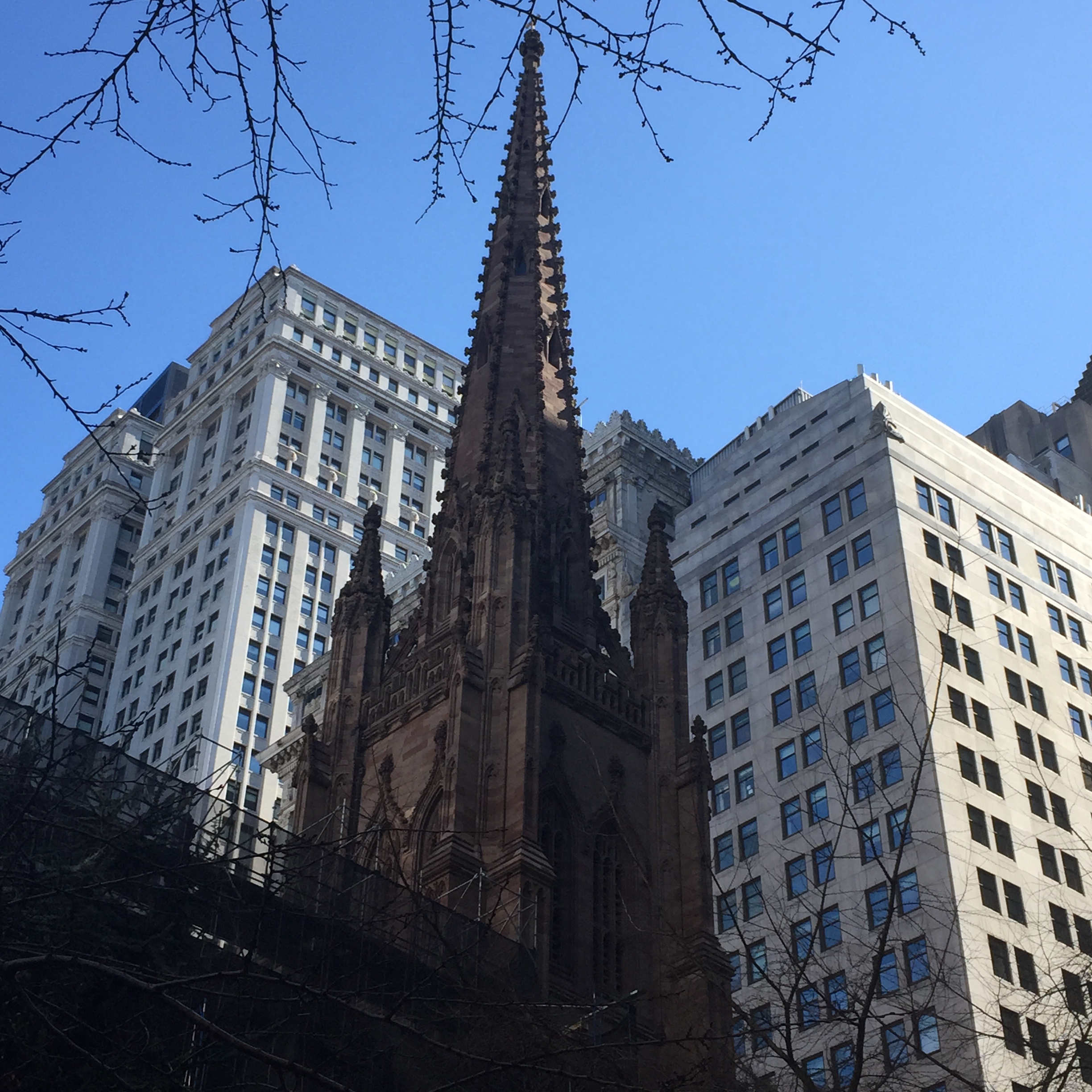
Nearby at Broadway and Wall Street is Trinity Wall Street Episcopal Church, first charted during colonial days (1696) by King William III. The current building on the site dates from 1846, but the cemetery attached to it is much older, and one of the few in Manhattan. It holds several luminaries, including Robert Fulton (inventor of the steamboat) as well as Alexander Hamilton and his wife Eliza Schuyler Hamilton.

Financial district 5

Walking behind the cemetery along Church Street, it is impossible to miss One World Trade. Adjacent to the original footprints of the World Trade Center (now reflecting pools) and the site of the 9-11 Museum, it dominates the skyline in the area, and is now open for business. The influx of workers to One World Trade is bringing new shops and restaurants to the area.  The new World Trade Center transportation hub is due to open at the intersections of Vesey, West Broadway, and Greenwich Streets at the end of 2015. Designed by famed Spanish architect Santiago Calatrava, it has been the source of controversy over its cost and overruns. However, seeing it soar in such an emotionally impactful area (Calatrava has said it is supposed to look like a bird being released from a child’s hand) was very pleasing to me.

Financial district 6

Prior to 2001 and the 9-11 attacks, about 15-20,000 residents lived in the Financial District. Nothing could be more revealing of the strong and resilient nature of New Yorkers (and also of the success of some incentives and tax breaks created by the city to spur growth) than the fact that now there are over 60,000 residents of the neighborhood. In 2014, the average price per square foot in the Financial District was higher than the average in Manhattan for the first time, comparable to that of the Upper West Side and Greenwich Village. Simultaneously historic and fresh, this neighborhood is the closest thing New York City has to the center of Rome, where new buildings are interspersed with views of the Forum or Coliseum.

Hamilton Heights

HamiltonHeights3

The hottest ticket in New York City this year is Lin-Manuel Miranda’s new musical, “Hamilton,” currently at the Public Theater on Lafayette Street but moving to Broadway this summer. Coincidentally the day after I was fortunate enough to see it, while searching for a new apartment for a couple, I found a possibility for them in Hamilton Heights. Of course I had heard of the neighborhood in upper Manhattan and had been there before, but the connection to Alexander Hamilton didn’t fully register until that moment. I decided that my next dérive (an unplanned walk in an urban environment) would take place in Hamilton Heights, while the soundtrack to “Hamilton” was still freshly ringing in my head.

Hamilton Heights lies between 135th and 155th Streets to the south and north, and between Edgecombe Road and the Hudson River to the east and west. This puts it just south of Washington Heights (location of Miranda’s “In the Heights”) and just north of Manhattanville and Morningside Heights. Why all the “heights” in upper Manhattan? Take a walk in any of these neighborhoods, and you will see – the elevation in this part of the island is considerable, and some streets are quite steep, particularly rising from the Hudson. Alexander Hamilton’s farmland in the last two years of his life before the infamous duel with Aaron Burr was roughly in the part of the neighborhood between 140th and 146th Streets.

HamiltonHeights4

Public transportation options are good in Hamilton Heights. The 1, A, B, C, and D trains all make stops here, and it is possible to get from 155th Street to Times Square in about 15 minutes. For my dérive, I took the C and emerged at St. Nicholas Avenue and 135th Street. St. Nicholas Park rises steeply to the west of St. Nicholas Avenue here, and the majestic neo-Gothic tower of Shepard Hall of the City College of New York can be seen rising from the ice-age Manhattan schist that was used to construct the iconic campus buildings. CCNY was the first public institution of higher learning in the United States, and the beauty of its campus holds up to the private colleges and universities that predated it. Ten Nobel Prize winners have graduated from CCNY, the most recent alum winning for Medicine in 2014.
HamiltonHeights1

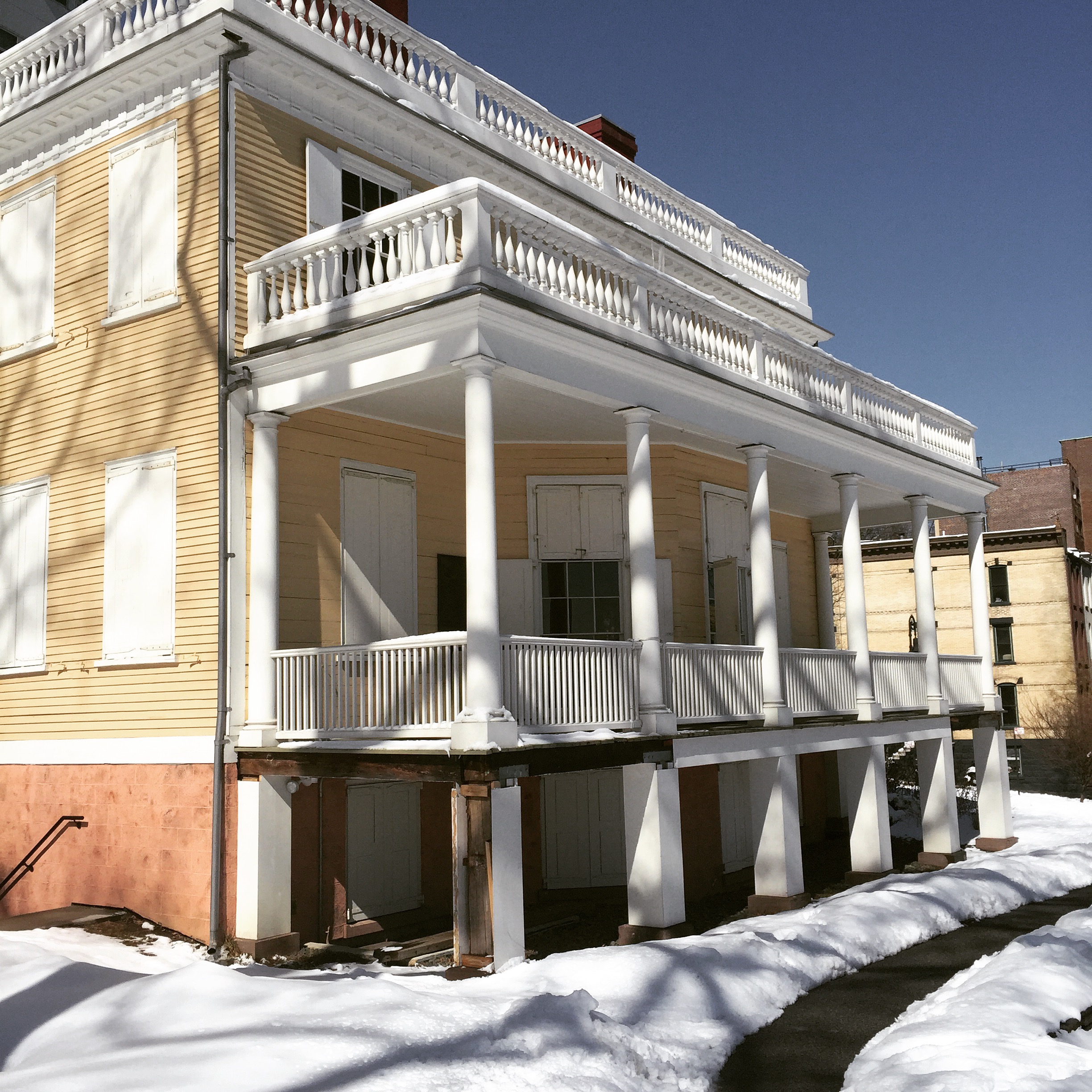
Just to the north of the main quad of CCNY sits Alexander Hamilton’s home for the final two years of his life, named Hamilton Grange after his ancestral home in Scotland. This location in St. Nicholas Park is not where he lived, however – the house itself has been moved three times, but has settled in this location, not too far from its original spot. The Grange is a National Park Service site, and has been restored to reflect its appearance during 1802-1804 when Hamilton lived in it.

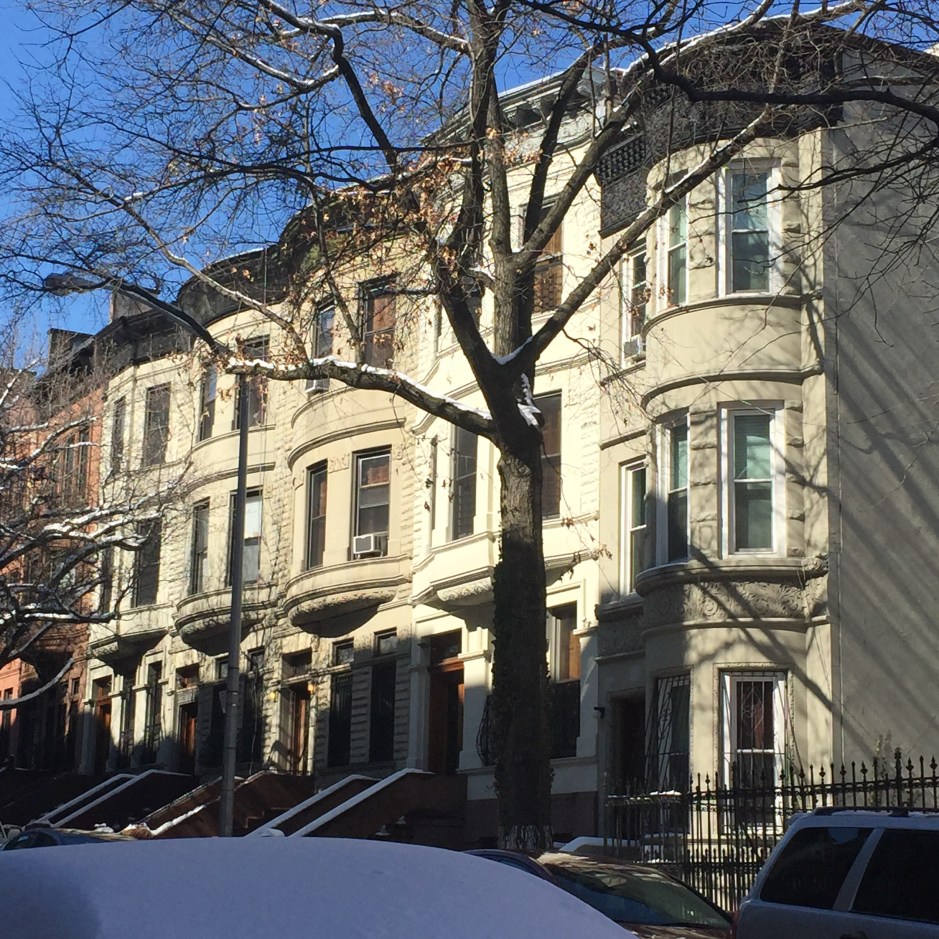
Walking north on Hamilton Terrace from St. Nicholas Park, it is easy to forget that you are in Manhattan. This is a very quiet, residential neighborhood with rows of townhouses or brownstones on tree-lined streets. Hamilton Terrace goes on for blocks without any intersections, and most of the townhouses here date from the 1890’s. Hamilton Terrace runs into Convent Avenue, and continuing north, the sub-neighborhood of Sugar Hill reveals stately rowhouses that once were the residences of famous New Yorkers such as Cab Calloway, W.E.B DuBois, Duke Ellington, and Babe Ruth (when he was an infant). Nicknamed Sugar Hill because it was where wealthy residents of Harlem moved in the 1920’s to enjoy the “sweet life,” the area holds large pre-war apartments that are still affordable, by current New York City standards.

HamiltonHeights2

The Billy Strayhorn standard, “Take the A Train,” most familiar as an instrumental version performed by the Duke Ellington orchestra, does have lyrics, and they give you clear directions about how to get to this charming affordable neighborhood in upper Manhattan:
You must take the A Train
To go to Sugar Hill way up in Harlem
If you miss the A Train
You’ll find you’ve missed the quickest way to Harlem
Hurry, get on, now, it’s coming
Listen to those rails a-thrumming (All Aboard!)
Get on the A Train
Soon you will be on Sugar Hill in Harlem

New York City townhouses and mansions

IMG_1868

When one thinks of living in New York City, apartment living is the default – and in fact the majority of New Yorkers do live in multi-occupant housing, ranging from luxury high rises in Manhattan to duplexes in College Point, Queens. However, apartment living is a relatively recent development in NYC history, and even today there are single-family townhouses (and even a handful of outright mansions) available in the city. What’s the definition of a townhouse versus a mansion? Well, there firm criteria do not exist, but a townhouse 25 feet wide or wider starts to be under consideration as a mansion, particularly if the façade is limestone and the overall square footage is 10,000 or above. (Also, you will know it when you see it.) In Europe, a mansion traditionally has a ballroom, but there are few of those left in New York City.

IMG_1416

The golden age of mansions in New York City was in the 19th and early 20th centuries, and many of those mansions in fact did hold ballrooms. The Clark Mansion on Fifth Avenue at 77th Street (now the site of an apartment building) had 25 bedrooms and 35 servant’s rooms. Charles Schwab built a 75 room mansion on Riverside Drive between 73rd and 74th Streets, also now replaced by an apartment complex. The Vanderbilt Mansion on Fifth and 57th, the largest residence ever built in New York City, had a two story ballroom as well as stables – and was destroyed to be replaced by Bergdorf Goodman. Some of the mansions in Carnegie Hill (all 50,000 square feet or more) faced somewhat better fates. The Carnegie Mansion now holds the Cooper-Hewitt National Design Museum, the Warburg Mansion houses the Jewish Museum, and the Otto Kahn House is the location of the Convent of the Sacred Heart, an independent school.

Until the end of the 19th century, apartment buildings – mainly tenements – were only for the less affluent. The middle class began to be attracted to the convenience of apartment living as the 20th century dawned, but the truly wealthy continued to live in single family homes until enough spacious apartments along Fifth Avenue (many with 12 rooms or more) were built and certain buildings became more prestigious. By the 1930’s, the tide had turned and more middle- and upper-class New Yorkers lived in apartment buildings than in single family homes, and now there are fewer than 2000 single family homes in Manhattan. However, there are considerably more in other boroughs. While a single family brownstone in Park Slope, Brooklyn, is just as difficult to find (and afford) as one on the Upper West Side of Manhattan, it is possible to find a variety of housing choices elsewhere, such as detached single family homes in Flushing, Queens or Staten Island, and even enormous homes with lawns in Dyker Heights, Brooklyn (home of the famous holiday light displays in December). For those with the funds to spend $20-100M on their new home, the few genuine mansions available offer far more square footage (and often significantly lower real estate taxes, unless comparing to a new development condo with a tax abatement) than some of the new Billionaire’s Row apartments making the news. Similarly, a townhouse in Washington Heights near the landmarked Morris-Jumel Mansion offers considerably more space than a similarly priced 2 bedroom coop on the Upper East Side.

IMG_3170

Townhouse living is radically different from apartment living, and there are those who would never consider living in a townhouse in the city (the stairs – no super – even having to take out and bag your own garbage!). However, for the person who does appreciate the difference, being able to own an actual home, as opposed to shares in a corporation (in a coop) or a certain number of square feet within a building (in a condo) is priceless. Real estate taxes often favor the single family dwelling, and of course there is no coop or condo board process to go through – if you can pay for the townhouse and the owner accepts your offer, you are in. I have a customer who will accept nothing else but a townhouse (specifically, between Central Park West in the 60’s or 70’s!), but many others who appreciate the convenience of an apartment in an elevator doorman building. Much as New York City neighborhoods provide a rich diversity in atmosphere to live within the city, the variety of housing types (condos, coops, and townhouses) also provide the possibility of finding the perfect home for each potential home owner – one that fits their own individuality, as well as helping them express it.

The Lower East Side

Lowereastside2

What’s the first word that pops into your mind when you think of the Lower East Side of Manhattan? Tenements? Immigration? Delis? Nightlife? All of those would be correct associations, but we can now add gastropubs, new development high-rises, and trendy hotels to the mix. For this dérive (an unplanned walk in an urban environment), I wandered this rapidly transforming neighborhood.

The Lower East Side once included the area now known as the East Village, but now is considered to be roughly between East Houston Street and Canal Street to the north and south, Bowery to the west, and the FDR Drive to the east. Before the Revolutionary War, the area was home to the Delancey farm, leaving only the names of Delancey and Orchard Streets as remnants of this pastoral history. A working class neighborhood for centuries, it hosted many different immigrant groups, but is perhaps best known for its Jewish population. When the American Girl doll company chose to add Rebecca Rubin – a Jewish girl growing up with an immigrant family in 1914 – to their roster of historical dolls, this fictional family was placed in the Lower East Side.

Lowereastside1

Starting on East Houston and Bowery, heading east, it doesn’t take long to find one of the iconic symbols of the area’s Jewish immigrant past – Katz’s deli on East Houston and Ludlow.  It’s hard to be in Katz’s without thinking of the famous scene from When Harry Met Sally (culminating in the famous line, “I’ll have what she’s having”) but it’s survived since 1888 based on the quality of its pastrami sandwiches. Bring cash – no credit cards accepted, but the attitude from your server is free.

Lowereastside6

Continuing east on Houston and turning south on Norfolk Street, the fifth oldest synagogue building in the United States, now the home of the Angel Orensanz Foundation, is on the east side of the street. After the Jewish population had largely left the area in the 1970’s, the building was abandoned and left to disrepair before being purchased by Spanish sculptor Angel Orensanz for studio space. The gothic-revival architecture of the building has been restored and the building now functions as a center for the arts as well as an artist’s studio.

Lowereastside7

Walking along Orchard Street, several signs of the changes taking place in the neighborhood appear. Russ and Daughters (named back in 1914, so don’t think that going into business with your daughters is solely a modern trend) has had a storefront selling Jewish deli food on East Houston for a century, but now an upscale sit-down restaurant, Russ and Daughters Café, is on Orchard Street. Guss’ Pickles was once in a small store on Orchard and Broome, but now with the retail location  closed, jars can be found for purchase in Whole Foods and Fairway. Similarly, the Essex Street Market on Essex near Rivington reflects in some ways the small food shops that once populated the neighborhood, but now exists in a food hall, with prices the residents of the neighborhood even 15 or 20 years ago could not have believed. The Tenement Museum, on Orchard near Delancey, has preserved the way of life of immigrants to the area during the 19th and early 20th centuries. Given that quite often only the history of the wealthy is recorded for future generations, it’s significant and rather unique that this museum exists.

Lowereastside8

Turning back to head north again, when crossing Delancey, I looked east and saw the Williamsburg Bridge. When it was built, many Jewish residents moved from the Lower East Side to Williamsburg in Brooklyn. Now the rebirth of Williamsburg as a popular place for young people to live and go for nightlife is mirrored in the Lower East Side, part of the fascinating cycle of change seen all over New York City in all time periods.

Lowereastside9

Heading over to Ludlow Street, I could not help but notice the new developments being built in the neighborhood. Although still primarily low-rise tenement buildings, new high-rise condos with all the amenities you could find in a similar building in Soho or Nolita (for, at least for now, at a lower price point) are beginning to spring up. The Blue Condominium was the first – and to many, it failed to fit into its environment (being much larger than surrounding buildings and extremely blue) – and many more are now in various states of construction. The rapid gentrification of the area led the National Trust for Historic Places to put the Lower East Side on their list of America’s Most Endangered Places. While it seems to me that it benefits neither the city nor the neighborhood to leave it full of crumbling tenements, a increased sensitivity in ensuring that the new developments blend in better with their surroundings can only be a good thing. The Hotel on Rivington was built to show off and contrast with its neighbors, while the Blue Moon Hotel, equally new and trendy inside, kept the exterior appearance of the building it renovated, making it almost identical to surrounding buildings.

Lowereastside5

Julian Casablancas sings about the inevitable changes that have been transforming the area in his song, “Ludlow Street.” In a typical Lower East Side scene, heading out in the morning after an evening of drinking too much, he thinks about how the indigenous Lenape tribes were first to be pushed out in 1624. As he sings, “Faces are changing on Ludlow Street/Yuppies invading on Ludlow Street/Nightlife is invading on Ludlow Street/And it’s hard to just move along.”

Soho

soho7
Before Tribeca (TRIangle BElow CAnal), Dumbo (Down Under Manhattan Bridge Overpass), Nolita (North of Little ITAly), or Nomad (North of MADison Square Park), there was SoHo (South of Houston Street). Although London’s Soho isn’t a shortened version of anything (it might be based on a hunting cry but has been a place name there since the early 1600’s so no one really knows), Manhattan’s Soho started the trend of cute acronyms for neighborhood names in the city. Today’s dérive (an unplanned walk in an urban environment) takes place in this cool downtown neighborhood.

Although today we know it as a beautiful area full of artists’ lofts and galleries, and as an upscale shopping destination, Soho in lower Manhattan has an interesting history. Originally a community for freed slaves of the Dutch East India Company in the 1600’s, this was the first settlement for people of color in the city. Surrounded by swampland and a canal, the area was not widely settled until the canal was filled in and became Canal Street. Becoming an industrial center in the mid-1800’s, most of the neighborhood’s characteristic cast iron buildings (the actual name of the historic district is Soho-Cast Iron) were created between 1840 and 1800. Originally used as a building material because cast iron was cheaper than stone or brick (but could be painted to resemble stone), cast iron was also easily molded and allowed for elaborate decoration around the large windows, themselves possible because of the strength of cast iron. With industry moving out of the area, the neighborhood fell into decline, until the 1960’s when artists looking for large spaces with plenty of natural light began to move in. Although originally the artists’ lofts were not zoned for residential living, eventually the city recognized the change that had occurred, and since the 1980’s, the neighborhood has become one of the city’s wealthiest.

Roughly bounded by (naturally) Houston Street to the north, Canal Street to the south, Crosby Street to the east, and Sixth Avenue to the west, I began this dérive on Houston and Crosby, walking south and turning west on Prince Street. Although Soho is surrounded by Greenwich Village, Little Italy, and Tribeca on various sides, and shares certain similarities with each, it also has its own distinctive feel. The neighborhood is full of architecturally significant buildings, many quite unique. The Little Singer Building (named because a few years after it was built in 1903, the Singer Company also built what was for a few years the tallest building in the world – and which was destroyed in 1967 before it could be landmarked), for instance, is now a combination of office spaces and artists’ lofts. It is covered in elaborate wrought iron decoration, terra cotta panels, and cast iron ornamentation. At Prince and Greene, one entire side of a building is painted in a trompe l’oeil façade of a cast iron building.

Prince and Spring Streets, particularly the areas near Broadway, are full of upscale shopping experiences. Dominique Ansel Bakery, famous for being the home of the cronut, is on Spring between Sullivan and Thompson. People line up between 7AM and 8AM every day to get the limited supply of cronuts (2 per person, only one type made per month), but don’t neglect the bakery later in the day – they make delicious treats in addition to the elusive cronuts!

While on Spring Street, glancing south when crossing Thompson Street reveals a beautiful view of One World Trade. Continuing east on Spring, I appreciated crossing the charming cobblestoned streets. Although all of SoHo would have been originally cobblestoned, only those streets still paved with Belgian blocks when the area was landmarked (a few of the north-south streets such as Mercer, Crosby, and Wooster Streets) remain as such. Seeing a row of Citibikes ready for rental, I imagine that cobblestoned streets and bicycling might not be the best pairing.

Soho becomes less hectic as you get away from Houston. Heading south on Mercer Street, It’s hard to imagine that plans to build two large elevated highways linking the Manhattan and Williamsburg Bridges with the Holland Tunnel were narrowly averted in the 1960’s. Fortunately, the value of this lovely area and its concentration of ornate cast iron buildings was recognized in time to preserve Soho for us to enjoy now and for future generations.

Soho3

Soho6

Soho5

Soho4

Soho2

Soho1

Central Park in winter (with photos)

Last week we missed having three feet of snow in the city as the storm veered east by about 50 miles, but we still had enough snow to make Central Park a winter wonderland. This made me think about the advantages of living near the park, and that they are not limited to warm weather months. My sister, who lives in Vermont, says that it’s important to find a winter weather sport to enjoy there so that one doesn’t get too much cabin fever during the long winter. There are far too many things to do in New York City for anyone to get cabin fever (although most cabins are larger than the average NYC apartment, I would speculate!), but it is important to be able to enjoy the outdoors and commune with nature year-round even in the city with so many indoor things to do.

There are two outdoor skating rinks in Central Park: Wollman Rink (now Trump Rink) in the southern part of the park, and Lasker Rink near the Harlem Meer in the northern part. Both rent skates and have a fee to enter, but Lasker Rink is less expensive and often less crowded. However, the views of the skyscrapers looming over the edges of the southern part of the park do make the views a little more picturesque at Wollman (Trump).

Every time it snows, certain areas of the park are well known as prime sledding spots. The best are both mid-park on the east side, Pilgrim Hill (enter at Fifth and 72nd) and Cedar Hill (enter at Fifth and 76th). Pilgrim Hill is steeper and Cedar Hill a little more gentle, but both get very crowded on a snow day. Bring your own sled, of course (or use a garbage bag or an empty pizza box in a pinch).

Every year, Central Park hosts a Winter Jam one weekend, mid-park near the Bandshell. Snow machines are brought in to create (or augment) snow and there are opportunities to learn snowshoeing, skiing, and kicksledding (equipment provided for all of these but lines can be long). There are also snowman building contests and a chance to sled, as well as pop-up food vendors.

After the park has received enough snow, you will see cross-country skiers and snowshoers in the park, but you don’t even need special equipment to truly enjoy the spectacular beauty of Central Park covered in white. Whether appreciating the permanent residents of the park (statuary) with a new layer of frosting to upgrade their look, seeing that someone has already cleared the Imagine mosaic in Strawberry Fields (do it yourself if no one else has), or appreciating a fresh look at the contrast of the stately buildings surrounding the park with the dazzling white of the park itself, Central Park in winter shows that the value of living in New York City within walking distance of the park is a year-round benefit.

Winter 5 Winter 7 Winter 8 Winter 9 Winter1 Winter2 Winter3 Winter4 Winter6 Winter10