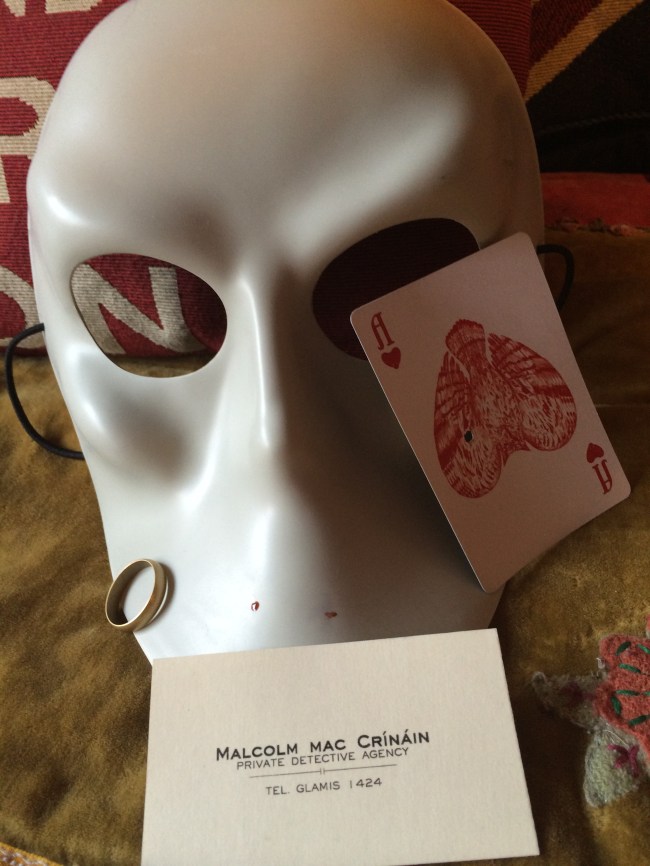
The abundance of the arts is one of my favorite things about living in New York City, and attending theater performances is certainly near if not at the top of my list. I enjoy all kinds of theater – Broadway (of course), off-Broadway, off-off Broadway – and each type has its own unique charm. However, there is a more recent form of theater that is not for everyone, but which can provide a thrilling experience for those open to a less predictable encounter – immersive theatre.
The grand dame of the genre here in New York City has been intriguing theater goers in NYC since 2011 – Sleep No More, at the McKittrick Hotel, 530 W. 27th Street, in Chelsea. A free-form mash-up between Macbeth and Hitchcock movies (especially “Rebecca”), previous incarnations of this theatrical event were presented in London in 2003 and in Boston in 2009. Created by Punchdrunk, a British theatre company founded in 2000 by Felix Barrett, Sleep No More follows this company’s innovative structure (or lack thereof). In a Punchdrunk production, as an audience member you are free to wander around a large performance space, which is decorated elaborately with an astonishing level of detail (in fact, it could be considered an art installation in its own right) and can be explored at will. The costumes, set design, and music reflect the 1920-30’s, except for when Bernard Herrmann’s themes from “Vertigo” or “The Man Who Knew Too Much” interject a sense of danger, or when the witches’ prophecy to Macbeth turns into an electronic dance rave. Those attending the performance are welcome to sit at a desk and read psychiatric notes at length from Lady’s Macbeth’s doctor, nibble on candies from a shop, get lost in a cemetery, or wander a maze near a nurse’s hut. What you are not allowed to do is to talk or show your face (the audience is distinguished from the actors by wearing white masks). However, there are also actors/dancers (it’s as much a modern dance performance as a theatrical one) roaming the five floors and you can choose to follow one throughout an entire loop (a performance is comprised of three repeating hours with a finale), or change your mind and decide to follow another character they interact with. This freedom of choice sums up the thrill of immersive theatre, but also why it is overwhelming for some: the three hours you spend within the McKittrick will be yours to control. As opposed to traditional theatre where a director has decided how to present the theatrical experience to you, in Punchdrunk’s version of immersive theatre, you largely direct the experience yourself. If you go many times (and I have!), you have the capacity to create a unique experience for each of those times. As you are admonished when you enter, “fortune favors the bold,” and the greater your willingness to open unlocked doors or be led into a private area for a one-on-one experience with one of the actors, the deeper your enjoyment of the experience will be.
Punchdrunk currently has a different production running in London, near Paddington Station, called The Drowned Man. Based loosely on elements of Georg Büchner’s unfinished play, “Woyzeck,” as well as Nathanael West’s “Day of the Locust,” this production exists on a more epic scale from Sleep No More, within several floors of a very large building (previously a mail sorting facility). The theme of duality pervades the experience, which takes place at the wrap party of a film shoot at the fictional Temple Studios in Los Angeles in the early 1960s. Two largely separate but similar storylines take place, one within the gates of the studio, and another outside the gates within the town. As in Sleep No More, the performance space is elaborately decorated, and the set, music and costumes reflect the time and place (ironically, set in America despite being in London – while Sleep No More is set in Scotland but is in New York). What I found, experiencing The Drowned Man after many experiences with Sleep No More, is that although the basic structure remains similar, the shows themselves are strikingly different in tone but equally thrilling. The actors speak more in The Drowned Man, and the storyline is more explicit. This production will be closing this summer, unfortunately, but if you have the chance to be in London before it does, I highly recommend checking it out.
My advice for anyone attending a Punchdrunk performance for the first time is to wander until you find a character, and then begin following him or her. The first time I attended Sleep No More I ended up on the fifth floor, and explored the rooms for almost an hour before even finding an actor. I left the evening with an appetite to experience more, but if there is even the chance that you may only experience a Punchdrunk performance only once, the experience will be greatly enhanced by trying to follow a thread of the storyline through a few actors’ performances. Wear comfortable footwear – if you have a busy evening you will likely be doing a lot of walking (perhaps even running) and multiple flights of stairs. My final piece of advice is not to try to stay with the person or people you arrived with – you aren’t allowed to talk and holding hands blocks up passageways for others (it’s very annoying to try to follow a character, but then lose them because you can’t get around a couple of confused people blocking the stairwell). You will likely have a much more satisfying experience exploring on your own, and then discussing your separate experiences over drinks after the performance.
At the McKittrick Hotel, site of Sleep No More in Chelsea, you can even enjoy delicious drinks and dinner while experiencing a taste of immersive theater. The Heath, a restaurant on the sixth floor of the building, is set as if you were enjoying a railway restaurant in a village in Scotland. As you enter the elevator, a sign warns, “This is no ordinary station and things are not always as they appear. If you are lucky enough for one of our residents to invite you into their space, you might experience an intense psychological situation. Please note that you may decline, however, fortune does favor the bold . . .” Live music and hosts in character, who may or may not whisk you away for a mysterious phone call or to open a back room with a key delivered on a silver platter, complete the unique atmosphere. And, yes, the food and drinks are excellent as well!
Punchdrunk may have originated immersive theatre, but they no longer have the monopoly on it. In Williamsburg, Brooklyn, Third Rail Projects has created Then She Fell, an immersive theatrical/dance experience on a much smaller scale than Sleep No More. Limited to only 15 audience members per show, it is based on the fictional characters in “Alice in Wonderland” but also explores the complex relationship between the real author of the work, Oxford mathematics Professor Charles Dodgson (pen name: Lewis Carroll), and the young daughter of the Dean of Christ Church College, Alice Liddell. In this immersive experience, you are not the director of your own experience: you are led by performers into a series of one-on-one (or in some cases, like the tea party run by the Hatter, small group) experiences. Occasionally you find yourself in a carefully curated room for a period of time, and are welcome to explore before a performer comes in to interact. Alcoholic drinks and food may be a part of the evening, depending on your particular experience. In this performance, you guaranteed not to see everything in one round, and in fact may not see the person you came with for the entire evening; they may have had some of the same experiences, but in a different order.
Queen of the Night, a recent foray into Manhattan immersive theatre, is at the Diamond Horseshoe Revue at the Paramount Hotel in midtown. Loosely based on Mozart’s character in “The Magic Flute,” it is far less interactive, and includes an element of dinner theatre (albeit a risqué version!). Alcoholic drinks and food are included, and there is a Cirque-type show to be watched while eating. While entering the venue and selecting a pre-show cocktail, there is a strong likelihood that you will be taken off for an interactive experience with one of the performers. Once seated at the tables (and unless you have a large group, you will likely share a table with people you didn’t know before you arrived) food arrives – but not necessarily the same food that tables nearby have. If you are up to the experience, you can barter some of your food with other tables. When I went, our table had lobster, so it was fairly easy to barter some of that for prime rib with our neighbors. While it is interactive in the sense that you may have an experience or two with performers, you do not direct your own experience. The drinks and wine are plentiful, so if you go into this ready to have a good time, and open to interacting with other members of the audience, you are likely to have a fun evening.
Immersive theatre seems to have influenced many productions, which break or eliminate the fourth wall despite being more traditional theatrical experiences. Here Lies Love at the Public Theater on Lafayette Street, certainly does not qualify as true immersive theater, but it is certainly more free-form than traditional theater. David Byrne wrote this musical version of a surprising (Imelda Marcos) story, and it was first presented last year at the Public but is back again this year due to popular demand. You don’t direct the experience yourself, but on the main floor you are not seated in static traditional style, but rather stand and move around to see different parts of the story. You may have a character interact with you or ask to dance with you, but that is the limit to the immersion.
My personal bias is that I think that the freedom Punchdrunk productions allows a participant is exhilarating, and that is what makes their shows so addictive – you can keep returning and experiencing something different. There is an exciting change that occurs from watching television or a film to experiencing live theater – the knowledge that events are happening in real time with people performing in your space with you. Immersive theatre takes that up one more level. Not only are things happening at the moment that you see them, but you can become a part of them, and possibly even take control of directing the theatrical experience you have. If you are willing to embrace the unknown and take risks, the satisfying result will prove that fortune truly does favor the bold.


 Julie Brannan, NYC residential real estate