Beekman Place

Beekman4 rotated

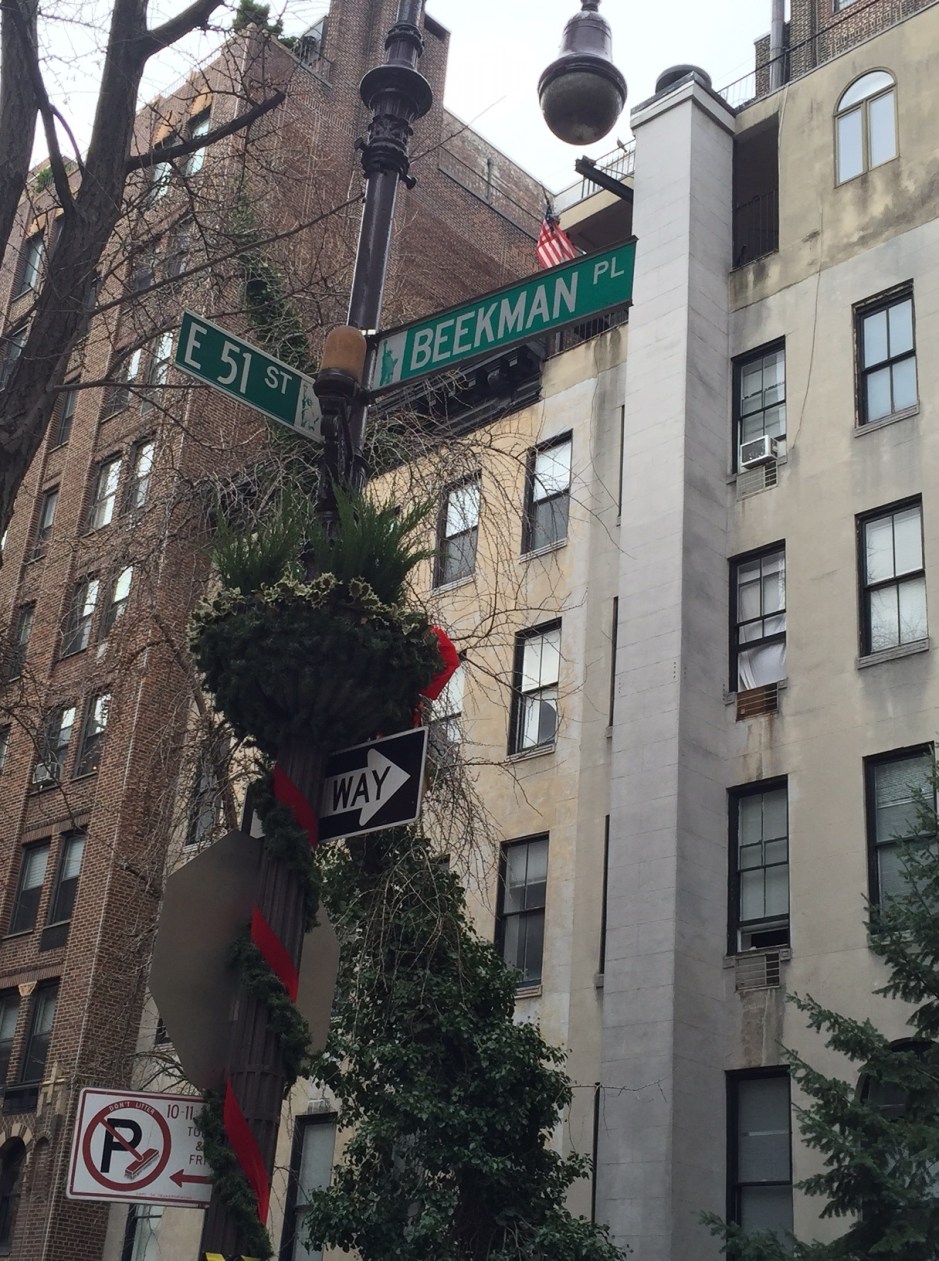
Walking through midtown along First Avenue is a stereotypically hectic New York City experience, with multiple lanes of busy traffic, shops, and restaurants creating a noisy and bustling ambiance. Walk just a few steps east of First on 51st Street, however, and it is as if the city has magically melted away. Welcome to Beekman Place, a quiet residential oasis just blocks from the heart of Midtown Manhattan.

Beekman Place itself is only two blocks long, from 49th to 51st Streets, running just a short block east of First Avenue. However, apartments in the streets immediately surrounding Beekman Place are often said to be in the eponymous neighborhood (itself a sub-division of the Turtle Bay area). Perched high above the east river, able to survey the FDR Drive but feeling removed from it, there are views of the iconic Pepsi Cola sign to the east, the Ed Koch Queensborough bridge to the north, and the United Nations to the south.

The area received its name due to the Beekman family mansion built there in 1760. During the Revolutionary War, the British headquartered in the mansion for a time. Nathan Hale (“I only regret that I have but one life to give for my country”) was tried as a spy in the mansion’s greenhouse, and was hanged in the orchard surrounding the home. Later, George Washington was a frequent visitor to Beekman mansion while president. The mansion was eventually torn down in 1874 after being abandoned in the 1850’s during a cholera epidemic. Eventually the area became a slum, only to have its fortunes turn with the building of One Beekman Place in 1929. The area became virtually a synonym for a certain type of privilege (Hubbell Gardiner in “The Way We Were” had grown up on Beekman – enough said), home to Rockefellers and foreign royalty.

Taking a dérive (an unplanned walk in an urban environment) in the area after previewing an apartment for sale for a customer, I found the area to be far from stuffy – charming and livable. East 51st Street ends in a steep series of steps that lead to Peter Detmold Park. The dog run here is relatively famous among pet owners in the city, being very large and beautiful. A non profit group, PDP-ARF (Peter Detmold Park – Animals Run Free) maintains the dog run, and it is a center for neighborhood events. The Beekman neighborhood association was going to hold a caroling party on the December afternoon that I was there, an almost small-town touch to this quiet gem.

Looking up from the park toward the back of the homes on the south side of Beekman Place, I realized what spectacular views over the East River those apartments have – many with private terraces. Walking back up from the park and taking the very short stroll along the fronts of those homes on Beekman Place, the feeling is similar to the Gramercy area, but with virtually no traffic. There is only one way to drive in (E. 50th) and two ways to drive out (E. 49th and 51st), but no reason to do so unless you live there. Walking back toward First Avenue on E. 49th, I found myself on another of New York City’s quirky one-block streets, Mitchell Place.

Walking away from Beekman Place, within just a few blocks I was in the heart of midtown, passing the Waldorf Astoria. I loved the contrast of this quiet sleepy yet residential area with the bustle of midtown so near.  Prices in this neighborhood, while not low budget, are still less than similar apartments on Park or Fifth, in part because it is so far to the  east of the 4-5-6 subway line. Elegant yet livable; remote yet close to the heart of the city; supremely pet friendly – Beekman Place won me over.
In the Heights

WashingtonHeights

This week’s dérive (an unplanned walk through an urban environment) takes place in a Manhattan neighborhood that holds Manhattan’s oldest surviving mansion, has a safer crime rate than Greenwich Village, is only 20 minutes from Times Square via express subway, and was the subject of a recent Tony Award winning musical – Washington Heights. Surprised? It’s time to take a closer look at this northern Manhattan neighborhood while there is still value to be had in this rapidly-evolving area.

Washington Heights lies just above Harlem, just below Inwood (the very top of Manhattan), and between the Hudson and Harlem Rivers. It is in named for Fort Washington, the highest spot in Manhattan and the site of a major battle with the British during the American Revolution (we lost that battle, but of course won the war). Currently the area has a large Dominican population (who descriptively call the neighborhood, “El Alto” for its hills and elevation), and the conflict between the existing residents and the process of gentrification was one of the themes of Lin-Manuel Miranda’s award winning musical, “In the Heights.” New developments are beginning to be built in the area – I recently sold such an apartment to investors and will be renting it out for them. After taking photographs of the apartment, it was time to take an unplanned walk in the neighborhood and discover its personality.

Starting at W. 168th Street and St. Nicholas Avenue, I will note that Washington Heights is actually easier to get to than some neighborhoods closer to midtown but without as many public transportation options. The A train (express) can get you to midtown in 20 minutes, and the C (local) and the 1 makes several stops along the Broadway line in the Heights. Dominating the area at the 168th Street stop is Columbia Medical Center. Surprisingly, the land it sits on was once the home of Hilltop Park, the home of the New York Highlanders baseball team from 1903-1912. They eventually moved their ballpark to the Bronx and changed their name – to the New York Yankees.

Walking east along W. 167 Street to Edgecombe Avenue, you dead end at a surprisingly pastoral park along a high bluff. Huge sections of the Manhattan schist left over from when the ice age receded form the edge, and tower to your left as you walk south along Edgecombe. At 162 Street, I was intrigued by a sign to the right for the Morris-Jumel Mansion, and walked along 162nd before turning onto Jumel Terrace to see a large white mansion with pillars. Built in 1765, it was used by George Washington for his headquarters for a few months in 1776, and at various times hosted guests as illustrious as Thomas Jefferson, John Adams, and Alexander Hamilton. A National Historic Landmark since 1961, it is now a museum decorated entirely in the Georgian style, with a bed that supposedly belonged to Napoleon.

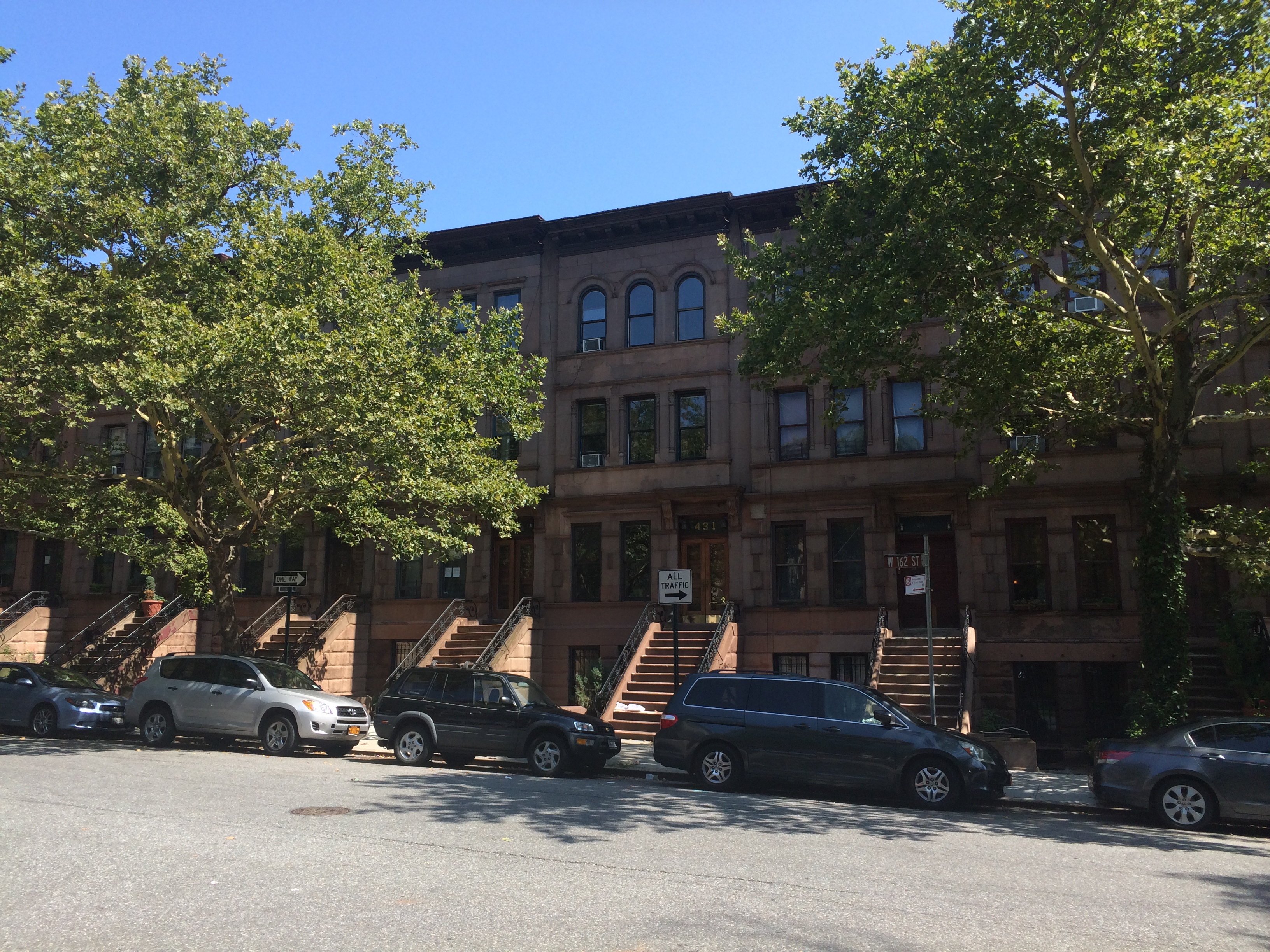
Continuing along W. 160th Street after turning from Jumel Terrace, there are beautiful rows of townhouses as well as a few large prewar apartment buildings. Turning south on Broadway, a bustling, but not overly crowded, thoroughfare awaits with plenty of shopping and restaurants. At W. 155th Street, the southern edge of Washington Heights, I was surprised to see a large (over two full blocks) cemetery, part of Trinity Church Wall Street but created in 1842 because they had run out of space in their downtown location. Still in use (recent additions were Mayor Ed Koch and Jerry Orbach), it has a large monument for John James Audubon, the famed naturalist best known for his detailed illustrations of birds. His name graces a nearby micro-neighborhood within Washington Heights – Audubon Terrace, a series of eight Beaux-Arts buildings in what was once his land. The nearby apartment buildings on Riverside where it makes a sharp eastward turn between 155th and 158th Streets represent a hidden gem within Manhattan real estate, a C train stop to get you to the rest of the city, but seemingly quiet and removed from it.

Taking the C back downtown, I reflect on the surprising variety of experiences available in this less-known (and perhaps misunderstood) area of Manhattan. Regardless of how long a person has been living in New York City, the richness and uniqueness of its many neighborhoods always allows for fresh discoveries – and in this case, the potential for great value in real estate.